Authentication and Accounting for
Network Services in Next-Generation
Mobile Networks
Hitesh Tewari
A thesis submitted for the degree of
Doctor in Philosophy in Computer Science
University of Dublin, Trinity College
Department of Computer Science
Declaration
I hereby declare that:
(a) This thesis has not been submitted as an exercise for a degree at this or any other University. (b) This thesis is entirely the work of the author, except where otherwise stated.
(c) The Trinity College Library may lend and copy this thesis upon request.
To my dearest wife Prerna for her love, support, and encouragement throughout the writing of this thesis
and
Acknowledgements
Abstract
Authentication and Accounting for Network Services in Next-Generation Mobile Networks Hitesh Tewari
Supervisor: Prof. Donal O’Mahony
Mobile communications technologies are in a constant state of flux. They have evolved from simple one-way radio communications systems, to today’s third-generation networks that support digital signaling and multimedia messaging. Traditionally mobile networks have been built and operated by large telecommunications network operators on a region or country wide basis. Such operators usually have roaming agreements to allow mobile users who roam outside of their home network to seamlessly access network services in foreign networks, and rely on trust-based billing techniques to charge for network usage in order to maintain their revenue streams.
It is envisaged that the next generation of mobile networks will consist of large numbers of wireless access networks comprising heterogeneous radio access technologies. These networks will be centered on a high-speed network core with IP as the main transmission and communications protocol. With large numbers of different sized independent network operators, value-added service providers and millions of roaming mobile users, there is a need to remove the implicit trust relationships between them, in order to provide simplified authentication procedures and incontestable charging for network services. Also the emergence of mobile ad hoc networks has sparked a great deal of interest in the employing them as a flexible tool in extending the reach of the fixed networking infrastructure in next-generation networks. However ad hoc networks usually consist of closed user groups and require all the nodes in the network to cooperate in the routing of packets. The limited battery life of mobile nodes is an important factor, and users must be compensated for forwarding packets on behalf of other nodes in the network. In addition, the presence of malicious nodes can disrupt of the cooperative nature of the network and lead to transmission failures.
Related Publications
Journal Papers:
H. Tewari and D. O’Mahony, “Real-Time Payments for Mobile IP”, IEEE Communications, vol. 42, no. 2, Feb. 2003, pp. 126-136.
Books:
D. O’Mahony, M. Peirce and H. Tewari, Electronic Payment Systems, Artech House, Boston/London, 1997. D. O’Mahony, M. Peirce and H. Tewari, Electronic Payment Systems for E-Commerce, 2nd Ed., Artech House, Boston/London, 2001.
Refereed Conferences:
H. Tewari and D. O’Mahony, “Lightweight AAA for Cellular IP”, Proceedings of European Wireless ’02, Florence, Italy, Feb. 2002, pp. 301-306.
H. Tewari and D. O’Mahony, “Multiparty Micropayments for Ad Hoc Networks”, Proceedings of IEEE Wireless Communications and Networking Conference (WCNC), New Orleans, Louisiana, USA, March 2003.
P. Argyroudis, R. Verma, H. Tewari and D. O'Mahony, “Performance Analysis of Cryptographic Protocols on Handheld Devices”, Proceedings of the 3rd IEEE International Symposium on Network Computing and
Applications, Cambridge, MA, Aug. 30 – Sep. 1, 2004.
Contents
1 INTRODUCTION... 1
1.1 MOBILE COMMUNICATIONS... 1
1.1.1 Mobile Network Generations... 2
1.2 THESIS MOTIVATION... 4
1.2.1 Next-Generation Network Scenario... 5
1.3 SCOPE OF THE RESEARCH... 7
1.3.1 Outline of the Dissertation ... 7
2 MANAGEMENT OF NEXT-GENERATION MOBILE NETWORKS... 9
2.1 INTRODUCTION... 9
2.2 THIRD-GENERATION MOBILE NETWORKS... 10
2.2.1 3GPP... 12
2.2.2 3GPP2... 13
2.3 BILLING IN TELECOMMUNICATIONS NETWORKS... 14
2.3.1 Fixed Telecommunications Billing... 15
2.3.2 Billing in GSM ... 16
2.3.3 GPRS Billing... 18
2.3.4 Billing in a 3G Environment... 19
2.4 MOBILE AND WIRELESS INTERNET... 20
2.4.1 Mobile IP ... 21
2.4.2 SIP Mobility ... 24
2.4.3 Micromobility Architectures... 25
2.4.4 Billing and Security for Internet Services ... 31
2.4.5 Wireless LANs ... 34
2.4.6 Mobile Ad Hoc Networks ... 36
2.5 3G AND MOBILE INTERNET INTERWORKING/INTEGRATION ISSUES... 39
2.5.1 Interworking Between 3G and WLAN Systems ... 39
2.5.2 Integration of Mobile Internet and Ad Hoc Networks ... 40
2.6 SUMMARY... 40
3 ELECTRONIC PAYMENT SYSTEMS ... 43
3.1 ELECTRONIC PAYMENTS... 43
3.1.1 Network Payment Model ... 44
3.1.2 Macropayment and Micropayment... 44
3.2 MACROPAYMENTS... 45
3.2.1 Electronic Cash... 45
3.2.2 Electronic Cheques... 47
3.2.3 Payment Card Systems... 48
3.2.4 Mobile Commerce Payments... 50
3.3 MICROPAYMENTS... 51
3.3.1 Hash Chain Schemes... 52
4 ACCOUNTING FOR NETWORK SERVICES IN THE MOBILE INTERNET ... 58
4.1 INTRODUCTION... 58
4.2 SYSTEM MODEL... 59
4.3 PROTOCOL GOALS... 61
4.4 PROTOCOL DESIGN... 62
4.4.1 Roles, Requirements and Assumptions... 62
4.4.2 Registration in the Access Network... 63
4.4.3 Payment Chain Purchase... 64
4.4.4 Location Management... 65
4.4.5 Call Delivery – Data... 66
4.4.6 Handover and Authentication ... 67
4.4.7 Call Delivery – Voice... 67
4.4.8 Broker Clearing ... 69
4.4.9 Discussion... 70
4.5 IMPLEMENTATION DETAILS... 71
4.5.1 ns-2 – The Network Simulator... 71
4.5.2 OpenSSL Cryptographic Toolkit ... 72
4.5.3 CMIS – Cellular IP Implementation... 72
4.5.4 MobPay – Cellular IP Extensions... 73
4.6 EXPERIMENTS AND MEASUREMENTS... 73
4.6.1 Experimental Setup ... 74
4.6.2 Evaluation of Results ... 75
4.7 SUMMARY... 77
5 MULTI-PARTY MICROPAYMENTS FOR MOBILE AD HOC NETWORKS ... 79
5.1 INTRODUCTION... 79
5.2 RELATED WORK... 80
5.3 SYSTEM MODEL... 81
5.4 PROTOCOL GOALS... 82
5.5 AD HOC PAYMENT PROTOCOL DESIGN... 82
5.5.1 Roles Requirements and Assumptions... 83
5.5.2 Broker Commitment... 83
5.5.3 Charge Assembly and Endorsement Distribution ... 85
5.5.4 Making Payments... 86
5.5.5 Change in Route – New Path ... 87
5.5.6 Redeeming Tokens... 89
5.5.7 Broker Clearing ... 89
5.5.8 Discussion... 89
5.6 IMPLEMENTATION DETAILS... 91
5.7 EXPERIMENTS AND MEASUREMENTS... 92
5.7.1 Experimental Setup ... 92
5.7.2 Performance Metrics ... 93
5.7.3 Evaluation of Results ... 93
5.8 SUMMARY... 94
6 SECURE ROUTING AND PACKET FORWARDING IN AD HOC NETWORKS... 96
6.1 INTRODUCTION... 96
6.3 SYSTEM MODEL... 100
6.4 PROTOCOL GOALS... 101
6.5 PROTOCOL DESIGN... 102
6.5.1 Roles, Requirements and Assumptions... 102
6.5.2 Authenticated Route Discovery ... 102
6.5.3 Secure Datagram Delivery ... 104
6.5.4 Identifying Misbehaving Nodes... 104
6.5.5 PRAT Algorithm ... 105
6.5.6 Discussion... 106
6.6 IMPLEMENTATION DETAILS... 107
6.7 EXPERIMENTS AND MEASUREMENTS... 107
6.7.1 Experimental Setup ... 107
6.7.2 Performance Metrics ... 108
6.7.3 Evaluation of Results ... 108
6.8 SUMMARY... 109
7 CRYPTOGRAPHIC PERFORMANCE ANALYSIS ... 111
7.1 INTRODUCTION... 111
7.2 METHODOLOGY... 112
7.3 PERFORMANCE COMPARISON OF CRYPTOGRAPHIC ALGORITHMS... 112
7.4 EFFICIENT HASH TOKEN GENERATION SCHEMES... 114
7.4.1 UOBT Performance Evaluation... 114
7.4.2 Optimal Hash Sequence Traversal Performance Evaluation ... 114
7.5 SUMMARY... 115
8 CONCLUSIONS... 116
8.1 SUMMARY OF CONTRIBUTIONS... 116
8.2 DIRECTIONS FOR FUTURE RESEARCH... 118
APPENDIX A CRYPTOGRAPHIC TERMS AND NOTATION... 120
A.1 CRYPTOGRAPHIC DEFINITIONS... 120
A.1.1 Authentication... 120
A.1.2 Identification... 120
A.1.3 Non-repudiation... 120
A.1.4 Security Association... 120
A.2 SECRET-KEY CRYPTOGRAPHY... 121
A.2.1 Block Ciphers... 121
A.2.2 Stream Ciphers... 121
A.2.3 Message Authentication Codes... 121
A.3 HASH FUNCTIONS... 122
A.3.1 Hash Chains... 122
A.3.2 Unbalanced One-way Binary Tree... 122
A.4 PUBLIC-KEY CRYPTOGRAPHY... 123
A.4.1 Digital Signatures... 124
A.4.2 Public Key Infrastructure (PKI)... 125
A.4.3 X.509 Certificates... 125
A.4.4 Certification Hierarchy... 126
B.1 UOBTGENERATION... 128
B.2 MOBPAY HEADER... 128
B.3 PROTOCOL OVERHEAD CALCULATIONS... 128
B.4 PERL SCRIPT FOR PROCESSING MOBPAY LOG FILES... 130
APPENDIX C ADPAY IMPLEMENTATION & MEASUREMENT DETAILS... 132
C.1 PERL SCRIPT FOR PROCESSING ADPAY LOG FILES... 132
C.2 ADPAY MEASUREMENTS... 133
APPENDIX D SECAD IMPLEMENTATION & MEASUREMENT DETAILS ... 134
D.1 RDSRAGENT MODIFICATIONS... 134
D.2 SECAD MEASUREMENTS... 137
APPENDIX E CRYPTOGRAPHIC PERFORMANCE ANALYSIS... 138
E.1 MAKEFILE... 138
E.2 OPTIMAL HASH SEQUENCE TRAVERSAL... 138
APPENDIX F OPENSSL X.509 CERTIFICATES... 142
F.1 CERTIFICATE CREATION WITH OPENSSL ... 142
F.2 X.509CERTIFICATE... 142
List of Figures
Figure 1-1 Architectural View of Present and Emerging Mobile Networks... 3
Figure 1-2 All-IP Next-Generation Network Architecture Proposal... 6
Figure 2-1 Third Generation Evolution Paths ... 11
Figure 2-2 3GPP/UMTS Network Architecture... 12
Figure 2-3 3GPP2/cdma2000 Network Architecture... 14
Figure 2-4 PSTN Billing... 16
Figure 2-5 Generation and Exchange of TAP Records... 17
Figure 2-6 Mobile Data Billing ... 18
Figure 2-7 3G Packet Domain Charging Logical Architecture ... 20
Figure 2-8 Mobile IP Network Architecture ... 21
Figure 2-9 Hierarchical Foreign Agents... 23
Figure 2-10 SIP-based Mobility ... 24
Figure 2-11 Intra- and Inter-domain Mobility... 25
Figure 2-12 Mobility Management in Cellular IP... 26
Figure 2-13 Key Management in Cellular IP Networks ... 28
Figure 2-14 Intra- and Inter-domain Mobility in HAWAII ... 29
Figure 2-15 RADIUS Accounting... 31
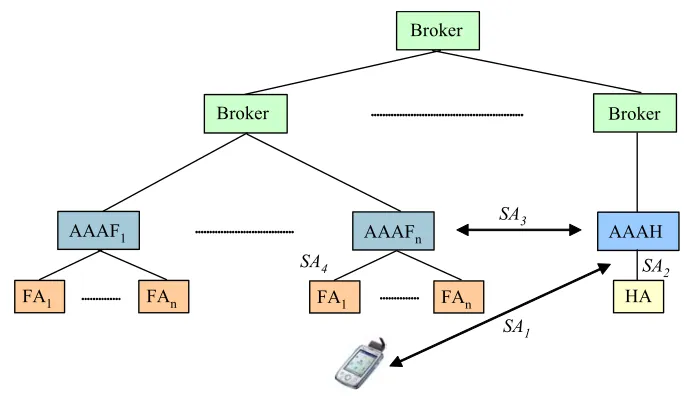
Figure 2-16 AAA Trust Model for Mobile IP... 32
Figure 2-17 Infrastructure-based 802.11 LAN... 34
Figure 2-18 Network Architecture View of Next-Generation Mobile Networks ... 41
Figure 3-1 Generic Payment Model ... 44
Figure 3-2 eCash Functional Model ... 46
Figure 3-3 FSTC Electronic Cheque Scheme ... 47
Figure 3-4 Entities Involved in a Credit Card Transaction... 48
Figure 3-5 Mobile Payments... 51
Figure 3-6 Digital Signature Generation using RSA... 52
Figure 3-7 Hash Chain Generation... 54
Figure 3-8 Micropayments Using Hash Chains ... 54
Figure 3-9 UOBT Generation ... 55
Figure 3-10 Optimal Hash Sequence Traversal ... 56
Figure 4-1 Network Model ... 60
Figure 4-2 Registration Procedure and Datagram Format ... 63
Figure 4-3 Payment Chain Purchase ... 64
Figure 4-4 Updating the Care-of Address ... 65
Figure 4-5 Accessing a Web Server ... 66
Figure 4-6 Handover in the Access Network ... 67
Figure 4-7 Location Query ... 68
Figure 4-8 Making a Voice Call ... 69
Figure 4-9 Redeeming Payment Hashes... 69
Figure 4-10 MobPay Network ... 73
Figure 4-11 Nam Screenshot of an ns-2 Simulated MobPay Network... 74
Figure 4-12 Protocol Overhead UDP Traffic ... 76
Figure 4-13 Protocol Overhead TCP Traffic... 76
Figure 5-1 Multi-Party Micropayments for Ad Hoc Networks ... 81
Figure 5-2 Purchase of Payment Chains and Broker Commitment... 84
Figure 5-4 Releasing Hash Tokens for Payment... 87
Figure 5-5 Payment of Nodes on New Path ... 88
Figure 5-6 Redeeming Payment Hashes... 89
Figure 5-7 Nam Screenshot of an ns-2 Simulated AdPay Network ... 91
Figure 5-8 Performance Results Comparing AdPay with the Standard DSR Protocol... 94
Figure 6- 1 Secure Routing in Ad Hoc Networks ... 100
Figure 6-2 Authenticated Route Discovery... 103
Figure 6-3 Secure Datagram Delivery... 104
Figure 6-4 Misbehaving Intermediate Node... 105
Figure 6-5 Packet Delivery Ratio for DSR, DSR+Mal and SecAd Protocols... 108
Figure 6-6 Average End-to-End Delay for DSR, DSR+Mal and SecAd Protocols ... 109
Figure 7- 1 Timing Measurements of Low-level Cryptographic Primitives on an iPAQ H3660... 112
Figure 7- 2 Efficiency Comparisons of Cryptographic Functions... 113
Figure A-1 Feistel Cipher... 121
Figure A-2 Generic UOBT... 123
Figure A-3 Public-key Encryption... 124
Figure A-4 Enveloped and Signed Data... 125
Figure A-5 X.509 Digital Certificate... 126
List of Tables
Glossary
3GPP Third Generation Partnership Project 3GGP2 Third Generation Partnership Project 2
AAA Authentication, Authorization and Accounting AAAB AAA Server Operated by a Broker
AAAH AAA Server in the Home Network AAAF AAA Server in the Foreign Network ACH Automated Clearing House
ACK Acknowledgement
AES Advance Encryption Standard
AH Authentication Header
AODV Ad Hoc On-Demand Distance Vector Routing
AP Access Point
ARAN Authenticated Routing for Ad Hoc Networks AuC Authentication Center
AuthCache Authentication Cache
B3G Beyond-3G
BK Broker
BS Billing System
BSC Base Station Controller BTS Base Transceiver System CA Certification Authority CAFE Conditional Access for Europe CBR Constant Bit Rate
CCoA Colocated Care-of Address CDR Call Detail Record
CDMA Code Division Multiple Access CEPS Common Electronic Purse Specification
CG Charging Gateway
CGF Charging Gateway Functionality
CHAP Challenge Handshake Authentication Protocol
CIP Cellular IP
CMIS Columbia IP Micromobility Software
CN Correspondent Node
CoA Care-of Address
CONFIDANT Cooperation of Nodes – Fairness in Dynamic Ad-hoc NeTworks CRL Certificate Revocation List
DARPA Defense Advanced Research Projects Agency D-AMPS Digital Advanced Mobile Phone System DCF Distributed Coordination Function DES Data Encryption Standard DHCP Dynamic Host Configuration Protocol
Diameter AAA Protocol
DNS Domain Name System
DoS Denial-of-Service
DSA Digital Signature Algorithm
DSR Dynamic Source Routing DSS Digital Signature Standard DTMF Dual Tone Multi-Frequency EAP Extensible Authentication Protocol ESP Encapsulating Security Payload
ETSI European Telecommunications Standards Institute
FA Foreign Agent
FCC Federal Communications Commission FES Fixed Earth Station
FN Foreign Network
FSTC Financial Services Technology Consortium FTP File Transfer Protocol
FV First Virtual
GFA Gateway Foreign Agent GGSN Gateway GPRS Support Node GMSC Gateway Mobile Switching Center GPRS General Packet Radio Service
GSM Global System for Mobile Communications
GSMA GSM Association
GSN GPRS Support Node
GTP GPRS Tunneling Protocol
GW Gateway Node
HA Home Agent
HAWAII Handoff-Aware Wireless Access Internet Infrastructure HLR Home Location Register
HN Home Network
HPLMN Home PLMN
HRPD High Rate Packet Data
HSCSD High Speed Circuit-Switched Data HSO Hot Spot Operator
HTTP Hyper Text Transfer Protocol
IDMP Intradomain Mobility Management Protocol IEC Inter-Exchange Carrier
IEEE Institute of Electrical and Electronic Engineers IETF Internet Engineering Task Force
IKE Internet Key Exchange
IMSI International Mobile Subscriber Identity
IP Internet Protocol
IPsec IP Security Protocol ISKMP Used in IPsec Key Exchange ISP Internet Service Provider ISM Industrial Scientific and Medical
IV Initialization Vector
LCoA Local Care-of-Address LEC Local Exchange Carrier LS Location Management Server
MA Mobility Agent
MANET Mobile Ad Hoc Network
MD5 Message Digest Algorithm – Developed by Ronald Rivest
MIP Mobile IP
MN Mobile Node
MOTO Mail Order/Telephone Order MoU Memorandum of Understanding MSC Mobile Switching Center NAI Network Access Identifier NAS Network Access Server NIC Network Interface Card
NO Network Operator
NS Network Simulator ns-2
OAKLEY Used in IPsec Key Exchange
OFDM Orthogonal Frequency Division Multiplexing OLSR Optimized Link State Routing
OSSL Open SSL (Secure Socket Library) PAP Password Authentication Protocol
PCF Point Control Function
PDA Personal Digital Assistant PDC Personal Digital Cellular PDN Packet Data Network PDP Packet Data Protocol
PDR Packet Delivery Ratio
PDSN Packet Data Serving Node
PIN Personal Identification Number PKI Public Key Infrastructure PLMN Public Land Mobile Network
POS Point-Of-Sale
POTS Plain Old Telephone Service PRAT Path Rating Agent
PSC Prepaid Service Center
PSTN Public Switched Telephone Network QoS Quality of Service
RADIUS Remote Dial In User Service RAN Radio Access Network
RC4 Stream Cipher – Developed by Ronal Rivest RNC Radio Network Controller
RERR Route Error
RREP Route Reply
RREQ Route Request
RSA Public-Key Cryptosystem – Developed by Rivest, Shamir and Adleman RTP Real-time Transport Protocol
RTSP Real Time Streaming Protocol
SA Security Association
SAODV Secure Ad Hoc On-Demand Distance Vector Routing
SCP Secure Charging Protocol
SET Secure Electronic Transactions SIM Subscriber Identity Module SIP Session Initiation Protocol SMS Short Messaging Service SSL Secure Sockets Layer
SWIFT Society for Worldwide Interbank Financial Telecommunications TADIG Transfer Account Data Interchange Group
TAP Transferred Account Procedure
TC Topology Control
TCL Tool Command Language
TCP Transmission Control Protocol TDMA Time Division Multiple Access TKIP Temporal Key Integrity Protocol TLS Transport Layer Security TTP Trusted Third Party
TIMIP Terminal Independent Mobility for IP UDP User Datagram Protocol
UMTS Universal Mobile Telecommunications System UOBT Unbalanced One-way Binary Tree
USIM UMTS Subscriber Identity Module UTRAN UMTS Terrestrial Radio Access Network VASP Value Added Service Provider
VINT Virtual InterNetwork Testbed VLR Visitor Location Register VPLMN Visited PLMN
VPN Virtual Private Network WAP Wireless Application Protocol
WCDMA Wideband Code Division Multiple Access WEP Wired Equivalent Protocol
Wi-Fi Wireless Fidelity WIM Wireless Identity Module
WinCE Windows CE
1
Introduction
“If I have seen further than other men, it is by standing on the shoulders of giants.”
Sir Isaac Newton (1642-1727)
1.1
Mobile Communications
Mobile radio communications systems have been successfully deployed since 1980 in different regions of the world to provide basic telephony services to mobile users. The last decade, in particular, has witnessed explosive growth, with the number of mobile phone users worldwide predicted to exceed 2 billion by the year 2010 [UMTS03]. Increasingly, mobile devices are being used for data services such as multimedia messaging and mobile Internet access [Jam03]. Statistics from the GSM Association show that in the fourth-quarter of 2004 there were 626 GSM network operators in 198 countries, providing coverage to more than 1.26 billion subscribers [GSMA04a]. At the present time the number of mobile networks worldwide is relatively small in number. These networks are independently managed and usually cover a large region or country.
Typically mobile users associate themselves with a single Network Operator (NO) who charges them for the provisioning of mobile communications services in their home network. In order to allow users to access network services while roaming outside of the home network, their Home Network (HN) operator may have extensive bilateral roaming agreements for accounting and billing purposes with other Foreign Network (FN) operators. There are predominantly two types of charging strategies in current mobile networks. The first is where a user subscribes to a credit-based or postpaid account and is billed by his home network operator periodically. This includes any charges incurred by a user for services used while roaming in distant networks. According to the GSM Association there are more than 20,000 individual roaming agreements or Memorandums of Understanding (MoUs) in place between GSM operators [GSMA]. Thus behind the simple objective of global roaming lies a complex process that gathers detailed information about each call in a Call Detail Record (CDR), and periodically bulk transfers the CDRs to a centralized billing system in the home network [PO99]. If the records are transferred immediately from the Mobile Switching Center (MSC) the process is known as hot billing, which allows bills to be processed on request or within a given time limit. The other popular method for charging is whereby a user purchases prepaid credit from his network operator and his account is decremented in real time for the provision of network services [LCR00]. However, there are usually restrictions on the roaming facilities provided for such prepaying users. One of the reasons is that sometimes prepaid charging cannot be performed at the FN, as the home and visited networks may exercise different prepaid service solutions that are incompatible. A major disadvantage from user’s point of view is that most networks require the visited MSC to route the prepaid call back through the HN. Prepaid calls are thus charged more than postpaid calls and make prepaid solutions too expensive for roaming for most users. As part of this thesis a solution which eliminates the need for a mobile user to associate themselves with a
enables payment to any network operator in real time for the provision of network services without the need for long-term contractual commitments between any of the entities in the system.
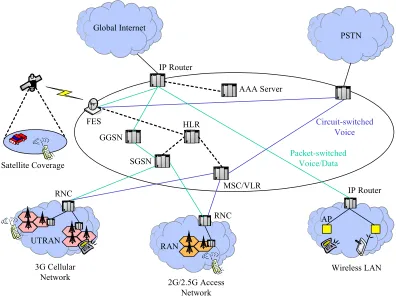
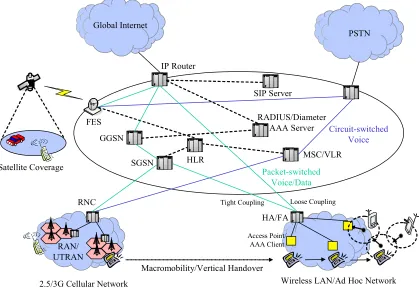
Today mobile communications have become an essential part of modern everyday life. In the future, with the advent of ubiquitous mobile communications, it will become transparent to the end users, much like the medium within which it operates. Ubiquitous communication will change the present model which is governed by communications between people, to communication between anything and everything. In such an environment, mobile users will have continuous access to network services via wireless devices, which may use software radio techniques to adapt themselves to the appropriate networking technology [CPP99, MRPS04]. It is also envisaged that in the future there will be large numbers of public and private network operators, who will provide access to voice and data services in existing fixed networks such as the PSTN and Internet [WAGZ+03]. These Radio Access Networks (RANs) will range in size from private home and office wireless networks, to public and private Wireless Local Area Networks (WLANs) in densely populated urban areas, to wide-area suburban public cellular networks, and global satellite networks as depicted in Figure 1-1.
Users will be able to select connectivity to applications and services using devices and access technologies that best suit their needs for each particular communications session. Factors such as the Quality of Service (QoS), connection speed, and costs will play a major role in determining the choice of provider. Roaming between independently operated networks will become an essential part of everyday life. A typical example will be users moving between their home and work environments via a number of intermediate wide-area networks. In addition to network operators there will be a large number of Value Added Service Providers (VASPs). These entities will provide services such as hosting location management information for Mobile Nodes (MNs), providing street maps, stock quotes and a host of other services.
Each of these network operators and service providers will require payment for services that they may provide to roaming mobile users. With potentially many thousands of NOs and VASPs and a billion plus mobile users with multiple devices, it is essential to simplify the billing and payment processes. It is also imperative to remove any complex trust relationships that may be required between these entities for the purposes of authentication and accounting for network usage. Secure payment for network usage and service provision is one of the main concerns of this thesis.
1.1.1
Mobile Network Generations
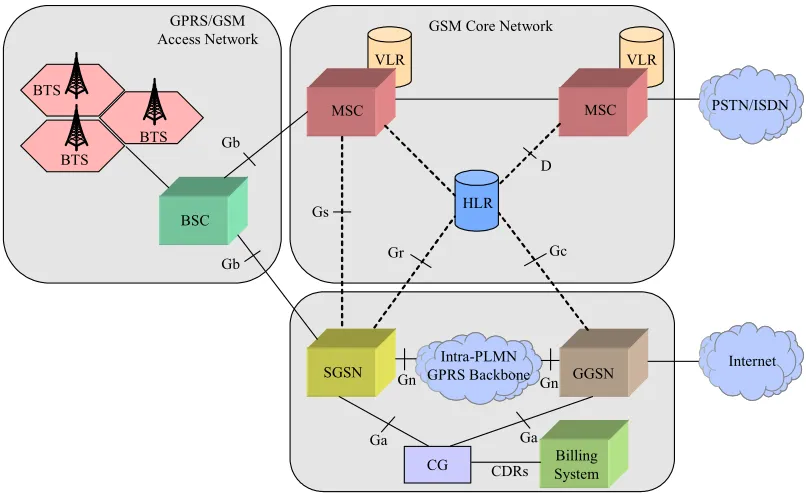
Studies on the next generation of mobile telecommunications systems, known as the third-generation (3G), began in the mid 1980s with a view to deploying commercial networks by early 2000. However this schedule has been delayed by many technical and commercial difficulties [Gar02]. As an interim solution, GSM operators in Europe are have been moving towards 3G-like services in an effort to generate new revenue streams. In Europe, the General Packet Radio Service (GPRS), also referred to as 2.5G, provides a packet-switched radio service that enables an always-on connection and an average data rate of 115Kbps [DGA01]. GPRS employs packet transmission technology in the core network while making use of existing GSM radio interfaces in the RAN. GPRS adds two new network elements to the existing GSM infrastructure, namely the Serving GPRS Support Node (SGSN) and the Gateway GPRS Support Node (GGSN) in the core network. The SGSN is responsible for the delivery of packets to the correct Radio Network Controller (RNC), while the GGSN is like an IP gateway, and acts as a logical interface to external data networks such as the Internet [CG97].
Figure 1-1 Architectural View of Present and Emerging Mobile Networks
3G systems currently under development on the other hand incorporate greatly enhanced air interfaces to support wider bandwidths for improved capacity and higher data rates. The 3G standards aim to support a wide range of bearer services from voice to high-rate data services of 144Kbps for vehicular, 384Kbps for pedestrian, and up to 2Mbps for in-door environments. European efforts in 3G, referred to as the Universal Mobile Telecommunications System (UMTS), are being have been developed under the auspices of the Third Generation Partnership Project (3GPP). UMTS will makes use of the Wideband Code Division Multiple Access (WCDMA) standard in the UMTS Radio Access Network (UTRAN) [3GPP].
The UMTS core network consists of circuit- and packet-switched domains and will makes use of evolved GSM/GPRS core network entities such as the MSC, SGSN and GGSN for access to the PSTN and Internet.
3G Cellular Network
PSTN
2G/2.5G Access Network Satellite Coverage
Global Internet
RNC
RNC HLR
SGSN GGSN
IP Router
Wireless LAN AP
AAA Server
MSC/VLR IP Router
RAN UTRAN
Circuit-switched Voice
Packet-switched Voice/Data
In North America, the Third Generation Partnership Project 2 (3GPP2) is developing has developed the cdma2000 system [3GPP2]. The core network is based on an evolved ANSI-41 network, while the RAN is based on cdmaOne [Sar00, PK01]. 3GPP2 however has taken advantage of the existing IETF Mobile IP protocol [Per02a, Per02b] to enhance the network architecture in order to provide IP capabilities.
Even as 3G networks are being deployed worldwide, focus has already shifted to the next generation of mobile networks. These networks have been referred to by a variety of names such as Beyond-3G (B3G) systems [Usk03, KJCH+03, LJP03], fourth-generation (4G) networks [BGQS+01, MAGM+03], and all-IP wireless networks [LPHC02, BL01]. These terms often mean different things to different people [MRPS04]. For instance, the 3GPP and 3GPP2 camps have contrasting strategies on the evolution of current 3G networks [PD00, RHD03]. However, there is one common theme that transcends all the proposed architectures, and it is that the Internet Protocol (IP) will play a crucial role in the development of any such future networks [HY03, BPIM+01].
The proposed architectures for IP-based next-generation networks range in complexity and design. At a very minimum these systems may contain evolved network elements to support packet transmission, along with a gateway IP-router between the telecom operators 3G network and the global Internet. In some proposals the Mobile IP protocol plays a major role in the mobility management, in relation to terminal mobility and routing of packets in the network. Other architectures propose IP transport in the radio access network [VVV03], which aims to simplify application development, as well as reduce overall network development and transmission costs.
The proponents of next-generation networks also see WLAN hotspots as complementing existing 3G networks in providing high-speed IP access of up to 100Mbps in local-area environments [BCHL+03, AHP03, DTNA+03]. Some of the proposals make use of the IETF Authentication, Authorization and Accounting (AAA) infrastructure [Per00, AAA] in conjunction with the existing 2.5/3G authentication mechanisms for terminal and user authentication, access control and billing [HMT02]. Finally, some of the more avant-garde proposals advocate a core network based around IP with a variety of radio access network technologies at the edges [New04]. They promote end-to-end transfer of IP packets with seamless roaming between 2G, 3G, WLAN and fixed networks [ZVTZ+02, VLLX02, BBT02, PCAG+04].
A crucial consideration that has however not been adequately addressed by the majority of researchers, is the complex issue of settlement of payments in a ubiquitous mobile communications scenario. In such a scenario for example, anyone with a Wi-Fi Access Point (AP) and high-speed connection to the Internet has the potential to become a picocell operator [WiFi]. With large numbers of network operators and service providers, it will become a near impossible task to establish bilateral agreements with all other operators. Even in situations where agreements are in place, the issue of operator trust in generating correct CDRs for service provision will be of vital importance. With so many NOs and roaming mobile users, the system will be open to operator fraud and user abuse. Thus billing based on preestablished trust relationships will no longer be adequate or scalable.
1.2
Thesis Motivation
single infrastructure [Met00]. To this effect, protocols have been under development by the IETF to address QoS [Wro97, BBCD+99], multicast group membership [MAGMA], and fast label switching [MPLS] issues. Work has also been underway to introduce mobility into the Internet to enable nodes to seamlessly roam among IP subnetworks [MIP]. Traditionally in IP networks each node is assigned a unique IP address. In normal IP routing, packets are routed from a source to a destination on a hop-by-hop basis, where a router makes a routing decision based on the network portion of the destination address. Thus an IP address is used for routing and also specifies a point of attachment for a node on the Internet. The Mobile IP protocol allows a MN to change its point of attachment to the Internet, and for such a change to be completely transparent to applications in that no IP address changes are needed to allow mobility. A MN can receive datagrams using its home address regardless of its actual position on the Internet [Per98]. Mobile IP solves the macromobility
problem in wide-area networks by updating the Care-of Address (CoA) at the Home Agent (HA), whenever a mobile node changes its point of attachment on the Internet.
Mobile IP was designed with a view to supporting MNs with relatively slow mobility patterns, and is not adequate for situations which require fast handoffs. With Mobile IP, any change in a MNs point of attachment results in signaling messages being sent to the HA in the home network, even though most of the path between the MN and the HA may remain unchanged. In response to this, micromobility architectures have been developed to support mobility within a local network or domain [CGKV+00, CKK02, SMMC04]. The main aim of these protocols is to minimize the number of signaling messages that have to be carried over the core network to support host mobility. With micromobility protocols, local handoffs result in signaling messages being generated which are limited to the administrative domain in which the MN is currently roaming. As long as a MN remains within the administrative domain of a single operator, there is no need to update its route entry in the home network.
However to transform the Internet into a viable telecommunications network, there is still one key element missing, and that is the lack of an efficient, scalable authentication and accounting structure. The Internet initially started life as a research network, and comprises numerous interconnected public and private subnetworks which are independently administered. In the majority of cases, these subnetworks are operated as closed user groups with pre-established trust relationships between the users and the network operator. The current approach to providing secure and trusted communications in IP networks is based on the IETF AAA protocols [RWRS00, CLGZ+03]. Users have an enduring relationship with a network operator, and inter-operator roaming agreements are required to allow mobile users to access resources in third-party networks. Payment for usage of network resources may take place after the services are used and CDRs must be exchanged by the operators for billing purposes. As noted earlier, with large numbers of users and operators, issues of trust and scalability become of crucial importance.
1.2.1
Next-Generation Network Scenario
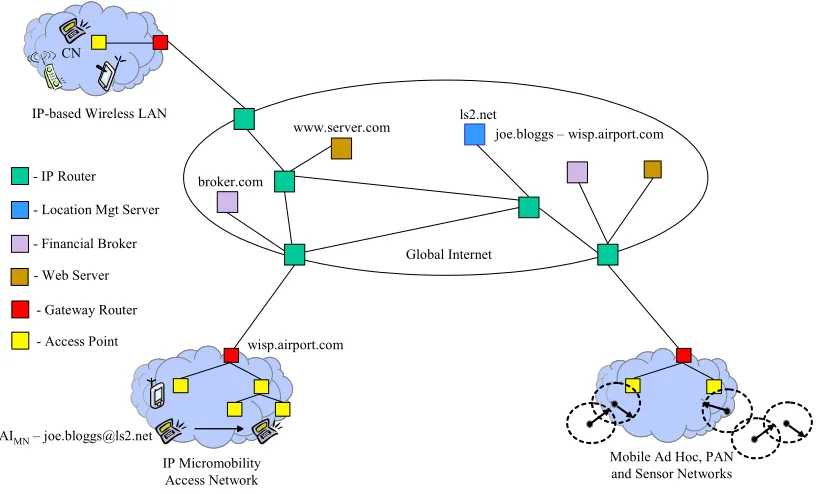
must register his care-of address with his preferred Location Management Server (LS). The LS keeps a mapping of the user’s NAI to his current CoA.
[image:23.612.128.538.277.524.2]Network operators generate revenue by charging for usage of network resources by roaming mobiles and may also provide other value-added services. Existing credit based mobile billing systems trust users to pay their bills based on strong identity verification and credit history checks. They also place total trust in the operator to bill the user for the correct amount, but provide no mechanisms to prove the authenticity of the generated CDRs. Unlimited credit with postfact punishment is too open to abuse in mobile networks. With a large population of mobile users and independent network operators, it is desirable to remove the need to trust them and thereby minimize fraud in the system. In this thesis micropayment technology [OPT01] is employed, which allows the routers within the access network to authenticate datagrams prior to making a routing decision, and the NO to be paid in real time for service provision. As long as the MN releases the correct payment tokens, the operator provides him with the requested service. This eliminates the need for billing and any long-lived accounting or trust relationship between the MN and the NO.
Figure 1-2 All-IP Next-Generation Network Architecture Proposal
In recent years ad hoc networks have gained acceptance as a mainstream networking technology. It is envisaged that ad hoc networks will play an integral part in providing a fast and flexible mechanism to extend the reach of WLAN hotspots and the Internet in next-generation networks. An ad hoc network is an infrastructureless network in which a group of nodes communicate with each other using multi-hop wireless links, and where the topology of the network can change unpredictably. Individual nodes are responsible for dynamically discovering which other nodes they can directly communicate with. Each node also acts as a router to forward packets for other nodes within the network [RR02]. Nodes in such networks may have affiliations with different NOs or could be under the administrative control of individual users. These users may not necessarily wish to cooperate in relaying packets on behalf of other users in the network.
One of the major concerns of such users will be to preserve the limited battery life of their mobile devices, and the relaying of packets directly impacts on this. Therefore, mechanisms have to be in place to
Global Internet IP-based Wireless LAN
CN
IP Micromobility Access Network - IP Router
- Location Mgt Server - Financial Broker - Web Server
Mobile Ad Hoc, PAN and Sensor Networks - Gateway Router
NAIMN– [email protected]
wisp.airport.com
ls2.net
broker.com
www.server.com joe.bloggs – wisp.airport.com
compensate the nodes involved in the relaying process, and for any value-added services that they may provide. However nodes in an ad hoc network do not have the luxury of long-lived trust relationships as is the case in the wired Internet. Also, it is not always possible to contact a Trusted Third Party (TTP) to verify user identities or payment tokens that may be presented to a node. In the latter case, the cost of contacting a TTP to verify the payment instrument may outweigh the actual benefits gained. Once again in this thesis a micropayment scheme is employed, which enables a node to join an existing ad hoc network, and allows it to pay each node that relays packets on its behalf in real time.
Current ad hoc routing protocols [RT99] implicitly trust all the participants in a network to cooperate in the forwarding of datagrams, and are not able to cope with network disruptions due to malicious behavior. For instance, an attacker can masquerade as a legitimate node and advertise false routes in the network. More sophisticated attacks can be mounted whereby a node selectively drops datagrams and points to collisions on the transmission medium as the probable cause. As part of this thesis, mechanisms have been developed to monitor such activity in order to be able to identify nodes that deliberately misbehave, and subsequently blacklist them from the network.
1.3
Scope of the Research
The focus of this research is to develop a lightweight authentication and accounting protocol for all-IP generation mobile communications networks. As outlined in Section 1.1, it is widely assumed that such next-generation mobile networks will comprise wireless infrastructure networks (where a MN communicates directly with a base station) as well as mobile ad hoc networks (where a node may relay packets through a number of intermediate mobile nodes prior to their reaching their destination). With this in mind, Section 1.2 proposed an integrated network architecture for such a next-generation mobile network scenario. In each case the NO or mobile nodes need to be paid for any services rendered. For the first scenario, a micropayment scheme for Mobile IP based networks has been developed which allows small and medium sized, independent NOs to be paid in real-time for service provision, i.e. the NO can be assured of payment by verifying the cryptographic tokens sent along with the packets as they travel through its operator’s access network. However from time-to-time a MN may also find itself outside the coverage of a fixed network access point or base station. In such situations the MN may get its packets relayed through a number of intermediate nodes. Again each node needs to be remunerated for the relaying operation. The initial payment protocol has been extended into a multi-party micropayment scheme for ad hoc networks to allow each intermediate node to be paid independently without the need to contact a TTP. Finally, to address the issue of malicious or rogue nodes in an ad hoc network scenario which may drop packets to disrupt the operation of the network, a secure route discovery and packet forwarding scheme was developed. This in conjunction with the multi-party micropayment scheme facilitates guaranteed payment for service provision in an ad hoc network. The three protocols combined together allow for an overall secure authentication and accounting infrastructure for next-generation mobile networks.
1.3.1
Outline of the Dissertation
authentication and accounting for IP networks need to be clearly understood and scrutinized before effective alternative solutions can be designed as part of this thesis.
This thesis proposes the use of electronic tokens to pay for mobile services rather than using traditional billing methods. Chapter 3 gives an overview of current electronic payment research. The majority of electronic payment solutions mimic real-world payment instruments such as cash, cheques and payment cards. These types of payment solutions aim to provide high-value transactions known as macropayments
and usually require verification or authorization from a TTP in the network. However these types of solutions are not suitable for repeated small-value transactions of a cent or less, as the cost of contacting the TTP far outweighs the value of the payment instrument. In the scenario for next-generation networks, the aim is to make use of micropayments based on hash chains to pay the network operator or connectivity provider on a per packet basis. A detailed review of a number of efficient hash chain schemes is performed, in order to understand the various techniques which can enable repeated payments from mobile devices.
In Chapter 4, a proposal for a real-time authentication and accounting scheme for Mobile IP based next-generation networks is presented. The current inadequacies of the existing AAA schemes are highlighted, and the requirements for an efficient and lightweight approach to the problem are identified. The details of the protocol are presented and its operation in a next-generation network environment is explained. The protocol was implemented using a version of the Cellular IP micromobility protocol [CIP] that was developed using the ns-2 simulator [NS]. The computation and communications costs of the implemented protocol are also analyzed.
Chapter 5 extends the concept of the real-time micropayments scheme to the domain of ad hoc networks. Ad hoc networks present their own unique challenges for authentication and accounting due to the lack of any central authority. In addition, there is no guarantee that a node has access to an online TTP all the time. These issues are addressed by presenting a multi-party micropayment solution that allows each node in the path between the source and destination to be paid in real time for packet forwarding in an ad hoc network. An evaluation using the ns-2 protocol simulator is presented, along with an informal analysis of the risk assessment and cryptographic processing overheads associated with the protocol.
As part of developing the payment solution for ad hoc networks, it was realized that for it to be effective, a secure route discovery and packet forwarding scheme was required. Hash chains in conjunction with public key cryptography are used to develop a secure routing and packet forwarding scheme for ad hoc networks in Chapter 6. The DSR protocol [JMH03] implementation in ns-2 was extended to incorporate cryptographic functions to implement the secure routing scheme.
2
Management of Next-Generation Mobile
Networks
“Radio has no future.”
Lord Kelvin, 1897, on Marconi’s experiments
2.1
Introduction
Next-generation wireless networks and services will be much more complex than today’s second-generation (2G) systems. Universal access, global roaming and multimedia services will be the key driving factors that will have a profound impact on how these networks will be managed [UK03]. Work has been ongoing over the past decade on third-generation (3G) cellular networks that will achieve global roaming, and seamless voice and data services at speeds of 384Kbps and above. However the roll-out of 3G networks has been somewhat delayed, mainly due to the very high costs associated with licensing the spectrum and building the networks, and problems associated with the handsets. From the end-users perspective, the lack of a clear set of killer applications and expensive tariffs has resulted in a slow uptake of the technology. Therefore in Europe and the United States, network operators have deployed or are in the process of deploying 2.5G systems, such as the GSM-based GPRS and cdmaOne-based cdma2000 1xRTT networks, which offer data rates up to 144Kbps [EHHK+01, HPNL02].
Even though 3G mobile communications systems have barely had time to be deployed, both industry and academia have already started looking beyond them [ZHA04]. The architecture, protocols, services and wireless technologies that will constitute next-generation networks are still under consideration and a subject of great debate. Network operators today are faced with a confusing array of technologies on how to best build next-generation networks. Each technology in turn has its own particular advantages and disadvantages. For example, the IETF Mobile IP protocol [Per02b] represents a simple and scalable global mobility solution for IP-based networks, but lacks support for fast handoff control, real-time location tracking and authentication. In contrast, current 2.5/3G systems offer support for seamless mobility, paging and QoS, but are built on complex connection-oriented networking infrastructure that lacks the inherent flexibility, scalability, and cost effectiveness found in packet-switched networks [BCJ00]. Next-generation networks are referred to by a number of names in the literature. The term fourth-generation (4G) is used in this thesis to refer to the next generation of networks targeting an all-IP solution [JL03, JT01, MP01, ZK03].
bit rates of up to 54Mbps, with bit rates in excess of 100Mbps planned for the future [Var03]. WLANs are being deployed not only in residential and small offices, but also on a larger scale in public areas such as airports, shopping malls and neighborhoods [Boingo]. This picture is further complicated by the arrival of two fundamentally different network technologies, namely ad hoc and wireless sensor networks. These two technologies will also play a major role in next-generation pervasive networks. An ad hoc network is a collection of wireless nodes that wish to communicate with each other but have no fixed infrastructure available. The network is autonomously formed among many nodes with varying functionalities and power levels, which also act as routers to forward packets on behalf of other nodes in the network [GL02]. Wireless sensor networks consists of large numbers of sensors which are tiny, low-cost, low power radio devices, dedicated to performing certain functions such as collecting environmental data. Many of the ad hoc network techniques will also be applicable to sensor networks.
In addition to sophisticated mobility management schemes, 4G networks will require scalable Authentication, Authorization and Accounting (AAA) procedures to be put in place [Met99, PCAG+04]. Such procedures will help in limiting the credit-risk exposure for the involved parties. With large numbers of roaming mobile users, there is a need to efficiently authenticate user credentials and remunerate network operators and value-added providers for service provision. At the present time users must place total trust in the accuracy of the usage records and the bills generated by the Network Operator (NO). Next-generation networks will consist of large numbers of independent network operators and the above processes will become subject to abuse. In particular, postfact billing with unlimited user credit has the potential for widespread abuse in next-generation mobile networks. This provides ample motivation and justification for simplifying the overall AAA process. Finally, traditional models of billing based on flat-rate pricing models combined with time dependent charging will not be sufficient for the provision of data services in next-generation networks, as they do not enable measurement that is based on the real value of the services offered [CISCO01, KKAM+04].
In the remainder of this chapter the mobility management, authorization and accounting techniques used in current cellular and next-generation networks are examined in detail. The rationale for doing this is to highlight the complex nature of the resulting network architecture if the present strategies for evolving current cellular networks into next-generation all-IP networks are adopted. Section 2.2 describes the current mobility procedures employed in 3G networks. Section 2.3 gives an overview of the billing techniques used in both fixed and mobile telecommunications networks. Section 2.4 takes an in-depth look at the various Internet technologies that will play a major role in the development of 4G networks. The Mobile IP protocol and the various micromobility proposals which have been designed to address some of its shortcomings are examined in detail [CGKW+02]. The inefficiencies and scalability problems of current AAA proposals for IP networks are also analyzed. The mobility and security issues facing two new wireless technologies, namely WLANs and ad hoc networks are then outlined. In Section 2.5, a number of strategies being pursued by the telecom operators to integrate their 3G networks with these emerging network technologies are examined. The chapter concludes by highlighting the problems that remain unaddressed. Prior to proceeding with reading the details of the main body of this chapter, it is recommended that the reader turn to Appendix A, which provides details of the various cryptographic terms, notation and operators used throughout the remainder of this thesis.
2.2
Third-Generation Mobile Networks
Cellular (PDC) in Japan [Tan03]. 2G networks in turn were successors to first-generation (1G) analog mobile systems such AMPS in the US. 1G and 2G networks were primarily designed to carry voice traffic, although 2G’s design also includes the low bit-rate Short Messaging Service (SMS).
[image:28.612.116.534.238.509.2]3G networks on the other hand will provide higher capacity and enhanced network functionality which will allows for advanced data and multimedia capabilities. 3G networks are expected to provide minimum data rates of 2Mbps in indoor environments and 144Kbps in outdoor environments. They will provide high-quality voice transmission with improved spectrum efficiency and packet-switched services such as wireless Internet access and real-time video. In addition, the vision of 3G is to provide an always-on service with global roaming between different operational environments using a single identity, and to provide the user with the same set of capabilities regardless of where they are in the network.
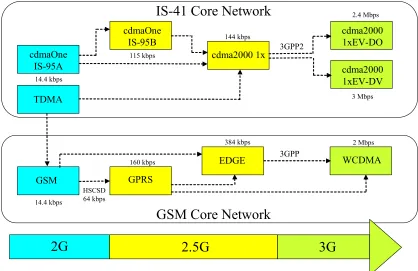
Figure 2-1 Third Generation Evolution Paths
Third-generation technologies were initially expected to provide a global access capability with a unified single radio interface and an advanced core network. However, operators are instead evolving their existing mobile networks towards the third generation. For example in Europe, the Universal Mobile Telecommunications System (UMTS) is being has been developed under the auspices of the Third Generation Partnership Project (3GPP). It is based on existing GSM/GPRS core network technologies and uses the Wideband CDMA standard (WCDMA) in the radio access network.
Similarly in the US, the Third Generation Partnership Project 2 (3GPP2) is a consortium of national standards bodies tasked with developing architectures and standards for third-generation cellular networks. The 3GPP2 is developing has developed the cdma2000 network which is based on the existing cdmaOne IS-95B standard and uses a variant of CDMA in the radio access network [Sar00]. The International Telecommunications Union [ITU] has adopted International Mobile Telecommunications 2000 (IMT-2000)
cdma2000 1x cdmaOne
IS-95B cdmaOne
IS-95A
TDMA
cdma2000 1xEV-DO cdma2000 1xEV-DV
IS-41 Core Network
GSM Core Network
EDGE GPRS
GSM
WCDMA
2.5G
2G
3G
3GPP 3GPP2
3 Mbps 2.4 Mbps 144 kbps
115 kbps
384 kbps 160 kbps
14.4 kbps
2 Mbps
to allow seamless evolution from the various 2/2.5G mobile standards that are extensively deployed around the world. Therefore it is not likely there will be one unified mobile system in the third generation. Figure 2.1 provides an overview of the various evolutionary paths towards the third generation.
2.2.1
3GPP
European efforts in 3G referred to as UMTS have been progressing in the Third Generation Partnership Project [3GPP]. The 3GPP was established in 1998 and consists of a number of telecommunications standards bodies, known as the 3GPP Organizational Partners [ARIB, CWTS, ETSI, ANSI T1, TTA, TTC], which is developing 3G standards for GSM based systems. UMTS is based on existing GSM/GPRS core network entities such as the GGSN and SGSN [CG97]. The standard interfaces and components of a 3G UMTS network are outlined in [3GPP03a] and illustrated in Figure 2-2 [VLLX02]. There are two land based network segments: the UMTS Radio Access Network (UTRAN) and the core network. The core network is further divided into the circuit- and packet-switched domains [CKK02].
Figure 2-2 3GPP/UMTS Network Architecture
A mobile user’s equipment communicates with multiple base stations, called Node Bs using WCDMA access and modulation techniques. The UMTS Radio Network Controller (RNC) can be considered to be roughly equivalent of the Base Station Controller (BSC) in GSM, and the Node Bs equate to the GSM Base Transceiver Stations (BTSs). Unlike GSM however the RNCs are connected together and can handle all radio resource issues autonomously. Each RNC controls a number of Node Bs and can perform soft handover. The RNCs and the base stations are collectively known as the UTRAN. From the UTRAN the core network is divided into packet- and circuit-switched parts. The Mobile Switching Center (MSC) and Visitor Location Register (VLR) handle connection-oriented circuit switching and mobility management tasks such as paging and location management. The Gateway MSC (GMSC) deals with incoming and outgoing connections to external networks such as the Public Switched Telephone Network (PSTN) for circuit-switched traffic.
2.2.1.1 Evolution of UMTS from GPRS
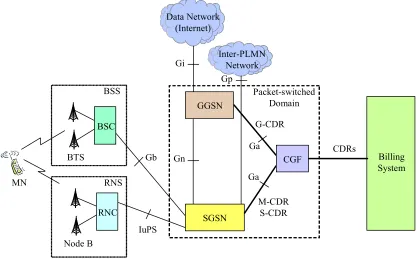
In evolving to an IP core network, 3GPP has decided to base it on the General Packet Radio Service (GPRS) [PD00]. GPRS has been standardized by the European Telecommunications Standards Institute [ETSI] to provide packet data services using GSM cellular networks [Par02]. GPRS improves the utilization of the existing radio resources. In addition, GPRS allows the subscriber to send and receive data in an end-to-end packet transfer mode, without using any network resources in circuit-switched mode. Packet-switched
UTRAN
MSC/VLR
SGSN
HLR Node B
RNC
GMSC
PSTN RNC
Node B GGSN
Internal IP Backbone
Global Internet
networks are more suitable for bursty data applications. In general, packet-switched data services provide greater flexibility and allow for charging strategies dependent upon the volume of data transmitted, which is in contrast to the time-oriented charging techniques applied for circuit-switched connections [BW97]. The packet-switched portion of the network in GPRS/UMTS consists of two types of GPRS Support Nodes (GSNs), the Serving GPRS Support Node (SGSN) and the Gateway GPRS Support Node (GGSN). The SGSN can be viewed as a packet-switched MSC [PCCA04]. It is responsible for session management, authentication, ciphering, and routing of data packets to mobile stations within its service area. The GGSN is a gateway node between the GPRS and external Packet Data Networks (PDNs) such as the Internet. In the case of an external IP network, the GGSN is seen as an ordinary IP router and is responsible for the allocation of IP addresses. It converts GPRS packets from the SGSN into the appropriate Packet Data Protocol (PDP) and sends them out to the corresponding PDN. In the other direction, PDP addresses of the incoming data packets are converted to the GSM address of the destination user. The readdressed packets are then sent to the responsible SGSN. For this purpose, the GGSN stores the current SGSN address of the user and his profile in its location register.
The SGSN handles the inter-RNC mobility of a host, while the GGSN handles inter-SGSN mobility. Both the SGSN and GGSN are involved in the security functions and the generation of CDRs for billing purposes. All GSNs are connected via an IP-based GPRS backbone network. Within this backbone, the GSNs encapsulate the PDN packets and transmit them using the GPRS Tunneling Protocol (GTP). In UMTS, a tunnel is created between the GGSN and SGSN. A mobile node (also known as a mobile station in telecoms terminology) can move between base stations and base station controllers without changing the SGSN, by moving one leg of tunnel. It can move to an access network controlled by a different SGSN by moving both legs of the tunnel without disturbing the data session [New04].
GPRS allows a single mobile station to transmit on multiple time slots of the same Time Division Multiple Access (TDMA) frame. This results in a very flexible channel allocation scheme, whereby one to eight time slots per TDMA frame can be allocated for one Mobile Node (MN). Moreover, uplink and downlink channels are allocated separately, which efficiently supports asymmetric data traffic such as Web browsing. Before a mobile node can start using GPRS services, it must register with a SGSN of the GPRS network. The network checks the user authorization, copies the user profile from the HLR to the SGSN and assigns a temporary identity to the user.
To exchange data packets with external PDNs, a mobile node must apply for one or more addresses used in the PDN, e.g. an IP address in the case the PDN is the Internet. This address is called a PDP address. For each session a PDP context is created which describes the characteristics of the session. It contains the PDP type, the PDP address of the mobile station, the requested QoS, and the address of the GGSN that serves as the access point to the PDN. This context is stored in the MN, the SGSN and the GGSN. With an active PDP context a MN is able to send and receive data packets. A mapping between the MNs PDP address and International Mobile Subscriber Identity (IMSI) allows the GGSN to transfer packets between the PDN and MN. A user may have several simultaneous PDP contexts active at a given time [BVE99].
2.2.2
3GPP2
GGSN in a GPRS/UMTS network [VLLX02, PCCA04]. In 3GPP, GPRS-based mobility was already defined, so IP network enhancements were considered on top of GPRS. In contrast to this, the 3GPP2 has opted to make use of the IETF Mobile IP [Per96a, Per97] protocol for network-layer mobility support [MH00, PD00].
One of the main reasons for adopting Mobile IP was its global acceptance and the ease with which it would allow interworking and roaming with other IP networks. The PDSN provides the Foreign Agent (FA) functionality in 3GPP2, while the Home Agent (HA) is a separate entity. A tunnel is created between the MN and the PDSN in order to transport IP packets between the two. The MN can move between base stations and base station controllers without interrupting the data session [New04]. The 3GPP2 architecture also makes use of AAA protocols and infrastructure to authenticate roaming data users [Per00]. This allows the visited network to query the home network for authentication credentials and ensures payment for services rendered. This is in addition to existing HLR/VLR based authentication for wireless voice services. More details on Mobile IP and AAA can be found in Section 2.4.
Figure 2-3 3GPP2/cdma2000 Network Architecture
The 3GPP2 has an evolutionary approach to the development of the cdma2000 network. Initial rollout has commenced with the introduction of cdma2000 1x, which is based on the cdmaOne standard and supports data rates up to 144Kbps. The next step is cdma2000 1xEV-DO (data only), which introduces a new air interface and supports up to 2.4Mbps on the downlink and 153Kbps on the uplink. It is also known as High Rate Packet Data (HRPD) and provides an always-on connectivity in a wide-area mobile environment. However, simultaneous voice over 1x and data over 1xEV-DO is difficult due to the use of separate carriers. Finally, cdma2000 1xEV-DV (data and voice) aims to introduce an all-IP architecture for radio access and the core network, and promises data rates up to 3Mbps.
2.3
Billing in Telecommunications Networks
All network operators, whether they are fixed, mobile, or value-added service providers have a requirement to generate revenue for the resources that they provide. The act of recording resource usage for the purposes of trend analysis, auditing, billing, or cost allocation is called accounting. Accounting in today’s telecommunications networks is a complex process. It consists of a number of sub-processes, namely metering, pricing, charging and billing. Metering is the process of measuring and collecting resource usage information in the form of a Call Detail Record(CDR), related to a single customer’s service utilization.
PSTN
Global Internet MSC/VLR
HLR
PDSN HA
AAA Radio Access Network
Core Network
Pricing is the process of determining a cost per unit or tariff and is dependent on a number of factors such as the time of day, destination of the call (local, national and international), subscriber type and charging plan. The charging process applies the appropriate tariffs to translate the customer’s resource usage information into an amount of money that he has to pay. This amount is then used by the billing process to generate an invoice for payment [PBSP01, KKAM+04].
There are a number of problems with existing telecommunications billing procedures, namely the cost of the actual billing process and the high level of fraud [Mep00]. Firstly, the cost of providing and maintaining a telecommunications billing system is quite high. It can be anything up to 50% of the total infrastructure investment and annual revenue of the network operator [CH00]. According to Jupiter Communications it costs an operator between $2.50 and $3 on average, to produce a paper bill for a residential customer, and more for business customers. Online billing and electronic payments could cut these costs in half, especially as half the calls to customer support centers are billing related. Secondly, the high level of fraud is an impediment to the development of next-generation networks. Recent reports indicate that between 1-3% of an operator’s revenue is lost due to fraud each year, of which 24% is related to roaming fraud [Llo03]. This amounts to anywhere between 12-60 billion US dollars annually [BWorld, DIDATA03].
In traditional telecommunication environments, charging and billing for telephony services is based on a contract between the end user and the network operator. The essence of this agreement is that the user gets access to the network services and will pay for those services according to the bills produced by the operator. The bills may contain both fixed and usage-dependant charges. To compute the usage-dependent charges, the operator has to monitor all the calls placed and received on the network. For each call placed by the user, the switches in the network generate one or more CDRs. Millions of CDRs are stored on disk or magnetic tape and are used as the raw data for the billing system. Thus, the implementation of billing for telephony services is based on an offline billing system and on having CDRs generated in the network.
The problems of fraud and lost revenue are further exacerbated in mobile telecommunications networks where there may be roaming users associated with third party NOs. Bilateral agreements are required between the operators to allow users to avail of services while roaming in foreign networks. From the users perspective he must place total trust in the accuracy of the operator generated CDRs. This is particularly important in the case of roaming users where there may be multiple NOs involved in routing a call. Complicated tariff structures make it difficult for a user to recall their precise usage, let alone dispute it at a later stage. Subscriber based billing with unlimited credit is too open to abuse in mobile networks. With large numbers of mobile users and independent network operators, these problems will only escalate in the future. In order to facilitate the understanding of the charging, accounting, and billing processes in telecommunications networks, a brief description of the overall architecture is provided, together with a presentation of the network components involved in these functions.
2.3.1
Fixed Telecommunications Billing
Figure 2-4 PSTN Billing
Although CDRs are in the process of being standardized, their contents can vary from operator to operator. This is partly due to the fact that the switching equipment from different manufacturers produces data in different formats. The only proof that a call took place is the CDR, and sophisticated duplication schemes are used to ensure that this data is not lost. The raw data generated by the switches is also kept for the purposes of settling disputes. However there are no mechanisms in place to ascertain the authenticity of the data, and the call records can either be denied by the customer or falsified by the operator. According to the Federal Communications Commission (FCC) of the United States, telephone company billing complaints jumped to 5,523 in the first three months of 2003, up 65% from a year earlier [FCC03].
2.3.2
Billing in GSM
The first GSM networks became operational in 1992 and initially consisted of only a handful of network operators. Today the Global System for Mobile Communications consists of more than 600 network operators with 74.9% of the world’s digital market [GSMA04a]. In 1987, network operators from fifteen countries signed a Memorandum of Understanding (MoU) in Copenhagen, which aimed to promote and encourage the worldwide adoption of GSM. Other working parties were also established to solve the problems associated with building and administering a worldwide system based on independent networks. These groups were later transformed into the GSM Association [GSMA].
One of the first tasks of the GSMA was to address the issue of cross border roaming and billing procedures. The GSMA estimates that more than 20,000 individual roaming agreements are in place between its GSM operators worldwide, with more being added every day. GSM is founded on the concept of roaming, allowing subscribers from other networks to use their mobiles when they visit other countries or networks. However behind the simple objective of global roaming lies a complex process that gathers information about each call, about each caller, and takes a standardized approach to the charges being incurred.
The Transferred Account Data Interchange Group (TADIG) within the GSMA was given the task of implementing the interchange of billing data between different network operators by defining and implementing the Transferred Account Procedure (TAP) [GSMA04b]. TAP is the mechanism by which operators exchange CDRs of roaming users and allows roaming partners to bill each other for the use of networks and services through a standardized process. Much of the traffic carried by a GSM Public Land Mobile Network (PLMN) either originates or terminates in another network. The operator of the local fixed network charges the wireless operator for each call that terminates at one of its fixed-line subscribers. The same applies in the other direction where the GSM operator charges the fixed-line operator for each call made to a mobile number from a landline. Therefore GSM network operators and their local fixed-line counterparts usually negotiate an interconnect agreement to make charging as simple as possible. Other fixed-line international operators have similar agreements amongst themselves.
LEC Billing
LEC Switch
LEC Switch CDR
IEC Billing
IEC Switch
IEC Switch IEC
Switch
LEC Billing
LEC Switch
LEC Switch CDR Settlement
Local Long Distance Local
Caller Callee
Caller gets
Thus in order to place a call for example from an Irish PLMN to a fixed phone in the US, it is not necessary for the two operators to directly negotiate a pricing contract. The Irish PLMN operator negotiates a price with an Irish PSTN operator, who in turn negotiates a terminating charge with its US counterpart. The Irish PSTN operator passes the call costs back to the Irish PLMN who recoups the cost of the call directly from its subscribers. This form of inter-administration accounting covers the division of revenue between both fixed and mobile networks. It does not, however, cover the costs incurred by foreign subscribers whilst roaming in other networks. TAP is required for inter-PLMN accounting for roaming mobile users. The latest version, TAP3, caters for variable length records and allows individual erroneous CDRs to be rejected. Figure 2-5 illustrates the collection and exchange of information required to support TAP.
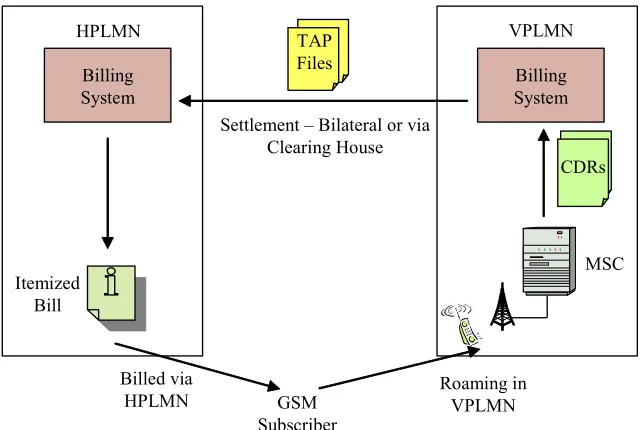
Figure 2-5 Generation and Exchange of TAP Records
In the case where a French subscriber calls a US number while roaming in an Irish PLMN, this call is routed via an Irish fixed network operator. The Irish fixed NO will still charge the Irish PLMN for the leg of the call placed to the US number. The Irish PLMN does not receive any revenue directly from the roaming mobile user. In order to recoup the costs incurred by the call, the Irish PLMN must charge the Home PLMN (HPLMN), in this case the French PLMN, to cover the costs incurred by the French mobile subscriber. The details of the calls made by a subscriber roaming in a Visited PLMN (VPLMN) are recorded by the serving MSC. Each call produces one or more CDRs which are transferred on a regular basis to the billing system of the VPLMN for pricing. The CDRs produced on behalf of roaming subscribers are converted and grouped in files under the TAP format. The transfer of TAP records between the home and visited mobile networks may be performed directly or via a clearinghouse. Invoicing between the operators normally happens on a monthly basis. On reception by the HPLMN, the TAP record is converted into an internal format and added together with any CDRs produced by the subscriber while in the home network [3GPP03b].
In recent years network operators have started to introduce prepaid solutions. One of the advantages of prepaid subscriptions is that it helps to reduce the risk of unpaid accounts. However, roaming mobile users add to the complexity of prepaid schemes, as the majority of prepaid mobile solutions are based on temporary
Billing System
Billing System
MSC VPLMN
HPLMN TAP
Files
Settlement – Bilateral or via Clearing House
GSM Subscriber
Roaming in VPLMN Billed via
HPLMN Itemized
Bill
accounts maintained in the home network. The hot billing approach is one solution which allows for the real-time collection of data and the transport of CDRs from the MSC in the visited network to the Prepaid Service Center (PSC). The balance in the customer’s account is decremented according to the CDR. As a customer uses up the prepaid credit, the HLR and the Authentication Center (AuC) are updated to allow or prevent further service access. In the hot billing approach, sending real-time CDRs on a per second basis to the PSC may incur heavy overhead for the network [LCR00].
2.3.3
GPRS Billing
Second-generation networks mainly catered for voice telephony servi