An Optimal Pair of Levels for Adding Relation
between Two Levels of a Linking Pin Organization
Structure with Two Subordinates
Kiyoshi Sawada
Abstract—This paper proposes a model of adding relation to a linking pin organization structure where every pair of siblings in a complete binary tree of height H is adjacent such that the communication of information in the organization becomes the most efficient. For a model of adding an edge between a node with a depthM and its descendant with a depth N, we formulated the total shortening distance which is the sum of shortening lengths of shortest paths between every pair of all nodes and obtained an optimal pair of depth (M, N)∗ which maximizes the total shortening distance.
Index Terms—organization structure, linking pin, complete binary tree, total distance.
I. INTRODUCTION
A
linking pin organization structure is a structure in which relations between members of the same section are added to a pyramid organization structure and is called System 4 in Likert’s organization classification [1]. In the linking pin organization structure there exist relations be-tween each superior and his direct subordinates and those between members which have the same immediate superior. The linking pin organization structure can be expressed as a structure where every pair of siblings which are nodes which have the same parent in a rooted tree is adjacent, if we let nodes and edges in the structure correspond to members and relations between members in the organiza-tion respectively [2], [3]. Then the height of the linking pin organization structure expresses the number of levels in the organization, and the number of children of each node expresses the number of subordinates of each member. Moreover, the path between a pair of nodes in the structure is equivalent to the route of communication of information between a pair of members in the organization, and adding edges to the structure is equivalent to forming additional relations other than those between each superior and his direct subordinates and between members which have the same direct subordinate.The purpose of our study is to obtain an optimal set of additional relations to the linking pin organization such that the communication of information between every member in the organization becomes the most efficient. This means that we obtain a set of additional edges to the structure minimizing the sum of lengths of shortest paths between every pair of all nodes.
We have obtained an optimal depth for each of the following two models of adding relations in the same level to
Manuscript received October 31, 2012.
K. Sawada is with the Department of Policy Studies, University of Marketing and Distribution Sciences, Kobe, 651-2188 Japan (e-mail: Kiyoshi [email protected]).
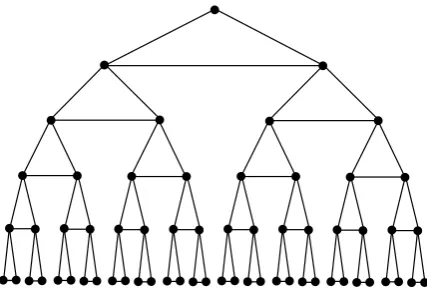
Fig. 1. An Example of a Complete Binary Linking Pin Structure ofH= 5
a complete K-ary linking pin structure of height H where every pair of siblings in a complete K-ary tree of height
H is adjacent: (i) a model of adding an edge between two nodes with the same depth and (ii) a model of adding edges between every pair of nodes with the same depth [5]. A completeK-ary tree is a rooted tree in which all leaves have the same depth and all internal nodes haveK(K= 2,3, . . .) children [6]. Furthermore, we have proposed a model of adding relation between the top and a member in a complete
K-ary linking pin structure of heightH [7]. When an edge between the root and a node with a depth N is added, an optimal depth N∗ is obtained by minimizing the sum of lengths of shortest paths between every pair of all nodes.
This paper proposes a model of adding an edge between a node with a depth M(M = 0,1, . . . , H −2) and its descendant with a depth N(N = M + 2, M + 3, . . . , H) in a complete binary (that is K = 2) linking pin structure of heightH(H = 2,3, . . .). This model corresponds to the formation of an additional relation between a superior and his indirect subordinate. Figure 1 shows an example of a complete binary linking pin structure ofH = 5.
If li,j(= lj,i) denotes the distance, which is the number
of edges in the shortest path from a node vi to a node vj
(i, j= 1,2, . . . ,2H+1−1) in the complete binary linking pin
structure of height H, then ∑i<jli,j is the total distance.
Furthermore, ifl′i,j denotes the distance from vi tovj after
adding an edge in this model,li,j−li,j′ is called the shortening distance betweenvi and vj, and
∑
i<j(li,j−l′i,j) is called
the total shortening distance. Minimizing the total distance is equivalent to maximizing the total shortening distance. When an edge between a node with a depthM and its descendant with a depthN is added to the complete binary linking pin structure of heightH, an optimal depth N∗ is obtained by
IAENG International Journal of Applied Mathematics, 42:4, IJAM_42_4_06
[image:1.595.319.533.196.342.2]maximizing the total shortening distance for each value ofM
[8]. Furthermore, an optimal pair of depth (M, N)∗ which maximizes the total shortening distance is revealed.
In Section 2 we formulate the total shortening distance of the above model. In Section 3 we show an optimal depth
N∗ which maximizes the total shortening distance for each value ofM. In Section 4 an optimal pair of depth(M, N)∗ which maximizes the total shortening distance is shown.
II. FORMULATION OFTOTALSHORTENINGDISTANCE
This section formulates the total shortening distance when an edge between a node with a depthM(M = 0,1, . . . , H− 2) and its descendant with a depth N(N = M + 2, M + 3, . . . , H)is added to a complete binary linking pin structure of heightH(H = 2,3, . . .).
LetvM denote the node with a depthM and letvN denote
the node with a depthN which gets adjacent tovM. The set
of descendants of vN is denoted by V1. (Note that every
node is a descendant of itself [6].) The set of descendants of vM and ancestors of parent of vN is denoted by V2.
(Note that every node is an ancestor of itself [6].) Let V3
denote the set obtained by removing V1 and V2 from the
set of descendants ofvM. LetV4denote the set obtained by
removing descendants ofvM from the set of all nodes of the
complete binary linking pin structure.
The sum of shortening distances between every pair of nodes inV1 and nodes inV2 is given by
AH(M, N) =W(H−N) ⌊N−M
2 ⌋
∑
i=1
(N−M−2i+ 1), (1)
where W(h) denotes the number of nodes of a complete binary tree of heighth(h= 0,1,2, . . .), and⌊x⌋denotes the maximum integer which is equal to or less than x. The sum of shortening distances between every pair of nodes inV2 is
given by
B(M, N) =
⌊N−M
2 ⌋−1
∑
i=1
⌊N−M
2 ⌋−i
∑
j=1
(N−M−2i−2j+1), (2)
where we define
0
∑
i=1
·= 0. The sum of shortening distances
between every pair of nodes in V1 and nodes in V3 is given
by
CH(M, N) = W(H−N)
⌊N−M−1 2 ⌋
∑
i=1
W(H−M−i)
×(N−M−2i). (3)
The sum of shortening distances between every pair of nodes inV2 and nodes inV3 is given by
DH(M, N)
=
⌊N−M−1 2 ⌋−1
∑
i=1
W(H−M−i)
×
⌊N−M−1 2 ⌋−i
∑
j=1
(N−M−2i−2j)
+
⌊N−M−1 2 ⌋
∑
i=1
W(H−N+i−1)
×
⌊N−M−1 2∑⌋−i+1
j=1
(N−M −2i−2j+ 2), (4)
where we define
−1
∑
i=1
·= 0. The sum of shortening distances
between every pair of nodes inV3 is given by
EH(M, N) = ⌊N−M
2 ⌋−1
∑
i=1
W(H−N+i−1)
× ⌊N−M
2 ⌋−i
∑
j=1
W(H−M −j)
×(N−M −2i−2j+ 1). (5)
The sum of shortening distances between every pair of nodes inV1 and nodes inV4 is given by
FH(M, N) = (W(H)−W(H−M))W(H−N) ×(N−M−1). (6)
The sum of shortening distances between every pair of nodes inV2 and nodes inV4 is given by
GH(M, N) = (W(H)−W(H−M))
× ⌊N−M
2 ⌋−1
∑
i=1
(N−M −2i−1). (7)
The sum of shortening distances between every pair of nodes inV3 and nodes inV4 is given by
JH(M, N) = (W(H)−W(H−M))
×
⌊N−M−1 2 ⌋
∑
i=1
W(H−N+i−1)
×(N−M −2i). (8)
From the above equations, the total shortening distance
SH(M, N)is given by
SH(M, N)
= AH(M, N) +B(M, N) +CH(M, N)
+DH(M, N) +EH(M, N) +FH(M, N)
+GH(M, N) +JH(M, N). (9)
III. ANOPTIMALDEPTHN∗FOREACHVALUE OFM This section obtains an optimal depth N∗ which maxi-mizes the total shortening distanceSH(M, N)for each value
ofM.
Let us classifySH(M, N)into two cases ofN =M+ 2L
whereL= 1,2, . . . ,⌊H−2M⌋ andN =M + 2L+ 1where
L = 1,2, . . . , ⌊H−M−1 2
⌋
. Since the number of nodes of a complete binary tree of heighthis
W(h) = 2h+1−1, (10)
IAENG International Journal of Applied Mathematics, 42:4, IJAM_42_4_06
SH(M, M+ 2L) andSH(M, M+ 2L+ 1)become
SH(M, M+ 2L)
= (2H−M−2L+1−1)
L
∑
i=1
(2L−2i+ 1)
+
L∑−1
i=1 L−i
∑
j=1
(2L−2i−2j+ 1)
+(2H−M−2L+1−1)
L∑−1
i=1
(
2H−M−i+1−1)
×(2L−2i)
+
L∑−2
i=1
(
2H−M−i+1−1)
L∑−i−1
j=1
(2L−2i−2j)
+
L∑−1
i=1
(
2H−M−2L+i−1)
L−i
∑
j=1
(2L−2i−2j+ 2)
+
L∑−1
i=1
(
2H−M−2L+i−1)
L−i
∑
j=1
(
2H−M−j+1−1)
×(2L−2i−2j+ 1)
+(2H+1−2H−M+1) (2H−M−2L+1−1)(2L−1)
+(2H+1−2H−M+1)
L∑−1
i=1
(2L−2i−1)
+(2H+1−2H−M+1)
L∑−1
i=1
(
2H−M−2L+i−1)
×(2L−2i)
= 22H−2M−3L+3−22H−2M−L+2−3·22H−M−2L+2
+ 22H−M−L+3−2H−M−2L+1−5·2H−M−L+1
+ 2H−M+3−(3L−2)2H+1−L, (11)
and
SH(M, M+ 2L+ 1)
= (2H−M−2L−1)
L
∑
i=1
(2L−2i+ 2)
+
L∑−1
i=1 L−i
∑
j=1
(2L−2i−2j+ 2)
+ (2H−M−2L−1)
L
∑
i=1
(
2H−M−i+1−1)
×(2L−2i+ 1)
+
L∑−1
i=1
(
2H−M−i+1−1)
L−i
∑
j=1
(2L−2i−2j+ 1)
+
L
∑
i=1
(
2H−M−2L+i−1−1)
× L∑−i+1
j=1
(2L−2i−2j+ 3)
+
L∑−1
i=1
(
2H−M−2L+i−1−1)
L∑−i
j=1
(
2H−M−j+1−1)
×(2L−2i−2j+ 2)
+ (2H+1−2H−M+1) (2H−M−2L−1)2L
+(2H+1−2H−M+1)
L∑−1
i=1
(2L−2i)
+(2H+1−2H−M+1)
L
∑
i=1
(
2H−M−2L+i−1−1)
×(2L−2i+ 1)
= 5
3·2
2H−2M−3L+1−5
3·2
2H−2M−L+1
−3·22H−M−2L+1+ 3·22H−M−L+1
−2H−M−2L+1−2H−M−L+3+ 5·2H−M+1
−3L·2H+1−2L. (12)
Lemma 1:
(i) IfL= 1, thenSH(M, M+ 2L)< SH(M, M+ 2L+ 1).
(ii) IfL≥2, thenSH(M, M+ 2L)> SH(M, M+ 2L+ 1).
Proof:
(i) IfL= 1, then
SH(M, M + 2L)−SH(M, M+ 2L+ 1)
= 22H−M−1
(
1 2M+1 +
1
2H−M−3−1
)
−3·2H−M + 1
< 0. (13)
(ii) IfL≥2, then
SH(M, M+ 2L)−SH(M, M + 2L+ 1)
= 1
3·2
2H−M−L+1
(
3− 1 2M −
9 2L +
7 2M+2L
)
+ 2H+2
(
1− 1 2M +
1 2M+1 −
1 2M+L+1
)
+L
> 0, (14)
whereL= 2,3, . . . ,⌊H−M2−1⌋. The proof is complete.
Lemma 2: IfL≥2, then L∗= 2 maximizesSH(M, M +
2L).
Proof: IfL≥2, then L∗ = 2maximizesSH(M, M + 2L)
since
SH(M, M+ 2L)−SH(M, M+ 2L+ 2)
= 22H−M−L+1
(
2− 1 2M −
9 2L+1 +
7 2M+2L+1
)
+ 2H
(
6− 1
2M+2L−1 −
1 2M+L−2−
1 2M+L + 1 2M+2L+1 ) + 1
> 0, (15)
whereL= 2,3, . . . ,⌊H−2M⌋−1. The proof is complete.
Lemma 3:
(i) If M = 0 and H = 4, then SH(M, M + 3) >
SH(M, M+ 4).
(ii) If M = 0 and H ≥ 5, then SH(M, M + 3) <
SH(M, M+ 4).
(iii) IfM ≥1, thenSH(M, M + 3)> SH(M, M + 4).
Proof:
IAENG International Journal of Applied Mathematics, 42:4, IJAM_42_4_06
(i) If M = 0andH = 4, then
SH(M, M+ 3)−SH(M, M + 4) = 2 > 0. (16)
(ii) If M = 0 andH ≥5, then
SH(M, M+ 3)−SH(M, M+ 4) = 22H−3
(
17 2H −1
) < 0.
(17) (iii) IfM ≥1, then
SH(M, M+ 3)−SH(M, M+ 4)
= 22H−M−2
(
1− 1
2M−2 +
1 2M−1 +
1 2M+1
)
+ 2H−M−3+ 2H+1
> 0, (18)
The proof is complete.
Theorem 4: LetN∗maximizeSH(M, N)for each value of
M, then we have the following:
(i) If M =H−2, thenN∗=M+ 2.
(ii) If M =H−3, thenN∗=M+ 3.
(iii) IfM ≤H−4, then we have the following:
(a) IfM = 0andH = 4, thenN∗=M+ 3.
(b) IfM = 0andH ≥5, thenN∗=M + 4.
(c) IfM ≥1, thenN∗=M+ 3.
Proof:
(i) If M =H−2, thenN∗=M+ 2 trivially.
(ii) IfM =H−3, thenN∗=M+3sinceSH(M, M+2)<
SH(M, M+ 3)from (i) of Lemma 1.
(iii) IfM ≤H−4, thenN∗=M+ 3forN ≤M+ 3from (i) of Lemma 1 and N∗=M+ 4for N ≥M+ 4from (ii) of Lemma 1 and Lemma 2.
(a) If M = 0 and H = 4, then N∗ = M + 3 since
SH(M, M+ 3)> SH(M, M + 4)from (i) of Lemma 3.
(b) If M = 0 and H ≥ 5, then N∗ = M + 4 since
SH(M, M+ 3)< SH(M, M + 4)from (ii) of Lemma 3.
(c) IfM ≥1, then N∗=M+ 3sinceSH(M, M+ 3)>
SH(M, M+ 4)from (iii) of Lemma 3.
The proof is complete.
IV. ANOPTIMALPAIR OFDEPTH(M, N)∗
This section seeks an optimal pair of depth(M, N)∗which maximizes the total shortening distanceSH(M, N).
Lemma 5:
(i) In the case ofM = 0we have the following:
(a) IfH= 2, then(M, N)∗= (0,2).
(b) IfH= 3,4, then(M, N)∗= (0,3).
(c) IfH≥5, then(M, N)∗= (0,4).
(ii) In the case ofM ≥1we have the following:
(a) IfH= 3, then(M, N)∗= (1,3).
(b) IfH≥4, then(M, N)∗= (1,4).
Proof:
(i) In the case ofM = 0.
(a) IfH = 2, then(M, N)∗= (0,2)from (i) of Theorem 4.
(b) IfH= 3, then(M, N)∗= (0,3)from (ii) of Theorem 4. If H = 4, then (M, N)∗ = (0,3) from (iii)-(a) of Theorem 4.
(c) If H ≥ 5, then (M, N)∗ = (0,4) from (iii)-(b) of Theorem 4.
(ii) In the case ofM ≥1.
(a) IfH = 3, then(M, N)∗= (1,3) trivially.
(b) IfH ≥4, then as follows. LetQH(M)denote the total
shortening distance whenN =M + 3, so that we have
QH(M)
≡ SH(M, M+ 3)
= −5·22H−2M−2+ 3·22H−M−1+ 11·2H−M−1
−3·2H+1−2 (19)
forM = 1,2, . . . , H−3. From
QH(M+ 1)−QH(M)
= 22H−M−2
(
1 2M−1 +
1 2M +
1 2M+1 +
1 2M+2 −3
)
−11·2H−M−2
< 0 (20)
forM = 1,2, . . . , H−4, and
SH(1,4)−SH(H−2, H) = 7·22H−4
(
1− 3 2H−2
)
+5>0,
(21) we have(M, N)∗= (1,4).
The proof is complete.
Theorem 6:
(i) IfH = 2, then(M, N)∗= (0,2).
(ii) IfH = 3, then(M, N)∗= (0,3).
(iii) IfH≥4, then(M, N)∗= (1,4).
Proof:
(i) IfH = 2, then(M, N)∗= (0,2) trivially.
(ii) IfH= 3, then(M, N)∗= (0,3)from (i)-(b) and (ii)-(a) of Lemma 5, and
SH(0,3)−SH(1,3) = 1 > 0. (22)
(iii) IfH= 4, then(M, N)∗= (1,4)from (i)-(b) and (ii)-(b) of Lemma 5, and
SH(0,3)−SH(1,4) =−4 < 0. (23)
IfH ≥5, then(M, N)∗= (1,4) from (i)-(c) and (ii)-(b) of Lemma 5, and
SH(0,4)−SH(1,4)
= 22H−4
(
1 2H−3 +
1 2H−1 +
1 22H−5 −1
)
−2
< 0. (24)
The proof is complete.
IAENG International Journal of Applied Mathematics, 42:4, IJAM_42_4_06
V. CONCLUSIONS
This study considered the addition of relation to a link-ing pin organization structure such that the communication of information between every member in the organization becomes the most efficient. For a model of adding an edge between a node with a depth M and its descendant with a depthN to a complete binary linking pin structure of height
H where every pair of siblings in a complete binary tree of height H is adjacent, we obtained an optimal depth N∗
which maximizes the total shortening distance for each value ofM. Furthermore, an optimal pair of depth(M, N)∗which maximizes the total shortening distance is revealed.
Theorem 6 shows that the most efficient manner of adding relation between a superior and his indirect subordinate is to add the relation between the top and a member of the second level below the top, that between the top and a member of the third level below the top, or that between a member of the first level below the top and a member of the fourth level below the top depending on the number of levels in the organization structure.
REFERENCES
[1] R. Likert and J. G. Likert, New Ways of Managing Conflict. New York: McGraw-Hill, 1976.
[2] S. P. Robbins, Essentials of Organizational Behavior, 7th ed. Upper Saddle River, N.J.: Prentice Hall, 2003.
[3] Y. Takahara and M. Mesarovic, Organization Structure: Cybernetic
Systems Foundation. New York: Kluwer Academic / Plenum Pub-lishers, 2003.
[4] K. Sawada and R. Wilson, “Models of Adding Relations to an Organization Structure of a CompleteK-ary Tree,” European Journal
of Operational Research, vol. 174, pp. 1491-1500, 2006.
[5] K. Sawada, “Adding Relations in the Same Level of a Linking Pin Type Organization Structure,” IAENG International Journal of Applied
Mathematics, vol. 38, pp. 20-25, 2008.
[6] T. H. Cormen, C. E. Leiserson, R. L. Rivest, and C. Stein, Introduction
to Algorithms, 2nd ed. Cambridge, Mass.: MIT Press, 2001. [7] K. Sawada, H. Kawakatsu, and T. Mitsuishi, “A Model of Adding
Relation between the Top and a Member of a Linking Pin Organization Structure withK Subordinates,” Lecture Notes in Engineering and
Computer Science: Proceedings of The International Multiconference of Engineers and Computer Scientist 2012, IMECS 2012, 14-16
March, 2012, Hong Kong, pp. 1598-1601.
[8] K. Sawada, “A Model of Adding Relation between Two Levels of a Linking Pin Organization Structure,” Lecture Notes in Engineering
and Computer Science: Proceedings of The World Congress on Engi-neering 2012, WCE 2012, 4-6 July, 2012, London, U.K., pp. 76-79.