Abstract—In order to reduce the total operation cost of the warehouse with order picking system, solving storage assignment problem (SAP) becomes an important issue. This paper develops a random weight multi-objective genetic algorithm with considering workload balance and replenishment, to improve the efficiency of picking operation. The result of the algorithm had been compared with random and first-come-first-served assignment policy by the simulation model. From the results of the simulation model, we can see that the algorithm proposed in this paper can get better performance than the common assignment policy.
Index Terms— Order picking system, Storage assignment problem, pick-and-pass warehouse system, Multi-objective genetic algorithm.
I. INTRODUCTION
In order picking system, the picking operation base on the order, and include picker-to-part, pick-and-sort, pick-and-pass, parts-to-picker, completely automated picking system (Dallari, 2009). With the development of e-business, pick-and-pass warehouse system becomes more popular because it had the advantage of handling small goods and frequent orders of inventory (Petersen & Gerald, 2005). Since the cost of order picking operation account for 50~75% of total operating costs (Coyle et al., 1996), improve the efficiency of picking operation to become an important problem. One important factor that affects picking operation is the storage assignment problem (Muppani & Adil, 2008), which is to assign products in an effective way. The mathematical model of storage assignment problem (SAP) has been proven a NP-hard problem (Frazelle & Sharp, 1989). Thus, many heuristic methods have been proposed for searching the optimal solution for SAP. One
simple storage assignment policy is random policy, which is generally used in the warehouse system (Petersen & Gerald, 2004). Pan & Wu (2009) develops an analytical model for pick-and-pass warehouse system to determine picker’s travel distance in different storage assignment policies. Yu and Koster (2008) design a performance approximation method for pick-and-pass warehouse system based on queuing network model. Bottani et al. (2012) use genetic algorithm (GA) to optimize item allocation with reducing travel time of pickers. Pan & Wu (2015) design a GA based heuristic algorithm in order to find an approximation solution for storage assignment problem with considers workload balance. To find an approximation solution in multi-object situation, we use multi-objective genetic algorithm for searching Pareto optimal solution. David Schaffer (1985) proposed the vector evaluated genetic algorithm (VEGA) as a first multi-objective evolutionary algorithm. Murata (1995) add a random coefficient before objective function in order to search Pareto optimal solution widely. Hajela and Lin (1993) develop a weight-based genetic algorithm (WBGA) by adding a weight before object function. However, few people consider the workload balancing and replenishment in the same time, thus we design a random-weight genetic algorithm (RWGA) based heuristic multi-objective genetic algorithm for order picking system.
DESCRIPTION OF ORDER PICKING SYSTEM AND PICKING OPERATION
A. Order Picking System
Order picking system can be use for different kinds of warehouse, like picker-to-part, pick-and-sort, pick-and-pass, etc. This study uses pick-and-pass warehouse system as research object. In pick and pass system, warehouse divided into forward area and reserve area. There are several picking lines in reward area, whole picking operations happen in here. The picking lines divided into different picking zones and connect by roller conveyor. Each picking zones store different SKUs but one SKU only store in one picking zone, and each picking zone has only one picker. After receiving the order, the picking line will start to operate, and each picking area will complete the responsible picking operation in the zone, and the SKUs will delivered to the next picking zone. However, if picker spend too much time in picking zone it may cause congestion. To prevent the congestion caused by picking operation in single picking zone, the workload of all picking zone have to distribute fairly. Also, if there is a shortage of SKU in the picking zone, it will cause replenishment problems and delay picking operations. Thus, the total of stock needs to approach customer demand as possible.
Using Multi-Objective Genetic Algorithm on
Order Picking System
Mengru Tu, Po-Hsun Shih, Ming-Feng Yang, Cheng-Kuan Lin, Sheng-Long Kao
This work was supported in part by the Department of Transportation Science, National Taiwan Ocean University. Paper titles are Using Multi-Objective Genetic Algorithm on Order Picking System.
M. R. Tu Author is with the Department of Transportation Science, National Taiwan Ocean University, No.2, Beining Rd., Keelung City 202, Taiwan(R.O.C). (corresponding author to provide phone: 0960-550-359; e-mail: [email protected]).
P. H. Shih Author is with Department of Information Management, Vanung University
M. F Yang, C. K. Lin Author were with the department of transportation science, National Taiwan Ocean University, No.2, Beining Rd., Keelung City 202, Taiwan (R.O.C).
B. Storage Assignment Problem
Pan et al. (2015) define the formulation model for storage assignment problem in a pick and pass warehouse system with following assumptions:
(1) All SKUs of all the orders have the same size and weights.
(2) The time to pick an SKUs from a rack is constant. (3) Each SKU is independent of the others in an order. (4) Each SKU is allocated in one zone only, i.e., an SKU
can only be picked by one picker. (5) Each rack store only one SKU.
(6) The storage racks are narrow and low, i.e., the travel time is negligible.
(7) All picking zone have the same number of racks. (8) Once a shortage of SKU is detected, an emergency
[image:2.595.46.299.490.797.2]replenishment is carried out and the time to replenish one SKU is constant.
Table 1 Notation
The notation is defined as follows:
i picking line index, i = 1,2,….,I
j picking zone index, j = 1,2,…..,J
r rack index, r = 1,2,…..,R
k SKU index, k = 1,2,……,K
mean number of SKU k to be picked demand rate of SKU k to be picked
c capacity of a rack
t picking time
L mean workload
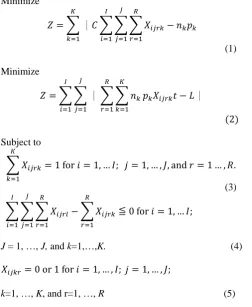
The mathematical model for the SAP in a pick-and-pass warehouse system with multi-objective can be described as follow:
Minimize
(1)
Minimize
(2)
Subject to
(3)
J = 1, …, J, and k=1,…,K. (4)
k=1, …, K, and r=1, …, R (5) Object function (1) described the absolute difference between storage spaces for an SKU in the system and expected picking demand. To decrease replenishment, the storage space for an SKU should close the expected picking demand. The object function (2) depicts the summation of absolute deviations of workloads of all pickers, since the imbalance of workload in each picking zone would cause serious delay on order throughput time (Pan & Wu, 2009), thus, to allocate SKUs fairly in each picking zone is another object in this paper. In Eq. (5) =1, means SKU k is assigned to rack r of zone j in picking line i; and 0, otherwise. Eq. (3) makes sure one rack only store one kind SKU. Eq. (4) ensures an SKU won’t be assigned to multiple picking zones in the system.
Since the SAP mathematical model of pick and pass system is a classical SAP which has been proven an NP-HARD problem (Abdel-Hamid & Borndorfer, 1994; Frazelle & Sharp, 1989), we design a heuristic multi-objective genetic algorithm to approximate the optimal solution.
II. THE MULTI-OBJECTIVE GENETIC ALGORITHM ON ORDER PICKING SYSTEM
A. The Storage Space Allocation
The space that an SKU needs should be determined before the decision of location assignment start, because the stock number may affect the needs of storage space directly. To decrease the replenishment operations happening, the numbers of all SKUs needs must approach the expected picking demand. And the difference can be defined as follow:
for k =1,2,…,K. (6)
Where = represent the total
storage space an SKU need in the system.
B. Multi-Objective Genetic Algorithm
This study aims to [balance the workload of each production line] and [reduce the number of replenishment times] in pick and pass warehouse system, instead of single optimal solution. Thus, we present a multi-objective genetic algorithm for searching as many Pareto-optimal solutions as possible. The step of algorithm flow is shown in Fig. 1. Encoding
Fitness function
Fitness function is used to evaluate the fit of each chromosome to the solution, and to calculate the f by bringing the chromosome into it, the higher value of would have better performance of the chromosome. To match the multi-objective decision, the fitness function is represented as follow:
(7)
Fig.1. Step of the provided Multi-objective algorithm
Fig.2. Chromosome for MOGA
w1 and w2 are the random weights, since constant weights may cause the direction in genetic algorithm fixed, random weights utilize various search directions to find Pareto optimal solutions (Murata & Ishibuchi, 1995).
is to
balance the workload between picking lines. Second part
is to measure the stock in forward area of a certain SKU close to the estimate picking demand.
Selection
for each chromosome is calculated by fitness function, and will affect the selection probability of selection. The selection probability can be defined as follow:
(8)
Crossover
Chromosomes between generations have a certain ratio of crossover. Select genes from parent chromosomes and generates a new offspring. A two-point crossover operation is to randomly select two genes from the parent chromosomes to exchange with the corresponding gene on the other chromosome and generate two new offspring chromosomes.
Mutation
Mutation is another important operation in the MOGA, which is to randomly select gene from the chromosome and replaced gene with a picking zone with surplus capacity. The mutation happens with a certain probability in generations.
Elite preserve strategy
The elite strategy can preserve the Pareto optimal solutions and replace chromosomes with them. Not only ensure the quality of chromosomes also keeps the variety of each generation.
Modify mechanism
All chromosomes need to be corrected to conform to the assumption, especially the initial solutions that are generated randomly and the solutions proposed by crossover and mutation operations. The step of modifying mechanism is defined as follow:
Step 0: Set picking zone z = 1.
Step 1: Check picking zone z overflow or not. If overflow happens, go to Step 2; otherwise, go to Step 6.
Step 2: Find the SKU b use the less space in zone z.
Step 3: Find zone a which use the less racks in picking line
j.
Step 4: Move SKU b to zone a, if overflow happens in zone a, go to Step 5; otherwise, go to Step 1.
Step 5: Move SKU b back to zone z, exchange SKU use the most space in zone a and zone z, then go to Step 2.
Step 6: If all picking been checked, over the modify mechanism; otherwise, z = z + 1 go to Step 2.
Termination criterion
The algorithm runs until it reaches a defined termination condition. When the maximum number of iterations criterion is met, then stop.
Step 1: Determined the storage space for all kind SKU by (6).
Step 2 : Set population(M),no. of generations(G),crossover rate ( ),mutation rate( ) , m = 1, g =0.
Step 3: Randomly generate chromosome m in generation g.
Step 4: Correct the chromosomes m in generation g by modify mechanism.
Step 5: If m = M, go to Step 6; otherwise, set m = m + 1 and go to Step 2.
Step 6: Compute fitness value using Eq. (7), ν = 1, 2…,
M.
Step 7: Update Pareto optimal solutions from generation g. Step 8: Select M chromosomes from generation g using Eq. (8) into next generation (g + 1).
Step 9: Select randomly M * chromosomes in generation (g+1) to crossover, correct the offspring and replace the parent chromosomes and correct.
Step 10: Randomly select M* in generation (g + 1) chromosomes to mutation operation and correct.
Step 11: Randomly select chromosomes in generation (g+1), and replace them with chromosome from tentative of Pareto optimal solutions.
Step 12: If g = T, stop the algorithm; otherwise, g = g + 1 and go to Step 6.
III. EXPERIMENTAL DESIGN
A. Description of Warehouse Configuration
The experiment assumes that there are three picking lines in the warehouse, and 10 picking zones on each picking line. Each zone has 60 storage racks, and the storage location can store 20 units of SKUs. Only one SKU can be located in one picking zone. A total of 200 kinds of SKUs are stored in the warehouse. The picking time is a unit time per item, and replenishment time for each SKU is fixed at five unit minutes.
The population size=30, generation =50.The detail value of experimental, as follow:
Total type of SKU=100 Picking line =2
Picking zone on each line =10
Distribution of SKU to be picked =U [5, 15] Population size=30
Crossover rate=0.6 Mutation rate=0.03 Generations=50
In order to determine the performance of the above method, we used the simulation system Flexsim to generate the picking simulation model. The model was run 50 times with 500 orders each time
B. Results
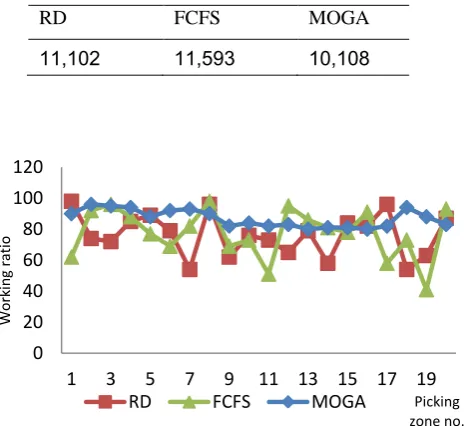
We compare the results of proposed method with random (RD) and first-come-first-served (FCFS) storage assignment methods. Random storage assignment policy is assigned SKUs to racks randomly, which is simple and widely accepted. First-come-first-served assignment policy allocates SKUs according to the time that SKUs storage in
the warehouse, earlier the SKU arrive, earlier the SKU assigned.Table.2 shows that MOGA spent the shortest completion time in three methods. The completion time includes replenishment time, item handling time and administration activities, so the shorter completion time means the performance improved. In Fig.3 the curve of MG is higher and smoother than others, which represents the picking operation of MG is more efficiency.
Table 2 Mean completion time (unit time) for 500 order in experience.
RD FCFS MOGA
11,102 11,593 10,108
Fig.3. Mean working ratio in each picking zone .
IV. CONCLUSION
Pick and pass warehouse system becomes popular and common nowadays with the rise of e-business. Workload balance between picking line and emergency replenishment could influence working efficiency a lot. To improve the efficiency of picking operation, this paper presents a random weight multi-objective genetic algorithm for storage assignment problem in order to find the approximation solution for NP-hard problem. The result of the numerical experiment shows that the throughput of our method is better than random assign policy and FCFS assign policy.
REFERENCES
[1] Abdel-Hamid, A. A. A., & Borndörfer, R. (1994). On the Complexity of Storage Assignment Problems.
[2] Bottani, E., Cecconi, M., Vignali, G., & Montanari, R. (2012). Optimisation of storage allocation in order picking operations through a genetic algorithm. International Journal of Logistics Research and Applications, 15(2), 127-146.
[3] Coyle, J.J., Bardi, E.J., and Langley, C.J., 1996. The management of business logistics. Minneapolis/St Paul: WestPublishing Company.
[4] Dallari, F., Marchet, G., & Melacini, M. (2009). Design of order picking system. The international journal of advanced manufacturing technology, 42(1-2), 1-12.
[5] Manufacturing Technology, 42 (1–2), 1–12.David Schaffer (1985)
[6] Frazele, E. A., & Sharp, G. P. (1989). Correlated assignment strategy can improve any order-picking operation. Industrial Engineering, 21(4), 33-37.
0 20 40 60 80 100 120
1 3 5 7 9 11 13 15 17 19
Wo
rk
ing
r
at
io
[image:4.595.309.545.186.399.2][7] Zou, X. K., Chan, C. M., Li, G., & Wang, Q. (2007). Multiobjective optimization for performance-based design of reinforced concrete frames. Journal of structural engineering, 133(10), 1462-1474.
[8] Yu, M., & De Koster, R. (2008). Performance approximation and design of pick-and-pass order picking systems. IIE Transactions, 40(11), 1054-1069.
[9] Muppani, V. R., & Adil, G. K. (2008). A branch and bound algorithm for class based storage location assignment. European Journal of Operational Research, 189(2), 492-507.. [10]Pan, J. C. H., & Wu, M. H. (2009). A study of storage
assignment problem for an order picking line in a pick-and-pass warehousing system. Computers & Industrial Engineering, 57(1), 261-268.
[11]Pan, J. C. H., Shih, P. H., Wu, M. H., & Lin, J. H. (2015). A storage assignment heuristic method based on genetic algorithm for a pick-and-pass warehousing system. Computers & Industrial Engineering, 81, 1-13.