© 2019, IRJET | Impact Factor value: 7.211 | ISO 9001:2008 Certified Journal
| Page 1571
Recycling Plastic Bottle Structure
Bhavin M. Patel
1, Dharmesh B. Patel
2, Harsh S. Gayakvad
3, Sanjay K. Makwana
4,
Prof. Mohit Sagar
51
Bhavin M. patel , at post: Chival ta: pardi Dist: Valsad, Gujarat, India
2Dharmesh B. Patel, at post : Ozar ta: Valsad Dist : Valsad, Gujarat, India
3Harsh S. Gayakvad , at post: panikhadak ta: khergam Dist : Navsari, Gujarat, India
4
Sanjay K. Makwana, at post : khijadiyari , ta: shankheswara Dist: Patan
5
Professor Mohit Sagar, Dept. civil Engineering, Sardar Patel College of Engineering, Gujarat, India
---***---Abstract – When the bottles are filled with soil or sand theywork as bricks and form a framework for walls or pillars in which plaster made of clay or a cement mixture fills the space between all bottles. This paper intends to investigate the application of plastic bottles as one of the urban wastage in buildings construction and that how it can lead to sustainable development. This paper also includes different factors such as time of execution, cost, load capacity, flexibility, reducing waste and energy efficiency; plastic bottles may be more effective compared to some conventional building materials such as brick and concrete block. Authors made effort towards waste plastic bottle used as construction material. Considering some limitation in properties of plastic bottles, authors tested bottle required properties, filler material.
Key Words: plastic bottle, soil , cement , nylon rope ,
water
1. INTRODUCTION
Population growth in today’s world, the need to the building has increased and to respond to this demand, the countries tend to use the industrial building materials and decline the use of indigenous and traditional materials. These factors in spite of increasing the energy consumption in the industry section; they can also raise the cost of homes and are considered as the barrier for users to obtain the basic needs of the life.
Plastic is one of the most disposable materials in the modern world. It makes up much of the street side litter in urban and rural areas. It is rapidly filling up landfills as choking water bodies. Plastic bottles make up approx. 11% of the content landfills, causing serious environmental consequences.
Due to the consequences some of the plastic facts are as follow:
More than 20000 plastic bottles are needed to obtain one tone of plastic.
It is estimated that 100 million tons of plastic are produced each year.
The average Indian throws away 36 kg of plastics each year.
Some plastic waste sacks are made from 64% recycled plastic.
Plastics packaging totals 42% of total consumption and every year little of this is recycled.
The objective of this project is to investigate the key and positive characteristics of this product and the benefits obtained by using it in building. It also intends to compare the characteristics of some construction materials such as brick, ceramic and concrete block with bottle
1.1 Objective
Design project which works on plastic bottle bricks
To evaluate the possibility of recycling waste PET bottles.
To test and compare the compressive strength of brick bottle with brick.
Easy to controlling
Easy to conveyance
System must be compact
cost should be low
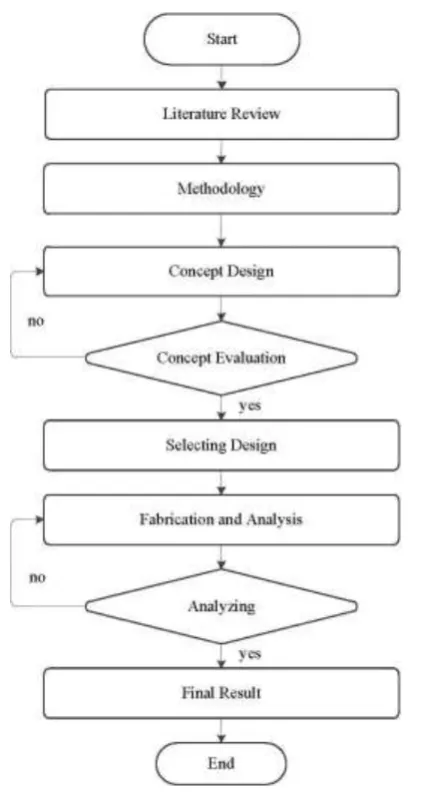
1.2 Methodology
© 2019, IRJET | Impact Factor value: 7.211 | ISO 9001:2008 Certified Journal
| Page 1572
1.3 Working principle
Construction of the wall is easy and normal process. The walls can be filled with almost anything (waste, sand, etc.) and then plastered overtop. By collecting plastic bottles and plastic waste to be used as a wall infill improves the surrounding environment and provides inexpensive building materials. Placing bottles right side up within a frame is known as a vertical bottle wall, while lying the bottles on their side is considered a bottle wall.
1. Build structural frame 2. Collect and fill bottles 3. Align bottles in wall cavity
4. Overlay frame with steel wires or mesh to hold bottles together for better structural
[image:2.595.58.271.94.492.2]5. Stuff loose plastic around bottle gaps 6. Plaster wall for clean finish
Fig 1: over view
2. Project Material
This construction require some of the basic materials which ensures a stable, eco friendly structure and also results in cheap construction as compared to brick wall. Materials uses for Bottle wall masonry construction are:
Soil
Plastic bottles Cement Nylon rope Water
2.1 Strength and cost calculations
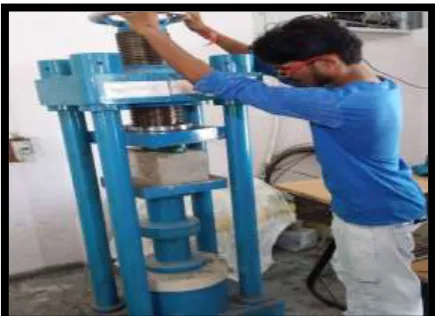
Compressive strength is that test for each bottle was determined on universal testing machine and the average value is considered for analysis. Weight of empty polyethylene terephthalate bottles and completely filled of polyethylene terephthalate bottles were noted and amount of soil used was calculated for the same.
Fig 2: Weighing Balance to weight pet bottle before testing
[image:2.595.308.559.551.704.2]© 2019, IRJET | Impact Factor value: 7.211 | ISO 9001:2008 Certified Journal
| Page 1573
[image:3.595.36.290.156.349.2]Data obtained as per universal testing machine is tabulated in table.
Table 1 Experiment testing Data
Load Area Compressive Average
(Kg) (mm 2) Strength
(MPa)
13000 14202.5 8.98
13000 14205 8.977
13001 14201.9 8.98
13000 14201.6 8.97 8.99
13002 14202.5 9.11
13011 14202.1 8.98
13005 14201.9 8.98
13023 14202.8 8.98
Sample Calculation of first reading: Load in kg = 13000 kg
Load in N. = 13000×9.81 = 127530 N Area = 14202.5 mm2
Compressive strength of bottle =127530/14202.5 = 8.98Mpa ( brick is having strength 10 Mpa) Similarly all calculations were done.
Summary from Compressive test:
Weight of a unit bottle brick was found to be less than that of a standard brick. Compressive strength of the bottle brick is also nearly equal than that of a standard brick. Thus we can conclude that using the concept of brick bottles is cost effective, energy efficient and commercially feasible.
Fig 3: Test applied on a waste PET bottles filled with soil and sealed tightly
2.2Comparison between the walls by Plastic Bottles wall
and Brick Wall
For construction Time and speed of Execution for 5 persons team-one working day for plastic wall is 15% faster and for brick wall 120 m2. Material and equipment cost for plastic bottle wall is less as compared to brick wall. Transportation cost for plastic bottle wall construction is less than brick wall. Plastic bottle wall construction require less manpower as compare to brick wall and require high cost. Strength and load capacity for plastic bottle wall construction is 20 times more than brick wall construction.
1. Time and speed of execution works done by five person team per day plastic bottle wall 15% faster compare to brick wall.
2. Material and equipment cost the plastic bottle wall saving in cement, water, grinder and fitting compare to brick wall more weight and more material use
3. Transportation cost on plastic bottle wall lighter and higher volume, easy and cheap displacement compare to brick wall grater weight and less volume, hard and costly displacement.
4. Strength and load capacity of plastic bottle 20 time more than brick wall.
5. Cleanness and beauty of work plastic bottle wall very clean execution no construction waste compare to brick wall high volume construction waste.
6. In plastic bottle wall high flexibility compare to brick wall.
7. Exaction cost plastic bottle wall less manpower use compare to brick wall.
8. Material wastage in plastic bottle wall less compare to brick wall.
3. Cost comparison between brick masonry wall and bottle masonry wall
[image:3.595.51.269.561.719.2]© 2019, IRJET | Impact Factor value: 7.211 | ISO 9001:2008 Certified Journal
| Page 1574
3.1.1 Brick Masonry wall Number of bricks
Actual size of brick =19 cm x9 cm x 9cm
Normal size of brick (with mortar joint) = 20 cm x10 cm x 10 cm
Volume of brick masonry = Area x thickness of wall
= 10 x 0.23
=2.3
No. of Brick = Volume of brick mason / Volume of 1 brick with mortar
No. of Brick = 2.3 / (0.2 X 0.1 X 0.1) No. of Brick = 1150 Nos
Mortar
Actual volume of bricks in brick masonry = 1150 × (0.19×0.19×0.19) = 1.76m3
Volume of wet mortar = 2.3 - 1.76 = 0.531m3
For frog filling, cut bricks, for bonding, wastage etc increase this quantity by 15%.
Volume of wet mortar = 1.15 × 0.531 = 0.610m3
Volume of dry mortar reduces by 25% when water is added
Volume of dry mortar =1.25×0.610 = 0.763m3
Material for 1:3 brick work
Quantity of brick = 2.3m3 Proportion 1:3
Volume of dry mortar = 0.763m3 1:3 = 4
C: S
Cement = (1/4) × 0.763 = 0.190m3
No. of bags = 0.190 / 0.035
= 6 bags
For 1 bag of cement
Weight = 50kg
Volume = 0.035m3
Sand = (3/4) ×0.763 = 0.237m3
Table 2 : Cost Estimation of Brick Wall Masonry
3.2.2 Plastic Bottle Masonry wall
Number of bottle
Actual size of bottle = 24cm x 8 cm ϕ Normal size of bottle (with mortar joint) = 24 cm x9 cm ϕ
Volume of bottle masonry = Area x thickness of wall = 10 ×0.24 =2.4m3
No. of Bottle = Vol. of bottle masonry / Vol. of 1 bottle with mortar joint
=2.4 / {0 .24×(π/4×0.092)}
=1572
Mortar
Actual volume of bricks in brick masonry = 1150 × (0.19×0.19×0.19)
= 1.76m3 Volume of wet mortar = 2.3 -1.76
= 0.531m3
Sr.
No Material Quantity Rate Per Amount(rs.)
1 Brick 1150 nos. 5 1 no. 5750
2 Cement 6 250 1 bag 1500
3
4
Sand
Labour Work
0.237
4
250
300
1 m3
1 person
59.25
1200
© 2019, IRJET | Impact Factor value: 7.211 | ISO 9001:2008 Certified Journal
| Page 1575
For frog filling, cut bricks, for bonding, wastage etc increase this quantity by 15%
Volume of wet mortar = 1.15 × 0.531 = 0.610m3
Volume of dry mortar reduces by 25% when water is added Volume of dry mortar = 1.25 × 0.610
= 0.763m3
Material for 1:3 brick work
Quantity of brick = 2.3m3 Proportion 1:3
Volume of dry mortar = 0.763m3 1:3 = 4
C:S
Cement = (1/4) × 0.763 = 0.190 m3
For 1 bag of cement Weight = 50kg Volume = 0.035m3
No of cement bag required = 0.190 / 0.035 = 5.45 bags
Sand = (3/4) ×0.763 = 0.237m3
Here, consider 1000 ml bottle
Soil= 1990×0.0001=1.99m3
No. of Labour
One labour can made 400 bottles per day (filling soil in bottles).
Total no. of bottles = 1572
[image:5.595.301.569.109.418.2]Numbers of labour needed = (1572/400) = 4 nos.
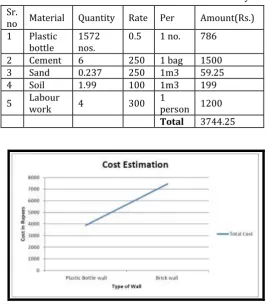
Table 3: Cost Estimation of Plastic Bottle Wall Masonry Sr.
no Material Quantity Rate Per Amount(Rs.) 1 Plastic
bottle 1572 nos. 0.5 1 no. 786 2 Cement 6 250 1 bag 1500 3 Sand 0.237 250 1m3 59.25 4 Soil 1.99 100 1m3 199 5 Labour work 4 300 1 person 1200
Total 3744.25
4. CONCLUSIONS
1. Use of innovative materials with sustainable application such as plastic bottles can have considerable benefits including finding the best optimization in energy consumption of the region, reducing environmental degradation.
2. Generally the bottle houses are bio-climatic in design, which means that when it is cold outside is warm inside and vice versa.
3. Re-using the plastic bottles as the building materials can have substantial effects on saving the building embodied energy by using them instead of bricks in walls and reducing the CO2 emission in manufacturing the cement by reducing the percentage of cement used.
4. Plastic bottles can cause the green construction by saving energy and resources, recycling materials, minimizing the emission, having significant operational savings and increasing work place productivity.
© 2019, IRJET | Impact Factor value: 7.211 | ISO 9001:2008 Certified Journal
| Page 1576
REFERENCES
1. Robbot bezo: "Making plastic bottle house in nigeria” 2015 year www.gujaratsamachar.com
2. Dr .Pratima.A.Patel, Akash Shah, Henish Patel: “Platic Bottles Offering Innovative Building Materials with Suistainable Application" Professor,CED,SCET,Surat,Gujarat www.wastebottleconstruction.com
3. www.samarpanfoundation.org
4. Mr.stephen messenger “Design /Sustsinable product design”April 2010.Taiwan, China.