Retrieval via Probability-based Semantics-Preserving Hashing. IEEE Transactions on
Cybernetics. ISSN 2168-2267 (In Press)
Published by: IEEE
URL:
http://dx.doi.org/10.1109/TCYB.2016.2608906
<http://dx.doi.org/10.1109/TCYB.2016.2608906>
This version was downloaded from Northumbria Research Link:
http://nrl.northumbria.ac.uk/28089/
Northumbria University has developed Northumbria Research Link (NRL) to enable users to
access the University’s research output. Copyright
©and moral rights for items on NRL are
retained by the individual author(s) and/or other copyright owners. Single copies of full items
can be reproduced, displayed or performed, and given to third parties in any format or
medium for personal research or study, educational, or not-for-profit purposes without prior
permission or charge, provided the authors, title and full bibliographic details are given, as
well as a hyperlink and/or URL to the original metadata page. The content must not be
changed in any way. Full items must not be sold commercially in any format or medium
without formal permission of the copyright holder. The full policy is available online:
http://nrl.northumbria.ac.uk/policies.html
Cross-view Retrieval via Probability-based
Semantics-Preserving Hashing
Zijia Lin, Student Member, IEEE, Guiguang Ding, Member, IEEE, Jungong Han, Jianmin Wang
Abstract—For efficiently retrieving nearest neighbours from large-scale multi-view data, recently hashing methods are widely investigated, which can substantially improve query speeds. In this paper, we propose an effective probability-based Semantics-Preserving Hashing method to tackle the problem of cross-view retrieval, termed SePH. Considering the semantic consistency between views, SePH generates one unified hash code for all observed views of any instance. For training, SePH firstly transforms the given semantic affinities of training data into a probability distribution, and aims to approximate it with another one in Hamming space, via minimizing their Kullback-Leibler divergence. Specifically, the latter probability distribution is derived from all pair-wise Hamming distances between to-be-learnt hash codes of the training data. Then with learnt hash codes, any kind of predictive models like linear ridge regression, logistic regression or kernel logistic regression, can be learnt as hash functions in each view for projecting the corresponding view-specific features into hash codes. As for out-of-sample extension, given any unseen instance, the learnt hash functions in its observed views can predict view-specific hash codes. Then by deriving or estimating the corresponding output probabilities w.r.t the predicted view-specific hash codes, a novel probabilistic approach is further proposed to utilize them for determining a unified hash code. To evaluate the proposed SePH, we conduct extensive experiments on diverse benchmark datasets, and the experimental results demonstrate that SePH is reasonable and effective.
Index Terms—Semantics-Preserving Hashing, SePH, Cross-view retrieval, Approximate nearest neighbour retrieval
I. INTRODUCTION
F
OR numerous algorithms in the fields of cybernetics,computer vision and machine learning, etc., retrieving nearest neighbours for an instance plays a fundamental role, as also revealed in [1] and [2]. However, with the explosion of data in recent years, efficient nearest neighbour retrieval from large-scale and rapidly-increasing databases becomes quite challenging. For tackling that, various tree-based indexing methods [3]–[6] and hashing methods [1], [2], [7]–[39] are proposed to perform exact or approximate nearest neighbour (ANN) retrieval with much higher speeds. As tree-based indexing methods can suffer from the so-called “curse of dimensionality” for high-dimensional data, recently hashing methods are becoming preferred and widely researched for
Zijia Lin is with Department of Computer Science and Technology, Tsinghua University, Beijing 100084, China (e-mail:
Guiguang Ding and Jianmin Wang are with School of Software, Tsinghua University, Beijing 100084, China (e-mail: {dinggg, jimwang}@tsinghua.edu.cn). Guiguang Ding is the corresponding author.
Jungong Han is with Civolution Technology, Eindhoven 5656AE, The Netherlands (e-mail:[email protected]).
handling such data. Generally, for hashing methods, by gener-ating ak-bit binary (i.e. 0or1) hash code for each instance, we can store the data compactly in hardware bits. Meanwhile, to perform ANN retrieval, the Hamming distances between the query hash code and those in the retrieval set can be efficiently calculated using fast bit-wise XOR and bit-count
operations1 with a sub-linear time complexity. And with all
Hamming distances calculated, generally only the small ones are kept and then ranked in an ascending order to select instances with smallest Hamming distances as the approximate nearest neighbours. Therefore, if the binary hash codes can well preserve the affinities between instances, hashing methods can perform ANN retrieval with much lower storage costs and higher query speeds [18], while the quality loss of the retrieved neighbours would be acceptable.
Generally speaking, we can roughly classify existing hash-ing methods into shash-ingle-view hashhash-ing [1], [2], [7]–[19] and multi-view hashing [20]–[39]. The former focuses on data with a single view, while the latter focuses on that with multiple views, like an object with pictures from different cameras or a news report with texts and images. Our work in this paper is about cross-view retrieval for multi-view data. Specifically, cross-view retrieval can utilize just one view of a query to retrieval its nearest neighbours in other different views, like using a query picture from one camera to retrieve relevant ones from other cameras, or using a textual query to retrieve semantically relevant images. Since cross-view retrieval can be utilized in many applications, it is becoming more and more popular, as also revealed in [35].
In recent years, researchers have proposed many effective hashing methods for cross-view retrieval, ranging from un-supervised ones [20]–[25] to supervised ones [26]–[39]. The former ones generally utilize only the features of training data in different views to exploit intra-view and inter-view correlations for learning hash functions, which project features into binary hash codes. Meanwhile, the latter ones can further exploit other available supervised information like semantic affinities of training data, to better learn the projections and yield superior performance. Actually, for supervised ones, well preserving the semantic affinities between instances is the key to reducing the quality loss of retrieved nearest neighbours, which is also the focus of our research.
In this paper, we propose a probability-based
Semantics-Preserving Hashing method for cross-view retrieval, termed
SePH. The proposed SePH belongs to supervised hashing.
1Both bit-wise XOR and bit-count operations are generally supported or
(a) Previous Work (b) Proposed SePH
Fig. 1. Illustration of the differences between previous work (left) and the proposed SePH (right). Hereoi(i= 1,2, . . . ,6)are to-be-learnt hash codes, blue solid edges between them denote their pairwise distances (similarities), and red dotted lines between edges denote the correlations between distances (similarities). Note that for clarity, some edges/lines are omitted.
Moreover, considering the semantic consistency between served views, SePH generates one unified hash code for all ob-served views of any instance, like [23] and [24]. For training, SePH firstly transforms the given semantic affinities of training instances into a probability distributionPand aims to approx-imate it in Hamming space. Specifically, SePH transforms all pairwise Hamming distances between to-be-learnt hash codes of the training instances into another probability distribution
Q, and then minimizes its Kullback-Leibler divergence
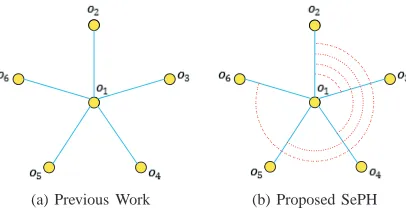
(KL-divergence) from P. In previous work [27], [34], [35], the supervised information, i.e. the semantic affinities of training instances, is generally utilized to independently weight each pairwise distance (similarity) between hash codes. Differently, SePH standardizes all pairwise Hamming distances into a global probability distribution by transforming each into a probability and thus makes them dependent on each others. In that way, apart from weighting pair-wise distances (similari-ties) between hash codes as previous work, SePH can further incorporate the correlations between distances (similarities) to force the to-be-learnt hash codes of training instances to better preserve the semantic affinities, as illustrated in Fig.
1, which shows the differences between previous work and
SePH in a vivid way. After learning the hash codes of training instances, SePH further learns hash functions independently in each view for projecting the corresponding features into binary hash codes, which can be open for any kind of effective predictive models. Specifically, in this paper, we respectively utilize linear ridge regression, logistic regression and kernel logistic regression as hash functions. As for out-of-sample extension, given an unseen instance, the learnt hash functions in each of its observed views can predict view-specific hash codes. Then by deriving or estimating the corresponding out-put probabilities w.r.t the predicted view-specific hash codes, a novel probabilistic approach is further proposed to utilize them for determining a unified hash code. Similar to [9], here SePH employs a two-step hashing framework. The reason why SePH adopts a two-step framework is two-fold. First and most important, utilizing a two-step framework can make SePH more flexible and enable it to use any kind of effective predictive models as hash functions. Second, utilizing a two-step framework can simplify the optimization process, since directly learning hash functions in a one-step manner can
probably make the objective function quite complex and even unable to be optimized. The reasonableness and effectiveness of SePH is well demonstrated by comprehensive experiments on diverse benchmark datasets.
We summarize the contributions of this paper as follows.
• We propose a probability-based Semantics-Preserving
Hashing method for cross-view retrieval, which
approx-imates a probability distribution derived from given se-mantic affinities of training data with another one derived from the to-be-learnt hash codes in Hamming space via minimizing their KL-divergence.
• We propose a novel probabilistic approach to determine a
unified hash code for any given unseen instance, utilizing its predicted view-specific hash codes from different ob-served views and the corresponding derived or estimated output probabilities.
This paper is based on our previous work presented in [40], but it substantially extends that work. Specifically, apart from non-linear kernel logistic regression, here we also utilize linear ridge regression and logistic regression as hash functions, so as to show that the learning of hash functions in SePH can be open for different predictive models. Actually, the experiments with linear ridge regression and logistic regression also well demonstrate the effectiveness of SePH. Particularly, for hash functions like linear ridge regression that cannot naturally provide output probabilities with the predicted view-specific hash codes, here we further propose an effective and general method to estimate the output probabilities, which are required for determining unified hash codes. Moreover, experiments are conducted on all benchmark datasets to validate the effective-ness of the proposed probabilistic approach for determining the unified hash code of an unseen instance. We also analyse the convergence of the optimization process for SePH with experiments, and report its off-line training costs and on-line hashing costs on all datasets. Additionally, more details of the experimental results, like standard errors, are also presented here. Detailed derivations for the gradient of the objective function of SePH are also provided in the supplementary material due to the limited space.
We organize the remainder of this paper as follows. Section
II gives an overview of previous researches on cross-view
hashing. Section IIIpresents formula details of the proposed
SePH, including off-line training and on-line hashing. Then
experiments are described in Section IV, including settings,
results and analyses. And finally we come to conclusions in SectionV.
II. RELATEDWORK
As mentioned previously, researchers have proposed many effective unsupervised and supervised cross-view hashing methods in recent years.
Unsupervised cross-view hashing methods [20]–[25]
gen-erally utilize only the features of training data in different views to exploit intra-view and inter-view correlations for learning hash functions to project features into binary hash
[image:3.612.74.277.65.169.2]which learns linear hash functions with intra-view and inter-view consistencies to map inter-view-specific features into a
com-mon Hamming space. Zhen et al. [22] proposed Spectral
Multimodal Hashing (SMH) based on spectral analysis of the correlation matrix of different views and developed an efficient algorithm to learn parameters from the data distribution so
as to obtain binary hash codes. Ding et al. [23] proposed
Collective Matrix Factorization Hashing (CMFH) that per-forms collective matrix factorization in different views with latent factor model to learn unified hash codes for training
instances. Zhou et al. [24] proposed Latent Semantic Sparse
Hashing (LSSH), which respectively utilizes sparse coding for images and matrix factorization for texts to learn their latent semantic features and eventually maps the learnt features to a joint abstraction space to generate unified hash codes. Xie
et al. [25] proposed Online Cross-modal Hashing (OCMH), which performs efficient updating of hash codes and analysis of cross-modal correlations for online hashing by learning shared latent codes.
Differently, supervised cross-view hashing methods [26]–
[39] can further exploit available supervised information like semantic labels or semantic affinities of training data for
gain-ing further performance improvements. Bronstein et al. [26]
proposed CMSSH that models the projections from features in each view to hash codes as binary classification problems with positive and negative examples, and utilizes boosting methods
to efficiently learn them. Kumar and Udupa [27] proposed
a principled cross-view hashing method termed CVH, which
is an extension of the single-view spectral hashing [8] in
multi-view cases. Specifically, CVH learns hash functions to map semantically similar instances to similar hash codes across different views, via minimizing the similarity-weighted pairwise Hamming distances between the hash codes of
train-ing instances. Zhen and Yeung [28] proposed Co-Regularized
Hashing (CRH) to learn hash functions for multi-view data based on a boosted co-regularization framework. In CRH, hash functions for each bit of the hash codes are learnt by solving DC (difference of convex functions) programs, while the learn-ing for multiple bits is performed via a boostlearn-ing procedure.
Yu et al. [32] proposed Discriminative Coupled Dictionary
Hashing (DCDH). Specifically, DCDH firstly learns a coupled dictionary for each view with side information like category labels to represent data from different views as the sparse codes in a shared dictionary space, and then learns unified hash functions for mapping them into binary hash codes.
Zhou et al. [34] proposed a spectral-based hashing method
termed KSH-CV, which removes the orthogonality constraints on hash code bits and learns kernel hash functions under an Adaboost framework to preserve inter-view similarities.
Zhang and Li [35] proposed SCM to take semantic labels
into consideration for the hash learning procedure for large-scale datasets via maximizing semantic correlations. SCM can learn orthogonal hash functions via eigenvalue decomposition (SCM-Orth) or non-orthogonal ones via sequential learning
(SCM-Seq). Moreover, Jiang and Li [37] integrated feature
learning and hash-code learning into an end-to-end learning framework with deep neural networks (one for each view) for cross-view hashing.
After reviewing the previous cross-view hashing methods, especially the supervised ones, we realize that well preserving the semantic affinities between instances is the key to reducing the quality loss of retrieved neighbours and achieving better performance. Generally, in supervised cases, given semantic affinities of training data, previous methods like [27], [34], [35] utilize them to independently weight each pairwise dis-tance (similarity) between to-be-learnt hash codes. Differently, in this paper the proposed SePH further incorporates the correlations between pairwise Hamming distances to force the to-be-learnt hash codes to better preserve the semantic affinities. As will be demonstrated by our experiments, SePH is reasonable and yields superior performance.
III. PROPOSEDSEPH
Fig.2illustrates the framework of the proposed SePH. Like [23] and [24], considering the semantic consistency between views, SePH generates one unified hash code for each instance, rather than respectively generate one different hash code for each observed view as other previous researches [26], [27],
[34], [35]. That also allows SePH to store data with less
space costs. As shown in Fig. 2, for hash learning SePH
requires the view-specific features of training instances in each view and an affinity matrix indicating their semantic affinities. Specifically, SePH firstly transforms the given affinity matrix into a probability distributionP in semantic space, and learns the semantics-preserving hash codes of training instances via utilizing their Hamming distances for deriving another
probability distributionQ in Hamming space to approximate
P (red dotted rectangle). Then with learnt hash codes and
view-specific features of training instances, SePH learns hash functions in each view independently for projecting features into hash codes (green dotted rectangle). As for out-of-sample extension, given any unseen instance, learnt hash functions in observed views firstly predict view-specific hash codes. Then by deriving or estimating the corresponding output probabilities w.r.t the predicted view-specific hash codes, SePH utilizes a novel probabilistic approach to merge them and determine a unified hash code (blue dotted rectangle). For ease of presentation, here we firstly describe SePH in the case with only two views, and then extend it to cases with more views.
A. Problem Formulation
Suppose that the training data is made up of n training
instances, denoted asO={o1, o2, . . . , on} withoi being the
ith one, and we can observe two views, i.e.X andY, of the
training instances. Moreover, SePH requires the view-specific feature matricesX ∈Rn×dx andY ∈Rn×dy of the training
data, which are respectively built with the dx-dimensional
feature vectors in X and the dy-dimensional feature vectors
in Y row by row. Specifically, the ith row of X, denoted
as Xi,· ∈ Rdx, is the feature vector of oi in the view X,
and likewise theith row inY, denoted as Yi,· ∈Rdy, is the
feature vector ofoi in the viewY. The affinity matrix of the
training data, denoted asA∈Rn×n, is also required by SePH
to provide supervised information. Here A is supposed to be
F(X) à H
Hash Functions for X
G(Y)àH
Hash Functions for Y
Functions
Ha X
Predicted Hash Code with Output Probabilities from X
1 0 1 0.6 0.510.76
1 1 1 0.710.820.58
Predicted Hash Code with Output Probabilities from X
1 0 1
0.6 0.510.76
1 1 1
0.710.820.58
Predicted Hash Code with Output Probabilities from Y Training of SePH: 1) Learning semantics-preserving hash codes of the training data (red dotted rectangle), via
approximating the probability distribution in semantic space ( P ) with that in Hamming space ( Q ) , 2) Learning hash functions for each view (green dotted rectangle)
Out-of-sample Extension: 1) Predicting hash codes from observed views, 2) Determining the unified hash code with a proposed probabilistic approach 1 0.75 0.65 0.98 0.1 0.61
0.75 0.65 0.98 0.10 0.61
1 0.28 0.72 0.35 0.31 0.28 1 0.7 0.34 0.29 0.72 0.7 1 0.07 0.78 0.35 0.34 0.07 1 0.26 0.31 0.29 0.78 0.26 1 Provided Affinity Matrix of
Training Data
1 0 1 1 0 1 0 1
0 0 0 1 0 1 1 0 1 1 Learnt Semantics-Preserving Hash
Codes of Training Data ( H )
1 1 1 Unified Hash Code
Merging Predicted View-specific Hash Codes
Un
View X of Training Data
View Y of Training Data
Y
Unseen Instance
d Affinity M
rainingDa
antics-Pres
Training D
Probability Distribution in Semantic Space ( P )
[image:5.612.50.299.343.522.2]Probability Distribution in Hamming Space ( Q )
Fig. 2. Framework of the proposed SePH, illustrated with two-view toy data. For training, SePH firstly learns semantics-preserving hash codes of the training data and then learns hash functions for each view. For out-of-sample extension, SePH firstly predicts view-specific hash codes and derive or estimate their corresponding output probabilities, and then merges them into a unified one.
TABLE I
IMPORTANTSYMBOLS INSEPH.
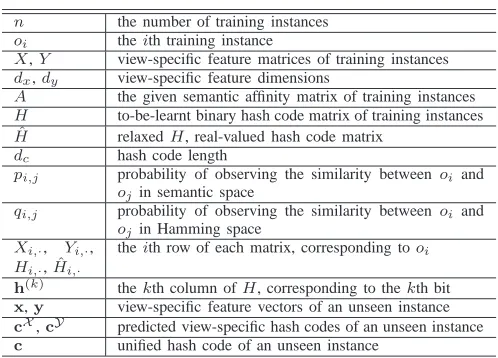
n the number of training instances
oi theith training instance
X,Y view-specific feature matrices of training instances
dx,dy view-specific feature dimensions
A the given semantic affinity matrix of training instances
H to-be-learnt binary hash code matrix of training instances
ˆ
H relaxedH, real-valued hash code matrix
dc hash code length
pi,j probability of observing the similarity between oi and
ojin semantic space
qi,j probability of observing the similarity between oi and
ojin Hamming space
Xi,·, Yi,·, Hi,·,Hˆi,·
theith row of each matrix, corresponding tooi
h(k) thekth column ofH, corresponding to thekth bit
x,y view-specific feature vectors of an unseen instance
cX,cY predicted view-specific hash codes of an unseen instance c unified hash code of an unseen instance
indicates the semantic affinity between oi andoj. Generally,
we can derive A from manual scoring, or estimate it from
correlations between semantic labels of the training instances,
like cosine similarities. With A, semantics-preserving hash
codes of the training instances can be learnt by SePH, which
form a hash code matrix H ∈ {−1,1}n×dc row by row.
Specifically, the ith row in H, denoted as Hi,·∈ {−1,1}dc,
is the dc-bit hash code ofoi. Note that for model simplicity,
here we utilize {−1,1} to represent binary hash codes, and they can be directly mapped into {0,1}. TableI summarizes the important symbols in this paper, which will be frequently used in the later description of SePH.
B. Semantics-Preserving Hashing
For preserving semantic affinities, if oi and oj are
se-mantically similar, their corresponding hash codes should
also be similar, and vice versa. As mentioned before, unlike previous related researches that utilize the given semantic affinities for independently weighting each pairwise distance (similarity) between hash codes, SePH can further incorporate the correlations between distances (similarities) to make the semantic affinities of training instances be better preserved by their to-be-learnt hash codes. Specifically, as illustrated in Fig. 2, in SePH the given semantic affinities are firstly transformed into a probability distributionP, and then another probability
distribution Q is derived from all the pairwise Hamming
distances between to-be-learnt hash codes to approximate P
in Hamming space. In that way, by transforming each pairwise Hamming distance into a probability, SePH standardizes them and makes them dependent on each other, and thus correlations between Hamming distances are incorporated.
To derive the probability distributionP in semantic space, we definepi,jas the probability of observing the semantic
sim-ilarity betweenoiandoj among all pairs of training instances.
Assuming thatpi,j is proportional toAi,j, i.e. the
correspond-ing semantic affinity, we can derive pi,j as the following
formula, which guarantees thatPn
i=1
Pn
j=1,j6=ipi,j= 1.
pi,j =
Ai,j
Pn i=1
Pn
j=1,j6=iAi,j
(1)
To derive the probability distributionQin Hamming space,
we define qi,j as the probability of observing the similarity
between oi and oj in Hamming space. Following t-SNE
[41], a Student t-distribution with one degree of freedom is utilized for transforming each pairwise Hamming distance into a probability, as formulated as follows.
qi,j =
(1 +h(Hi,·, Hj,·))−1 Pn
k=1
Pn
m=1,m6=k(1 +h(Hk,·, Hm,·))−1
(2)
whereh(·,·)denotes the Hamming distance between two hash codes. Considering that∀1≤i≤n, Hi,·∈ {−1,1}dc, for any
from their corresponding squared Euclidean distance, as shown in formula (3).
h(Hi,·, Hj,·) =
1
4kHi,·−Hj,·k
2
2 (3)
By substituting formula (3) into formula (2), we can rewrite qi,j as follows to make it more tractable for optimization.
qi,j=
(1 +1
4kHi,·−Hj,·k 2 2)−1
Pn k=1
Pn
m=1,m6=k(1 +
1
4kHk,·−Hm,·k22)−1
(4)
As mentioned previously, SePH aims to learn an optimal
binary H that can enable Q to well approximate P, so as
to preserve the semantic affinities modelled by P. Here we
take the Kullback-Leibler divergence to measure the difference
between QandP, as defined as follows.
DKL(PkQ) =
n X
i=1
n X
j=1,j6=i
pi,jlog
pi,j
qi,j
(5)
Then by minimizingDKL(PkQ), SePH can learn the optimal
binary hash code matrixH of the training data. And thus the
objective function of SePH is formulated as follows.
Ψ0= min
H∈{−1,1}n×dc
n X
i=1
n X
j=1,j6=i
pi,jlog
pi,j
qi,j
(6)
where pi,j is defined as formula (1) and qi,j as formula (4).
The objective function above, however, is NP-hard for directly deriving the optimal binaryH. To make it more tractable, like
previous work, here H is relaxed to be a real-valued matrix
ˆ
H. Moreover, as shown in the following formula, to make the
learnt Hˆ near to the optimal binaryH, we further introduce
a quantization loss term in the objective function to lead the entries ofHˆ to be near to−1or1.
Ψ = min
ˆ
H∈Rn×dc
n X
i=1
n X
j=1,j6=i
pi,jlog
pi,j
qi,j
+ α
Ck|Hˆ| −Ik
2 2
s.t. qi,j =
(1 +1
4kHˆi,·−Hˆj,·k 2 2)−1
Pn k=1
Pn
m=1,m6=k(1 +
1
4kHˆk,·−Hˆm,·k 2 2)−1
(7)
whereIis a matrix with each entry being 1, andk|Hˆ| −Ik2 2
measures the quantization loss from real-valued Hˆ to binary
H. Additionally, α is a model parameter for weighting the
quantization loss term, andC=n×dc is a normalizing factor
to make the parameter tuning for αless affected by the hash
code length and the training set size.
C. Solution and Implementation Issues
The objective function Ψ of SePH is an unconstrained
non-convex optimization problem. Actually, its non-convexity comes from both the KL-divergence term and the quantization
loss term. And thus for optimizing Ψ, we can only derive
a locally optimal H. Compared to other hashing methodsˆ
that utilize a convex objective function, it may seem to be a weakness of the proposed SePH. However, as our experiments will demonstrate, the performance of SePH is fortunately not sensitive to the local optimality of its objective function. For
optimizingH, various effective gradient descent methods canˆ be utilized. Specifically, for theith row ofH, i.e.ˆ Hˆi,·, we can
derive its corresponding gradient as follows.
∂Ψ
∂Hˆi,·
=
n
X
j=1,j6=i
(pi,j−qi,j)(1 +
1
4kHˆi,·−Hˆj,·k
2 2)
−1( ˆH
i,·−Hˆj,·)
+2α
C (|Hˆi,·| −1
T
)⊙σ( ˆHi,·)
(8)
where 1 is a dc-dimensional column vector with each entry
being 1,⊙denotes entry-wise multiplication between vectors,
and σ( ˆHi,·) is a dc-dimensional row vector made up of the
signs of entries in Hˆi,·. Actually, here σ( ˆHi,·) = ∂|
ˆ
Hi,·|
∂Hˆi,·
, and the gradients w.r.t non-differentiable zero entries are simply set as0. For detailed derivations, one can refer to the supplementary material.
By calculating ∂Ψ
∂Hˆi,·
for all 1 ≤i ≤n, effective gradient
descent methods can be applied to derive an optimal Hˆ.
Then by getting the signs of entries in H, we can derive anˆ
optimized binary hash code matrixH, i.e.H =sign( ˆH), with the signs of zero entries in Hˆ set as 1. For gradient descent methods, the time complexity of deriving H is O(T n2dc),
whereT is the number of needed iterations.
D. Learning Hash Functions
With the learnt hash codes of training instances, i.e. H,
SePH will independently learn hash functions for each view to perform out-of-sample extension. Actually, for SePH, any effective predictive models can be utilized as hash functions. Hence linear ridge regression, support vector machine (SVM) or its variants like bagging-based SVM [42], logistic regres-sion, kernel logistic regresregres-sion, and many other models can be utilized.
In this paper, we respectively utilize linear ridge regression, logistic regression and kernel logistic regression, to learn the projections from features to hash codes for each view. Linear ridge regression is widely-used in many previous researches on hashing, while for logistic regression and kernel logistic regression, they are employed because both can naturally provide output probabilities w.r.t the predicted hashing results, which, as will be explained later, are required for determining the unified hash code of an unseen instance. Note that here hash functions are learnt independently in different views. And thus for ease of presentation, in the following, only the hash
function learning process in the view X is described, which
can be directly extended to other views.
Like [26] and [23], here we learn hash functions bit by bit. Actually, considering that bits in the hash codes may not be independent of each other in cases, more sophisticated learning methods that incorporate the correlations between bits can also be investigated to obtain performance improvements, which is left to our future work. Denote the column corresponding
to the kth bit in the learnt hash code matrix H as h(k) ∈
{−1,1}n, i.e. thekth column ofH. For linear ridge regression,
its objective function to project features, i.e.X, into h(k), is given as follows.
F(k)= min u(k)kh
(k)−
where u(k) ∈ Rdx is the to-be-learnt weighting vector, and
µ is a weighting parameter for the regularizer. By setting
∂F(k)
∂u(k) = 0, the optimal u
(k) can be directly derived as
u(k) = XTX+µE−1
XTh(k), where E ∈ Rdx×dx is an identity matrix. Here the time complexity for derivingu(k)is
O(2nd2x+d3x). Then by learningu(k) for all1≤k≤d
c, we
can derive{u(k)}dc
k=1 as the hash function set based on linear
ridge regression for the viewX. Here SePH with linear ridge
regression as hash functions is denoted as SePHlinear.
Regarding logistic regression, its objective function is for-mulated as follows.
G(k)= min
w(k)
n X
i=1
log1 +e−h(k) i Xi,·w(k)
+ηkw(k)k22 (10)
where h(ik) ∈ {−1,1} is the ith entry in h(k), w(k) ∈ Rdx
is the to-be-learnt weighting vector, and η is a parameter
for weighting the regularizer. Here G(k) can be optimized
with gradient descent methods, and the corresponding time complexity will be O(T1(k)ndx)withT
(k)
1 being the number
of needed iterations. By optimizing G(k) for all 1≤k≤d
c,
the derived{w(k)}dc
k=1will work as the hash function set based
on logistic regression for the viewX. Here SePH with logistic regression as hash functions is denoted as SePHlr.
Furthermore, we introduce kernel logistic regression as hash functions, expecting to utilize kernel tricks to better handle non-linear projections from features to hash codes. Here we
map each feature vector Xi,· to the Reproducing Kernel
Hilbert Space (RKHS) as φ(Xi,·), and utilize them to build
a kernel feature matrix Φ row by row. In RKHS, for kernel
featuresφ(Xi,·)andφ(Xj,·), we can efficiently calculate their
inner product φ(Xi,·)φT(Xj,·) as κ(Xi,·, Xj,·) with kernel
tricks, whereκ(·,·)denotes a kernel function. Then similarly, with kernel features, the objective function of kernel logistic
regression corresponding to the kth bit can be formulated as
follows.
H(k)= min w(k)
n X
i=1
log1 +e−hi(k)φ(Xi,·)w
(k)
+λkw(k)k2 2
(11) whereλis a parameter for weighting the regularizer. Following
kernel CCA [43], here w(k) is required to be in the span
of the training kernel features, i.e. w(k) = ΦTv(k) where
v(k) is the to-be-learnt spanning weights. Then φ(X
i,·)w(k)
in formula (11) is rewritten as (φ(Xi,·)ΦT)v(k), where we
can calculate φ(Xi,·)ΦT as κ(Xi,·, X). It can be observed
that, for kernel logistic regression, its costs for training and predicting will be proportional to n, i.e. the training set size, which is unsuitable for large training sets. As pointed out by Hu et al. [44], generally the training kernel features would
be redundant for spanning w(k). And thus here we propose
to sample kernel features from Φ via random sampling or
other alternative methods like k-means to build a much smaller one for spanningw(k), which is denoted asΦˆ. Suppose that
the sampling size is s(s ≪ n). Then we need to learn a
s-dimensional weighting vectorvˆ(k) for spanningw(k)withΦˆ,
i.e. w(k) = ˆΦTvˆ(k). And formula (11) can be rewritten as
follows.
H(k)= min ˆ v(k)
n X
i=1
log1 +e−h(ik)(φ(Xi,·) ˆΦT)vˆ(k)
+λkΦˆTvˆ(k)k22
(12)
In this case, for kernel logistic regression, its costs for training
and predicting will be proportional to the sampling size s
rather than the training set sizen. Then its training can become more scalable and its predicting can be more efficient. Here
H(k)can also be optimized with gradient descent methods, and
the corresponding time complexity will be O(K+T2(k)ns), whereT2(k) is the number of needed iterations and K is the costs of calculatingΦ ˆΦT and Φ ˆˆΦT. By optimizing H(k) for
all 1 ≤ k ≤ dc, we can derive {Φˆ,vˆ(1),vˆ(2), . . . ,vˆ(dc)}
as the non-linear hash function set based on kernel logistic regression for the view X. It should be noticed that here all
ˆ
v(k)(1 ≤ k ≤ dc) share an identical Φˆ, which can further
reduce the training and predicting costs for all dc kernel
logistic regressions. For example, the total training costs for thedckernel logistic regressions will beO(K+Pdkc=1T
(k) 2 ns)
rather thanO(Kdc+Pdkc=1T (k)
2 ns). Here SePH with kernel
logistic regression as hash functions is denoted as SePHklr.
E. Generating Hash Codes
With learnt hash functions, the view-specific hash codes of
any unseen instanceou can be predicted. Taking the viewX
as an example, assume that the feature vector ofou isx, and
its predicted view-specific hash code is denoted as cX, with
the kth bit denoted as cX
k. Then we can derive that cXk =
sign(xu(k)) for linear ridge regression,cX
k =sign xw(k)
for logistic regression, and cXk = sign(φ(x) ˆΦT)ˆv(k) for
kernel logistic regression, withsign(·)denoting the sign of an expression. By predictingcXk for1≤k≤dc, we can get the
predicted view-specific hash codecX. The time complexity for linear ridge regression, logistic regression and kernel logistic regression to predict cX are respectivelyO(dxdc), O(dxdc)
andO(K′+sdc), whereK′ denotes the costs of calculating
φ(x) ˆΦ in kernel logistic regression.
Given an unseen instanceou, if only one view is observed,
its predicted view-specific hash code can be directly utilized as its unified hash code. Meanwhile, if both views are observed, we need to determine its unified hash code by merging predicted view-specific hash codes from both views, especially in cases where the predicted view-specific hash codes conflict,
as illustrated in Fig. 2. To tackle that, we propose a novel
probabilistic approach in this paper for determining the value
of each bit in the unified hash code of ou. As mentioned
previously, the proposed combining approach requires the output probabilities w.r.t each bit of the predicted view-specific hash codes, i.e.p(cZk =b|z)whereZ ∈ {X,Y},1≤k≤dc,
b∈ {−1,1}andz∈ {x,y}.
Taking the view X as an example, here we introduce an
results. Inspired by Gaussian Mixture Model (GMM) [45], for linear ridge regression and similar methods, to estimate p(cXk =−1|x)and p(cXk = 1|x), we assume that the corre-sponding original predicted result (i.e. xu(k) for linear ridge
regression) comes from either of two Gaussian distributions
that respectively correspond to −1 and1. The two Gaussian
distributions are modelled as follows. During training, given
h(k) ∈ {−1,1}n, the training instances are separated into
two sets, one consisting of training instances with thekth bit
of their corresponding hash codes being −1 and the other
consisting of those with the kth bit being 1. Suppose that
features of training instances in the first set forms a feature matrix Xn, and those in the second set forms another feature
matrix Xp. With the learnt weighting vector u(k), we can
derive Xnu(k) and Xpu(k), and both are assumed to be
respectively sampled from the two to-be-modelled Gaussian
distributions corresponding to −1 and 1. Then we take the
mean value µn and the standard deviationσn ofXnu(k) to
model the Gaussian distribution corresponding to −1, and
similarly take the mean valueµpand the standard deviationσp
of Xpu(k) to model the Gaussian distribution corresponding
to 1. Similar to GMM, with both Gaussian distributions, the
output probabilitiesp(cXk =−1|x)andp(cXk = 1|x) for any
x can be estimated as follows.
gn= σ 1
n
√
2πexp
−(xu(k)−µn)2
2σ2
n
gp= σ 1
p
√
2πexp
−(xu(k)−µp)2
2σ2
p
p(cXk =−1|x) = gn
gn+gp
p(cXk = 1|x) = gp
gn+gp
(13)
As for logistic regression and kernel logistic regression, the required output probabilities are naturally provided, and can
be respectively derived as the following formulas, with b ∈
{−1,1}.
p(cXk =b|x) =1 +e−bxw(k)−1
(14)
p(cXk =b|x) =1 +e−b(φ(x) ˆΦT)ˆv(k)−
1
(15)
With output probabilities derived or estimated, the predicted view-specific hash codes can be merged into a unified one.
Suppose that for an unseen instance ou, its feature vectors
in X and Y are respectively denoted as x and y, and c ∈
{−1,1}dc is its to-be-determined unified hash code, with the
kth bit denoted asck. Then bit by bit,ck is determined as the
following formula.
ck =sign
p(ck = 1|x,y)−p(ck =−1|x,y)
(16)
Assuming thatX andY are conditionally independent onck,
we can derive the following formula with Bayes’ theorem.
ck=sign
p(x|ck= 1)p(y|ck= 1)p(ck= 1)
−p(x|ck=−1)p(y|ck=−1)p(ck=−1)
(17)
Moreover, with the Bayes’ theorem, we can further transform the formula above into the following one.
ck=sign
p(ck= 1|x)p(ck= 1|y) p(ck= 1)
−p(ck=−1|x)p(ck=−1|y)
p(ck=−1)
(18)
where p(ck = b|z) = p(cZk = b|z) with b ∈ {−1,1},z ∈
{x,y},Z ∈ {X,Y}, and all these probabilities can be derived with formula (13) / (14) / (15) or using other more sophisti-cated estimation methods. Here p(ck =−1) and p(ck = 1)
are the priori probabilities for the kth bit being−1 or 1. In our previous work [40], both priori probabilities are simply set to be equal, i.e.p(ck = 1) =p(ck =−1). However, the
assumption about the balance between−1 and1 in [40] can
sometimes be unreasonable, especially in some imbalanced
datasets. Therefore, here we propose that p(ck = −1) and
p(ck = 1) should be dataset-dependent, and statistics-based
or learning-based methods are expected to be utilized for estimating them. Specifically, in this paper, p(ck =−1) and
p(ck= 1)are respectively estimated as the relative frequencies
of−1 and1 inh(k), i.e. p(c
k =−1) =
Pn
i=1Cond(h
(k)
i =−1)
n
and p(ck = 1) =
Pn
i=1Cond(h
(k)
i =1)
n where Cond(·) is a
condition function returning 1 if the condition holds and 0
otherwise. Actually, our experiments show that such a dataset-dependent estimation method can help SePH to obtain fur-ther performance improvements, compared to simply setting p(ck = 1) = p(ck =−1). We will further investigate other
more sophisticated estimation methods in our future work.
For the unseen instance ou, with all ck(1 ≤ k ≤ dc)
determined, SePH will generate its unified hash codec. Note
that alternatively one can utilize multi-view learning methods like [46], [47] to learn hash functions for each combination of views and then directly generate unified hash codes without combining, but that can probably lead to much higher learning costs due to the “exponential explosion” of view combinations.
F. Extensions
Actually, for cases with more than two views, we can per-form training for SePH in nearly the same way, except that we need to learn hash functions for more views. Meanwhile, for out-of-sample extension, after predicting view-specific hash codes in the same manner, it is slightly different to merge them into a unified one. Specifically, we extend formula (18) as follows for cases of more views with similar derivations.
ck =sign Qm
i=1p(ck = 1|zi) (p(ck = 1))m−1
−
Qm
i=1p(ck =−1|zi) (p(ck=−1))m−1
!
(19)
where m ≥ 1 indicates how many views are observed, and
zi denotes the feature vector in theith view. Here all needed probabilities can be derived or estimated in the same way as those in formula (18).
IV. EXPERIMENTS
A. Experimental Settings
In this paper, we conduct experiments on three benchmark datasets to evaluate the proposed SePH. Specifically, the
benchmark datasets include Wiki [48], MIRFlickr [49] and
NUS-WIDE [50], and they are all with an image view and a
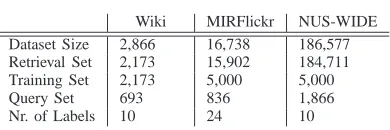
text view. TableIIgives some statistics of them.
Wiki is made up of 2,866 instances collected from
TABLE II
STATISTICS OF THREE BENCHMARK DATASETS.
Wiki MIRFlickr NUS-WIDE Dataset Size 2,866 16,738 186,577 Retrieval Set 2,173 15,902 184,711 Training Set 2,173 5,000 5,000 Query Set 693 836 1,866 Nr. of Labels 10 24 10
SIFT feature vector is provided to describe its image view and a 10-D topic vector is given to describe its text view. Each instance is mannually annotated with one semantic label from 10 candidates. Following [23], [24], we take 25% of Wiki to form the query set, and the rest works as the retrieval set.
MIRFlickr originally contains 25,000 instances collected
from Flickr. Each instance consists of an image and its associated textual tags, and is manually annotated with one or more of 24 provided semantic labels. To avoid noises, here we remove textual tags that appear less than 20 times in the dataset, and then delete instances without textual tags or semantic labels. After pretreatment, we get 16,738 instances left. For each instance, a 150-D edge histogram is provided to describe its image view, while its text view is represented as
a 500-D feature vector derived from PCA [51] on its binary
tagging vector w.r.t the remaining textual tags. We take 5% of MIRFlickr to form the query set, and the rest works as the retrieval set.
NUS-WIDE is a large dataset originally containing 269,648
instances. Like MIRFlickr, each instance in NUS-WIDE con-sists of an image and its associated textual tags, and is manually annotated with one or more semantic labels from 81 candidates. Following [23], [24], here we only keep the top 10 most frequent labels and the corresponding 186,577 instances annotated with them. For each instance, a 500-D Bag-of-Visual-Words SIFT feature vector is provided to describe its image view, while its text view is represented as a binary tagging vector w.r.t the top 1,000 most frequent tags. We also take 1% of NUS-WIDE to form the query set, and the rest works as the retrieval set.
Considering the small size of Wiki, we follow [23] and take its retrieval set as the training set. As for the large MIRFlickr and NUS-WIDE, to simulate real-world cases where only the supervised information of a small fraction of the data is provided, for either dataset we just sample 5,000 instances from the corresponding retrieval set to form the training set. It should be noticed that, the learnt hash codes of training instances in the training process of SePH will be discarded after hash functions are learnt, and then SePH generates hash codes for all instances in the dataset with the learnt hash functions. Moreover, although each bit in the hash codes generated by SePH is in{−1,1}, in our experiments we map
them into {0,1} and compactly store them bit by bit. Like
most previous hashing methods, to perform ANN retrieval for
any query hash code Hq, its Hamming distance to any ith
hash code Hi in the retrieval set, denoted as h(Hq, Hi), is
calculated as h(Hq, Hi) = bit count(Hq ⊕Hi), where ⊕
denotes XOR operation between the bits of Hq and Hi, and
bit count counts the number of1 in the binary XOR result.
Then we rank all instances in the retrieval set based on their corresponding Hamming distances in an ascending order and take the top ones as the ANNs for the query instance.
In our experiments, the annotated semantic labels of any training instance are represented as a binary labelling vector.
Then we derive the affinity matrix of each dataset, i.e. A in
formula (1), as the cosine similarities between labelling vectors
of training instances. The only model parameter α in the
objective function of SePH (i.e. formula (7)) is empirically set as 0.01 for all datasets. As for the learning of hash functions
in each view, µ in formula (9) for linear ridge regression
in SePHlinear, η in formula (10) for logistic regression in
SePHlr, and λ in formula (12) for kernel logistic regression
in SePHklr, are automatically set via 5-fold cross-validation on
the corresponding features and learnt hash codes of training in-stances. Particularly, for kernel logistic regression in SePHklr,
a RBF kernel is utilized, with its parameterσ2set as the mean squared Euclidean distance between feature vectors of training instances. Additionally, on all datasets the sampling size for
ˆ
Φin formula (12) is empirically set as 500. We perform both
random sampling and k-means sampling for SePHklr, which
are denoted as SePHklr+rndand SePHklr+kmrespectively. To
encourage further developments, the codes of SePH will be published in a near future.
We employ the supervised CMSSH [26], CVH [27],
KSH-CV [34], SCM-Orth and SCM-Seq [35], and the unsupervised
IMH [21], LSSH [24], CMFH [23] as baselines to compare
with the proposed SePH. Note that for IMH, we calculate its required affinity matrices with the provided semantic labels of training instances, and thus it is actually supervised here. To make fair comparisons, we carefully perform parameter tuning for baselines, and report their best performance in this paper. We perform 10 runs for SePH and any compared baseline with a non-convex objective function with different initial values, and report the average performance.
Following previous researches, we utilize mean average
precision (mAP) to measure the retrieval performance of all
cross-view hashing methods. A higher mAP value means
better retrieval performance. Here the definition of mAP is
given as follows.
mAP = 1
|Q|
|Q| X
i=1
1
mi
mi
X
j=1
precision(Ri,j) (20)
whereQis the query set with its size being|Q|, and for theith query,m1
i
Pmi
j=1precision(Ri,j)denotes its average precision
(AP), mi denotes the number of its ground-truth relevant
instances in the retrieval set, Ri,j is a subset of its ranked
retrieval result consisting of instances from the top one to the
jth ground-truth relevant one, and precision(Ri,j) measures
the precision value in Ri,j. Like [23], [24], an instance is
ground-truth relevant to a query if they share at least one semantic label.
B. Experimental Results
TABLE III
CROSS-VIEW RETRIEVAL PERFORMANCE OF THE PROPOSEDSEPH (i.e. SEPHlinear, SEPHlr, SEPHklr+rndANDSEPHklr+km)AND COMPARED BASELINES ON ALL BENCHMARK DATASETS WITH DIFFERENT HASH CODE LENGTHS,IN TERMS OFmAP. FORSEPH,THE STANDARD ERRORS OFmAP
OVER10RUNS ARE ALSO REPORTED.
Wiki MIRFlickr NUS-WIDE
16 bits 32 bits 64 bits 128 bits 16 bits 32 bits 64 bits 128 bits 16 bits 32 bits 64 bits 128 bits
Image Query
v.s.
Text Database
CMSSH [26] 0.1877 0.1771 0.1646 0.1552 0.5728 0.5743 0.5706 0.5706 0.4063 0.3927 0.3939 0.3739 CVH [27] 0.1257 0.1212 0.1215 0.1171 0.6067 0.6177 0.6157 0.6074 0.3687 0.4182 0.4602 0.4466 IMH [21] 0.1573 0.1575 0.1568 0.1651 0.6016 0.6120 0.6070 0.5982 0.4187 0.3975 0.3778 0.3668 LSSH [24] 0.2141 0.2216 0.2218 0.2211 0.5784 0.5804 0.5797 0.5816 0.3900 0.3924 0.3962 0.3966 CMFH [23] 0.2132 0.2259 0.2362 0.2419 0.5861 0.5835 0.5844 0.5849 0.4267 0.4229 0.4207 0.4182 KSH-CV [34] 0.1965 0.1839 0.1701 0.1662 0.5793 0.5767 0.5732 0.5744 0.4229 0.4162 0.4026 0.3877 SCM-Orth [35] 0.1598 0.1460 0.1383 0.1131 0.5854 0.5751 0.5704 0.5649 0.3787 0.3668 0.3593 0.3520 SCM-Seq [35] 0.2210 0.2337 0.2442 0.2596 0.6237 0.6343 0.6448 0.6489 0.4842 0.4941 0.4947 0.4965 SePHlinear ±0.00230.2479 ±0.00270.2589 ±0.00170.2788 ±0.00160.2833 ±0.00090.6672 ±0.00050.6724 ±0.00060.6757 ±0.00030.6782 ±0.00230.5465 ±0.56030.0009 ±0.56600.0007 ±0.56940.0005
SePHlr
0.2375 0.2531 0.2619 0.2686 0.6640 0.6699 0.6736 0.6757 0.5393 0.5503 0.5562 0.5601 ±0.0030 ±0.0024 ±0.0016 ±0.0013 ±0.0011 ±0.0004 ±0.0003 ±0.0004 ±0.0013 ±0.0016 ±0.0006 ±0.0005 SePHklr+rnd
0.2835 0.3003 0.3099 0.3204 0.6727 0.6792 0.6833 0.6860 0.5450 0.5532 0.5605 0.5650 ±0.0028 ±0.0022 ±0.0024 ±0.0014 ±0.0007 ±0.0005 ±0.0007 ±0.0006 ±0.0011 ±0.0012 ±0.0006 ±0.0008
SePHklr+km ±0.28380.0026 ±0.30090.0023 ±0.00190.3074 ±0.32070.0015 ±0.67330.0008 ±0.67930.0007 ±0.00050.6829 ±0.68640.0005 ±0.54770.0014 ±0.00100.5568 ±0.00080.5640 ±0.00090.5666
Text Query
v.s.
Image Database
CMSSH [26] 0.1630 0.1617 0.1539 0.1517 0.5715 0.5732 0.5699 0.5697 0.3874 0.3849 0.3704 0.3699 CVH [27] 0.1185 0.1034 0.1024 0.0990 0.6026 0.6041 0.6017 0.5972 0.3646 0.4024 0.4339 0.4255 IMH [21] 0.1463 0.1311 0.1290 0.1301 0.5895 0.6031 0.6010 0.5930 0.4053 0.3892 0.3758 0.3627 LSSH [24] 0.5031 0.5224 0.5293 0.5346 0.5898 0.5927 0.5932 0.5932 0.4286 0.4248 0.4248 0.4175 CMFH [23] 0.4884 0.5132 0.5269 0.5375 0.5937 0.5919 0.5931 0.5919 0.4627 0.4556 0.4518 0.4478 KSH-CV [34] 0.1710 0.1665 0.1696 0.1576 0.5786 0.5763 0.5728 0.5715 0.4088 0.3906 0.3869 0.3834 SCM-Orth [35] 0.1553 0.1389 0.1262 0.1096 0.5857 0.5747 0.5672 0.5604 0.3756 0.3641 0.3565 0.3523 SCM-Seq [35] 0.2134 0.2366 0.2479 0.2573 0.6133 0.6209 0.6295 0.6340 0.4536 0.4620 0.4630 0.4644 SePHlinear
0.5431 0.5619 0.5809 0.5872 0.7188 0.7285 0.7356 0.7385 0.6375 0.6532 0.6633 0.6674
±0.0042 ±0.0017 ±0.0015 ±0.0014 ±0.0013 ±0.0006 ±0.0004 ±0.0003 ±0.0022 ±0.0012 ±0.0005 ±0.0004
SePHlr
0.5531 0.5724 0.5888 0.5966 0.7176 0.7283 0.7347 0.7385 0.6291 0.6455 0.6545 0.6597 ±0.0050 ±0.0025 ±0.0016 ±0.0008 ±0.0009 ±0.0006 ±0.0004 ±0.0004 ±0.0013 ±0.0007 ±0.0006 ±0.0004
SePHklr+rnd ±0.63100.0031 ±0.00150.6512 ±0.00150.6633 ±0.00150.6692 ±0.00050.7216 ±0.00070.7296 ±0.00060.7372 ±0.00060.7408 ±0.00130.6283 ±0.00150.6415 ±0.00080.6530 ±0.00050.6584
SePHklr+km
0.6310 0.6516 0.6652 0.6701 0.7247 0.7328 0.7410 0.7437 0.6378 0.6513 0.6612 0.6674
±0.0024 ±0.0018 ±0.0018 ±0.0013 ±0.0011 ±0.0011 ±0.0010 ±0.0008 ±0.0011 ±0.0012 ±0.0007 ±0.0011
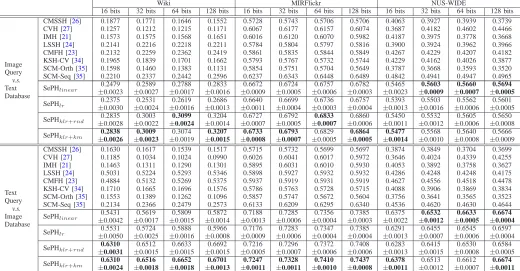
Table III, including both the performance of retrieving text
with image (i.e. “Image Query v.s. Text Database”) and that of retrieving image with text (i.e. “Text Query v.s. Image Database”). For the former task, the image view of instances in the query set is utilized to generate their corresponding query hash codes, while for the latter one, the text view is utilized. As for any instance in the retrieval set, like CMFH and LSSH, SePH generates one unified hash code for both views. Moreover, considering that the objective function of SePH is non-convex, here we also report the standard errors
w.r.t the performance of SePHlinear, SePHlr, SePHklr+rnd
and SePHklr+km over the ten runs on each dataset, so as to
investigate how different initial values of Hˆ can affect the performance of SePH
From Table III, we can get the following observations. 1)
Even with varying hash code lengths, the proposed SePH, including SePHlinear, SePHlr, SePHklr+rndand SePHklr+km,
significantly outperforms all compared baselines on all the three benchmark datasets, which well demonstrates its effec-tiveness. The superiority of SePH is attributed to both its capability of better preserving semantic affinities in Hamming space and the effectiveness of the learnt hash functions. 2) On all datasets, the performance of SePH keeps increasing as the hash code length increases, meaning that it can well utilize longer hash codes for better preserving the semantic affinities. Meanwhile, as also observed in [23], [34], [35], the perfor-mance of CMSSH, KSH-CV and SCM-Orth decreases, which may be caused by the imbalance between bits in the hash
codes learnt by singular value decomposition or eigenvalue decomposition. 3) The standard errors w.r.t the performance of SePHlinear, SePHlr, SePHklr+rnd and SePHklr+km are
quite small on all datasets (less than2%of the corresponding
mAP value), meaning that the performance of SePH is not
sensitive to the local optimality of its objective function. 4) Generally, SePHlinearand SePHlrare inferior to SePHklr+rnd
/ SePHklr+km, while on the large MIRFlickr and NUS-WIDE,
the performance of SePHlinear and that of SePHlr are quite
comparable to that of SePHklr+rnd / SePHklr+km. That, on
one hand, shows the superiority of kernel logistic regression in modelling the non-linear projections from features to bi-nary hash codes, and on the other hand, also reflects the effectiveness of utilizing linear ridge regression or logistic regression as hash functions. 5) On all datasets, it can be seen that SePHklr+km is generally superior to SePHklr+rnd,
but the superiority is insignificant (less than 2%). Therefore,
the performance of SePHklr is not sensitive to the sampling
strategy for the learning of kernel logistic regression. Furthermore, we perform paired-sample t-test [52] for eval-uating the significance of the improvements achieved by the proposed SePH over the compared baselines in both cross-view retrieval tasks on all datasets with different hash code
lengths. For each algorithm, we take the corresponding AP
(average precision) values of the query set as samples from
its AP distribution, and compare them between algorithms
for significance tests. The significance level is set as a typical
[image:10.612.52.572.111.382.2]16 bits 32 bits 64 bits 128 bits 0.4
0.5 0.6 0.7 0.8 0.9 1
(a)
Hash Code Length Image Query v.s. Text Database on the Training Set of NUS−WIDE
CMSSH CVH IMH LSSH CMFH KSH−CV SCM−Orth SCM−Seq SePH
16 bits 32 bits 64 bits 128 bits 0.4
0.5 0.6 0.7 0.8 0.9 1
(b)
Hash Code Length Text Query v.s. Image Database on the Training Set of NUS−WIDE
[image:11.612.87.260.57.330.2]CMSSH CVH IMH LSSH CMFH KSH−CV SCM−Orth SCM−Seq SePH
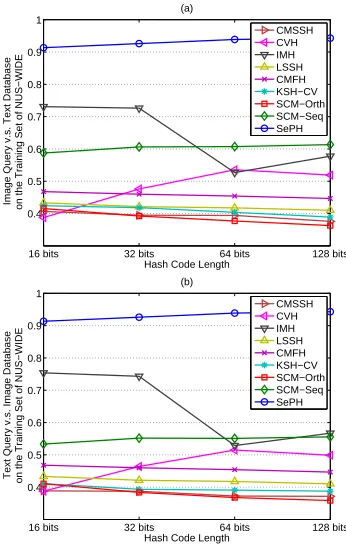
Fig. 3. Cross-view retrieval performance of all algorithms on the training set of NUS-WIDE with different hash code lengths, which reflects the quality of the hash codes learnt by each algorithm for a training set.
all significance tests between variants of SePH and compared baselines is around10−7, which is far less than the significance
level 0.01, meaning that the improvements gained by SePH
over the compared baselines are statistically significant. To get more inside details about the superiority of SePH, we further analyse the quality of the learnt hash codes of training instances. Specifically, on the training set of each dataset, we utilize the corresponding learnt hash codes to perform cross-view retrieval, repeatedly using one as a query to retrieve nearest neighbours from the rest, and then measure
the correspondingmAP value. Since we utilize the semantic
labels of instances to define their ground-truth relevance for
calculatingmAP, the derivedmAP values can quantitatively
reflect how well the learnt hash codes can preserve the given semantic affinities of training instances. Fig. 3 illustrates the performance of learnt hash codes by SePH in the two cross-view retrieval tasks on the training set of the largest NUS-WIDE, with the hash code length varying from 16 to 128.
Fig. 3 also presents the performance of baselines for
com-parison. We can observe that SePH significantly outperforms
the baselines, with the correspondingmAP being above0.9.
Actually, similar results can also be observed on Wiki and
MIRFlickr, with the correspondingmAP value of SePH being
1.0 on Wiki and above0.9 on MIRFlickr. For more details,
one can refer to the supplementary material. Therefore, it can be seen that the hash codes learnt by SePH can well preserve the semantic affinities of training instances. Additionally, by
comparing Fig. 3 and Table III, one can observe that the
retrieval performance of the learnt hash codes of training
0 50 100 150 200
0.2 0.4 0.6 0.8 1 1.2 1.4 1.6
Objective Function Value
Iterations
NUS−WIDE
0 50 100 150 2000.3
0.4 0.5 0.6 0.7 0.8 0.9 1
Quality of Learnt Hash Codes
[image:11.612.353.525.57.191.2]of the Training Set
Fig. 4. Variances of the objective function value and the corresponding quality of learnt hash codes of training instances in SePH as the number of iterations increases, on NUS-WIDE with the hash code length fixed as 16 bits.
instances is significantly better than that of the hash codes generated by learnt hash functions. We attribute this to: 1) the view-specific features of the three datasets are somewhat weak and may not well describe the instance in the corresponding view, 2) the employed predictive models, i.e. linear ridge regression, logistic regress and kernel logistic regression, may not be capable enough. Therefore, stronger features and more powerful predictive models need to be further investigated.
In our experiments, we utilize the method of gradient
descent with a momentum of 0.5 to optimize the objective
functionΨ(i.e. formula (7)) of SePH. Here we further conduct experiments to analyse the convergence of the optimization process and see how the quality of the learnt hash codes of training instances varies with iterations. Specifically, by fixing
the hash code length as 16 bits, we perform 200 iterations
of gradient descent on Wiki, MIRFlickr and NUS-WIDE to optimizeΨ. Then for each iteration, we calculate the value of
Ψ. Meanwhile, we take the corresponding value ofHˆ to derive hash codes of the training instances, and analyse their quality by measuring their retrieval performance on the corresponding training set. Note that since SePH learns one unified hash code for each training instance, the retrieval performance of learnt hash codes in “Image Query v.s. Text Database” will be identical to that in “Text Query v.s. Image Database” on the training set, and thus we just report one. The experimental results on the largest NUS-WIDE is illustrated in Fig.4, and those on Wiki, MIRFlickr are provided in the supplementary material due to the limited space. Then we can obtain the following observations. 1) The optimization process for SePH
can generally converge in around100iterations, and for Wiki
and MIRFlickr it can even converge faster. 2) As the number of iterations increases, the quality of the learnt hash codes of training instances quickly increases and then converges.
C. Experimental Validations of the Proposed Probabilistic Approach for Determining Unified Hash Codes
TABLE IV
COMPARISONS BETWEEN THE PROPOSED PROBABILISTIC APPROACH(i.e. SEPHlinear, SEPHlr, SEPHklr+rndANDSEPHklr+km)AND OTHER STRATEGIES FOR DETERMINING THE UNIFIED HASH CODES OF UNSEEN INSTANCES.
Wiki MIRFlickr NUS-WIDE
16 bits 32 bits 64 bits 128 bits 16 bits 32 bits 64 bits 128 bits 16 bits 32 bits 64 bits 128 bits
Image Query
v.s.
Text Database
SePHlinear[Img] 0.1443 0.1503 0.1557 0.1574 0.6128 0.6153 0.6169 0.6184 0.4608 0.4674 0.4707 0.4743
SePHlinear[Txt] 0.2281 0.2334 0.2491 0.2518 0.6585 0.6637 0.6668 0.6688 0.5211 0.5309 0.5354 0.5408
SePHlinear[Rand] 0.1901 0.2054 0.2255 0.2336 0.6528 0.6602 0.6647 0.6679 0.5226 0.5389 0.5479 0.5552
SePHlinear[Equal] 0.2407 0.2477 0.2677 0.2710 0.6673 0.6724 0.6756 0.6779 0.5431 0.5554 0.5608 0.5660
SePHlinear 0.2479 0.2589 0.2788 0.2833 0.6672 0.6724 0.6757 0.6782 0.5465 0.5603 0.5660 0.5694
SePHlr[Img] 0.1463 0.1527 0.1574 0.1596 0.6110 0.6143 0.6163 0.6172 0.4612 0.4668 0.4707 0.4725
SePHlr[Txt] 0.2333 0.2480 0.2556 0.2618 0.6550 0.6611 0.6649 0.6671 0.5226 0.5329 0.5384 0.5428
SePHlr[Rand] 0.1959 0.2163 0.2320 0.2422 0.6484 0.6569 0.6619 0.6652 0.5254 0.5403 0.5494 0.5558
SePHlr[Equal] 0.2311 0.2454 0.2545 0.2608 0.6633 0.6693 0.6729 0.6750 0.5366 0.5463 0.5516 0.5558
SePHlr 0.2375 0.2531 0.2619 0.2686 0.6640 0.6699 0.6736 0.6757 0.5393 0.5503 0.5562 0.5601
SePHklr+rnd[Img] 0.1882 0.2018 0.2099 0.2163 0.6263 0.6311 0.6332 0.6352 0.4640 0.4705 0.4756 0.4784
SePHklr+rnd[Txt] 0.2689 0.2815 0.2900 0.2994 0.6624 0.6686 0.6725 0.6752 0.5222 0.5310 0.5375 0.5417
SePHklr+rnd[Rand] 0.2415 0.2644 0.2815 0.2953 0.6597 0.6691 0.6745 0.6782 0.5256 0.5399 0.5496 0.5560
SePHklr+rnd[Equal] 0.2801 0.2954 0.3052 0.3161 0.6723 0.6787 0.6829 0.6856 0.5428 0.5509 0.5581 0.5626
SePHklr+rnd 0.2835 0.3003 0.3099 0.3204 0.6727 0.6792 0.6833 0.6860 0.5450 0.5532 0.5605 0.5650
SePHklr+km[Img] 0.1867 0.1989 0.2070 0.2149 0.6257 0.6298 0.6323 0.6346 0.4653 0.4726 0.4780 0.4795
SePHklr+km[Txt] 0.2698 0.2825 0.2871 0.2992 0.6630 0.6689 0.6721 0.6755 0.5267 0.5364 0.5432 0.5464
SePHklr+km[Rand] 0.2406 0.2640 0.2785 0.2950 0.6600 0.6685 0.6737 0.6783 0.5287 0.5443 0.5541 0.5585
SePHklr+km[Equal] 0.2805 0.2956 0.3027 0.3160 0.6729 0.6788 0.6824 0.6859 0.5455 0.5547 0.5620 0.5644
SePHklr+km 0.2838 0.3009 0.3074 0.3207 0.6733 0.6793 0.6829 0.6864 0.5477 0.5568 0.5640 0.5666
Text Query
v.s.
Image Database
SePHlinear[Img] 0.2158 0.2350 0.2481 0.2568 0.6335 0.6387 0.6415 0.6435 0.4999 0.5116 0.5169 0.5199
SePHlinear[Txt] 0.5320 0.5489 0.5615 0.5667 0.7121 0.7213 0.7279 0.7304 0.6170 0.6301 0.6393 0.6457
SePHlinear[Rand] 0.4561 0.5078 0.5377 0.5553 0.6961 0.7088 0.7173 0.7216 0.6065 0.6297 0.6448 0.6531
SePHlinear[Equal] 0.5419 0.5595 0.5768 0.5828 0.7198 0.7293 0.7361 0.7390 0.6371 0.6511 0.6611 0.6669
SePHlinear 0.5431 0.5619 0.5809 0.5872 0.7188 0.7285 0.7356 0.7385 0.6375 0.6532 0.6633 0.6674
SePHlr[Img] 0.2251 0.2444 0.2572 0.2645 0.6316 0.6368 0.6401 0.6421 0.4987 0.5085 0.5141 0.5173
SePHlr[Txt] 0.5415 0.5573 0.5742 0.5808 0.7075 0.7184 0.7250 0.7286 0.6111 0.6282 0.6371 0.6426
SePHlr[Rand] 0.4604 0.5131 0.5475 0.5643 0.6907 0.7044 0.7130 0.7184 0.6034 0.6269 0.6415 0.6494
SePHlr[Equal] 0.5553 0.5731 0.5916 0.5996 0.7173 0.7282 0.7345 0.7384 0.6287 0.6452 0.6543 0.6597
SePHlr 0.5531 0.5724 0.5888 0.5966 0.7176 0.7283 0.7347 0.7385 0.6291 0.6455 0.6545 0.6597
SePHklr+rnd[Img] 0.3916 0.4325 0.4520 0.4625 0.6521 0.6582 0.6621 0.6648 0.4966 0.5066 0.5134 0.5169
SePHklr+rnd[Txt] 0.5761 0.5884 0.5989 0.6035 0.7089 0.7167 0.7237 0.7271 0.6019 0.6159 0.6260 0.6303
SePHklr+rnd[Rand] 0.5675 0.6129 0.6397 0.6505 0.7021 0.7141 0.7231 0.7281 0.5960 0.6176 0.6324 0.6404
SePHklr+rnd[Equal] 0.6302 0.6514 0.6643 0.6702 0.7215 0.7294 0.7371 0.7405 0.6267 0.6398 0.6522 0.6575
SePHklr+rnd 0.6310 0.6512 0.6633 0.6692 0.7216 0.7296 0.7372 0.7408 0.6283 0.6415 0.6530 0.6584
SePHklr+km[Img] 0.3813 0.4194 0.4422 0.4522 0.6528 0.6583 0.6633 0.6655 0.5018 0.5118 0.5178 0.5216
SePHklr+km[Txt] 0.5762 0.5882 0.5991 0.6036 0.7118 0.7199 0.7273 0.7301 0.6148 0.6287 0.6377 0.6440
SePHklr+km[Rand] 0.5637 0.6107 0.6381 0.6485 0.7044 0.7162 0.7260 0.7304 0.6060 0.6282 0.6420 0.6508
SePHklr+km[Equal] 0.6304 0.6510 0.6653 0.6709 0.7246 0.7326 0.7408 0.7435 0.6359 0.6494 0.6601 0.6661
SePHklr+km 0.6310 0.6516 0.6652 0.6701 0.7247 0.7328 0.7410 0.7437 0.6378 0.6513 0.6612 0.6674
i.e. image and text, for comparison, we introduce the following
baselines with other strategies. 1) SePH•[Img]: using the
predicted hash code from the image view as the unified one, 2) SePH•[Txt]: using the predicted hash code from the text view as the unified one, 3) SePH•[Rand]: randomly taking−1 or1
for a bit when predicted values from different views conflict,
4) SePH•[Equal]: using the proposed approach but setting
p(ck = 1) =p(ck=−1)for all bits in formula (18) and (19),
which is used in our previous work [40]. Here SePH• stands
for SePHlinear, SePHlr, SePHklr+rnd or SePHklr+km. And
different combining strategies will result in different unified hash codes for instances in the retrieval sets. The experimental
results are shown in Table IV. And we can observe that on
all datasets with different hash code lengths, 1) SePH• and
SePH•[Equal] generally outperform SePH•[Img], SePH•[Txt]
and SePH•[Rand], which well demonstrates the superiority
of the proposed probabilistic approach for determining the
unified hash codes of unseen instances, and 2) SePH•
gen-erally outperforms SePH•[Equal], which demonstrates the
reasonableness of making p(ck = 1) and p(ck = −1)
dataset-dependent and the effectiveness of estimating them
with relative frequencies of −1 and 1 in the corresponding
bit of the learnt hash codes of training instances.
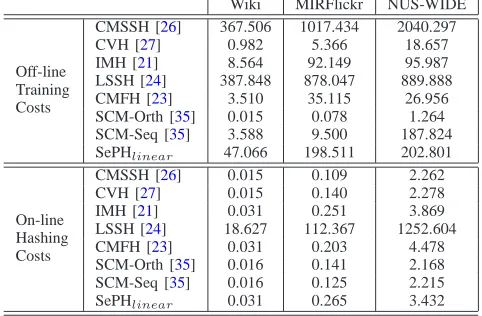
TABLE V
OFF-LINE TRAINING COSTS AND ON-LINE HASHING COSTS FOR COMPARED HASHING METHODS THAT USE LINEAR RIDGE REGRESSION AS
HASH FUNCTIONS,IN TERMS OF SECOND.
Wiki MIRFlickr NUS-WIDE
Off-line Training Costs
CMSSH [26] 367.506 1017.434 2040.297 CVH [27] 0.982 5.366 18.657 IMH [21] 8.564 92.149 95.987 LSSH [24] 387.848 878.047 889.888 CMFH [23] 3.510 35.115 26.956 SCM-Orth [35] 0.015 0.078 1.264 SCM-Seq [35] 3.588 9.500 187.824 SePHlinear 47.066 198.511 202.801
On-line Hashing Costs
CMSSH [26] 0.015 0.109 2.262 CVH [27] 0.015 0.140 2.278 IMH [21] 0.031 0.251 3.869 LSSH [24] 18.627 112.367 1252.604 CMFH [23] 0.031 0.203 4.478 SCM-Orth [35] 0.016 0.141 2.168 SCM-Seq [35] 0.016 0.125 2.215 SePHlinear 0.031 0.265 3.432
D. Comparison of Training and Hashing Costs