Unsupervised Lexicon-Based Resolution of Unknown Words for Full
Morphological Analysis
Meni Adler and Yoav Goldberg and David Gabay and Michael Elhadad Ben Gurion University of the Negev
Department of Computer Science∗ POB 653 Be’er Sheva, 84105, Israel
{adlerm,goldberg,gabayd,elhadad}@cs.bgu.ac.il
Abstract
Morphological disambiguation proceeds in 2 stages: (1) an analyzer provides all possible analyses for a given token and (2) a stochastic disambiguation module picks the most likely analysis in context. When the analyzer does not recognize a given token, we hit the prob-lem of unknowns. In large scale corpora, un-knowns appear at a rate of 5 to 10% (depend-ing on the genre and the maturity of the lexi-con).
We address the task of computing the distribu-tionp(t|w)for unknown words for full mor-phological disambiguation in Hebrew. We troduce a novel algorithm that is language in-dependent: it exploits a maximum entropy let-ters model trained over the known words ob-served in the corpus and the distribution of the unknown words in known tag contexts, through iterative approximation. The algo-rithm achieves 30% error reduction on dis-ambiguation of unknown words over a com-petitive baseline (to a level of 70% accurate full disambiguation of unknown words). We have also verified that taking advantage of a strong language-specific model of morpholog-ical patterns provides the same level of disam-biguation. The algorithm we have developed exploits distributional information latent in a wide-coverage lexicon and large quantities of unlabeled data.
∗
This work is supported in part by the Lynn and William Frankel Center for Computer Science.
1 Introduction
The term unknowns denotes tokens in a text that can-not be resolved in a given lexicon. For the task of full morphological analysis, the lexicon must pro-vide all possible morphological analyses for any given token. In this case, unknown tokens can be categorized into two classes of missing informa-tion: unknown tokens are not recognized at all by the lexicon, and unknown analyses, where the set of analyses for a lexeme does not contain the cor-rect analysis for a given token. Despite efforts on improving the underlying lexicon, unknowns typi-cally represent 5% to 10% of the number of tokens in large-scale corpora. The alternative to continu-ously investing manual effort in improving the lex-icon is to design methods to learn possible analy-ses for unknowns from observable features: their letter structure and their context. In this paper, we investigate the characteristics of Hebrew unknowns for full morphological analysis, and propose a new method for handling such unavoidable lack of in-formation. Our method generates a distribution of possible analyses for unknowns. In our evaluation, these learned distributions include the correct anal-ysis for unknown words in 85% of the cases, con-tributing an error reduction of over 30% over a com-petitive baseline for the overall task of full morpho-logical analysis in Hebrew.
The task of a morphological analyzer is to pro-duce all possible analyses for a given token. In Hebrew, the analysis for each token is of the form lexeme-and-features1: lemma, affixes, lexical
cate-1
In contrast to the prefix-stem-suffix analysis format of
gory (POS), and a set of inflection properties (ac-cording to the POS) – gender, number, person, sta-tus and tense. In this work, we refer to the mor-phological analyzer of MILA – the Knowledge Cen-ter for Processing Hebrew2(hereafter KC analyzer). It is a synthetic analyzer, composed of two data re-sources – a lexicon of about 2,400 lexemes, and a set of generation rules (see (Adler, 2007, Section 4.2)). In addition, we use an unlabeled text cor-pus, composed of stories taken from three Hebrew daily news papers (Aruts 7, Haaretz, The Marker), of 42M tokens. We observed 3,561 different com-posite tags (e.g., noun-sing-fem-prepPrefix:be) over this corpus. These 3,561 tags form the large tagset over which we train our learner. On the one hand, this tagset is much larger than the largest tagset used in English (from 17 tags in most unsupervised POS tagging experiments, to the 46 tags of the WSJ cor-pus and the about 150 tags of the LOB corcor-pus). On the other hand, our tagset is intrinsically factored as a set of dependent sub-features, which we explicitly represent.
The task we address in this paper is morphologi-cal disambiguation: given a sentence, obtain the list of all possible analyses for each word from the an-alyzer, and disambiguate each word in context. On average, each token in the 42M corpus is given 2.7 possible analyses by the analyzer (much higher than the average 1.41 POS tag ambiguity reported in En-glish (Dermatas and Kokkinakis, 1995)). In previ-ous work, we report disambiguation rates of 89% for full morphological disambiguation (using an un-supervised EM-HMM model) and 92.5% for part of speech and segmentation (without assigning all the inflectional features of the words).
In order to estimate the importance of unknowns in Hebrew, we analyze tokens in several aspects: (1) the number of unknown tokens, as observed on the corpus of 42M tokens; (2) a manual classification of a sample of 10K unknown token types out of the 200K unknown types identified in the corpus; (3) the number of unknown analyses, based on an annotated corpus of 200K tokens, and their classification.
About 4.5% of the 42M token instances in the
Buckwalter’s Arabic analyzer (2004), which looks for any le-gal combination of prefix-stem-suffix, but does not provide full morphological features such as gender, number, case etc.
2
http://mila.cs.technion.ac.il.html
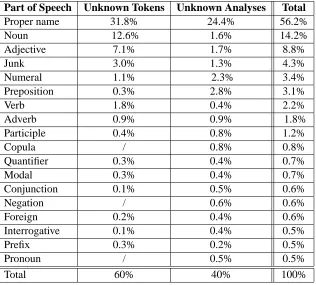
training corpus were unknown tokens (45% of the 450K token types). For less edited text, such as ran-dom text sampled from the Web, the percentage is much higher – about 7.5%. In order to classify these unknown tokens, we sampled 10K unknown token types and examined them manually. The classifica-tion of these tokens with their distribuclassifica-tion is shown in Table 13. As can be seen, there are two main classes of unknown token types: Neologisms (32%) and Proper nouns (48%), which cover about 80% of the unknown token instances. The POS distribu-tion of the unknown tokens of our annotated corpus is shown in Table 2. As expected, most unknowns are open class words: proper names, nouns or adjec-tives.
Regarding unknown analyses, in our annotated corpus, we found 3% of the 100K token instances were missing the correct analysis in the lexicon (3.65% of the token types). The POS distribution of the unknown analyses is listed in Table 2. The high rate of unknown analyses for prepositions at about 3% is a specific phenomenon in Hebrew, where prepositions are often prefixes agglutinated to the first word of the noun phrase they head. We observe the very low rate of unknown verbs (2%) – which are well marked morphologically in Hebrew, and where the rate of neologism introduction seems quite low.
This evidence illustrates the need for resolution of unknowns: The naive policy of selecting ‘proper name’ for all unknowns will cover only half of the errors caused by unknown tokens, i.e., 30% of the whole unknown tokens and analyses. The other 70% of the unknowns ( 5.3% of the words in the text in our experiments) will be assigned a wrong tag.
As a result of this observation, our strategy is to focus on full morphological analysis for unknown tokens and apply a proper name classifier for un-known analyses and unun-known tokens. In this paper, we investigate various methods for achieving full morphological analysis distribution for unknown to-kens. The methods are not based on an annotated corpus, nor on hand-crafted rules, but instead ex-ploit the distribution of words in an available lexicon and the letter similarity of the unknown words with known words.
3
Category Examples Distribution Types Instances
Proper names ’asulin (family name) oileq`
’a’udi (Audi) ice`` 40% 48%
Neologisms ’agabi (incidental) iab`
tizmur (orchestration) xenfz 30% 32%
Abbreviation mz”p (DIFS) t"fn
kb”t (security officer) h"aw 2.4% 7.8%
Foreign
presentacyah (presentation) divhpfxt ’a’ut (out) he``
right
3.8% 5.8%
Wrong spelling
’abibba’ah.ronah (springatlast) dpexg`aaia` ’idiqacyot (idication) zeivwici` ryuˇsalaim (Rejusalem) milyeix
1.2% 4%
Alternative spelling ’opyynim (typical) mipiite`
priwwilegyah (privilege ) diblieeixt 3.5% 3%
Tokenization ha”sap (the”threshold) sq"d
[image:3.612.96.516.71.324.2]‘al/17 (on/17) 71/lr 8% 2%
Table 1: Unknown Hebrew token categories and distribution.
Part of Speech Unknown Tokens Unknown Analyses Total
Proper name 31.8% 24.4% 56.2%
Noun 12.6% 1.6% 14.2%
Adjective 7.1% 1.7% 8.8%
Junk 3.0% 1.3% 4.3%
Numeral 1.1% 2.3% 3.4%
Preposition 0.3% 2.8% 3.1%
Verb 1.8% 0.4% 2.2%
Adverb 0.9% 0.9% 1.8%
Participle 0.4% 0.8% 1.2%
Copula / 0.8% 0.8%
Quantifier 0.3% 0.4% 0.7%
Modal 0.3% 0.4% 0.7%
Conjunction 0.1% 0.5% 0.6%
Negation / 0.6% 0.6%
Foreign 0.2% 0.4% 0.6%
Interrogative 0.1% 0.4% 0.5%
Prefix 0.3% 0.2% 0.5%
Pronoun / 0.5% 0.5%
Total 60% 40% 100%
[image:3.612.150.466.385.670.2]2 Previous Work
Most of the work that dealt with unknowns in the last decade focused on unknown tokens (OOV). A naive approach would assign all possible analyses for each unknown token with uniform distribution, and con-tinue disambiguation on the basis of a learned model with this initial distribution. The performance of a tagger with such a policy is actually poor: there are dozens of tags in the tagset (3,561 in the case of He-brew full morphological disambiguation) and only a few of them may match a given token. Several heuristics were developed to reduce the possibility space and to assign a distribution for the remaining analyses.
Weischedel et al. (1993) combine several heuris-tics in order to estimate the token generation prob-ability according to various types of information – such as the characteristics of particular tags with respect to unknown tokens (basically the distribu-tion shown in Table 2), and simple spelling fea-tures: capitalization, presence of hyphens and spe-cific suffixes. An accuracy of 85% in resolving un-known tokens was reported. Dermatas and Kokki-nakis (1995) suggested a method for guessing un-known tokens based on the distribution of the ha-pax legomenon, and reported an accuracy of 66% for English. Mikheev (1997) suggested a guessing-rule technique, based on prefix morphological rules, suf-fix morphological rules, and ending-guessing rules. These rules are learned automatically from raw text. They reported a tagging accuracy of about 88%. Thede and Harper (1999) extended a second-order HMM model with aC=ck,imatrix, in order to
en-code the probability of a token with a suffix sk to
be generated by a tagti. An accuracy of about 85% was reported.
Nakagawa (2004) combine word-level and character-level information for Chinese and Japanese word segmentation. At the word level, a segmented word is attached to a POS, where the character model is based on the observed characters and their classification: Begin of word, In the
middle of a word, End of word, the character is a word itself S. They apply Baum-Welch training over a segmented corpus, where the segmentation of each word and its character classification is observed, and the POS tagging is ambiguous. The segmentation
(of all words in a given sentence) and the POS tagging (of the known words) is based on a Viterbi search over a lattice composed of all possible word segmentations and the possible classifications of all observed characters. Their experimental results show that the method achieves high accuracy over state-of-the-art methods for Chinese and Japanese word segmentation. Hebrew also suffers from ambiguous segmentation of agglutinated tokens into significant words, but word formation rules seem to be quite different from Chinese and Japanese. We also could not rely on the existence of an annotated corpus of segmented word forms.
Habash and Rambow (2006) used the root+pattern+features representation of Arabic tokens for morphological analysis and generation of Arabic dialects, which have no lexicon. They report high recall (95%–98%) but low precision (37%–63%) for token types and token instances, against gold-standard morphological analysis. We also exploit the morphological patterns characteris-tic of semicharacteris-tic morphology, but extend the guessing of morphological features by using contextual features. We also propose a method that relies exclusively on learned character-level features and contextual features, and eventually reaches the same performance as the patterns-based approach.
Mansour et al. (2007) combine a lexicon-based tagger (such as MorphTagger (Bar-Haim et al., 2005)), and a character-based tagger (such as the data-driven ArabicSVM (Diab et al., 2004)), which includes character features as part of its classifica-tion model, in order to extend the set of analyses suggested by the analyzer. For a given sentence, the lexicon-based tagger is applied, selecting one tag for a token. In case the ranking of the tagged sentence is lower than a threshold, the character-based tagger is applied, in order to produce new possible analyses. They report a very slight improvement on Hebrew and Arabic supervised POS taggers.
including unknowns.
3 Method
Our objective is: given an unknown word, provide a distribution of possible tags that can serve as the analysis of the unknown word. This unknown anal-ysis step is performed at training and testing time. We do not attempt to disambiguate the word – but only to provide a distribution of tags that will be dis-ambiguated by the regular EM-HMM mechanism.
We examined three models to construct the distri-bution of tags for unknown words, that is, whenever the KC analyzer does not return any candidate anal-ysis, we apply these models to produce possible tags for the tokenp(t|w):
Letters A maximum entropy model is built for all unknown tokens in order to estimate their tag distribution. The model is trained on the known tokens that appear in the corpus. For each anal-ysis of a known token, the following features are extracted: (1) unigram, bigram, and trigram letters of the base-word (for each analysis, the base-word is the token without prefixes), together with their index relative to the start and end of the word. For example, the n-gram features extracted for the word
abc are { a:1 b:2 c:3 a:-3 b:-2 c:-1
ab:1 bc:2 ab:-2 bc:-1 abc:1 abc:-1 } ; (2) the prefixes of the base-word (as a single feature); (3) the length of the base-word. The class assigned to this set of features, is the analysis of the base-word. The model is trained on all the known tokens of the corpus, each token is observed with its possible POS-tags once for each of its occurrences. When an unknown token is found, the model is applied as follows: all the possible linguistic prefixes are extracted from the token (one of the 76 prefix sequences that can occur in Hebrew); if more than one such prefix is found, the token is analyzed for each possible prefix. For each possible such segmentation, the full feature vector is constructed, and submitted to the Maximum Entropy model. We hypothesize a uniform distribution among the possible segmentations and aggregate a distribution of possible tags for the analysis. If the proposed tag of the base-word is never found in the corpus preceded by the identified prefix, we remove this possible analysis. The eventual outcome of the
model application is a set of possible full morpho-logical analyses for the token – in exactly the same format as the morphological analyzer provides.
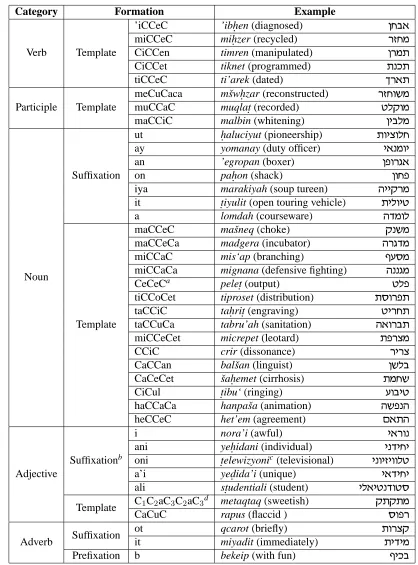
Patterns Word formation in Hebrew is based on root+pattern and affixation. Patterns can be used to identify the lexical category of unknowns, as well as other inflectional properties. Nir (1993) investi-gated word-formation in Modern Hebrew with a spe-cial focus on neologisms; the most common word-formation patterns he identified are summarized in Table 3. A naive approach for unknown resolution would add all analyses that fit any of these patterns, for any given unknown token. As recently shown by Habash and Rambow (2006), the precision of such a strategy can be pretty low. To address this lack of precision, we learn a maximum entropy model on the basis of the following binary features: one fea-ture for each pattern listed in column Formation of Table 3 (40 distinct patterns) and one feature for “no pattern”.
Pattern-Letters This maximum entropy model is learned by combining the features of the letters model and the patterns model.
Linear-Context-based p(t|c) approximation
The three models above are context free. The linear-context model exploits information about the lexical context of the unknown words: to estimate the probability for a tagtgiven a contextc–p(t|c)
– based on all the words in which a context occurs, the algorithm works on the known words in the corpus, by starting with an initial tag-word estimate
p(t|w) (such as the morpho-lexical approximation, suggested by Levinger et al. (1995)), and iteratively re-estimating:
ˆ
p(t|c) =
P
w∈Wp(t|w)p(w|c) Z
ˆ
p(t|w) =
P
c∈Cp(t|c)p(c|w)allow(t, w) Z
whereZ is a normalization factor, W is the set of all words in the corpus, C is the set of contexts.
allow(t, w)is a binary function indicating whethert
is a valid tag forw.p(c|w)andp(w|c)are estimated via raw corpus counts.
Category Formation Example
Verb Template
’iCCeC ’ibh.en (diagnosed) oga` miCCeC mih.zer (recycled) xfgn CiCCen timren (manipulated) oxnz CiCCet tiknet (programmed) zpkz tiCCeC ti’arek (dated) jx`z
Participle Template
meCuCaca mˇswh.zar (reconstructed) xfgeyn muCCaC muqlat. (recorded) hlwen maCCiC malbin (whitening) oialn
Noun
Suffixation
ut h.aluciyut (pioneership) zeivelg ay yomanay (duty officer) i`pnei
an ’egropan (boxer) otexb`
on pah.on (shack) oegt
iya marakiyah (soup tureen) diiwxn it t.iyulit (open touring vehicle) zileih
a lomdah (courseware) dcnel
Template
maCCeC maˇsneq (choke) wpyn maCCeCa madgera (incubator) dxbcn miCCaC mis‘ap (branching) srqn miCCaCa mignana (defensive fighting) dppbn CeCeCa pelet. (output) hlt tiCCoCet tiproset (distribution) zqextz taCCiC tah.rit. (engraving) hixgz taCCuCa tabru’ah (sanitation) d`exaz miCCeCet micrepet (leotard) ztxvn
CCiC crir (dissonance) xixv
CaCCan balˇsan (linguist) oyla CaCeCet ˇsah.emet (cirrhosis) zngy CiCul t.ibu‘ (ringing) reaih haCCaCa hanpaˇsa (animation) dytpd heCCeC het’em (agreement) m`zd
Adjective
Suffixationb
i nora’i (awful) i`xep
ani yeh.idani (individual) ipcigi oni t.elewizyonic (televisional) ipeifieelh
a’i yed.ida’i (unique) i`cigi
ali st.udentiali (student) il`ihpcehq
Template C1C2aC3C2aC3
d metaqtaq (sweetish) wzwzn
CaCuC rapus (flaccid ) qetx
Adverb Suffixation
ot qcarot (briefly) zexvw
it miyadit (immediately) zicin
Prefixation b bekeip (with fun) sika
a
CoCeC variation:wzer‘wyeq (a copy).
bThe feminine form is made by the t and iya suffixes:ipcigi
yeh.idanit (individual),dixvepnwcriya (Christian).
cIn the feminine form, the last h of the original noun is omitted. d
[image:6.612.94.512.62.627.2]C1C2aC3C2oC3variation:oehphwqt.ant.wn (tiny).
Model Analysis Set Morphological Disambiguation Coverage Ambiguity Probability
Baseline 50.8% 1.5 0.48 57.3%
Pattern 82.8% 20.4 0.10 66.8%
Letter 76.7% 5.9 0.32 69.1%
Pattern-Letter 84.1% 10.4 0.25 69.8%
WordContext-Pattern 84.4% 21.7 0.12 66.5% TagContext-Pattern 85.3% 23.5 0.19 64.9% WordContext-Letter 80.7% 7.94 0.30 69.7%
[image:7.612.103.512.59.229.2]TagContext-Letter 83.1% 7.8 0.22 66.9% WordContext-Pattern-Letter 85.2% 12.0 0.24 68.8% TagContext-Pattern-Letter 86.1% 14.3 0.18 62.1%
Table 4: Evaluation of unknown token full morphological analysis.
of the words appearing in that context, and similarly the probability of a tag given a word is the averaged probability of that tag in all the (reliable) contexts in which the word appears. We use the function
allow(t, w)to control the tags (ambiguity class) al-lowed for each word, as given by the lexicon.
For a given word wi in a sentence, we examine
two types of contexts: word context wi−1, wi+1,
and tag contextti−1, ti+1. For the case of word
con-text, the estimation ofp(w|c) andp(c|w) is simply the relative frequency over all the eventsw1, w2, w3
occurring at least 10 times in the corpus. Since the corpus is not tagged, the relative frequency of the tag contexts is not observed, instead, we use the context-free approximation of each word-tag, in or-der to determine the frequency weight of each tag context event. For example, given the sequence
icnl ziznerl daebztgubah l‘umatit lmadai (a quite oppositional response), and the analyses set pro-duced by the context-free approximation: tgubah [NN 1.0] l‘umatit [] lmadai [RB 0.8, P1-NN 0.2]. The frequency weight of the context {NN RB} is
1∗0.8 = 0.8and the frequency weight of the con-text{NN P1-NN}is1∗0.2 = 0.2.
4 Evaluation
For testing, we manually tagged the text which is used in the Hebrew Treebank (consisting of about 90K tokens), according to our tagging guideline (?). We measured the effectiveness of the three mod-els with respect to the tags that were assigned to the unknown tokens in our test corpus (the ‘correct tag’),
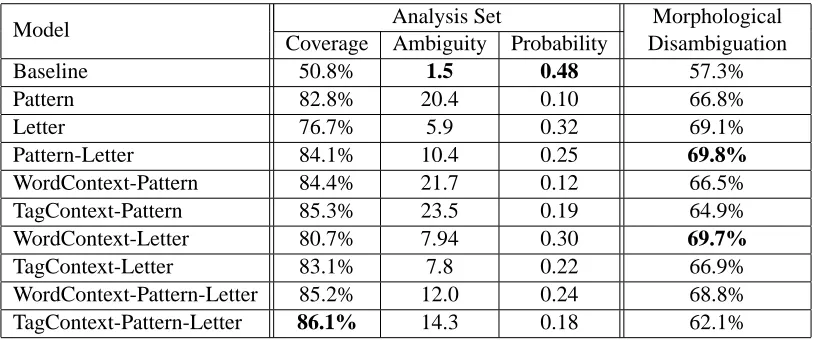
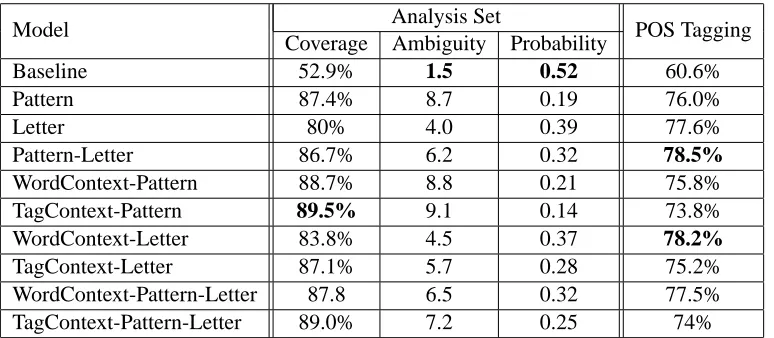
according to three parameters: (1) The coverage of the model, i.e., we count cases wherep(t|w) con-tains the correct tag with a probability larger than 0.01; (2) the ambiguity level of the model, i.e., the average number of analyses suggested for each to-ken; (3) the average probability of the ‘correct tag’, according to the predicted p(t|w). In addition, for each experiment, we run the full morphology dis-ambiguation system where unknowns are analyzed according by the model.
Our baseline proposes the most frequent tag (proper name) for all possible segmentations of the token, in a uniform distribution. We compare the following models: the 3 context free models (pat-terns, letters and the combined patterns and letters) and the same models combined with the word and tag context models. Note that the context models have low coverage (about 40% for the word context and 80% for the tag context models), and therefore, the context models cannot be used on their own. The highest coverage is obtained for the combined model (tag context, pattern, letter) at 86.1%.
Model Analysis Set POS Tagging Coverage Ambiguity Probability
Baseline 52.9% 1.5 0.52 60.6%
Pattern 87.4% 8.7 0.19 76.0%
Letter 80% 4.0 0.39 77.6%
Pattern-Letter 86.7% 6.2 0.32 78.5%
WordContext-Pattern 88.7% 8.8 0.21 75.8% TagContext-Pattern 89.5% 9.1 0.14 73.8% WordContext-Letter 83.8% 4.5 0.37 78.2%
[image:8.612.115.502.59.228.2]TagContext-Letter 87.1% 5.7 0.28 75.2% WordContext-Pattern-Letter 87.8 6.5 0.32 77.5% TagContext-Pattern-Letter 89.0% 7.2 0.25 74%
Table 5: Evaluation of unknown token POS tagging.
the method is measured by its impact on the eventual disambiguation of the unknown words. For full mor-phological disambiguation, our method achieves an error reduction of 30% (57% to 70%). Overall, with the level of 4.5% of unknown words observed in our corpus, the algorithm we have developed contributes to an error reduction of 5.5% for full morphological disambiguation.
The best result is obtained for the model com-bining pattern and letter features. However, the model combining the word context and letter fea-tures achieves almost identical results. This is an interesting result, as the pattern features encapsulate significant linguistic knowledge, which apparently can be approximated by a purely distributional ap-proximation.
While the disambiguation level of 70% is lower than the rate of 85% achieved in English, it must be noted that the task of full morphological disam-biguation in Hebrew is much harder – we manage to select one tag out of 3,561 for unknown words as opposed to one out of 46 in English. Table 5 shows the result of the disambiguation when we only take into account the POS tag of the unknown tokens. The same models reach the best results in this case as well (Pattern+Letters and WordContext+Letters). The best disambiguation result is 78.5% – still much lower than the 85% achieved in English. The main reason for this lower level is that the task in He-brew includes segmentation of prefixes and suffixes in addition to POS classification. We are currently investigating models that will take into account the
specific nature of prefixes in Hebrew (which encode conjunctions, definite articles and prepositions) to better predict the segmentation of unknown words.
5 Conclusion
We have addressed the task of computing the distri-bution p(t|w) for unknown words for full morpho-logical disambiguation in Hebrew. The algorithm we have proposed is language independent: it ex-ploits a maximum entropy letters model trained over the known words observed in the corpus and the dis-tribution of the unknown words in known tag con-texts, through iterative approximation. The algo-rithm achieves 30% error reduction on disambigua-tion of unknown words over a competitive baseline (to a level of 70% accurate full disambiguation of unknown words). We have also verified that tak-ing advantage of a strong language-specific model of morphological patterns provides the same level of disambiguation. The algorithm we have devel-oped exploits distributional information latent in a wide-coverage lexicon and large quantities of unla-beled data.
References
Meni Adler. 2007. Hebrew Morphological
Disambigua-tion: An Unsupervised Stochastic Word-based Ap-proach. Ph.D. thesis, Ben-Gurion University of the
Negev, Beer-Sheva, Israel.
Roy Bar-Haim, Khalil Sima’an, and Yoad Winter. 2005. Choosing an optimal architecture for segmentation and pos-tagging of modern Hebrew. In Proceedings of
ACL-05 Workshop on Computational Approaches to Semitic Languages.
Tim Buckwalter. 2004. Buckwalter Arabic morphologi-cal analyzer, version 2.0.
Evangelos Dermatas and George Kokkinakis. 1995. Au-tomatic stochastic tagging of natural language texts.
Computational Linguistics, 21(2):137–163.
Mona Diab, Kadri Hacioglu, and Daniel Jurafsky. 2004. Automatic tagging of Arabic text: From raw text to base phrase chunks. In Proceeding of
HLT-NAACL-04.
Michael Elhadad, Yael Netzer, David Gabay, and Meni Adler. 2005. Hebrew morphological tagging guide-lines. Technical report, Ben-Gurion University, Dept. of Computer Science.
Nizar Habash and Owen Rambow. 2006. Magead: A morphological analyzer and generator for the arabic dialects. In Proceedings of the 21st International
Con-ference on Computational Linguistics and 44th Annual Meeting of the Association for Computational Linguis-tics, pages 681–688, Sydney, Australia, July.
Associa-tion for ComputaAssocia-tional Linguistics.
Moshe Levinger, Uzi Ornan, and Alon Itai. 1995. Learn-ing morpholexical probabilities from an untagged cor-pus with an application to Hebrew. Computational Linguistics, 21:383–404.
Saib Mansour, Khalil Sima’an, and Yoad Winter. 2007. Smoothing a lexicon-based pos tagger for Arabic and Hebrew. In ACL07 Workshop on Computational
Ap-proaches to Semitic Languages, Prague, Czech
Repub-lic.
Andrei Mikheev. 1997. Automatic rule induction for unknown-word guessing. Computational Linguistics, 23(3):405–423.
Tetsuji Nakagawa. 2004. Chinese and Japanese word segmentation using word-level and character-level in-formation. In Proceedings of the 20th international
conference on Computational Linguistics, Geneva.
Raphael Nir. 1993. Word-Formation in Modern Hebrew. The Open University of Israel, Tel-Aviv, Israel. Uzi Ornan. 2002. Hebrew in Latin script. L˘eˇson´enu,
LXIV:137–151. (in Hebrew).
Scott M. Thede and Mary P. Harper. 1999. A second-order hidden Markov model for part-of-speech tag-ging. In Proceeding of ACL-99.
R. Weischedel, R. Schwartz, J. Palmucci, M. Meteer, and L. Ramshaw. 1993. Coping with ambiguity and un-known words through probabilistic models.