Computer Simulation of Multiphase Binary Diffusion in Gas–Solid Type Couples
Shinji Tsuji
Department of Mechanical and Precision System, School of Science and Engineering, Teikyo University, Utsunomiya 320-8551, Japan
Model 1 for describing multiphase diffusion and Model 2 for determining the interdiffusion coefficient of each phase in binary gas–solid couples were developed by modifying models previously presented. No restrictions on the number of phases, the values of interdiffusion coefficients, or the homogeneity ranges of phases were placed on the present models.
Composition profiles, mass changes per unit area of surface and dimensional changes normal to the surface for N–Cr, N–Fe, and N–Ti couples were numerically calculated from diffusivity and phase equilibrium data with Model 1. A good agreement between experimental and calculated results was found. It was confirmed that Model 1 is compatible with Model 2, which can be easily applied and is useful when no references are available for diffusivity data.
(Received December 9, 2004; Accepted April 20, 2005; Published June 15, 2005)
Keywords: computer simulation, composition profile, mass change, dimensional change, layer width, interdiffusion coefficient, phase boundary composition, partial molar volume, nitriding, nitrogen–chromium system, nitrogen–iron system, nitrogen–titanium system
1. Introduction
In binary gas–solid couples, new phases often form as layers parallel to the surface. For example, if pure iron is oxidized, Fe2O3, Fe3O4and FeO form on the surface under given conditions. Similar behavior is observed during case hardening processes such as carburizing and diffusion coat-ing processes such as chromizcoat-ing. Estimation of the layer width and simulation of the composition profile in the diffusion zone at any diffusion time are interesting, not only from a theoretical but also from a practical point of view.
An analytical solution for two-phase diffusion in a binary semi-infinite medium was presented by Jost,1)but no solution
has been derived for more than one product phase. Ja¨ger and Matauschek2)presented approximate solutions for the layer
growth of one and two product phases in a semi-infinite medium on the assumption of the linear concentration in a phase. The solutions can be easily generalized to a general n-phase system. However, their method is not totally satisfac-tory because it gives no description of the composition profiles. Two different models, for describing multiphase diffusion3) (Model 1) and determining the interdiffusion coefficient in each phase4) (Model 2) were developed for Boltzmann–Matano type diffusion where a variable
x=t1=2is introduced and the solutionc
i¼ciðÞis assumed.
It has already been pointed out5)that the layer growth rate
of a product phase increases proportionally to the product of the square root of the interdiffusion coefficient and the homogeneity range of the phase, if the miscibility gap between adjacent phases is excluded. Therefore, a rise in the number of phases present in a couple and a drop in the amount of the preceding product make the simulation still more difficult. One purpose of the present study was to develop a general model for the numerical description of binary multiphase diffusion without being restricted by the number of phases, the interdiffusion coefficient, or the homogeneity range of a phase. This was done by modifying the preceding Model 1.
Equilibrium phase boundary data and diffusion data are
needed to execute Model 1. The former data are available for almost all binary systems (for example, reference6)). The
latter data are available for some limited systems only. It is therefore useful to apply Model 2 to systems for which there are no available diffusivity data. Another purpose of the present study is to verify the compatibility between Models 1 and 2.
2. Models
For general gas–solid binary couples, one diffusing component, A, is transferred from the gas phase to the solid phase, and the other component, B, is transferred in the opposite direction. The following assumptions are made:
(a) the composition at each phase boundary, including that at the surface, is time independent;
(b) the interdiffusion coefficient in each phase, DðjÞ, is composition independent;
(c) the ratio of the number of moles for component A entering the solid phase to that for componentBleaving the solid phase,, is time independent.
In gas–solid couples, for such diffusion processes as nitriding and carburizing, the partial molar volume of the diffusing gas component, A, is much smaller than that of the metallic diffusing component, B. However, most analyses of diffusion in gas–solid couples have ignored possible effects due to variations of molar volume with composition, and have assumed constant molar volume over the composition range considered. Nevertheless, these effects should be of significance in the calculated composition profile, mass change, and dimensional change of the solid phase. The additional assumption is made here that:
(d) molar volume changes linearly with composition. The present numerical simulation of multiphase diffusion in gas–solid couples consists of the following two models:
(1) numerical calculation for describing the Boltzmann– Matano type of diffusion where the concentration of a diffusing component, c, can be expressed in terms of a single variablex=t1=2;
(2) numerical calculation of the interdiffusion coefficient for each phase in the Boltzmann–Matano type of diffusion couple.
2.1 Numerical calculation for describing multiphase diffusion (Model 1)
The equations describing the concentration profiles in the product phase jand the terminal phasenare given by
cA¼CAðj;j1Þ þ
CAðj;jþ1Þ CAðj;j1Þ
erf½!ðj;jþ1Þ erf½!ðj;jiÞ ferf½ erf½!ðj;j1Þg ð1Þ
and
cA¼CAðn;nþ1Þ
CAðn;nþ1Þ CAðn;n1Þ
1erf½!ðn;n1Þ
f1erf½g ð2Þ
where¼x=½2t1=2DðjÞ1=2
¼=½2DðjÞ1=2,CAðj;j1Þ ¼
NAðj;j1Þ=fNAðj;j1Þ VAþ ½1NAðj;j1Þ VBg. The
termVistands for the partial molar volume of componenti,
NAðj;j1Þstands for the mole fraction of componentAat
the phase boundary in phasejcoexisting with phasej1or jþ1,NAð1;0Þstands for that at the surface; andNAðn;nþ1Þ
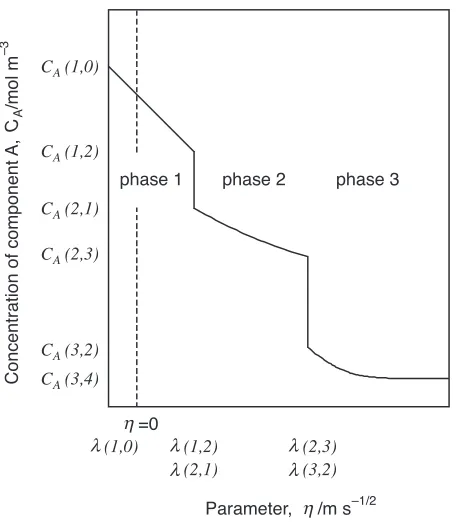
stands for that in the solid phase att¼0. An example of a schematiccAprofile is shown in Fig. 1.
The unknowns !ðj;j1Þ, where j¼1;2;. . .;n, can substantially be obtained by a binary bisection method.3) By adding a modification, a general numerical method that is not restricted by the number of phases present in the couple, the interdiffusion coefficient and the solubility range of a phase has been developed. Provided that the parameters !ðj;j1Þare all known, the following characteristic values can be obtained:
ðj;j1Þ the rate constant for the moving of interfaces
ðj1=jÞ or ðj=jþ1Þ[ms1=2] =2!ðj;j1Þ DðjÞ1=2;
Xðj;j1Þ the displacement of interface ðj1=jÞ or
ðj=jþ1Þ relative to the x¼0 plane [m] = t1=2ðj;j1Þ;
XS the displacement of the surface relative to the
x¼0plane [m] =Xð1;0Þ;
kWðjÞ the rate constant for layer growth of phase j[ms1=2] =ðj;jþ1Þ ðj;j1Þ;
WðjÞ the layer width of phase j[m] =Xðj;jþ1Þ
Xðj;j1Þ;
PðjÞ[x;NA] the point expressed by the distance and mole
fraction of componentA;
kM the rate constant for mass change per unit area of surface [gm2s1=2];
M the change in mass of the solid phase per unit area of surface [gm2] =t1=2kM.
kM is given by the following equation which eq. (27) in Ref. 3) has been modified into:
kM¼ ð1;0Þ Að1;0Þ ðRAþRBÞ ð3Þ
where
Að1;0Þ ¼1=ðVAþVBÞ ð4Þ
andRiin eq. (3) is the relative atomic mass of component i.
The data necessary for the calculation and some character-istic calculated data are shown in Fig. 2.
2.2 Numerical calculation of interdiffusion coefficients (Model 2)
We developed a model for determining interdiffusion coefficients for all the phases present in a gas–solid couple.4)
With this model there is no need to evaluate the concentration gradient in each phase. The method principally consists of the calculation of integrals and determination of XS by the
following equations, respectively:
SiðjÞ ¼
Z Xðj;jþ1Þ
Xðj;j1Þ
½ciCiðn;nþ1Þdx ð5Þ
and
phase 1 phase 2 CA (1,0)
CA (1,2)
CA (2,1)
CA (2,3)
CA (3,2) CA (3,4)
(1,0) (1,2) λ
λ η λ
λ λ
(2,3)
Concentration of component
A,
CA
/mol m
–3
Parameter, /m s–1/2
(2,1) (3,2)
phase 3
=0
η
Fig. 1 Schematic–c profile of three-phase diffusion in a gas–solid couple.
D (j)
NA(j, j 1)
VA, VB RA, RB
γ
(j, j 1)
ω
λ(j, j 1) kW (j) kM
P(j)(x,NA) XS W(j)
M
∆
t
Fig. 2 Input and output data used in Model 1. Here,PðjÞ½x;NAdenotes a
[image:2.595.57.286.494.755.2] [image:2.595.308.543.522.736.2]Xs¼
RA
Xn
k¼1
SAðkÞ þRB
Xn
k¼1
SBðkÞ M
RACAðn;nþ1Þ þRBCBðn;nþ1Þ
ð6Þ
Here,Mcan be obtained, provided thatXSis known. From
eqs. (17a, b) in Ref. 3) and eq. (44) in Ref. 4), the mole ratio is given by
¼
Xn
k¼1
SBðkÞ CBðn;nþ1Þ XS
Xn
k¼1
SAðkÞ CAðn;nþ1Þ XS
ð7Þ
The number in moles of componentihaving passed through interfaceðj=jþ1Þis given by
Qiðj=jþ1Þ ¼
Xn
k¼jþ1
SiðkÞ Ciðn;nþ1Þ Xðj;jþ1Þ ð8Þ
Now, we can numerically calculate interdiffusion coefficients for all the phases present by the initial substitution of QAðj=jþ1ÞandQBðj=jþ1Þand the sequential substitution
of the results obtained into the following equations,3)i.e.
ðj=jþ1Þ ¼QAðj=jþ1Þ=QBðj=jþ1Þ ð9Þ
Aðj;jþ1Þ ¼Aðjþ1;jÞ
¼ðj=jþ1Þ=½ðj=jþ1ÞVAþVB ð10Þ
exp Xðj;jþ1Þ
2Xðj;j1Þ2
4DðjÞ t
¼Xðj;j1Þ ½Aðj;j1Þ CAðj;j1Þ
Xðj;jþ1Þ ½Aðj;jþ1Þ CAðj;jþ1Þ
ð11aÞ
and
f Xðn;n1Þ 2½DðnÞ t1=2
¼CAðn;nþ1Þ CAðn;n1Þ
Aðn;n1Þ CAðn;n1Þ
ð11bÞ
wherefð!Þ ¼1=2!erfcð!Þ expð!2Þ.
The necessary data for the calculation and some character-istic calculated data are shown in Fig. 3.
3. Example of Simulations
Nitriding of chromium, iron, and titanium will be used as examples here since equilibrium and diffusivity data are
available as input data for their systems, and the reliable mass changes, dimensional changes and diffusion layer widths needed for comparison with the calculated results have been measured. It is possible by either Model 1 or Model 2 to make simulations of composition profiles and the associated changes, provided that the equilibrium and diffusivity or experimental data are known.
By approximating the linear dependence of molar volumes on composition, the partial molar volumes of both the diffusing components for a given system were calculated from the molar volumes of nitrides and the parent pure metal in reference to the lattice parameter data.7)Phase boundary compositions excluding the surface composition were taken from the equilibrium phase diagrams.6)
3.1 Nitriding of Chromium
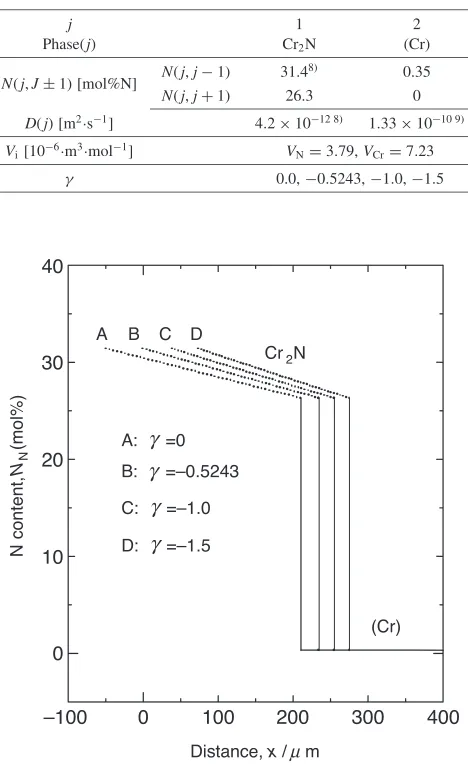
Nitrogen content profiles of nitrided chromium calculated from Table 1 are shown in Fig. 4. The profile for case A stands for expansion normal to the surface, that for case B no change, and those for C and D, shrinkage. On the other hand, the following equations were already deduced in Ref. 3),i.e.
NA(j, j 1)
W(j) P(j)[x, NA] VA, VB RA, RB t
M or X
∆ S
D(j)
(j, j 1)
(j, j 1)
P(j)[x, NA] γ
λ ω
XS or ∆M
Fig. 3 Input and output data used in Model 2. Here,PðjÞ½x;NAmust be
input when a linear approximation is not made of the composition profile in phasej. The bottom item on the left side means thatXSis output in the
[image:3.595.49.296.349.523.2]case whereMis input, andMis output in the case whereXSis input.
Table 1 Phase boundary compositions, interdiffusion coefficients, partial molar volumes, and the mole ratio for the N–Cr system at 1473 K utilized in the calculations using Model 1.
j Phase(j)
1 Cr2N
2 (Cr)
Nðj;J1Þ[mol%N] Nðj;j1Þ 31.4
8Þ 0.35
Nðj;jþ1Þ 26.3 0 DðjÞ[m2s1] 4:21012 8Þ 1:331010 9Þ
Vi[106m3mol1] VN¼3:79,VCr¼7:23
0.0,0:5243,1:0,1:5
–100 0 100 200 300 400 0
10 20 30 40
N content,
NN
(mol%)
Distance, x /
A B C D
A: γ =0 B: =–0.5243 C: =–1.0 D: =–1.5
Cr2N
(Cr)
m µ
γ γ γ
[image:3.595.310.544.376.759.2] [image:3.595.56.284.625.735.2]1=2!ð1;0Þferf½!ð1;0Þ !ð1;2Þg exp½!ð1;0Þ2
¼CAð1;0Þ CAð1;2Þ
Að1;0Þ CAð1;0Þ
ð12Þ
When takes the value of case B, it makes the termVAþ
VB nearly equal to zero, and then the parameter Að1;0Þ
approaches infinity, as is clear from eq. (4). Next, when Að1;0Þhaving the value of infinity is substituted into eq. (3), i.e.
XS¼
M Að1;0Þ ðRAþRBÞ
ð13Þ
it can be seen that!ð1;0Þwhich is written asXS=½2Dð1Þt1=2
becomes nearly zero. Equation (1), where j¼1, therefore, yields
cA¼CAð1;0Þ þ
CAð1;2Þ CAð1;0Þ
erf½!ð1;2Þ
erff=½2Dð1Þ1=2g ð14Þ
Equation (14) is identical to the solution1)to diffusion into a
homogeneous phase, a second phase developing from the surface given by Jost. That is, it is apparent that the solution by Jost can be applied only to no net transfer of volume through the surface for both diffusing components. Figure 4 shows that Xs increases from a negative value to a larger
positive value with a decrease in mole ratio , that is, the dimensional change of the nitrided chromium normal to the surface continuously varies from expansion to shrinkage with a decrease in.
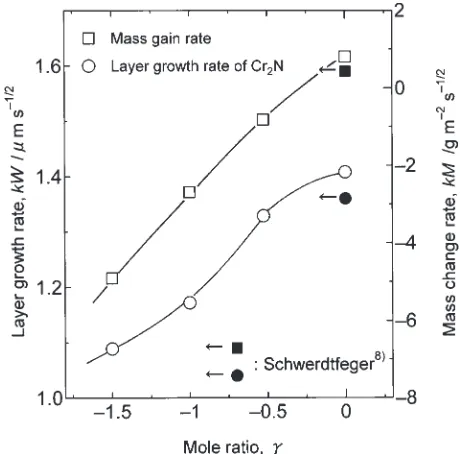
The dependence of the rate constant for layer growth of Cr2N and the rate constant for mass change upon the mole ratio are shown in Fig. 5, in which both of them decrease with a decrease in and especially the latter reaches negative values. An ammonia gas used in gas nitriding processes is decomposed into nascent nitrogen and hydrogen at the nitriding temperature,i.e.
NH3!Nþ3H
For example, the nascent nitrogen reacts with chromium and forms chromium nitride. It is clear from the above reaction equation that the mole ratio is zero when the evaporation rate of chromium from the surface is negligibly small. Therefore, the nitriding processes will not result in the mass losses seen in Cases B, C, and D. On the other hand, in siliconizing processes performed on iron with silicon tetra-chloride under neutral atmosphere, the following substitution reaction mainly occurs:
SiCl4(g)þ2Fe(s)¼Si(in Fe)þ2FeCl2
where the mole ratio has the value-2. It has been reported by Mitani and Onishi10) that the mass loss of siliconized steel decreases parabolically with treatment time. Their observa-tions correspond to the negative value of the mole ratio.
The experimental values ofkW(Cr2N) andkMobtained by Schwerdtfeger8) are less than the calculations in the case
where¼0. This is perhaps due to evaporation of chromium at the high nitriding temperature 1473 K employed in his study. Even if this is not so, the calculations show close agreement with the experimental results.
3.2 Nitriding of Iron
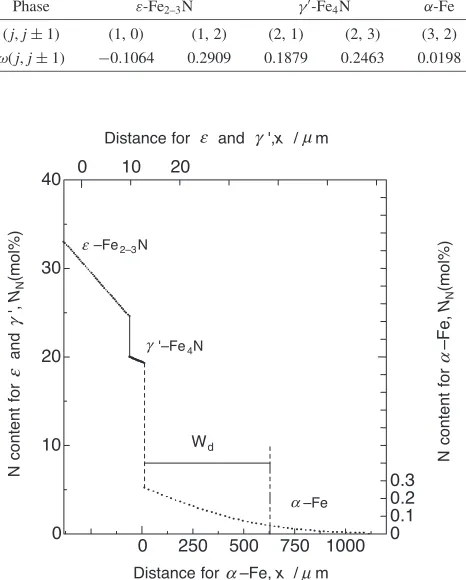
The parameters !ðj;j1Þ, calculated from the data in Table 2 are shown in Table 3. Substituting !ð1;0Þ and !ð1;2Þfor the most outer product phase"-Fe2{3N,!ð2;1Þand !ð2;3Þfor the inner product phase0-Fe4N into eq. (1), and !ð3;2Þfor the terminal phase-Fe into eq. (2) gives acA–
curve or a NA–x curve. The nitrogen content profile thus
calculated is shown in Fig. 6. As is clear from the figure, the -Fe layer in which nitrogen atoms diffuse away is much wider than the compound layer, which consists of"-Fe2{3N
Fig. 5 Dependence of mass change rate and layer growth rate on for chromium nitrided at 1473 K. The arrow indicates that a negative value of
[image:4.595.311.541.72.299.2]is possible.
Table 2 Phase boundary compositions, interdiffusion coefficients, partial molar volumes, and the mole ratiofor the N–Fe system at 773 K utilized in the calculations using Model 1.
j Phase(j)
1
"-Fe2{3N
2
0-Fe 4N
3
-Fe
Nðj;J1Þ[mol%N] Nðj;j1Þ 33 20 0.26
11Þ
Nðj;jþ1Þ 24.6 19.3 0
DðjÞ[m2s1] 9:81015 12Þ 2:351014 13Þ 3:651012 14Þ
Vi[106m3mol1] VN¼4:24,VFe¼7:04
[image:4.595.52.549.691.785.2]and0-Fe
4N. The width of the diffusion layer,Wd, is defined
as the distance from the0-Fe
4N/-Fe interface to the plane at which-Fe is saturated with 0.046 mol% N at 573 K. The calculated diffusion layer width of 616mmagrees well with the experimental result15)of about 650mm.
Steel parts increase slightly in size during nitriding. This dimensional change is affected by such factors as the temperature and time of nitriding, the relative thicknesses of the nitriding layer and core, and the shape of the parts. An expansion of the order of a 40mmincrease in diameter occurs in solid round bars made of Nitralloy 135 nitrided at 798 K for 259.2 ks.16) On the other hand, calculations with the
diffusivity and equilibrium data for the N–Fe system under the preceding heating conditions result in expansion of 28.5mmin diameter. Nitralloy 135 containing such alloying components as aluminum, chromium, and molybdenum with higher affinity for nitrogen than iron will take in a greater mass of nitrogen; furthermore, the partial molar volume of nitrogen for "-Fe2{3N is 12:4106m3/mol,17) which is much larger than that in Table 2. This leads to greater expansion in diameter for the Nitralloy 135, as is clear from the following equation, which is obtained from the combi-nation of eq. (4) with eq. (13) for the condition¼0:
XS¼
MVA
RA
ð15Þ
Therefore, provided that these effects are taken into consid-eration, the expansion calculated will be larger, and the difference between the calculated and experimental results will become a reasonable value.
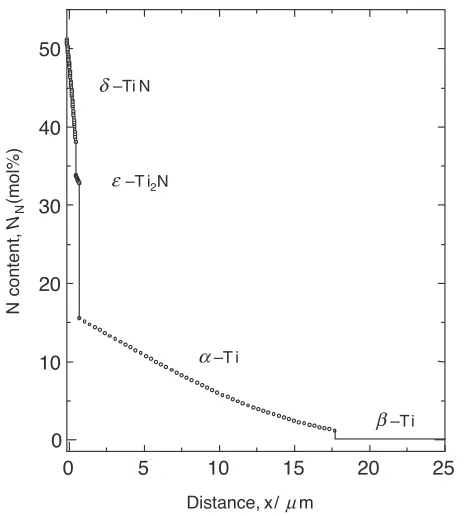
3.3 Nitriding of Titanium
[image:5.595.47.289.85.135.2]ThekWðjÞ,kM, andð1;0Þcalculated from the data shown in Table 4 and those experimentally obtained, are shown in Table 5. As can be seen in the table, the agreement between the calculated and experimental results in terms of both quantities is quite satisfactory. The layer growth rates calculated for "-Ti2N and -Ti are larger than those experimentally obtained, for which ion nitriding was em-ployed. It is generally known that layer growth rates are larger for ion nitriding than for gas nitriding. Figure 7 shows
Table 3 Values of!ðj;j1Þcalculated from data given in Table 2. j
Phase
1
"-Fe2{3N
2
0-Fe4N
3
-Fe
ðj;j1Þ (1, 0) (1, 2) (2, 1) (2, 3) (3, 2)
!ðj;j1Þ 0:1064 0.2909 0.1879 0.2463 0.0198
0 250 500 750 1000
0 10 20 30
40 0 10 20
0 0.1 0.2 0.3 –Fe2–3N
ε
γ
α
'–Fe4N
–Fe
N content for
εγ
and
',
NN
(mol%)
N content for
α
–Fe,
NN
(mol%)
Distance for –Fe, x
Wd
µ
α / m
Distance for ε and γ',x /µm
[image:5.595.54.287.99.389.2]Fig. 6 Calculated nitrogen content profile in iron nitrided at 773 K for 28.8 ks.
Table 4 Phase boundary compositions, interdiffusion coefficients, partial molar volumes, and the mole ratiofor the N–Ti system at 1173 K utilized in the calculations using Model 1.
j Phase(j)
1 -TiN
2
"-Ti2N
3
-Ti
4
-Ti
Nðj;J1Þ[mol%N] Nðj;j1Þ 51.2
18Þ 33.8 15.5 0.14
Nðj;jþ1Þ 38.1 32.8 1.2 0.0
DðjÞ[m2s1] 1:111016 19Þ 8:041016 20Þ 4:091015 19Þ 1:771012 19Þ
Vi[106m3mol1] VN¼0:80,VTi¼10:8
[image:5.595.43.553.550.645.2]0
Table 5 Comparison of calculated rate constants for layer growth of phase j and mass gain per unit area of surface with those experimentally obtained for titanium nitrided at 1173 K.
Product phase Rate constant
1: -TiN 2:"-Ti2N 3:-Ti
kWðjÞ[ms1=2] Calculated values 5:0610
9 2:09109 1:42107
Experimental values 2:54108 18Þ 1:62107 18Þ
kM[gm2s1=2] Calculated values 2:3710
2
Experimental values 1:96102 21Þ,1:77102 22Þ
[image:5.595.55.548.690.785.2]a nitrogen content profile calculated from the values in Table 4. Although the profile in-Ti seems parallel to thex -axis, a decrease in nitrogen content from 0.14 to 0.01 mol% N extends over 413mm.
The quantitiesWðjÞ,PðjÞ½x;NA,SiðjÞandM shown in
Table 6, which had been calculated from the data in Table 4, were utilized for determination of the interdiffusion coef-ficients of the phases using Model 2. Here, the following two cases are dealt with:
Case 1, nitrogen content profiles in -TiN and"-Ti2N were assumed to be linear;
Case 2, those in -TiN,"-Ti2N and-Ti were to be linear. In the case where a nitrogen content profile is approximated by a linear function,SiðjÞis given by
SiðjÞ ¼WðjÞ ½Ciðj;j1Þ þCiðj;jþ1Þ=2 ð16Þ
In the case where a nitrogen content profile is described by PðjÞ½x;NA,SiðjÞwas evaluated using the Simpson
integra-tion formula. UsingSiðjÞ thus obtained,XScalculated from
eq. (6), from eq. (7), andDðjÞfrom eqs. (8), (9), (10), and (11a, 11b) are shown in Table 7 together. Here, DðjÞ ¼
100 ½DðjÞ DðjÞ=DðjÞ, whereDðjÞstands forDðjÞin
Table 4 andDðjÞstands for that calculated from eqs. (11a) and (11b) in Model 2. To obtain a more accurate interdiffu-sion coefficient it is necessary to input data closer to the original concentration profile, as clear from a comparison of Cases 1 and 2 in Table 7. Using the closer input data also gives more accurate and XS, as is understood from a
comparison of in Table 4 and S (¼XS=t1=2) in Table 5
with those in Table 7. The above shows that Model 1 and Model 2 are compatible with no inconsistencies between them.
0 5 10 15 20 25 0
10 20 30 40 50
δ
ε
β α
–Ti N
–T i2N
–T i
–T i
N content,
NN
(mol%)
Distance, x/µm
[image:6.595.54.292.69.327.2]Fig. 7 Calculated nitrogen content profile in titanium nitrided at 1173 K for 14.4 ks.
Table 6 Layer widths, points as a function of distance and nitrogen content, and mass gain per unit area of surface calculated from the values in Table 4 using Model 1. Here, distancexis measured relative to the interfaceðj1=jÞ. Temperature and time for nitriding are 1173 K and 14.4 ks, respectively.
j Phase
1 -TiN
2
"-Ti2N 3
-Ti
4
-Ti
WðjÞ[mm] 0.6 0.25 16.99 463.2
1.7, 13.66 48.3, 0.12 3.4, 11.80 96.5, 0.09 5.1, 9.99 144.7, 0.07 6.8, 8.25 193.0, 0.05 PðjÞ½x;NA[mm, mol% N] 8.5, 6.65 241.2, 0.04
10.2, 5.19 289.5, 0.03 11.9, 3.92 337.7, 0.02 13.6, 2.83 386.0, 0.01 15.3, 1.93 434.2, 0.01
[image:6.595.306.551.122.285.2]M[gm2] 2.85
Table 7 IntegrationSiðjÞobtained from the values in Table 6, and dimensional change normal to the surfaceXS, the mole ratio ofand
interdiffusion coefficients that were calculated using Model 2.
j Phase
1 -TiN
2
"-Ti2N
3
-Ti
4
-Ti
SNðjÞ[molm2] 4:34102 1:12102 1:519101 2:27102
STiðjÞ[molm2] 3:21103 8:3104 1:125102 1:68103
Case 1 Xs[mm] 0:10
0:033
DðjÞ[m2s1] 1:281016 9:291016 3:691015 1:801012
DðjÞ[%] 15.3 15.5 9:8 1.7
SNðjÞ[molm2] 4:34102 1:12102 1:256101 2:27102
STiðjÞ[molm2] 3:21103 8:3104 9:30103 1:68103
Case 2 Xs[mm] 0:16
0.001
DðjÞ[m2s1] 1:101016 7:991016 4:011015 1:791012
[image:6.595.45.552.600.786.2]4. Conclusions
Model 1 for describing multiphase diffusion and Model 2 for determining interdiffusion coefficients for each phase present in binary gas–solid couples have been developed by modifying the models previously presented. It has been confirmed that Model 1 is compatible with Model 2. No restriction is imposed on the number of phases, the interdiffusion coefficients, or the homogeneity ranges of phases.
The good agreements between the numerical and exper-imental results shows that Model 1 is capable of predicting composition profiles, mass changes per unit area of surface, and dimensional changes normal to the surface. It is apparent that Model 2 can be easily applied, and is useful when no references are available for diffusivity data.
REFERENCES
1) W. Jost:Diffusion in Solids, Liquids and Gases, (Academic Press, New York, 1960) pp. 71–72.
2) I. Ja¨ger and Matauschek: Z. Metallkd.69(1978) 761–765. 3) S. Tsuji: Metall. Mater. Trans. A25A(1994) 753–761. 4) S. Tsuji: Metall. Mater. Trans. A25A(1994) 741–751. 5) S. Tsuji: J. Jpn. Inst. Met.41(1977) 678–685.
6) T. B. Massalski:Binary Alloy Phase Diagrams, (ASM, Ohio, 1986). 7) P. Villars and L. D. Calvert:Pearson’s Handbook of Crystallographic
Data for Intermetallic Phases, (The Materials Information Society, Ohio, 1991).
8) K. Schwerdtfeger: Trans. AIME239(1967) 1432–1438. 9) M. J. Klein: J. Appl. Phys.38(1967) 167–170.
10) Y. Mitani and M. Onishi: J. Jpn. Inst. Met.23(1959) 273–276. 11) R. Rawlings and D. Tambini: J. Iron Steel Inst.184(1956) 302. 12) M. O. Speidel: Proc. 2nd High Nitrogen Steels (Aachen 1990) 128. 13) G. E. Totten and M. A. H. Howes:Steel Heat Treatment Handbook,
(Marcel Dekker Inc., 1997) p. 695.
14) J. D. Fast and M. B. Verrijp: J. Iron Steel Inst.176(1954) 24. 15) T. Sone, E. Tsunasawa and K. Yamanaka: Netsu Shori24(1984) 316–
322.
16) American Society for Metals:Metals Handbook 9th Ed., vol. 4, (ASM,
Ohio, 1980) pp. 199–203.
17) V. G. Paranjpe, M. Cohen, M. B. Bever and C. F. Floe: Trans. AIME, 188(1950) 261–267.
18) E. Metin and O. T. Inal: Metall. Trans. A20A(1989) 1819–1832. 19) R. J. Wasilewski and G. L. Kehl: J. Inst. Metals.83(1954) 94–104. 20) F. W. Wood and O. G. Paasche: Thin Solid Films40(1977) 131–137. 21) L. S. Richardson and N. J. Grant: Trans. AIME200(1954) 69–70. 22) Yu. V. Levinskii: Izv. Akad Nauk SSSR Neorg Mater.4(1968) 2068–
2073.
Appendix
Almost all the symbols in this paper correspond to those used in the previous papers.3,4)The parameter!ðj;j1Þand the rate constantsðj;j1Þ, as an example, in Refs. 3) and 4) were written as
ðj;j1Þ ¼!ðj;j1Þ DðjÞ1=2 ðA:1Þ
and
Xðj;j1Þ ¼ðj;j1Þ 2t1=2 ðA:2Þ
Those in this paper, however, are defined as
ðj;j1Þ ¼!ðj;j1Þ 2DðjÞ1=2 ðA:3Þ
and
Xðj;j1Þ ¼ðj;j1Þ t1=2 ðA:4Þ
In eq. (23) in Ref. 3), which is written as
dQAð0=1Þ
dt ¼ Dð1Þ @cA
@x
S
ðA:5Þ
a mistake was found. This equation must be modified to
dQAð0=1Þ
dt ¼ Dð1Þ @cA
@x
S
þCAð1;0Þ
dXS
dt
ðA:6Þ
This leads to the elimination of the termCAð1;0Þin eqs. (24),