Interdiffusion in
Phase of the Ternary Ti-Al-V System
Tomoshi Takahashi
1, Yoritoshi Minamino
2and Masao Komatsu
31Department of Environmental Materials Engineering, Institute of Niihama National College of Technology, Niihama 792-8580, Japan
2
Department of Adaptive Machine Systems, Graduate School of Engineering, Osaka University, Suita 565-0871, Japan 3Department of Mechanical Engineering, Hiroshima Institute of Technology, Hiroshima 731-5143, Japan
The interdiffusion in Ti-richTi-Al-V alloys has been investigated in the temperature range from 1323 to 1473 K. The direct interdiffusion coefficients, DD~Ti
AlAl and DD~TiVV, and indirect interdiffusion coefficients, DD~TiAlV and DD~TiVAl, are positive in the ternary alloys, and these four
interdiffusion coefficients have slight concentration dependence. The values ofDD~Ti
AlAlare larger than those ofDD~TiVV, and the values ofDD~TiAlVare also
larger than those ofDD~Ti
VAl. The repulsive interactions exist between Al and V atoms in the Ti-Al-V alloys, because the ratio values of indirect
coefficient to direct one are positive. On the other hand, the interactions between Ti (solvent) and Al (or V) atoms are attractive in the present alloy, since the ratio of converted interdiffusion coefficients in the ternary alloys shows negative values.
[doi:10.2320/matertrans.MRA2007110]
(Received May 9, 2007; Accepted October 9, 2007; Published December 25, 2007)
Keywords: titanium-aluminum-vanadium alloy, ternary diffusion, diffusion couple, thermodynamic interaction
1. Introduction
Most practical-titanium alloys contain some -stabiliz-ing elements such as chromium, vanadium, niobium and molybdenum, and only practical -stabilizing element of aluminum up to about 5 mass%Al as substitutional solute elements.1,2)It has been reported that the microstructures and mechanical properties in the basic-titanium alloys contain-ing aluminum and vanadium are markedly affected by the thermomechanical treatments, aging and preciptation. Gen-erally speaking, the mechanical and physical properties of the materials are strongly related to their microstructures, whose evolution can be controlled not only by the working such as forging and rolling, but also by heat treatments for recovery, recrystallization, grain size control, diffusional transforma-tion and precipitatransforma-tion. The main and important phenomena for recovery, recrystallization, transformation, precipitation and so on in such treatments are diffusion. Therefore, the knowledge for diffusion mechanism and the diffusion coefficients of aluminum and vanadium are indispensable to understand the above some processes and behavior during heat treatments of basic-titanium alloys containing alumi-num and vanadium.3,4)
Many experimental studies on diffusion in titanium-base binary alloys containing or -stabilizing elements have been performed.3–8) On the other hand, interdiffusion in ternary Ti-Al-V alloys has not been investigated yet, although investigation of interdiffusion in some titanium-base ternary alloys has been made.9,10) Therefore, the purposes of the present work are (a) to determine the interdiffusion coefficients in the-phase region of the binary Ti-Al and Ti-V alloys and the ternary Ti-Al-V alloys in a temperature range from 1323 to 1473 K, and (b) to estimate the thermodynamic interactions between solute-solute atoms (and solvent-solute atoms) inTi-Al-V solid solutions.
2. Experimental Procedures
2.1 Diffusion couples and their concentration profiles
Thirteen kinds of the alloy ingots were prepared with pure
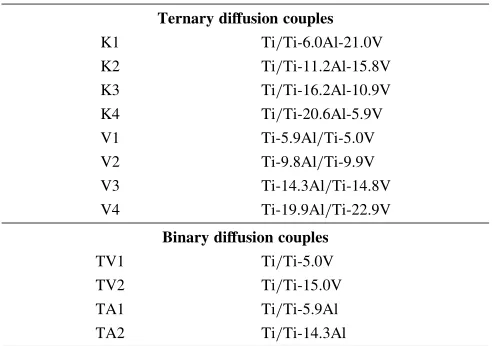
metals of 99.99 mass% sponge Ti, 99.99 mass%Al and 99.9 mass%V by an Ar arc melting, and they were cut to the alloy bars. These alloy bars were sealed into quartz capsules with argon gas about 20 kPa, and then annealed at 1473 K for 86.4 ks for homogenization. After the homoge-nization they were quenched into ice water. These homo-genized alloy bars were cut into alloy plates of 10103mm3 in size. The surfaces of alloy plates were metallographically polished by SiC papers and 0.3mm alumina powder, and immediately these polished plates were hold together by means of stainless steel clamps according to twelve kinds of combinations of alloys for ternary and binary diffusion couples as shown in Table 1, where the terminal compositions of diffusion couples are listed.
[image:1.595.304.550.610.783.2]The assembled diffusion couples and a small amount of sponge Ti enclosed a tungsten foil for an oxygen getter were sealed into a quartz capsule with argon gas about 20 kPa, and then they were annealed in the temperature range from 1323 to 1473 K for 122.4 to 28.8 ks. After diffusion annealing, they were quenched in ice water. The annealed diffusion couples were mounted in synthetic resin, and cut at their center
Table 1 Terminal composition of diffusion couples in Ti-Al-V alloys (at%).
Ternary diffusion couples
K1 Ti/Ti-6.0Al-21.0V
K2 Ti/Ti-11.2Al-15.8V K3 Ti/Ti-16.2Al-10.9V
K4 Ti/Ti-20.6Al-5.9V
V1 Ti-5.9Al/Ti-5.0V
V2 Ti-9.8Al/Ti-9.9V
V3 Ti-14.3Al/Ti-14.8V V4 Ti-19.9Al/Ti-22.9V
Binary diffusion couples
TV1 Ti/Ti-5.0V
TV2 Ti/Ti-15.0V
TA1 Ti/Ti-5.9Al
TA2 Ti/Ti-14.3Al
parallel to the diffusion direction in order to expose sections which had no oxidation and evaporation of elements. These sections of diffusion couples were metallographically pol-ished. The characteristic X-ray intensities of Al and V parallel to the diffusion direction were measured on the polished surface of these diffusion couples by a JEOL JXA-8900 electron microanalyzer (EPMA), and they were converted to solute concentration profiles of Al and V by correction for atomic number, absorption and fluorescence effects, using the bulk alloy compositions at the ends of the couples as standards.11,12)
2.2 Diffusion coefficients
The binary Ti-Al and Ti-V interdiffusion coefficients were determined from the concentration profiles in binary diffu-sion couples (TV1, TV2, TA1 and TA2) by using Matano method.13) On the other hand, the ternary interdiffusion coefficients in the Ti-Al-V alloys have been evaluated from the concentration profiles in ternary diffusion couples (K1, K2, K3, K4, V1, V2, V3 and V4) by using the extended the Matano-Kirkaldy method.14,15)
Z Ci
Cið1Þ
xdCi¼ 2t
X2
k¼1 ~ D
D3ik@Ck=@x ði¼1;2Þ; ð1Þ
whereCi(i¼1;2) is the concentration of solute i,Cð1Þi and
Ciðþ1Þthe terminal compositions at the ends of the diffusion couples, DD~3ii (i¼1;2) the direct interdiffusion coefficients,
~ D
D3ikthe indirect interdiffusion coefficients (the superscript 3 is denoted as the solvent), t the diffusion time, and x the distance from the Matano interface located at x¼0. The Matano interface can be determined for diffusion profile from the relation:
ZCðþ1Þi
Cð1Þi
xdCi¼0 ði¼1;2Þ: ð2Þ
The four interdiffusion coefficients in eq. (1) are evaluated at the common compositions of intersection (C1andC2) of the diffusion paths in two independent diffusion couples.
In addition, the impurity diffusion coefficients of Al in Ti-V alloys and those of Ti-V in Ti-Al alloys were determined from the concentration profiles in ternary diffusion couples (V1, V2, V3 and V4) by the Hall’s method.16,17) This Hall’s
method enables us to estimate accurate diffusion coefficients near the concentration extremes, at which diffusion element is very dilute. The application of the Hall’s method to the analysis for these impurity diffusion coefficients has already been described elsewhere.18)
3. Results and Discussion
3.1 Microstructures of diffusion couples
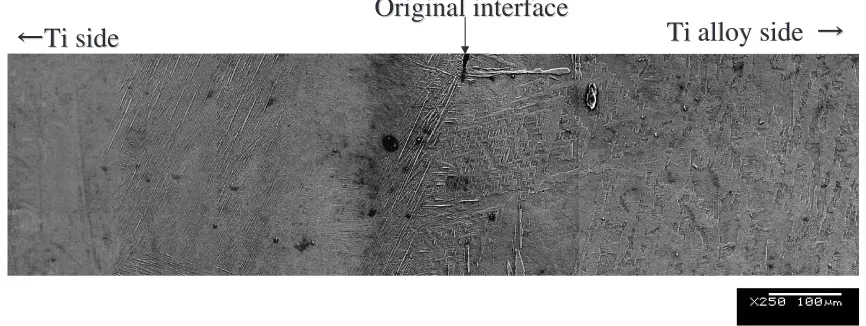
Figure 1 shows a scanning electron micrograph of the diffusion zone of the diffusion couple (K3) annealed at 1473 K for 43.2 ks. In Fig. 1, a black striation observed at the upper part of micrograph indicates the original interface of bonded alloys. In the vicinity of this original interface, a martensitic structure of the ternary Ti-Al-V alloy can be seen. It is considered that the martensitic structure is formed during iced water cooling19)from the(bcc) phase in Ti-Al-V alloy at 1473 K, according to the Ti-Al,20)Ti-V8)and Ti-Al-V21,22) phase diagrams.
3.2 Concentration profiles and diffusion paths
The concentration profiles of Al and V in the K3 and V2 diffusion couples annealed at 1473 K for various diffusion times of 28.8, 43.2 and 64.8 ks are respectively plotted against (x=t0:5) in Figs. 2(a) and (b), by way of example. The concentration profiles of Al and V in diffusion couples vary monotonously with, and each one of these profiles lies on a single curve in spite of various diffusion times, indicating that the interdiffusion coefficients are independent of annealing time and they can be determined by the application of the Matano-Kirkaldy method.17) As can be seen in Fig. 2(a), the penetration depth of Al is slightly larger than that of V. This suggests that aluminum diffuses slightly faster than vanadium in Ti-Al-V alloys. Figures 3(a) and (b) show the diffusion paths for all ternary diffusion couples at 1473 K and 1373 K on the phase Ti-Al-V diagram triangles. The diffusion paths at the other temperatures are similar in shape to those in Figs. 3(a) and (b). The monotonous shapes of diffusion paths are drawn in most of the diffusion couples of the present work, and these monotonous ones are mainly caused by the small difference in mobility between Al and V in ternary alloys. On the other hand, some S-shaped curves of
Original interface
Ti side
Ti alloy side
Ti alloy side
Ti side
Original interface
[image:2.595.81.514.78.241.2]diffusion paths are observed in the Ti-Al/Ti-V couples (V3 and V4) which have comparatively large solute concentra-tions.
[image:3.595.56.284.73.441.2]3.3 Binary and ternary interdiffusion coefficients and their concentration dependence
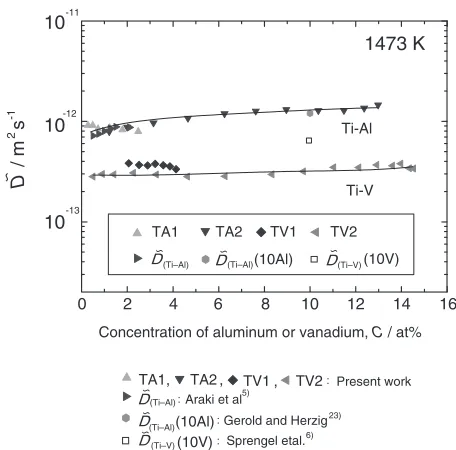
Figure 4 shows the concentration dependences of binary ~
D
DðTi-AlÞ and DDð~Ti-VÞ, which are obtained from the diffusion profiles in the binary diffusion couples of Ti/Ti-Al alloys (TA1, TA2) and Ti/Ti-V alloys (TV1, TV2) by the Matano method.13)TheDD~
ðTi-AlÞ increases from about81013m2/s to131013m2/s with increasing Al concentration in the range of 0 at%Al to 12 at%Al, and its average value are about 101013m2/s. On the other hand, the DD~
ðTi-VÞ shows an almost constant value of3:51013m2/s. Thus theDD~
ðTi-AlÞ value is about three times as large asDD~ðTi-VÞone. The present values of DDð~Ti-AlÞ at 1473 K are quite similar to those of
~ D
DðTi-AlÞ(2 at%Al) by Arakiet al.5)andDDð~Ti-AlÞ(10 at%Al) by Gerold and Herzig23) in the Ti-Al systems, while DDð~Ti-VÞ (10 at%V) =6:71013m2/s by Sprengelet al.6)are larger than the present values ofDDð~Ti-VÞ.
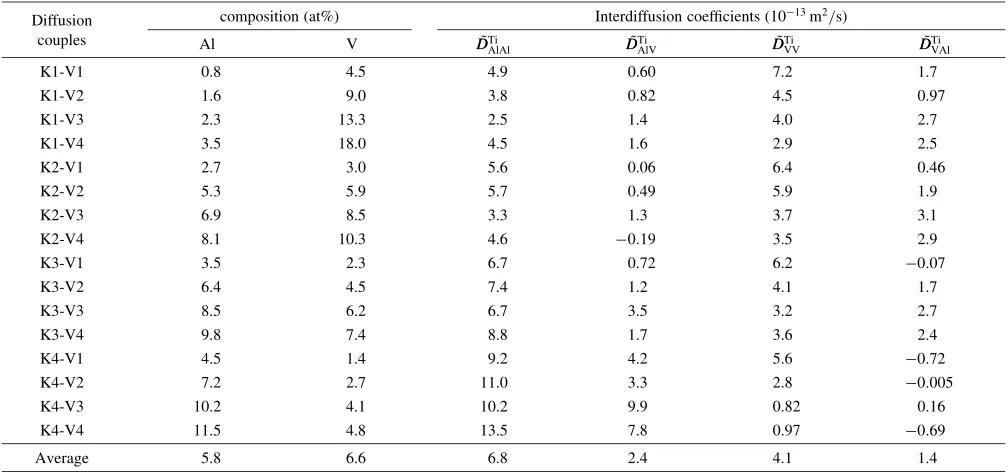
The ternary interdiffusion coefficients, DD~TiAlAl,DD~TiAlV,DD~TiVV and DD~TiVAl, in the Ti-Al-V solid solutions at 1373 K and 1473 K were obtained at the sixteen compositions on the
intersections of the diffusion paths by the extended the Matano-Kirkaldy method.14,15)Tables 2(a) and (b) list them, and Figs. 5(a) to (d) show DD~TiAlAl, DD~TiAlV, DD~TiVV and DD~TiVAl at
-4 -2 0 2 4
0 2 4 6 8 10
Concentration,
C
/ at%
/ 10–6 m s–0.5
V(28.8ks) Al(28.8ks) V(43.2ks) Al(43.2ks) V(64.8ks) Al(64.8ks)
V Al
.
(b) 1473 K V2
-6 -4 -2 0 2 4 6
0 2 4 6 8 10 12 14 16 18
Concentration,
C
/ at%
/ 10–6m s–0.5
V (28.8 ks) Al (28.8 ks) V (43.2 ks) Al (43.2 ks) V (64.8 ks) Al (64.8 ks)
(a) 1473 K K3 Al
V
.
Fig. 2 Typical concentration profiles in diffusion couples (a) K3 annealed at 1473 K and (b) V2 annealed at 1473 K for 28.8, 43.2 and 64.8 ks, respectively.
0 5 10 15 20 25
0 5 10 15 20 25
Concentration of Aluminum ,
C
Al
/ at%
Concentration of Vanadium , CV / at%
K1 K2
K3 K4
V1 V2 V3 V4
1473K,28.8ks
0 5 10 15 20 25
0 5 10 15 20 25
Concentration of Aluminum, C / at%
Concentration of Vanadium, C / at%
K1
K2 K3
K4 (b)
1373 K, 72 ks
V4 V3
V2
V1
Fig. 3 Diffusion paths for the diffusion couples annealed at (a) 1473 K for 28.8 ks and (b) 1373 K for 72.0 ks.
0 2 4 6 8 10 12 14 16
-12 -11
D
/ m
2 s
-1
TA1 TA2 TV1 TV2
D(Ti–Al) D(Ti–Al)(10Al)
Concentration of aluminum or vanadium, C / at% 10
10
10-13
Ti-Al
Ti-V 1473 K
D(Ti–Al)
5)
(10Al) D(Ti–Al)
23)
TA1, TA2, TV1, TV2 Present work Araki et al
Gerold and Herzig
D(Ti–V)(10V)
D(Ti–V)(10V) Sprengel etal. 6)
[image:3.595.315.539.76.423.2] [image:3.595.311.539.472.697.2]1473 K on the ternary Ti-Al-V diagram triangles. All direct coefficients and most of the indirect coefficients are positive, although some indirect coefficients in the vicinity of the terminal compositions show the small negative values. The indirect coefficients determined in the vicinity of the terminal compositions inevitably have the large analysis-error induced from small vales of the [@Ck=@x] and [RxdCi] factors in
eq. (1) near the terminal compositions.24,25) Therefore, the both indirect coefficients DD~Ti
AlV andDD~TiVAl are recognized as positive. The average values of their coefficients are helpful for comparison between the diffusion rates of aluminum and vanadium, although there are some concentration depend-ences of the binary and ternary diffusion coefficients as mentioned later. As listed in Table 2(b), the average values of DD~TiAlAl, DD~TiAlV, DD~TiVV and DD~TiVAl at sixteen compositions in
Fig. 5 are respectively 6:81013m2/s, 2:41013m2/s, 4:11013m2/s and 1:41013m2/s, and the average values of sixteen compositions is Ti-5.8 at%Al-6.6 at%V. Apparently, theDD~Ti
AlAlandDD~ Ti
AlV are respectively larger than the DD~Ti
VV and DD~TiVAl. This is in good agreement with the suggestion from the diffusion profiles of aluminum and vanadium in Fig. 2 that aluminum diffuses slightly faster than vanadium in Ti-Al-V alloys. As shown in Fig. 5(a), the
~ D DTi
AlAl value increases with increasing Al concentration, and increases with decreasing V concentration; it increases from about 41013m2/s in the Ti-Al-V solid solutions near the Ti-V side to about 91013m2/s121013m2/s near the Ti-Al side. As shown in Fig. 5(c), the DD~TiVV value shows the values around 41013m2/s, that is, it shows quite small concentration dependence.
Table 2(a) Interdiffusion coefficients in Ti-Al-V alloys at 1373 K.
Diffusion composition (at%) Interdiffusion coefficients (1013m2/s)
couples Al V DD~Ti
AlAl DD~TiAlV DD~TiVV DD~TiVAl
K1-V1 1.3 4.5 1.8 0.053 2.2 0.50
K1-V2 3.3 10.4 1.4 0.22 1.1 3.6
K1-V3 3.8 12.0 2.1 0.006 1.7 0.42
K1-V4 5.3 19.0 1.3 0.21 1.2 0.62
K2-V1 3.5 2.5 1.9 0:24 1.7 0.28
K2-V2 7.1 6.6 1.6 0.40 1.0 1.5
K2-V3 7.5 7.2 2.5 0:26 1.8 0.36
K2-V4 10.0 12.6 2.2 0.28 1.4 0.37
K3-V1 4.3 1.6 2.8 0.82 2.5 0.81
K3-V2 9.0 3.9 3.1 1.9 2.2 2.4
K3-V3 9.6 4.3 3.1 2.1 3.0 2.1
K3-V4 12.8 7.5 4.6 0.44 3.3 4.3
K4-V1 4.2 1.7 2.6 0.62 2.1 0.46
K4-V2 9.4 3.3 3.0 2.0 1.2 0.57
K4-V3 10.2 3.5 3.0 2.3 1.3 0.50
K4-V4 13.6 4.8 2.9 2.6 1.0 0.30
Table 2(b) Interdiffusion coefficients in Ti-Al-V alloys at 1473 K.
Diffusion composition (at%) Interdiffusion coefficients (1013m2/s)
couples Al V DD~Ti
AlAl DD~TiAlV DD~TiVV DD~TiVAl
K1-V1 0.8 4.5 4.9 0.60 7.2 1.7
K1-V2 1.6 9.0 3.8 0.82 4.5 0.97
K1-V3 2.3 13.3 2.5 1.4 4.0 2.7
K1-V4 3.5 18.0 4.5 1.6 2.9 2.5
K2-V1 2.7 3.0 5.6 0.06 6.4 0.46
K2-V2 5.3 5.9 5.7 0.49 5.9 1.9
K2-V3 6.9 8.5 3.3 1.3 3.7 3.1
K2-V4 8.1 10.3 4.6 0:19 3.5 2.9
K3-V1 3.5 2.3 6.7 0.72 6.2 0:07
K3-V2 6.4 4.5 7.4 1.2 4.1 1.7
K3-V3 8.5 6.2 6.7 3.5 3.2 2.7
K3-V4 9.8 7.4 8.8 1.7 3.6 2.4
K4-V1 4.5 1.4 9.2 4.2 5.6 0:72
K4-V2 7.2 2.7 11.0 3.3 2.8 0:005
K4-V3 10.2 4.1 10.2 9.9 0.82 0.16
K4-V4 11.5 4.8 13.5 7.8 0.97 0:69
[image:4.595.46.549.83.306.2] [image:4.595.46.550.346.582.2]For comparison with the binary diffusion coefficients and the ternary direct coefficients in the dilute region of Al or V elements in the Ti-Al-V alloy, some data of binaryDD~ðTi-AlÞin Ti-Al alloy andDDð~Ti-VÞ in Ti-V alloy are also plotted on the Ti-Al side and the Ti-V side on the ternary Ti-Al-V diagram triangles in Fig. 5(a) and (c), respectively. In the dilute region of element j in ternary i-j-k alloy, the concentration gradient of element j becomes essentially zero and then the diffusion flux of element i in ternary alloy must be essentially the same as that in binary alloy, when the concentration of element j approaches to zero. Therefore, the DD~k
ii approaches to the
binaryDD~ðikÞ when the j element becomes to zero according to Shuck and Tool,26)
lim
Cj!0
~ D
Dkii¼DD~ðikÞ: ð3Þ In fact, in the whole Ti-Al-V diagram triangle in Fig. 5(a), the ternary directDD~Ti
AlAlincreases from about41013m2/s (near the Ti-V side) to about121013m2/s (near the Ti-Al side) with decreasing V concentration. Furthermore, in the dilute range of V element, theDD~TiAlAlapproaches to theDDð~Ti-AlÞ values of about 81013m2/s to131013m2/s accord-ing to the relationship of eq. (3) by Shuck and Tool,26)and its concentration dependence that the ternary DD~TiAlAl value increases with increasing Al concentration as mentioned above is in agreement with that ofDD~ðTi-AlÞ. On the other hand,
theDD~Ti
VVvalue in the dilute range of Al element of the Ti-Al-V alloy also shows quite small concentration dependence around the values of 41013m2/s (Fig. 5(c)), and the
~ D
DðTi-VÞvalue is almost constant between about31013m2/ s and41013m2/s, that is, both diffusion coefficients of
~ D
DTiVV and DDð~Ti-VÞ are about equal to each other. Thus, the ternary direct diffusion coefficients closely linked to the binary diffusion coefficients, and their concentration depend-ence is similar to that of binary interdiffusion in the dilute region of element j.
Shuck and Tool26)also presented the relation between the cross coefficient DD~k
ij and concentration of element i Ci as
follows:
lim
Ci!0
~ D
Dkij¼0 ð4Þ
This equation indicates that the limiting values of cross coefficientsDD~k
ij are zero on the j-k side. In fact, as shown in
Figs. 5(b) and (d), the DD~Ti
AlV value scatters in some degree around 11013m2/s, but they depend slightly on the concentration, that is, they decrease with decreasing Al concentration, and probably approach to zero on the Ti-V side. As well asDD~TiAlV, theDD~TiVAl value also scatters in some degree around11013m2/s. However they decrease with decreasing V concentration, and probably approach to zero on the Ti-Al side.
25
5 10 15 20
20 15 10 5 Ti Al (at%) V (at%) 1473K 0.49 1.6 0.6 1.4 –0.19 1.3 0.82 0.06 0.72 1.2 4.2 3.5 1.7 3.3 9.9 7.8 25
D
AlV(10 -13m2 / s)
Ti D AlV Ti = 0 (b) (a)
5 10 15 20
20 15 10 5 Ti Al (at%) V (at%) 1473K 5.7 4.5 4.9 2.5 4.6 3.3 3.8 5.6 6.7 7.4 9.2 6.7 8.8 11.0 13.0 13.5
D
AlAl(10-13 m2 / s) Ti
25
25
5.8 5.4 2.3
DAl(Ti-V) D(Ti-Al) 9.7 12.0 7.9 13.0 13.0 14.0 8.8 25
5 10 15 20
20 15 10 5 Ti Al (at%) V (at%) 1473K 1.9 2.5 1.7 2.7 2.9 3.1 0.97 0.46 –0.07 1.7 –0.72 2.7 2.4 –0.005 0.16 –0.69 25
D
VAl (10 -13m2 / s)
Ti D VAl Ti = 0 (d) (c) 25
5 10 15 20
20 15 10 5 Ti Al (at%) V (at%) 1473K 5.9 2.9 7.2 4.0 3.5 3.7 4.5 6.4 6.2 4.1 5.6 3.2 3.6 2.8 0.82 0.97
D
VV(10-13 m2 / s) Ti 25 D DV(Ti-Al) 6.2 4.4 (Ti-V)
2.8 3.5 3.8 3.0 3.1 2.8 3.0 3.7
Fig. 5 Direct and indirect interdiffusion coefficients (a)DD~Ti
[image:5.595.87.510.69.440.2]3.4 Impurity diffusion coefficients and their temper-ature dependence
The limiting value of DD~k
ii to the j-k side is equal to the
impurity diffusion coefficient of component i, D
iðjkÞ, in a binary j-k alloy according to the relationship presented by Shuck and Tool,26)
lim
Ci!0
~ D
Dkii¼DiðjkÞ ð5Þ
Impurity diffusion coefficients,DAl(Ti-V)of Al in Ti-V alloys andD
V(Ti-Al)of V in Ti-Al alloys, that is, the limiting values ofDD~k
iiatCi0, can be experimentally determined by Hall’s
method16,17) at the terminal compositions of the profiles obtained from the Ti-V and Ti-Al sides of the diffusion couples V1-V4. Figs. 6(a) and (b) respectively show their concentration dependence at 1373 K and 1473 K and the temperature dependence of theD
Al(Ti-5.0V)in Ti-5.0 at%V and
D
V(Ti-5.9Al) in Ti-5.9 at%Al. In addition, the DAl(Ti-V) and
D
V(Ti-Al)are also plotted on the V side in Fig. 5(a) and Ti-Al side in Fig. 5(c), respectively. The concentration depend-ence ofD
V(Ti-Al) is vague because of only two data, but the
DAl(Ti-V)decrease slightly with the V concentration as shown in Fig. 6(a). BothDAl(Ti-5.0V)at Ti-5.0 at%V andDV(Ti-5.9Al)at Ti-5.9 at%Al follow linear Arrhenius-type equation relation-ships as shown in Fig. 6(b), and their temperature
depend-ence of the impurity diffusion coefficients can be expressed by
DAl(Ti-5.0V)
¼1:3107expð150kJ mol1/RT1Þm2/s ð6Þ and
DV(Ti-5.9Al)
¼4:3107expð165kJ mol1/RT1Þm2/s ð7Þ The activation energy for the impurity diffusion of V in-Ti is found from calculation to be 167 kJ/mol by use of the data by Murdocket al.27)in the same temperature range (1323 K– 1473 K). The activation energy for the impurity diffusion of V (165 kJ/mol) in Ti-5.9 at%Al alloys obtained by the present work is similar to that for the impurity diffusion of V (167 kJ/mol) in-Ti by Murdocket al.27)
3.5 Thermodynamic interactions among the solute com-ponents
The relation between DD~3
ij=DD~3ii and Wagner’s interaction
parameter,"ðijÞ, in very dilute solutions of the ternary alloys is represented by Kirkaldyet al.,28)as follows.
~ D
D3ij=DD~3ii¼ ½1þ"ðijÞNi ð8Þ
whereNiis the mole fraction of component i. In accordance
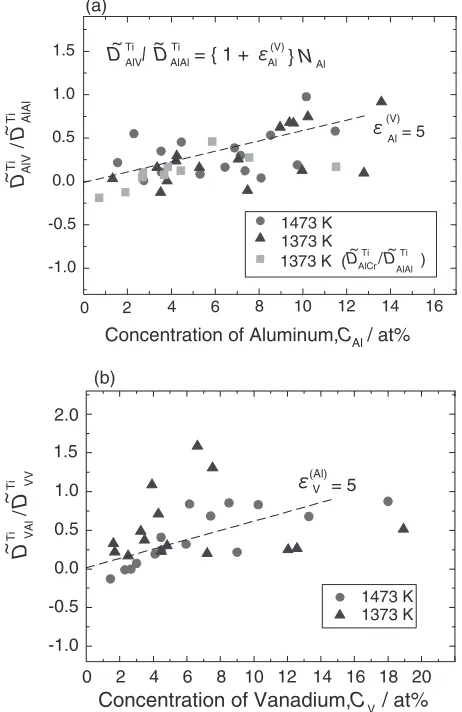
with eq. (8), the DD~TiAlV=DD~TiAlAl andDD~TiVAl=DD~TiVV values at 1373 and 1473 K are plotted against Al and V concentrations in Figs. 7(a) and (b), respectively. Figure 7(a) also includes theDD~TiAlCr=DD~TiAlAlin the ternary Ti-Al-Cr alloy at 1373 K10)for comparison. The experimental values of DD~Ti
AlV=DD~ Ti AlAl and
~ D DTi
VAl=DD~ Ti
VV increase with increasing Al and V concentration in the Ti-Al-V alloys, although they scatter around the broken line of "ðVAlÞ¼5 and "ðAlVÞ¼5 at both 1473 K and 1373 K. These plots by eq. (8) suggest that"ðVAlÞand"ðAlVÞare the values of about 5 in Ti-Al-V alloys. These positive "ðVAlÞ and "ðAlVÞ
indicate that repulsive interactions between V and Al atoms exist in the ternary Ti-Al-V system.
Tanakaet al.29,30)have derived a method for evaluation of interaction parameter in dilute liquid phase in a ternary 3-2-1 alloy (3 = solvent, and 2,1 = solutes) on the bases of the free volume theory by Shimoji and Niwa,31) and proposed eq. (9) as the evaluation method of interaction parameters in dilute liquid ternary alloys.
"ð21Þ¼ fð@2GEx=@N1@N2ÞN2!0;N1!0gkT
¼ ðð21ÞT2ð1ÞÞ=kT ð9Þ
whereGExis the excess Gibbs free energy,kthe Boltzmann
constant, and ð21Þ and 2ð1Þ the enthalpy and entropy inter-action parameters,29) respectively. The value ofð1Þ
2 can be calculated by using Miedema’s enthalpy32) of solution at infinite dilution relating the constituent elements. In addition, the value of ð21Þ can be evaluated on the basis of molar volume30,33) of the constituent elements, the melting point of an alloy and the correction factor34) of mean atomic frequency for the transfer from the solid state to the liquid state at the melting point. For instance, we obtain the values of ðVAlÞ¼5:6104, VðAlÞ ¼5:02, AlðVÞ¼1:19105, and
AlðVÞ¼11:1at 1473 K (3¼Ti,2¼V,1¼Al) for the Ti-Al-V alloy.
0 5 10 15 20 25
10
-13
2 s
-1
Concentration of vanadium or aluminum, C /at%
V(Ti-Al) :1473 K
D
-14
10 10-12 10-11
*
D*
D*
D*
Al(Ti-V) :1473 K
V(Ti-Al) :1373 K
Al(Ti-V) :1373 K (a)
1473 K
1373 K
Impurity diffusion coefficitnt,
D
* /
m
6.5 7.0 7.5
D* / m
2
s
-1
(1/T)x10
4V(Ti-5.9Al)
10-14 10-13 10-12
Al(Ti-5.0V)
(b)
Impurity diffusion coefficient,
D*
D*
Morita and Tanaka35) also derived the simple relation between the interaction parameter"ðijÞ;Lin dilute liquid phase and the"ðijÞ;Sin dilute solid phase in a ternary 3-2-1 alloy, in the case where the elastic energies between the constituent i and j atoms and those between k and i atoms due to the difference in their atomic radius, elastic modulus of con-stituent atoms and so on are similar to each other;
"ðijÞ;L¼"ðijÞ;S ð10Þ
They also verified the relation between interaction parame-ters in liquid and solid in ternary Fe alloys and obtained the good correlation as indicated by eq. (10). If we assume that the relation of eq. (10) would be hold in dilute liquid and solid phase in ternary Ti-Al-V alloy, applying eqs. (9) and (10) to the ternary solid alloys, can give "ðVAlÞ¼4:0 and
"ðAlVÞ¼8:4 at 1473 K in the solid solutions of Ti-Al-V alloys. These evaluated values are similar to the experimental values of"ðVAlÞ ¼5 and"ðAlVÞ¼5 of this research. This good agreement supports the positive values of about 5 for"ðVAlÞand
"ðAlVÞ.
The interdiffusion coefficients in a ternary system can be described in a different form by the choice of dependent component ‘solvent’.9) For instance, when the dependent component is changed from superscript 3(Ti) to 2(Al) or 1(V), as follows;
~ D
D211¼DD~311 ðV1=V2ÞDD~312; ð11Þ ~
D
D213¼ ðV3=V2ÞDD~312; ð12Þ ~
D
D122¼DD~322 ðV2=V1ÞDD~321; ð13Þ and
~ D
D123¼ ðV3=V1ÞDD~321: ð14Þ whereV1,V2andV3are the partial molar volumes of 1, 2 and 3, respectively. Consequently, we can obtain the following equations similar to eq. (8) by considering the component 2 and component 1 as ‘solvent’.
~ D
D213=DD~211¼ ½1þ"ð13ÞN1; ð15Þ and
~ D
D123=DD~122¼ ½1þ"ð23ÞN1: ð16Þ From eqs. (15) and (16), we can obtain the interaction parameters "ð13Þ or "ð23Þ, giving the information about the interaction between 3(Ti) and 1(V), or 3(Ti) and 2(Al), respectively. By using DD~Ti
AlAl¼7:41013m2/s, DD~TiAlV¼
1:21013m2/s, DD~Ti
VV¼4:11013m2/s and DD~TiVAl¼
1:71013m2/s at the common composition of N Al¼
0:064andNV¼0:045in the diffusion couples K3 and V2 in Table 2(b), and the values of VV¼8:36106m3/mol,
VAl ¼9:99106m3/mol andVTi¼10:58106m3/mol at the composition referred from the literature,33)we obtain the interaction parameter "ðVTiÞ ¼ 16 and "ðAlTiÞ ¼ 4:8 at 1473 K. These negative vales of"ðVTiÞand"ðAlTiÞsuggest that the interactions between Ti and Al (V) atoms are attractive in the present alloys.
4. Summary
Ternary interdiffusion experiments of Ti-Al-V alloys have been performed in the temperature range from 1323 to 1473 K. The results are summarized as follows.
(1) The interdiffusion coefficients, DD~Ti
AlAl, DD~TiAlV, DD~TiVV and
~ D DTi
VAlare positive in the ternary Ti-Al-V alloys. The four interdiffusion coefficients depend slightly on concen-tration dependence in the Ti-Al-V solid solutions. Aluminum atoms diffuse faster than vanadium atoms in the ternary Ti-Al-V alloys, because the values ofDD~TiAlAl are larger than those ofDD~TiVV.
(2) The impurity diffusion coefficients of Al (or V) in Ti-V (or Al) alloys can be expressed by the following equations.
DAl(Ti-5.0V)
¼1:3107expð150kJ mol1/RT1Þm2/s DV(Ti-5.9Al)
¼4:3107expð165kJ mol1/RT1Þm2/s (3) The repulsive interactions exist between Al and V
atoms in the Ti-Al-V alloys, since the ratio values of indirect coefficient to direct one, DD~Ti
AlV=DD~TiAlAl and
~ D
DTiVAl=DD~TiVV, are positive. On the other hand, the interactions between Ti (solvent) and Al (or V) atoms are attractive in the present alloys, since the ratio values of converted interdiffusion coefficients in the ternary alloys are negative.
0 2 4 6 8 10 12 14 16
-1.0 -0.5 0.0 0.5 1.0 1.5
D
Ti AlV
/
D
Ti AlAl
Concentration of Aluminum,CAl / at%
1473 K 1373 K 1373 K (DTi
AlCr /D Ti AlAl )
DAlVTi / DAlAlTi = { 1 + Al(V)} NAl
Al (V)
= 5
(a)
0 2 4 6 8 10 12 14 16 18 20
-1.0 -0.5 0.0 0.5 1.0 1.5 2.0
D
Ti VAl
/
D
Ti VV
Concentration of Vanadium,CV / at%
1473 K 1373 K
V (Al)
= 5 (b)
Fig. 7 (a) Relation betweenDD~Ti
AlV=DD~TiAlAland Al concentration, (b) Relation
betweenDD~Ti
[image:7.595.53.284.76.432.2]Acknowledgement
This work was financially supported by the Light Metal Educational Inc., Osaka 541-0056, Japan.
REFERENCES
1) O. Izumi: Nonferrous Materials (Japan Inst. Metals, Sendai, 1987) pp. 118–141.
2) H. Kusamichi, Y. Murakami, H. Kimura and O. Izumi:Titanium and Its Application, (Nikkan Kogyo Newspaper Co., Tokyo, 1983) pp. 41–50. 3) H. Nakajima and M. Koiwa: Bull. Japan Inst. Metals30(1991) 526–
535.
4) H. Nakajima: J. Mater. Sci. Soc. Japan36(1999) 9–15.
5) H. Araki, T. Yamane, Y. Minamino, S. Saji, Y. Hana and S. B. Jung: Met. Trans. A25A(1994) 874–876.
6) W. Sprengel, T. Yamada and H. Nakajima: Defect and Diffusion Forum143–147(1997) 431–436.
7) M. A. Dayananda: Diffusion in Solid Metals and Alloys, Landolt-Boernstein Ed., H. Mehrer, (Springer-Verlag, Berlin, 1991) pp. 372– 436.
8) T. Kishi: working group of structure in Titanium alloys: Diffusion Data of Titanium and Titanium Alloys, The Iron and Steel Inst. Japan, Tokyo (1994) pp. 109–127.
9) A. Brunsch and S. Steeb: Z. Metallkd.65(1974) 765–773.
10) T. Takahashi, N. Matsuda, S. Kubo, T. Hino, M. Komatsu and K. Hisayuki: J. Japan Inst. Light Metals54(2004) 280–286.
11) I. Uchiyama, A. Watanabe and S. Kimoto: X-ray Micro Analyzer, (Nikkan Kogyo Newspaper Co., Tokyo, 1974) pp. 127–196. 12) H. Soejima: Electron Probe Micro Analyzer, (Nikkan Kogyo
News-paper Co., Tokyo, 1987) pp. 338–402. 13) C. Matano: Japan J. Phys.8(1933) 109–112. 14) J. S. Kirkaldy: Can. J. Phys.35(1957) 435–440.
15) J. S. Kirkaldy, J. E. Lane and G. R. Masson: Can. J. Phys.41(1963) 2174–2186.
16) L. D. Hall: J. Chem. Phys.21(1953) 87–89.
17) J. E. Hilliard, B. L. Averbach and M. Cohen: Acta Metall.7(1959) 86– 92.
18) T. Takahashi, Y. Minamino, K. Asada, S. B. Jung and T. Yamane: J. High Temperature Soc., Japan22(1996) 121–128.
19) H. Kimura: Bull. Japan Inst. Metals9(1970) 620–638.
20) I. Ohnuma, Y. Fujita, H. Mitsui, K. Ishikawa, R. Kainuma and K. Ishida: Acta Mater.48(2000) 3113–3123.
21) T. Tsujimoto: J. Japan Inst. Metals32(1968) 970–975.
22) K. Hashimoto, H. Doi and T. Tsujimoto: J. Japan Inst. Metals49(1985) 410–416.
23) U. Gerold and Chr. Herzig: Defect and Diffusion Forum 143–147 (1997) 437–442.
24) T. R. Heyward and J. I. Goldstein: Met. Trans.4(1973) 2335–2342. 25) G. W. Roper and D. P. Whittle: Met. Sci.14(1980) 21–28. 26) F. O. Shuck and H. L. Tool: J. Phys. Chem.67(1963) 540–545. 27) J. F. Murdock, T. S. Lundy and E. E. Stansbury: Acta Metall.12(1964)
1033–1040.
28) J. S. Kirkaldy, Zia-Ul-Haq and L. C. Brown: ASM Trans. Q56(1963) 834–849.
29) T. Tanaka, N. V. Gokcen, P. J. Spencer, Z. Morita and T. Iida: Z. Metallkde.84(1993) 100–105.
30) T. Tanaka, N. V. Gokcen, K. C. Hari Kumer, S. Hara and Z. Morita: Z. Metallkde.87(1996) 779–783.
31) M. Shimoji and K. Niwa: Acta Metall.5(1957) 496–501.
32) A. K. Niessen, F. R. de Boer, R. Boom, p. F. de Chatel, W. C. M. Mattens and A. R. Miedema: Calphad7(1983) 51–70.
33) T. Iida and R. I. L. Guthrie: The properties of Liquid Metals, (Clarendon Press, Oxford, 1988) pp. 14–71.
34) T. Tanaka, N. Imai, A. Kiyose, T. Iida and Z. Morita: Z. Metallkde.82 (1991) 836–840.