Sentiment Analysis Using a Novel Human Computation Game
Claudiu-Cristian Musat Alireza Ghasemi
Artificial Intelligence Laboratory (LIA) Ecole Polytechnique F´ed´erale de Lausanne (EPFL)
IN-Ecublens, 1015 Lausanne, Switzerland [email protected]
Boi Faltings
Abstract
In this paper, we propose a novel human com-putation game for sentiment analysis. Our game aims at annotating sentiments of a col-lection of text documents and simultaneously constructing a highly discriminative lexicon of positive and negative phrases.
Human computation games have been widely used in recent years to acquire human knowl-edge and use it to solve problems which are infeasible to solve by machine intelligence. We package the problems of lexicon construc-tion and sentiment detecconstruc-tion as a single hu-man computation game. We compare the re-sults obtained by the game with that of other well-known sentiment detection approaches. Obtained results are promising and show im-provements over traditional approaches.
1 Introduction
We propose a novel solution for the analysis of sen-timent expressed in text media. Novel corpus based and lexicon based sentiment analysis methods are created each year. The continual emergence of con-ceptually similar methods for this known problem shows that a satisfactory solution has still not been found. We believe that the lack of suitable labelled data that could be used in machine learning tech-niques to train sentiment classifiers is one of the ma-jor reasons the field of sentiment analysis is not ad-vancing more rapidly.
Recognizing that knowledge for understanding sentiment is common sense and does not require ex-perts, we plan to take a new approach where labelled
data is obtained from people using human computa-tion platforms and games. We also prove that the method can provide not only labelled texts, but peo-ple also help by selecting sentiment-expressing fea-tures that can generalize well.
Human computation is a newly emerging paradigm. It tries to solve large-scale problems by utilizing human knowledge and has proven useful in solving various problems (Von Ahn and Dabbish, 2004; Von Ahn, 2006; Von Ahn et al., 2006a).
To obtain high quality solution from human com-putation, people should be motivated to make their best effort. One way to incentivize people for sub-mitting high-quality results is to package the prob-lem at hand as a game and request people to play it. This process is called gamification. The game design should be such that the solution to the main problems can be formed by appropriately aggregat-ing results of played games.
In this work, we propose a cooperative human computation game for sentiment analysis called Guesstiment. It aims at annotating sentiment of a collection of text documents, and simultaneously constructing a lexicon of highly polarized (positive and negative) words which can further be used for sentiment detection tasks. By playing a collabora-tive game, people rate hotel reviews as posicollabora-tive and negative and select words and phrases within the re-views that best express the chosen polarity.
learning techniques and prove the superiority of hu-man cognition for this task. In a third experiment we use the same annotations in a multi faceted opin-ion classificatopin-ion problem and find that results are superior to those obtained using known linguistic re-sources.
In (section 2) we review the literature related to our work. We then outline the game and its rules (section 3). We compare the Guesstiment results to the state-of-the-art machine learning, standard crowd-sourcing methods and sentiment dictionar-ies(section 4) and conclude the paper with ideas for future work (section 5).
2 Related Work
In this section we review the important literature re-lated and similar to our work. Sine we propose a human computation approach for sentiment analy-sis, we start by reviewing the literature on human computation and the closely related field of crowd-sourcing. Then we move on by having a brief look on the human computation and knowledge acquisi-tion games proposed so far by the researchers. Fi-nally, we briefly review major sentiment analysis methods utilized by the researchers.
2.1 Human Computation and Crowd-Sourcing
The literature on human computation is highly over-lapping with that of crowd-sourcing, as they are closely connected. The two terms are sometimes used interchangeably although they are slightly dif-ferent. Crowd-sourcing in its broadest form, ”is the act of taking a job traditionally performed by a des-ignated agent (usually an employee) and outsourc-ing it to an undefined, generally large group of peo-ple in the form of an open call”(Quinn and Bederson, 2011; Howe, 2006). Since the first use of the word crowd-sourcing by J. Howe (Howe, 2006), there has been a lot of interest in this field due to the wide ac-cessibility of anonymous crowd workers across the web.
The work described in (Rumshisky, 2011) uses crowd-sourcing to perform word sense disambigua-tion on a corpus. In (Vondrick et al., 2010), crowd-sourcing is used for video annotation. Moreover, (Christophe et al., 2010) has used crowd-sourcing for satellite image analysis.
(Settles, 2011a) is another approach which aims at combining active learning with crowd-sourcing for text classification. The principal contribution of their work is that as well as document annotation, they use human computation also to perform fea-ture selection. (Law et al., ) is another recent work which proposes a game for acquisition of attribute-value pairs from images.
2.2 Human Computation Games
Luis Von Ahn, the pioneer of the field of human computation, designed a game to encourage play-ers to semantically annotate a large corpus of images (Von Ahn and Dabbish, 2004). It was the first human computation game.
Following Von Ahn’s work, more researchers were encouraged to package computational prob-lems as joyful games and have a group of non-expert users play them (Von Ahn, 2006). Verbosity (Von Ahn et al., 2006a) was designed with the goal of gathering common sense knowledge about words. KissKissBan (Ho et al., 2009) was another game for image annotation.
Peekaboom(Von Ahn et al., 2006b) aimed at im-age segmentation and ”Phrase Detectives” (Cham-berlain et al., 2008) was used to help constructing an anamorphic corpus for NLP tasks. Another human computation game is described in (Riek et al., 2011) whose purpose is semantic annotation of video data.
2.3 Sentiment Analysis
The field of sentiment analysis and classification currently mostly deals with extracting sentiment from text data. Various methods (Turney, 2002; Esuli and Sebastiani, 2006; Taboada et al., 2011; Pang et al., 2002) have been proposed for effec-tive and efficient sentiment extraction of large col-lections of text documents.
Most of the research has been oriented towards finding the overall polarity of whole documents. The problem was broken down even more by using of the faceted opinion concept (Liu, 2010). The goal of this attempt was to determine precisely what aspects of the concepts the expressed opinions should be linked to. We will use this distinction to assess our method’s viability in both overall and multi faceted opinion analysis.
The work in (Brew et al., 2010) is an attempt to use crowd-sourcing for sentiment analysis. The au-thors use a crowd of volunteers for the analysis of sentiments of economical news items. Users provide annotations which are then used to learn a classifier to discriminate positive articles from negatives. It uses active learning to select a diverse set of arti-cles for annotations so that a generalizable, precise classifier can be learned from annotated data. The work in (Zhou et al., 2010) is another approach to use active learning to improve sentiment classifica-tion. It uses a deep network to learn a sentiment classifier in a semi-supervised manner. Moreover, this method uses active learning to learn from unla-beled data which are the most informative samples that need to be labeled.
Two more recent works that have focused on sen-timent classification by designing human compu-tation games are (Weichselbraun et al., 2011) and (Al-Subaihin et al., 2011). In (Weichselbraun et al., 2011) the game ”Sentiment Quiz” has been pro-posed that aims at finding the degree of polarity of words in a lexicon. In each round of the game, the player is asked to vote about polarity of a given words from most negative to most positive. The player is score based on the agreement between his vote and the votes of previous players. ”Sentiment Quiz” demands annotation in the word level and therefore can only be used to construct a sentiment lexicon.
Another work which aims at sentiment classifica-tion is (Al-Subaihin et al., 2011). In this work, a multi-player game is proposed which aims at find-ing the sentiment of individual sentences. The game is played by three groups of two players each. Each team is shown a sentence and its members are asked to highlight the sentiment carrying terms of the sen-tence separately and quickly. The first team whose players’ votes match wins and the current game
round finishes. The game continues by introducing different sentences to the teams and hence gathers information about polarity of terms and their corre-sponding context.
3 The Proposed Game
In this section we propose a novel human compu-tation game called Guesstiment. We use the infor-mation provided while playing this game to obtain a reliable dataset of sentiment annotated data as well as a lexicon of highly polarized positive and negative words.
Having two by-products as the result of playing instead of merely trying to obtain document annota-tions is the most important contribution of Guessti-ment. The idea of using crowd-sourcing for feature extraction has already been used in (Settles, 2011b), but not as a human computation game. In the rest of the following section, we will discuss the game play and rules of Guesstiment.
3.1 Rules of Guesstiment
Guesstiment is a two-player asynchronous game. It aims at annotating a large corpus of text documents, similar to the goal of the ESP game in (Von Ahn and Dabbish, 2004) for images. However, Guessti-ment does this in a different way because of its rules and asynchronous approach. The differences allow Guesstiment to obtain more useful information from played game rounds than ESP does.
The two players of the game are called ”Sug-gester” and ”Guesser”. These roles are initialized randomly and interchanged between the two players after each round of the game.
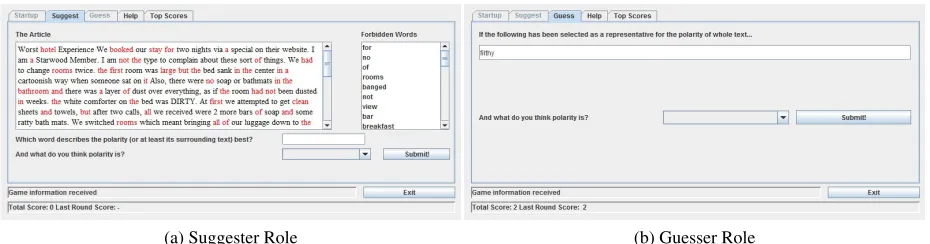
The Suggester, who starts each round will be given the whole text of a review document and he/she is supposed to:
1. Decide whether the whole text is positive or negative, i.e. the author is praising about a sub-ject or criticising it.
The Guesser, on the other hand, will be given only the word (or word sequence) suggested by the Suggester (he won’t see the whole text) and he has to guess polarity of the whole text just based on that single word. If the polarities suggested by the two players agree, they are both given some posi-tive score (based on factors described below) oth-erwise 0. Then the roles are interchanged and the game continues with a new document. The guesser can also refuse to make a guess about polarity of the text (when for example the suggested word is am-biguous or not very discriminative) in which case the suggester has two more opportunities to suggest another word from the text.
Guesstiment is a cooperative game. It means that the two players are not opponent and they both re-ceive equal score after each round (Not high score for one player and low score for the other). There-fore, the Suggester should make his best efforts to select the most polarized word from the test which best describes the selected sentiment or polarity. The UI screens for Suggester and Guesser are depicted in figures 1a and 1b respectively.
3.1.1 Scoring
The score of each suggested word (or word se-quence) depends on a variety of factors, includ-ing the length of the sequence and its novelty, i.e. how many times it has already been selected by other players. Suppose that the word sequence w is present in the current text document and also it has been present in text documents of nw of previ-ously played game rounds. Assuming w has been selectedkwtime before current game round, the po-tential score ofw,P Sw is defined as:
P Sw =
1
length(w)×kw nw
(1)
In (1),length(w)is the length (number of words) of phrasew. Using this scoring strategy, players are encouraged to select as shortest phrases as possible. Single words that are not already selected by other players will yield the highest score.
Moreover, some words are not allowed as sug-gestions and will yield zero score regardless of the agreement in polarity judgements. These words are
coloured red in the text and are separately displayed in the forbidden list.
The cooperation between the Suggester and the Guesser requires an agreement between them. This allows the game to collect precise annotations and simultaneously build a good quality lexicon of words which are most important in detecting polar-ity of the text.
The total score of each player is displayed on the scoreboard at the bottom of the Suggest/Guess graphical user interface.
4 Experiments
4.1 Implementation Details
The game was implemented as a traditional three-tier web application. For data storage, we used the H2 embedded database which has proven to be fast enough for scientific information retrieval applica-tions. For the server side of the application we used the Play! framework, which is a lightweight easy to use framework for Java MVC web application framework.
The client side is a Java Applet. We used a service oriented approach to define interactions between the client and the server so that the game play is de-fined as a sequence of HTTP requests between client and server. Using this approach,, client and server are maximally separate and therefore various client applications can be written, for instance to run on smart phones.
4.2 Experimentation Environment
A total of 80000 review texts were extracted along with their corresponding ratings from the TripAdvi-sor website1. Among these, 1000 articles were ran-domly selected and inserted in the game database to be used in game rounds. More than 20 players played the game over the course of one month and 697 annotations were collected during this period, of which 312 are distinct.
For selecting articles for each round, a combina-tion of strategies were used. From the set of docu-ments which have not already been labelled by any of the players, we select the article with the least difference between number of positive and negative (as collected in the lexicon constructed so far) words
1
(a) Suggester Role (b) Guesser Role
Figure 1: The Suggest/Guess UI.
so that we get the most information from annota-tions. If all document have been annotated at least two times, we make the selection among documents for which the two annotations disagree, so that we solve disagreements by majority vote.
4.3 Quality of Annotations
For each review text in the TripAdvisor website, there is a corresponding rating score given by the very writer of the text. These ratings, score the qual-ity of services of the mentioned hotel from the point of view of the review writer.They give a score of 1 (most negative) to 5 (most positive) to the described hotel which is presumably correlated with the inher-ent sinher-entiminher-ent of the review text written by the same author for the same hotel.
We used these review ratings as the ground truth to assess the quality of player annotations. We con-sidered review ratings higher than 3 as having posi-tive sentiment and those with rating lower than 3 as having negative sentiment. Review with rating equal to 3 were considered neutral and excluded from fur-ther experiments. LetRatei be the numerical rating of document i, according to the above criteria, we accept documentiif and only if:
Ratei ∈ {1,2,4,5} (2)
As well as annotations provided by players of the game, we also compared the ground truth to the re-sults of state-of-the-art machine learning techniques adapted for sentiment analysis. We considered senti-ment analysis as a typical binary classification prob-lem and used a simple bag of words approach for feature extraction.
For the learning algorithm, we used Support Vec-tor Machines (SVM) and the Na¨ıve Bayes meth-ods which are two well-known learning algorithms for text classification problems (Brew et al., 2010). In the SVM method, document feature vectors are transformed to high-dimensional kernel space and then a maximum margin separating hyperplane is sought in the new kernel space. Training of SVM is quadratic in the amount of training data and there-fore it is hardly feasible for large-scale problems.
The Na¨ıve Bayes approach is another learning algorithm which is simpler and faster to run than SVM. In this statistical method, feature words are considered independent random variables and Bayes rule is used to derive posterior probabilities of hav-ing positive and negatives sentiment for each docu-ment. The sentiment with maximum posterior prob-ability is the predicted sentiment for the given docu-ment.
Results of comparison between the ground truth and various annotation approaches are depicted in table 1. For the game results, we aggregated differ-ent annotations for individual documdiffer-ents by major-ity voting. Moreover, for the machine learning algo-rithms we used cross-validation to adjust the param-eters. Moreover, the results were computed by aver-aging 10-fold cross-validation results over all folds.
Accuracy of each method is defined as:
Accuracy= Ncorrect
Ntotal (3)
.
Table 1: Comparison of Game Annotation Accura-cies With that of Automatic Classifiers
Method Accuracy
Game Collected Annotations 90.4
Na¨ıve Bayes 80.5
Logistic Regression 83.6
SVM 82.8
truth andNtotalis the total number of documents. It can be seen in table 1 that our method outperforms machine learning.
4.4 Comparison with Classical Crowd-Sourcing
We also made a comparison between our approach and simple crowd-sourcing. For this goal, we used the results of a survey conducted in summer 2011. 40 of the review texts were selected randomly from the whole dataset and given to a crowd of 27 student to be annotated based on their sentiment. Individual annotations for each document were aggregated us-ing majority votus-ing. The ground truth was computed in the same way as the previous section.
We re-executed the Guesstiment in a period of one week using only those 40 reviews and compared the quality of the obtained annotations to that of the sur-vey (aggregated using majority voting). Similar to the survey, we aggregated annotations for individual documents by majority voting.
The results, depicted in table 2, are quite promis-ing. Accuracy of the simple crowd-sourcing was 82.5% whereas gamification acquired an accuracy of 100%. We can see that merely packaging the prob-lem as a game significantly improves accuracy of the results.
We can infer from tables 1 and 2 that gamification actually helps in obtaining good quality annotation results. Therefore, annotations derived from play-ers’ effort are highly reliable and can be used for further studies, discussed below.
4.5 Comparison with Sentiment Dictionary Performance
The previous experiments proved the viability of human computation for detecting the polarities of whole documents. Manual classification is however
Table 2: Comparison between Quality of the Results of Gamification and Crowd-Sourcing
Method Accuracy
Game Collected Annotations 100
Aggregated Crowd Votes 82.5
expensive, even if it takes the form of a game. We take a step further and use the result of the game, in the form of a sentiment dictionary, in a subse-quent automated classification task. We compare the Guesstiment dictionary with an established re-source, OpinionFinder (Wilson et al., 2005) in a multi faceted opinion classification problem.
The OpinionFinder dictionary (OF) contains 8220 entries representing tuples of English words, either in the original form or stemmed, and their most likely parts of speech. Each tuple has an associated polarity which can be positive, negative or neutral. There are 5276 words in the original form in the dic-tionary that have a positive or negative polarity. By contrast, the Guesstiment dictionary GS only con-tains 312 terms, nearly 17 times less than Opinion-Finder. Of these, 175 words are negative and 137 positive. Each of the words within the two dictio-naries has an intrinsic polarity P(w),∀w ∈ D =
{OF, GS}.
The opinion extraction task is topic oriented. We extract faceted opinions (Liu, 2010) - occurrences of sentiment that can be attached to a given topic or class within a topic modelzi ∈ θ, i∈ {1..k}where kis the number of independent topics. We used two sets of topics: the first is a statistical topic model ob-tained with Latent Dirichlet Allocation (Blei et al., 2003) withk = 50 topics from which we retained the most probable 5 words for each topic and created sets of topic relevant termsP{zi}. The second set of topic terms contains the most common 90 nouns in all available hotel reviews, which were afterwards manually separated into 11 classes.
[image:6.612.329.527.107.154.2]and the allowed combinations are based on gram-matical dependency chains:
w1 ∗
−
→w2, w1 ∈ P{zi}, i={1..k}, w2 ∈D (4)
obtained using the Stanford parser (De Marneffe and Manning, 2008).
This binding brings confidence to the model and prevents the accidental misinterpretation of uni-grams. Also, the higher granularity of the opinion description allows clustering users based on their preferences.
We define a construct c relevant to a topic zi within a review r as
czi ∈zi×D
c= (w1, w2|w1 ∈ P{zi}, w2 ∈D, w1 ∗
− →w2)
(5)
The polarity of the said relevant construct is given by the orientation of the contained dictionary word:
P(c) =P(w2) (6)
The polarityP of the opinion expressed within a reviewr ∈Rwith respect to a topicziis defined as the sum of the polarities of constructs relevant tozi. This allows us to assess the strength of the opinion expressed with regard to a topic.
P :R×θ7→ R
P(r, zi) =PrP(czi), i={1..k}
(7)
while the overall polarity of the review is the sum of all topic dependent polarities
P :R7→ R
P(r) =Pki=1P(r, zi) (8)
We test whether the method assigns positive over-all polarities to reviews which have high (4 and 5) numeric ratingsnr(r)and negative to those with low ones (1 and 2). We compare the precision and recall of the method using both dictionaries and both topic sets. The dataset consists of 2881 reviews regarding
the Las Vegas Bellagio hotel. Table 3 summarizes the results. We confine our analysis to a subset of 2594 reviews from the initial 2881 for which the nu-meric rating is greater or smaller than 3.
We notice that the recall is consistently lower for the frequent noun topics, which was expected be-cause of the significantly smaller number of topic terms. However the recall does not depend on the chosen dictionary. This is relevant because with a much smaller pool of dictionary terms, similar re-sults are obtained. Precision is constant in all four cases, which also shows that results similar to those of OpinionFinder can be obtained with our much smaller dictionary.
The precision and recall values in Table 3 do not reflect the capacity of the higher grained opin-ion analysis to extract targeted user preferences. The overall variance of the hotel’s numeric ratings V ar(nr(r)) shows how much the reviewers dis-agree on the quality of the stay. Generally this disagreement comes from the different sets of val-ues the reviewers have. For example some consider cleanliness the most important aspect while others are interested in a busy nightlife.
We cluster users based on the faceted opinions we retrieved, using the k-Means algorithm (Mac-Queen, 1967). Each reviewer is represented by a feature vector and each feature i within the vec-tor is the cumulative opinion expressed by the re-viewer with regard to topic zi. The reviews within the same clusterjhave a similar representation from the mined opinion perspective. If the quality of the opinion mining process is high, the numeric rat-ings associated to the reviews within a cluster will also be similar, thus their varianceV arj(nr(r))will be lower than the overall variance. We study the difference between the mean intra cluster variance avgV arj(nr(r)) and overall variance V ar(nr(r)) and the results are shown in table 4 for different numbers of clusters, using both topic models and both dictionaries.
resulted from playing the Guesstiment game is bet-ter suited for faceted opinion analysis than an estab-lished resource like OpinionFinder.
5 Conclusion
In this paper we introduced Guesstiment, a human computation game for simultaneous feature extrac-tion and sentiment annotaextrac-tion. By conducting vari-ous experiments, we showed that quality of the an-notations obtained using our approach outperforms those obtained by classic crowd-sourcing. This is an indicator of the fact that packaging a crowd-sourcing problem as a game can improve the quality of the obtained results. It’s mostly because that games at-tract more attention from people than simple ques-tions which are common ways of crowd-sourcing.
We also showed that our approach outperforms state-of-the-art machine learning methods which il-lustrates that human computation power is still su-perior to machine intelligence in this problem.
The idea of the game could be further extended by testing other more complicated scoring func-tions which could better motivate players to submit high quality results. Also other document selection strategies can be created to make a better trade-off between informativeness and interestingness, or ex-ploration and exploitation. Moreover, a computer player could be designed to perform active learning on feature extraction and direct the word suggestion process toward selecting more informative features, hereby obtaining a more discriminative high-quality lexicon.
References
A.A. Subaihin, H.S. Khalifa, and A.M.S. Al-Salman. 2011. A proposed sentiment analysis tool for modern arabic using human-based computing. In
Proceedings of the 13th International Conference on Information Integration and Web-based Applications
and Services, pages 543–546. ACM.
David M Blei, Andrew Y Ng, and Michael I Jordan. 2003. Latent dirichlet allocation. Journal of Machine
Learning Research, 3(4-5):993–1022.
Anthony Brew, Derek Greene, and Padraig Cunningham. 2010. Using crowdsourcing and active learning to track sentiment in online media. InECAI, volume 215 ofFrontiers in Artificial Intelligence and Applications, pages 145–150. IOS Press.
J. Chamberlain, M. Poesio, and U. Kruschwitz. 2008. Phrase detectives: A web-based collaborative annota-tion game. Proceedings of I-Semantics, Graz.
Emmanuel Christophe, Jordi Inglada, and Jerome Maudlin. 2010. Crowd-sourcing satellite image anal-ysis. InIGARSS, pages 1430–1433. IEEE.
Marie-Catherine De Marneffe and Christopher D Man-ning. 2008. The stanford typed dependencies repre-sentation. Coling 2008 Proceedings of the workshop on CrossFramework and CrossDomain Parser Evalu-ation CrossParser 08, 1(ii):1–8.
Andrea Esuli and Fabrizio Sebastiani, 2006. SentiWord-Net: A publicly available lexical resource for opinion mining, volume 6, page 417422. Citeseer.
C.J. Ho, T.H. Chang, J.C. Lee, J.Y. Hsu, and K.T. Chen. 2009. Kisskissban: a competitive human computa-tion game for image annotacomputa-tion. In Proceedings of
the ACM SIGKDD Workshop on Human Computation,
pages 11–14. ACM.
J. Howe. 2006. The rise of crowdsourcing.Wired maga-zine, 14(14):1–5.
E. Law, B. Settles, A. Snook, H. Surana, L. von Ahn, and T. Mitchell. Human computation for attribute and attribute value acquisition.
Bing Liu. 2010. Sentiment analysis : A multi-faceted problem.Science, 25(1):76–80.
J. B. MacQueen. 1967. Some methods for classifica-tion and analysis of multivariate observaclassifica-tions. In Pro-ceedings of 5th Berkeley Symposium on Mathematical Statistics and Probability, pages 281–297.
B. Pang, L. Lee, and S. Vaithyanathan. 2002. Thumbs up?: sentiment classification using machine learning techniques. InProceedings of the ACL-02 conference on Empirical methods in natural language
processing-Volume 10, pages 79–86. Association for
Computa-tional Linguistics.
A.J. Quinn and B.B. Bederson. 2011. Human computa-tion: a survey and taxonomy of a growing field. In
Proceedings of the 2011 annual conference on
Hu-man factors in computing systems, pages 1403–1412.
ACM.
Laurel D. Riek, Maria F. O’Connor, and Peter Robinson. 2011. Guess what? a game for affective annotation of video using crowd sourcing. In Sidney K. D’Mello, Arthur C. Graesser, Bj¨orn Schuller, and Jean-Claude Martin, editors, ACII (1), volume 6974 of Lecture Notes in Computer Science, pages 277–285. Springer. Anna Rumshisky. 2011. Crowdsourcing word sense
def-inition. InLinguistic Annotation Workshop, pages 74– 81. The Association for Computer Linguistics. B. Settles. 2011a. Closing the loop: Fast, interactive
Table 3: Precision and Recall of Overall Review Polarity Detection
Total TP FP FN Precision Recall
LDA GS 2594 1399 456 739 0.75 0.65
OF 2594 1434 461 699 0.75 0.67
Top Frequency GS 2594 1275 405 914 0.75 0.58
OF 2594 1362 371 861 0.78 0.61
Table 4: Weighted Average of Intra Cluster Variances
k 1 10 11 12 13 14 15 % Decrease
Variance LDA GS 1.03 1.01 0.99 0.99 0.98 0.96 1.01 6.79 OF 1.03 0.99 0.95 0.99 0.99 1.01 0.96 7.761 Top Frequency GS 0.62 0.52 0.52 0.51 0.49 0.52 0.5 20.964
OF 0.68 0.57 0.59 0.56 0.57 0.56 0.56 17.64
Natural Language Processing (EMNLP), Edinburgh, Scotland, July.
B. Settles. 2011b. Closing the loop: Fast, interactive semi-supervised annotation with queries on features and instances. Conference on Empirical Methods in Natural Language Processing (EMNLP), Edinburgh, Scotland, July.
Maite Taboada, Julian Brooke, Milan Tofiloski, Kim-berly D. Voll, and Manfred Stede. 2011. Lexicon-based methods for sentiment analysis. Computational Linguistics, 37(2):267–307.
Peter D. Turney. 2002. Thumbs up or thumbs down?: semantic orientation applied to unsupervised classifi-cation of reviews. InProceedings of the 40th Annual Meeting on Association for Computational Linguis-tics, ACL ’02, pages 417–424, Stroudsburg, PA, USA. Association for Computational Linguistics.
L. Von Ahn and L. Dabbish. 2004. Labeling images with a computer game. InProceedings of the SIGCHI
conference on Human factors in computing systems,
pages 319–326. ACM.
L. Von Ahn, M. Kedia, and M. Blum. 2006a. Verbosity: a game for collecting common-sense facts. In Pro-ceedings of the SIGCHI conference on Human Factors
in computing systems, pages 75–78. ACM.
L. Von Ahn, R. Liu, and M. Blum. 2006b. Peekaboom: a game for locating objects in images. InProceedings of the SIGCHI conference on Human Factors in
com-puting systems, pages 55–64. ACM.
L. Von Ahn. 2006. Games with a purpose. Computer, 39(6):92–94.
Carl Vondrick, Deva Ramanan, and Donald Patterson. 2010. Efficiently scaling up video annotation with crowdsourced marketplaces. In Kostas Daniilidis, Pet-ros Maragos, and Nikos Paragios, editors,ECCV (4),
volume 6314 of Lecture Notes in Computer Science, pages 610–623. Springer.
Albert Weichselbraun, Stefan Gindl, and Arno Scharl. 2011. Using games with a purpose and bootstrap-ping to create domain-specific sentiment lexicons. In Craig Macdonald, Iadh Ounis, and Ian Ruthven, edi-tors,CIKM, pages 1053–1060. ACM.
Theresa Wilson, Paul Hoffmann, Swapna Somasun-daran, Jason Kessler, Janyce Wiebe, Yejin Choi, Claire Cardie, Ellen Riloff, and Siddharth Patwardhan. 2005. Opinionfinder : A system for subjectivity analysis.
Learning, (October):34–35.