SPMRL’13 Shared Task System:
The CADIM Arabic Dependency Parser
Yuval Marton Microsoft Corporation
City Center Plaza Bellevue, WA, USA
Nizar Habash, Owen Rambow CCLS
Columbia University New York, NY, USA
Sarah Alkuhlani CS Department Columbia University New York, NY, USA
Abstract
We describe the submission from the Columbia Arabic & Dialect Modeling group (CADIM) for the Shared Task at the Fourth Workshop on Statistical Pars-ing of Morphologically Rich Languages (SPMRL’2013). We participate in the Arabic Dependency parsing task for pre-dicted POS tags and features. Our system is based on Marton et al. (2013).
1 Introduction
In this paper, we discuss the system that the Columbia Arabic & Dialect Modeling group (CADIM) submitted to the 2013 Shared Task on Parsing Morphologically Rich Languages (Seddah et al., 2013). We used a system for Arabic depen-dency parsing which we had previously developed, but retrained it on the training data splits used in this task. We only participated in the Arabic dependency parsing track, and in it, only optimized for predicted (non-gold) POS tags and features.
We first summarize our previous work (Sec-tion 2). We then discuss our submission and the re-sults (Section 3).
2 Approach
In this section, we summarize Marton et al. (2013). We first present some background information on Arabic morphology and then discuss our method-ology and main results. We present our best per-forming set of features, which we also use in our SPMRL’2013 submission.
2.1 Background
Morphology interacts with syntax in two ways: agreement and assignment. In agreement, there is coordination between the morphological features of two words in a sentence based on their syntactic configuration (e.g., subject-verb or noun-adjective agreement in GENDER and/or NUMBER). In as-signment, specific morphological feature values are assigned in certain syntactic configurations (e.g., CASEassignment for the subject or direct object of a verb).
The choice of optimal linguistic features for a parser depends on three factors: relevance, redundancy and accuracy. A feature has rel-evance if it is useful in making an attach-ment (or labeling) decision. A particular fea-ture may or may not be relevant to parsing. For example, the GENDER feature may help parse the Arabic phrase
èYKYm.Ì'@
/YKYm.Ì'@
èPAJË@ H.AK.
bAb AlsyAr¯h Aljdyd/Aljdyd¯h1 ‘door car the-newmasc.sg/f em.sg[lit.]’ using syntactic agreement:
ifthe-newis masculine (Aljdyd
YKYm.Ì'@
), it should at-tach to the masculine door (bAbH.AK.
), resulting in the meaning ‘the car’s new door’; ifthe-newis fem-inine (Aljdyd¯hèYKYm.Ì'@
), it should attach to the femi-ninethe-car(AlsyAr¯hèPAJË@
), resulting in ‘the door of the new car’. In contrast, theASPECTfeature does1
Arabic orthographic transliteration is presented in the HSB scheme (Habash et al., 2007): (in alphabetical order)
@ H. H H h. h p X
XP P
¨
¨
¬
¼ È Ð à è ð ø
A b t θ j H x d ð r z s š S D T ˇDς γ f q k l m n h w y and the additional letters: ’Z
, Â@
, ˇA@
, ¯A@
, ˆwð'
, ˆyZø'
,¯hè
, ýø
.not constrain any syntactic decision.2 Even if rele-vant, a feature may not necessarily contribute to op-timal performance since it may beredundantwith other features that surpass it in relevance. For ex-ample, theDETandSTATEfeatures alone both help parsing because they help identify the idafa con-struction (the modificiation of a nominal by a gen-itive noun phrase), but they are redundant with each other and the DET feature is more helpful since it also helps with adjectival modification of nouns. Fi-nally, the accuracyof automatically predicting the feature values (ratio of correct predictions out of all predictions) of course affects the value of a feature on unseen text. Even if relevant and non-redundant, a feature may be hard to predict with sufficient ac-curacy by current technology, in which case it will be of little or no help for parsing, even if helpful when its gold values are provided. The CASE fea-ture is very relevant and not redundant, but it cannot be predicted with high accuracy and overall it is not useful.
Different languages vary with respect to which features may be most helpful given various tradeoffs among these three factors. It has been shown pre-viously that if the relevant morphological features in assignment configurations can be recognized well enough, then they contribute to parsing accuracy. For example, modeling CASE in Czech improves Czech parsing (Collins et al., 1999): CASE is rele-vant, not redundant, and can be predicted with suf-ficient accuracy. However, it had been more diffi-cult showing that agreement morphology helps pars-ing, with negative results for dependency parsing in several languages (Nivre et al., 2008; Eryigit et al., 2008; Nivre, 2009). In contrast to these negative re-sults, Marton et al. (2013) showed positive results for using agreement morphology for Arabic.
2.2 Methodology
In Marton et al. (2013), we investigated morphologi-cal features for dependency parsing of Modern Stan-dard Arabic (MSA). The goal was to find a set of rel-evant, accurate and non-redundant features. We used both the MaltParser (Nivre, 2008) and the Easy-First
2
For more information on Arabic morphology in the con-text of natural language processing see Habash (2010). For a detailed analysis of morpho-syntactic agreement, see Alkuhlani and Habash (2011).
Parser (Goldberg and Elhadad, 2010). Since the Easy-First Parser performed better, we use it in all experiments reported in this paper.
For MSA, the space of possible morphological features is quite large. We determined which mor-phological features help by performing a search through the feature space. In order to do this, we separated part-of-speech (POS) from the morpho-logical features. We defined a core set of 12 POS features, and then explored combinations of mor-phological features in addition to this POS tagset. This core set of POS tags is similar to those pro-posed in cross-lingual work (Rambow et al., 2006; Petrov et al., 2012). We performed this search inde-pendently for Gold input features and predicted in-put features. We used our MADA+TOKAN system (Habash and Rambow, 2005; Habash et al., 2009; Habash et al., 2012) for the prediction. As the Easy-First Parser predicts links separately before labels, we first optimized for unlabeled attachment score, and then optimized the Easy-First Parser labeler for label score.
As had been found in previous results, assignment features, specifically CASE and STATE, are very helpful in MSA. However, in MSA this is true only under gold conditions: sinceCASEis rarely explicit in the typically undiacritized written MSA, it has a dismal accuracy rate, which makes it useless when used in machine-predicted (real, non-gold) condi-tion. In contrast with previous results, we showed that agreement features are quite helpful in both gold and predicted conditions. This is likely a result of MSA having a rich agreement system, covering both verb-subject and noun-adjective relations.
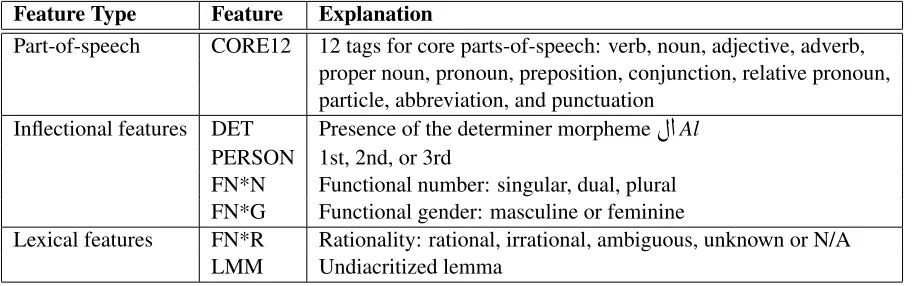
Feature Type Feature Explanation
Part-of-speech CORE12 12 tags for core parts-of-speech: verb, noun, adjective, adverb, proper noun, pronoun, preposition, conjunction, relative pronoun, particle, abbreviation, and punctuation
Inflectional features DET Presence of the determiner morpheme
È@
AlPERSON 1st, 2nd, or 3rd
FN*N Functional number: singular, dual, plural FN*G Functional gender: masculine or feminine
Lexical features FN*R Rationality: rational, irrational, ambiguous, unknown or N/A
[image:3.612.80.536.63.206.2]LMM Undiacritized lemma
Table 1: Features used in the CADIM submission with the Easy-First Parser (Goldberg and Elhadad, 2010).
Training Set Test Set LAS UAS LaS
5K (SPMRL’2013) dev≤70 81.7 84.7 92.7
All (SPMRL’2013) dev≤70 84.8 87.4 94.2
Marton et al. (2013) test (old split)≤70 81.7 84.6 92.8
5K (SPMRL’2013) dev 81.1 84.2 92.7
All (SPMRL’2013) dev 84.0 86.6 94.1
5K (SPMRL’2013) test 80.5 83.5 92.7
All (SPMRL’2013) test 83.2 85.8 93.9
[image:3.612.158.454.241.370.2]Marton et al. (2013) test (old split) 81.0 84.0 92.7
Table 2: Results of our system on Shared Task test data, Gold Tokenization, Predicted Morphological Tags; and for reference also on the data splits used in our previous work (Marton et al., 2013); “≤70” refers to the test sentences with 70 or fewer words.
Training Set Test Set Labeled Tedeval Score Unlabeled Tedeval Score
5K (SPMRL’2013) test≤70 86.4 89.9
All (SPMRL’2013) test≤70 87.8 90.8
Table 3: Results of our system on on Shared Task test data, Predicted Tokenization, Predicted Morphological Tags; “≤70” refers to the test sentences with 70 or fewer words
(again, both when using gold and when using pre-dicted POS and morphological features).
We also showed that for parsing with predicted POS and morphological features, training on a com-bination of gold and predicted POS and morpholog-ical feature values outperforms the alternative train-ing scenarios.
2.3 Best Performing Feature Set
The best performing set of features on non-gold in-put, obtained in Marton et al. (2013), are shown in Table 1. The features are clustered into three types.
• First is part-of-speech, represented using a
“core” 12-tag set.
• Second are the inflectional morphological fea-tures: determiner clitic, person and functional gender and number.
• Third are the rationality (humanness) feature, which participates in morphosyntactic agree-ment in Arabic (Alkuhlani and Habash, 2011), and a form of the lemma, which abstract over all inflectional morphology.
3 Our Submission
3.1 Data Preparation
The data split used in the shared task is different from the data split we used in (Marton et al., 2013), so we retrained our models on the new splits (Diab et al., 2013). The data released for the Shared Task showed inconsistent availability of lemmas across gold and predicted input, so we used the ALMOR analyzer (Habash, 2007) with the SAMA databases (Graff et al., 2009) to determine a lemma given the word form and the provided (gold or predicted) POS tags. In addition to the lemmas, the ALMOR an-alyzer also provides morphological features in the feature-value representation our approach requires. Finally, we ran our existing converter (Alkuhlani and Habash, 2012) over this representation to obtain functional number and gender, as well as the ratio-nality feature.3 For simplicity reasons, we used the MLE:W2+CATiB model (Alkuhlani and Habash, 2012), which was the best performing model on seen words, as opposed to the combination system that used a syntactic component with better results on unseen words. We did not perform Alif or Ya nor-malization on the data.
We trained two models: one on 5,000 sentences of training data and one on the entire training data.
3.2 Results
Our performance in the Shared Task for Arabic De-pendency, Gold Tokenization, Predicted Tags, is shown in Table 2. Our performance in the Shared Task for Arabic Dependency, Predicted Tokeniza-tion, Predicted Tags, is shown in Table 3. For predicted tokenization, only the IMS/Szeged sys-tem which uses syssys-tem combination (Run 2) out-performed our parser on all measures; our parser performed better than all other single-parser sys-tems. For gold tokenization, our system is the sec-ond best single-parser system after the IMS/Szeged single system (Run 1). For gold tokenization and predicted morphology (Table 2), we also give the performance reported in our previous work (Mar-ton et al., 2013). The increase over the previously
3
The functional feature generator of (Alkuhlani and Habash, 2012) was trained on a different training set from the parser, but the functional feature generator was not trained on any of the test corpus for the Shared Task.
reported work may simply be due to the different split for training and test, but it may also be due to improvements to the functional feature prediction (Alkuhlani and Habash, 2012), and the predicted features provided by the Shared Task organizers.
References
Sarah Alkuhlani and Nizar Habash. 2011. A corpus for modeling morpho-syntactic agreement in Arabic: gen-der, number and rationality. InProceedings of the 49th Annual Meeting of the Association for Computational Linguistics (ACL), Portland, Oregon, USA.
Sarah Alkuhlani and Nizar Habash. 2012. Identifying broken plurals, irregular gender, and rationality in Ara-bic text. In Proceedings of the 13th Conference of the European Chapter of the Association for Compu-tational Linguistics, pages 675–685. Association for Computational Linguistics.
Michael Collins, Jan Hajic, Lance Ramshaw, and Christoph Tillmann. 1999. A statistical parser for Czech. InProceedings of the 37th Annual Meeting of the Association for Computational Linguistics (ACL), pages 505–512, College Park, Maryland, USA, June.
Mona Diab, Nizar Habash, Owen Rambow, and Ryan Roth. 2013. LDC Arabic Treebanks and Associated Corpora: Data Divisions Manual. Technical Report CCLS-13-02, Center for Computational Learning Sys-tems, Columbia University.
Gülsen Eryigit, Joakim Nivre, and Kemal Oflazer. 2008. Dependency parsing of Turkish. Computational Lin-guistics, 34(3):357–389.
Yoav Goldberg and Michael Elhadad. 2010. An effi-cient algorithm for easy-first non-directional depen-dency parsing. In Proceedings of Human Language Technology (HLT): the North American Chapter of the Association for Computational Linguistics (NAACL), pages 742–750, Los Angeles, California.
David Graff, Mohamed Maamouri, Basma Bouziri, Sondos Krouna, Seth Kulick, and Tim Buckwal-ter. 2009. Standard Arabic Morphological Analyzer (SAMA) Version 3.1. Linguistic Data Consortium LDC2009E73.
Nizar Habash and Owen Rambow. 2005. Arabic Tok-enization, Part-of-Speech Tagging and Morphological Disambiguation in One Fell Swoop. InProceedings of the 43rd Annual Meeting of the Association for Com-putational Linguistics (ACL), pages 573–580, Ann Ar-bor, Michigan.
and A. Soudi, editors, Arabic Computational Mor-phology: Knowledge-based and Empirical Methods. Springer.
Nizar Habash, Owen Rambow, and Ryan Roth. 2009. MADA+TOKAN: A toolkit for Arabic tokenization, diacritization, morphological disambiguation, POS tagging, stemming and lemmatization. In Khalid Choukri and Bente Maegaard, editors,Proceedings of the Second International Conference on Arabic Lan-guage Resources and Tools. The MEDAR Consortium, April.
Nizar Habash, Owen Rambow, and Ryan Roth. 2012. MADA+TOKAN Manual. Technical report, Techni-cal Report CCLS-12-01, Columbia University. Nizar Habash. 2007. Arabic Morphological
Representa-tions for Machine Translation. In Antal van den Bosch and Abdelhadi Soudi, editors, Arabic Computational Morphology: Knowledge-based and Empirical Meth-ods. Kluwer/Springer.
Nizar Habash. 2010. Introduction to Arabic Natural Language Processing. Morgan & Claypool Publish-ers.
Yuval Marton, Nizar Habash, and Owen Rambow. 2013. Dependency parsing of Modern Standard Arabic with lexical and inflectional features. Computational Lin-guistics, 39(1).
Joakim Nivre, Igor M. Boguslavsky, and Leonid K. Iomdin. 2008. Parsing the SynTagRus Treebank of Russian. In Proceedings of the 22nd International Conference on Computational Linguistics (COLING), pages 641–648.
Joakim Nivre. 2008. Algorithms for Deterministic Incre-mental Dependency Parsing. Computational Linguis-tics, 34(4).
Joakim Nivre. 2009. Parsing Indian languages with MaltParser. InProceedings of the ICON09 NLP Tools Contest: Indian Language Dependency Parsing, pages 12–18.
Slav Petrov, Dipanjan Das, and Ryan McDonald. 2012. A universal part-of-speech tagset. InProceedings of the Conference on Language Resources and Evalua-tion (LREC), May.
Owen Rambow, Bonnie Dorr, David Farwell, Rebecca Green, Nizar Habash, Stephen Helmreich, Eduard Hovy, Lori Levin, Keith J. Miller, Teruko Mitamura, Florence Reeder, and Siddharthan Advaith. 2006. Par-allel syntactic annotation of multiple languages. In Proceedings of the Fifth Conference on Language Re-sources and Evaluation (LREC), Genoa, Italy. Djamé Seddah, Reut Tsarfaty, Sandra Kübler, Marie
Can-dito, Jinho Choi, Richárd Farkas, Jennifer Foster, Iakes Goenaga, Koldo Gojenola, Yoav Goldberg, Spence Green, Nizar Habash, Marco Kuhlmann, Wolfgang