Proceedings of the Workshop on Distributional Semantics and Compositionality (DiSCo’2011), pages 43–47,
Detecting compositionality using semantic
vector space models based on syntactic context.
Shared task system description
∗Guillermo Garrido NLP & IR Group at UNED
Madrid, Spain
Anselmo Pe ˜nas NLP & IR Group at UNED
Madrid, Spain
Abstract
This paper reports on the participation of the NLP GROUP at UNED in the DiSCo’2011 compositionality evaluation task. The aim of the task is to predict compositionality judge-ments assigned by human raters to candidate phrases, in English and German, from three common grammatical relations: adjective-noun, subject-verb and subject-object.
Our participation is restricted to adjective-noun relations in English. We explore the use of syntactic-based contexts obtained from large corpora to build classifiers that model the compositionality of the semantics of such pairs.
1 Introduction
This paper reports on the NLP GROUP at UNED ’s participation in DiSCo’2011 Shared Task. We at-tempt to model the notion of compositionality from analyzing language use in large corpora. In doing this, we are assuming the distributional hypothesis:
words that occur in similar contexts tend to have similar meanings (Harris, 1954). For a review of the field, see (Turney and Pantel, 2010).
1.1 Approach
In previous approaches to compositionality detec-tion, different kinds of information have been used: morphological, lexical, syntactic, and distributional.
∗
This work has been partially supported by the Spanish Ministry of Science and Innovation, through the project Holo-pedia (TIN2010-21128-C02), and the Regional Government of Madrid, through the project MA2VICMR (S2009/TIC1542).
For our participation, we are interested in exploring, exclusively, the reach of pure syntactic information to explain semantics.
Our approach draws from the Background Knowledge Base representation of texts introduced in (Pe˜nas and Hovy, 2010). We hypothesize that behind syntactic dependencies in natural language there are semantic relations; and that syntactic con-texts can be leveraged to represent meaning, particu-larly of nouns. A system could learn these semantic relations from large quantities of natural language text, to build an independent semantic resource, a Background Knowledge Base (BKB) (Pe˜nas and Hovy, 2010).
From a dependency-parsed corpus, we automat-ically harvest meaning-bearing patterns, matching the dependency trees to a set of pre-specified syn-tactic patterns, similarly to (Pado and Lapata, 2007). Patterns are matched to dependency trees to produce propositions, carriers of minimal semantic units. Their frequency in the collection is the fundamen-tal source of our representation.
Our participation, due to time constraints, is re-stricted to adjective-noun pairs in English.
2 System Description
Our hypothesis can be spelled out as: words (or word compounds) with similar syntactic contexts are semantically similar.
The intuition behind our approach is that non-compositional compounds are units of meaning. Then, the meaning of an adjective-noun combina-tion that is not composicombina-tional should be different from the meaning of the noun alone; for similar
approaches, see (Baldwin et al., 2003; Katz and Giesbrecht, 2006; Mitchell and Lapata, 2010). We propose studying the distributional semantics of a
adjective-noun compound; in particular, we will rep-resent it via its syntactic contexts.
2.1 Adjective-noun compounds
Given a particular adjective-noun compound, de-notedha, ni, we want to measure its composition-ality by comparing its syntactic contexts to those of the noun: hni. After exploring the dataset we real-ized that considering nouns alone introduced noise, as contexts of the target and different meanings of the noun might be hard to separate; in order to soften this problem we decided to compare the occurrences of theha, nipair to those of the noun with adifferent adjective.
Given a dependency-parsed corpusC, we denote
Nthe set of all nouns occurring inCandAthe set of all adjectives. An adjective-noun pair,ha, ni, is an occurrence in the dependency parse of the sentence of an arc(a, n), wherenis the governor of an adjec-tival relation, withaas modifier. We define the com-plementaryofha, nias the set of all adjective-noun pairs with the same noun but a different adjective:
hac, ni={hb, ni such thatb∈A, b6=a}
In order to detect compositionality, we compare the semantics of ha, ni to those of its complemen-taryhac, ni. We use syntactic context as the repre-sentation of these compounds’ semantics.
We calltarget pairsthoseha, niin which we are interested, as they appear in the training, validation, or test sets for the task. For each of them, its com-plementary target is:hac, ni.
We model the syntactic contexts of anyha, nipair as asetof vectors in a set of vector spaces defined as follows. After inspection of the corpus, and its de-pendency parse annotation layer, we manually spec-ified a few syntactic relations, which we consider codify the relevant syntactic relations in which an ha, ni takes part. For each of these syntactic rela-tions, we built a vector space model, and we repre-sented as a vector in it each of the target patterns, and each of their respective complementary targets. To compute compositionality of a target, we calcu-lated the cosine similarity between the target vec-tor and the target’s complementary vecvec-tor. So, for
each syntactic relation, and for each target, we have a value of its similarity to the complementary tar-get. These similarity values are considered features, from which to learn the compositionality of targets.
For results comparability, we used the PukWaC corpus1as dataset. PukWaC adds to UkWaC a layer of syntactic dependency annotation. The corpus has been POS-tagged and lemmatized with the TreeTag-ger2. The dependency parse was done with Malt-Parser (Nivre and Scholz, 2004).
2.2 Implementation details
We defined a set of 19 syntactic patterns that define interesting relations in which an ha, ni pair might take part, trying to exploit the dependencies pro-duced by the MaltParser (Nivre and Scholz, 2004), including:
• Relations to a verb, other than the auxiliary to be and to have: subject; object; indirect object; subject of a passive construction; logical sub-ject of a passive construction.
• The relations defined in the previous point, en-riched with a noun that acts as the other element of a [subject-verb-object] or [subject-passive verb-logical subject] construction.
• Collapsed prepositional complexes. • Noun complexes.
• As subject or object of the verb to be. • Modified by a second adjective. • As modifier of a possessive.
The paths were defined manually to match our in-tuitions of which are the paths that best describe the context of anha, nipair, similarly to (Pado and Lap-ata, 2007). For each of the patterns, the set of words that are related through it to the targetha, nidefine the target’scontext.
For most of our processing, we used simple pro-grams implemented in Prolog and Python. We im-plemented Prolog programs to model the depen-dency parsed sentences of the full PUkWaC corpus, and to match and extract these patterns from them. After an aggregating step, where proper nouns, num-bers and dates are substituted by place-holder
vari-1Available at http://wacky.sslmit.unibo.
it
2http://www.ims.uni-stuttgart.
ables, they amount to over 16 million instances, representing the syntactic relations in which every ha, ni pair in the corpus takes part. In further pro-cessing, only those that affect the target pairs, or the nouns in them, have to be taken into account.
As described above, each pattern we have defined yields a vector space, where each target and its com-plementary are represented as a vector. The base vectors of the vector space model for a pattern are the words that are syntactic contexts, with that syn-tactic pattern, of any target in the target set3.
The value of the coordinate for a target and a base vector is the frequency of the context word as related to the target by the pattern. All frequencies were locally scaled using logarithms4.
For each syntactic pattern, and for each target and complementary, we have two vectors, represent-ing their meanrepresent-ings in the vector space distributional model. The complementary vector, in particular, represents the centroid (average) of the meanings of all hb, ni pairs, that share the noun with the target but have a different adjective,b
We propose that a target will be more composi-tional if its meaning is more similar to the meaning of the centroid of its complementary, that codifies the general meaning of that noun (whenever it ap-pears with a different adjective).
For each syntactic pattern and target, we can com-pute the cosine similarity to the complementary tar-get, and obtain a value to use as a feature of the com-positionality of the target. Those features will be used to train a classifier, being the compositionality score of each sample the label to be learnt.
We used RapidMiner5 (Mierswa et al., 2006) as our Machine Learning framework. The classifiers we have used, that are described below, are the im-plementations available in RapidMiner.
3It would have been possible to consider a common vector
space, using all patterns as base vectors. We decided not to do so after realising that a single similarity value for a target and its complementary was not by itself a signal strong enough to predict the compositionality score. A second objective was to assess the relative importance of different syntactic contexts for the task.
4
We did not attempt any global weighting. We leave this for future work.
5http://rapid-i.com
2.3 Feature selection
From the 19 original features, inspection of the cor-relation to the compositionality score label showed that some of them were not to be expected to have much predictive power, while some of them were too sparse in the collection.
We decided to perform feature selection previ-ous to all subsequent learning steps. We used RapidMiner genetic algorithm for feature selection6. Among the patterns which features were not selected were those where theha, nipair appears in prepo-sitional complexes, in noun complexes, as indirect object, as subject or object of the verb to be, and as subject of a possessive. Among those selected were subject and objects of both active and passive con-structions, and the object of possessives.
2.4 Runs description
Numeric scores For the numeric evaluation task, we built a regression model by means of a SVM classifier. We used RapidMiner’s implementation of mySVMLearner (R¨uping, 2000), that is based on the optimization algorithm of SVM-light (Joachims, 1998). We used the default parameters for the clas-sifier. A simple dot product kernel seemed to ob-tain the best results in 10-fold cross validation over the union of the provided train and validation re-sults. For the three runs, we used identical settings, optimizing different quality measures in each run: absolute error (RUN SCORE-1), Pearson’s correla-tion coefficient (RUN SCORE-2), and Spearman’s rho (RUN SCORE-3). The choice of a SVM classifier was motivated by the objective of learning a good parametric classifier model. In initial experiments, SVM showed to perform better than other possible choices, like logistic regression. In hindsight, the relatively small size of the dataset might be a reason for the relatively poor results. Experimenting with other approaches is left for future work.
Coarse scores For the coarse scoring, we decided to build a different set of classifiers, that would learn the nominal 3-valued compositionality label. The classifiers built in our initial experiments turned out
6
Run avg4 r ρ
RUN-SCORE-1 16.395 0.483 0.487
RUN-SCORE-2 15.874 0.475 0.463
RUN-SCORE-3 16.318 0.494 0.486
[image:4.612.106.269.58.114.2]baseline 17.857 – –
Table 1: TRAINING. Numeric score runs results on 10-fold cross-validation for the training set. avg4: average absolute error;r: Pearson’s correlation;ρ: Spearman’s rho.
Run avg4 r ρ
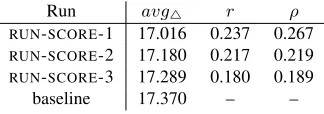
RUN-SCORE-1 17.016 0.237 0.267
RUN-SCORE-2 17.180 0.217 0.219
RUN-SCORE-3 17.289 0.180 0.189
baseline 17.370 – –
Table 2: TEST. Numeric score runs for the test set. Only for the en-ADJ-NN samples.avg4: average absolute error;r: Pearson’s correlation;ρ: Spearman’s rho.
to lazily choose the most frequent class (“high”) for most of the test samples. In an attempt to overcome this situation and possibly learn non linearly separa-ble classes, we tried neural network classifiers7. In hindsight, from seeing the very poor performance of this classifiers on the test set, it is clear that any per-formance gains were due to over-fitting on the train-ing set.
For RUN COARSE-2, we binned the numeric scores obtained inRUN-SCORE-1, dividing the score
space in three equal sized parts; we decided not to assume the same distribution of the three labels for the training and test sets. The results were worse than the numeric scores, due to the fact that the 3 classes are not equally sized.
2.5 Results
Results in the training phase For all our training, we performed 10-fold cross validation. For refer-ence, we report the results as evaluated by averag-ing over the 10 splits of the union of the provided training and validation set in Table 1. We compared against a dummy baseline: return as constant score the average of the scores in the training and
valida-7
For RUN COARSE-1, we used AutoMLP (Breuel and Shafait, 2010), an algorithm that learns a neural network, op-timizing both the learning rate and number of hidden nodes of the network. ForRUN COARSE-3, we learnt a simple neural net-work model, by means of a feed-forward neural netnet-work trained by a backpropagation algorithm (multi-layer perceptron), with a hidden layer with sigmoid type and size8.
tion sample sets.
Disappointingly, the resulting classifiers seemed to be quitelazy, yielding values significatively close to the average of the compositionality label in the training and validation set.
The AutoMNLP and neural network seemed to perform reasonably, and better than other classifiers we tried (e.g., SVM based). We were wary, though, of the risk of having learnt an over-fitted model; un-fortunately, the results on the test set confirmed that: for instance, the accuracy ofRUN-SCORE-3 for the
training set was0.548, but for the test set it was only 0.327.
Results in the test phase After the task results were distributed, we verified that our numeric score runs, for the subtask en-ADJ-NN performed quite well: fifth among the 17 valid submissions for the subtask, using the average point difference as quality measure. Nevertheless, in terms of ranking correla-tion scores, our system performs presumably worse, although separate correlation results for the en-ADJ-NN subtask were not available to us at the time of writing this report.
Our naive baseline turns out to be strong in terms of average point score. Of course, the ranking corre-lation of such a baseline is none; using ranking cor-relation as quality measure would be more sensible, given that it discards such a baseline.
3 Conclusions
We obtained modest results in the task. Our three numeric runs obtained results very similar to each other. Only taking part in the en-ADJ-NN subtask, we obtained the 5th best of a total of 17 valid sys-tems in average point difference. Nevertheless, in terms ranking correlation scores, our systems seem to perform worse. The modifications we tried to spe-cialize for coarse scoring were unsuccessful, yield-ing poor results.
[image:4.612.106.268.171.228.2]References
Timothy Baldwin, Colin Bannard, Takaaki Tanaka, and Dominic Widdows. 2003. An empirical model of multiword expression decomposability. In Proceed-ings of the ACL 2003 workshop on Multiword expres-sions: analysis, acquisition and treatment - Volume 18, MWE ’03, pages 89–96, Stroudsburg, PA, USA. Asso-ciation for Computational Linguistics.
Thomas Breuel and Faisal Shafait. 2010. Automlp: Sim-ple, effective, fully automated learning rate and size adjustment. InThe Learning Workshop. Online, 4. Zellig S. Harris. 1954. Distributional structure. Word,
pages 146–162.
Thorsten Joachims. 1998. Making large-scale svm learn-ing practical. LS8-Report 24, Universit¨at Dortmund, LS VIII-Report.
Graham Katz and Eugenie Giesbrecht. 2006. Automatic identification of non-compositional multi-word ex-pressions using latent semantic analysis. In Proceed-ings of the Workshop on Multiword Expressions: Iden-tifying and Exploiting Underlying Properties, MWE ’06, pages 12–19, Stroudsburg, PA, USA. Association for Computational Linguistics.
Ingo Mierswa, Michael Wurst, Ralf Klinkenberg, Martin Scholz, and Timm Euler. 2006. Yale: rapid prototyp-ing for complex data minprototyp-ing tasks. InKDD’06, pages 935–940.
Jeff Mitchell and Mirella Lapata. 2010. Composition in distributional models of semantics.Cognitive Science, 34(8):1388–1429.
Joakim Nivre and Mario Scholz. 2004. Deterministic dependency parsing of english text. COLING ’04. Sebastian Pado and Mirella Lapata. 2007.
Dependency-Based Construction of Semantic Space Models. Com-putational Linguistics, 33(2):161–199, jun.
Anselmo Pe˜nas and Eduard Hovy. 2010. Semantic en-richment of text with background knowledge. pages 15–23, jun.
Stefan R¨uping. 2000. mySVM-Manual.
http://www-ai.cs.uni-dortmund.de
/SOFTWARE/MYSVM/.
Peter D. Turney and Patrick Pantel. 2010. From fre-quency to meaning: Vector space models of semantics.