Cite this:Dalton Trans., 2017,46, 465
Received 16th October 2016, Accepted 5th December 2016
DOI: 10.1039/c6dt03969c
www.rsc.org/dalton
Halochromic coordination polymers based on a
triarylmethane dye for reversible detection of
acids
†
Marina S. Zavakhina,
a,bIrina V. Yushina,
aDenis G. Samsonenko,
a,bDanil N. Dybtsev,*
a,bVladimir P. Fedin,
a,bStephen P. Argent,
cAlexander J. Blake
cand
Martin Schröder
a,dChromeazurol B (Na2HL) is a pH-sensitive (halochromic) dye based on a hydroxytriarylmethane core and
two carboxylate functional groups, which makes it suitable for the synthesis of coordination polymers. Two new coordination polymers [NaZn4(H2O)3(L)3]·3THF·3H2O (1) and [Zn3(H2O)3(μ2-OH2)(μ3-OH)
(HL)2(H2L)]·2THF·3H2O (2) incorporating Chromeazurol B linkers have been prepared and characterised.
The structure of1comprises pentanuclear heterometallic {Zn4Na} nodes linked by six L
3−anions to give a
layered structure with a honeycomb topology.2crystallizes as a double-chain ribbon (ladder) structure with two types of metal node: a mononuclear Zn(II) cation and tetranuclear {Zn(II)}4cluster. Chromeazurol
B anions link each tetranuclear cluster to four individual Zn(II) cations and each Zn(II) cation with four tetranuclear clusters. Both compounds show pH-sensitivity in water solution which can be observed visu-ally, giving the first example of a halochromic coordination polymer. The halochromic properties of
1 towards HCl vapors were systematically investigated. As-synthesized violet-grey1reversibly changes color from orange to pink in the presence of vapors of 2 M and 7 M HCl, respectively. The coordination of the Chromeazurol B anion at each color stage was examined by diffuse reflectance spectroscopy and FT-IR measurements. The remarkable stability of1to acid and the observed reversible and reproducible color changes provide a new design for multifunctional sensor materials.
Introduction
Metal–organic frameworks (MOFs) are hybrid materials assembled from metal ions or clusters and organic linkers,1 and their adaptable modular design results in various tailored properties for the resultant porous materials2 including gas storage and separation properties.3The use of porous MOFs as sensors is another important direction and is receiving increasing attention.4Compared to molecular sensors, porous MOFs have a number of advantages, such as potentially higher stability, and, most importantly, the microporous structure
with extended surface area can ensure effective adsorption of analyte molecules from gas or liquid media into the pores, thus potentially improving detection limits. Also, by tuning the pore geometry and functionality, the crystalline MOF sensor can be adapted for the detection of a specific molecule within a set of complex mixtures. There are many interesting examples of MOFs used for the detection of explosives,5 hazar-dous organic substances,6 and metal cations.7 These properties are typically based on magnetic,8 electrochemical/ electromechanical9 or luminescent10 response of the porous framework upon inclusion of the particular guest molecule. Although luminescence sensors possess good detection levels, an external UV light source is usually required for visuali-zation. In contrast, colorimetric sensors featuring a change of color of the material by an external stimulus can potentially be monitored visually and are therefore simpler to use. To date, however, there are few reports on colorimetric sensing by MOFs in which different porphyrinic,11diimide,12or viologen-substituted ligands13have been employed. In another example based on Co(II), a color change occurs when the metal cation changes coordination environment from octahedral to tetrahedral.14
†Electronic supplementary information (ESI) available: Synthesis and analytical methods, crystallographic information, IR spectra, TGA plots and additional figures and photographs. CCDC 1504745 and 1504746. For ESI and crystallo-graphic data in CIF or other electronic format see DOI: 10.1039/c6dt03969c aNikolaev Institute of Inorganic Chemistry, Russian Academy of Sciences,
Siberian Branch, Acad. Lavrentiev Ave., 3, Novosibirsk, 630090, Russian Federation. E-mail: [email protected]; Fax: +7 (383) 330 9489
bNovosibirsk State University, Pirogov str., 2, Novosibirsk, 630090,
Russian Federation
cSchool of Chemistry, University of Nottingham, NG7 2RD Nottingham, UK
dSchool of Chemistry, University of Manchester, M13 9PL Manchester, UK
Open Access Article. Published on 05 December 2016. Downloaded on 10/04/2017 14:50:05.
This article is licensed under a
Halochromic compounds (pH indicators) are among the most commonly used sensors in chemistry. Such molecules often possess a system of conjugated bonds which are altered upon protonation or deprotonation. Hydroxytriarylmethane-based pH indicators are classic examples of such systems.15 These molecules, if incorporated into a coordination polymer, e.g., within the linkers of a MOF, could function as halochromic detectors within the resultant material. Strikingly, this idea, despite being rather simple and straightforward, has not to our knowledge been explored previously. Chromeazurol B (also known as Chrome Pure Blue BX, Eriochrome Azurol B, Mordant Blue 1, herein denoted as Na2HL) is a well-known pH-sensitive
compound based on hydroxytriarylmethane core.16Depending on its protonation level, it exists in one of four different forms, each having a distinct color, thus representing a one-component universal pH sensor (Fig. 1). It also bears two carboxylate groups in its structure suggesting its potential use as a bridging ligand within a MOF architecture. Although a few structurally charac-terized molecular coordination compounds based on hydroxy-arylmethane ligands have been reported, their pH dependent halochromic behavior has not been investigated.17
In this work we present two new coordination polymers [NaZn4(H2O)3(L)3]·3THF·3H2O (1) and [Zn3(H2O)3(μ2-OH2)(μ3
-OH)(HL)2(H2L)]·2THF·3H2O (2) based on the Chromeazurol B
dye as a bridging linker, and report their optical properties for
1as a function of pH. These compounds are the first examples of MOF materials that show halochromic behavior in aqueous solution as well as with acidic vapors. The observation of reversible color changes and the structural stability of 1 at low pH demonstrate its pH sensing capabilities and opens new perspectives for MOF materials in important sensing applications.
Results and discussion
Protonation levels of Chromeazurol B (Na2HL)
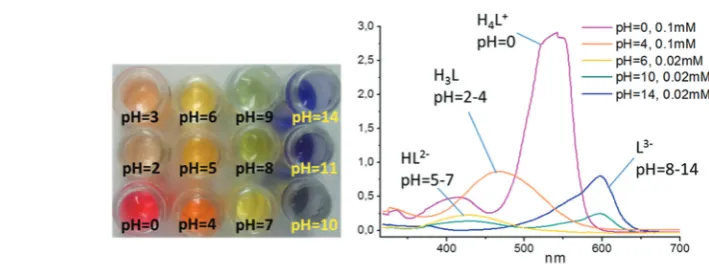
The dependence of Chromeazurol B color with pH was exam-ined by spectrophotometry in solution for pH = 0–14. Four absorbance bands (550 nm, 480 nm, 430 nm, 600 nm) in the visible spectrum can be assigned to 4 different forms of the dye (Fig. 2).18At pH = 0 the pink-red protonated form H4L+is
formed (ε(550 nm) = 2.8 × 10⁴M−1 cm−1), while at pH = 2–4 the less intense red-orange form H3L (ε(H3L, 480 nm) = 8.6 ×
103 M−1cm−1) is formed and at pH >4 a yellow-orange form HL2−(ε(430 nm) = 1.1 × 10⁴M−1cm−1) exists. Finally, the fully deprotonated blue form of Chromeazurol B L3−(ε(600 nm) = 3.9 × 10⁴M−1cm−1) is formed in highly basic solutions.15,16
Synthesis
Compounds [NaZn4(H2O)3(L)3]·3THF·3H2O (1) and [Zn3(H2O)3(μ2
-OH2)(μ3-OH)(HL)2(H2L)]·2THF·3H2O (2) were obtained by reaction
of Chromeazurol B Na2(HL) with Zn(OAc)2in water/THF solution.
The solvent composition is critical, because compound 1 is obtained from a 2 : 1 mixture of water : THF, while2can be iso-lated from the more polar 4 : 1 water : THF solvent mixture. Both crystalline products are deeply colored and appear almost black. Crystals of the compound1adopt a rhombohedral shape with a dark golden hue, while2forms octahedral crystals with a green-ish luster, red in transmitted light (Fig. S1†).
Structures
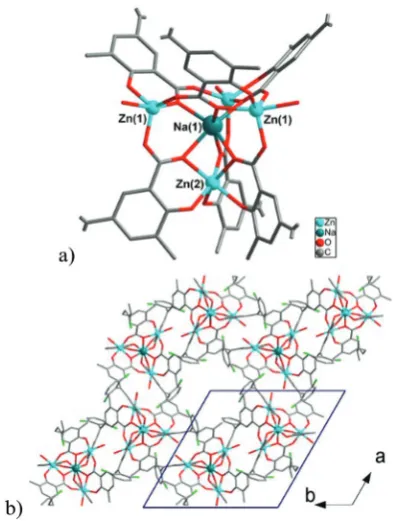
[NaZn4(H2O)3(L)3]·3H2O·3THF (1). Compound 1 shows a
layered structure constructed around a pentanuclear {Zn4Na}
cluster (Fig. 3a) comprising of two types of Zn(II) cations [three Zn(1) and one Zn(2)] and one Na(1) cation. The Zn(1) cation Fig. 1 View of different forms of Chromeazurol B in solution.
Fig. 2 Photographs and UV-vis spectra of Chromeazurol B in aqueous solutions of different pH.
Open Access Article. Published on 05 December 2016. Downloaded on 10/04/2017 14:50:05.
This article is licensed under a
[image:2.595.149.461.51.112.2] [image:2.595.92.447.569.703.2]shows a distorted trigonal bipyramidal coordination environ-ment formed by an aqua ligand and four carboxylate O-donors of three ligands L3−. The Zn(2) center has a distorted octa-hedral geometry formed by six O-donors from three carboxy-late and three phenocarboxy-late moieties of L3−. All Zn–O distances are in range 1.9618(18)–2.2216(19) Å, and Na(1) has distorted octahedral coordination environment formed by six carboxy-late oxygen atoms from six ligands L3− (Na–O = 2.2573(19)– 2.334(2) Å). Each pentanuclear {Zn4Na} building unit is bound
to six Chromeazurol linkers, each of which bridges two Zn4Na
units to form layers (Fig. 3b) of honeycomb topology (Fig. S7†). The X-ray diffraction analysis also reveals three THF guest molecules per formula unit and some residual electron density assigned to a disordered water molecules in the void space in
1(ca. 3H2O molecules per formula unit according to PLATON/
SQUEEZE19). Elemental analysis data confirm the composition of the compound. Thermogravimetric analysis (TGA) of1 indi-cates an ill-defined two-step weight loss up to 250 °C (18%), attributed to both guest and coordinated solvent molecules (calc. 16.3%), followed by the framework decomposition.
[Zn3(H2O)3(μ2-OH2)(μ3-OH)(HL)2(H2L)]·2THF·3H2O (2).
Compound 2 has a chain structure with the asymmetric unit containing three Zn(II) cations and three Chromeazurol B ligands, one as H2L− and two as HL2−. Zn(1) has octahedral
coordination formed by six O-donors (three of carboxylate and three of phenolate moieties) of three organic ligands (Fig. 4a). Two Zn(2) and two Zn(3) centers form a tetranuclear building unit {Zn2(H2O)3(μ-OH2)(μ3-OH)(OOCR)2}2 (Fig. 4b), whereas the
Zn(1) centers form part of mononuclear units. Zn(2) has a dis-torted octahedral coordination formed by three carboxylate
oxygen atoms of two organic ligands, two aqua-ligands (one terminal and one bridged), and a bridgingμ3-OH group. Zn(3)
has slightly distorted octahedral coordination environment formed by a carboxylate oxygen, three aqua-ligands (two terminal and one bridged), and twoμ3-OH groups. Zn(2) connects to Zn(3)
viabridged carboxylate group of the organic ligand, a μ2-OH2,
and a μ3-OH group. Zn(3) connects to another Zn(3) via two
μ3-OH ligands with eachμ3-OH ligand connecting one Zn(2) and
two Zn(3) cations (Fig. 3b). Each tetranuclear unit connects with four Zn(1) cations via four bridging HL2− ligands, while each Zn(1) cation connects with two tetranuclear unitsviatwo bridging HL2−ligands. The H2L−moiety is coordinated to Zn(1) as a
termi-nal ligand. Thus, Zn(1) centers can be described as two– con-nected nodes, while the tetranuclear units act as four-concon-nected nodes. Interconnection of these coordination nodes forms form polymeric chains (Fig. 4c) with the unit cell containing 96 mole-cules of Chromeazurol B and 96 Zn atoms (32 mononuclear and 16 tetranuclear units) to give an overall formula [Zn3(H2O)3(μ2
-OH2)(μ3-OH)(HL)2(H2L)]. The interstitial space is occupied by
solvent THF and water molecules, and the tentative guest compo-sition (two THF and three H2O molecules per formula unit) was
established from elemental analysis data and thermal gravi-metric analysis (TGA). TGA shows a multistep weight loss curve with the first step (4% loss at 100 °C) attributed to 1 THF molecule (calc. 3.9%) and the second step (12%, 150 °C) to the removal of the remaining guest molecules (calc. 10.7%), followed by a decomposition of the coordination polymer above 170 °C.
Sensing properties
Successful synthesis of new coordination compounds in-corporating Chromeazurol B prompted us to investigate the halo-Fig. 3 (a) View of {NaZn4} cluster in1. (b) The structure of the layer in1.
Hydrogen atoms are omitted for clarity.
Fig. 4 Views of (a) the coordination environment of the Zn(1) cation in
2, (b) the structure of tetranuclear cluster in2, and (c) the structure of the polymeric chain in2. Hydrogen atoms are omitted for clarity.
Open Access Article. Published on 05 December 2016. Downloaded on 10/04/2017 14:50:05.
This article is licensed under a
[image:3.595.66.264.49.310.2] [image:3.595.318.536.50.272.2]chromic behavior of these materials. Preliminary experiments with thin layer samples of 1 and2 in both water and dilute HCl solution ( pH = 2) indicate that they have similar behavior. The color of crystals of both compounds changes reversibly from violet to orange by varying the pH of the media from neutral to acidic (Fig. S9†). Because of their similarity in pH behavior and the better crystallinity and quality for1, we inves-tigated the detailed halochromic properties of 1 only. The stability of 1 under a broad range of acidic and basic con-ditions was examined by powder X-ray diffraction analysis (Fig. 5). When exposed to vapors20of an aqueous solution of 2 M HCl ( partial pressure of HCl gas ca. 10−3 mmHg),
1 retains its crystallinity for at least 1 day. Moreover, under vapors of 7 M HCl ( partial pressure of HCl gasca. 0.64 mmHg) the crystals of1remain stable for at least 8 h and even after 1 day of exposure the quality of the diffraction pattern remains good. However, under vapors of aqueous NH3solution at pH 9 1 decomposes rapidly and thus were only able to conduct sensing experiments under acidic atmospheres only.
The halochromic properties of 1 were investigated by a number of methods. Because of the intense absorbance of1, the crystals were ground and mixed with BaSO4 (5% of 1 in
BaSO4 by weight). A thin layer of the corresponding powder
mixture was exposed to vapors of solutions of HCl of different concentrations (2 M to 7 M). The violet-gray color of the as-synthesized 1@BaSO4 turned orange in 2 M and pink in
7 M HCl (Fig. 6a–c). When exposed to HCl vapors of intermedi-ate concentration between 4 M and 6 M HCl the sample exhibi-ted intermediate colors (Fig. S10†). In 7 M HCl the color of the sample changed over a few minutes, while in 2 M the tran-sition takes few hours (Fig. S11†). It is important to note that all changes were completely reversible since pink and orange powders turned back to violet-gray after aeration, though the complete release of acid is a slower process than its uptake.
Diffuse reflectance spectroscopy (DRS) measurements clearly supported the visual observations as the spectra of the pelleted samples of 1@BaSO4 exposed to various media
revealed remarkable changes depending on the acidity of the atmosphere (Fig. 7). For comparison we also carried out the DRS measurements of pellets of Na2HL@BaSO4, treated
simi-larly to 1@BaSO4. The positions of the reflectance peaks
for solid samples Na2HL@BaSO4 are similar to the
adsorp-tion bands in the UV-VIS spectra of Chromeazurol B in aqueous solutions at similar acidity. Also, the observed DRS peaks of 1@BaSO4 closely match those for the free ligand
Na2HL@BaSO4. Therefore, coordination of Zn(II) to donor groups of the Chromeazurol B ligand does not seem to change the ability of the latter to accept the protons from the acidic environment. In other words, particular protonated forms of the pH-sensitive ligand exist in the coordination polymer1as in free Chromeazurol B under comparable conditions.
The DRS data for as prepared Na2HL@BaSO4show only the
component HL2−atca. 460 nm (ref. 17) while the spectrum of
1@BaSO4 consists of two absorption bands at ca. 480 and
620 nm (Fig. 7a), assigned to the two anionic forms L3−and HL2−, respectively, although only L3−is assumed in the crystal Fig. 5 PXRD patterns for1(calculated) and for1under different vapors
of 2 M HCl, 7 M HCl, NH3solution at pH 9. Exposure time is 24 h for 2 M
acid vapors, 24 h and 8 h for 7 M HCl vapors, and 2 h for NH3.
Fig. 6 Views of1@BaSO4(5% in BaSO4): (a) in air, (b) under 2 M HCl
vapor and (c) under 7 M HCl vapor.
Fig. 7 Absorbance spectra and forms of the organic anion in 1: (a) under air, (b) under 2 M acid vapor and (c) under 7 M acid vapor. Black lines are for1and the red lines for Na2HL.
Open Access Article. Published on 05 December 2016. Downloaded on 10/04/2017 14:50:05.
This article is licensed under a
[image:4.595.328.527.47.389.2] [image:4.595.50.284.52.142.2] [image:4.595.45.290.630.693.2]X-ray diffraction data. During exposure of Na2HL@BaSO4 to
2 M HCl vapor the band at 460 nm undergoes a bathochromic shift to 470 nm, supporting the formation of the triply-proto-nated charge neutral form H3L (Fig. 7b). There is also a similar
absorption band in the reflectance spectrum of 1@BaSO4
under 2 M HCl vapors so we can assume full protonation of the bound Chromeazurol B ligand in1under these conditions. Finally, when exposed to vapors of 7 M HCl the sample Na2HL@BaSO4 turned pink as does free Chromeazurol B in
highly acidic solutions. This color and the major absorption band atca. 550 nm are characteristic of the fully protonated H4L+ species (Fig. 7c). The diffuse reflectance spectrum of 1@BaSO4exposed to 7 M HCl vapors has a similar pink color
and, much like the free Chromeazurol B sample, displays the second component atca. 475 nm, along with a major band at 550 nm. This suggests the simultaneous presence of H3L as
well as H4L+ species in the samples. It should be noted that
the DRS measurements and all required manipulations with the powder samples were carried out under air which may result in a partial reduction of the protonation level of the samples due to the release of volatile HCl. This explains the presence of the H3L component in the spectra of both samples
Chromeazurol B and1exposed to the 7 M HCl vapors with the highest acid content. The obtained DRS data indicate that within the studied range of conditions the Chromeazurol B ligand undergoes the transition between three forms (HL2−, H3L and H4L+) while framework 1 between four forms (L3−,
HL2−, H3L and H4L+), which makes the visual changes more
characteristic and demonstrates the potential advantage of halochromic MOFs over molecular pH sensors.
Independent confirmation of the suggested protonated forms of Chromeazurol B ligand in crystalline 1 under different atmosphere (air, 2 M or 7 M HCl vapors) could be obtained by IR spectroscopy (Fig. 8 and S13†). Notable changes are observed for peaks at 735 and 1490 cm−1assigned to vibrations of the Zn(II) bound carboxylate anion COO−, and
for the distinct peak at 1620 cm−1 assigned to the νCvO
stretching vibration of the protonated carboxylate group bound to Zn(II).21Along with the increase in acidity of the media and hence the protonation level of 1, the peaks for Zn(II)-bound COO−gradually disappear while the corresponding peaks for Zn(II)-bound COOH emerge. Note, that the IR spectroscopic data support the structural models displayed in Fig. 7.
We also estimated the level of protonation of 1 under vapors of 2 M or 7 M HCl after 1 h. The corresponding micro-crystalline samples were dispersed in 3 ml of a distilled H2O
and the acidities of the resultant solutions measured using a pH sensitive electrode. The amount of the acidic protons (degree of protonation), calculated from the pH values were found to be 2.8 and 3.9 per ligand L for the samples saturated at 2 M HCl and 7 M HCl, respectively (ESI Table S4†). These match very well to the theoretical protonation levels of the Chromeazurol B ligand (i.e., 3 and 4, respectively), proposed for the corresponding samples (Fig. 7b and c).
The fully reversible nature of the halochromic properties of
1 was demonstrated when 1@BaSO4 sample was alternately
treated with 2 M HCl and 7 M HCl vapors several times (Fig. 9). The DRS data indicate reversible changes of the spectra support-ing the correspondsupport-ing visual changes of the sample within a few minutes or half an hour, depending on the HCl concentration (Fig. S14†). As noted above, the residual peaks at 550 nm in the compound exposed to 2 M HCl apparently result from the incomplete deprotonation of the sample. Note, however, that after these repeating experiments in the acidic atmosphere con-ditions the sample could be completely regenerated to its origi-nal color and spectra by aeration for few days.
Conclusions
The present work describes the synthesis and structural characterization of two coordination compounds based on Chromeazurol B dye. The products incorporate the pH-sensi-Fig. 8 IR spectra of1exposed in the air (black), in 2 M HCl vapors (red)
and in 7 M HCl vapors (blue).
Fig. 9 From bottom to top: DRS data of a series of consecutive experi-ments of exposure for 1@BaSO4 to vapors from HCl of different
molarity. Exposure time for each experiment is 1 h, unless otherwise stated.
Open Access Article. Published on 05 December 2016. Downloaded on 10/04/2017 14:50:05.
This article is licensed under a
[image:5.595.327.526.51.210.2] [image:5.595.48.290.555.690.2]tive properties of the ligand resulting in coordination polymers with hitherto unprecedented halochromic properties. Various spectroscopic techniques provide the insights into the proto-nation levels of this pH-sensitive system. The marked stability of1and2from pH-neutral aqueous solutions to highly acidic HCl fumes, and the reversible and reproducible character of the corresponding color changes provide new opportunities and directions for MOFs in the design and development of multifunctional sensor materials.
Acknowledgements
The work was supported by the Grant of the Government of the Russian Federation (Grant No. 14.Z50.31.0006). MS is grateful to EPSRC for support and to the ERC for an Advanced Grant.
Notes and references
1 (a) N. Stock and S. Biswas, Chem. Rev., 2012, 112, 933; (b) V. Guillerm, D. Kim, J. F. Eubank, R. Luebke, X. Liu, K. Adil, M. S. Lah and M. Eddaoudi,Chem. Soc. Rev., 2014,43, 6141; (c) S. Qiu and G. Zhu,Coord. Chem. Rev., 2009,253, 2891. 2 (a) B. Li, M. Chrzanowski, Y. Zhang and S. Ma, Coord.
Chem. Rev., 2016, 307, 106; (b) P. Peluso, V. Mamane and S. Cossu, J. Chromatogr., A, 2014, 1363, 11; (c) H. Wu, Q. Gong, D. H. Olson and J. Li,Chem. Rev., 2012,112, 836; (d) V. Stavila, A. A. Talin and M. D. Allendorf,Chem. Soc. Rev., 2014,43, 5994.
3 (a) Z. Zhang, Z.-Z. Yao, S. Xiang and B. Chen, Energy Environ. Sci., 2014, 7, 2868; (b) J.-R. Li, J. Sculley and H.-C. Zhou, Chem. Rev., 2012, 112, 869; (c) K. Sumida, D. L. Rogow, J. A. Mason, T. M. McDonald, E. D. Bloch, Z. R. Herm, T.-H. Bae and J. R. Long,Chem. Rev., 2012,112, 724; (d) M. P. Suh, H. J. Park, T. K. Prasad and D.-W. Lim, Chem. Rev., 2012,112, 782; (e) X. Lin, N. R. Champness and M. Schröder,Top. Curr. Chem., 2010,293, 35.
4 (a) L. E. Kreno, K. Leong, O. K. Farha, M. Allendorf, R. P. Van Duyne and J. T. Hupp,Chem. Rev., 2012,112, 1105; (b) Z. Hu, B. J. Deibert and J. Li, Chem. Soc. Rev., 2014, 43, 5815; (c) D. Liu, K. Lu, C. Poon and W. Lin,Inorg. Chem., 2014,53, 1916; (d) B. Liu,J. Mater. Chem., 2012,22, 10094; (e) P. Kumar, A. Deep and K.-H. Kim,Trends Anal. Chem., 2015,73, 39. 5 (a) C. Zhang, L. Sun, Y. Yan, J. Li, X. Song, Y. Liu and
Z. Liang, Dalton Trans., 2015, 44, 230; (b) X.-G. Liu, H. Wang, B. Chen, Y. Zou, Z.-G. Gu, Z. Zhao and L. Shen, Chem. Commun., 2015,51, 1677.
6 N. A. Khan, Z. Hasan and S. H. Jhung, J. Hazard. Mater., 2013,244–245, 444.
7 (a) R.-M. Wen, S.-D. Han, G.-J. Ren, Z. Chang, Y.-W. Li and X.-H. Bu,Dalton Trans., 2015,44, 10914; (b) B. Liu, L. Hou, W.-P. Wu, A.-N. Dou and Y.-Y. Wang,Dalton Trans., 2015,
44, 4423.
8 (a) C.-B. Tian, R.-P. Chen, C. He, W.-J. Li, Q. Wei, X.-D. Zhang and S.-W. Du,Chem. Commun., 2014,50, 1915;
(b) M. C. Muñoz, A. B. Gaspar, A. Galet and J. A. Real,Inorg. Chem., 2007, 46, 8182; (c) G. J. Halder, C. J. Kepert, B. Moubaraki, K. S. Murray and J. D. Cashion, Science, 2002,298, 1762.
9 (a) Y. Wang, H. Ge, Y. Wu, G. Ye, H. Chen and X. Hu, Talanta, 2014,129, 100; (b) S. Achmann, G. Hagen, J. Kita, I. M. Malkowsky, C. Kiener and R. Moos,Sensors, 2009,9, 1574; (c) M. D. Allendorf, R. J. T. Houk, L. Andruszkiewicz, A. A. Talin, J. Pikarsky, A. Choudhury, K. A. Gall and P. J. Hesketh,J. Am. Chem. Soc., 2008,130, 14404.
10 (a) J. Aguilera-Sigalat and D. Bradshaw, Chem. Commun., 2014,50, 4711; (b) Y. Lu and B. Yan,Chem. Commun., 2014,
50, 13323; (c) H.-L. Jiang, D. Feng, K. Wang, Z.-Y. Gu, Z. Wei, Y.-P. Chen and H.-C. Zhou,J. Am. Chem. Soc., 2013,
135, 13934; (d) B. V. Harbuzaru, A. Corma, F. Rey, J. L. Jord, D. Ananias, L. D. Carlos and J. Rocha,Angew. Chem., Int. Ed., 2009,48, 6476; (e) Y.-H. Han, C.-B. Tian, Q.-H. Lia and S.-W. Du,J. Mater. Chem. C, 2014,2, 8065.
11 B. J. Deibert and J. Li,Chem. Commun., 2014,50, 9636. 12 A. Mallick, B. Garai, M. A. Addicoat, P. St. Petkov, T. Heinec
and R. Banerjee,Chem. Sci., 2015,6, 1420.
13 (a) B. Tan, C. Chen, L.-X. Cai, Y.-J. Zhang, X.-Y. Huang and J. Zhang, Inorg. Chem., 2015, 54, 3456; (b) J. Wu, C. Tao, Y. Li, J. Li and J. Yu,Chem. Sci., 2015,6, 2922; (c) H.-Y. Li, Y.-L. Wei, X.-Y. Dong, S.-Q. Zang and T. C. W. Mak,Chem. Mater., 2015,27, 1327.
14 Q. Chen, Z. Chang, W.-C. Song, H. Song, H.-B. Song, T.-L. Hu and X.-H. Bu, Angew. Chem., Int. Ed., 2013, 52, 11550.
15 P. F. Gordon and P. Gregory,Organic Chemistry in Colour, Springer-Verlag, 1987.
16 N. Pollaková-Mouková, D. Gotzmannová, V. Kubáň and L. Sommer,Collect. Czech. Chem. Commun., 1981,46, 354. 17 (a) S. C. Burdette, G. K. Walkup, B. Spingler, R. Y. Tsien and
S. J. Lippard,J. Am. Chem. Soc., 2001,123, 7831; (b) D. Dong, X. Jing, X. Zhang, X. Hu, Y. Wu and C. Duan,Tetrahedron, 2012, 68, 306; (c) A. P. Meacham, K. L. Druce, Z. R. Bell, M. D. Ward, J. B. Keister and A. B. P. Lever,Inorg. Chem., 2003, 42, 7887; (d) D. A. Shultz, S. H. Bodnar and J. W. Kampf,Chem. Commun., 2001, 93; (e) L. J. McCormick, B. F. Abrahams, B. A. Boughton, M. J. Grannas, T. A. Hudson and R. Robson,Inorg. Chem., 2014,53, 1721; (f) D. A. Shultz, S. H. Bodnar, R. K. Kumar and J. W. Kampf, J. Am. Chem. Soc., 1999,121, 10664.
18 Deprotonation of both carboxylic groups of Chromeazurol B takes place at similar pH, therefore, the H2L–
intermedi-ate cannot be isolintermedi-ated as a dominating form in solution. 19 A. L. Spek,Acta Crystallogr., Sect. C: Cryst. Struct. Commun.,
2015,71, 9.
20 P. E. Liley, G. H. Thomson, D. G. Friend, T. E. Daubert and E. Buck, in Perry’s Chemical Engineers’ Handbook, ed. R. H. Perry, D. W. Green and J. O. Maloney, McGraw-Hill, New York, 7th edn, 1999, section 2, p. 76.
21 K. Nakamoto, Infrared and Raman Spectra of Inorganic and Coordination Compounds, Wiley, New York, 4th edn, 1986.
Open Access Article. Published on 05 December 2016. Downloaded on 10/04/2017 14:50:05.
This article is licensed under a