Adaptive Power Saving Receiver for DVB-H Exploiting
Adaptive Modulation and Coding
Tallal Osama ELSHABRAWY, Sherif Hassan Abdel WAHED
Faculty of Information Engineering & Technology, German University, Cairo, Egypt Email: [email protected], [email protected] Received November 12,2009; revised December 11,2009; accepted January 18,2010
Abstract
Broadcasting live digital TV to a small battery-powered handheld device is very challenging. One of the most promising technologies to provide such services is DVB-H (Digital Video Broadcasting over Hand-held). Power consumption has always been one of the most crucial challenges for handheld devices. In this paper, a novel Adaptive Modulation and Coding (AMC) framework is proposed for DVB-H systems to ad-dress the challenging problem of power consumption. The proposed power saving AMC framework operates by rearranging the transmitted frames in a pre-defined pattern. The adaptive receiver selects the appropriate modulation technique and/or code rate, one that achieves a target Bit Error Rate (BER), and then could be switched off and/or powered down resulting in significant potential for saving of reception and processing powers. Simulation of the DVB-H system under the proposed framework proved that the proposed power saving AMC framework is capable of achieving power saving up to 71.875% in COST207 Typical Urban 6-paths (TU6) channel. Furthermore, numerical analysis for the power saving potential and BER perform-ance of the proposed framework is performed for both flat Rayleigh channel and multipath TU6 channel.
Keywords:Broadcast, DVB-H, Power Consumption, Power Saving, Adaptive Modulation and Coding, AMC,
RCPC Codes.
1. Introduction
Multimedia services demand has grown rapidly in the previous decade. As a result, the Digital Video Broad- casting (DVB) project was founded in 1993 by the Euro- pean Telecommunications Standards Institute (ETSI) with the goal of standardizing digital television services. In order to meet market demands, the DVB project re-leased several standards regulating digital video broad-casting via satellite (DVB-S), cable (DVB-C), and ter-restrial television (DVB-T) [1].
Recently along with the wireless era, there emerged a growing demand for multimedia services over handheld devices (defined as small and lightweight battery-power- ed devices). Accordingly, the ETSI ratified the standard for digital video broadcasting for handheld devices (DVB-H) in November 2004 [2], which is an amendment of the DVB-T standard [3] for handheld devices. DVB-H specifications were defined to achieve IP (Internet Pro-tocol) data broadcasting to handheld devices. One of the most promising features of DVB-H is its synergy with interactive cellular platforms such as GPRS/UMTS [4,6], allowing for IP-based interactive broadcasting “on the
move”. Since its release, DVB-H technology has been employed worldwide by a number of mobile operators in order to add new multimedia services such as Mobile TV [7]. In March 2008, DVB-H was officially endorsed by European Union as the preferred technology for terres-trial mobile broadcasting [8].
The DVB-H is a superset of DVB-T with additional three main features to meet the specific requirements of
battery-powered handheld devices:
•MPE-FEC: Multi-Protocol Encapsulation - Forward Error Correction (MPE-FEC) employs a powerful chan-nel coding on top of the DVB-T chanchan-nel coding. Inten-sive testing of DVB-H showed that MPE-FEC reduces Signal to Noise Ratio (SNR) requirements up to 8 dB [9].
•4K OFDM Mode: A new 4K Orthogonal Frequency Division Multiplexing (OFDM) mode is introduced in order to facilitate network planning. The new 4K mode offers a compromise between the good Doppler per-formance of the 2K mode and the good suitability for large Single Frequency Networks of the 8K mode.
data is transmitted for a service between two consecutive bursts. Time-slicing is capable of reducing the receiver average power consumption up to 90% by switching off the receiver between consecutive bursts [9,10].
Handheld devices are usually small and lightweight to facilitate ease of mobility. Hence, batteries are restricted to be small and lightweight as well resulting in a low power battery. Therefore, battery life time is a crucial limitation for handheld devices and should be used effi-ciently. DVB-H addressed this problem by introducing time slicing which is able to reduce the receiver average power consumption up to 90%. Since then, a new field of research emerged looking for techniques to reduce the power consumption furthermore.
Power saving techniques for DVB-H could be catego-rized into cooperative techniques and compression tech-niques. The power saving potential in DVB-H networks exploiting cooperation among handheld devices is inves-tigated in [11]. It is shown using numerical results that power saving of over 50% can be achieved by coopera-tive networks of three handheld devices in fully cooper-ating mode. The power saving potential due to employ-ing progressive video codecs is studied in [12]. It is pro-posed to use progressive video codecs to provide a trade-off between video quality and receiver power con-sumption. JPEG2000 proved to be the best compression algorithm as it allows the receiver to control power con-sumption depending on quality level.
Adaptive Modulation and Coding (AMC), first intro-duced in the late 1970s [13], is one of the promising techniques to reduce power consumption. In [14], it is shown that AMC could result in power savings (at the transmitter) up to 40% over fading channels. However, AMC is impractical for broadcast systems as it is unfea-sible to transmit at different code rates and modulation schemes to each user. To adopt the AMC concept in broadcast systems, the transmitter must adapt to the user (i.e. receiver) experiencing the worst channel. This con-stitutes a penalty to other users experiencing good chan-nels.
In this paper, a novel power saving AMC framework is proposed for DVB-H systems. The proposed frame-work features three power saving schemes: Adaptive Coding (AC), Adaptive Modulation (AM), or Adaptive Modulation and Coding (AMC), in order to reduce the receiver power consumption significantly. The novelty arises from the fact that the proposed framework is initi-ated from receiver in contrast to traditional AMC schemes that rely on the existence of a feedback channel (from receiver to transmitter). Such feedback channels are unfeasible in broadcast systems. It is shown that the proposed framework is capable of achieving power sav-ings up to 71.875%. The proposed power saving AMC framework operates by rearranging the transmitted frames in a pre-defined pattern. The adaptive receiver selects the appropriate modulation technique and/or code
rate, one that achieves a target Bit Error Rate (BER), and then could be switched off and/or powered down result-ing in significant potential for savresult-ing of reception and processing powers.
A power saving approach similar to the proposed power saving AC scheme is introduced in [15]. This ap-proach saves power by leaving out some FEC columns in the MPE-FEC frame once the receiver has received all the error-free data packets instead of always receiving the full frame. The maximum power saving potential for this approach is limited to 25%. The power saving AC scheme proposed in this paper operates rather over the physical layer and could reap the benefits from switching off and/or powering down circuitry components from the receiver frontend in saving both reception and processing powers where receiving a bit stream usually consumes much more power than processing it.
The organization of this paper is as follows. In Section 2, the DVB-H system is briefly illustrated. In Section 3, the novel power saving AMC framework is proposed. In Section 4, theoretical performance of the proposed framework is analyzed numerically. In Section 5, simu-lation results are given to illustrate the power saving po-tential of the proposed framework. Finally, a conclusion is given in Section 6.
2. DVB-H System
2.1. System Overview
DVB-H transmits IP-based services. The IP datagrams are typically produced via MPEG-4/AVC coding of video/audio signals. The IP datagrams are encapsulated by the IP encapsulator. The output is then modulated by a Coded OFDM (COFDM) modulator with 2K, 4K, or 8K carriers. The modulation scheme used could be QPSK, 16-QAM, or 64-QAM. The transmitted signal is organized into frames. Each OFDM frame consists of 68 OFDM symbols. Four frames constitute one super frame.
2.2. Channel Coding
[image:2.595.311.535.637.705.2]The DVB-H system employs powerful concatenated channel coding consisting of a variable rate punctured Convolutional code as the inner code and a Reed-Solo-mon (RS) code as the outer code. This combination pro-vides great performance due to the optimum performance
of Viterbi decoder and ability of RS code to correct burst errors produced by Viterbi decoder.
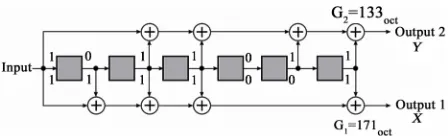
[image:3.595.61.283.230.346.2]The DVB-H standard employs a (204, 188) shortened RS code that corrects up to 8 erroneous bytes in a re-ceived word. In addition, it employs a variable rate punc- tured convolutional code based on a powerful 1/2 mother code compiled by Odenwalder [16]. A schematic dia-gram of the convolutional encoder is shown in Figure 1. The code rates supported by DVB-H are 1/2, 2/3, 3/4, 5/6, and 7/8. The puncturing patterns for the different code rates are given in Table 1.
Table 1. Puncturing patterns for different code rates [17].
Code Rate Puncturing Pattern
1/2 X: 1
Y: 1
2/3 X: 1 0
Y: 1 1
3/4 X: 1 0 1
Y: 1 1 0
5/6 X: 1 0 1 0 1
Y: 1 1 0 1 0 7/8 X: 1 0 0 0 1 0 1
Y: 1 1 1 1 0 1 0
1 and 0 denote transmitting and puncturing of coded bits, respectively.
Table 2. Power saving of DVB-H’S code vs RCPC code.
Code Rate 2/3 3/4 5/6 7/8
DVB-HPower Saving(%) 1.9 5.71 17.14 42.86 RCPCPower Saving(%) 25 33.33 40 42.86 Power saving of different code rates was calculated compared to worst- case of receiving the whole transmit frame (i.e. code rate 1/2).
Table 3. Puncturing patterns for Hagenauer RCPC codes [18] (M = 6 and P = 8).
Code Rate Puncturing Pattern
8/9 X: 1111 0111
Y: 1000 1000
4/5 X: 1111 1111
Y: 1000 1000
2/3 X: 1111 1111
Y: 1010 1010
4/7 X: 1111 1111
Y: 1110 1110
½ X: 1111 1111
Y: 1111 1111
Table 4. Puncturing patterms for proposed AC scheme em-ploying Hagenauer RCPC codes (M = 6 and P = 8).
Code Rate Puncturing
Pattern Puncturing Pattern
8/9 Q1 X: 1111 0111
Y: 1000 1000
4/5 Q2 X: 0000 1000 Y: 0000 0000
2/3 Q3 X: 0000 0000
Y: 0010 0010
4/7 Q4 X: 0000 0000 Y: 0100 0100
1/2 Q5
X: 0000 0000 Y: 0001 0001
3. Proposed Power Saving AMC Framework
In this section, a novel power saving AMC framework is proposed for DVB-H systems. The three power saving schemes: adaptive coding, adaptive modulation, or adap-tive modulation and coding, supported by the AMC framework are proposed in Subsections 3.1, 3.2, and 3.3, respectively. Hardware aspects of the proposed frame-work are discussed in Subsection 3.4.
3.1. Novel Power Saving AC Scheme
3.1.1. Novel Power Saving AC Scheme Framework Since for broadcast systems the transmit power is much less crucial than handheld receiver power, therefore tran- smission using the strongest code (i.e. lowest code rate) is proposed in the power saving AC scheme introduced in this paper. The transmitted frame is arranged in such a way that higher code rates (i.e. weaker codes) are trans-mitted first and then incremental bits (constituting stronger codes) are transmitted afterwards. The incre-mental bits are chosen according to pre-defined punctur-ing patterns. This gives the receiver the flexibility to re-ceive few more bits in order to upgrade the code to a str- onger one, in case higher rate codes are not sufficiently powerful to meet the target BER. The transmitted frame size defines how often the code rate is allowed to change (i.e. adaptation rate). The adaptation rate is a very im-portant design parameter that depends on time variation of the channel (i.e. Doppler frequency).
On the other end, the adaptive power saving receiver selects the appropriate code rate, one that achieves a tar-get BER, according to certain thresholds and then could be switched off and/or powered down resulting in sig-nificant potential for saving of receiving and processing power. The adaptive receiver is incremental in nature. It works by initially receiving the weakest coded bits, and then using the received SNR a decision is made whether the receiver should receive the bits of the next stronger code.
3.1.2. DVB-H Convolutional Code
Employing DVB-H standard punctured convolutional code in the proposed scheme would face the following crucial limitation. Close inspection of the puncturing patterns given in Table 1 reveals that not all bits of high rate codes are used by lower rate codes. Therefore, by arranging bits of the transmit frame in accordance to the proposed scheme, the adaptive receiver would be occa-sionally forced to receive more bits than required for the decoding of stronger codes. This introduces losses in the power saving potential compared to the case of using ideal RCPC codes as shown in Table 2.
The power saving of the proposed AC scheme when RCPC code of rate Ri is employed at the receiver could be simply calculated as follows,
T
ra
n
sm
iss
[image:3.595.61.282.465.572.2] [image:3.595.62.278.608.720.2]100
1 ×
−
=
i WC i
R R
P (1)
where RWC denotes the worst case scenario code rate. The power saving of the proposed AC scheme when DVB-H convolutional code is employed was calculated numeri-cally using puncturing patterns summarized in Table 1.
3.1.3. RCPC Codes
In order to get over the crucial limitation of DVB-H’s convolutional code, employment of RCPC codes is pro-posed. RCPC codes are variable rate punctured convolu-tional codes with rate-compatibility restriction on punc-turing patterns. The rate-compatibility restriction ensures that all code bits of high rates code are used by the lower rate codes. RCPC codes were first introduced by Hage- nauer in [18]. Hagenauer produced families of RCPC codes with rates between 8/9 and 1/4.
Hagenauer RCPC code with memory M = 6 and punc-turing period P = 8, that is based on the same DVB-H standard 1/2 mother code, is employed in the proposed AC scheme. The puncturing patterns of employed code rates are summarized in Table 3 where the bits in bold are the ones required to be transmitted by the proposed scheme for each code rate.
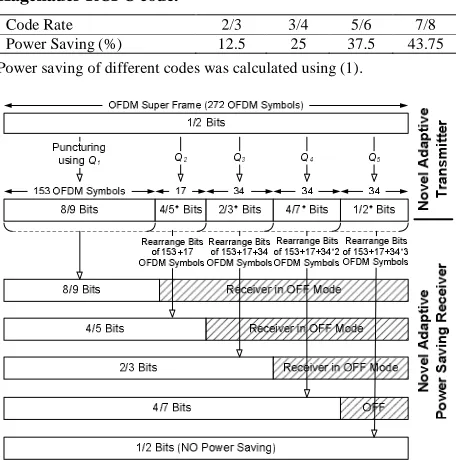
For example, the proposed power saving AC scheme employing Hagenauer RCPC code is illustrated in Figure 2. This scheme assumes portable reception (i.e. v= 3km/hr, thus channel is quasi-stationary over the period of one super frame). Hence, an adaptation rate of super frame is adopted. Each transmitted super frame is ar-ranged such that higher code rates are transmitted first followed by incremental bits in order to upgrade the code. The incremental bits are chosen according to the pre-defined puncturing patterns summarized in Table 4. The adaptive receiver must rearrange the received bits according to the puncturing patterns given in Table 3 before the Viterbi decoder. Assume in Figure 2 that the receiver decides that the 4/5 code is sufficient to meet the target BER. Then, the receiver will receive 170 instead of 272 OFDM symbols. This translates into a power saving of 37.5% compared to the worst case of receiving the whole super frame. The power saving of the pro-posed AC scheme employing Hagenauer RCPC code is summarized in Table 5. It is worth noting that generating RCPC code with the same code rates of DVB-H standard convolutional code would require a puncturing period of 210 which would make finding the best puncturing pat-tern for each code rate very tedious.
3.2. Novel Power Saving AM Scheme
3.2.1. Novel Power Saving AM Scheme Framework In order to adopt the AM concept in broadcast systems, users experiencing good SNR conditions should be allo-cated a high modulation technique such as 16-QAM,
while users experiencing bad SNR conditions should be allocated a more robust modulation technique such as QPSK. However, transmitting two different modulation techniques is unfeasible. Instead, it is proposed to com-bine both constellations in a hierarchical fashion where lower modulation symbols are embedded inside higher modulation ones. For instance, the constellation diagram of an AM scheme supporting QPSK and 16-QAM is de-picted in Figure 3 where the two left most bits of each 16-QAM symbol could be treated as a QPSK symbol embedded inside the 16-QAM symbol. In this manner, only the two right most bits would not be retrieved by receivers employing QPSK. Hence, retransmission using QPSK modulation of those non-embedded bits is re-quired.
Table 5. Power saving of proposed AC scheme employing Hagenauer RCPC code.
Code Rate 2/3 3/4 5/6 7/8
Power Saving(%) 12.5 25 37.5 43.75
[image:4.595.310.538.281.511.2]Power saving of different codes was calculated using (1).
Figure 2. Schematic of the proposed AC scheme (adaptation rate: super frame).
[image:4.595.330.516.551.696.2]Accordingly in the proposed power saving AM scheme, the transmitted frame constituting a block of convolutionally coded bits is subdivided into L clusters. In order to provide users (i.e. receivers) having good SNR conditions the highest power saving potential, the first cluster consists of all coded bits which are then modulated using the highest modulation technique (i.e. modulation technique having the largest constellation size). As a result, users having good SNR conditions are capable of reliably receiving the highest modulation symbols and then could switch off and/or power down their receiver frontend resulting in significant power saving potential. For users experiencing bad SNR condi-tions (where the highest modulation technique is insuffi-cient to meet the target BER), the second cluster of the transmit frame consists of the non-embedded coded bits (i.e. coded bits that will be lost when employing lower modulation techniques such as QPSK) which are then modulated using a lower modulation technique. As a result, users having bad SNR conditions are capable of receiving the first two clusters and then could switch off and/or power down their receiver frontend resulting in significant power saving potential. The remaining clus-ters are arranged in a similar fashion to accommodate coded bits that are not embedded in previous clusters (i.e. are not embedded in higher modulation symbols).
The transmitted frame size defines how often the modulation technique is allowed to change (i.e. adapta-tion rate). The adaptaadapta-tion rate is a very important design parameter that depends on time variation of the channel (i.e. Doppler frequency).
On the other end, the adaptive power saving receiver selects the appropriate modulation technique, one that achieves a target BER, according to certain thresholds and then could be switched off and/or powered down
Receiver in OFF Mode 1/2 Coded Bits
aOFDM Super Frame (272 OFDM Symbols)a
16-QAM Symbols
QPSK (NO Power Saving)
Rearrange Bits of 272 OFDM Symbols
16-QAM
QPSK Symbols
a136 OFDM Symbolsa a136 OFDM Symbolsa
1. Select S1Coded Bits 2. 16-QAM Modulation
1. Select S2Coded Bits 2. QPSK Modulation
Figure 4. Schematic of proposed AM scheme (adaptation rate: super frame).
Table 6. Selection patterns employed by the proposed AM scheme.
Modulation Selection Pattern Selected Bits
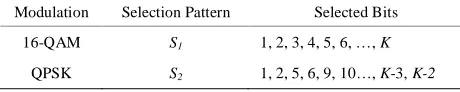
16-QAM S1 1, 2, 3, 4, 5, 6, …, K
QPSK S2 1, 2, 5, 6, 9, 10…, K-3, K-2
resulting in significant potential for saving of receiving and processing powers. The adaptive receiver is incre-mental in nature. It works by initially receiving the high-est modulation symbols, and then using the received SNR a decision is made whether the receiver should re-ceive the symbols of the next lower modulation tech-nique.
3.2.2. Employment of AM Scheme in DVB-H
For example, the proposed power saving AM scheme employing two modulation techniques (QPSK and 16-Q- AM) is depicted in Figure 4. This scheme assumes port-able reception (i.e. v=3km/hr, thus channel is quasi- stationary over the period of one super frame). Hence, an adaptation rate of super frame is adopted. Furthermore, 1/2 rate convolutional code is employed in order to main- tain reliable performance in bad SNR conditions. Each transmitted super frame is arranged such that higher mo- dulation symbols (in this example 16-QAM symbols) are transmitted first followed by lower modulation symbols (in this example QPSK symbols). The selected bits are chosen according to the pre-defined selection patterns summarized in Table 6. Assume the receiver decides that the 16-QAM is sufficient to meet the target BER. Then, the receiver will receive 136 instead of 272 OFDM sym- bols. This translates into a power saving of 50% compa- red to the worst case of receiving the whole super frame.
3.2.3. Power Saving Potential
The power saving of the proposed AM scheme when modulation technique Mi is employed at the receiver could be simply calculated as follows,
100 ) ( log
) ( log 1
2
2 ×
− =
i WC i
M M
P (2)
where MWC denotes the worst case scenario modulation technique. The power saving for the three modulation techniques supported by DVB-H is given in Table 7.
3.3. Novel Power Saving AMC Scheme
[image:5.595.59.287.493.620.2] [image:5.595.56.286.677.723.2]rate are allowed to change (i.e. adaptation rate). The ad-aptation rate is a very important design parameter that depends on time variation of the channel (i.e. Doppler frequency).
3.3.2. Employment of AMC Scheme in DVB-H For example, the proposed AMC scheme employing two modulation techniques (QPSK and 16-QAM) and five code rates is depicted in Figure 5. This scheme assumes portable reception (i.e. v=3km/hr, thus channel is quasi- stationary over the period of one super frame). Hence, an adaptation rate of super frame is adopted.The transmit-ted bits are first rearranged using the five puncturing patterns summarized in Table 4. Then, the bits are further divided into two groups according to the selection pat-terns summarized in Table 6. Finally, the first and second group of bits (S1 and S2) are modulated using 16-QAM and QPSK modulation techniques, respectively.
The adaptive receiver selects the appropriate modula-tion and coding configuramodula-tion, one that achieves a target BER, according to pre-defined SNR thresholds and then could switch off and/or reduce power from any possible circuitry in the frontend resulting in significant potential for saving of reception and processing powers. The ceiver is incremental in nature. It works by initially re-ceiving bits of the highest modulation technique and weakest code (i.e. 16-QAM, 8/9), and then using the re-ceived SNR a decision is made whether the receiver should receive symbols of the next stronger code. As-sume the receiver decides that 16-QAM and 2/3 code are sufficient to meet the target BER. Then, the receiver will receive and process 102 instead of 272 OFDM symbols. This translates into a power saving of 62.5%.
3.3.3. Power Saving Potential
The power saving of the proposed AMC scheme when modulation technique Mi and code rate Rj are employed at the receiver could be simply calculated as follows,
100 ) ( log ) ( log ) ( log ) ( log 2 2 2 2 , × − = j WC WC i BC WC j i R R M M M M
P (3)
Table 7. Power saving of proposed AM scheme.
Modulation QPSK 16-QAM 64-QAM
Power Saving(%) – 50 66.67
[image:6.595.309.538.438.694.2]Power saving of different modulation techniques calculated compared to worst-case scenario of receiving the whole transmit frame (i.e. QP- SK).
Table 8. Power saving (%) of proposed AMC scheme.
Code Rate Modulation
1/2 4/7 2/3 4/5 8/9
16-QAM 50 56.25 62.5 68.75 71.875
QPSK - 6.25 12.50 18.75 21.875
Power saving of different AMC configurations was calculated compa- red to worst-case scenario of receiving whole transmit frame (i.e. QP- SK, 1/2).
where MWC and MBC denote the worst and best case mod- ulation technique, respectively. RWC depicts the worst case code rate. Equation (3) is valid only for a scheme supporting two modulation techniques. Power saving of the proposed AMC scheme is given in Table 8.
3.4. Hardware Aspects
It is emphasized that the proposed AMC framework op-erates at the physical layer leading to power saving po-tential in the Radio Frequency (RF) frontend (a main source of battery power drainage in DVB-H devices). By switching off the receiver, this do not necessarily mean the receiver is going to sleep mode. As in conventional TDMA systems, the receiver during inactivity periods has the ability to switch off and/or reduce power from any possible circuitry in the frontend [19]. In the pro-posed AMC framework, power reduction could be achi- eved by using a DC-to-DC converter [20] to reduce sup-ply voltage during receiver inactivity periods. Typical supported switching rate in DC-to-DC converters is 6 MHz (i.e. 0.16 µs), for example; Texas Instruments TPS62601. This high switching rate achieves the adapta-tion rates employed by the proposed framework.
4. Numerical Analysis
In this section, the theoretical performance of the pro-posed power saving AMC framework is analyzed nu-merically. For simplicity and without loss of generality,
Receiver in OFF Mode 1/2 Coded Bits
aOFDM Super Frame (272 OFDM Symbols)a
8/9 Bits 4/5' Bits 2/3' Bits 4/7' Bits 1/2’ Bits
a153 OFDM Symbolsa a17a a34a a34a a34a Puncturing using Q1
N o v e l A d a p ti v e T ra n s m it te r 16-QAM, 8/9 N o v e l A d a p ti v e P o w e r S a v in g R e c e iv e r 8/9* Bits
a136 OFDM Symbols (16-QAM)a a136 OFDM Symbols (4-QAM)a 1. Select S1Coded Bits
2. 16-QAM Modulation
1. Select S2Coded Bits 2. 4-QAM Modulation
4/5* 2/3* 4/7* 1/2* 8/9** Bits 4/5** 2/3** 4/7** 1/2**
17 17 17
8.5
76.5 76.5 8.5 17 17 17
Receiver in OFF Mode
16-QAM, 4/5
Receiver in OFF Mode
16-QAM, 2/3
Receiver in OFF Mode
16-QAM, 4/7
Receiver in OFF Mode
16-QAM, 1/2
Receiver in OFF Mode
4-QAM, 8/9 OFF 4-QAM, 4/5 OFF 4-QAM, 2/3 OFF 4-QAM, 4/7 4-QAM, 1/2 (NO Power Saving)
Q2 Q3 Q4 Q5
[image:6.595.62.281.648.691.2]2 4 6 8 10 12 14 16 18 10-5
10-4 10-3 10-2 10-1
SNR (dB)
B
it
E
rr
o
r
R
ate
[image:7.595.176.423.81.265.2]8/9 (QPSK) 4/5 (QPSK) 2/3 (QPSK) 4/7 (QPSK) 1/2 (QPSK) 8/9 (16-QAM) 4/5 (16-QAM) 2/3 (16-QAM) 4/7 (16-QAM) 1/2 (16-QAM)
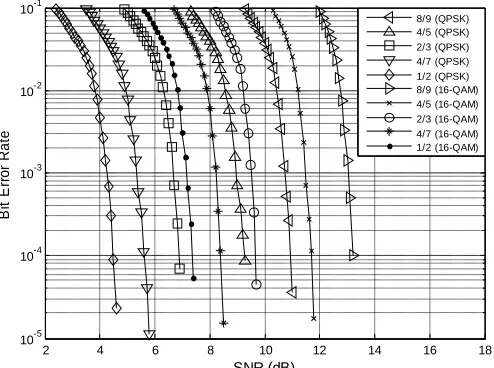
Figure 6. BER performance of fixed-rate AMC scheme in AWGN channel.
10 20 30 40 50 60 70 80 90
Thresholds Criteria
SNR
th - 1dB SNRth SNRth + 1dB SNRth + 2dB SNRth + 3dB SNRth + 4dB
P
o
w
e
r
S
a
v
in
g
(
%)
[image:7.595.180.435.297.479.2]10 dB (Theory) 18 dB (Theory) 26 dB (Theory) 10 dB (Simulation) 18 dB (Simulation) 26 dB (Simulation)
Figure 7. Power saving of proposed AMC scheme in flat Rayleigh channel.
10-4 10-3 10-2 10-1 100
Thresholds Criteria
SNR
th - 1dB SNRth SNRth + 1dB SNRth + 2dB
B
it
E
rr
o
r
R
a
te
10 dB (Theory) 18 dB (Theory) 26 dB (Theory) 34 dB (Theory) 10 dB (Simulation) 18 dB (Simulation) 26 dB (Simulation) 34 dB (Simulation)
[image:7.595.176.437.512.696.2]perfect Channel State Information (CSI) is assumed at the receiver. The numerical analysis is performed for the generic case of an AMC scheme. The numerical analysis of AC and AM schemes could be regarded as special cases. The numerical analysis is performed in two envi-ronments: flat Rayleigh channel and COST207 Typical Urban 6-paths (TU6) channel [21]. The power delay pro-file of the TU6 channel is given in Section 5.1.
4.1. Flat Fading Channel
The power saving is given by,
∑ ∑
= = = L i N j j i j iSaving P p
P
1 1
,
, (4)
where Pi,j denotes the power saving due to employing modulation technique Mi and code Rj at the adaptive re-ceiver and is given by (3). L and N are the number of modulation techniques and code rates supported by the proposed AMC scheme. pi,j depicts the probability of selecting modulation technique Mi and code Rj, and is given as, ( ) dx x f p U j i L j i x x X j
i ( )
) (
,
,
, =
∫
(5)where
x
i(,Lj) andx
i(,Uj) denote the lower and upper SNR thresholds of using modulation technique Mi and code Rj, respectively. fX(x) is the Probability Density Function (PDF) of the received SNR. Since a Rayleigh channel is considered, the received SNR follows an ex-ponential distribution. Hence, fX(x) is defined as,0 1
)
(x = e− x≥ f
x
X λ
λ (6)
where λ depicts the average channel SNR. The BER in flat Rayleigh channel is given by,
∑ ∑ ∫
= = = L i N j x x X ji x f x dx
BER BER U j i L j i 1 1 , ( ) ( ) ) ( , ) ( , (7)
where BERi,j(x) denotes the BER due to employing modulation technique Mi and code Rj at the adaptive re-ceiver while having SNR x. It is obtained from the Monte Carlo simulations of DVB-H system in AWGN given in Figure 6.
The appropriate modulation and code are selected by comparing the SNR to a set of predefined thresholds that guarantee a target BER. A target BER of 10-3 is chosen. The 10-3 SNR thresholds (depicted SNRth in Figs.) could be obtained easily from Figure 6. Such thresholds are incrementally increased and decreased by steps of 1 dB to provide a tradeoff between power saving and BER. The simulation results depicted in Figure 6 show that (16-QAM, 1/2) mode performs better than (QPSK, 4/5)
and (QPSK, 8/9) modes while providing better power saving. As a result, those two modes were eliminated from the proposed AMC scheme.
Figures 7 and 8 illustrate the power saving and BER of the proposed scheme, respectively, where the modulation and code rate are allowed to change every convolutional block through-out the simulations (The DVB-H standard defines the convolutional 1/2 coded block to be 3264 bits). Simulation results are in excellent agreement with theoretical results. The BER performance is limited by the deep fades of the Rayleigh channel. This explains the BER floor experienced in the low SNR region where the AMC scheme cannot guarantee target BER anymore (even with the aid of 1/2 code). At SNR of 26 dB, the AMC scheme is capable of achieving almost its full power saving potential of 71%.
4.2. Multipath TU6 Channel
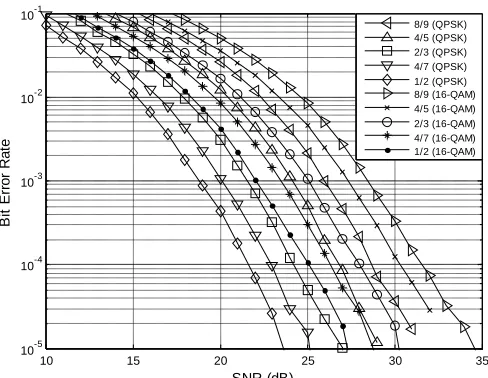
For simplicity and without loss of generality, COST207 TU6 channel having Doppler frequency of 40 Hz and an AMC scheme employing an adaptation rate of quarter frame (i.e. modulation and coding configuration is al-lowed to change every 17 OFDM symbols) are consid-ered. Numerical analysis of the BER performance in TU6 multipath channel is very tedious due to the fre-quency-selective nature of the channel. To the best of the authors’ knowledge, there is no upper bound on the BER performance of OFDM employing concatenated RS-con- volutional codes in frequency-selective fading channels due to the complicated nature of this problem. However, an approximate method is adopted in order to perform numerical analysis of the BER performance in the fre-quency-selective TU6 channel. The approximate BER estimation method works by averaging the SNR in time (i.e., over the quarter frame interval) and frequency (i.e. across sub-carriers) referred to as mean quarter frame SNR. Then, the BER could be obtained from BER per-formance of DVB-H system employing proposed AMC scheme in 40 Hz TU6 channel (depicted in Figure 9). Hence, Equation (7) could be used to deduce the BER performance where BERi,j(x) denotes the BER due to employing modulation technique Mj and code rate Ri at the adaptive receiver while having x as the mean quarter frame SNR. BERi(x) is obtained from Figure 9. For the distribution of the mean quarter frame SNR, fX(x) em-ployed in Equations (5), (7) is approximated as a log-normal distribution where the PDF of the received mean quarter frame SNRis defined as,
( ) 0 2 1 ) ( 2 2 2 ln ≥ = − − x e x x f x X σ µ π
σ (8)
where µ and σ depict the average and standard deviation of the nature logarithm of x, the mean quarter frame SNR.
10 15 20 25 30 35 10-5
10-4 10-3 10-2 10-1
SNR (dB)
B
it
Er
ro
r
Ra
te
[image:9.595.175.419.77.266.2]8/9 (QPSK) 4/5 (QPSK) 2/3 (QPSK) 4/7 (QPSK) 1/2 (QPSK) 8/9 (16-QAM) 4/5 (16-QAM) 2/3 (16-QAM) 4/7 (16-QAM) 1/2 (16-QAM)
Figure 9. BER performance of fixed-rate AMC scheme in 40 Hz TU6 channel.
0 10 20 30 40 50 60 70 80
Thresholds Criteria
SNR
th Av g
-2dB SNR
th Av g
SNR
th Avg
+2dB SNR
th Avg
+4dB SNR
th Avg
+6dB SNR
th Av g
+8dB SNR
th Av g
+10dB SNR
th Av g
+12dB
P
o
w
e
r
S
a
vi
n
g
(
%)
Theory Simulation
30dB
22dB 24dB 26dB 28dB
Figure 10. Power saving of proposed AMC scheme in 40 Hz TU6 channel.
10-6 10-5 10-4 10-3 10-2 10-1 100 101
Thresholds Criteria
SNRth-2dB SNRth SNRth+2dB SNRth+4dB SNRth+6dB SNRth+8dB SNRth+10dB SNRth+12dB
B
it
E
rr
o
r
R
a
te
[image:9.595.179.424.513.702.2]22 dB (Theory) 24 dB (Theory) 26 dB (Theory) 28 dB (Theory) 30 dB (Theory) 22 dB (Simulation) 24 dB (Simulation) 26 dB (Simulation) 28 dB (Simulation) 30 dB (Simulation)
TU6 channel, the PDF of the received mean quarter frame SNR could fit a log-normal distribution with param- eters:
• µ= 4.046256349081641 • σ = 0.529152417564057
The appropriate modulation and coding configuration is selected by comparing the mean quarter frame SNR to a set of predefined SNR thresholds that guarantee a tar-get BER. A tartar-get BER of 10-3 is chosen. The assignment of the 10-3 SNR thresholds is defined in the next section. These thresholds are incrementally increased and de-creased by steps of 2 dB to provide a tradeoff between power saving and BER. Figures 10 and 11 illustrate the power saving and BER of the proposed AMC scheme, respectively. The simulation results of the power saving potential are in excellent agreement with theoretical ones. However, the simulation results of BER performance are better than theoretical ones. As a result, the theoretical BER results (obtained via proposed approximate method) could be regarded as an upper bound on the BER per-formance.
5. Simulation Results
[image:10.595.63.280.519.562.2]In this section, the simulation results of DVB-H system employing the proposed power saving AMC framework are given and discussed comprehensively. Section 5.1 defines the channel model and adaptation rates used throughout the simulations. Section 5.2 summarizes the simulation parameters of the DVB-H system employing the proposed AMC framework. Simulation results illus-trating power saving potential and BER performance of DVB-H system employing AC, AM, and AMC schemes are given in Sections 5.3, 5.4, and 5.5, respectively. Fi-nally, the three power saving schemes are compared in Section 5.6.
Table 9. TU6 channel power delay profile.
Tap Number 1 2 3 4 5 6
Delay (μs) 0.0 0.2 0.5 1.6 2.3 5.0
Power (dB) -3 0 -2 -6 -8 -10
Doppler Spectrum Rayleigh
Table 10. Reception model and velocity range for different Doppler Frequencies.
Doppler Frequency Receiver Velocity Range
10 Hz Moderately
Mo-bile 13.5 – 54 km/h
40 Hz Severely Mobile 54 – 216 km/h
Table 11. SNR thresholds (dB) (adaptation rate: quarter frame, 40HZ TU6 channel).
Code Rate 8/9 4/5 2/3 4/7
SNR Threshold [18, ∞[ ]16, 18] ]13, 16] ]11, 13]
5.1. Channel Model and Adaptation Rates
The COST207 TU6 channel model [21] has proven to be a very good representative for typical mobile reception. The power delay profile of the TU6 channel is given in Table 9. In order to model various types of receivers, two Doppler frequencies were considered. The Doppler fre-quencies along with their corresponding velocity ranges are summarized in Table 10. The velocity range is calcu-lated starting from carrier frequency 800 MHz (upper part of Band V) to carrier frequency 200 MHz (lower part of Band III).
Accordingly, the proposed power saving schemes were implemented employing three adaptation rates (to ac-commodate different Doppler frequencies and to provide a trade-off between performance and complexity). The three supported adaptation rates are: super frame, frame and quarter frame (where as the name implies, the modu- lation and/or coding configuration is allowed to change every super frame, frame, and quarter frame correspond-ing to 272, 68, and 17 OFDM symbols, respectively).
5.2. Simulation Model
For simulation experiments, a DVB-H system is em-ployed assuming 2K OFDM mode with 1/4 guard interval. The DVB-H standard convolutional code is replaced by the Hagenauer RCPC code in order to exploit full power saving potential. 8 MHz channel is considered. Perfect CSI is assumed at the receiver. Simulations are run for 500 OFDM super frames. MATLAB/SIMULINK [22] is the simulation tool used. For simulations of DVB-H em-ploying the proposed AC scheme, an AC scheme that supports five code rates (1/2, 4/7, 2/3, 4/5, and 8/9) is considered. Furthermore, QPSK is chosen as the modu-lation technique. For simumodu-lations of DVB-H employing the proposed AM scheme, an AM scheme that supports two modulation techniques (QPSK and 16-QAM) is con-sidered. In addition, the convolutional code rate is fixed to 1/2. For simulations of DVB-H employing the pro-posed AMC scheme, an AMC scheme that supports two modulation techniques (QPSK and 16-QAM) and five code rates (1/2, 4/7, 2/3, 4/5, and 8/9) is considered.
5.3. Power Saving AC Scheme
[image:10.595.54.288.601.656.2] [image:10.595.58.285.690.719.2]10 15 20 25 30 35 40 45
Thresholds Criteria
SNRthAvg - 1dB SNRthAvg SNRthAvg + 1dB SNRthAvg + 2dB SNRthAvg + 3dB SNRthAvg + 4dB
P
o
w
e
r
S
a
v
ing
(
%)
[image:11.595.161.436.77.276.2]18 dB 20 dB 22 dB 24 dB
Figure 12. Power savings of proposed AC scheme in 40 Hz TU6 channel.
10-5 10-4 10-3 10-2
Thresholds Criteria
SNR
th
Avg - 1dB SNR th
Avg SNR
th
Avg + 1dB SNR th
Avg + 2dB SNR th
Avg + 3dB SNR th Avg + 4dB
B
it
E
rr
o
r
R
a
te
[image:11.595.161.436.306.512.2]18 dB 20 dB 22 dB 24 dB
Figure 13. BER performance of proposed AC scheme in 40 Hz TU6 channel.
5000 super frames. For example, consider an AC scheme with an adaptation rate of quarter frame in a 40 Hz TU6 channel. The 10-3 thresholds are given in Table 11. Power saving and BER of the AC scheme at different values of average channel SNR are depicted in Figures 12 and 13, respectively.
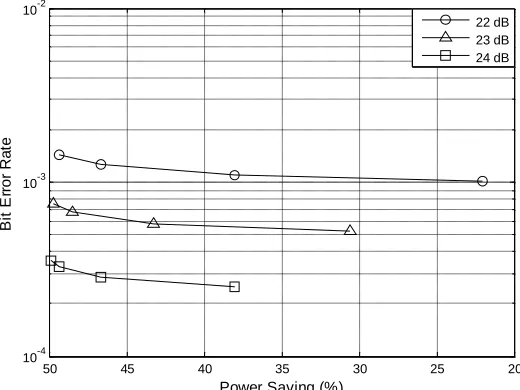
Figures 12 and 13 demonstrate the tradeoff of increas-ing/decreasing the decision thresholds. Increasing the thresholds, improves the BER performance on the ex-pense of power saving. Figures 12 and 13 could be com-bined as depicted in Figure 14. For a target BER, Figure 14 could be used to determine the corresponding power saving given the average channel SNR. Moreover, the appropriate thresholds to be employed by the receiver could be deduced. For example at average channel SNR of 18 dB power saving of approximately 29% could be
achieved for a target BER of 10-3. At high average channel SNR, maximum power saving potential of 43.75% could be achieved.
10 15 20 25 30 35 40 45 10-5 10-4 10-3 10-2
B
it
E
rr
o
r
R
a
te
Power Saving (%)
[image:12.595.173.423.75.260.2]18 dB 20 dB 22 dB 24 dB
Figure 14. BER vs. power saving of proposed AC scheme in 40 Hz TU6 channel.
18 19 20 21 22 23 24
20 25 30 35 40 45
SNR (dB)
P
o
w
e
r
S
a
v
ing
(
%)
(40 Hz, Super Frame) (40 Hz, Quarter Frame) (10 Hz, Super Frame) (10 Hz, Frame)
Figure 15. Power saving vs. SNR of proposed AC scheme for different adaptation rates and Doppler frequencies in TU6 channel (Target BER = 10-3).
20 25
30 35
40 45
50 10-4 10-3 10-2
B
it
E
rr
o
r
R
a
te
Power Saving (%)
22 dB 23 dB 24 dB
[image:12.595.172.423.287.478.2] [image:12.595.167.427.511.706.2]3% more power at 18 dB. At high average channel SNR, all schemes achieve maximum power saving potential of 43.75%.
5.4. Power Saving AM Scheme
Consider an AM scheme with an adaptation rate of quar-ter frame in a 40 Hz TU6 channel. The 10-3 SNR thresh-olds could be defined in a similar manner to AC scheme. The power saving versus the BER performance is shown in Figure 16. For a target BER, Figure 16 could be used to determine the corresponding power saving given the av-erage channel SNR. Moreover, the appropriate thresholds to be employed by the receiver could be deduced. For in- stance, at average channel SNR of 22 dB power saving of 22% could be achieved. At high average channel SNR, maximum power saving potential of 50% could be
achieved.
5.5. Power Saving AMC Scheme
Consider an AMC scheme with an adaptation rate of quarter frame in a 40 Hz TU6 channel. The 10-3 SNR thresholds could be obtained in a similar manner to AC scheme. The power saving versus the BER performance is shown in Figure 17. For a target BER, Figure 17 could be used to determine the corresponding power saving given average channel SNR. Moreover, the appropriate thresholds to be employed by the adaptive receiver could be deduced. For instance, at average channel SNR of 22 dB power saving of 30% could be achieved. At high av-erage channel SNR, maximum power saving potential of 71.875% could be achieved.
0 10 20 30 40 50 60 70 80 10-6 10-5 10-4 10-3 10-2
B
it
E
rr
o
r
R
a
te
Power Saving (%)
[image:13.595.172.424.279.467.2]22 dB 24 dB 26 dB 28 dB 30 dB
Figure 17. BER vs. power saving of proposed AMC in 40 Hz TU6 channel.
18 20 22 24 26 28 30 32
10 20 30 40 50 60 70 80
SNR (dB)
P
o
w
e
r
S
a
v
ing
(
%)
AC AM AMC
[image:13.595.172.426.499.690.2]5.6. Comparison of Three Power Saving Schemes
The proposed three power saving schemes are compared in terms of power saving potential in Figure 18 The pro-posed AC scheme provides significant power saving (28.5–43.75%) for a wide range of SNRs (18–24 dB). On the other hand, the proposed AM scheme provides more power saving (50%) compared to the AC scheme but for a narrower range of SNRs (23–24 dB). This narrow ran- ge of SNRs is due to the limited power saving modes (only two modulation techniques, opposed to the five code rates supported by the AC scheme). Note that in the low SNR region (18–22 dB) the AC scheme provide higher power saving potential than AM scheme where at very low SNRs (18–20 dB) the AM scheme fails to pro-vide any power saving for the target BER of 10-3.
For high average channel SNR (above approximately 22.5 dB), the proposed AMC scheme is clearly the better choice. It provides significant power saving (42–71.87- 5%) for a very wide range of SNRs (22.5–32 dB). The proposed AMC scheme is unable to provide any power saving (for the target BER of 10-3) in the low SNR region (18–20 dB) due to the fact that the QPSK modulation technique is actually embedded inside the 16-QAM con-stellation (see Figure 3) and hence making it much less robust than the normal non-embedded QPSK modulation technique employed by the AC scheme. This also justi-fies why the AC scheme outperforms the AM scheme in the very low SNR region.
6. Conclusions
In this paper, a novel power saving AMC framework was proposed for DVB-H systems to address the challenging problem of power consumption. The proposed frame-work features three schemes: adaptive coding, adaptive modulation, and adaptive modulation/coding in order to reduce the receiver power consumption. The proposed AMC framework is initiated from receiver in contrast to traditional AMC schemes that rely on the existence of a feedback channel. It operates by rearranging transmitted frames in a pre-defined pattern. The adaptive receiver se- lects the appropriate modulation and/or coding configu-ration, one that achieves a target BER, and then could be switched off and/or powered down resulting in signifi-cant potential for saving of reception and processing po- wers. It was shown that the proposed power saving AMC framework is capable of achieving remarkable power saving (up to 71.875%) in TU6 channel environment.
Furthermore, numerical analysis for the power saving potential and BER performance of the proposed AMC framework is performed where theoretical ones were shown to be in excellent agreement with simulation re-sults for the case of Rayleigh channel. For TU6 channel,
the numerical results could serve as an upper bound on the BER performance of the proposed scheme.
In addition, the effect of adaptation rate on power sav- ing was studied for different Doppler frequencies. As ex- pected, increasing the adaptation rate helps the adaptive receiver increase the power saving potential particularly for fast fading channels. This is obvious for the 40 Hz TU6 channel where the proposed AC scheme employing an adaptation rate of quarter frame saves 6% more power than the one employing an adaptation rate of super frame.
Finally, the three schemes supported by the proposed framework (AC, AM, and AMC) were compared in terms of power saving potential. It was shown that for environments characterized by high average channel SNR (greater than 22.5 dB), the AMC scheme would be the best scheme where 42–71.875% power saving was achieved for the target BER of 10-3. On the other hand, for environments characterized by low SNR (less than 22.5 dB), the AC scheme would yield the highest power saving potential (28.5–42%).
7. References
[1] U. Reimers, “DVB—The family of international standar- ds for digital video broadcasting,” in Proceedings of IEEE, Vol. 94, No. 1, January 2006.
[2] ETSI EN 302 304: “Digital Video Broadcasting (DVB); transmission system for handheld terminals (DVB-H),” European Telecommunication Standard, November 2004. [3] ETSI EN 300 744: “Digital Video Broadcasting (DVB); framing structure, channel coding and modulation for digital terrestrial television (DVB-T)”, European Tele- communication Standard, January 2004.
[4] C. Rauch, W. Kellerer, and P. Sties, “Hybrid mobile inte- ractive services combining DVB-T and GPRS,” in Proceedings of European Personal Mobile Commu- nication Conference, Vienna, Austria, February 2001. [5] E. Stare and S. Lindgren, “Hybrid broadcast-telecom
systems for spectrum efficient mobile broadband internet access,” in Nordic Radio Symposium, Sweden, 2001. [6] G. Gardikis, G. Kormentzas, G. Xilouris, H. Koumaras,
and A. Kourtis, “Broadband data access over hybrid DVB-T networks,” in Proceedings of 3rd Conference on Heterogeneous Network, Ilkley, UK, July 2005.
[7] A. Kumar, “Mobile TV: DVB-H, DMB, 3G systems and rich media applications,” Focal Press, 2007.
[8] J. Gozalvez, “The european union backs the DVB-H standard [mobile radio],” IEEE Vehicular Technology Magazine, Vol. 3, pp. 3–12, June 2008.
[9] ETSI TR 102 401: “Digital Video Broadcasting (DVB); transmission system for handheld terminals (DVB-H),” Validation Task Force Report, May 2005.
[10] G. Gardikis, H. Kokkinis, and G. Kormentzas, “Evaluati- on of the DVB-H data link layer,” in Proceedings of European Wireless, Paris, France, April 2007.
power saving strategies for IP-services supported over DVB-H networks,” in Proceedings of IEEE Wireless Communication and Network Conference, March 2007. [12] E. Belyaev, T. Koski, J. Paavola, A. Turlikov, and A.
Ukhanva, “Adaptive power saving on the receiver side in digital video broadcasting systems based on progressive video codec,” The 11th International Symposium on Wireless Personal Multimedia Communication, 2008. [13] J. F. Hayes, “Adaptive feedback communications,” IEEE
Transactions on Communication Technology, Vol. COM- 16, pp. 29–34, February 1978.
[14] A. Goldsmith and S. G. Chua, “Adaptive coded modula- tion for fading channels,” IEEE Transactions on Communication, Vol. 46, pp. 595–602, May 1998. [15] E. D. Balaguer, F. H. P. Fitzek, and O. Olsen, “Perfor-
mance evaluation of power saving strategies for DVB-H services using adaptive MPE-FEC decoding,” The 16th Annual IEEE International Symposium on Personal Indoor and Mobile Radio Communication, Berlin, Ger- many, September 2005.
[16] J. Odenwalder, “Optimal decoding of convolutional codes,
” Ph.D. dissertation, Department of Systems Sciences, School of Engineering and Applied Sciences, University of California, Los Angeles, 1970.
[17] Y. Yasuda, K. Kashiki, and Y. Hirata, “High-rate punct- ured convolutional codes for soft decision viterbi de- coding,” IEEE Transactions on Communication, Vol. COM-32, pp. 315–319, March 1984.
[18] J. Hagenauer, “Rate-compatible punctured convolutional Codes (RCPC Codes) and their applications,” IEEE Transactions on Communication, Vol. 36, pp. 389–400, April 1988.
[19] T. S. Rappaport. Wireless communications: Principles & practice,” Prentice Hall, New Jersey, 1996.
[20] F. L. Luo, and H. Ye, Essential DC/DC Converters. CRC Press, 2006.
[21] COST207, “Digital land mobile communications,” Com- mission of the European Communities, Directorate General Communications, Information Industries and Innovation, 1989, pp. 135–147.
![Table 3. Puncturing patterns for Hagenauer RCPC codes [18] (M = 6 and P = 8).](https://thumb-us.123doks.com/thumbv2/123dok_us/8752346.389788/3.595.61.282.465.572/table-puncturing-patterns-hagenauer-rcpc-codes-m-p.webp)