Original Article
Identification of lncRNAs via microarray
analysis for predicting HER2-negative breast
cancer response to neoadjuvant chemotherapy
Dengjie Ouyang1*, Juan Su1*, Peng Huang2, Moyun Li1, Qianying Li1, Piao Zhao1, Qitong Chen1, Qiongyan Zou1, Xueping Feng3, Ke Qian1, Lun Li1, Wenjun Yi1
1Department of Breast and Thyroid Surgery, The Second Xiangya Hospital, Central South University, China; 2Department of General Surgery, Xiangya Hospital, Central South University, China; 3Institute of Medical Science,
Xiangya Hospital, Central South University, China. *Equal contributors.
Received February 10, 2018; Accepted March 24, 2018; Epub May 1, 2018; Published May 15, 2018
Abstract: Mortality is high in patients with locally advanced HER2-negative breast cancer, especially those with
residual tumor after neoadjuvant chemotherapy (NAC). Tissue-specific long non-coding RNAs (lncRNAs) are respon
-sible for specific breast cancer subtypes. To identify the lncRNAs involved in residual cancer tissues (RCTs) and
to evaluate their potential for predicting HER2-negative breast cancer response to NAC, we used three paired tis-sues to compare differences in gene expression between RCTs and remittent tistis-sues (RTs) after NAC in human HER2-negative breast cancer. Subsequently, we detected expression of the top ten up-regulated and down-reg-ulated lncRNAs in 11 paired tissues via quantitative RT-PCR analysis. Finally, we explored the potential function of these dysregulated lncRNAs through bioinformatics analysis. Our results indicate that 1348 mRNAs and 183 lncRNAs were differentially expressed in RCTs compared with RTs, and the expression levels of four novel lncRNAs (DSCAM-AS1, LINC01508, lnc-MGST1-2 and lnc-BTG2-2) were in agreement with the microarray analysis results.
Furthermore, we found that the expression level of LINC01508 was significantly related to poor prognosis, suggest -ing that LINC01508 is a potential biomarker for predict-ing breast cancer response to NAC, which might be helpful in exploring potential diagnostic factors and therapeutic targets for chemo-resistant HER2-negative breast cancer.
Keywords: HER2-negative breast cancer, neoadjuvant chemotherapy, chemo-resistance, gene expression microar-ray, long non-coding RNAs/lncRNAs
Introduction
Breast cancer (BC) is the second leading cause of cancer mortality among women worldwide [1]. Based on global transcriptomic analysis, BC is subdivided into different molecular subtypes, including luminal A, luminal B, HER2-enriched, claudin-low, basal-like, and normal breast-like subtypes [2, 3]. Moreover, luminal B BC can be further classified as either HER2 positive or HER2 negative [4]. For HER2-negative BC, the therapeutic strategy is restricted to chemother-apy and endocrine therchemother-apy. However, some patients acquire chemo-resistance during che-motherapy, which leads to treatment failure and high mortality. Therefore, it is important to clarify the molecular mechanism of chemother-apy resistance in HER2-negative BC patients.
than that of HER2-positive or triple-negative BC (TNBC). However, Niikura et al. [11] have sug-gested that patients with luminal tumors have lower pCR rates than those with HER2-positive or triple-negative tumors. The differential res- ponse in a single BC tumor tissue may be caused by clinical heterogeneity, which is an inherent feature of breast tumors. In residual cancer tissues (RCTs), the shape and structure of some cancer cells are changed [12], and cells can develop drug resistance. Thus, we speculate that the heterogeneity of BC tumor tissues after NAC may lead to poor outcomes, and the residual tumor is a critical indicator of treatment failure.
Long non-coding RNAs (lncRNAs) are defined as RNA genes longer than 200 bp with no cod-ing potential [13], and recent studies have shown that lncRNA gene silencing is involved in chromatin modification, transcriptional activa
-Tissue collection
[image:2.612.94.373.74.433.2]In this study, we recruited 48 BC patients who had undergone NAC, from which 34 patients were excluded according to our inclusion crite-ria, which is presented in Figure 1. BC tissue samples consisting of RCTs and RTs from patients who had invasive BC diagnosed histo-pathologically and had been treated with NAC were collected consecutively between Sep- tember 2015 and May 2016. None of these patients accepted radiotherapy or endocrine therapy prior to breast tumor resection. The RTs were resected 2 mm from the edge of the tumor (according to the standard of safe cut-ting for breast-conserving surgery after NAC [19]). This study and the necessary sample col-lection were approved by the Ethical Review Committee of the Second Xiangya Hospital of Central South University.
Figure 1.Flowchart of inclusion criteria for patient enrollment.
RNA extraction and quality control
To isolate total RNA from each tissue, frozen tissues were resuspended in TRIzol reagent (Life Technologies) and were finally eluted into 100 μL of Elution Solution according to the manufacturer’s instructions. Quantification and quality checks were performed with a NanoDrop ND-2000 spectrophotometer (Thermo Scien- tific). All the RNA samples were stored at -80°C until further analysis.
LncRNA and mRNA microarray expression
profiling
An Agilent Human Gene Expression (8*60 K, Design ID: 039494) microarray was used in this study. The lncRNAs were obtained from authoritative databases (i.e., RefSeq, Ensembl, UCSC Known genes, and LNCipedia) and relat-ed literature. The mRNAs were collectrelat-ed from RefSeq and GENCODE. Each transcript was represented by a specific exon or splice junc -tion probe, which could identify individual tran-scripts accurately. Sample labeling, microarray hybridization, and washing were performed based on the Agilent One-Color Microarray-Based Gene Expression Analysis protocol
lated genes was an FC≥2.0 and a P value ≤0.05.
Co-expression of lncRNAs with mRNAs and function prediction: The gene ontology (GO) project provides a controlled vocabulary to describe gene and gene product attributes (http://www.geneontology.org) and has been widely used in large-scale genomic and tran-scriptional data functional studies. KEGG path-way analysis offered us a reliable method to elucidate the candidate biological pathways in which the lncRNAs interacted with the mRNAs. In this study, a bioinformatics analysis was performed to annotate the functional roles of the mRNAs, which were significantly correlated with the aforementioned lncRNAs.
qRT-PCR validation of 3 differentially ex-pressed lncRNAs
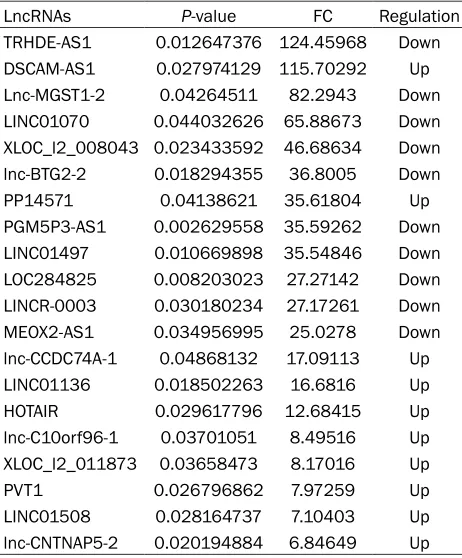
Quantitative real-time PCR was performed to validate the microarray experiments using an independent cohort of 11 paired BC RCT and RT samples. Total RNA was extracted following the manufacturer’s protocols for each kit. RNA quality was confirmed using a NanoDrop 1000 spectrophotometer. An OD260/280 of approxi-Table 1. The top 20 dysregulated lncRNAs (RCT vs. RT)
LncRNAs P-value FC Regulation
TRHDE-AS1 0.012647376 124.45968 Down
DSCAM-AS1 0.027974129 115.70292 Up
Lnc-MGST1-2 0.04264511 82.2943 Down
LINC01070 0.044032626 65.88673 Down
XLOC_l2_008043 0.023433592 46.68634 Down
lnc-BTG2-2 0.018294355 36.8005 Down
PP14571 0.04138621 35.61804 Up
PGM5P3-AS1 0.002629558 35.59262 Down
LINC01497 0.010669898 35.54846 Down
LOC284825 0.008203023 27.27142 Down
LINCR-0003 0.030180234 27.17261 Down
MEOX2-AS1 0.034956995 25.0278 Down
lnc-CCDC74A-1 0.04868132 17.09113 Up
LINC01136 0.018502263 16.6816 Up
HOTAIR 0.029617796 12.68415 Up
lnc-C10orf96-1 0.03701051 8.49516 Up
XLOC_l2_011873 0.03658473 8.17016 Up
PVT1 0.026796862 7.97259 Up
LINC01508 0.028164737 7.10403 Up
lnc-CNTNAP5-2 0.020194884 6.84649 Up
(Agilent Technology). Briefly, total RNA was transcribed to double-stranded cDNA, syn-thesized into cRNA and labeled with cya-nine-3-CTP. Labeled cRNAs were hybrid-ized onto the microarray. After washing, the arrays were scanned with an Agilent Scanner G2505C (Agilent Technologies) and microarray profiling was conducted in the laboratory of the OE Biotechnology Company in Shanghai, People’s Republic of China.
Microarray results analysis and prediction of the functions of lncRNAs
[image:3.612.91.322.84.363.2]down-regu-mately 1.8 was set as the criterion of accept-able purity. Reverse transcription was per-formed by following the manufacturer’s proto-cols for a First Strand cDNA Synthesis Kit. The relative levels of the top ten up-regulated and down-regulated lncRNAs were determined via quantitative real-time PCR, which was per-formed using ABI Power SYBR1Green PCR Master Mix (Applied Biosystems, USA). Relative lncRNA expression levels were calculated using the 2-ΔΔCt method and were normalized to β-actin expression.
Kaplan-Meier analysis
The prognostic value of lncRNA expression was evaluated using the online database Kaplan-Meier Plotter (www.kmplot.com), which con-tained lncRNA expression data and survival information for 761 clinical BC patients. To ana-lyze the relapse-free survival (RFS) of patients with BC, patient samples were split into two
groups by median expression (high vs. low expression) and assessed using a Kaplan-Meier survival curve, with a hazard ratio (HR) with 95% confidence intervals (CI) and a log-rank P value.
Results
General expression profiles of differentially
expressed lncRNAs and mRNAs
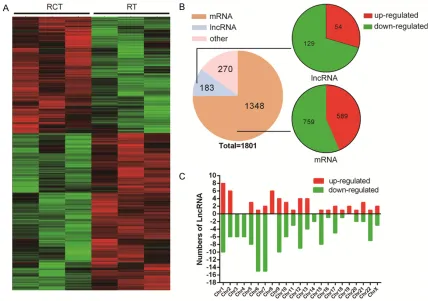
[image:4.612.91.519.74.375.2]Feature Extraction software was used to obtain standardized data (Table 1). In unsupervised hierarchical clustering analysis, the differen-tially expressed lncRNAs were used to generate a heat map (Figure 2A). In total, 1801 genes were significantly altered (FC>2; P<0.05) in 3 pairs of samples, including 1348 mRNAs, 183 lncRNAs and 270 other genes (Figure 2B). The chromosome location data showed the number of up- or down-regulated lncRNAs located on specific human chromosomes (Figure 2C). Figure 2.LncRNA microarray data of three paired BC tissues (between RCT and RT). The lncRNA expression patterns in samples is shown as a heatmap based on hierarchical clustering (A); Using second-generation RNA microarray
analysis, 1801 RNAs (log fold-changes >2) were detected. Pie chart showing the proportion of components (B);
LncRNA function prediction
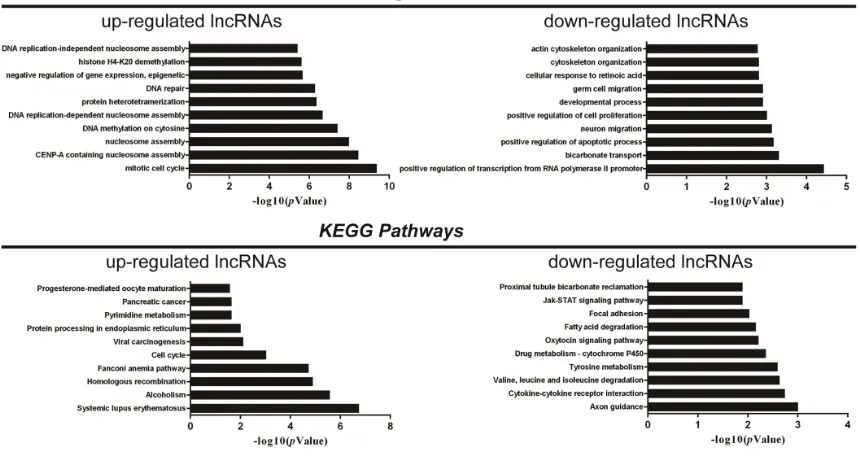
Hundreds of lncRNAs were co-expressed with thousands of mRNAs. The lncRNAs were clus-tered into hundreds of GO and KEGG pathway annotations, and the top ten GO biological pro-cesses and KEGG pathways enriched for the
[image:5.612.92.522.84.313.2]up-regulated or down-regulated lncRNAs are presented in Figure 3. In our results, “positive regulation of cell proliferation” was enriched in GO biological process for down-regulated lncRNAs, while “drug metabolism-cytochrome P450” was enriched in the KEGG pathway for down-regulated lncRNAs, which indicates the Figure 3.GO and KEGG pathway analysis. The top 10 GO terms associated with the coding gene functions of up-regulated lncRNAs (left upper panel) and down-regulated lncRNAs (right upper panel) are listed. The top 10 pathways associated with the coding genes of up-regulated lncRNAs (left lower panel) and down-regulated lncRNAs (right lower panel) are listed.
Figure 4.Validation of dysregulated lncRNAs and prediction of their prognostic value. We selected 20 lncRNAs (the
top ten up-regulated and down-regulated lncRNAs) for real-time PCR quantification in 11 paired BC tissues. The data
show that lnc-MGST1-2 and lnc-BTG2-2 are down-regulated in the residual cancer tissues, while LINC01508 and
DSCAM-AS1 are significantly up-regulated in the residual cancer tissues compared with their levels in the remittent
[image:5.612.97.517.389.558.2]possibility that the down-regulated lncRNAs participate in the chemo-resistance process. RT-PCR confirmation and prognostic value
To validate the microarray data, the top ten up-regulated and down-regulated lncRNAs were examined by RT-PCR in 11 pairs of BC tis-sues (RCT and paired RT). In our results, we found that the expression of two up-regulated lncRNAs (LINC01508 and DSCAM-AS1) and two down-regulated lncRNAs (lnc-MGST1-2 and lnc-BTG2-2) was consistent with the microarray analysis and showed a significant difference between RCT and RT (Figure 4A).
We also predicted the prognostic value of lncRNA expression using Kaplan-Meier Plotter, and the clinical data co-related to 11 lncRNAs (6 up-regulated lncRNAs and 5 down-regulated lncRNAs) was acquired from TCGA database (The Cancer Genome Atlas). Interestingly, we found that the expression level of the novel lncRNA LINC01508 was significantly related to the overall survival of BC patients (P=0.014), and a high LINC01508 expression level indi-cated a poor BC patient prognosis (Figure 4B). Discussion
BC is the most frequently diagnosed cancer in females, and a large number of patients, espe-cially those with HER2-negative BC, experience treatment failure due to recurrence and metas-tasis. Various drugs have been approved for BC, but the acquisition of resistance remains a substantial obstacle for clinical management of the disease. After chemotherapy, the morphol-ogy and structure of some cancer cells are altered in RCTs. These tissues are character-ized by degeneration of cancer cells, prolifera-tion of fibrous tissue cells and infiltraprolifera-tion of lymphocytes [12]. Additionally, epithelium- and cancer stem cell-related markers have been found in RCTs [20]. At the same time, drug resistance is enhanced in residual cancer cells. The resistant and normal tumor stem cells exhibit the same pattern of accumulated muta-tions, which leads to newly acquired drug resis-tance via gene activation, point mutations and gene amplification [21]. However, the specific mechanism is unclear. Therefore, elucidation of these molecular mechanisms, particularly the mechanism associated with chemotherapy
resistance, is crucial for better prediction of BC patient outcome and response to therapy. Although study of lncRNAs has increased rapidly, only a few lncRNAs are well unders- tood. Among the 183 differentially expressed lncRNAs we identified from the microarray results, only four were verified to be dysregu -lated in chemo-resistant tissues. Expression of lncRNAs exhibits temporal-spatial specificity. For instance, different lncRNAs derived from different types of tumor tissues and specific tissue-based lncRNAs are responsible for spe-cific subtypes of BC. Therefore, determining how to design different groups for analysis is critical for identifying the subset-specific lncRNAs. This study is the first to perform a microarray analysis comparing RCTs and RTs, and the majority of the differentially expressed lncRNAs we found have seldom been reported previously.
The new lncRNAs are generally less evolution-arily conserved than known lncRNAs, with a large fraction unique to humans or primates. Our predicted function results showed enrich-ment in hundreds of biological processes and pathways, among which we found some cancer behaviors that were specifically enriched in the down-regulated lncRNA group, indicating that chemo-resistance is related to silencing of tumor suppressor genes. Through analysis of RNA-seq samples in a cohort of 947 BC patients, Yashar et al. [22] found that DSCAM-AS1 was down-regulated in BC tissues and par-ticipated in tumor progression and tamoxifen resistance.
Acknowledgements
This work was supported by the National Na- tural Science Foundation of China (81441084), the Natural Science Foundation of Hunan Province of China (2015jj4059), the Develop- ment and Reform Commission of Hunan Province of China (201465), and the Hunan Provincial Innovation Foundation for Postgra- duate (No. CX2017B073).
Disclosure of conflict of interest
None.
Address correspondence to: Dr. Wenjun Yi, Depart- ment of Breast and Thyroid Surgery, The Second Xiangya Hospital, Central South University, 139 Renmin Road, Changsha 410008, China. E-mail: [email protected]
References
[1] Siegel RL, Miller KD, Jemal A. Cancer statistics, 2016. CA Cancer J Clin 2016; 66: 7-30. [2] Holliday DL, Speirs V. Choosing the right cell
line for breast cancer research. Breast Cancer Res 2011; 13: 215.
[3] Prat A, Perou CM. Deconstructing the molecu-lar portraits of breast cancer. Mol Oncol 2011; 5: 5-23.
[4] Gnant M, Thomssen C, Harbeck N. St. Gallen/ Vienna 2015: a brief summary of the consen-sus discussion. Breast Care (Basel) 2015; 10: 124-130.
[5] Mauri D, Pavlidis N, Ioannidis JP. Neoadjuvant versus adjuvant systemic treatment in breast cancer: a meta-analysis. J Natl Cancer Inst 2005; 97: 188-194.
[6] Bonadonna G, Valagussa P, Brambilla C, Ferrari L. Preoperative chemotherapy in oper-able breast cancer. Lancet 1993; 341: 1485. [7] Weigelt B, Geyer FC, Reis-Filho JS. Histological
types of breast cancer: how special are they? Mol Oncol 2010; 4: 192-208.
[8] Cortazar P, Zhang L, Untch M, Mehta K, Costantino JP, Wolmark N, Bonnefoi H, Cameron D, Gianni L, Valagussa P, Swain SM, Prowell T, Loibl S, Wickerham DL, Bogaerts J, Baselga J, Perou C, Blumenthal G, Blohmer J, Mamounas EP, Bergh J, Semiglazov V, Justice R, Eidtmann H, Paik S, Piccart M, Sridhara R, Fasching PA, Slaets L, Tang S, Gerber B, Geyer CJ, Pazdur R, Ditsch N, Rastogi P, Eiermann W, von Minckwitz G. Pathological complete
re-sponse and long-term clinical benefit in breast
cancer: the CTNeoBC pooled analysis. Lancet 2014; 384: 164-172.
[9] von Minckwitz G, Untch M, Blohmer JU, Costa SD, Eidtmann H, Fasching PA, Gerber B, Eiermann W, Hilfrich J, Huober J, Jackisch C, Kaufmann M, Konecny GE, Denkert C,
Nekljudova V, Mehta K, Loibl S. Definition and
impact of pathologic complete response on prognosis after neoadjuvant chemotherapy in various intrinsic breast cancer subtypes. J Clin Oncol 2012; 30: 1796-1804.
[10] Lv M, Xu P, Wu Y, Huang L, Li W, Lv S, Wu X, Zeng X, Shen R, Jia X, Yin Y, Gu Y, Yuan H, Xie H, Fu Z. LncRNAs as new biomarkers to dif-ferentiate triple negative breast cancer from non-triple negative breast cancer. Oncotarget 2016; 7: 13047-13059.
[11] Niikura N, Tomotaki A, Miyata H, Iwamoto T, Kawai M, Anan K, Hayashi N, Aogi K, Ishida T, Masuoka H, Iijima K, Masuda S, Tsugawa K, Kinoshita T, Nakamura S, Tokuda Y. Changes in tumor expression of HER2 and hormone receptors status after neoadjuvant chemo-therapy in 21 755 patients from the Japanese breast cancer registry. Ann Oncol 2016; 27: 480-487.
[12] Cho CW. Formulation strategy to overcome multi-drug resistance (MDR). Arch Pharm Res 2011; 34: 511-513.
[13] Ponting CP, Oliver PL, Reik W. Evolution and functions of long noncoding RNAs. Cell 2009; 136: 629-641.
[14] Guttman M, Amit I, Garber M, French C, Lin MF, Feldser D, Huarte M, Zuk O, Carey BW, Cassady JP, Cabili MN, Jaenisch R, Mikkelsen TS, Jacks T, Hacohen N, Bernstein BE, Kellis M, Regev A, Rinn JL, Lander ES. Chromatin signature re-veals over a thousand highly conserved large non-coding RNAs in mammals. Nature 2009; 458: 223-227.
[15] Xue X, Yang YA, Zhang A, Fong KW, Kim J, Song B, Li S, Zhao JC, Yu J. LncRNA HOTAIR enhanc-es ER signaling and confers tamoxifen renhanc-esis- resis-tance in breast cancer. Oncogene 2016; 35: 2746-2755.
[16] Wang YL, Overstreet AM, Chen MS, Wang J, Zhao HJ, Ho PC, Smith M, Wang SC. Combined inhibition of EGFR and c-ABL suppresses the growth of triple-negative breast cancer growth through inhibition of HOTAIR. Oncotarget 2015; 6: 11150-11161.
[17] Jiang M, Huang O, Xie Z, Wu S, Zhang X, Shen A, Liu H, Chen X, Wu J, Lou Y, Mao Y, Sun K, Hu S, Geng M, Shen K. A novel long non-coding RNA-ARA: adriamycin resistance-associated. Biochem Pharmacol 2014; 87: 254-283. [18] Li XJ, Zha QB, Ren ZJ, Tang JH, Yao YF.
[19] Mittendorf EA, Buchholz TA, Tucker SL, Meric-Bernstam F, Kuerer HM, Gonzalez-Angulo AM, Bedrosian I, Babiera GV, Hoffman K, Yi M, Ross MI, Hortobagyi GN, Hunt KK. Impact of chemo-therapy sequencing on local-regional failure risk in breast cancer patients undergoing breast-conserving therapy. Ann Surg 2013; 257: 173-179.
[20] Das M, Sahoo SK. Folate decorated dual drug loaded nanoparticle: role of curcumin in en-hancing therapeutic potential of nutlin-3a by reversing multidrug resistance. PLoS One 2012; 7: e32920.
[21] Jwa E, Shin KH, Kim JY, Park YH, Jung SY, Lee ES, Park IH, Lee KS, Ro J, Kim YJ, Kim TH. Locoregional recurrence by tumor biology in breast cancer patients after preoperative che-motherapy and breast conservation treatment. Cancer Res Treat 2016; 48: 1363-1372.