A Study on the Causes for Failures in Mathematics
by Engineering Students Using CFRM Model
A. Praveen Prakash, J. Esther Jerlin, J. Bennilo Fernandes
Abstract: The quality of teaching and learning mathematics has
been one of the major challenges and concern of the educators. Mathematics is often considered as a subject that a student mostly find hard to understand. In reality, mathematics comprises of wide variety of skills and concepts. Mathematics education should enable engineering students to communicate their ideas in an unambiguous and understandable way and should equip themselves with the analytical skills as practicing engineers. Here the study of causes for failure in Mathematics among engineering students i s analyzed using combined Fuzzy Relational Maps (CFRMs). It is important to note that the performance in mathematics in all engineering colleges by stude nts undergoing BE and B . T e c h courses are c o n s i d e r a b l y poor. Here we analyze the problem by taking a survey from engineering students and mathematics teachers working in engineering colleges. This paper consists of four sections. The first section states the existing problem in teaching/learning mathematics in Engineering Colleges of Tamil Nadu which is obtained through interview. Section two gives the description of CFRM models. Section three deals with the analysis related to the failure in mathematics by engineering students through the attributes of teachers and students and their analysis. Section four gives conclusions and suggestions based on the analysis.
Index Terms: CFRM model, fixed point, hidden pattern, relational matrix, limit cycle, failure.
I. INTRODUCTION
In all Engineering degree courses a level of mathematical ability is required to pursuing the course with understanding. It acts as a challenge for the students as it plays a vital role in different discipline. The main reason attributed by mathematics teacher at the entry level in colleges is that the students are not well acquainted with the basics of Mathematics. But o n t h e o t h e r h a n d , f r o m t he student’s point of view it was found that, they are bored in the class and are not able to follow the class as the portions are completed hastily by the teachers. In our survey, we found most of the engineering students saying that they have fear for their mathematics teachers and the subject due to harsh treatment by the teachers. Engineering teachers mostly complain that the students lack sufficient knowledge and understanding of XI and XII standard syllabus. Also the mass media such as cinema, T.V, Internet, mobile etc. play a vital role in distracting the attention of the adolescents through
Manuscript received March 12, 2014; revised April 04, 2014.
A. Praveen Prakash is with the Faculty of Mathematics, Hindustan University, Padur, Chennai (e-mail: [email protected])
J. Esther Jerlin is with the Department of Mathematics, Hindustan University, Padur, Chennai (e-mail: [email protected])
J. Bennilo Fernandes is with the Department of Embedded System, Hindustan University, Padur, Chennai (e-mail: [email protected])
programs that are made mostly having ‘profit’ as their only motive, though they can play a constructive role in their intellectual pursuit.
II. FUZZY RELATIONAL MAP (FRM) MODEL A. Fuzzy Relational Map (FRM)
Initially the causal associations are divided into two disjoint units. To define a Fuzzy Relational Map these two disjoint units are taken as a domain space and a range space. Here the term disjoint we mean the sense of concepts which we have taken. Further it is assumed that no intermediate relations exist among the domain elements itself and within the elements of the range space. In general, the number of elements in the range space need not be equal to the number of elements in the domain space. In this discussion, the elements of the domain space are from the real vector space of dimension n and the range space is of dimension m. Here n need not be equal to m. The domain space and the range space are denoted by D and R respectively. Thus D = {D1, D2, …,Dn} is the domain space, where each Di = {(x1, x2, …, xn) | xj = 0 or 1}, for i = 1, …, n. Similarly R = {R1, R2, …,Rm} is the range space, where Rj = {(x1, x2, …, xm) | xj = 0 or 1} for j=1, 2, …, m.
Definition: 2.1.1: A FRM is a directed graph or a map from Domain Space to Range Space with concepts like policies or events etc. as nodes and causalities as edges. It represents casual relations between spaces D and R.
Definition 2.1.2: The directed edge from D to R denotes the causality of D on R, called relations. Every edge in the FRM is weighted with a number in the set {0, 1}.
Definition 2.1.3: Let Di and Rj denote the two sets of nodes of an FRM. Let eij be the weight of the edge DiRj, eij € {0,1}. The weight of the edge DiRj is positive if increase in Di implies increase in Rj or decrease in Di implies decrease in Rj. i.e., causality of Di on Rj is 1. If eij =0 then Di does not have any effect on Rj. We do not discuss the cases when increase in Di implies decrease in Rj or decrease in Di implies increase in Rj. When the nodes of the FRM are fuzzy sets, then they are called fuzzy nodes, FRMs with edge weights {0, 1} are called simple FRMs. Let D1, …,Dn be the nodes of the domain space D of an FRM and R1, …,Rm be the nodes of the range space R of an FRM.
can be a rectangular matrix; with rows corresponding to the domain space and columns corresponding to the range space. This is one of the marked differences between FRMs and FCMs.
Definition 2.1.5: Let D1, …,Dn and R1,…,Rm be the nodes of an FRM. Let DiRj (or RjDi) be the edges of an FRM, j = 1, 2, …, m, i = 1, 2, …, n. The edges form a directed cycle if it possesses a directed cycle. An FRM is said to be acyclic if it does not possess any directed cycle.
Definition 2.1.6: An FRM with cycles is said to be an FRM with feedback. When the causal relations flow through a cycle in a revolutionary manner, the FRM is called a dynamical system.
Definition 2.1.7: Let DiRj(or RjDi), 1≤ j ≤ m, 1 ≤i≤ n. When Rj(or Di) is switched on and if causality flows through edges of the cycle and if it again causes Rj(orDi), we say that the dynamical system goes round and round. This is true for any node Rj(or Dj) for 1 ≤i≤n, (or 1 ≤ j ≤m). The equilibrium state of this dynamical system is called the hidden pattern. If the equilibrium state of the dynamical system is a unique state vector, then it is called a fixed point. Consider an FRM with R1… Rm and D1… Dn as nodes. For example let us start the dynamical system by switching on R1or D1. Let us assume that the FRM settles down with R1 and Rm (or D1 and Dn) on i.e. the state vector remains as (1 0 … 0 1) in R [or (1 0 … 0 1) in D], this state vector is called the fixed point. If the FRM settles down with a state vector repeating in the form A1 → A2→….→Ai→ A1or (B1 → B2 … Bi→ B1) then this equilibrium is called a limit cycle.
Definition 2.1.8 : Determination of Hidden pattern. Let R1, …,Rm and D1, …, Dn be the nodes of a FRM with feedback. Let E be the relational matrix. Find a hidden pattern when D1 is switched ON, that is when an input is given as vector A1 = (1 0 0 … 0) in D1 the data should pass through the relational matrix E. This is obtained by multiplying A1 with the relational matrix E. Let A1E = (r1, …,rm) after thresholding and updating the resulting vector A1E we get a vector B. Now we pass on B onto ET to obtain BET. We update and threshold the vector BET so that the BET is equal to A
2. This procedure is repeated till we get a limit cycle or a fixed point.
B. Justification for using FRM
1) Since we cannot categorically express the cause of failure in any statistical data we are forced to use fuzzy models for this study.
2) The data is an unsupervised one.
3) Since the attributes are based on the relation between a teacher and a student, we divide the casual associations into two disjoint units as domain space and range space.
4) Hence FRM model is best suited for this study.
III. Analysis of failure in Mathematics among students pursuing in engineering courses in colleges and the expected outcome using CFRM
D1, D2, …….,D10 are the nodes forming the domain space that describes the methods of approach by teaches in dealing with the students in teaching the subject Mathematics.
D1-Good knowledge about the subject D2-Interest in teaching
D3-Dedication to profession and goal oriented D4-Kind, considerate and understanding the students D5-Using innovative teaching methodology
D6-Taking interest in the students in class and outside class and motivating them
D7-Giving punishment in front of the students in the class D8-Being rude to the students without following psychological approach.
D9-Failing to give continuous test and assessing their performances.
D10-Providing notes and encouraging self-study without working out the problems.
We have taken ten nodes related to the behavioral outcome of the students in this study.
These concepts form the range space which is listed below.
R1- Interested in mathematics R2- Sincere student
R3- Regular to class R4- Attentive in class
R5- Complete their assignments in time
R6- Lose their confidence level at the time of examination R7- Have fear for the subject
R8- Doesn’t fare well in the exams
R9- Fail to understand the concept and suffer due to lack of logical reasoning and application skill
R10- Feel shy to ask clarification in front of their classmates
[image:2.595.307.547.508.593.2]A. According to the first expert’s opinion which is arrived at through response from engineering student we obtained the following relational directed graph is as follows
Fig. 1. Directed graph of the first expert
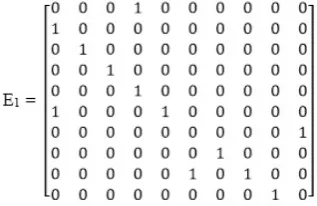
The relational matrix is given below
[image:2.595.339.498.625.728.2]Consider the node D6, ‘Taking interest in the students in class and outside class and motivating them’ to be in the on state and rest of the nodes in the off state.
i.eX1= (0 0 0 0 0 1 0 0 0 0).
Then X1E1= (1 0 0 0 1 0 0 0 0 0) = Y1 Y1E (0 1 0 0 0 1 0 0 0 0) = X2 X2E1 (1 0 0 0 1 0 0 0 0 0) = Y2 = Y1
When the node D6 is in the on state we get a fixed pair as {(0 1 0 0 0 1 0 0 0 0),(1 0 0 0 1 0 0 0 0 0)}, i.eR1 and R5 are on the On state. The students are interested in mathematics and complete their assignments in time. We also note that along with D6 , that we kept in “On-State”, D5 also comes up in “On State”. This can be interpreted as when D6 “Teacher take interest in students inside as well as outside the class and motivate them and follow innovative teaching methodology, creates “Interest in Maths” (R1) and complete their assignments in time (R5) that prove way for effective process of teaching/learning.
Consider the node R4‘Attentive in class’ to be in the on state and rest of the nodes in the off state.
i.e.S1= (0001000000).
S1E = (1000100000) = T1 T1E1= (0001000000)= S2
S2E = (1 0 0 0 1 0 0 0 0 0) = T2 = T1
We get the fixed pair as {(1000100000) ,(0001000000)} .
When the node R4 is in the on state we get D1, D5in the on-state. The students are attentive in the class (R4) only when the teachers have good knowledge of the subject (D1) and deliver them by using appropriate teaching methods (D5).
[image:3.595.332.507.100.216.2]B. The second expert’s opinion is arrived from the response of an engineering lecturer we obtained the relational directed graph is as follows
Fig. 3. Directed graph of the second expert
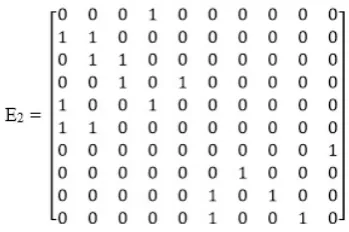
The relational matrix is given below
Fig. 4. Relational matrix of the second expert
Consider the node D6, ‘Taking interest in the students in class and outside class and motivating them’ to be in the on state and rest of the nodes in the off state .i.e X1= (0 0 0 0 0 1 0 0 0 0 ).
Then X1E2= (1 1 0 0 0 0 0 0 0 0 ) = Y1
Y1E (0 1 1 0 1 1 0 0 0 0) = X2 X2E2 (1 1 1 1 0 0 0 0 0 0) = Y2
Y2E (1 1 1 1 1 1 0 0 0 0) = X3 X3E2 (1 1 1 1 0 0 0 0 0 0) = Y3=Y2
When the node D6 is in the on state we get a fixed pair as {(1 1 1 1 1 1 0 0 0 0 ), (1 1 1 1 1 0 0 0 0 0 )}, i.e R1,R2,R3,R4, R5 are on the On state. The students are sincere, regular to class, attentive in class, interested in mathematics, and complete their assignments in time.
We note that the nodes D1to D6 comes up “On-State” for R1to R5 comes up “On-State”. So the effective learning to take place, the teacher had to have good knowledge of the subject (D1), should have interest in teaching (D2), should have dedicated to the profession and should work to achieve the set goal (D3), should be kind, considerate and understanding the students (D4), should have innovative methods of teaching the subjects (D5) and continuous motivating the students throughout both inside as well as outside the class room (D6).
Consider the node R4 ‘Attentive in class’ to be in the on state and rest of the nodes in the off state.
i.e.S1= (0 0 0 1 0 0 0 0 0 0).
S1E = (1 0 0 0 1 0 0 0 0 0) = T1 T1E2 (1 0 0 1 0 0 0 0 0 0) = S2
S2E (1 1 0 0 1 1 0 0 0 0) = T2 T2E2 (1 1 0 1 0 0 0 0 0 0) = S3
S3E (1 1 1 0 1 1 0 0 0 0) = T3 T3E2 (1 1 1 1 0 0 0 0 0 0) = S4
We get the fixed pair as {(1111110000) ,(1111000000)}.
When the node R4 is in the on state we get D1, D2, D3, D4, D5, D6 in the on state. This confirms the opinion of the experts mentioned above.
[image:4.595.52.290.197.276.2]C. According to the third expert’s opinion from a parent we obtained the following relational directed graph
Fig. 5. Directed graph of the third expert
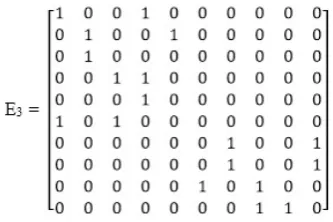
[image:4.595.75.242.313.424.2]The relational matrix is given below
Fig. 6. Relational matrix of the third expert
Consider the node D6, ‘Taking interest in the students in class and outside class and motivating them’ to be in the on state and rest of the nodes in the off state.
i.e X1= (0 0 0 0 0 1 0 0 0 0 ). Then X1E3= (1 0 1 0 0 0 0 0 0 0 ) = Y1
Y1E (1 0 0 1 0 1 0 0 0 0) = X2 X2E3 (1 0 1 1 0 0 0 0 0 0) = Y2
Y2E (1 0 0 1 1 1 0 0 0 0) = X3 X3E3 (1 0 1 1 0 0 0 0 0 0) = Y3=Y2
When the node D6 is in the on state we get a fixed pair as {(1 0 0 1 1 1 0 0 0 0 ),(1 0 1 1 0 0 0 0 0 0 )}, i.e R1,R3,R4, are on the on state. The students are sincere, regular to class, attentive in class.
Consider the node R4 ‘Attentive in class’ to be in the on state and rest of the nodes in the off state.
i.e.S1= (0 0 0 1 0 0 0 0 0 0 ).
S1E = (1 0 0 1 1 0 0 0 0 0) = T1 T1E2 (1 0 1 1 0 0 0 0 0 0) = S2
S2E (1 0 0 1 1 1 0 0 0 0) = T2 T2E2 (1 0 1 1 0 0 0 0 0 0) = S3= S2
We get the fixed pair as {(1001110000) ,(1011000000)}
When the node R4 is in the On-State we get D1, D4, D5, D6 in the On-State. i.e Good knowledge about the subject , Kind, considerate and understanding the students, Using innovative teaching methodology ,Taking interest in the students in class and outside class and motivating them come to the on state.
D. Combined FRM
Combined opinion of all the three experts could be obtained by finding the sum of the three matrices and the hidden pattern will give their collective opinion.
Let P=E1+E2+E3
The relational matrix is given below
Fig. 7. Combined relational matrix
Consider the node D6, ‘Taking interest in the students in class and outside class and motivating them’ to be in the on state and rest of the nodes in the off state.
i.e X1= (0 0 0 0 0 1 0 0 0 0 ). Then X1P= (1 1 1 0 0 0 0 0 0 0 ) = Y1 Y1P (1 1 1 1 1 1 0 0 0 0) = X2 X2P (1 1 1 1 1 0 0 0 0 0) = Y2 Y2P (1 1 1 1 1 1 0 0 0 0) = X3 X3P (1 1 1 1 1 0 0 0 0 0) = Y3=Y2
When the node D6 is in the on state we get a fixed pair as {(1 1 1 1 1 1 0 0 0 0 ), (1 1 1 1 1 0 0 0 0 0 )}, i.e R1, R2,R3,R4,R5 are on the on state. This outcome is same as that obtained through first two concepts.
Consider the node R4 ‘Attentive in class’ to be in the on state and rest of the nodes in the off state.
[image:4.595.339.516.315.434.2]T2P (1 1 1 1 1 0 0 0 0 0) = S3 S3P (1 1 1 1 1 1 0 0 0 0) = T3= T2
We get the fixed pair as {(1111110000) ,(1111100000)}. When the node R4 is in the on state we get D1, D2, D3 ,D4 D5, D6 in on state. This again confirms the majority opinion discussed above.
IV. CONCLUSION AND SUGGESTION
According to the analysis, When the node D6‘Taking interest in the students in class and outside class and motivating them’ in on state and rest of the nodes in the off state,we get a fixed pair as{(1 1 1 1 1 1 0 0 0 0 ),(1 1 1 1 1 0 0 0 0 0 )}, i.e R1, R2,R3,R4,R5 are on the on state. i.e The students are sincere, regular to class, attentive in class ,have interest in learning mathematics and complete their assignments in time .
When the node R4 ‘Attentive in class’ to be in the on state and rest of the nodes in off state. We get the fixed pair as {(1111110000) , (1111100000)} i.e. D1,D2,D3,D4,D5,D6are on the on-state. i.e. Good knowledge about the subject ,Interest in teaching, Dedication to profession and goal oriented, Kind, considerate and understanding the students, Using innovative teaching methodology, Taking interest in the students in class and outside class and motivating them come to the On state.
Thus the role of mathematics teachers plays a major part in molding and shaping the behavior of the students, for they should pay more attention to the students or else aversion tomath’s by students will be the natural, which they carry over till they complete their engineering courses. Students too should understand their responsibilities in respecting the teachers and gaining knowledge from them.
V. FUTURE WORK
Analyzing the problem faced by the engineering students in Tamil Nadu regarding Mathematics using Fuzzy Models.
ACKNOWLEDGMENT
The authors wish to thank the management of Hindustan University and Prof. Dhanapalan College of Arts & Science for the constant source of encouragement and support.
REFERENCES
[1] Kosko, B, “Neural Networks and Fuzzy System; Prentice Hall of India”,- 1997.
[2] W.B. Vasantha Kandaswamy and Yasmin Sultana, “Knowledge Processing using Fuzzy Relations Maps”, Ultra.Sci 12;242-245, -2000.
[3] W.B.Vasantha Kandaswamy, Florentine Smarandache, “Fuzzy cognitive maps and Neutroscophic Cognitive Maps”; Xiquan, AZ
-2003.
[4] W.B.VasanthaKandasamy, Florentin Smarandache, K. Ilanthenral “ELEMENTARY FUZZY MATRIX THEORY AND FUZZY MODELS FOR SOCIAL SCIENTISTS”; -2007.