Benzothiazole Based Schiff’s Base Nematic Liquid Crystals
and their Copper Complexes
Panyam R. Ramesh, V. S. Rao Nandiraju and Devashsish Sengupta
Chemistry Department,
Assam University, Silchar–788 011, INDIA. email: [email protected].
(Received on: August 30, 2016)
ABSTRACT
Benzothiazole based Schiff’s bases and their copper complexes were synthesized by simple and straight forward synthetic methods. The molecular structural characterization is consistent with the elemental and analytical spectroscopic data. The thermal behavior and the phase characterization were investigated by the differential scanning calorimetry (DSC) and polarising optical microscopy (POM) studies. The Ligands exhibited enatiotropic nematic mesogenic phases while the copper complexes of these Schiff bases were found to be non mesogenic.
Keywords: Benzothiazoles, DSC, POM, mesogenic, nematic.
1. INTRODUCTION
The chemistry of 2-amino benzothiazole and their derivatives has gained increasing interest in both synthetic organic chemistry and biological fields. Its application in drug design and their numerous pharmacological activities like- antitumor, antimicrobial, anti-inflammatory, anticonvulsant, and antidiabetic activities have been reported1-2. 2-aminobenzothiazole derivatives in isolated and fused heterocycles and their potential as better chemotherapeutic agents are reported.3 It is well known that nitrogen and sulphur atom play key roles in the coordination of metals at the active sites of numerous metallobiomolecules4-5. Liquid crystals containing a heterocyclic ring system have also been attracting attention in their own right. These kinds of compounds exhibit interesting properties. Ligands containing benzothaizole and benzoxazole rings with different central linkages and different lateral substitution have effected changes on mesomorphic properties6-7. It has been reported that benzothiazole-based liquid crystals possessed good
interest as hole-transporting materials in organic light emitting devices (OLEDs)8. Ha et.al have reported homologous series of 6-methoxy-2-(4-alkanoyloxybenzylidenamino) benzothiazoles, with benzothiazole as a mesogenic core in Schiff base liquid crystals exhibiting nematic phases.9 Therefore, in order to further explore it has been found interesting to the 6 substituted 2-aminobenzothiazole moiety and their metal complexes for mesogenic character.
2. RESULTS AND DISCUSSION
The methodology adopted to synthesize novel benzothiazole based nematic liquid crystals and their copper complex is shown in scheme 1.
Scheme 1. Synthesis of compounds 5a-5b. Reagents and conditions: (i) KSCN, glacial AcOH, Br2, below 15
°C, stirring 6h; (ii) dry acetone, KHCO3, R-Br (where R= C16H33- and C18H37-), KI; (iii) Abs. EtOH,
AcOH, Δ, 6h; (iv) Abs. EtOH, Cu(CH3COO)2, Δ, 4h.
The molecule (4a or 4b) consists of benzothiazole and phenyl rings linked by a salicylidene moiety. A salicylidene linkage was preferred rather than a benzylidene linkage due to the presence of an ortho-hydroxyl group in the benzylidene moiety, which enhances the transverse dipole moment as well as the stability of the imines through intramolecular H-bonding, and thus overcomes the hydrolytic instability of the molecules towards moisture.
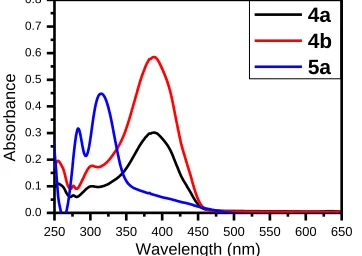
correspond to π-π* transition of aromatic phenyl ring and 350-450 nm correspond to n-π* transition of imine chromophore of ligands respectively. Absorption maximum of n-π* transition of imine chromophore is at 388 nm. Interestingly, upon complexation with copper ion n-π* transition of ligand is affected and blue shifted to 315 nm. This blue shift clearly hints the formation of copper complex and strong binding of copper ion with imine functional group.
Fig. 1 Absorption spectra of ligands and their copper complex
The liquid crystalline behaviour of compounds (4a, 4b and 5a) was characterised and studied by differential scanning calorimetry (DSC) and polarising optical microscopy (POM). The phase transition temperatures and thermodynamic data of enthalpies and entropies for all the compounds are summarised in Table 1.
Table 1: Phase transition temperatures (°C) of the compounds 4a, 4b and 5a recorded for second heating (first row) and second cooling (second row) cycles at 10 °C/min from DSC and confirmed by polarized optical microscopy. The enthalpies (ΔH in kJ/mol) are presented in parentheses.
Compound Phase transition temperatures
(enthalpy) 4a Cr 78.16 (21.0) N 107.8 (0.20) Iso
Cr 67.8 (22.5) N 104.2 (0.30) Iso 4b Cr 84.67 (28.6) N 106 (0.34) Iso Cr 75.8 (30.0) N 104.3 (0.32) Iso 5a Cr 158.75 I
Cr 151.7 I
250 300 350 400 450 500 550 600 650 0.0
0.1 0.2 0.3 0.4 0.5 0.6 0.7 0.8
A
b
s
o
rb
a
n
c
e
Wavelength (nm)
The DSC thermograms of compounds, 4a and 4b in the second heating and cooling cycles are shown in Figure 2.
Fig. 2 DSC thermograms of 4a and 4b in the second heating and cooling cycle at 10 °C m−1.
The compounds 4a and 4b exhibited the enantiotropic nematic phase and in both the samples the width of the nematic phase range in the cooling cycle was much larger than the nematic phase range during the heating cycle. The width of the nematic phase range of 4b is smaller than 4a.
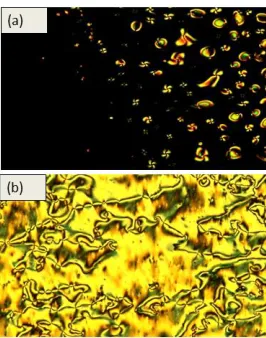
Representative textures of the mesomorphic phases of compound 4a at different temperatures in the cooling cycle are shown in Figure 3. On cooling from the isotropic phase all the compounds (4a and 4b) exhibited Schlieren textures in the nematic phase. This indicates homogeneous alignment of the molecules along with the nematic director being on average parallel to the substrate surface. However, copper complexes of 4a and 4b did not exhibit mesomorphic behaviour. Investigations are in progress to understand the reason for such behaviour of complexes.
Fig. 3 Microphotographs of the compound 4a in the nematic phase in the cooling cycle: (a) and (b) are Schlieren textures at 99.6 and at 76.3 °C.
60 70 80 90 100 110
0 5 10 15 20 25 30 35 40
H
e
a
t flo
w
(m
W
)
Temperature (C)
3. EXPERIMENTAL SECTION
Chemicals were procured from Alfa Aesar, Aldrich and Tokyo Kasei Kogyo. Solvents were of AR grade and were distilled and dried before use. IR spectra were recorded on a Shimadzu IR Prestige–21, FTIR–8400S (νmax in cm−1) on KBr discs. UV–visible absorption spectra in CHCl3 were recorded on a Shimadzu UV–1601PC spectrophotometer
(λmax in nm). 1
H nuclear magnetic resonance spectra were recorded on NMR spectrometers (Bruker DPX–400 400 MHz or JEOL AL300FTNMR 300 MHz) in CDCl3 solution
(chemical shift δ in parts per million) with tetramethyl silane (TMS) as internal standard. Liquid crystalline properties were observed and characterised using a polarising microscope (Nikon) Optiphot−2−pol provided with hot-andcold-stage, HCS302, with STC200 temperature controller, from INSTEC Inc. USA). The phase transition temperatures and associated enthalpies were recorded by DSC (Perkin–Elmer Pyris–1 system) at a heating or cooling rate of 10 °C min−1.
Synthetic procedures
Synthesis of 2-amino-6-butylbenzothiazole (2)
To a 96% acetic acid solution of 4-butyl aniline (5mmol) and potassium thiocyanate (20mmol), an acetic acid solution (4ml) of bromine (5mmol) added below 15 °C and the mixture stirred for 6h. When the reaction was complete, the resulting precipitate was filtered and washed with water. The filtrate was neutralized with ammonium hydroxide. The resulting compound 2 precipitate was filtered, dried, and purified by column chromatography. Compound 2 spectral data are given below.
Yield 56%; m.p.112-114 °C. 1H NMR (400 MHz, CDCl3): δ= 7.44 (1H, d, J=8 Hz, ArH);
7.40 (1H, d, J=1.2 Hz, ArH); 7.13 (1H, dd, J=8 and 1.2 Hz, ArH); 5.19 (2H, s, -NH2); 2.65
(2H, t, J=7.6 Hz, –CH2–); 1.61 (2H, m, J=7.6 Hz, –CH2–); 1.36 (2H, m, J=7.6 Hz, –CH2–);
0.92 (3H, t, J=7.6 Hz, –CH3)
4-n-Hexadecyloxysalicylaldehyde (3a) and 4-n-octadecyloxysalicylaldehyde (3b) were synthesized by the reported procedure.15
4-n-Hexadecyloxysalicylaldehyde (3a)
Colourless solid; Yield, 75%; IR νmax (cm−1): 1665 (νC=O, aldehyde), 3443 (νO–H,
H-bonded).
1
H NMR (CDCl3, 300 MHz): δ = 11.41 (1H, s, –OH); 9.65 (1H, s, –CH=O); 7.39 (1H, d, J =
8.4 Hz, ArH); 6.52 (1H, d, J = 8.7 Hz, ArH); 6.41 (1H, d, J = 2.1 Hz, ArH); 4.01 (2H, t, J = 6.6 Hz, –O–CH2–); 1.65 (2H, q, –CH2–); 1.38–1.20 (26H, m, –(CH2)13–); 0.86 (3H, t, J = 6.6
Hz, –CH3).
2-[N-(4-n-hexadecyloxysalicylideneamino)]-6-butyl benzothiazole (4a)
Yield, (89%); IR νmax (cm−1): 1618 (νCH=N, imine); 3425(νO–H, H-bonded).
1
H NMR (CDCl3, 400 MHz): δ = 12.67 (1H, s, –OH); 9.11 (1H, s, –CH=N–); 7.84 (1H, d, J
= 8.4 Hz, ArH); 7.61 (1H, d, J = 0.8 Hz, ArH); 7.38 (1H, d, J = 8.4 Hz, ArH); 7.28 (1H, dd,
J = 8.4 and 1.6 Hz, ArH); 6.52 (1H, dd, J = 8.8 and 2.4 Hz, ArH); 6.51 (1H, d, J=2.4 Hz, ArH); 4.03 (2H, t, J=6.4 Hz -OCH2); 2.75 (2H, t, J=7.6 Hz, –CH2–); 1.81-1.26 (32H, m, J=6.8 Hz, –(CH2)16–); 0.94 (3H, t, J=7.2 Hz, -CH3); 0.87 (3H, t, J=6.8 Hz, -CH3)
2-[N-(4-n-octadecyloxysalicylideneamino)]-6-butyl benzothiazole (4b)
1
H NMR (CDCl3, 400 MHz): δ = 12.67 (1H, s, –OH); 9.11 (1H, s, –CH=N–); 7.84 (1H, d, J
= 8.4 Hz, ArH); 7.61 (1H, d, J = 0.8 Hz, ArH); 7.38 (1H, d, J = 8.4 Hz, ArH); 7.30 (1H, dd,
J = 8.4 and 1.6 Hz, ArH); 6.53 (1H, dd, J = 8.8 and 2.4 Hz, ArH); 6.51 (1H, d, J=2.4 Hz, ArH); 4.03 (2H, t, J=6.8 Hz -OCH2); 2.73 (2H, t, J=7.6 Hz, –CH2–); 1.59-1.25 (36H, m, J=6.8 Hz, –(CH2)18–); 0.94 (3H, t, J=7.6 Hz, -CH3); 0.87 (3H, t, J=7.2 Hz, -CH3)
Bis [2-[N-(4-n-hexadecyloxysalicylideneamino)]-6-butyl benzothiazole] copper (II) (5a) An ethanolic solution of 4a and 4b (6 mmol) was added to an ethanol solution of copper acetate (3 mmol). The mixture was refluxed with a few drops of KOH for 4h to yield the copper complex. The reaction mixtures were filtered and washed with hot water and hot ethanol and dried in vacuum. The residue was recrystallized from EtOH. Yield 64%.
4. CONCLUSIONS
We have successfully synthesized and characterized benzothiazole based Schiff’s base ligands and their copper complexes. The chemical constitution of the ligands and their molecular structure resembles a rod like molecule exhibiting enantiotropic nematic phases. This could be due to the butyl substituent at terminal position, similar to the terminal methoxy group showing nematic phases as reported by S T Ha et.al9 and A K prajapathi et.al.
10
Further, the azomethine (CH= N) linkage could have enhanced the nematic phase stability.
11
It is interesting to note that long alkanoyloxy chain favoured the lamellar arrangement which resulted in the monotropic SmC phase formation for the decanoyloxyderivative, an enantiotropic SmC that was observed from the dodecanoyloxy to the hexadecanoyloxy derivatives as reported by H T Ha etal 9. Generally, a smectic phase is observed for higher members of a series as the longer alkyl chain is able to intertwine and facilitate the smectic phase formation 12-14. But in our case both ligands are containing long hexadecyloxy and octadecyloxy terminal chains have shown nematic behaviour which is an interesting finding. The nematic phase range however decreases with the increase in the chain length which is evident from the DSC and POM studies. The copper complexes 5a and 5b did not exhibit mesomophic behaviour which is similar to the previous report.9
ACKNOWLEDGEMENTS
REFERENCES
1. Shiwani Jaiswal et al., Research Journal of Pharmaceutical, Biological and Chemical Sciences., 3(1)/77 (2012).
2. S. Bondock, et al., Journal of Sulfur Chemistry., 30(1), 74–107 (2009). 3. S T Ha et.al Liquid Crystals., 37(5), 547–554 (2010).
4. Sinan Saydam, Synth. React. Inorg. Met.-Org. Chem., 32(3), 437–447 (2002). 5. Chen et al, Journal of Coordination Chemistry., 61, 1951 (2008).
6. S. T Ha et al Phase Transitions., 83(3), 195–204 (2010). 7. B. T. Thaker et al Mol. Cryst. Liq. Cryst., 575, 64–76 (2013).
8. M. Funahashi and J. I. Hanna, Jpn. J. Appl. Phys., 1996, 35, 703. M. Funahashi and J. I. Hanna, Phys. Rev. Lett., 1997, 78, 2184; M. Funahashi and J. I. Hanna, Mol. Cryst. Liq. Cryst., 304, 429 (1997).
9. S. T. Ha, T. M. Koh, S. T. Ong and Y. Sivasothy, Chinese Chemical Letters., 20, 1449– 1452 (2009).
10. A. K. Prajapati and N. L. Bonde, J. Chem. Sci., 118 (2), 203 (2006).
11. P. J. Collings and M. Hird, Introduction to Liquid Crystals: Chemistry and Physics, Taylor & Francis Ltd., UK, (1998).
12. G. Y. Yeap, S. T. Ha, P. L. Lim, P. L. Boey, M. M. Ito, S. Sanehisa and Y. Youhei, Liq. Cryst., 33(2) 205 (2006).
13. P. Berdague, J.P. Bayle, M.S. Ho and B.M. Fung, Liq. Cryst., 14, 667 (1993).