Determination of optimum nutritional require-ments of plants is an essential component of the modern agricultural system. Although several studies on this subject have been reported, the role of bo-ron (B) in plant nutrition still draws great attention among the studies on the plant-mineral relationship (Shireen et al. 2018).
Soybean, a global crop used as a feed for livestock, is a major source of five essential fatty acids for hu-mans. It consists of approximately 16% saturated fatty acids (palmitic [C16:0] and stearic acids [C18:0]), 24% monounsaturated fatty acids (oleic acid [C18:1]),
and 60% polyunsaturated fatty acids (linoleic [C18:2] and linolenic acids [C18:3]). Although oils with high unsaturated fatty acids are considered healthier for human beings, they are comparatively less stable due to their easy oxidation and lower melting point (Dutton et al. 1951). Thus, soybean oils are considered unstable due to a higher percentage of unsaturated fatty acids (Aukema and Campbell 2011). Fatty acid composition of soybean oil is a quantitative trait that is supposed to be largely affected by boron deficiency and toxicity in soil (Worthington and Boswell 1971, Bellaloui et al. 2013).
Boron application affecting the yield and fatty acid composition
of soybean genotypes
Mehmet Hamurcu
1*, Derya Arslan
2, Erdogan E. Hakki
1, M. Musa Özcan
3,
Anamika Pandey
1, Mohd Kamran Khan
1, Sait Gezgin
11Department of Soil Science and Plant Nutrition, Faculty of Agriculture, Selçuk University,
Konya, Turkey
2Department of Food Engineering, Faculty of Engineering and Architecture,
Necmettin Erbakan University, Konya, Turkey
3Department of Food Engineering, Faculty of Agriculture, Selçuk University, Konya, Turkey
*Corresponding author: [email protected]
Citation: Hamurcu M., Arslan D., Hakki E.E., Özcan M.M., Pandey A., Khan M.K., Gezgin S. (2019): Boron application affecting the yield and fatty acid composition of soybean genotypes. Plant Soil Environ., 65: 238–243.
Abstract: The effects of different boron (B) dosages (0, 2 and 12 mg B/kg) were determined on four soybean (Glycine max (L.) Merr.) cultivars, namely 13935, Türksoy, ME 3399 and Deficiency. B contents of the dried plant samples, dry weight, total oil, biomass, seed yield (g/pot), seed protein contents and seed fatty acid compositions were estimated. The seed protein content and shoot dry weight of soybean cultivars increased and decreased with B supply, respecti-vely. The seed oil of cv. Türksoy had the highest ratio of stearic and oleic acids under 2 mg B/kg treatment. The highest total oil content under 12 mg B/kg treatment was observed in cv. Deficiency with 8% higher total oil content. The ratio of saturated fatty acids to unsaturated fatty acids decreased in cvs. 13935 and ME 3399, and increased in cvs. Türksoy and Deficiency at B treatments. Seeds oil of cvs. 13935 and ME 3399 showed the highest α-linolenic acid levels under 2 mg B/kg and 12 mg B/kg soil treatment, respectively. The study revealed that high concentrations of boron had a diminishing effect on seed yield (except cv. Türksoy), increasing effect on protein content and variable effect on saturated and unsaturated fatty acid compositions. This specifies the involvement of boron in the formation of seed protein and fatty acids in soybean. However, detailed research is required to understand the mechanisms behind the process.
Keywords: boron deficiency; boron toxicity; dicotyledonous plants; fatty acid content; micronutrient
Several researchers highlighted that soil B range between 0–0.4, 0.5–2.4, 2.4–4.9 ppm and above 5 ppm could be considered as deficient, optimum, toxic and highly toxic, respectively (Hodgkiss et al. 1942, Wolf 1971). Hodgkiss et al. (1942) confirmed that in a growth mixture containing 50% sand and 50% soil, 2.5 ppm B is the upper limit for plant pro-duction. However, in the case of many plants, 2 mg B/kg in the soil can be toxic (Carlos 2000). This depends on the rate of plant B uptake from the soil that varies according to the soil texture, soil pH and the presence of other cations in the soil. As in neutral or acidic soils, B subsists as undissociated boric acid; it is efficiently absorbed by the plant roots.
Limited studies have been performed on B effects on soybean yield and seed fatty acid and oil composition. Schon and Blevins (1990) and Ross et al. (2006) dem-onstrated that the time of B application (vegetative and flowering stage) and the amount of B applied could have positive effects on soybean yield. Bellaloui et al. (2013) showed an altered seed composition and increased B accumulation in seeds on foliar B application. However, the effect of soil B application on soybean seed fatty acid composition remained unturned.
Hence, in this study, the responses of soybean culti-vars against B deficiency and toxicity were investigated for the first time in greenhouse experiments using B-deficient Central Anatolian agricultural soil. The study aimed at evaluating the variations among the studied soybean genotypes towards B deficient, toxic B and highly toxic B growth conditions, in terms of yield, seed protein content and fatty acid composition.
MATERIAL AND METHODS
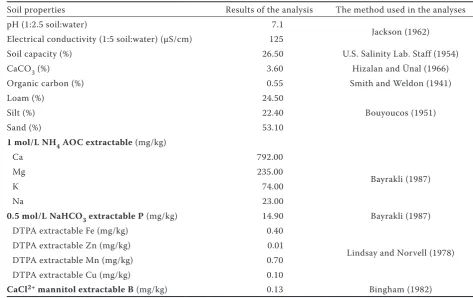
[image:2.595.57.531.442.740.2]Four soybean cultivars (13935, Türksoy, ME 3399 and Deficiency) were grown under controlled green-house conditions at the Selcuk University, Faculty of Agriculture, Konya, Turkey. During the experiment, temperature, solar intensity and relative humidity in-side the greenhouse were maintained at 25 ± 3°C, 1750 ± 50 kcal/m2 and 60 ± 10%, respectively. B deficient soil (with 0.13 mg B/kg soil) with different mineral elements was used to conduct the trial (Table 1). Determining the effect of B deficiency on the fatty acid composition of soybean genotypes was one of the main objectives of the experiment and therefore, soil deficient in B was utilized for the experiment.
Table 1. Properties of the soil used in the assay
Soil properties Results of the analysis The method used in the analyses
pH (1:2.5 soil:water) 7.1
Jackson (1962) Electrical conductivity (1:5 soil:water) (μS/cm) 125
Soil capacity (%) 26.50 U.S. Salinity Lab. Staff (1954)
CaCO3 (%) 3.60 Hizalan and Ünal (1966)
Organic carbon (%) 0.55 Smith and Weldon (1941)
Loam (%) 24.50
Bouyoucos (1951)
Silt (%) 22.40
Sand (%) 53.10
1 mol/L NH4 AOC extractable (mg/kg)
Ca 792.00
Bayrakli (1987)
Mg 235.00
K 74.00
Na 23.00
0.5 mol/L NaHCO3 extractable P (mg/kg) 14.90 Bayrakli (1987)
DTPA extractable Fe (mg/kg) 0.40
Lindsay and Norvell (1978)
DTPA extractable Zn (mg/kg) 0.01
DTPA extractable Mn (mg/kg) 0.70
DTPA extractable Cu (mg/kg) 0.10
CaCl2+ mannitol extractable B (mg/kg) 0.13 Bingham (1982)
B treatments were made toxic by adding 2 mg B/kg and 12 mg B/kg soil in the form of boric acid (H3BO3). A randomized complete block design was imple-mented for each trial with four replications. B was applied to the nutrient/Hoagland’s solution at three levels as B0 = no B supply (inadequate soil B content); B1 = 2 mg/kg (toxic B level) and B2 = 12 mg/kg B (highly toxic B level) (Hodgkiss et al. 1942, Wolf 1971). Five seeds were grown in each pot contain-ing 3 kg soil each with all the nutrients required for normal growth except B. The water content of the soil was kept at 50–75% of field capacity dur-ing the assay. At maturity, plants were harvested, washed and plant shoot length and biomass were measured followed by air-drying in a hot air oven at 70°C for 48 h.
Dry matter. Seed yield per plant was determined as g/plant by weighing peeled seeds on a 0.01 g sensitive balance (Sartorius LE623 S, Göttingen, Germany).
Determination of the boron content. B concen-trations of the leaf samples were determined using the Inductive Coupled Plasma-Atomic Emission Spectroscopy (ICP-AES) (Vista-Pro Axial; Varian Pty Ltd., Victoria, Australia) (Soil Survey Laboratory Methods Manual 2004).
Protein analysis. Protein contents of the seeds were determined according to the standard manual method AACC 46-30 of Combustion Nitrogen Analyzer, Leco TruSpec CN (Saint Joseph, USA).
Oil extraction. The oil from soybean seeds (about 10 g) was extracted using petroleum ether at a solvent ratio of 10:1 (v/w plant material) and boiled (60°C) for 4 h using a Soxhlet extractor (Ankara, Turkey).
Fatty acid analysis. To determine the fatty acid composition of the oils, fatty acid methyl esters were prepared from soybean oil using cold saponification method (Stefanoudaki et al. 1999). A gas chromato-graph (Shimadzu, Kyoto, Japan), equipped with a flame ionization detector and a split/splitless injector, was employed. Separations were made on a Teknokroma TR-CN100 (Barcelona, Spain) fused-silica capillary column (60 m, 0.25 mm internal diameter, 0.20 µm film thickness). The carrier gas was nitrogen, with a flow rate of 1 mL/min. The injection volume was 1 mL, and peaks were identified by comparing their retention times with those of the authentic reference compounds (Sigma-Aldrich, St. Louis, USA).
Statistical analysis. In the statistical part, data were subjected to the analysis of variance and stand-ard deviation for all the assessed parameters was estimated based on the values of three replicates.
RESULTS AND DISCUSSION
Studies on the determination of B deficiency or toxicity symptoms in plants have drawn greater interest worldwide (Wimmer and Goldbach 2007).
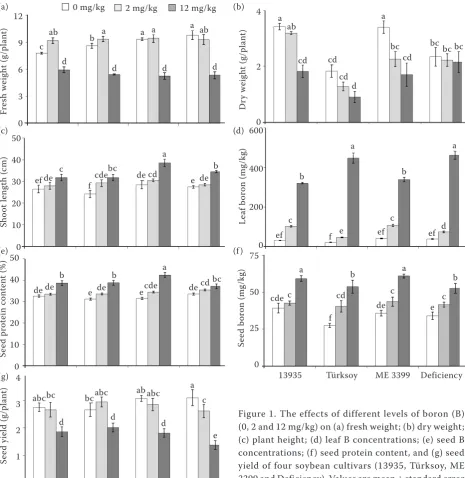
In this study, biomass, dry weight, seed yield and B concentrations of soybean cultivars were affected by different levels of B treatment (Figure 1).
Plant dry weights decreased by 19% and 40% under 2 mg B/kg and 12 mg B /kg treatment, respectively when compared to 0 mg B/kg supply. The greatest decrease in dry weight due to B application was recorded in cv. ME 3399, whereas the cv. Deficiency was the least influenced cultivar (Figure 1). This was in accordance with the previous studies that reported significant vari-ations in plants in sensitivity towards B toxicity (Paull et al. 1988). In the present study, mean plant lengths of soybean cultivars were increased by 9% and 28% after 2 and 12 mg B/kg treatments, respectively (Figure 1).
B concentrations of soybean cultivars were also en-hanced with increasing B concentrations in the soil. Mean B concentrations of the soybean cultivars were 82.52 and 391.60 mg/kg of leaves dry weight after 2 and 12 mg B/kg treatments, respectively. Türksoy cultivar presented the highest increase in B concentration. According to Benton et al. (1991), an adequate amount of B in leaves is 20–75 mg B/kg of dry weight during the flowering period. Hence, the boron amount in tissues above this concentration can be considered as toxic. Accordingly, under 2 mg B/kg treatment, leaves of cvs. 13935 and ME 3399 contained toxic levels of B; while under 12 mg B/kg supply, all the cultivars contained toxic levels of B (Figure 1). Toxic levels (2 and 12 mg/kg) of B application led to a decrease in seed yields in all the cultivars used in the experi-ment (except cv. Türksoy under 2 mg/kg treatexperi-ment). However, the effects of B application on seed yield were not consistent in previous studies, either (Ross et al. 2006). This may be due to differences in soil physical and chemical properties, which affects the B availability to plants (Ross et al. 2006).
In this study, the protein content of soybean seeds increased with B dosages, where the highest increase was obtained in cv. ME 3399 (Figure 1). B deficient conditions showed the lowest protein content in all the genotypes similar to the results observed by Bellaloui et al. (2013) and Worthington and Boswell (1971).
respec-tively. At 12 mg B/kg application, all genotypes except cv. Deficiency showed a decreased total oil content. Similarly, in experiments conducted by Bellaloui et al. (2013), the total oil content decreased under B application. However, the inverse association between protein and oil content under B supply was reported by Bellaloui et al. (2013).
Boron toxicity dosage has reduced the fat content of soybean seeds (except for cv. Deficiency). Generally, quantitative values of palmitic acid of cvs. ME 3399 and Deficiency soybean cultivars increased at the level of
2 mg B/kg supply. Linoleic acid levels in oils varied in between 49.75% and 54.88%. cv. Türksoy had the low-est average linoleic acid level (49.88%). Also, linoleic acid contents of oils of all the soybean cultivars except cv. Türksoy decreased with the increase in boron dos-age levels. Despite the application of various doses of boron, the rate of unsaturated fatty acids in soybean oil is not below 80%. According to these results, the toxicity effect of boron on linoleic acid synthesis in soybean seeds was observed; however, cv. Türksoy was less affected under boron toxicity. Generally, fatty acid 12 9 6 3 0 Fr es h w ei gh t ( g/ pl an t)
0 mg/kg 2 mg/kg 12 mg/kg
c ab
d
d d d
a a a a ab
b D ry w ei gh t ( g/ pl an t) 4 2 0 d a a ab cd cd cd cd
bc bcbc bc
Sh oo t l en gt h (c m ) 50 40 30 20 10 0 a b c
ef de fcdebc decd e de
600 400 200 0 Le af b or on (m g/ kg
) a a
b b d ef ef c c ef e f 50 40 30 20 10 0 Se ed p ro te in c on te nt (% )
de de de de
b b a
cd
e e
bc cde
13935 Türksoy ME 3399 Deficiency
Se ed b or on (m g/ kg ) 75 50 25 0 a a
c c c
b b cde f cd de e Se ed y ie ld (g /p la nt ) 4 3 2 1 0 a
abcbc bcabc abc c
e ab
d d d
[image:4.595.66.532.94.573.2]13935 Türksoy ME 3399 Deficiency
Figure 1. The effects of different levels of boron (B) (0, 2 and 12 mg/kg) on (a) fresh weight; (b) dry weight; (c) plant height; (d) leaf B concentrations; (e) seed B concentrations; (f ) seed protein content, and (g) seed yield of four soybean cultivars (13935, Türksoy, ME 3399 and Deficiency). Values are mean ± standard error based on four replications (n = 4)
(a) (b)
(c) (d)
(e) (f )
compositions of soybean oils were affected depending on the boron dosages and showed differences among soybean cultivars. These differences can be probably due to cultivar, genetic factor, boron level, and soil-enzyme interactions. Under 2 mg B/kg supply, the increase in B concentration was associated with an increase in the protein and oleic acid content (except cv. Türksoy) and decrease in linoleic acids. This sug-gests that B application regulates the seed composition by influencing the fatty acid content and seed protein (Bellaloui et al. 2010). B applications resulted in a level significant increase in the oleic acid ratio of cv. 13935, leading to a 17.92% increase.
Cv. Türksoy oils had the lowest levels of α-linolenic acid (6.96% mean). However, this fatty acid did not show regular changes according to the B treatments. The levels of α-linolenic acid in the cvs. Deficiency
and Türksoy decreased after B application. Lowering of α-linolenic acid content is important in soybean oil research due to its association with flavour instabil-ity. Decreased percentage of linolenic acids [C18:3] and increased percentage of stearic acids [C18:0] can enhance the frying stability of the oil.
The oils of cv. Deficiency contained the lowest ratios of saturated fatty acids such as stearic (5.40%) and palmitic (9.01%) acids. Stearic acid levels of all the cultivars increased under 12 mg B/kg as compared to deficient B application (except cv. ME 3399 oils) with the highest increase determined in cv. Türksoy oils as 72.5% and 56.9% on 2 and 12 mg B/kg supply levels, respectively. Soybean oil with a high percentage of stearic acids [C18:0] has significantly greater oxida-tive stability than the normal soybean oil. Cv. Türksoy showed the highest increase in stearic acids at B treat-0 mg/kg 2 mg/kg 12 mg/kg
To
ta
l o
il
(%
)
25
20
15
10
5
0 b
f f f
a d cd i
h e c g
Pa
lm
iti
c
ac
id
s (
%
)
12
8
4
0 a
d d d d d
bc bc bc bc b
c
St
ea
ri
c
ac
id
s (
%)
8
6
4
2
0
b b
a
c c
fg cd
cd ef g
de
e
O
le
ic
a
ci
ds
(%
) 24
18
12
6
0
b b c b b b
cd a a a c
d
Li
no
le
ic
a
ci
ds
(%
)
60
40
20
0
abca–dcde g fg g a de ef abb–eef
13935 Türksoy ME 3399 Deficiency 13935 Türksoy ME 3399 Deficiency 8
5
3
0
b a b de
f cde bcd bcd a
[image:5.595.62.533.95.463.2]cde bc ef
Figure 2. The effects of different levels of boron (B) (0, 2 and 12 mg/kg) on (a) seed total oil content and the ratios of (b) palmitic acids; (c) stearic acids; (d) oleic acids; (e) linoleic acids and (f ) α – linolenic acids of four soybean cultivars (13935, Türksoy, ME 3399 and Deficiency). Values are mean ± standard error based on four replications (n = 4)
(a) (b)
(c) (d)
(e) (f )
α-lino
le
ni
c
ac
id
s (
%
ments, although the ratio of saturated to unsaturated fatty acids will be high in this cultivar under 12 mg B/kg treatment, the oil obtained may have a greater oxidative stability. On the contrary, palmitic acid levels decreased in all the genotypes after B treatment, except oils of the cv. Deficiency.
In conclusion, taking into account the changes in biomass, dry matter and seed yield of dwarf soybean cultivars after B treatment, it can be concluded that cvs. 13935, ME 3399 and Deficiency are more tolerant to B deficiency and can be cultivated without B applica-tion. Türksoy has been observed as the cultivar with additional average/lower biomass/yields under normal growth conditions in most of the previous studies (Copur et al. 2009, Bakal et al. 2017). In this study, it can be considered as sensitive towards B deficiency because while all the other genotypes showed higher seed yield under 0 B supply as compared to 2 mg B/kg treatment, cv. Türksoy provided lower seed yield de-spite having high dry mass under 0 B supply. The seed protein content of soybean cultivars changed depending on the B applications, and the highest level of increase in the protein values was determined in cv. ME 3399.
Overall, B application led to a considerable increase in the protein contents of the soybean seeds, whereas their dry weights were decreased. Accordingly, both lower and high toxic level of B application resulted in significantly reduced seed yields and enhanced seed protein content in all the experimental cultivars. However, the genotypes used in this study can be grown under B deficient and toxic growth conditions depending on the results ob-tained regarding the yield and fatty acid composition.
REFERENCES
Aukema H., Campbell L. (2011): Oil nutrition and utilization. In: Daun J., Eskin M.N.A., Hickling D. (eds): Canola. Amsterdam, Elsevier, 245–280.
Bakal H., Gulluoglu L., Onat B.Z., Arioglu H. (2017): The effect of growing seasons on some agronomic and quality characteris-tics of soybean varieties in the Mediterranean region in Turkey. Turkish Journal of Field Crops, 22: 187–196.
Bayraklı F. (1987): Soil and Plant Analyses. Samsun, Ondokuz Mayıs University. (In Turkish)
Bellaloui N., Hu Y.B., Mengistu A., Kassem M.A., Abel C.A. (2013): Effects of foliar boron application on seed composition, cell wall boron, and seed δ15N and δ13C isotopes in water-stressed soy-bean plants. Frontiers in Plant Science, 4: 270.
Bellaloui N., Reddy K.N., Gillen A.M., Abel C.A. (2010): Nitrogen metabolism and seed composition as influenced by foliar boron application in soybean. Plant and Soil, 336: 143–155.
Benton J.Jr.J., Wolf B., Mills H.A. (1991): Plant Analysis Handbook. A Practical Sampling, Preparation, Analysis, and Interpretation Guide. Athens, Micro Macro International.
Bingham F.T. (1982): Boron. In: Page A.L. (ed): Methods of Soil Analysis. Madison, American Society of Agronomy, 431–447. Bouyoucos G.J. (1951): A recalibration of the hydrometer method
for making mechanical analysis of soils. Agronomy Journal, 43: 434–438.
Carlos B. (2000): Effects of Boron on Plants. Las Vegas, University of Nevada Cooperative Extension.
Copur O., Gür M.A., Demire O., Karakuş M. (2009): Performance of some soybean [Glycine max (L.) Merr.] genotypes double cropped in semi-arid conditions. Notulae Botanicae Horti Agro-botanici Cluj-Napoca, 37: 85–91.
Dutton H.J., Lancaster C.R., Evans C.D., Cowan J.C. (1951): The flavor problem of soybean oil. VIII. Linolenic acid. Journal of the American Oil Chemists’ Society, 28: 115–118.
Hızalan E., Ünal H. (1966): Soil Chemical Analysis. Ankara, Univer-sity of Ankara Agriculture Faculty Publics, 273.
Hodgkiss W.S., Hageman R.H., McHargue J.S. (1942): The amount of boron absorbed by soybean plants and its effect on their growth. Plant Physiology, 17: 652–660.
Jackson M.L. (1962): Soil Chemical Analysis. London, Verlag: Pren-tice Hall, Inc., 496.
Lindsay W.L., Norvell W.A. (1978): Development of a DTPA soil test for zinc, iron, manganese, and copper. Soil Science Society of America Journal, 42: 421–428.
Paull J.G., Cartwright B., Rathjen A.J. (1988): Responses of wheat and barley genotypes to toxic concentrations of soil boron. Eu-phytica, 39: 137–144.
Ross J.R., Slaton N.A., Brye K.R., DeLong R.E. (2006): Boron fer-tilization influences on soybean yield and leaf and seed boron concentrations. Agronomy Journal, 98: 198–205.
Schon M.K., Blevins D.G. (1990): Foliar boron applications increase the final number of branches and pods on branches of field-grown soybeans. Plant Physiology, 92: 602–607.
Shireen F., Nawaz M.A., Chen C., Zhang Q., Zheng Z., Sohail H., Sun J., Cao H., Huang Y., Bie Z. (2018): Boron: Functions and ap-proaches to enhance its availability in plants for sustainable agri-culture. International Journal of Molecular Sciences, 19: E1856. Smith H.W., Weldon M.D. (1941): A comparison of some methods
for the determination of soil organic matter. Soil Science Society of America Journal, 5: 177–182.
Stefanoudaki E., Kotsifaki F., Koutsaftakis A. (1999): Classification of virgin olive oils of the two major cretan cultivars based on their fatty acid composition. Journal of the American Oil Chem-ists’ Society, 76: 623–626.
U.S. Salinity Laboratory Staff (1954): Diagnosis and Improvement of Saline and Alkali Soils. Washington, U.S. Government Pub-lishing Office.
Wimmer M.A., Goldbach H.E. (2007): Boron in the apoplast of higher plants. In: Sattelmacher B., Horst W.J. (eds): The Apoplast of Higher Plants: Compartment of Storage, Transport and Reac-tions. Dordrecht, Springer, 19–32.