Impact of Mobility Models on Performance of Ad hoc
Position based Routing Protocol LAR
Radhwan Basher Mahmood
College of Computers Sciences and Mathematics University of Mosul, Iraq
ABSTRACT
Defining the benchmarking of mobility modeling is one of the most important challenges faced by researchers in the field of un-infrastructural network applications where these mobility models picture out the way how the wireless equipment can move, distribution and acceleration in a specific wireless network environment. To achieve the ambition of finding the appropriate model, many studies have examined the movement models in an unspecific aspect of Ad hoc routing algorithms. In this work, the evaluations of three types of mobility models with position based routing algorithm ALR have been done. The validation based on the performance metrics showed that the models that are close to the nature of the applied routing algorithm be more effectively and practically, so there is intensity needs to conduct deeply studies of the structural technique of the routing entity with the particular nature of each motion model to conduct more realistic and exquisite results.
Keywords
Ad hoc networks, mobility models, position based routing protocols
1.
INTRODUCTION
The initial novel of Mobile Ad Hoc Wireless Network MANET was founded essentially at the beginning of the 1980s for the development of military purposes, where during the battles there is an urgent need to create temporary and dynamic communication networks that are able to communicate between fighters and military equipment on the battlefield in the absence of stationary infrastructure. Sometime later, specifically in the middle of the nineties of the last century and with the advent of the standard wireless communications technology IEEE 802.11, MANET applications started to appear in services of a civil nature outside the military domains. At the same time, many of the traditional network-based products have been adopted and demonstrated their applicability and feasibility; this
encouraged the researchers at Ad Hoc field to expand these techniques and make them conform to the dynamic and unstable environment which are the most distinguished features of ad hoc networks [2].
In ad hoc networks, every node takes advantages of the routing in the multi-hop propagation with peer- to- peer distribution fashion where the nodes act as a host and router at the same time. This issue considers the most challenges in the research area that represent the needs to finding the proper ad-hoc routing algorithm and the mobility style that will be applied to manage the behavior of the nodes in the network efficiently and effectively.
In general, routing algorithms can be categorized into three classes based on how the link status between nodes in the network can be discovered and maintained. These classes are: proactive, reactive and position-based routing protocols [3].
In proactive routing, every node in the network - at any time- maintains information tables for every node in the network and distributes those tables for each other whenever changes the network topology. The merit of this type lies in the speed of sending messages from source to destination since the route is always available, while in another side, this type consumes scarce resources such as wireless bandwidth and battery power of the mobility nods especially with substantially dynamic networks. Cases of this type are DSDV [4], OLSR [5] and DREAM [6].
In reactive routing, the route not always is available as mentioned in the previous type but done on demand: Every node sending route discovery when its need to sending data to the partner node and wait until receive route response then start sending data. The features of this type are decreasing the amount of consuming wireless channel with saving battery life as possible. Examples of this type are DSR [7], AODV [8] and ARA [9].
28 The third type of routing schemes is the position based
protocols and sometimes called location-aware protocols. In these protocols, the system takes advantage of geographical positioning techniques like GPS (Global Position System) where every node in the network assumes knowing its location previously. The location information employed by the sender node to find the route to the destination in discover mode. On the intermediate node, the protocol restricts the flooding direction to the neared distance to the destination node. DREAM [6], GRA [10] and LAR [11] are examples of this class. In this work, the last one (LAR protocol) has been chosen as an anchor application to evaluate the performance of the protocol with a variety of Ad Hoc mobility models. One of the main distinguishing features of MANET is the mobility of its nodes with the dynamic environment, which is considered the most challenging points were focused-on extremely by the researchers in this discipline. This with the addition of difficulty in implementing and operating such networks on the ground because of the high cost and wide diversity in their applications, these reasons and other reasons - which are out this work scope - have led to reliance on modeling simulation and emulation systems [12]. In this research, NS2 simulation [13] is used in order to simulate the ad hoc network topology with LAR routing protocol and conduct the communication model and simulation parameters, while in order to generate the mobility scenarios BonnMotion tool [14] is used.
The main objective of this paper is to evaluate the variety of wireless mobility models with the concept of position based routing protocol (Location Aided Routing Protocol LAR). The remainder of this paper is organized as follows. In the next section, a brief overview is given of the mobility models in the ad-hoc network. Section 3 presents the LAR routing protocol, Section 4 demonstrates the simulation setting and performance parameters. The result of the evaluation and discussions are illustrated in section 5. Finally, section 6 concludes the paper.
2.
MOBILITY MODELS
The mobility models describe the movements pattern of wireless devices (like personal smartphones, laptops, and sensors), and it can also depict how their directions and velocity acceleration changed over time. The design of these models plays significant facts to evaluate routing communication performance; therefore, it’s very necessary to mimic the real-life applications in an accurate behavior. Otherwise, the results of the observation study may be deceptive. So far it’s necessary to choose the appropriate mobility model depending on the underlying application.
In order to evaluate the performance of the routing protocols in real-life systems, a realistic trace-based model must be obtained. However since MANET have not wildly applied, gained real traces data becomes more challenging. In this situation, another type of modeling (synthetic-based model) is proposed to use.
Synthetic models try to mimic the movement characteristics of the mobile nodes MNs in realistic networks. In these models the MNs can be grouped into three types depend on dependence related to each individual node with others nodes in the network. Random Waypoint Mobility Model RMM [15] is an example of the first type (independent) where every node chooses a random destination and moves and changes its speed and direction in a random state and totally independently assumption. In another side, a model
like the Reference Point Group Mobility Model RPGM [16] divides the nodes in the network to many groups and in each group, the nodes pick out a logical center and attempt to travel depending on its path. This type of mobile models can be specified - depend on the dependency – as spatial dependency where the nodes in this scenario try to change its movement in the correlated pattern. In the third type, the pattern movement of the nodes conflicts with geographical obstacles and vehicle pathway in the city-like maps and on campus. Manhattan Grid model [17] is an example of this type (see Figure 1).
The next section briefly presents three synthetic mobile models that have chosen in the evaluation simulation which include: The Random Waypoint model, The Reference Point Group model and The Manhattan Grid model.
2.1.Random Waypoint model:
The Random Waypoint model RW was initially proposed by the authors of [15], then the model has been nominated as ‘benchmark’ for the simulation of MANET because of its simplicity and the nature of its widely simulation implementation. In this model, the nodes are randomly distributed throughout the network area. Then each node selects a random destination and travels to reach that place at the fixed speed randomly selected from the interval of the minimum and maximum speeds. Upon arrival, the node stops for a randomly specified period of time, then repeat the same procedure until simulation time finished. Figure 2 shows the movements of an MN in the simulation network with the area of (300m X 300m).
Fig.2: The movement of one MN in RW model
2.2.
Reference Point Group Mobility
Model
In the previous mobility model all individual nodes acting independently. Therefore, these types of models could be called "Entity Mobility Models". In practice, such cases are difficult to exist on the earth. In many practical applications, the elements of these applications tend to assemble in certain groups and the path of each group typically follows a predefined of reference point or group leader. For example, the movement of soldiers on the battlefield, when the movement of soldiers following the motion of the commander or to the leader in the field.
The authors of [16] suggest a Reference Point Group Mobility Model RPGM where the nodes in the network area are divided into groups and the movements of the nodes in each single group are followed the RW model. In RPGM model, the MNs of each group identify a reference point center and reside around the center and along the movement path of this reference point. The default action of the central point determines the actual path and the speed of all nodes in subsidiary individual group.
2.3.
Manhattan Grid Mobility Model
Third mobility model is Manhattan Grid mobility model MG [17]. The nodes in MG model are restricted to geographical obstacles like the road’s pathway and the buildings in the urban city. MG divided the simulation area into a grid of verticals and horizontal streets. The MNs are allowed to move only along the grid map (up or down for vertical streets and left or right for horizontal streets). The MNs at the beginning of simulation time are distributed randomly in the pathway of the streets, then each node moves straight away until rich the conjunction vertices, the node there turns and chooses the next direction within a certain probability. Figure 3 illustrates MG map with five columns and five rows (16 blocks).
3.
LOCATION AIDED ROUTING
PPROTOCOL
Location-Aided Routing protocol [19] LAR belongs to the position based routing protocols, and sometimes called geographical- based protocols. Initially, each node in LAR assumes has known its location in the simulation area. When the node S intends to send a packet to node D and does not know the route to node D, its initiate a route discovery phase. In route discovery, node S - in order to estimate the current location of node D - employs the currently available information (location and speed) about node D, and to do so; node S calculates two zones (Expected Zone and Request Zone). Node S then forwards the request packet to all nodes belong to that area (expected and request) until reaching the node D. Immediately node D replays with a packet containing the pathway from S to D.
[image:3.595.321.539.70.230.2]In LAR ad-hoc routing algorithm, the achievements of restricting the transmission in a certain area are contribute to minimizing the routing overhead issue, in the opposite of applying the default flooding method in ad hoc re-active and pro-active approaches. In this work, the simulation’s script of LAR protocol has been obtained from the implementation in [1].
Fig.3: MG model with 16 blocks
4.
SIMULATION ENVIRONMENTS
AND EVALUATION PARAMETERS
4.1.Simulation Environments
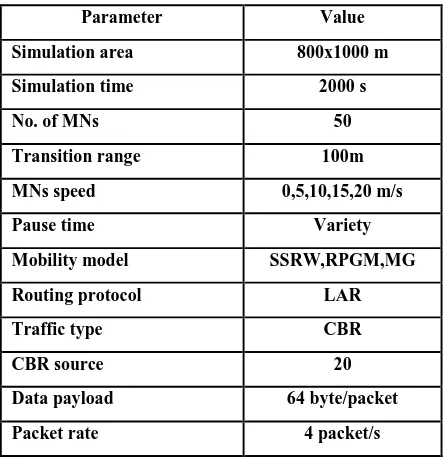
The simulation ns2.32 [13] has been used in order to evaluate the mobility models (SSRW, RPGM, and MGM) with LAR ad hoc routing protocol. Table 1 explains environments setting and parameters configuration in ns2.
Table (1) NS2 parameters setting
Parameter Value
Simulation area 800x1000 m
Simulation time 2000 s
No. of MNs 50
Transition range 100m
MNs speed 0,5,10,15,20 m/s
Pause time Variety
Mobility model SSRW,RPGM,MG
Routing protocol LAR
Traffic type CBR
CBR source 20
Data payload 64 byte/packet
Packet rate 4 packet/s
To generate mobility scenarios, BonnMotion tools are used [14]. In BonnMotion, (bm) command is used to create the mobility scenaios and (NSFile) command is used to convert the output trace file from the BonnMotion format to ns2 traced file format. From the traced files, and in order to extract significant data that related to our evaluation, Linux AWK scripts have been used. And to obtain the result precisely, for each of the five simulation's speeds (0, 5, 10, 15 and 20) the average of 5 trace files are calculated, so as a total of 75 traces files are generated for all three mobility scenarios.
4.2. Evaluation Parameters
To evaluate the performance of LAR ad hoc routing protocol with previous three mobility models the following 4 metrics are considered:
[image:3.595.320.542.294.523.2]30 End-to-End Delay EED: this includes all possible packet
delay; (propagation, buffering and transition times).
Protocol Overhead Ratio POR: It’s the ratio of protocol load (data and control) over all protocol packets.
Hop Count HC: it’s an average of all hops in the route path of data packets from the sender node to the destination.
5.
SIMUAION RESULTS AND
DISCUTIONS
Figures (4, 5, 6 and 7) illustrate the results of the four measurement metrics that have been chosen to evaluate the performance of a hoc LAR routing protocol with the mobility models (SSRW, RPGM, and MG).
Figure 4 shows the packet delivery ratio PRD with increasing of node’s mobility speed. The figure can obviously observes that a PRGM model has achieved a higher percent of delivered data comparing with RW and MG models, while in this figure the worst case goes to RW. In general, the mobile models have delivered all data (100 percentages) at mobility of (0 m/s) and the amount of delivering data dropped obviously when the speed increased, exception the case at the speed of (5 m/s) for PRGM model where the fig. 4 shows that the delivery ratio increasing with increases of the MNs speeds. So the figure can remarks that in PRGM mobile model the speed of MNs is not significantly affected on packets submission, this justifies the fact of the grouping cooperation features of PRGM model has enhanced the positioning characteristics of ad hoc LAR protocol.
Figure 5 present the ratio of routing protocol overhead POR. this metric is a valuable parameter since it computes the overloading payloads in the protocol that include control packets, errors and the initial setting packets. In MANET environment, more amounts of overhead's packets are counting on more consumption of resources like communication bandwidth and battery power. Figure 5 shows that the MG model has obtained the minimum amount of POR followed by PRGM then RW.
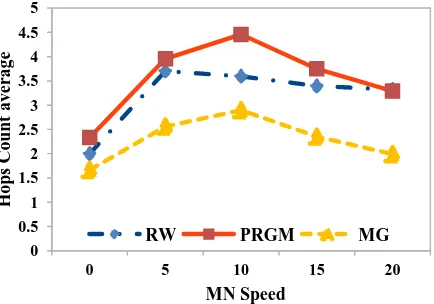
[image:4.595.325.542.505.657.2]The hops count average HC is presented in figure 6 .The figure can notes that all mobile models have the same shape of distribution over MNs speeds. MG model has achieved the best case for minimum HC average while PRGM obtained the maximum of HC values.
Fig4: Packet delivery ratio
Fig5: Protocol overhead ratio
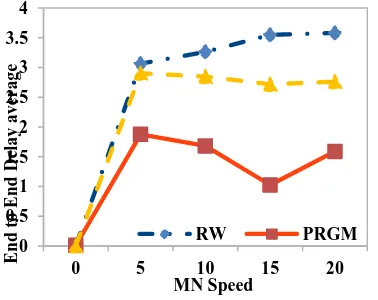
End to End Delay average EED is presented in figure 7. The results in this figure came compatible with previous results where the models that have restricted movement in some situations (PRGM and MG in our study) with the ability to reduce the dependence on randomized movement in mobility patterns have the capability to complete their tasks with minimal effort and resources.
6.
CONCLUSION
In this paper, three of movement’s models have been evaluated with ad hoc LAR routing protocol. The simulation results of the evaluation parameters illustrate that it’s necessary to choose an appropriate movement model for each routing protocol where the best results can be obtained when there is harmony or appropriateness between the structural characteristics of each routing algorithm with the applied movement's behavior. Therefore, the studies which evaluate the suitability of the movement models with each routing protocol individually are indispensable to be carried out in future works.
Fig6: Hops count average
0 20 40 60 80 100 120
0 10 20 30
Pa
ck
et
De
li
v
er
y
Ra
tio
1
0
0
%
MN Speed
RW PRGM MG
0 10 20 30 40 50 60
0 5 10 15 20
Pro
to
cl
O
v
er
h
ea
d
Ra
tio
1
0
0
%
MN Speed
RW PRGM MG
0 0.5 1 1.5 2 2.5 3 3.5 4 4.5 5
0 5 10 15 20
H
o
p
s Co
u
n
t
a
v
er
a
g
e
MN Speed
Fig. 7: Average of end-to - end delay in ms
7.
REFERENCES
[1] Camp, T., Boleng, J., Williams, B., Wilcox, L. and Navidi, W., 2002. Performance comparison of two location based routing protocols for ad hoc networks. In INFOCOM 2002. Twenty-First Annual Joint Conference of the IEEE Computer and Communications Societies. Proceedings. IEEE(Vol. 3, pp. 1678-1687). IEEE.
[2] Conti, M. and Giordano, S., 2014. Mobile ad hoc networking: milestones, challenges, and new research directions. IEEE Communications Magazine, 52(1), pp.85-96.
[3] Meghanathan, N., 2009. Survey and taxonomy of unicast routing protocols for mobile ad hoc networks. The International Journal on Applications of Graph Theory in Wireless Ad hoc Networks and Sensor Networks, 1(1), pp.1-21.
[4] Perkins, C.E. and Bhagwat, P., 1994, October. Highly dynamic destination-sequenced distance-vector routing (DSDV) for mobile computers. In ACM SIGCOMM computer communication review(Vol. 24, No. 4, pp. 234-244). ACM.
[5] Jacquet, P., Muhlethaler, P., Clausen, T., Laouiti, A., Qayyum, A. and Viennot, L., 2001. Optimized link state routing protocol for ad hoc networks. In Multi Topic Conference, 2001. IEEE INMIC 2001. Technology for the 21st Century. Proceedings. IEEE International (pp. 62-68). IEEE.
[6] Basagni, S., Chlamtac, I., Syrotiuk, V.R. and Woodward, B.A., 1998, October. A distance routing effect algorithm for mobility (DREAM). In Proceedings of the 4th annual ACM/IEEE international conference
on Mobile computing and networking (pp. 76-84). ACM.
[7] Johnson, D.B., Maltz, D.A. and Broch, J., 2001. DSR: The dynamic source routing protocol for multi-hop wireless ad hoc networks. Ad hoc networking, 5, pp.139-172.
[8] Perkins, C., Belding-Royer, E. and Das, S., 2003. Ad hoc on-demand distance vector (AODV) routing (No. RFC 3561).
[9] Gü, M., Sorges, U. and Bouazizi, I., 2002, August. ARA—the ant-colony based routing algorithm for MANETs. In null (p. 79). IEEE.
[10]Jain, R., Puri, A. and Sengupta, R., 2001. Geographical routing using partial information for wireless ad hoc networks. IEEE Personal communications, 8(1), pp.48-57.
[11]Ko, Y.B. and Vaidya, N.H., 2000. Location‐Aided Routing (LAR) in mobile ad hoc networks. Wireless networks, 6(4), pp.307-321.
[12]Conti, M. and Giordano, S., 2014. Mobile ad hoc networking: milestones, challenges, and new research directions. IEEE Communications Magazine, 52(1), pp.85-96.
[13]Ns 2 project, http://www.isi.edu/nsnam/ns/
[14]BonnMotion, a mobility scenario generation and analysis tool, http://web.informatik.uni-bonn.de
[15]Johnson, D.B. and Maltz, D.A., 1996. Dynamic source routing in ad hoc wireless networks. In Mobile computing (pp. 153-181). Springer, Boston, MA.
[16]Hong, X., Gerla, M., Pei, G. and Chiang, C.C., 1999, August. A group mobility model for ad hoc wireless networks. In Proceedings of the 2nd ACM international workshop on Modeling, analysis and simulation of wireless and mobile systems (pp. 53-60). ACM.
[17]Universal Mobile Telecommunications System (UMTS) Selection procedures for the choice of radio transmission technologies of the UMTS, Umts 30.03 version 3.2.0, tr 101 112 ed., European Telecommunications Standards Institute (ETSI), 1998.
[18]Navidi, W. and Camp, T., 2004. Stationary distributions for the random waypoint mobility model. IEEE transactions on Mobile Computing, (1), pp.99-108.
[19]Ko, Y.B. and Vaidya, N.H., 2000. Location‐Aided Routing (LAR) in mobile ad hoc networks. Wireless networks, 6(4), pp.307-321.
0 0.5 1 1.5 2 2.5 3 3.5 4
0 5 10 15 20
En
d
to
En
d
De
la
y
a
v
er
a
g
e
MN Speed