Working with men who self-harm in a learning disability
secure unit: Staff perspectives
Rebecca Fish and Hannah Morgan
Series Editor: Hannah Morgan2 | P a g e
The Authors
Rebecca Fish has been working with people with learning disabilities since 1997.
Her early work explored the meaning of self-harm for people with learning
disabilities and the staff who work with them. This work informed policy and
practice in the UK. She completed her PhD in 2015 and works as a researcher for
the Centre for Disability Research (CeDR) at Lancaster University.
Hannah Morgan is a Senior Lecturer in Disability Studies and Director of the Centre
for Disability Research (CeDR) at Lancaster University. Her research interests focus
on disabled people’s experiences of health and welfare services and on
professional practice and education in these areas.
Fish, R. and Morgan, H. (2017) Working with men who self-harm in a
learning disability secure unit: Staff perspectives CeDR Research
Report 2017:1 Lancaster: Centre for Disability Research.
The Centre for Disability Research (CeDR) is a specialist research
grouping that promotes and conducts high quality interdisciplinary
research and research-led teaching about disability. CeDR publishes a
range of working, briefing and position papers as well as research
reports, summaries and other resources
3 | P a g e
Introduction
Men’s self-harm is very rarely spoken about. Self-harm is often described in the
literature as something that women who have survived traumatic experiences turn
to as a method of coping because other methods have been suppressed. This may
be down to more frequent disclosure on behalf of women, or services recognising
or categorising women’s behaviours more accurately as harm. However,
self-report research from Canada and the US suggests there has been an increase in
non-suicidal self-harm among young men (between 36% and 38.7%) (Ross and
Heath, 2002, Whitlock and Knox, 2007). There is a small amount of research from
the UK, such as Babiker and Arnold (1997) and Taylor (2003), who argue that when
men self-harm, generally their injuries are more violent and can be misdiagnosed
as accidental.
Because of this obscurity, Green and Jakupcak (2015) suggest that researchers and
clinicians may be less likely to assess for or even recognise self-harm in men due to
historically gendered views on these behaviours. They conclude that men’s
self-harm may be overlooked by professionals because ‘men’s self-damaging behaviours
are informed by traditional male gender norms, and as a result, are not adequately
represented by current definitions’ (Green and Jakupcak, 2015:2).
Claes et al (2007) highlight the minimal research on self-harm in male populations
internationally. Their survey of 399 psychiatric inpatients in Belgium found that
men’s self-harm behaviours can be even more dangerous, and easier to overlook
than women’s. Indeed, because self-harm is stigmatised for men even more than
for women, men feel marginalised by other men and hide their self-harm from
family and friends (Babiker and Arnold, 1997). Not seeking support can cause
feelings of isolation which in turn can give rise to more self-harm (Taylor, 2003).
Taylor’s interviews with five men in a UK mental health drop in centre show that
men find it difficult to communicate the need for emotional help. Taylor suggests
that the increase in men’s self-harm is the result of society becoming less
patriarchal, and the resulting feelings of powerlessness in the face of expectations
of masculinity. Feelings of disempowerment and lack of control over
4 | P a g e
Research in Inpatient services
Self-harm can be brought on by trauma in childhood and during times when
dominant forms of coping are taken away yet the person needs to communicate
distress. In inpatient services, ordinary coping strategies are limited and people
may not feel like revealing their distress as it may lengthen their stay.
Furthermore, as a function of masculine gender socialisation, men may be poor
reporters of their emotional state. The expectations of normative masculinity
allow men to express angry feelings more freely than women in secure care (Fish,
2015), but the pressure on men to be invulnerable and independent constrains
their help seeking behaviours and the provision of services for them (Inckle, 2014).
Therefore, gender expectations can get in the way of the recognition of self-harm
as well as help-seeking, and detention in inpatient services can exacerbate this.
Staff may recognise men’s distress but not expect men to self-harm. Gough and
Hawkins’ (2000) interviews with staff in a forensic psychiatric service in England
found that they hold negative or punitive beliefs due to lack of awareness (also
described by Moores et al., 2011). Fish and Reid (2011) propose that researchers
should consult staff to find out how organisational structure can influence
self-harm. They interviewed staff in the UK working with men with learning disabilities
who self-harm and found that staff considered men’s self-harming to be related to
lack of control over their circumstances, and suggested that men were more likely
to refuse medication or food, or display more aggressive forms of self-harm such as
punching walls. Support workers wanted more skills to help them work with this
user group. This suggests that staff do recognise the impact of self-harming
behaviours in men and the reasons behind them, but possibly only those
traditionally associated with masculine forms of behaviour.
5 | P a g e
there is clear evidence why self-harm should be treated separately to suicide
(Marzano et al., 2016).
The existing literature shows the complex nature of men’s self-harm, and how
certain aspects of life in inpatient services can influence it. The very small body of
literature about the changing nature of men’s self-harm (Van Camp et al., 2011,
Taylor, 2003) flags up the need for more research with men who use services and
the staff that work with them. As a starting point, exploring the experiences of
staff can provide valuable knowledge into interpersonal experiences and ways of
working with this user group. The majority of the literature focussing on men’s
self-harm comes from work done in psychiatric services or prisons. No studies to
date focus solely on men with learning disabilities, who it can be argued are
subjected to particular intersectional experiences throughout their lives,
marginalisation or discrimination, and furthermore may use inpatient or secure
services at some point.
Method
This project was granted ethical approval from the NHS Local Research Ethics
Committee and the Lancaster University FASS and LUMS ethics committee.
Semi-structured interviews were used to gain the views of nine staff members in a
forensic learning disability unit in England, using a qualitative framework. The
staff consisted of one psychiatrist, two psychological therapy staff and six direct
care staff.
Research questions were as follows:
What types of male self-harm have staff seen?
How is the type of self-harm changing with this user group?
What insights do staff have into the functions of men’s self-harm?
What are the challenges of working with men who self-harm?
What are good strategies for supporting these men?
What are staff support needs?
6 | P a g e
Results
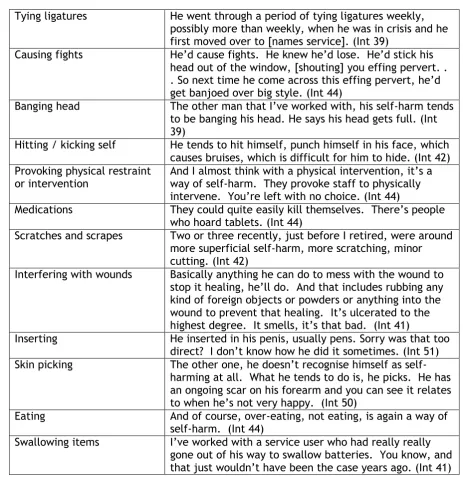
[image:6.595.63.527.232.710.2]Types of self-harm
Table 1 shows the types of self-harm that staff had seen in men they worked with.
More ‘masculine’ styles of self-harm such as causing fights or tying ligatures were
described, as well as other less severe behaviours such as picking and scratching.
Swallowing items, a behaviour traditionally associated with women on the unit,
was also described by one interviewee.
Table 1: Types of self-harm reported
Tying ligatures He went through a period of tying ligatures weekly, possibly more than weekly, when he was in crisis and he first moved over to [names service]. (Int 39)
Causing fights He’d cause fights. He knew he’d lose. He’d stick his head out of the window, [shouting] you effing pervert. . . So next time he come across this effing pervert, he’d get banjoed over big style. (Int 44)
Banging head The other man that I’ve worked with, his self-harm tends to be banging his head. He says his head gets full. (Int 39)
Hitting / kicking self He tends to hit himself, punch himself in his face, which causes bruises, which is difficult for him to hide. (Int 42) Provoking physical restraint
or intervention And I almost think with a physical intervention, it’s a way of self-harm. They provoke staff to physically intervene. You’re left with no choice. (Int 44)
Medications They could quite easily kill themselves. There’s people who hoard tablets. (Int 44)
Scratches and scrapes Two or three recently, just before I retired, were around more superficial self-harm, more scratching, minor cutting. (Int 42)
Interfering with wounds Basically anything he can do to mess with the wound to stop it healing, he’ll do. And that includes rubbing any kind of foreign objects or powders or anything into the wound to prevent that healing. It’s ulcerated to the highest degree. It smells, it’s that bad. (Int 41)
Inserting He inserted in his penis, usually pens. Sorry was that too direct? I don’t know how he did it sometimes. (Int 51) Skin picking The other one, he doesn’t recognise himself as
self-harming at all. What he tends to do is, he picks. He has an ongoing scar on his forearm and you can see it relates to when he’s not very happy. (Int 50)
Eating And of course, over-eating, not eating, is again a way of self-harm. (Int 44)
[image:6.595.72.529.237.715.2]7 | P a g e
Is the type of self-harm changing with this user group?
Three participants reported noticing a change in self-harm, both in terms of types
and level or frequency of self-harm. This was attributed to culture within units as
well as the wider society:
What I can see, particularly within high secure locations, is that the profile of self-harm has changed, in my view. So for the male population, that used to be something that may have happened, but it was something that was either hidden or not admitted to, whereas now, it is in the main very open. . . I think, for me just looking round and looking at the groups of service users, there seems to be, there’s an acceptance that it’s ok. So people don’t, they don’t seem to feel afraid of coming forward now and saying, I’ve done this. But I think the scales have just gone up. Whereas one time, you know it might just have been a cut or a graze, or a bruise where someone’s rubbed their skin. Now it seems to be you’ve got to reach for the sky and, you know get something that will kind of really shock, or cause the individual maximum disruption. (Int 41)
One participant reasoned that the increase in male self-harm was related to
individual factors and anxiety due to imminent resettlement:
What I have noticed with the two gentlemen I was referring to, is yes I can say for both of them, it is increasing, and it started to increase because resettlement’s on the cards now. And I think that’s around anxiety levels and they way they’re feeling. And I know that because I’m picking it up, because [it’s on the reports], so I’m able to pick that up. (Int 42)
Meanings of self-harm
Table 2 shows staff perceptions of the meanings of self-harm for the men they
work with. Some of the perceived functions were relational, a response to bullying
or powerlessness. A common thought was that men were using self-harm as a
means of communication, or because of difficulties in getting people to understand
their distress. Another popular perception was that men self-harmed as a way to
bring on or stop ward moves.
Table 2: Meanings of self-harm
Sabotaging family
visits So he was harming his own interests. He’d do something to harm his interest. And as soon as mum turned up with the partner, he’d say something to sabotage the meeting. So he was getting his retaliation first. (Int 44)
To avoid moving He can walk round the grounds and people will know and talk to him and it’s normal here. Whereas in the community, he was very, he was bullied, he was exploited and he was very
vulnerable. So for him, the thought of moving on from here is massively unsettling and I think that’s partly why he self-harms, to show people that I still need support. To keep the care. (Int 39)
8 | P a g e
move so, and then they’ll request a move, or they’ll do something to make a move happen. It might be seriously self-harming or it might be aggression, depending on what they’re able to access or what they’re able to do. (Int 39)
Turning emotional pain into physical pain
And it’s, again perhaps they struggle to put it into words and perhaps it’s the emotional pain. They put emotional pain into physical pain. I’m struggling for the words. They’re turning one into the other so it’s tangible. (Int 44)
Self-care By physically harming themselves, it gives them a reason for looking after themselves. (Int 44)
Communication [He self-harms] to ask for help without asking for help, I think. (Int 43)
Reduce stress It comes in different forms. It’s more chronic and that is where they use a de-stress coping strategy. (Int 40)
Control I think it is about control and taking it to the extreme cases again, those individuals can then be in control of their own treatment regime. Cos quite often what you’ll find is, ‘I want to dress that myself, I want to it at a specific time, I want to go to the clinic to have that reviewed, but I’ll only go in an
afternoon.’ (Int 41)
Coping When I understand a little bit about their background, I’m able to say things along the lines of, well this is an effective coping strategy for you, and we explore the relationship with self-harm as a coping strategy, and we look at alternative coping. But it’s a very strong coping strategy for people, and it’s effective. It does the job. (Int 43)
Copying others’
behaviour [It’s] learnt behaviour, without even looking at it. Learnt behaviour. Self-fulfilling prophecy almost. (Int 44) Manifestation of
distress I can imagine a lot of men in this service saying that self-harm is better than crying. You could see people doing that, that sort of bravado approach. Because you could still have lots of scars and look tough, rather than somebody who’s crying. (Int 43) Response to
powerlessness I think if they feel bullied or powerless, that seems to be a massive trigger for the men I’ve worked with. So if, yeah if there’s a situation on the flat where they’ve felt that they were threatened or were insulted in a public way, then that can usually, usually comes out in self-harm. (int 39)
Individual diagnosis Being overwhelmed with worry, that seems to be a link with the men. With the men that I’ve worked with anyway. I think part of the issue is because people are so different. So we might have somebody there with autism, we might have somebody there with personality disorder. Somebody who’s seriously aggressive with somebody who’s previously been a victim. And it’s just the nature of services, but that contributes to it. (Int 39)
Challenges of working with male self-harm
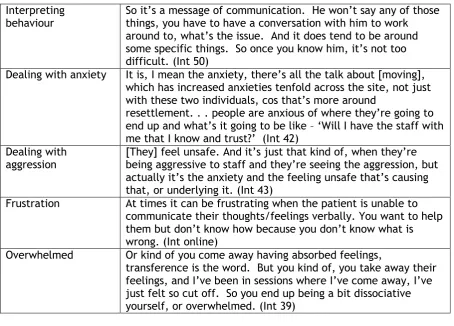
The major challenges related to the visibility of the self-harm. One of the
9 | P a g e
[image:9.595.72.527.143.469.2]to see when someone had self-harmed because some of the men tried to hide their
wounds. Feelings of frustration and sadness were also discussed.
Table 3: Challenges of working with men who self-harm
Interpreting
behaviour So it’s a message of communication. He won’t say any of those things, you have to have a conversation with him to work around to, what’s the issue. And it does tend to be around some specific things. So once you know him, it’s not too difficult. (Int 50)
Dealing with anxiety It is, I mean the anxiety, there’s all the talk about [moving], which has increased anxieties tenfold across the site, not just with these two individuals, cos that’s more around
resettlement. . . people are anxious of where they’re going to end up and what’s it going to be like – ‘Will I have the staff with me that I know and trust?’ (Int 42)
Dealing with
aggression [They] feel unsafe. And it’s just that kind of, when they’re being aggressive to staff and they’re seeing the aggression, but actually it’s the anxiety and the feeling unsafe that’s causing that, or underlying it. (Int 43)
Frustration At times it can be frustrating when the patient is unable to communicate their thoughts/feelings verbally. You want to help them but don’t know how because you don’t know what is wrong. (Int online)
Overwhelmed Or kind of you come away having absorbed feelings,
transference is the word. But you kind of, you take away their feelings, and I’ve been in sessions where I’ve come away, I’ve just felt so cut off. So you end up being a bit dissociative yourself, or overwhelmed. (Int 39)
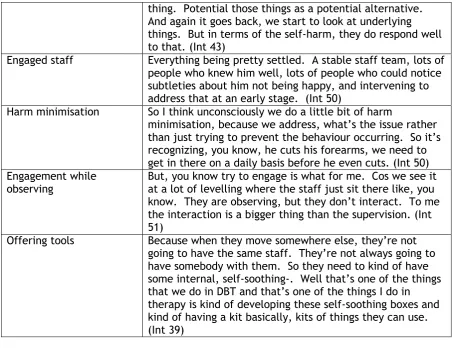
Strategies for working with men who self-harm
Many of the strategies rested on the maintenance of strong therapeutic
relationships, as well as supporting peer and family relationships. Maintaining
self-esteem and focussing on men’s strengths was another common strategy as
described by staff. Art and psychological therapy were seen as extremely
successful.
Table 4: Strategies used by staff
Listening to men We’ve got to listen. We’ve got to enable people, as I said earlier, to put what they’re feeling into words, and perhaps we need more specialists. More nurse specialists. (Int 44) Supporting relationships [We ask them} Do you want me to get in touch with your
family? Is there a friend you’d like to talk to, you know, on another ward? (Int 44)
10 | P a g e
things you do, but I like you. . . And yeah it really is fundamental. (Int 45)
Art therapy [Art therapy is] about providing a safe space, the same time each week, providing art materials. So sometimes people talk and share their experiences through variable
communications, talking therapy. But then other times they might draw or use art materials to provide a visual communication of how they’re feeling. Because sometimes they can’t find the words to describe their experiences or how it feels. (Int 39)
CBT therapy Yeh, one of the most useful things with CBT is you teach the service user to become their own therapist. They understand what they do and why they do it and they’ve got relapse prevention stuff for the future. With PTSD, once the trauma is processed, with physically changed parts of the brain and physically changed where it’s stored in the brain, and reoccurrence should be, you know minimal. (Int 43)
Using pictures/diagrams We do a lot of diagrams, as to what different things might contribute to the self-harm, what the triggers might be, how they feel before, how they feel afterwards. . . It’s a catalyst for discussion, and it’s not as direct. (Int 39) Consistency of staff Cos I think if people are moved around too much, you don’t
see it, you don’t see the patterns as much. You don’t pick up on what’s going on. And you tend to see the person in crisis. (int 39)
Talking off the wards They seem to think it’s personal to them. It’s, so they are making it private, personally I take them out and that’s when they can talk to you. If everybody is there, you know. And that’s the way that works, once you take them out. (Int 40)
Talking about progress [We talk about a] ladder, a progress ladder. They say, maybe before you were self-harming ten times a week. All right, now you are self-harming eight times a week. What has changed? (Int 40)
Relational security I think it’s about, it is about supporting those individuals. It’s about recognising that that problem exists. It’s about making sure that our staff are the best we can have them. I think there’s a lot of work been done over the years in regards to that. (Int 41)
Supporting resettlement It’s done over a period of time where the staff team that are identified to be working with them when they move on, will come here and work with them. They’ll start visiting the house, the flat, buy in things and eventually our staff will take a back seat and their staff will take sort of over more of the lead. (Int 42)
Talking about strengths Everybody has his strength and if you promote that
strength. . . ‘You are very good at organising people. You are very good in making suggestions.’ You see, if you keep talking about their strengths, my God, people value it. And I tell you, he will think about the positive things more than the negative. (Int 40)
11 | P a g e
thing. Potential those things as a potential alternative. And again it goes back, we start to look at underlying things. But in terms of the self-harm, they do respond well to that. (Int 43)
Engaged staff Everything being pretty settled. A stable staff team, lots of people who knew him well, lots of people who could notice subtleties about him not being happy, and intervening to address that at an early stage. (Int 50)
Harm minimisation So I think unconsciously we do a little bit of harm
minimisation, because we address, what’s the issue rather than just trying to prevent the behaviour occurring. So it’s recognizing, you know, he cuts his forearms, we need to get in there on a daily basis before he even cuts. (Int 50) Engagement while
observing But, you know try to engage is what for me. Cos we see it at a lot of levelling where the staff just sit there like, you know. They are observing, but they don’t interact. To me the interaction is a bigger thing than the supervision. (Int 51)
Offering tools Because when they move somewhere else, they’re not going to have the same staff. They’re not always going to have somebody with them. So they need to kind of have some internal, self-soothing-. Well that’s one of the things that we do in DBT and that’s one of the things I do in therapy is kind of developing these self-soothing boxes and kind of having a kit basically, kits of things they can use. (Int 39)
Staff support
[image:11.595.71.528.70.418.2]Staff valued clinical supervision as well as peer support. Staff used individual
strategies to deal with men, such as acknowledging trauma, focussing on positives
of the person and distancing themselves a little from the self-harm in order to
avoid burnout.
Table 5: Staff support
Clinical supervision I know in this environment and other environments, there’s a lot of clinical supervision delivered, which is a big difference to years ago. So it’s recognised that people working with those individuals carry a lot of that round, and need to offload and share it and get support. So I think that’s better than it ever was. I don’t think you can do too much of that, because I think it’s always always needed. (Int 41)
Working in teams It’s more about the containment and the safety. So consistency of staff, consistency of setting, bringing in, having a multi-disciplinary approach, sharing information, having time to reflect with other professionals working with that person. (Int 39)
12 | P a g e
Peer support I think we’ve got to give staff the opportunity to say something like, they’re doing my bloody head in. And get that out. And without saying, [GASP] oh, you can’t say that. Well yes you can because that’s how you feel. And if you allow staff to say how they feel and then talk around it, and everybody else is starting to feel the same, so it’s what can we do about it, that sort of thing. (Int 42)
Management support [Making sure] management is watching them, making sure that they’re safe and they’re well. Because they can’t identify burn out, well very rarely can you identify burn out. You just suddenly. Even if you’ve got training around it, you don’t always, well you just don’t. (Int 43)
Focussing on positives But in terms of like applying that to me and service users I’m working with, and the difficulties faced. The positives looking at the progress, looking at, like myself, if I’m becoming overly sort of hung up on something. (int 43) Distancing self Maintaining some clinical distancing, although it’s a mixed
bag. And also I’ve talked about it to friends of mine in this service about, we all have a therapy mode. We can all go into a therapy mode where we-, and it’s kind of like armour that you put a psychological armour type stuff. And that helps. (Int 43)
Taking a trauma approach
I find it helps when taking a trauma informed approach to supporting people who you find challenging. (int Online) Training From a personal point of view I would like some training on
self-harm and I think this would also benefit the team, particularly for staff who describe it as attention seeking/being needy/manipulative. (Int Online)
Discussion
Van Camp et al (2011) note the changing nature of men’s self-harm, that men are
beginning to self-harm in ways traditionally considered to be more ‘feminine’.
This was noticed by some of the participants in the current study, where they
described that men they worked with had begun to self-harm in different ways,
and agrees with the suggestion by Marzano et al. (2016) that men’s self-harm
should be looked at separately from suicidality.
13 | P a g e
growing up have been often implicated in self-harm research. Gomez et al (2015)
attributed self-harm to level of abuse as a child, and argued that this was more a
predictor of later self-harm than a person’s gender. Marginalised groups such as
disabled and gay men report higher levels of self-harm citing high levels of bullying
and victimisation as reasons (King et al., 2003).
Communication of distress was a major function, as described in studies with
women (Pembroke, 1996). McClintock et al (2003) evidenced that self-harm is
highest in people who have no speech. Whittock et al (2011) commented that
disclosure of self-harm was low, contributing to the invisibility of male self-harm.
This was also acknowledged in the current study, with participants describing men
being reluctant to ask for help, and hiding their wounds.
Staff participants in this study describe using a number of strategies to deal with
their own feelings. These included distancing themselves somewhat, as well as
focussing on positives. This is an encouraging point and contrasts with the studies
by Ramluggun (2013) and Marzano and Adler (2007), who report that staff felt they
had no resources or skills to deal with men’s self harm. Staff valued clinical
supervision and peer support as ways to share information and ‘offload’ their
concerns.
This study has gathered valuable information about things that work with men who
self-harm. Participants reported the types of therapies that they feel have made a
difference, as well as supporting important relationships, including the therapeutic
relationship. No other research has detailed this range of perspectives on behalf of
staff and further work could explore these in more depth with both service-users
and staff.
References
BABIKER, G. & ARNOLD, L. 1997. The language of injury: Comprehending self-mutilation, Wiley-blackwell.
CLAES, L., VANDEREYCKEN, W. & VERTOMMEN, H. 2007. Self-injury in female versus male psychiatric patients: A comparison of characteristics, psychopathology and
aggression regulation. Personality and Individual Differences, 42, 611-621. DONSKOY, A.-L. 2011. “Starting From Scratch”: An Exploration of the Narratives of the
Pathways Leading up to the First Episode of Self-Wounding. University of Bath. FISH, R. 2015. Learning Disabled Women on Locked Wards: Living at the Intersection of
Gender, Disability and Deviance. PhD Thesis, Lancaster University.
14 | P a g e
GÓMEZ, J. M., BECKER-BLEASE, K. & FREYD, J. J. 2015. A brief report on predicting self-harm: is it gender or abuse that matters? Journal of Aggression, Maltreatment & Trauma, 24, 203-214.
GOUGH, K. & HAWKINS, A. 2000. Staff attitudes to self-harm and its management in a forensic psychiatric service. The British Journal of Forensic Practice, 2, 22-28. GREEN, J. D. & JAKUPCAK, M. 2015. Masculinity and Men’s Self-Harm Behaviors:
Implications for Non-Suicidal Self-Injury Disorder. Psychology of Men & Masculinity. HYCNER, R. H. 1985. Some guidelines for the phenomenological analysis of interview data.
Human studies, 8, 279-303.
INCKLE, K. 2014. Strong and Silent: Men, Masculinity, and Self-injury. Men and Masculinities, 1097184X13516960.
KING, M., MCKEOWN, E., WARNER, J., RAMSAY, A., JOHNSON, K., CORT, C., WRIGHT, L., BLIZARD, R. & DAVIDSON, O. 2003. Mental health and quality of life of gay men and lesbians in England and Wales. The British Journal of Psychiatry, 183, 552-558. MARZANO, L. & ADLER, J. R. 2007. Supporting staff working with prisoners who self-harm:
A survey of support services for staff dealing with self-harm in prisons in England and Wales. international journal of Prisoner Health, 3, 268-282.
MARZANO, L., ADLER, J. R. & CICLITIRA, K. 2015. Responding to repetitive, non‐suicidal self‐harm in an English male prison: Staff experiences, reactions, and concerns. Legal and Criminological Psychology, 20, 241-254.
MARZANO, L., CICLITIRA, K. & ADLER, J. 2012. The impact of prison staff responses on self‐harming behaviours: Prisoners’ perspectives. British journal of clinical psychology, 51, 4-18.
MARZANO, L., MARZANO, L., CICLITIRA, K., CICLITIRA, K., ADLER, J. R. & ADLER, J. R. 2016. Non-suicidal self-harm amongst incarcerated men: a qualitative study. Journal of Criminal Psychology, 6, 157-172.
MCCLINTOCK, K., HALL, S. & OLIVER, C. 2003. Risk markers associated with challenging behaviours in people with intellectual disabilities: a meta‐analytic study. Journal of Intellectual Disability Research, 47, 405-416.
MOORES, P., FISH, R. & DUPEROUZEL, H. 2011. ‘I can try and do my little bit’-training staff about self-injury. Journal of Learning Disabilities and Offending Behaviour, 2, 4-7.
PEMBROKE, L. R. 1996. Self-harm Perspectives from personal experience, London, Chipmunkapublishing.
RAMLUGGUN, P. 2013. A critical exploration of the management of self-harm in a male custodial setting: Qualitative findings of a comparative analysis of prison staff views on self-harm. Journal of forensic nursing, 9, 23-34.
ROSS, S. & HEATH, N. 2002. A study of the frequency of self-mutilation in a community sample of adolescents. Journal of Youth and Adolescence, 31, 67-77.
TAYLOR, B. 2003. Exploring the perspectives of men who self‐harm. Learning in health and social care, 2, 83-91.
VAN CAMP, I., DESMET, M. & VERHAEGHE, P. 2011. Gender differences in non-suicidal self-injury: Are they on the verge of leveling off. International Proceedings of
Economics Development & Research, 23, 28.
15 | P a g e
Male self-harm is becoming more frequent and life-threatening in secure services.
However, to date, the existing literature about men’s self-harm comes from
psychiatric services or prisons and does not focus on men with learning disabilities.
This report details experiences of staff working with learning-disabled men who
self-harm in a locked unit, based on a small scale qualitative study in England. A
key finding was that the men the staff worked with undertook very distinctive
self-harming behaviours, and the perceived functions of self-harm differed from that of
women in the same setting.
http://wp.lancs.ac.uk/cedr