© 2019, IRJET | Impact Factor value: 7.34 | ISO 9001:2008 Certified Journal
| Page 1716
Kids Learning Zone a 3D Android Application
Shivkumar Hegonde
1, Sanket Walke
2, Sai Shivaram Marapalli
3, Chandan Prasad
4,
Pallavi Zutshi
51,2,3
Trainee of Android App Developer (TSSDC, Pune)
4
Android Master Trainer (TSSDC, Pune)
5
Youth Development Module Trainer (TSSDC, Pune)
---***---Abstract -
In this paper we seek to understand the objectiveand outcome of kid education by observing their learning styles. Our behaviors like how we are reacting or expressing our knowledge is what others adapt. We have compared learning outcomes of various online tools for kids. However, we have seen that learning methods/styles are not effective for kids learning, as there are still a few things missing.
Specifically, in all the online kids learning
(App/games/links/portals etc.) education we can see only a couple of Behavioral traits and majorly they are missing many things. In this paper we have we have overcome this challenge of effective online learning and have offered practical suggestions for self-learning of the kids.
Key Words: VAK learning styles model, visual learners, auditory learners, kinaesthetic learners.
1. INTRODUCTION:
Kids are in the midst of a vast, unplanned experiment, surrounded by technologies that were not available but 10 years ago. Smart technologies like Smartphones, tablets and many more are transforming the way of interactive digital experiences in case of children. Learning styles are some methods around how someone uses their senses to receive the information; how their brain absorbs and processes the received information and how they organize it and present that information [1][2]. It’s an individual's unique strategy for learning and understanding, based on their strengths, weaknesses, and their preferences.
Learning is a little complex concept because everyone has a different way of learning and understanding. Mostly used learning style is called the VAK learning style model which provides an easy and quick reference to the different or preferred learning styles [1][2].
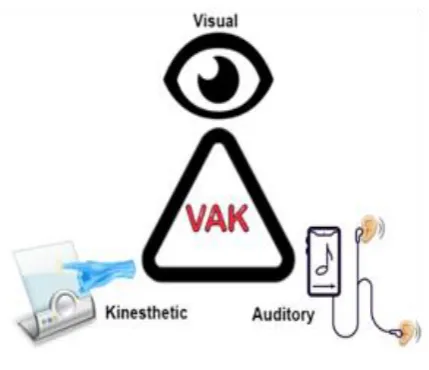
VAK stands for Visual, Auditory, and Kinesthetic (Tactile/Hands on). The theory suggests that all individuals prefer to learn through one of these sense channels.
1.1 VAK Module
VAK stands for Visual, Auditory, and Kinesthetic (Tactile/Hands on). The theory suggests that all individuals prefer to learn through one of these sense channels.
1.2 Visual Learning Style:
Visual learning style is to see or observe things. Children who use this style/method of learning they have to see the teacher’s body language and their facial expressions to fully understand the concept/content of a lesson [1][2]. They prefer to sit in the front row of the classroom. Some learners think in graphics and learn best from visual displays like pictures, charts, diagrams, graphs, displays, handouts, films. During a lesson, visual learners often take detailed notes to absorb the information [1][2].
1.3 Auditory Learning Style:
Auditory learning style has the transfer of information through listening. Children who use this style/method, learn best through verbal lessons, talking things through and listening to the spoken word, of self or others, discussions, of sounds and noises [2][3]. They interpret the underlying meanings of speech through listening to the tone of the voice, pitch, and speed of voice. Visual information may have less meaning until it is heard. These learners have some benefit from reading text aloud sometimes. These children like to discuss their ideas, work in groups, chant information that is important to remember, review printed or on paper material before auditory information is presented [1][2].
1.4 Kinesthetic Learning Style:
Kids who are Kinesthetic learners, they learn best through a hands-on experience means they learn from physical activity or practical approach. They prefer to take frequent study breaks, work in a standing position, trying more than one time to get perfection [2][3].
1.5 Kids and Smartphone:
© 2019, IRJET | Impact Factor value: 7.34 | ISO 9001:2008 Certified Journal
| Page 1717
devices like Large screen displays, user friendly, HD, [image:2.595.72.287.124.309.2]lightweight, attractive design etc. [2][4].
Fig 1 – VAK Style Module
2. LITERATURE REVIEW
2.1 Learning cycles and learning styles:
The theory presents a way of structuring a session or a whole course using a learning cycle. The different stages of the cycle are associated with distinct learning styles. Individuals differ in their preferred learning styles and recognizing this is the first stage in raising students' awareness of the alternative approaches possible [2][5]. According to Kolb (1984, 38) "Learning is the process whereby knowledge is created through the transformation of experience" (author's italics). The theory presents a way of structuring and sequencing the curriculum and indicates.
In particular, how a session, or a whole course, may be taught to improve student learning [2][5]. It suggests that learning is cyclical, involving four stages, sometimes referred to as feeling, watching/reflecting, thinking, and doing (Fielding, 1994). An important feature of the theory is that the different stages are associated with distinct learning styles [5].
2.2 Learning Mobile educational applications for
children:
The popularity of smart mobile devices is growing fast. These digital devices represent a new generation of technological tools that offer remarkable access to content as well as opportunities for creative use even by young children [2][4]. Most of the best-selling paid apps in the education category are targeted towards children [4]. At the same time, the educational value of those applications is difficult to be determined.
Parents and educators, who are turning to those devices for the potential educational benefits they expect for
their children and/or their students, have a limited number of tools with which to evaluate these apps [2][4].
2.3 Effectiveness of VAK and improvements to
teaching techniques:
In this regard, a new innovation is important in learning to write overall-summary in the class. Teachers should build a motivation for the kid learners by creating a helpful learning atmosphere [1][6]. Currently, many learning methods are developed in the world of education. The model/method developed is expected to be an alternative to help the kid learners in summary writing, one of the alternatives is VAK model. VAK model presume that learning will be successful by giving attention toward learning techniques/styles and exploring the possibilities that the kid learners have. Learning is focused on providing direct and enjoyable learning experience [2][6]. It is achieved by learning to recall(visual), learning by hearing (auditory), and learning with movement and emotion (kinesthetic). kid learners should be able to utilize the three components in learning activities [2][4][6].
2.4 RELATED WORK:
2.4.1 Kids Learning App:
This app allows children to play many entertaining games, puzzles, tasks with ease of process. It can help children to easily adapt digital applications there by grading up their knowledge.
Limitation:
It is not having Virtual Reality, Augmented Reality, Puzzles, 3D White Board, Phonetic, Color.
2.4.2 Play, Nursery, LKG, UKG Kids:
It's an all in one app where it has its range starting from Numbers, Alphabets with pictures, Animals, Birds, Fruits, Vegetables, Shapes etc.
Limitation:
It is not having Auditory, Kinesthetic, Virtual Reality, Augmented Reality, Games, Puzzles, 3D White Board, Logic Enhancer, Phonetic etc.
2.4.3 ABC Kids- Tracing & Phonetics:
© 2019, IRJET | Impact Factor value: 7.34 | ISO 9001:2008 Certified Journal
| Page 1718
Limitation:It is not having Auditory, Kinesthetic, Virtual Reality, Augmented Reality, Puzzles, 3D White Board, Phonetic, Numbers, Good Habits, Days of Week & Years, Body Parts.
2.4.4 English Kids App:
This app will be useful very much in teaching and educating your children through digital tasks, challenges and games on math’s, Alphabets, Numbers, Days, Weeks, Additions, Subtractions, etc.
Limitations:
It is not having Virtual Reality, Augmented Reality, Games, Puzzles, 3D White Board, Phonetic.
2.4.5 Math Kids:
It's a very helpful app for your child education and the levels for mathematics. With this app provided better visual tasks, challenges on problems children can easily grade up their abilities and brain power.
Limitations:
It is not having Virtual Reality, Augmented Reality, 3D White Board, Phonetic, Alphabets, Good Habits, Days of Week & Years, Body Parts, Animals.
2.4.6 Kids Pre School All-In-One App:
This app mainly concentrates on 6 areas are very important and ought to do tasks. They are Alphabets, Mathematics, Colors and Shapes, Fruits and vegetables, Animals and Vehicles. Basically it's an all in one app for children before schooling.
Limitations:
It is not having Auditory, Virtual Reality, Augmented Reality, Games, Puzzles, 3D White Board, Logic Enhancer, Phonetic.
2.4.7 Kids Spelling Learning:
With this app child can learn spellings for each and every word. And they can able to learn spelling formation through voice recognition and digital lessons.
Limitations:
It is not having Virtual Reality, Augmented Reality, Games, Puzzles, 3D White Board, Logic Enhancer, Phonetic, Numbers, Good Habits.
2.4.8 Numbers Learning for Kids:
It's an amazing app for kids to teach Numbers and their counting, pre math’s with audio support. With this app
kids can easily learn, listen Numbers and their ascending and descending orders with curiosity and creativity.
Limitations:
It is not having Augmented Reality, Games, Puzzles, 3D White Board, Logic Enhancer, Phonetic, Alphabets, Good Habits, Days of Week & Years, Body Parts, Animals, Vegetables & Flowers.
2.4.9 VR Thrills: Roller Coaster 360:
It's a real fun creating app for kids. Generally, kids are fascinated about the excursion things like roller coaster and all. With this app we can make them happy with virtual roller coaster experience. It has good real graphics and V. R effects.
Limitations:
It is not having Visual, Auditory, Kinesthetic, Augmented Reality, Games, Puzzles, 3D White Board, Logic Enhancer, Phonetic, Numbers, Alphabets, Colors & Shapes, Good Habits, Days of Week & Years, Body Parts, Animals, Vegetables & Flowers.
2.4.10 WizarKids:
It's a nurturing app that can help kids to rectify their lacking, short comings in their education system. It facilitates kids to fill up their gaps and laps in their regular curriculum through scanning of flash cards, coloring books, picture books, story books, there by embracing their creativity.
Limitations:
It is not having Visual, Auditory, Kinesthetic, Virtual Reality, Games, Puzzles, 3D White Board, Logic Enhancer, Phonetic, Numbers, Alphabets, Colors & Shapes, Good Habits, Days of Week & Years, Body Parts, Animals, Vegetables & Flowers.
2.4.11 Animal Sounds for Kids:
It's a pretty nice app that helps young children learn different animals and their respective sounds.
Limitations:
It is not having Virtual Reality, Augmented Reality, Games, Puzzles, 3D White Board, Logic Enhancer, Phonetic, Numbers, Good Habits, Days of Week & Years, Body Parts, Animals.
2.4.12 Color for Kids, Toddlers, Babies:
© 2019, IRJET | Impact Factor value: 7.34 | ISO 9001:2008 Certified Journal
| Page 1719
Limitations:It is not having Auditory, Kinesthetic, Virtual Reality, Augmented Reality, Games, Puzzles, 3D White Board, Phonetic, Numbers, Alphabets, Good Habits, Days of Week & Years, Body Parts, Animals.
Chart -1: Taxonomy Chart
2.4.13 Learn Shapes for Kids, Toddlers - Educational Game:
By using this app kid can exercise about physical shapes like rectangles, triangles, squares and differences among them.
Limitations:
It is not having Virtual Reality, Augmented Reality, Games, Puzzles, 3D White Board, Logic Enhancer, Phonetic, Numbers, Alphabets, Good Habits, Days of Week & Years, Body Parts, Animals.
3. EXISTING SYSTEM:
Nowadays the digitalization has enhanced the area for learning methodologies and learning platforms. There are lots of traditional approaches for kids learning such as Slate-Pencil, Cards, Posters, Videos, Audios, Pictures etc.
These traditional methods are not much effective to get the knowledge in better way and swift in this digital world.
The taxonomy chart is the tabular representation of different systems or application on the basis of different parameters to analyze and provide the justification of proposed system. Parameters Sources / Apps V isu al A ud it ory Ki n est he ti c V irt ua l Re al it y A ugm en te d Re al it y G am es P uz zl es 3 D Whi te B oa rd Lo gi c Enha n ce r P ho n et ic Nu m be rs A lph ab et s Co lo
rs & S
ha pe s G oo d Ha b it s D ay s o f We ek & Y ea rs B ody P art s A n im al s, V ege ta b le
s & F
lo
we
rs
Kids Learning App √ √ √ X X √ X X √ X √ √ X X X X X
Play, Nursery, LKG, g UKG Kids √ X X X X X X X X X √ √ √ √ √ √ √
ABC Kids - Tracing & Phonics √ X X X X √ X X √ X X √ √ X X X √
English Kids App √ √ √ X X X X X √ X √ √ √ √ √ √ √
Math Kids √ √ √ X X √ √ X √ X √ X √ X X X √
Kids Pre School All-In-One
App √ X √ X X X X X X X √ √ √ √ √ √ √
Kids Spelling Learning √ √ √ X X X X X X X X √ √ X √ √ √
Numbers Learning For Kids √ √ √ √ X X X X X X √ X √ X X X X
VR Thrills: Roller Coaster 360 X X X √ X X X X X X X X X X X X X
WizarKids X X X X √ X X X X X X X X X X X X
Animal sounds for kids √ √ √ X X X X X X X X √ √ X X X √
Colors for Kids, Toddlers,
Babies √ X X X X X X X √ X X X √ X X X √
Learn Shapes for Kids,
Toddlers - Educational Game √ √ √ X X X X X X X X X √ X X X √
Kids Learning Zone
(Proposed System)
© 2019, IRJET | Impact Factor value: 7.34 | ISO 9001:2008 Certified Journal
| Page 1720
Fig 2 - Existing System Architecture
4. PROPOSED SYSTEM:
Our proposed system is to overcome existing system and making a perfect application for kids by touching all the corners of the kid learning aspects.
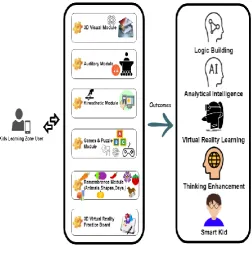
Fig 3 - Proposed System
4.1 3D Visual Module:
This module contains all visual things like Pictures, Charts, Tables, Objects etc. are shown in 3D Visualization.
4.2 Auditory Module:
This module contains all Auditory things in Phonetic manner like pronunciation of Words pitch of voice etc.
4.3 Kinesthetic Module:
This module contains all things are expressed using hands on experience.
4.4 Games and Puzzles Module:
This module contains 3D games and puzzles which will enhance logic building. It helps in logic enhancement, kid’s analytical thinking etc.
4.5 Remembrance Module:
This module consists of analytical aspect for checking the competency in context of grasping the content by the children/kids. With the help of 3D object realization and object finding in real world in as a game.
4.6 3D Virtual Reality Practice Board Module:
This module consists 3D White board which can be used as a board and we can draw objects, numbers, alphabets, animals etc. by gestures.
5. CONCLUSIONS:
In this paper, we analyzed and offer a general view on kid’s over all development using VAK Module. Moreover, the comparisons among the variables (age group, research method, and learning styles, learning outcome) helped us to get useful information so that we worked on it and kids learning becomes more fruitful.
In proposed system, the results imply that this can stimulate the development of preschool age kids. Which again result into Logic Building, Analytical Intelligence, Thinking Enhancement, Virtual Reality Learning and Finally a “SMART KID”.
6. REFERENCES:
[1] http://www.childtherapypinner.nlp4kids.org/
[2] https://www.wikipedia.org
[3] Wan Raihan Wan Shaaidi TATI University College, “A study of the preferred learning styles of students taking the english 1119 paper in smk tengku intan zaharah: are the teachers aware of these learning styles?” November 2012.
[4] Stamatios Papadakis and Michail Kalogiannakis, Department of Preschool Education, Faculty of Education, University of Crete, Crete, Greece, Mobile educational applications for children: what educators and parents need to know, 2017.
[image:5.595.37.290.334.591.2]© 2019, IRJET | Impact Factor value: 7.34 | ISO 9001:2008 Certified Journal
| Page 1721
application in geography in higher education September2000.
[6] Maulidia Tifani Alfin Nur Hardiana, Prof. Pujiati Suyata, Yogyakarta State University, Indonesia, August 2018 “The Effectiveness of VAK (Visual, Auditory, Kinesthetic) Model in Learning of Summary Writing”.
[7] Ibrahim Yasar Kazu Faculty of Technical Education, Department of Educational Sciences, Firat University, 23119 Elazig, Turkey, “The Effect of Learning Styles on Education and the Teaching Process”.
BIOGRAPHIES:
Name: Shivkumar Hegonde
Qualification: BE in Computer Engineering.
Name: Sanket Walke
Qualification: BSC in Computer Science.
Name: Sai Shivaram Marapalli Qualification: BTech in Computer Science and Engineering.
Name: Chandan Prasad
Qualification: M.E Computer Engineering,
Android Master Trainer TSSC, (NSDC),
Facilitator at Tata Strive.
Name: Pallavi Zutshi