64
Atalaya at SemEval 2019 Task 5: Robust Embeddings for Tweet
Classification
Juan Manuel P´erez Universidad de Buenos Aires
CONICET
Franco M. Luque
Universidad Nacional de C´ordoba CONICET
Abstract
In this article, we describe our participa-tion in HatEval, a shared task aimed at the detection of hate speech against immigrants and women. We focused on Spanish sub-tasks, building from our previous experiences on sentiment analysis in this language. We trained linear classifiers and Recurrent Neural Networks, using classic features, such as bag-of-words, bag-of-characters, and word embed-dings, and also with recent techniques such as contextualized word representations. In partic-ular, we trained robust task-oriented subword-aware embeddings and computed tweet rep-resentations using a weighted-averaging strat-egy. In the final evaluation, our systems showed competitive results for both Spanish subtasks ES-A and ES-B, achieving the first and fourth places respectively.
1 Introduction
Hate speech against women, immigrants, and many other groups is a pervasive phenomenon on the Internet. On the early days of the World Wide Web, many academics adventured that prejudices and hatred would be removed in this space by the dissolution of identities (L´evy, 2001; Rheingold, 1993). Twenty years after this hypothesis, we can say that it has not been the case. The prevalence of racism in the “World White Web” has been stud-ied in a number of works (Adams and Roscigno, 2005; Kettrey and Laster, 2014) and so has been the misogyny in the virtual world (Filipovic, 2007; Mantilla, 2013).
Racist and sexist discourse are a constant in so-cial media, but peaks are documented after “trig-ger” events, such as murders with religious or po-litical reasons (Burnap and Williams, 2015). Most social media companies are concerned about this issue and take actions against it; nonetheless, most of the efforts still need human intervention, mak-ing this task very expensive. Therefore, reducmak-ing
human intervention is vital in order to have effec-tive tools to avoid the escalation of hate speech.
HatEval (Basile et al., 2019) is a SemEval-2019 shared task aimed at the detection of hate speech towards immigrants and women in tweets. It com-prises two subtasks, with datasets in English (EN) and Spanish (ES) for both of them, giving a total of four subtasks. Subtask A is the binary classifica-tion of tweets into hateful or not hateful (HS). Sub-task B is a triple binary classification Sub-task where, in addition to HS, tweets are classified into aggres-sive or not aggresaggres-sive (AG), and targets of hate speech are classified into single humans or groups of persons (TR).
In this article, we present our participation in HatEval as team Atalaya. We focused our efforts on subtask A for Spanish (ES-A) but also worked at subtask B in Spanish (ES-B) and subtask A in English (EN-A). Our systems are based on our participation in the polarity classification task of Spanish tweets TASS 2018 (Sentiment Analysis at SEPLN) (Mart´ınez-C´amara et al., 2018; Luque and P´erez, 2018).
To represent tweets, we experimented with a mixed approach of bag-of-words, bag-of-characters and tweet embeddings, which were cal-culated from word vectors using different aver-aging schemes. We used fastText (Bojanowski et al., 2016) to get subword-aware representations specifically trained for sentiment analysis tasks.
These word representations are robust to noise since they can be computed for unseen words by using subword embeddings. Moreover, we trained them using a database of 90M tweets from various Spanish-speaking countries, giving wide domain-specific vocabulary coverage. We achieved ad-ditional robustness by doing preprocessing us-ing several text-normalization and noise-reduction techniques.
et al., 2018), a deep contextualized word rep-resentation that has drawn a lot of attention in the last months. Unlike fastText, ELMo returns context-dependent embeddings from a multi-layer bidirectional-LSTM language model. These rep-resentations improved the state-of-the-art of sev-eral NLP tasks.
For the neural approach, we used bidirectional LSTMs to combine the word embeddings. We also did experiments that mix sequential models with complementary representations such as bag-of-words.
The rest of the paper is as follows. Next Sec-tion presents the primary tools we used to build our systems. Section 3 presents the configuration and development of both linear and neural models. Section 4 briefly shows our results in the competi-tion, and Section 5 concludes the work with some observations about our experience.
1.1 Previous Work
The detection of hate speech is a sentence classifi-cation task quite related to sentiment analysis and has been studied for several social media networks (Thelwall, 2008; Pak and Paroubek, 2010; Saleem et al., 2017). Regarding the detection of hateful content, Greevy and Smeaton (2004) used bag-of-words and SVMs to detect racist content in web pages. Following a similar approach, Warner and Hirschberg (2012) used unigrams and Brown clus-ters with SVMs to detect anti-semitic messages on Twitter.
Waseem and Hovy (2016) annotated a corpus and used character n-grams to detect hateful com-ments, and Badjatiya et al. (2017) used the same dataset to train deep learning models and fine-tuned embeddings along with Gradient Boosted Trees. Zhang et al. (2018) trained a deep neural network combining CNNs with Gated-recurrent units (Cho et al., 2014), outperforming previous systems in several datasets.
Anzovino et al. (2018) collected a corpus of misogynous tweets and proposed a taxonomy to distinguish them into different categories. The au-thors proposed a number of different techniques to classify them, showing that simple approaches (as using linear models along with token n-grams) achieve competitive performance on small-sized datasets.
Regarding shared tasks, Fersini et al. (2018a) presented a challenge on misogyny detection on
Twitter –both in Spanish and English– whereas Fersini et al. (2018b) posed a similar challenge but in Italian and English. Bosco et al. (2018) pro-posed an automatic detection contest over Twitter posts and Facebook comments, comprising gen-eral hate speech.
2 Techniques and Resources
2.1 Preprocessing
Preprocessing is crucial in NLP applications, es-pecially when working with noisy user-generated data. Here, we followed Luque and P´erez (2018), defining two levels of preprocessing: basic and sentiment-oriented preprocessing. We used one or the other, depending on the configuration.
Basic tweet preprocessing includes tokeniza-tion, replacement of handles, URLs, and e-mails, and shortening of repeated letters.
Sentiment-oriented preprocessing includes low-ercasing, removal of punctuation, stopword, and numbers, lemmatization –using TreeTagger (Schmid, 1995)– and negation handling. For nega-tion handling, we followed a simple approach: We find negation words and add the prefix ’NOT ’
to the following tokens. Up to three tokens are negated, or less if a non-word token is found.
2.2 Bags of Words and Characters
The simplest approach considered to build tweet representations was bag-of-words encoding. A bag-of-words (BoW) builds feature vectors for each token seen in training data. For a partic-ular tweet, its BoW vector contains the number of occurrences of each token on it, resulting in high-dimensional and sparse vectors. Variations of BoW include counting not only single tokens but also n-grams of tokens, binarizing counts, and limiting the number of features.
Character usage in tweets may also hold use-ful information for sentiment analysis. Charac-ter n-grams –such as the presence and repetition of uppercase letters, emoticons, and exclamation marks– may indicate a strong presence of senti-ment of some kind, where others may indicate a more formal writing style, and therefore an ab-sence of sentiment.
texts of tweets, with no preprocessing at all. BoCs have the same variants and parameters as BoWs.
2.3 Word Embeddings
We used fastText, a subword-aware embeddings library (Bojanowski et al., 2016) to get context-independent word representations. Instead of using publicly available pre-trained vectors, we trained our own embeddings on a dataset of ∼
90 million tweets from various Spanish-speaking countries. We prepared two versions of the data: one using only basic preprocessing, and the other using sentiment-oriented preprocessing (with the exception of excepting lemmatization). For these two datasets, skip-gram embeddings were trained using different parameter configurations, includ-ing a number of dimensions, size of word and sub-word n-grams, and size of context window.
2.4 Tweet Embeddings
Linear combinations were used to compute a rep-resentation for a single tweet. We followed two simple approaches: plain average and weighted average. In the second case, we used a scheme that resembles Smooth Inverse Frequency (SIF) (Arora et al., 2017), inspired by TF-IDF reweight-ing. Each wordwis weighted with a+pa(w), where
p(w) is the word unigram probability, and ais a smoothing hyper-parameter. Big values ofamean more smoothing towards plain averaging.
2.5 Context-Dependent Embeddings
After the great leap forward that represented context-independent word embeddings, a new wave came in the last years. Instead of having vec-tors trained for each word, context-dependent rep-resentations are generated for each token given a sentence. For instance, McCann et al. (2017) used a deep LSTM encoder for Machine Translation to generate context-aware vectors.
ELMo (Peters et al., 2018) is one of these context-dependent approaches and is based on a deep bidirectional language model (biLM). The architecture of the language model consists of L layers of bidirectional LSTMs, plus a context-independent token representation. Hence, for each token in a sequence, we get2L+ 1vector repre-sentations. To obtain a final vector for each token, the authors suggest collapsing the layers into vec-tors by means of a linear combination.
In this work, we used the implementation and pre-trained models from Che et al. (2018). The
Spanish model was trained withL= 2layers and 1024 dimensions, and the linear combination was done using a simple average.
3 Models
In this section, we describe the models we used in the competition.
3.1 Linear Classifiers
The first set of models we trained were simple classifying models implemented with scikit-learn (Pedregosa et al., 2011).
We started from the optimal configuration from Luque and P´erez (2018), that combines bag-of-words (BoW), bag-of-characters (BoC) and tweet embeddings as follows:
• BoW: All unigrams and bigrams of words, with binarized counts and TF-IDF re-weighting. For the Spanish training dataset, this encoding gives 53504 sparse features.
• BoC: All n-grams of characters for n ≤
5, with binarized counts and TF-IDF re-weighting. For the Spanish training dataset, it gives 226156 sparse features.
• Tweet embeddings: Computed fromfastText
sentiment-oriented word vectors of 50 di-mensions. Weighted averaging was done as described in Section 2.4, with a smoothing value ofa= 0.1.
Here, the only parameters specifically optimized using the HatEval development set were the n -gram ranges considered for BoW and BoC.
Using this vectorial representation we trained logistic regressions and linear-kernel SVMs with different hyperparameter values. The best results are shown in the first block of Tab. 1, asLR0 and
SVM0.
Next, to confirm the relevance of each of the three components, we performed ablation tests for each of them. Results are displayed asSVMBoW, SVMBoC andSVMemb in Tab. 1. Drops in the performance show the relevance of all compo-nents, especially for BoW and BoC.
Model Acc F1 (avg)
LR0 0.84 0.84
SVM0 0.85 0.85
[image:4.595.110.253.62.159.2]SVMBoW 0.81 0.81 SVMBoC 0.81 0.81 SVMemb 0.84 0.84 SVMELM o 0.84 0.84
Table 1: Experiments with logistic regressions (LRs) and SVMs on the Spanish development set. Models are described in Section 3.1. The best result is in bold.
obtained using PCA to reduce from the original 1024 to 100 dimensions.
Results are shown as SVMELM o in Tab. 1. It can be seen that, under this configuration, we are not able to improve our results using ELMo.
To participate in the Spanish subtask B (ES-B) we used a very naive approach. We didn’t develop or tune a specific system for this subtask but in-stead used the same system and configuration that was found optimal for subtask A. To do this, we first mapped the triple classification problem to a 5-way classification problem for all the possible label combinations:
HS AG TR
0 0 0
1 0 0
1 0 1
1 1 0
1 1 1
Then, we simply trained the classifier using the Spanish subtask B training dataset.
3.2 Neural Models
The second set of models we trained are neural models. We trained Recurrent Neural Networks (RNNs) using pre-trained context-dependent rep-resentations for Spanish.
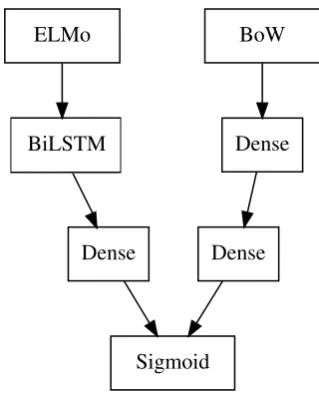
The first model considered was a bidirectional LSTM with a dense layer on top, consuming ELMo vectors; we call this model LSTM-ELMo. Also, we tried another model by adding a second input consisting of a bag-of-words, as illustrated in Figure 1. We call this modelLSTM-ELMo+BoW. UsingfastTextembeddings (of dimension 300 and context window 5) instead of BoW was considered as suggested by Peters et al. (2018) but discarded as it had no positive impact in performance (in the development dataset).
The biLSTM layer consists of 256 units. The bag-of-words has the 3500 most-frequent n-grams (having document-frequency less than0.65),
fol-lowed by a 512-unit dense layer. The two last dense layers have 64 neurons.
We used Keras (Chollet et al., 2015) to imple-ment and train our models. Adam (Kingma and Ba, 2014) was the chosen optimizer, with lr = 35∗10−5 anddecay = 0.01. To regularize our models, we applied dropout with keep-prob of 0.2 on the first layer, and 0.45 on the second, and we also early-stopped the training monitoring the per-formance on the development dataset. The hy-perparameters were chosen from a small random search, as training ELMo is computationally ex-pensive.
ELMo
BiLSTM
BoW
Dense
Dense Dense
[image:4.595.335.495.246.443.2]Sigmoid
Figure 1: TheLSTM-ELMo+BoWarchitecture. ELMo and BoW boxes represent inputs.
[image:4.595.146.217.402.463.2]4 Results
Table 2 displays the evaluation results for the three classifiers trained for subtask A: SVM0, and both neural models LSTM-ELMoand LSTM-ELMo+BoW. For Spanish, the best performing system was SVM0. Despite its simplicity, it ranked first in terms of average F1 in the official results.
Among the neural models,LSTM-ELMo+BoW
performed best, and ranked in position 17 for Spanish in terms of average F1.1 We can observe thatLSTM-ELMo+BoWperforms better on the de-velopment set, although its performance decreases sharply in the test set. In spite of the applied regularization, we might have incurred in overfit-ting during model selection (Cawley and Talbot, 2010) as the chosen model has higher variance
1Results shown in Tab. 2 differ from the ones in the
Spanish English
Dev Test Dev Test
Classifier Acc F1 (avg) Acc F1 (avg) Acc F1 (avg) Acc F1 (avg)
SVM0 0.850 0.850 0.731 0.730 — — — —
LSTM-ELMo 0.820 0.816 0.732 0.721 0.705 0.695 0.508 0.471
[image:5.595.76.524.64.145.2]LSTM-ELMo+BoW 0.824 0.821 0.719 0.712 0.743 0.738 0.502 0.461
Table 2: Our evaluation results for subtask A on the development and test sets for Spanish and English. F1 (avg) is the average on positive and negative classes.
thanLSTM-ELMo. This last model achieved sim-ilar results toSVM0. This difference between the models was not seen in English.
For the Spanish subtask B (ES-B), the same
SVM0 system was used, achieving an average F1 of 0.758 and an EMR score of 0.657 over the test set (fourth place in terms of EMR).
5 Conclusion and future work
As in our previous experience with sentiment anal-ysis, we found that linear models can be a match for neural models. Moreover, this time our SVM ranked in the first place in one of the subtasks.
We believe that –for this kind of challenges with small-sized datasets– preprocessing techniques, data normalization and robustness play a stronger role than model design and hyperparameter tun-ing. On the other hand, deep neural models are highly expressive and prone to overfitting, requir-ing berequir-ing extremely careful with regularization.
Acknowledgments
We are grateful to Pablo Brusco for providing us with helpful comments. This material is based upon work supported by the Air Force Office of Scientific Research under award number FA9550-18-1-0026, and also by a research grant from Se-CyT, Universidad Nacional de C´ordoba.
References
Josh Adams and Vincent J Roscigno. 2005. White supremacists, oppositional culture and the world wide web. Social Forces, 84(2):759–778.
Maria Anzovino, Elisabetta Fersini, and Paolo Rosso. 2018. Automatic identification and classification of misogynistic language on twitter. In International Conference on Applications of Natural Language to Information Systems, pages 57–64. Springer.
Sanjeev Arora, Yingyu Liang, and Tengyu Ma. 2017. A simple but tough-to-beat baseline for sentence
em-beddings. InInternational Conference on Learning Representations.
Pinkesh Badjatiya, Shashank Gupta, Manish Gupta, and Vasudeva Varma. 2017. Deep learning for hate speech detection in tweets. In Proceedings of the 26th International Conference on World Wide Web Companion, pages 759–760. International World Wide Web Conferences Steering Committee.
Valerio Basile, Cristina Bosco, Elisabetta Fersini, Deb-ora Nozza, Viviana Patti, Francisco Rangel, Paolo Rosso, and Manuela Sanguinetti. 2019. Semeval-2019 task 5: Multilingual detection of hate speech against immigrants and women in twitter. In Pro-ceedings of the 13th International Workshop on Se-mantic Evaluation (SemEval-2019). Association for Computational Linguistics.
Piotr Bojanowski, Edouard Grave, Armand Joulin, and Tomas Mikolov. 2016. Enriching word vec-tors with subword information. arXiv preprint arXiv:1607.04606.
Cristina Bosco, Dell’Orletta Felice, Fabio Poletto, Manuela Sanguinetti, and Tesconi Maurizio. 2018. Overview of the evalita 2018 hate speech detection task. InEVALITA 2018-Sixth Evaluation Campaign of Natural Language Processing and Speech Tools for Italian, volume 2263, pages 1–9. CEUR.
Pete Burnap and Matthew L Williams. 2015. Cyber hate speech on twitter: An application of machine classification and statistical modeling for policy and decision making. Policy & Internet, 7(2):223–242.
Gavin C Cawley and Nicola LC Talbot. 2010. On over-fitting in model selection and subsequent selection bias in performance evaluation. Journal of Machine Learning Research, 11(Jul):2079–2107.
Wanxiang Che, Yijia Liu, Yuxuan Wang, Bo Zheng, and Ting Liu. 2018. Towards better UD parsing: Deep contextualized word embeddings, ensemble, and treebank concatenation. InProceedings of the CoNLL 2018 Shared Task: Multilingual Parsing from Raw Text to Universal Dependencies, pages 55–64, Brussels, Belgium. Association for Compu-tational Linguistics.
phrase representations using rnn encoder-decoder for statistical machine translation. arXiv preprint arXiv:1406.1078.
Franc¸ois Chollet et al. 2015. Keras. https://
keras.io.
Elisabetta Fersini, Maria Anzovino, and Paolo Rosso. 2018a. Overview of the task on automatic misog-yny identification at ibereval. In Proceedings of the Third Workshop on Evaluation of Hu-man Language Technologies for Iberian Languages (IberEval 2018), co-located with 34th Conference of the Spanish Society for Natural Language Process-ing (SEPLN 2018). CEUR Workshop ProceedProcess-ings. CEUR-WS. org, Seville, Spain.
Elisabetta Fersini, Debora Nozza, and Paolo Rosso. 2018b. Overview of the evalita 2018 task on au-tomatic misogyny identification (ami). Proceed-ings of the 6th evaluation campaign of Natural Language Processing and Speech tools for Italian (EVALITA’18), Turin, Italy. CEUR. org.
Jill Filipovic. 2007. Blogging while female: How internet misogyny parallels real-world harassment.
Yale JL & Feminism, 19:295.
Edel Greevy and Alan F Smeaton. 2004. Classifying racist texts using a support vector machine. In Pro-ceedings of the 27th annual international ACM SI-GIR conference on Research and development in in-formation retrieval, pages 468–469. ACM.
Heather Hensman Kettrey and Whitney Nicole Laster. 2014. Staking territory in the “world white web” an exploration of the roles of overt and color-blind racism in maintaining racial boundaries on a popular web site. Social Currents, 1(3):257–274.
Diederik P Kingma and Jimmy Ba. 2014. Adam: A method for stochastic optimization. arXiv preprint arXiv:1412.6980.
Pierre L´evy. 2001. Cyberculture, volume 4. U of Min-nesota Press.
Franco M. Luque and Juan Manuel P´erez. 2018. Ata-laya at TASS 2018: Sentiment analysis with tweet embeddings and data augmentation. InProceedings of TASS 2018: Workshop on Semantic Analysis at SEPLN, TASS@SEPLN 2018, co-located with 34nd SEPLN Conference (SEPLN 2018), Sevilla, Spain, September 18th, 2018., pages 29–35.
Karla Mantilla. 2013. Gendertrolling: Misogyny adapts to new media. Feminist Studies, 39(2):563– 570.
Eugenio Mart´ınez-C´amara, Yudivi´an Almeida Cruz, Manuel C. D´ıaz-Galiano, Suilan Est´evez Velarde, Miguel ´A. Garc´ıa-Cumbreras, Manuel Garc´ıa-Vega, Yoan Guti´errez V´azquez, Arturo Montejo R´aez, Andr´e Montoyo Guijarro, Rafael Mu˜noz Guillena, Alejandro Piad Morffis, and Julio Villena-Rom´an. 2018. Overview of TASS 2018: Opinions, health
and emotions. In Proceedings of TASS 2018: Workshop on Semantic Analysis at SEPLN (TASS 2018), volume 2172 of CEUR Workshop Proceed-ings, Sevilla, Spain. CEUR-WS.
Bryan McCann, James Bradbury, Caiming Xiong, and Richard Socher. 2017. Learned in translation: Con-textualized word vectors. InAdvances in Neural In-formation Processing Systems, pages 6294–6305.
Alexander Pak and Patrick Paroubek. 2010. Twitter as a corpus for sentiment analysis and opinion mining. InLREC, volume 10, pages 1320–1326.
F. Pedregosa, G. Varoquaux, A. Gramfort, V. Michel, B. Thirion, O. Grisel, M. Blondel, P. Pretten-hofer, R. Weiss, V. Dubourg, J. Vanderplas, A. Pas-sos, D. Cournapeau, M. Brucher, M. Perrot, and E. Duchesnay. 2011. Scikit-learn: Machine learning in Python. Journal of Machine Learning Research, 12:2825–2830.
Matthew E. Peters, Mark Neumann, Mohit Iyyer, Matt Gardner, Christopher Clark, Kenton Lee, and Luke Zettlemoyer. 2018. Deep contextualized word rep-resentations. CoRR, abs/1802.05365.
Howard Rheingold. 1993. The virtual commu-nity: Finding commection in a computerized world. Addison-Wesley Longman Publishing Co., Inc.
Haji Mohammad Saleem, Kelly P Dillon, Susan Be-nesch, and Derek Ruths. 2017. A web of hate: Tack-ling hateful speech in online social spaces. arXiv preprint arXiv:1709.10159.
Helmut Schmid. 1995. Improvements in part-of-speech tagging with an application to german. InIn Proceedings of the ACL SIGDAT-Workshop, pages 47–50.
Mike Thelwall. 2008. Social networks, gender, and friending: An analysis of myspace member profiles.
Journal of the American Society for Information Sci-ence and Technology, 59(8):1321–1330.
William Warner and Julia Hirschberg. 2012. Detecting hate speech on the world wide web. In Proceed-ings of the Second Workshop on Language in Social Media, pages 19–26. Association for Computational Linguistics.
Zeerak Waseem and Dirk Hovy. 2016. Hateful sym-bols or hateful people? predictive features for hate speech detection on twitter. In Proceedings of the NAACL student research workshop, pages 88–93.