524
Vista.ue at SemEval-2019 Task 5: Single Multilingual Hate Speech
Detection Model
Kashyap Raiyani, Teresa Gonc¸alves, Paulo Quaresma and Vitor Beires Nogueira Computer Science Department, University of ´Evora, Portugal
(kshyp,tcg,pq,vbn)@uevora.pt
Abstract
This paper shares insight from participating in SemEval-2019 Task 5. The main propose of this system-description paper is to facili-tate the reader with replicability and to pro-vide insightful analysis of the developed sys-tem. Here in Vista.ue, we proposed a sin-gle multilingual hate speech detection model. This model was ranked 46/70 for English Task A and 31/43 for English Task B. Vista.ue was able to rank 38/41 for Spanish Task A and 22/25 for Spanish Task B.
1 Introduction
According to the article (Bosco et al., 2017), nearly a quarter of a billion people, throughout the world, currently live in a country other than their place of birth. This is an increase of 41% from 2000 to 2015. This figure includes more than 21 million refugees often vulnerable and dissat-isfied. Since 2015, Europe is facing an unprece-dented refugee crisis, the by-effect of the Syrian civil war and the terrible living conditions in equa-torial Africa. 1,300,000 people have generated this increased migration flow to Europe which can only but increase, putting European stable soci-eties, so far, under pressure.
Therefore, the implications for the European so-ciety and the way we behave towards immigra-tion, immigrant integration and social inclusion for newcomers and their children, are becoming more decisive and must be addressed either at a local or global level, considering a political and social perspective. While this phenomenon stim-ulates the generation and diffusion of hate speech and hate crimes, at the same time several initia-tives are promoted, but they should be further im-proved to increase the awareness and empathy of receiving populations while avoiding polarization against immigrants.
Hate speech analysis and hate maps allow both a greater understanding of social phenomena linked to the integration of migrants, that more targeted actions to improve it. The integration of mi-grants is strongly linked to the new cultural con-text where they try to rebuild their lives. The pro-cess of acculturation depends on personal and so-cial variables of the migrant, in large part in turn dependent on the cultural context of his/her ori-gin, on the characteristics of the context of reset-tlement and on events occurring during this life period. The different migrants strategies firstly af-fect the different outcomes achieved. In particular, he can decide whether or not to maintain the cul-tural identity of origin and whether or not to es-tablish and maintain new relationships within the new contest. This gives rise to four possible dif-ferent outcomes: integration, assimilation, separa-tion/segregation, marginalization (Berry,1997).
1.1 Motivation
character-ized by a negative natural population change, also compounded by negative net migration, Italy is af-fected by a negative natural change, that was com-pletely offset by net migration which accounted for 108% of the total population change.
As a part of the motivation, we participated in the shared task named ”SemEval-2019 Task 5: Multilingual Detection of Hate Speech Against Immigrants and Women in Twitter”. Section 2 outlines the existing approaches in a systematic manner and the description of the task mentioned in Section3. Paper also provides a short, compre-hensive and structured overview of automatic hate speech detection in Section4 followed my result comparison and conclusion in Section5and6 re-spectively.
2 Related Work
For any text classification task, the most obvi-ous information to utilize is surface-level features, such as a bag of words. Indeed, unigrams and larger n-grams are included in the feature sets by a majority of authors (Chen et al.,2012;Sood et al., 2012; Xu et al., 2012; Warner and Hirschberg, 2012;Van Hee et al., 2015). These features are often reported to be highly predictive. Still, in many works, n-gram features are combined with a large selection of other features. For example, in their recent work, (Nobata et al.,2016) report that while token and character n-gram features are the most predictive single features in their exper-iments, combining them with all additional fea-tures further improves performance.
Character level n-gram features might provide a way to attenuate the spelling variation problem of-ten faced when working with user-generated com-ment text. For instance, the phrase ”ki11 yrslef a$$hole”, which is regarded as an example of hate speech, will most likely pose problems to token based approaches since the unusual spelling vari-ations will result in very rare or even unknown tokens in the training data. While using Charac-ter level approaches, on the other hand, are more likely to capture the similarity to the canonical spelling of these tokens. Author (Mehdad and Tetreault, 2016) systematically compare charac-ter n-gram features with token n-grams for hate speech detection and found that character n-grams prove to be more predictive than token n-grams.
Apart from word and character based features, hate speech detection can also benefit from other
surface features (Chen et al.,2012;Nobata et al., 2016), such as information on the frequency of URL mentions and punctuation, comment and to-ken lengths, capitalization, words that cannot be found in English dictionaries, and the number of non-alpha numeric characters present in tokens.
Hate speech and sentiment analysis are closely related, and it is safe to assume that usually, neg-ative sentiment pertains to a hate speech message. Because of this, several approaches acknowledge the relatedness of hate speech and sentiment anal-ysis by incorporating the latter as an auxiliary clas-sification. Author (Dinakar et al., 2012; Sood et al., 2012; Njagi et al., 2015) followed a mul-tistep approach in which a classifier dedicated to detect negative polarity is applied prior to the clas-sifier specifically checking for evidence of hate speech. Further, (Njagi et al., 2015) run an addi-tional classifier that weeds out non-subjective sen-tences prior to the aforementioned polarity classi-fication.
3 Task Description and Dataset
The main task (Basile et al., 2019) was to detect Hate Speech in Twitter toward two different tar-gets, immigrants and women. The data were avail-able in a multilingual perspective, English, and Spanish.
3.1 Task Description
The task was partition into two groups: Task A and Task B. Making a total of four subtasks (En-glish/Spanish task A/B).
TASK A - Hate Speech(HS) Detection against Immigrants and Women: a two-class (or bi-nary) classification where systems have to predict whether a tweet in English or in Spanish with a given target (women or immigrants) is hateful or not hateful.
TASK B - Aggressive behavior(AG) and Target Classification(TR): where systems are asked first to classify hateful tweets for English and Spanish (e.g., tweets, where Hate Speech against women or immigrants has been identified,) as aggressive or not aggressive, and second to identify the tar-get harassed as individual or generic (i.e. single human or group).
indicat-ing if the target is a generic group of people (0) or a specific individual (1) denoted as TR. And if HS occurs (i.e. the value for the feature at point HS is 1), a binary value indicating if the tweeter is aggressive (1) or not (0) denoted as AG. Thus, making 3 columns (named HS, TR and, AG) for each tweet.
3.2 Dataset
As per detail provided by the organizing commit-tee, all data for the competition were collected from Twitter and manually annotated mainly via the ”Figur8 crowdsourcing platform”. The Table 1describes the distribution of the dataset.
Language Task Train Dev Test
[image:3.595.323.511.150.218.2]English A 9000 1000 3000 English B 9000 1000 3000 Spanish A 5000 500 1600 Spanish B 5000 500 1600
Table 1: Task Dataset Distribution.
The Table 2 and 3 describes the Hate Speech Tweet data distribution/property over training and development dataset.
Task Non-HS HS
EN-A 5790 4210
EN-B 5790 1463 (TR=AG=0)
ES-A 2921 2579
[image:3.595.84.280.260.328.2]ES-B 2921 315 (TR=AG=0)
Table 2: Task A/B Data Property of Non-HS/HS.
Lan TR(AG=0) AG(TR=0) AG=TR=1
EN 984 1187 576
ES 86 498 1180
Table 3: Task B Data Property (HS=1).
4 System Description
This section will talk about the preprocessing of the data, the experimental setup, and the multilin-gual system architecture.
4.1 Tweet Preprocessing
Here, for EN/ES tweets, we are only removing ”url” from each tweet. This is done with the help of regular expression.
r"http\S+", "url", tweet
4.2 Experimental Setup
Here, a common architecture is used for all the four subtasks. The only difference is the hyper-parameter. The Table 4 shows the experimental parameter values.
Task Paramter Value
EN/ES - A/B batch size 1 EN/ES - A/B epochs 2 EN/ES - A/B optimizer Adam EN/ES - A/B validation split 0.20
Table 4: Experimental Parameter.
4.3 Single Multilingual System Architecture
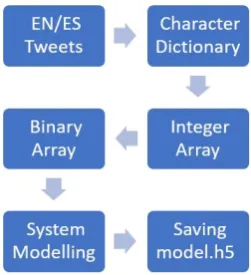
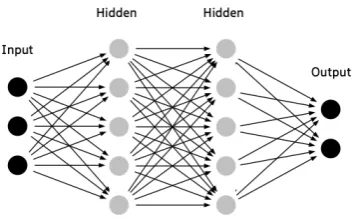
[image:3.595.92.270.414.482.2]Author (Raiyani et al., 2018) have used simple feedforward dense architecture and able to achieve beyond the average result for finding aggression over social media (Facebook and Twitter). In par-ticular, their model was able to stand the best performing model for English Tweets. Using a similar architectural concept, here, we are using a character-based dictionary. First of all, all the unique characters from the dataset are stored in the form of a dictionary. Then, using this dictionary, each character in the dataset are replaced by its key value. Thus, this transforms the dataset into an integer from the text. Finally, this integer data is further transformed into a binary array and fed to the Dense architecture. The Figure1shows the flowchart of system process. Where as the Figure 2shows the Dense Architecture.
Figure 1: System Flowchart.
To store the intermediate character into the dic-tionary, pika library1 was used. The number of unique characters found for English and Spanish
[image:3.595.353.479.526.664.2]is respectively 169 and 172 (this also includes all the special character and emojis).
Figure 2: Feedforward Dense Architecture.
The architectural hyper parameter were selected based on trail and run. The same can be found in the Table5. The code of the entire task could be found in the online GitHub repository (Raiyani, 2019).
Task Dense Value Activation
EN-A/B layer 1 100 Relu EN-A layer 2 200 Sigmoid
EN-B layer 2 200 Relu
[image:4.595.94.271.100.209.2]ES-A/B layer 1/2 50 Relu EN/ES-A/B layer 3 2 Softmax
Table 5: Architecture Parameter.
In the next section we will talk about the system performance and its global standing in the task.
5 Result Comparison and Discussion
The Table 6 shows the English task A average precision, recall, and F1 measure in reference to the baseline (SVC and MFC). The same for Span-ish task A is found in the Table 7. The Table 8 shows the F1 measure over all the three param-eter (namely, Hate Speech (HS), Target Classifi-cation(TR), and Aggressive(AG)). The ranking of task B is done using the value of Exact Match Ra-tio(EMR) (the evaluation formula could be found here2). The Table9shows the EMR value in ref-erence to the baseline SVC and MFC.
The provided final ranking among all the sub-tasks are shown in Table10.
6 Conclusion and Future Work
In this system description paper, we presented a single multilingual model for hate speech detec-tion among immigrant and women. Through the
2https://competitions.codalab.org/ competitions/19935
System P R F1
Heigh 0.690 0.679 0.651 SVC 0.595 0.549 0.451 Vista.ue 0.483 0.488 0.420 MFC 0.289 0.500 0.367
Table 6: English - Task A Result.
System P R F1
[image:4.595.340.494.194.261.2]Heigh 0.734 0.741 0.730 SVC 0.701 0.707 0.701 Vista.ue 0.596 0.593 0.594 MFC 0.294 0.500 0.370
Table 7: Spanish - Task B Result.
System F1 Low High Obtain
EN B - HS 0.348 0.602 0.463 EN B - TR 0.372 0.752 0.596 EN B - AG 0.214 0.621 0.530 ES B - HS 0.370 0.761 0.573 ES B - TR 0.424 0.824 0.640 ES B - AG 0.413 0.760 0.578
Table 8: English/Spanish Task B F1 Result.
EMR MFC SVC High Obtain
EN B 0.580 0.308 0.580 0.284 ES B 0.588 0.605 0.635 0.536
Table 9: English/Spanish Task B EMR Result.
Task System Rank
EN A SVC 35
Vista.ue 46
MFC 68
EN B MFC 1
SVC 27
Vista.ue 31
ES A SVC 21
Vista.ue 38
MFC 41
ES B SVC 13
Vista.ue 23
[image:4.595.327.508.313.408.2]MFC 18
[image:4.595.353.479.552.730.2]system ranking, we can see that for task A of both the languages, the system is performing better than MFC baseline where on task B results could be improved. Further, We consider that our system can be grown, mainly due to the following facts: (1) The system does not count any NLP feature into account (2) Due to this, many hate tweets are missed. (3) Especially, for task B, features like Part of Speech (POS) tagging and Entity Extrac-tion (EE) can improve the result. Lastly, how to address these aspects and generate a more accu-rate, comprehensive and fine-grained hate speech detection remains our further work.
Acknowledgments
The authors would like to thank COMPETE 2020, PORTUGAL 2020 Programs, the European Union, and ALENTEJO 2020 for supporting this research as part of Agatha Project SI & IDT num-ber 18022 (Intelligent analysis system of open of sources information for surveillance/crime control).
References
Valerio Basile, Cristina Bosco, Elisabetta Fersini, Deb-ora Nozza, Viviana Patti, Francisco Rangel, Paolo Rosso, and Manuela Sanguinetti. 2019. Semeval-2019 task 5: Multilingual detection of hate speech against immigrants and women in twitter. In Pro-ceedings of the 13th International Workshop on Se-mantic Evaluation (SemEval-2019). Association for Computational Linguistics.
John W. Berry. 1997. Immigration, acculturation, and adaptation.Applied Psychology, 46(1):5–34.
Cristina Bosco, Viviana Patti, Marcello Bogetti, Michelangelo Conoscenti, Giancarlo Francesco Ruffo, Rossano Schifanella, and Marco Stranisci. 2017. Tools and resources for detecting hate and prejudice against immigrants in social media.
In SYMPOSIUM III. SOCIAL INTERACTIONS IN
COMPLEX INTELLIGENT SYSTEMS (SICIS) at AISB 2017, pages 79–84. AISB.
Ying Chen, Yilu Zhou, Sencun Zhu, and Heng Xu. 2012. Detecting offensive language in social me-dia to protect adolescent online safety. In Proceed-ings of the 2012 ASE/IEEE International Confer-ence on Social Computing and 2012 ASE/IEEE In-ternational Conference on Privacy, Security, Risk and Trust, SOCIALCOM-PASSAT ’12, pages 71– 80, Washington, DC, USA. IEEE Computer Society.
Karthik Dinakar, Birago Jones, Catherine Havasi, Henry Lieberman, and Rosalind Picard. 2012. Com-mon sense reasoning for detection, prevention, and
mitigation of cyberbullying. ACM Trans. Interact. Intell. Syst., 2(3):18:1–18:30.
Yashar Mehdad and Joel Tetreault. 2016. Do charac-ters abuse more than words? InProceedings of the 17th Annual Meeting of the Special Interest Group on Discourse and Dialogue, pages 299–303. Asso-ciation for Computational Linguistics.
Dennis Njagi, Z Zuping, Damien Hanyurwimfura, and Jun Long. 2015. A lexicon-based approach for hate speech detection. International Journal of Multime-dia and Ubiquitous Engineering, 10:215–230.
Chikashi Nobata, Joel Tetreault, Achint Thomas, Yashar Mehdad, and Yi Chang. 2016. Abusive lan-guage detection in online user content. In Proceed-ings of the 25th International Conference on World Wide Web, WWW ’16, pages 145–153, Republic and Canton of Geneva, Switzerland. International World Wide Web Conferences Steering Committee.
Kashyap Raiyani. 2019. Single
multi-lingual hate speech detection model.
https://github.com/kraiyani/
Single-Multilingual-Hate-Speech-Detection-Model.
Kashyap Raiyani, Teresa Gonc¸alves, Paulo Quaresma, and Vitor Beires Nogueira. 2018. Fully connected neural network with advance preprocessor to iden-tify aggression over facebook and twitter. In Pro-ceedings of the First Workshop on Trolling, Aggres-sion and Cyberbullying (TRAC-2018), pages 28–41. Association for Computational Linguistics.
Sara Owsley Sood, Elizabeth F. Churchill, and Judd Antin. 2012. Automatic identification of personal insults on social news sites. J. Am. Soc. Inf. Sci. Technol., 63(2):270–285.
European Union. 2015. People in the EU: who are we and how do we live?, 2015 edition edition. Luxem-bourg.
Cynthia Van Hee, Els Lefever, Ben Verhoeven, Julie Mennes, Bart Desmet, Guy De Pauw, Walter Daele-mans, and V´eronique Hoste. 2015. Detection and fine-grained classification of cyberbullying events.
InProceedings of the 10th Recent Advances in
Nat-ural Language Processing (RANLP 2015), Hissar, Bulgaria.
William Warner and Julia Hirschberg. 2012.Detecting hate speech on the world wide web. InProceedings of the Second Workshop on Language in Social Me-dia, LSM ’12, pages 19–26, Stroudsburg, PA, USA. Association for Computational Linguistics.