Predicting Emotion in Spoken Dialogue from Multiple Knowledge Sources
Kate Forbes-Riley
University of Pittsburgh
Learning Research and Development Center
Pittsburgh PA, 15260, USA
[email protected]
Diane J. Litman
University of Pittsburgh
Department of Computer Science
Learning Research and Development Center
Pittsburgh PA, 15260, USA
[email protected]
Abstract
We examine the utility of multiple types of turn-level and contextual linguistic features for automatically predicting student emotions in human-human spoken tutoring dialogues. We first annotate student turns in our corpus for negative, neutral and positive emotions. We then automatically extract features represent-ing acoustic-prosodic and other lrepresent-inguistic in-formation from the speech signal and associ-ated transcriptions. We compare the results of machine learning experiments using different feature sets to predict the annotated emotions. Our best performing feature set contains both acoustic-prosodic and other types of linguistic features, extracted from both the current turn and a context of previous student turns, and yields a prediction accuracy of 84.75%, which is a 44% relative improvement in error reduc-tion over a baseline. Our results suggest that the intelligent tutoring spoken dialogue system we are developing can be enhanced to automat-ically predict and adapt to student emotions.
1 Introduction
This paper investigates the automatic classification of student emotional states using acoustic-prosodic, non-acoustic-prosodic, and contextual information, in a cor-pus of human-human spoken tutoring dialogues. Motiva-tion for this work comes from the discrepancy between the performance of human tutors and current machine tutors. In recent years, the development of computa-tional tutorialdialoguesystems has become more preva-lent (Aleven and Rose, 2003), as one method of attempt-ing to close the performance gap between human and computer tutors. It has been hypothesized that the suc-cess of such computer dialogue tutors could be further increased by modeling and adapting to student emotion;
for example (Aist et al., 2002) have shown that adding human-provided emotional scaffolding to an automated reading tutor increases student persistence. We are build-ing an intelligent tutorbuild-ing spoken dialogue system with the goal of using spoken and natural language processing capabilities to automatically predict and adapt to student emotions. Here we present results of an empirical study demonstrating the feasibility of modeling student emo-tion in a corresponding corpus of human-human spoken tutoring dialogues.
Our methodology builds on and generalizes the results of this prior work in spoken dialogue emotion predic-tion, by introducing new linguistic and contextual fea-tures, and exploring emotion prediction in the domain of naturally occurring tutoring dialogues. We first an-notate student turns in our human-human tutoring cor-pus for emotion. We then automatically extract acoustic-prosodic and other types of linguistic features from the student utterances in our corpus, and from their local and global dialogue contexts. We perform a variety of ma-chine learning experiments using different feature com-binations to predict our emotion categorizations. Our ex-periments show that 1) by using either acoustic-prosodic or other types of features alone, prediction accuracy is significantly improved compared to a baseline classifier for emotion prediction, 2) the addition of features identi-fying specific subjects and tutoring sessions only some-times improves performance, and 3) prediction accuracy can typically be improved by combining features across multiple knowledge sources, and/or by adding contextual information. Our best learned model achieves a predic-tion accuracy of 84.75%, which is a relative improvement of 44% over the baseline error. Our results provide an empirical basis for enhancing the corresponding spoken dialogue tutoring system we are developing to automat-ically predict and ultimately to adapt to a student model that includes emotional states.
2 The Dialogue System and Corpus
We are currently building a spoken dialogue tutorial sys-tem called ITSPOKE (IntelligentTutoringSPOKEn dia-logue system) (Litman and Silliman, 2004), with the goal of automatically predicting and adapting to student emo-tions. ITSPOKE uses as its “back-end” the text-based Why2-Atlas dialogue tutoring system (VanLehn et al., 2002). In ITSPOKE, a student types an essay answering a qualitative physics problem. ITSPOKE then engages the student in spoken dialogue to correct misconceptions and elicit more complete explanations, after which the student revises the essay, thereby ending the tutoring or causing another round of tutoring/essay revision. Student speech is digitized from microphone input and sent to the Sphinx2 recognizer. The most probable “transcription” output by Sphinx2 is then sent to the Why2-Atlas natural language back-end for syntactic, semantic and dialogue analysis. Finally, the text response produced by the back-end is sent to the Cepstral text-to-speech system, then played to the student through a headphone. ITSPOKE has been pilot-tested and a formal evaluation with stu-dents is in progress.
Our human-human corpus contains spoken dialogues collected via a web interface supplemented with an au-dio link, where a human tutor performs the same task as ITSPOKE. Our subjects are university students who
have taken no college physics and are native speakers of American English. Our experimental procedure, tak-ing roughly 7 hours/student over 1-2 sessions, is as fol-lows: students 1) take a pretest measuring their physics knowledge, 2) read a small document of background ma-terial, 3) use the web and voice interface to work through up to 10 problems with the human tutor (via essay revi-sion as described above), and 4) take a post-test similar to the pretest.1 Our corpus contains 149 dialogues from
17 students. An average dialogue contains 45.3 student turns (242.2 words) and 44.1 tutor turns (1096.2 words). A corpus example is shown in Figure 1, containing the problem, the student’s original essay, and an annotated (Section 3) excerpt from the subsequent spoken dialogue (some punctuation is added for clarity).
PROBLEM (TYPED): If a car is able to accelerate at 2 m/s , what acceleration can it attain if it is towing another car of equal mass?
ESSAY (TYPED): The maximum acceleration a car can reach when towing a car behind it of equal mass will be halved. Therefore, the maximum acceleration will be 1m/s .
DIALOGUE (SPOKEN): . . .9.1 min. into session. . .
TUTOR: Uh let us talk of one car first.
STUDENT: ok.(EMOTION = NEUTRAL)
TUTOR : If there is a car, what is it that exerts force on the car such that it accelerates forward?
STUDENT : The engine(EMOTION = POSITIVE)
TUTOR : Uh well engine is part of the car, so how can it exert force on itself?
STUDENT : um... (EMOTION = NEGATIVE)
Figure 1: Excerpt from Human-Human Spoken Corpus
3 Annotating Student Emotion
In our spoken dialogue tutoring corpus, student emotional states can only be identified indirectly – via what is said and/or how it is said. We have developed an annotation scheme for hand labeling the student turns in our corpus with respect to three types of perceived emotions (Litman and Forbes-Riley, 2004):
Negative: a strong expression of emotion such as con-fused, bored, frustrated, uncertain. Because a syntactic question by definition expresses uncertainty, a turn con-taining only a question is by default labeled negative. An example negative turn isstudent in Figure 1. Evidence of a negative emotion comes from the lexical item “um”,
1The human corpus corresponds to the
as well as acoustic and prosodic features, e.g., prior and post-utterance pausing and low pitch, energy and tempo.
Positive: a strong expression of emotion such as confi-dent, interested, encouraged. An example isstudent in Figure 1, with its lexical expression of certainty, “The engine”, and acoustic and prosodic features of louder speech and faster tempo.
Neutral: no strongexpression of emotion, including weak (negative or positive) or contrasting (negative and positive) expressions, as well as no expression. Because groundings serve mainly to encourage another speaker to continue speaking, a student turn containing only a grounding is by default labeled neutral. An example is
student in Figure 1. In this case, acoustic and prosodic features such as moderate loudness and tempo give evi-dence for theneutrallabel (rather than overriding it).
The features mentioned in the examples above were elicited duringpost-annotation discussion, for expository use in this paper. To avoid influencing the annotator’s in-tuitive understanding of emotion expression, and because such features are not used consistently or unambiguously across speakers, our manual contains examples of labeled dialogue excerpts (as in Figure 1) with links to corre-sponding audio files, rather than a description of particu-lar features associated with particuparticu-lar labels.
Our work differs from prior emotion annotations of spontaneous spoken dialogues in several ways. Al-though much past work predicts only two classes (e.g., negative/non-negative) (Batliner et al., 2003; Ang et al., 2002; Lee et al., 2001), our experiments produced the best predictions using our three-way distinction. In con-trast to (Lee et al., 2001), our classifications are context-relative (context-relative to other turns in the dialogue), and task-relative (task-relative to tutoring), because like (Ang et al., 2002), we are interested in detecting emotional changes across our dialogues. Although (Batliner et al., 2003) also employ a relative classification, they explicitly as-sociate specific features with emotional utterances.
To analyze the reliability of our annotation scheme, we randomly selected 10 transcribed dialogues from our human-human tutoring corpus, yielding a dataset of 453 student turns. (Turn boundaries were manually anno-tated prior to emotion annotation by a paid transcriber.) The 453 turns were separately annotated by two differ-ent annotators as negative, neutral orpositive, follow-ing the emotion annotation instructions described above. The two annotators agreed on the annotations of 385/453 turns, achieving 84.99% agreement, with Kappa = 0.68.2
This inter-annotator agreement exceeds that of prior stud-ies of emotion annotation in naturally occurring speech
2
(Carletta, 1996). P(A) is the pro-portion of times the annotators agree, and P(E) is the propro-portion of agreement expected by chance.
(e.g., agreement of 71% and Kappa of 0.47 in (Ang et al., 2002), and Kappa ranging between 0.32 and 0.42 in (Shafran et al., 2003)). As in (Lee et al., 2001), the machine learning experiments described below use only those 385 student turns where the two annotators agreed on an emotion label. Of these turns, 90 were negative, 280 wereneutral, and 15 werepositive.
4 Feature Extraction
For each of the 385 agreed student turns described above, we next extracted the set of features itemized in Figure 2. These features are used in our machine learning experi-ments (Section 5), and were motivated by previous stud-ies of emotion prediction as well as by our own intuitions.
Acoustic-Prosodic Features
4 normalized fundamental frequency (f0) features: maximum, minimum, mean, standard deviation
4 normalized energy (RMS) features: maximum, minimum, mean, standard deviation
4 normalized temporal features: total turn dura-tion, duration of pause prior to turn, speaking rate, amount of silence in turn
Non-Acoustic-Prosodic Features
lexical items in turn
6 automatic features: turn begin time, turn end time, isTemporalBarge-in, isTemporalOverlap, #words in turn, #syllables in turn
6 manual features: #false starts in turn, isPri-orTutorQuestion, isQuestion, isSemanticBarge-in, #canonical expressions in turn, isGrounding
Identifier Features: subject, subject gender, problem Figure 2: Features Per Student Turn
then normalized (divided) each feature by the same fea-ture’s value for the first student turn in the dialogue, and by the value for the immediately prior student turn. We found that features normalized by first turn were the best predictors of emotion (Litman and Forbes, 2003).
While acoustic-prosodic features address how some-thing is said, features representing what is said are also important. Lexical information has been shown to improve speech-based emotion prediction in other do-mains (Litman et al., 2001; Lee et al., 2002; Ang et al., 2002; Batliner et al., 2003; Devillers et al., 2003; Shafran et al., 2003), so our first non-acoustic-prosodic feature represents the transcription3of each student turn
as a word occurrence vector (indicating the lexical items that are present in the turn).
The next set of non-acoustic-prosodic features are also automatically derivable from the transcribed dialogue. Turn begin and end times4are retrieved from turn
bound-aries, as are the decisions as to whether a turn is a tem-poral barge-in (i.e., the turn began before the prior tutor turn ended) or a temporal overlap (i.e., the turn began and ended within a tutor turn). These features were motivated by the use of turn position as a feature for emotion pre-diction in (Ang et al., 2002), and the fact that measures of dialogue interactivity have been shown to correlate with learning gains in tutoring (Core et al., 2003). The number of words and syllables in a turn provide alternative ways to quantify turn duration (Litman et al., 2001).
The last set of 6 non-acoustic-prosodic features rep-resent additional syntactic, semantic, and dialogue infor-mation that had already been manually annotated in our transcriptions, and thus was available for use as predic-tors; as future research progresses, this information might one day be computed automatically. Our transcriber la-bels false starts (e.g., I do-don’t), syntactic questions, and semantic barge-ins. Semantic barge-ins occur when a stu-dent turn interrupts a tutor turn at a word or pause bound-ary. Unlike temporal barge-ins, semantic barge-ins do not overlap temporally with tutor turns. Our transcriber also labels certain canonical expressions that occur fre-quently in our tutoring dialogues and function as hedges or groundings. Examples include “uh”, “mm-hm”, “ok”, etc. (Evens, 2002) have argued that hedges can indi-cate emotional speech (e.g., “uncertainty”). However, many of the same expressions also function as ground-ings, which generally correspond to neutral turns in our dialogues. We distinguish groundings as turns that con-sist only of a labeled canonical expression and are not
3In our human-computer data, all features computed from transcriptions will be computed from ITSPOKE’s logs (e.g., the best speech recognition hypothesis).
4These are computed relative to the beginning of the dia-logue, e.g., the begin time oftutor in Figure 1 is 9.1 minutes.
preceded by (i.e., not answering) a tutor question.5
Finally, we recorded 3 “identifier” features for each turn. Prior studies (Oudeyer, 2002; Lee et al., 2002) have shown that “subject” and “gender” can play an important role in emotion recognition, because different genders and/or speakers can convey emotions differently. “sub-ject” and “problem” are uniquely important in our tu-toring domain, because in contrast to e.g., call centers, where every caller is distinct, students will use our system repeatedly, and problems are repeated across students.
5 Emotion Prediction using Learning
We next performed machine learning experiments us-ing the feature sets in Figure 3, to study the effects that various feature combinations had on predicting emotion. We compare our normalized acoustic-prosodic feature set (speech) with 3 non-acoustic-prosodic feature sets, which we will refer to as “text-based” sets: one containing only the lexical items in the turn (lexical), another containing the lexical items and the automatic features (autotext), and a third containing all 13 features (alltext). We further compare each of these 4 feature sets with an identical set supplemented with our 3 identifier features (+ident sets).
speech: 12 normalized acoustic-prosodic features
lexical: lexical items in turn
autotext: lexical + 6 automatic features
alltext: lexical + 6 automatic + 6 manual features
+ident: each of the above sets + 3 identifier features Figure 3: Feature Sets for Machine Learning We use the Weka machine learning software (Witten and Frank, 1999) to automatically learn our emotion pre-diction models. In earlier work (Litman and Forbes, 2003), we used Weka to compare a nearest-neighbor classifier, a decision tree learner, and a “boosting” al-gorithm. We found that the boosting algorithm, called “AdaBoost” (Freund and Schapire, 1996), consistently yielded the most robust performance across feature sets and evaluation metrics; in this paper we thus focus on AdaBoost’s performance. Boosting algorithms generally enable the accuracy of a “weak” learning algorithm to be improved by repeatedly applying it to different distribu-tions of training examples (Freund and Schapire, 1996). Following (Oudeyer, 2002), we select the decision tree learner as AdaBoost’s weak learning algorithm.
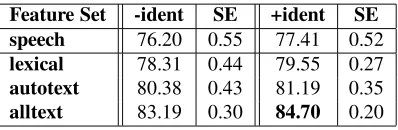
To investigate how well our emotion data can be learned with only speech-based or text-based features, Table 1 shows the mean accuracy (percent correct) and
standard error (SE)6 of AdaBoost on the 8 feature sets
from Figure 3, computed across 10 runs of 10-fold cross-validation.7 Although not shown in this and later
ta-bles, all of the feature sets examined in this paper pre-dict emotion significantly better than a standard majority class baseline algorithm (always predict “neutral”, which yields an accuracy of 72.74%). For Table 1, AdaBoost’s improvement for each feature set, relative to this baseline error of 27.26%, averages 24.40%, and ranges between 12.69% (“speech-ident”) and 43.87% (“alltext+ident”).8
Feature Set -ident SE +ident SE speech 76.20 0.55 77.41 0.52
lexical 78.31 0.44 79.55 0.27
autotext 80.38 0.43 81.19 0.35
[image:5.612.319.537.141.194.2]alltext 83.19 0.30 84.70 0.20
Table 1: %Correct on Speech vs. Text (cross-val.) As shown in Table 1, the best accuracy of 84.70% is achieved on the “alltext+ident” feature set. This ac-curacy is significantly better than the acac-curacy of the seven other feature sets,9 although the difference
be-tween the “+/-ident” versions was not significant for any other pair besides “alltext”. In addition, the results of five of the six text-based feature sets are significantly better than the results of both acoustic-prosodic feature sets (“speech +/- ident”). Only the text-only feature set (“lexical-ident”) did not perform statistically better than “speech+ident” (although it did perform statistically bet-ter than “speech-ident”). These results show that while acoustic-prosodic features can be used to predict emo-tion significantly better than a majority class baseline, us-ing only non-acoustic-prosodic features consistently pro-duces even significantly better results. Furthermore, the more text-based features the better, i.e., supplementing lexical items with additional features consistently yields further accuracy increases. While adding in the subject-and problem- specific “+ident” features improves the ac-curacy of all the “-ident” feature sets, the improvement is only significant for the highest-performing set (“alltext”). The next question we addressed concerns whether combinationsof acoustic-prosodic and other types of
fea-6We compute the SE from the std. deviation (std(x)/sqrt(n), where n=10 (runs)), which is automatically computed in Weka. 7For each cross-validation, the training and test data are drawn from turns produced by the same set of speakers. We also ran cross-validations training on n-1 subjects and testing on the remaining subject, but found our results to be the same.
8Relative improvement over the baseline error for feature
set x = !"$#
%'&(
) *+ !"$#
%'&(
, where error(x) is 100 minus the %correct(x) value shown in Table 1.
9For any feature set, the mean +/- 2*SE = the 95% con-fidence interval. If the concon-fidence intervals for two feature sets are non-overlapping, then their mean accuracies are sig-nificantly different with 95% confidence.
tures can further improve AdaBoost’s predictive accu-racy. We investigated AdaBoost’s performance on the set of 6 feature sets formed by combining the “speech” acoustic-prosodic set with each text-based set, both with and without identifier features, as shown in Table 2.
Feature Set -ident SE +ident SE lexical+speech 79.26 0.46 79.09 0.36
autotext+speech 79.64 0.47 79.36 0.48
alltext+speech 83.69 0.36 84.26 0.26
Table 2: %Correct on Speech+Text (cross-val.) AdaBoost’s best accuracy of 84.26% is achieved on the “alltext+speech+ident” combined feature set. This result is significantly better than the % correct achieved on the four “autotext” and “lexical” combined feature sets, but is not significantly better than the “alltext+speech-ident” feature set. Furthermore, there was no significant dif-ference between the results of the “autotext” and “lexi-cal” combined feature sets, nor between the “-ident” and “+ident” versions for the 6 combined feature sets.
Comparing the results of these combined (speech+text) feature sets with the speech versus text results in Table 1, we find that for autotext+speech-ident and all +ident fea-ture sets, the combined feafea-ture set slightly decreases pre-dictive accuracy when compared to the corresponding text-only feature set. However, there is no significant difference between the best results in each table (all-text+speech+ident vs. alltext+ident).
Emotion Class Precision Recall F-Measure negative 0.71 0.60 0.65
neutral 0.86 0.92 0.89
positive 0.50 0.27 0.35
Table 3: Other Metrics on “alltext+speech+ident” (LOO)
In addition to accuracy, other important evalua-tion metrics include recall, precision, and F-Measure (-,+./0213'3,)4.-/5068756:9;
./0213'3<4./06:76:9; ). Table 3 shows AdaBoost’s per-formance with respect to these metrics across emotion classes for the “alltext+speech+ident” feature set, using leave-one-out cross validation (LOO). AdaBoost accu-racy here is 82.08%. As shown, AdaBoost yields the best performance for the neutral (majority) class, and has bet-ter performance for negatives than for positives. We also found positives to be the most difficult emotion to anno-tate. Overall, however, AdaBoost performs significantly better than the baseline, whose precision, recall and F-measure for negatives and positives is 0, and for neutrals is 0.727, 1, and 0.842, respectively.
6 Adding Context-Level Features
[image:5.612.87.286.201.266.2]di-alogue context can sometimes improve the accuracy of predicting negative user states, compared to the use of features computed from only the turn to be predicted. Thus, we investigated the impact of supplementing our turn-level features in Figure 2 with the features in Fig-ure 4, representing local and global10aspects of the prior
dialogue, respectively.
Local Features: feature values for the two student turns preceding the student turn to be predicted
Global Features: running averages and totals for each feature, over all student turns preceding the turn to be predicted
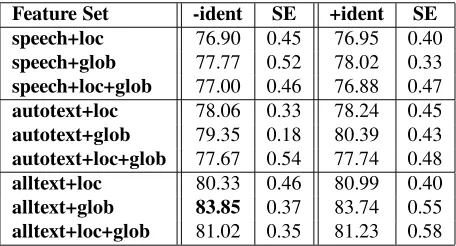
Figure 4: Contextual Features for Machine Learning We next performed machine learning experiments us-ing our two original speech-based feature sets (“speech +/- ident”), and four of our text-based feature sets (“au-totext” and “alltext” +/- ident), each separately supple-mented with local, global, and local+global features. Ta-ble 4 presents the results of these experiments.
Feature Set -ident SE +ident SE speech+loc 76.90 0.45 76.95 0.40
speech+glob 77.77 0.52 78.02 0.33
speech+loc+glob 77.00 0.46 76.88 0.47
autotext+loc 78.06 0.33 78.24 0.45
autotext+glob 79.35 0.18 80.39 0.43
autotext+loc+glob 77.67 0.54 77.74 0.48
alltext+loc 80.33 0.46 80.99 0.40
alltext+glob 83.85 0.37 83.74 0.55
[image:6.612.72.300.356.479.2]alltext+loc+glob 81.02 0.35 81.23 0.58
Table 4: %Correct, Speech vs. Text, +context (cross-val.)
AdaBoost’s best accuracy of 83.85% is achieved on the “alltext+glob-ident” combined feature set. This re-sult is not significantly better than the % correct achieved on its “+ident” counterpart, but both of these results are significantly better than the % correct achieved on all other 16 feature sets. Moreover, all of the results for both the “alltext” and “autotext” feature sets were sig-nificantly better than the results for all of the “speech” feature sets. Although the “alltext+loc” feature sets were not significantly better than the best autotext feature sets (autotext+glob), they were better than the remaining “au-totext” feature sets, and the “alltext+loc+glob” feature sets were better than all of the autotext feature sets. For all feature sets, the difference between the “-ident” and
10Running totals are only computed for numeric features if the result is interpretable, e.g., for turn duration, but not for tempo. Running averages for text-based features additionally include a “# turns so far” feature and a “# essays so far” feature.
“+ident” versions was not significant. In sum, we see again that the more text-based features the better: adding text-based features again consistently improves results significantly. We also see that global features perform better than local features, and while global+local perform better than local features, global features alone consis-tently yield the best performance.
Comparing these results with the results in Tables 1 and 2, we find that while overall the performance of contextual non-combined feature sets shows a small performance increase over most non-contextual com-bined or non-comcom-bined feature sets, there is again a slight decrease in performance across the best results in each table. However, there is no significant differ-ence between these best results (alltext+glob-identvs. all-text+speech+ident vs. alltext+ident).
Table 5 shows the results of combining speech-based and text-based contextual feature sets. We investigated AdaBoost’s performance on the 12 feature sets formed by combining the “speech” acoustic-prosodic set with our “autotext” and “alltext” text-based feature sets, both with and without identifier features, and each separately sup-plemented with local, global, and local+global features.
Feature Set -iden SE +iden SE auto+speech+lo 78.23 0.39 77.30 0.52
auto+speech+gl 79.33 0.22 78.84 0.39
auto+speech+lo+gl 78.26 0.20 78.01 0.43
all+speech+lo 82.44 0.31 82.15 0.56
all+speech+gl 84.75 0.32 84.35 0.20
all+speech+lo+gl 81.43 0.28 81.04 0.43
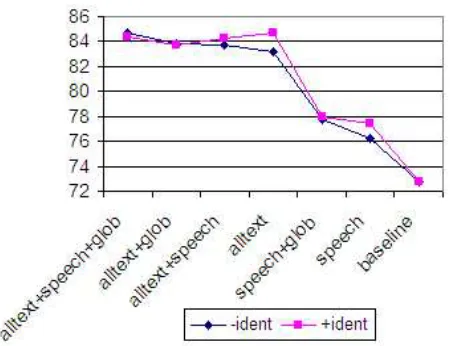
[image:6.612.313.541.360.447.2]are added or replaced in the right-to-left order shown. The “+ident” condition initially increases, then decreases with the addition of “global” or “speech” features to the “alltext” feature set, but then slightly increases again when these feature sets are combined. With less fea-tures “+ident” typically outperforms “-ident”, although this switches when “alltext” and “global” features are combined (with and without “speech”).
Figure 5: Comparison of %Correct for Best Results
7 Feature Usage in Machine Learning
As discussed above, we use AdaBoost to “boost” a de-cision tree algorithm. Although the Weka output of Ad-aBoost does not include a decision tree, to get an intu-ition about how our features are used to predict emo-tion classes in our domain, we ran the basic decision tree algorithm on our highest-performing feature set, “alltext+speech+glob-ident”. Table 6 shows the feature types used in this feature set, and the feature usages of each based on the structure of the tree. Following (Ang et al., 2002), feature usage is reported as the percent-age of decisions for which the feature type is queried. As shown, the turn-based (non-context) text-based fea-tures are the most highly queried, with lexical items and manual features queried most, followed by the temporal (speech-based) features. Manual text-based global fea-tures are queried far more than other global feafea-tures.
8 Conclusions and Current Directions
We have examined the utility of different features for automatically predicting student emotions in a corpus of tutorial spoken dialogues. Our emotion annotation schema distinguishes negative, neutral and positive emo-tions, with inter-annotator agreement and Kappa values that exceed those obtained for other types of spoken dia-logues. From our annotated student turns we extracted a
Features Turn Global Total Speech-Based 14.29% 1.97% 16.26%
Temporal 12.81% 0.99% 13.79% Energy 1.48% 0.99% 2.46%
Pitch 0% 0% 0%
Text-Based 67.98 15.76 83.74%
[image:7.612.66.291.178.351.2]Lexical 41.87% - 41.87% Automatic 8.37% 0.99% 9.36% Manual 17.73% 14.78% 32.51%
Table 6: Feature Usage for “alltext+speech+glob-ident”
variety of acoustic and prosodic, text-based, and contex-tual features. We used machine learning to examine the impact of different feature sets (with and without iden-tifier features) on prediction accuracy. Our results show that while acoustic-prosodic features outperform a base-line, non-acoustic-prosodic features, and combinations of both types of features, perform even better. Adding cer-tain types of contextual features and identifier features also often improves performance. Our best performing feature set, which contains speech and text-based features extracted from the current and previous student turns, yields an accuracy of 84.75% and a 44% relative im-provement in error reduction over a baseline. Our ex-periments suggest that ITSPOKE can be enhanced to au-tomatically predict student emotions.
Acknowledgments
This research is supported by NSF Grants Nos. 9720359 and No. 0328431. We thank Kurt VanLehn and the Why2-Atlas team, and Scott Silliman of ITSPOKE, for system development and data collection. We also thank Pamela Jordan and Mihai Rotaru for helpful suggestions.
References
G. Aist, B. Kort, R. Reilly, J. Mostow, and R. Pi-card. 2002. Experimentally augmenting an intelli-gent tutoring system with human-supplied capabilities: Adding human-provided emotional scaffolding to an automated reading tutor that listens. InProc. of Intel-ligent Tutoring Systems, 6th International Conf. (ITS).
V. Aleven and C. P. Rose, editors. 2003. Proc. of the AIED 2003 Workshop on Tutorial Dialogue Systems: with a view toward the classroom.
J. Ang, R. Dhillon, A. Krupski, E.Shriberg, and A. Stol-cke. 2002. Prosody-based automatic detection of an-noyance and frustration in human-computer dialog. In Proc. of the International Conference on Spoken Lan-guage Processing (ICSLP), pages 2037–2040.
A. Batliner, K. Fischer, R. Huber, J. Spilker, and E. Noth. 2003. How to find trouble in communication. Speech Communication, 40:117–143.
J. Carletta. 1996. Assessing agreement on classification tasks: the kappa statistic. Computational Linguistics, 22(2):249–254.
M. G. Core, J. D. Moore, and C. Zinn. 2003. The role of initiative in tutorial dialogue. InProc. of the 11th Conference of the European Chapter of the Association for Computational Linguistics (EACL), pages 67–74.
R. Cowie, E. Douglas-Cowie, N. Tsapatsoulis, G. Votsis, S. Kollias, W. Fellenz, and J. Taylor. 2001. Emotion recognition in human-computer interaction.IEEE Sig-nal Processing Magazine, 18:32–80.
R. Craggs. 2004. A two dimensional annotation scheme for emotion in dialogue. InProc. of AAAI Spring Sym-posium: Exploring Attitude and Affect in Text.
L. Devillers, L. Lamel, and I. Vasilescu. 2003. Emotion detection in task-oriented spoken dialogs. InProc. of the IEEE International Conference on Multimedia & Expo (ICME).
M. Evens. 2002. New questions for Circsim-Tutor. Pre-sentation at the 2002 Symposium on Natural Language Tutoring, University of Pittsburgh.
Y. Freund and R.E. Schapire. 1996. Experiments with a new boosting algorithm. InProc. of 19th International Conf. on Machine Learning (ICML), pages 148–156.
C.M. Lee, S. Narayanan, and R. Pieraccini. 2001. Recognition of negative emotions from the speech sig-nal. InProc. of the IEEE Automatic Speech Recogni-tion and Understanding Workshop (ASRU).
C.M. Lee, S. Narayanan, and R. Pieraccini. 2002. Com-bining acoustic and language information for emotion recognition. InProc. of the International Conference on Spoken Language Processing (ICSLP).
J. Liscombe, J. Venditti, and J.Hirschberg. 2003. Classi-fying subject ratings of emotional speech using acous-tic features. InProc. of EuroSpeech.
D. Litman and K. Forbes-Riley. 2004. Annotating stu-dent emotional states in spoken tutoring dialogues. In Proc. of the 5th SIGdial Workshop on Discourse and Dialogue.
D. Litman and K. Forbes. 2003. Recognizing emotion from student speech in tutoring dialogues. InProc. of the IEEE Automatic Speech Recognition and Under-standing Workshop (ASRU).
D. Litman and S. Silliman. 2004. ITSPOKE: An in-telligent tutoring spoken dialogue system. In Proc. of the Human Language Technology Conference: 4th Meeting of the North American Chapter of the Asso-ciation for Computational Linguistics (HLT/NAACL) (Companion Proceedings).
D. Litman, J. Hirschberg, and M. Swerts. 2001. Predict-ing user reactions to system error. InProceedings of the 39th Meeting of the Association for Computational Linguistics (ACL), pages 362–369.
P-Y. Oudeyer. 2002. The production and recognition of emotions in speech: features and algorithms. Inter-national Journal of Human Computer Studies, 59(1-2):157–183.
T. Polzin and A. Waibel. 1998. Detecting emotions in speech. InProc. of Cooperative Multimodal Commu-nication.
Y. Qu, J. G. Shanahan, and J. Wiebe, editors. 2004.AAAI Working Notes of the Spring Symposium: Exploring Attitude and Affect in Text, Stanford, CA.
I. Shafran, M. Riley, and M. Mohri. 2003. Voice signa-tures. InProc. of the IEEE Automatic Speech Recog-nition and Understanding Workshop (ASRU).
K. VanLehn, P. W. Jordan, C. P. Ros´e, D. Bhembe, M. B¨ottner, A. Gaydos, M. Makatchev, U. Pap-puswamy, M. Ringenberg, A. Roque, S. Siler, R. Sri-vastava, and R. Wilson. 2002. The architecture of Why2-Atlas: A coach for qualitative physics essay writing. InProc. of Intelligent Tutoring Systems, 6th International Conference (ITS).