Original Article
A cross-sectional analysis of China-sponsored clinical
trials registered with ClinicalTrials.gov
Yun Xue1, Zhaorui Guan1, Lei Ma1, Bo Wang2, Ya Bai1, Yang Xu3, Gang Zhao1, Xuedong Liu1
1Department of Neurology, Xijing Hospital, Fourth Military Medical University, Xi’an 710032, China; 2Department of Epidemiology, Fourth Military Medical University, Xi’an 710032, China; 3Department of University Hospital, Xi’an Medical University, Xi’an 710021, China
Received November 27, 2015; Accepted February 14, 2016; Epub June 15, 2016; Published June 30, 2016
Abstract: To evaluate the quality of the information that is available for clinical trials that are sponsored by institutes in China, Hong Kong, and Taiwan and are registered with the ClinicalTrials.gov database. A search of ClinicalTrials. gov was performed on March 31, 2014 to identify trials that were sponsored by institutes located in mainland China, Hong Kong, and Taiwan. The details of these trials were examined and compared using statistical analysis. Among the included trials (N=5820), 72.5% were interventional studies, 26.3% were observational studies, 1.1% were patient registries, and 0.1% were expanded access situations. Moreover, 53.2%, 10.0%, and 36.8% of the trials were sponsored by mainland China, Hong Kong, and Taiwan, respectively. Thirty-three percent of the studies were registered before the trial had been started, while 65.0% were registered after the start or upon completion of the trial. Only 20.7% of all of the studies examined provided links to published results, and the trials based in mainland China were significantly more likely to be published than those based in Hong Kong or Taiwan (P<0.05). The total number of registered trials increased over the time period examined, and they predominately encompassed small- and medium-sized interventional studies. Randomized controlled trials (RCTs) only represented approximately one-fourth of the registered trials. Since October 2007, the number of clinical trials sponsored by China has increased significantly, and the publication of study results has also gradually increased. The current transparency of the registry information associated with clinical trials based in China, Hong Kong, and Taiwan is imperfect, and the publication record falls short of expectations. Thus, the capacity and input of clinical research should be enhanced, and the quality and quantity of registered trials needs to be improved.
Keywords: Clinical trials, China, clinical trial registration
Introduction
Clinical trials have important significance for
the prevention, diagnosis, and treatment of dis-ease states [1]. Moreover, the registration of clinical trials provides a means for the public to access information regarding study design
and to track research progress prior to official
implementation of a trial [2]. Trial registration is also necessary to ensure the transparency of information and to improve the quality of clini-cal trials [3, 4]. In February 2000, cliniclini-cal trial registration became more readily accessible following the establishment of the website, ClinicalTrials.gov, by funding provided by the U.S. Food and Drug Administration (FDA), the National Institutes of Health (NIH), and the National Library of Medicine [5]. In September 2004, the International Committee of Medical
showed that registered information pertaining to Chinese clinical trials was incomplete, and the number of Chinese trials was small [11, 12]. Thus, to promote an environment that would foster clinical research in China, the gov-ernment supplemented clinical trial funding, systematically trained clinicians, and created an integrated platform for the analysis of results.
Currently, ClinicalTrials.gov is the most ad- vanced and informative registry platform
[image:2.612.92.523.71.530.2]avail-able. Previously, the registered information available in ClinicalTrials.gov has been asse- ssed in regards to the minimum required data set [11, 12], yet no published reports to date have conducted a complete investigation of the information available for the Chinese clinical tri-als that are registered with ClinicalTritri-als.gov. Therefore, the objective of the present study was to provide a comprehensive statistical analysis of the status of the clinical trials regis-tered by research groups in China, as well as by research groups in Hong Kong and Taiwan, in
the ClinicalTrials.Gov da- tabase.
Material and methods
Clinical trial criteria
There were more than 140,000 studies registe- red with ClinicalTrials.gov as of March 31, 2014 [13]. Therefore, we limited our study sample to “China sponsored” trials which
were defined as “studies
led by Chinese (including Hong Kong and Taiwan) organizations and conduct the experiments or pro-vide subsidized technolo-gy”. Trials that were ex- cluded from the analysis were those that included Chinese participants yet were sponsored by an institution that was not
based or affiliated with
China.
The terms, “China”, “Hong Kong”, and “Taiwan”, were used for the database search. Three XML data sets were subsequently downloaded and these comprised 9725 clinical investigations that had been registered with Cli- nicalTrials.gov as of March 31, 2014.
Questionnaire design
Based on the features of the “Tabular view” of the ClinicalTrials.gov website, we designed a question-naire to obtain detailed information about each trial. In addition, reason for exclusion, agency cla- ss, registration before/
after enrollment of first
participant, and study location were recorded.
[image:3.612.95.391.109.726.2]Each trial was classified
Table 1. Characteristics of the interventional trials that have been sponsored by mainland China, Taiwan, and Hong Kong and have been registered with ClinicalTrials.gov
Characteristics examined
Mainland
(N=2522) (N=1202)Taiwan Hong Kong(N=498)
n % n % n %
Study Design
Randomized 1803 71.49% 817 67.97% 411 82.53% Non-randomized 263 10.43% 202 16.81% 35 7.03% Missing 453 17.96% 183 15.22% 52 10.44%
Classification
Safety 85 3.37% 54 4.49% 16 3.21%
Safety/efficacy 1651 65.46% 501 41.68% 186 37.35%
Efficacy 586 23.24% 428 35.61% 224 44.98%
Bio-equivalence 11 0.44% 4 0.33% 2 0.40%
Bio-availability 8 0.32% 2 0.17% 0 0
Pharmacokinetics 11 0.44% 16 1.33% 0 0 Pharmacokinetic/dynamics 23 0.91% 7 0.58% 3 0.60% Pharmacodynamics 8 0.32% 2 0.17% 1 0.20%
Missing 139 5.51% 188 15.64% 66 13.25%
Intervention Model
Parallel 1797 71.25% 770 64.06% 373 74.90% Single group 625 24.78% 320 26.62% 89 17.87%
Factorial 49 1.94% 40 3.33% 8 1.61%
Cross-over 45 1.78% 66 5.49% 25 5.02%
Missing 6 0.24% 6 0.50% 3 0.60%
Masking
Open 1522 60.35% 599 49.83% 222 44.58% Single 349 13.84% 266 22.13% 103 20.68% Double 645 25.57% 333 27.70% 170 34.14%
Missing 6 0.24% 4 0.33% 3 0.60%
Primary purpose
Treatment 2017 79.98% 831 69.13% 389 78.11% Prevention 298 11.82% 119 9.90% 39 7.83%
Diagnostic 54 2.14% 75 6.24% 17 3.41%
Screening 16 0.63% 9 0.75% 0 0
Supportive 51 2.02% 44 3.66% 21 4.22%
Health service research 22 0.87% 39 3.24% 15 3.01% Basic science 22 0.87% 32 2.66% 2 0.40%
Other 0 0 7 0.58% 0 0
Missing 42 1.67% 46 3.83% 15 3.01%
Study phase
0 22 0.87% 11 0.92% 0 0
I 136 5.39% 56 4.66% 17 3.41%
I/II 134 5.31% 36 3.00% 15 3.01%
II 562 22.28% 187 15.56% 57 11.45%
II/III 127 5.04% 35 2.91% 16 3.21%
III 320 12.69% 114 9.48% 74 14.86%
IV 497 19.71% 252 20.97% 84 16.87%
as: interventional, observational, observational [patient registry], or expanded access.
Common baseline features included: primary/
study completion date type, first received date,
start date, primary completion date, study result, gender, enrollment of healthy volun-teers, study location, has DMCs (Data Monitoring Committees), number of
collabora-tors (1, 2, 3, 4, ≥5, missing), number of out
-come measures (1, 2, 3, 4, ≥5, missing), num
-ber of study arms (1, 2, 3, 4, ≥5, missing), and number of publications (1, 2, 3, 4, ≥5,
missing).
Sponsor institutions were classified as univer -sity, hospital, research institute/organization,
missing), and phase (0, I, I/II, II, II/III, IV, missing).
Observational/observational [patient registry] features that were recorded included: model (cohort, case-control, case only, case-cross-over, family-based, ecologic or community, oth-ers, missing), time perspective (cross-section-al, prospective, retrospective, other, missing), target follow-up duration, biospecimen (sam-ples with/without DNA, non-retained, missing), biospecimen (blood, DNA, tissue, urine, feces, others, missing), and sampling method (proba-bility, non-proba(proba-bility, missing).
The expanded access recruitment studies were
[image:4.612.92.366.110.505.2]classified as: available, no longer available,
Table 2. Characteristics of the observational studies that have been sponsored by mainland China, Taiwan, and Hong Kong and have been registered with ClinicalTrials.gov
Mainland
(n=508) (n=940)Taiwan HongKong(n=83)
n % n % n %
Observational Model
Cohort 193 37.99% 234 24.89% 32 38.55% Case-control 168 33.07% 231 24.57% 20 24.10% Case-only 70 13.78% 178 18.94% 20 24.10% Case-crossover 5 0.98% 12 1.28% 0 0
Family-based 3 0.59% 17 1.81% 0 0
Ecologic or community 9 1.77% 6 0.64% 2 2.41%
Other 4 0.79% 145 15.43% 1 1.20%
Missing 56 11.02% 117 12.45% 8 9.64%
Time perspective
Cross-sectional 54 10.63% 233 24.79% 17 20.48% Prospective 355 69.88% 389 41.38% 57 68.67% Retrospective 74 14.57% 155 16.49% 5 6.02%
Other 5 0.98% 80 8.51% 1 1.20%
Missing 20 3.94% 83 8.83% 3 3.61%
Duration
N 507 99.80% 921 97.98% 83 100%
Y 1 0.20% 19 2.02% 0 0
Biospecimen
With DNA 113 22.24% 118 12.55% 15 18.07% Without DNA 65 12.80% 69 7.34% 5 6.02% Non-retained 9 1.77% 12 1.28% 1 1.20% Missing 321 63.19% 741 78.83% 62 74.70%
Sampling Method
Probability Sample 260 51.18% 256 27.23% 19 22.89% Non-probability 239 47.05% 457 48.62% 59 71.08%
Missing 9 1.77% 227 24.15% 5 6.02%
government, industry, and other. Individual sponsors were
classi-fied based on their affiliation to
a unit or organization. Trials were also categorized based on therapeutic area: neurological, stroke, cardiovascular, respira-tory, infectious, diabetes, tumor, and other. Age of the
partici-pants was classified as: ≥18
years, <18 years, or missing.
More than one classification for
age was chosen if the partici-pants included children and adults. Trial enrollment was based on the total number of participants and was divided
into five levels: 0-100, 101-500,
501-1000, >1000, and missing. Additional details that were recorded regarding the interven-tional studies were: study design (randomized, non-randomized,
missing), endpoint classification (safety, safety/efficacy, efficacy,
temporarily unavailable, and approved for marketing.
Statistical analysis
All of the above items were listed on separate lines. The following items are multiple choices: ages, description, condition, intervention. For the trials that were excluded, only the NCT num-ber, sponsor, and reason for exclusion were recorded.
These questionnaires were converted into an electronic form and SPSS 18.0 was used to
perform statistical analyses. Chisquare (χ2)
tests were used to examine associations between study characteristics and regions. The statistical tests were two-tailed with a type I error of 0.05.
Results
A search of the ClinicalTrials.gov database
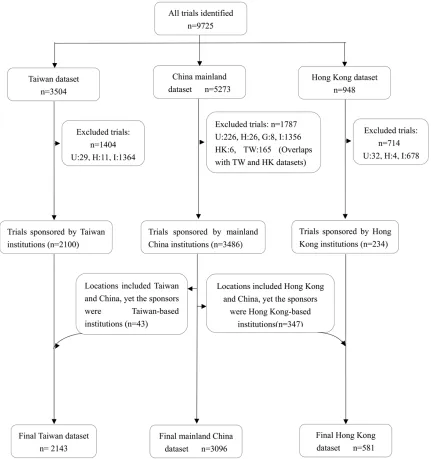
[image:5.612.89.522.96.547.2]identified 9725 studies (Figure 1). Among the listed trials, 5273 were sponsored by mainland China, 948 were sponsored by Hong Kong, and 3504 were sponsored by Taiwan. In the data set for mainland China (“China” is included in Table 3. Multiple choice items for the interventional and observational studies that have been spon-sored by mainland China, Taiwan, and Hong Kong and have been registered with ClinicalTrials.gov
Mainland Taiwan Hong Kong
n/N % n/N % n/N %
Condition
Neurological 151/3072 4.92% 202/2164 9.33% 65/586 11.09%
Stroke 65/3072 2.12% 71/2164 3.28% 16/586 2.73%
Cardiovascular 322/3072 10.48% 122/2164 5.64% 26/586 4.44%
Respiratory 130/3072 4.23% 125/2164 5.78% 32/586 5.46%
Infectious 201/3072 6.54% 113/2164 5.22% 21/586 3.58%
Diabetes 133/3072 4.33% 106/2164 4.90% 21/586 3.58%
Tumor 1029/3072 33.50% 407/2164 18.81% 90/586 15.36%
Other 1041/3072 33.89% 1018/2164 47.04% 315/586 53.75%
Intervention
Drug 1637/3389 48.30% 615/2223 27.67% 223/616 36.20%
Procedure 457/3389 13.48% 202/2223 9.09% 101/616 16.40%
Biological 206/3389 6.08% 32/2223 1.44% 13/616 2.11%
Behavioral 57/3389 1.68% 130/2223 5.85% 57/616 9.25%
Device 219/3389 6.46% 153/2223 6.88% 79/616 12.82%
Radiation 98/3389 2.89% 17/2223 0.76% 3/616 0.49%
Dietary Supplement 50/3389 1.48% 49/2223 2.20% 9/616 1.46%
Genetic 14/3389 0.41% 17/2223 0.76% 0 0
Other 261/3389 7.70% 215/2223 9.67% 68/616 11.04%
Missing 390/3389 13.00% 793/2223 35.67% 63/616 10.23%
Age
N 97/3071 3.16% 225/2297 9.80% 32/592 5.41%
<18 358/3071 11.66% 267/2297 11.62% 41/592 6.93%
≥18 2787/3071 90.75% 1805/2297 78.58% 519/592 87.67%
Description
Blood 137/543 25.23% 134/970 13.81% 16/83 19.28%
DNA 9/543 1.66% 23/970 2.37% 2/83 2.41%
Tissue 48/543 27.26% 36/970 3.71% 1/83 1.20%
Urine 10/543 1.84% 10/970 1.03% 0 0
Feces 0 0 0 0 0 0
Other 19/543 3.50% 25/970 2.58% 3/83 3.61%
Table 4. Common characteristics of the interventional and observational studies that have been sponsored by mainland China, Taiwan, and Hong Kong and have been registered with ClinicalTrials. gov
Mainland n=3030 Taiwan n=2142 Hong Kong n=581
n % n % n %
Recruitment status
Unknown 606 20.00% 829 38.70% 117 20.14%
Recruiting 1636 53.99% 1115 52.05% 194 33.39%
Completed 747 24.65% 691 32.26% 277 47.68%
Not yet Recruiting 262 8.65% 108 5.04% 35 7.28%
Active, not recruiting 251 8.28% 123 5.74% 46 7.92%
Rolling invitation 82 2.71% 43 2.01% 4 0.69%
Terminated 26 0.86% 40 1.87% 19 3.27%
Suspended 14 0.46% 5 0.23% 4 0.69%
Withdrawn 12 0.40% 17 0.79% 2 0.34%
Primary completion date type
Actual 807 26.63% 636 29.69% 234 40.28%
Anticipated 2112 69.70% 902 42.11% 248 42.69%
Missing 111 3.66% 604 28.20% 99 17.04%
Study completion date type
Actual 721 23.80% 630 29.41% 251 43.20%
Anticipated 2020 66.67% 958 44.72% 255 43.89%
Missing 289 9.54% 554 25.86% 75 12.91%
Registration is:
Beforea 1245 41.09% 593 27.68% 183 31.50%
After 1773 58.51% 1518 70.87% 386 66.44%
Undetermined 12 0.40% 31 1.45% 12 2.07%
Agency class
Industry 330 10.89% 119 5.56% 20 3.44%
University 1340 44.22% 46 2.15% 444 76.42%
Hospital 1230 40.59% 1909 89.12% 51 8.78%
Government 69 2.28% 60 2.80% 58 9.98%
Organization 38 1.25% 3 0.14% 8 1.38%
Other 17 0.56% 5 0.23% 0 0
Collaborator
1 494 16.30% 401 18.72% 120 20.65%
2 136 4.49% 59 2.75% 35 6.02%
3 55 1.82% 13 0.61% 9 1.55%
4 43 1.42% 8 0.37% 3 0.52%
≥5 136 4.49% 44 2.05% 6 1.03%
Missing 2166 71.49% 1617 75.49% 408 70.22%
Study arm
1 705 23.27% 498 23.25% 87 14.97%
2 1548 51.09% 672 31.37% 304 52.32%
3 302 9.97% 169 7.89% 50 8.61%
4 140 4.62% 49 2.89% 14 2.41%
≥5 75 2.48% 31 1.45% 3 0.52%
Missing 260 8.58% 723 33.75% 123 21.17%
Publication
the location), there were 43 trials sponsored by Taiwan institutions and 347 trials sponsored by Hong Kong institutions. Based on the inclusion and exclusion criteria for the current study, only 5820 trials were eligible, including 3096 that were sponsored by mainland China, 581 that were sponsored by Hong Kong, and 2143 that were sponsored by Taiwan. Among the 3905 excluded trials, 1787, 1404, and 714 trials were sponsored by mainland China, Taiwan, and Hong Kong, respectively.
Interventional trials accounted for more than 50% of the total trials registered (mainland China: 81%, Taiwan: 56%, Hong Kong: 86%), while observational studies comprised the sec-ond most frequent study type (mainland China: 16%, Taiwan: 44%, Hong Kong: 14%). In addi-tion, there were 61 observational [patient
regis-try] studies, five expanded access studies from
[image:7.612.90.512.70.430.2]mainland China, and one expanded access study from Taiwan.
Table 1 lists selected characteristics of all the interventional trials that were examined, as well as the comparisons that were made between the data for each of the three regions. The fre-quency of the randomized trials that were based in mainland China, Taiwan, and Hong Kong were 71.49% (n=1803), 67.97% (n=817),
and 82.53% (n=411), respectively. Safety/effi
-cacy and effi-cacy trials accounted for most of
the trials that were examined (China: 88.7%, n=2237; Taiwan: 77.29%, n=929; Hong Kong: 82.33%, n=410). In addition, parallel and open-label interventional models constituted a large proportion of the trials (China: 71.25% and 60.35%, Taiwan: 64.06% and 49.83%, Hong Kong: 74.9% and 44.58%, respectively in each case). Approximately 25-34% of the trials had a double-blind design, while intent-to-treat analy-ses comprised 80% of the trials based in China, 69.13% of the trials based in Taiwan, and 78.11% of the trials based in Hong Kong. Furthermore, phase II and phase IV studies
2 102 3.37% 59 2.75% 19 3.27%
3 54 1.78% 29 1.35% 8 1.38%
4 48 1.58% 19 0.89% 7 1.20%
≥5 161 5.31% 104 4.86% 52 8.95%
Missing 2364 78.02% 1745 81.47% 430 74.01%
Study result
Y 45 1.49% 43 2.01% 8 1.38%
N 2985 98.51% 2099 97.99% 573 98.62%
Enrollment
0-100 1367 45.12% 1224 57.14% 301 51.81%
101-500 1177 38.84% 698 32.59% 204 35.11%
501-1000 211 6.96% 91 4.25% 32 5.51%
>1000 243 8.02% 83 3.87% 35 6.02%
Missing 32 1.06% 46 2.15% 9 1.55%
Gender
Both 2674 88.25% 1878 87.68% 517 88.98%
Male 56 1.85% 55 2.57% 15 2.58%
Female 300 9.90% 205 9.57% 49 8.43%
Missing 0 0 4 0.19% 0 0
Accepting healthy volunteers
Y 419 13.83% 581 27.12% 103 17.73%
N 2606 86.01% 1544 72.08% 425 73.15%
Missing 5 0.17% 17 0.79% 53 9.12%
DMC
Y 2144 70.76% 849 39.64% 198 34.08%
N 683 22.54% 784 36.60% 248 42.69%
Missing 203 6.70% 509 23.76% 135 23.24%
comprised the first and second largest propor -tion of interven-tional trials, while nearly one-third to one-half of the studies examined did not indicate the study phase.
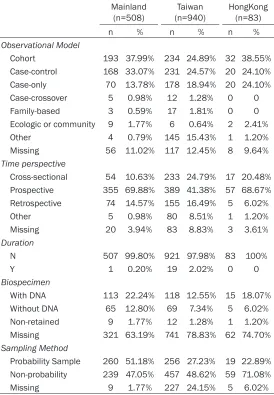
Table 2 lists selected characteristics of all the observational studies that were examined. Cohort studies represented the largest propor-tion (China: 37.99%, Taiwan: 24.89%, Hong Kong: 38.55%), followed by case-control and case-only studies. In addition, there were a large number of prospective studies (China: 69.88%, Taiwan: 41.38%, Hong Kong: 68.67%), followed by cross-sectional and retrospective studies.
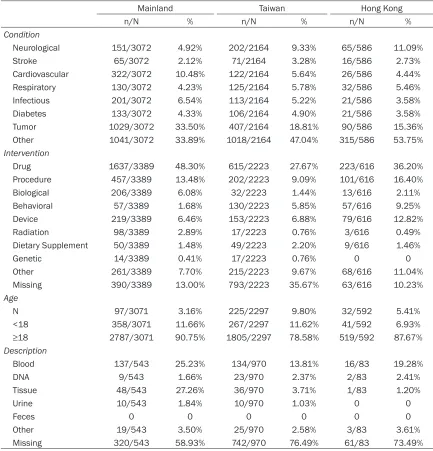
Additional multiple choice items that were included in the questionnaire used to examine the eligible trials addressed: therapeutic area,
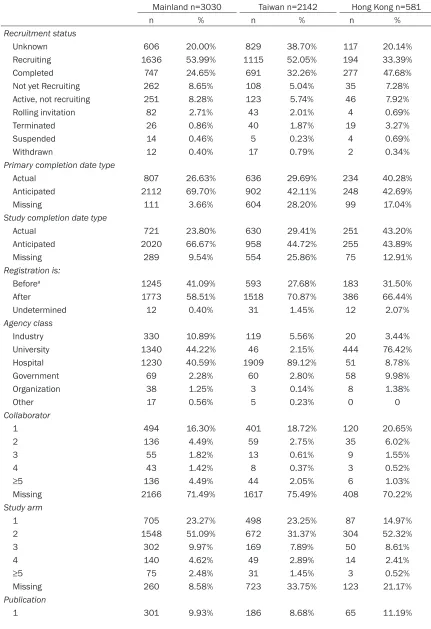
pants or were completed (80%). When the start and registry dates of the trials were compared, only about one-third of the trials were found to
be registered before the official start of the
studies.
[image:8.612.90.526.98.176.2]Overall, 20.72% of published trials could be found in peer-reviewed biomedical journals indexed by Medline, and for only 5.6% of all of the completed trials, the results were published within 15 ± 14.4 months of trial completion (Table 5). Furthermore of the published trials, approximately 26% were funded primarily by Hong Kong-associated institutes, followed by institutes in mainland China (21.5%) and Taiwan (18.15%, P<0.05 for Hong Kong vs. mainland China). It was also observed that 25% of the trials from mainland China were spon-sored by Beijing-based institutions compared Table 5. The number of publications associated with the trials sponsored by mainland China, Taiwan, and Hong Kong and have been registered with ClinicalTrials. gova
Trial sponsors Numbers of publications
<5 5-9 10-19 20-29 30-39 40-49 ≥50 Total %
Mainland China 505 103 44 9 4 - 1 666/3096 21.50%
Taiwan 286 55 31 11 3 1 2 389/2143 18.15%
Hong Kong 99 28 19 4 1 - - 151/581 25.99%
Total 890 186 94 24 8 1 3 1206/5820 20.72%
[image:8.612.92.374.215.444.2]aComparison of these three regions was performed by using a Chi-square test (x2=12.723, P<0.05).
Figure 2. Regional distribution of the trials sponsored by institutions in main-land China.
partici-to 18% and 15% of the trials that were spon-sored by institutes based in Shanghai and Guangzhou, respectively (Figure 2). Since the establishment of the ChiCTR, the number of clinical trials based in mainland China has
increased significantly, and was found to be
much greater than the numbers for the other two regions after 2012 (Figures 3 and 4). Mainland also gradually began to publish study result and published the biggest number of papers in the three regions after 2011 (Figure 4).
Discussion
When we examined the clinical trials that have been sponsored by institutes in China and reg-istered with ClinicalTrials.gov, we determined that the number of registered trials had in- creased with each year, particularly after the establishment of the ChiCTR in 2007. There was also a gradual increase in the number of
published findings. The types of trials that were
predominantly registered included small and medium-sized interventional, single-center stu-
the clinical trials registered between 2007 and 2010 [14]. Company was also the primary source of funding for 85% of the randomized controlled drug trials that were published up until March 27, 2012 [15], as well as for 96 reg-istered trials (73%) that were published in 19 high-impact journals [16]. These differences
potentially reflect a weakness of Chinese com -panies, and in particular, a weakness of the clinical trial registration process.
Regarding the predominant therapeutic areas of the clinical trials examined, tumor trials accounted for the highest proportion of studies that were based in mainland China, Taiwan, and Hong Kong, and are similarly represented by other domestic and foreign institutions [16-18]. This indicates that China, as well as other nations, have a common interest in the treat-ment of tumors and other chronic diseases. A relatively high percentage of missing entries were found, and some of the missing items tended to be associated with important trial
[image:9.612.90.383.72.203.2]design details. These findings indicate that Figure 3. Cumulative number of trials registered with ClinicalTrials.gov between
2005 and 2014.
Figure 4. Cumulative number of published studies. The Chi-square test was used to compare the data for the three regions (x2=4.214, P>0.05).
[image:9.612.89.384.254.388.2]Chinese researchers who are responsible for registering clinical trials do not always have
suf-ficient information to provide a complete regis -tration, and this highlights the need for a more professional and serious attitude towards com-pleting each registration entry [19]. Accordingly, research groups in China have prioritized spe-cialized training for the registration of clinical trials due to the majority of registered trials with incomplete entries.
Before April 30, 2008, only 11% of the complet-ed trials that were examincomplet-ed were publishcomplet-ed. In comparison, publications of European and American clinical trials have spanned several years, while China has only recently begun pub-lishing trial results. Moreover, the accuracy and integrity of the latter have been recognized as needing improvement [20-22]. Forty-six per-cent of the trials funded by the NIH are pub-lished in peer-reviewed biomedical journals indexed by Medline within 30 months of a trial’s completion, with only about one-third of trials remaining unpublished after 51 months [22]. However, the publication of all China-sponsored studies (including Hong Kong and Taiwan) were only about 20.7% and the reported study result were 5.6%. The results of the present analysis
also indicate that a significant proportion of the
registered trials that were examined were not published following completion of the trials. Research has shown that industry-funded trials are more likely to exhibit greater publication bias than those funded by academic institu-tions [29]. However, in the present study,
regis-tered trials funded by non-profit organizations
were published more frequently than those funded by commercial organizations. Therefore, integrating the information from this compre-hensive collection of clinical trials may facilitate the presentation of both negative and positive data and prevent publication bias.
An important finding was that approximately
50% of the interventional and observational studies that were examined included fewer than 100 participants. Small trials can be use-ful in early-phase drug evaluations or biological investigations [23, 24]. However, there are risks
associated with reliably establishing the effica -cy of treatments that exert modest effects in a small trial, particularly when clinical practice guidelines are developed based on the results obtained from a small, and potentially
unrepre-sentative, sample population [25-28]. There- fore, the utility of small trials should be addressed cautiously. Additional limitations to consider are that the data available on ClinicalTrials.gov are recorded by trial sponsors or principal investigators, and therefore may include recording errors. Furthermore, some
records may have been modified, such as the
recruitment status, during the study period. Conclusions and perspectives
This study revealed the status of China-sponsored clinical trials registered with ClinicalTrials.gov to date. Due to the consistent efforts of Chinese researchers, clinical trial reg-istration has been widely recognized and imple-mented in recent years; however, the quality and quantity of clinical investigations are still affected by country/regional laws, regulations, economic conditions, research and technology, as well as other factors. In 2013, the Chinese
government officially launched 13 national clin -ical research centers in order to strengthen the country’s research capacity and experience, and this was an important step in building China’s clinical research unit towards becoming a global leading force [30].
Disclosure of conflict of interest None.
Address correspondence to: Dr. XD Liu, Department of Neurology, Xijing Hospital, Fourth Military Medical University, Xi’an 710032, China. Tel: +86 138-9195-1606; E-mail: [email protected]
References
[1] Zarin DA, Tse T, Williams RJ, Califf RM, Ide NC. The ClinicalTrials.gov results database--update and key issues. N Engl J Med 2011; 364: 852-860.
[2] Laine C, Horton R, DeAngelis CD, Drazen JM, Frizelle FA, Godlee F, Haug C, Hébert PC, Kotzin S, Marusic A, Sahni P, Schroeder TV, Sox HC, Van der Weyden MB, Verheugt FW. Clinical trial registration--looking back and moving ahead. N Engl J Med 2007; 356: 2734-2736.
[3] Andrews CA. Ethical and scientific implications of the globalization of clinical research. N Engl J Med 2009; 360: 2793; author reply 2793. [4] Zarin DA, Tse T. Medicine. Moving toward
trans-parency of clinical trials. Science 2008; 319: 1340-1342.
[6] De Angelis C, Drazen JM, Frizelle FA, Haug C, Hoey J, Horton R, Kotzin S, Laine C, Marusic A, Overbeke AJ, Schroeder TV, Sox HC, Van Der Weyden MB; International Committee of Medical Journal Editors. Clinical Trial Re- gistration: A Statement from the International Committee of Medical Journal Editors. N Engl J Med 2004; 351: 1250-1251.
[7] De Angelis CD, Drazen JM, Frizelle FA, Haug C, Hoey J, Horton R, Kotzin S, Laine C, Marusic A, Overbeke AJ, Schroeder TV, Sox HC, Van Der Weyden MB; International Committee of Medical Journal Editors. Is this clinical trial ful-ly registered?--A statement from the Inter- national Committee of Medical Journal Editors. N Engl J med 2005; 352: 2436-2438. [8] Wu TX, Li YP, Liu GJ, Li J. Clinical trial
registra-tion system and evidence-based medicine. Zhong Xi Yi Jie He Xue Bao 2007; 5: 229-233. [9] Yu H, Liu J. A review of international clinical tri-al registration. Zhong Xi Yi Jie He Xue Bao 2007; 5: 234-242.
[10] Bian ZX, Wu TX. Legislation for trial registration and data transparency. Trials 2010; 11: 64. [11] Li YP, Wu TX, Li J, Zhong ZH, Jia WN; Joint
Statement Working Group, Chinese Clinical Trial Registration and Publishing Collaboration. Joint statement of establishing Chinese Clinical Trial Registration and Publishing sys-tem. J Chinese Integr Med 2006; 4: 331-2. [12] Liu X, Li Y, Yu X, Feng J, Zhong X, Yang X, Li J.
Assessment of registration quality of trials sponsored by China. J Evid Based Med 2009; 2: 8-18.
[13] ClinicalTrials.gov protocol data element defini -tions (DRAFT). http://prsinfo.clinicaltrials.gov/ de finitions.html. [Accessed March 31, 2014]. [14] Califf RM, Zarin DA, Kramer JM, Sherman RE,
Aberle LH, Tasneem A. Characteristics of Clinical Trials Registered in ClinicalTrials.gov, 2007-2010. JAMA 2012; 307: 1838-1847. [15] Riveros C, Dechartres A, Perrodeau E, Ha-
neef R, Boutron I, Ravaud P. Timing and Completeness of Trial Results Posted at ClinicalTrials.gov and Published in Journals. PLoS Med 2013; 10: 1-12.
[16] Becker JE, Krumholz HM, Ben-Josef G, Ross JS. Reporting of results in clinicaltrials.gov and high-impact journals. JAMA 2014; 311: 1063-1065.
[17] Bourgeois FT, Murthy S, Mandl KD. Comparative effectiveness research: An empirical study of trials registered in ClinicalTrials.gov. PLoS One 2012; 7: e28820.
[18] Zarin DA, Tse T, Ide NC. Trial Registration at ClinicalTrials.gov between May and October 2005. N Engl J Med 2005; 353: 2779-2787. [19] DeMets DL, Califf RM. A historical perspective
on clinical trials innovation and leadership: where have the academics gone? JAMA 2011; 305: 713-714.
[20] Prayle AP, Hurley MN, Smyth AR. Compliance with mandatory reporting of clinical trial re-sults on ClinicalTrials.gov: cross sectional study. BMJ 2012; 344: d7373-d7373.
[21] Mathieu S, Boutron I, Moher D, Altman DG, Ravaud P. Comparison of registered and pub-lished primary outcomes in randomized con-trolled trials. JAMA 2009; 302: 977-984. [22] Ross JS, Tse T, Zarin DA, Xu H, Zhou L, Krumholz
HM. Publication of NIH funded trials registered in ClinicalTrials.gov: cross sectional analysis. BMJ 2012; 344: d7292.
[23] Berry DA. Adaptive clinical trials in oncology. Nat Rev Clin Oncol 2011; 9: 199-207.
[24] O’Donnell PH, Stadler WM. Pharmacogenomics in early-phase oncology clinical trials: Is there a sweet spot in phase II? Clin Cancer Res 2012; 18: 2809-2816.
[25] Yusuf S, Collins R, Peto R. Why do we need some large, simple randomized trials? Stat Med 1984; 3: 409-422.
[26] Peto R, Collins R, Gray R. Large-scale random-ized evidence: large, simple trials and over-views of trials. J Clin Epidemiol 1995; 48: 23-40.
[27] Califf RM, DeMets DL. Principles from clinical trials relevant to clinical practice: Part I. Circulation 2002; 106: 1015-1021.
[28] Califf RM, DeMets DL. Principles from clinical trials relevant to clinical practice: Part II. Circulation 2002; 106: 1172-1175.
[29] Anderson ML, Peterson ED. Compliance with results reporting at ClinicalTrials.gov. N Engl J Med 2015; 372: 2370-1.