Exploring Content Features for Automated Speech Scoring
Shasha Xie, Keelan Evanini, Klaus Zechner Educational Testing Service (ETS)
Princeton, NJ 08541, USA
{sxie,kevanini,kzechner}@ets.org
Abstract
Most previous research on automated speech scoring has focused on restricted, predictable speech. For automated scoring of unrestricted spontaneous speech, speech proficiency has been evaluated primarily on aspects of pro-nunciation, fluency, vocabulary and language usage but not on aspects of content and topi-cality. In this paper, we explore features repre-senting the accuracy of the content of a spoken response. Content features are generated us-ing three similarity measures, includus-ing a lex-ical matching method (Vector Space Model) and two semantic similarity measures (Latent Semantic Analysis and Pointwise Mutual In-formation). All of the features exhibit moder-ately high correlations with human proficiency scores on human speech transcriptions. The correlations decrease somewhat due to recog-nition errors when evaluated on the output of an automatic speech recognition system; how-ever, the additional use of word confidence scores can achieve correlations at a similar level as for human transcriptions.
1 Introduction
Automated assessment of a non-native speaker’s proficiency in a given language is an attractive ap-plication of automatic speech recognition (ASR) and natural language processing (NLP) technology; the technology can be used by language learners for individual practice and by assessment providers to reduce the cost of human scoring. While much research has been done about the scoring of re-stricted speech, such as reading aloud or repeating
sentences verbatim (Cucchiarini et al., 1997; Bern-stein et al., 2000; Cucchiarini et al., 2000; Witt and Young, 2000; Franco et al., 2000; Bernstein et al., 2010b), much less has been done about the scor-ing of spontaneous speech. For automated scor-ing of unrestricted, spontaneous speech, most auto-mated systems have estiauto-mated the non-native speak-ers’ speaking proficiency primarily based on low-level speaking-related features, such as pronuncia-tion, intonapronuncia-tion, rhythm, rate of speech, and fluency (Cucchiarini et al., 2002; Zechner et al., 2007; Chen et al., 2009; Chen and Zechner, 2011a), although a few recent studies have explored features based on vocabulary and grammatical complexity (Zechner et al., 2007; Bernstein et al., 2010a; Bernstein et al., 2010b; Chen and Zechner, 2011b).
To date, little work has been conducted on au-tomatically assessing the relatively higher-level as-pects of spontaneous speech, such as the content and topicality, the structure, and the discourse in-formation. Automated assessment of these aspects of a non-native speaker’s speech is very challeng-ing for a number of reasons, such as the short length of typical responses (approximately 100 words for a typical 1 minute response, compared to over 300 words in a typical essay/written response), the spon-taneous nature of the speech, and the presence of disfluencies and possible grammatical errors. More-over, the assessment system needs text transcripts of the speech to evaluate the high level aspects, and these are normally obtained from ASR systems. The recognition accuracy of state-of-the-art ASR sys-tems on non-native spontaneous speech is still rel-atively low, which will sequentially impact the
liability and accuracy of automatic scoring systems using these noisy transcripts. However, despite these difficulties, it is necessary for an automated assess-ment system to address the high level information of a spoken response in order to fully cover all as-pects that are considered by human raters. Thus, in this paper we focus on exploring features to repre-sent the high-level aspect of speech mainly on the accuracy of the content.
As a starting point, we consider approaches that have been used for the automated assessment of con-tent in essays. However, due to the qualitative dif-ferences between written essays and spontaneous speech, the techniques developed for written texts may not perform as well on spoken responses. Still, as a baseline, we will evaluate the content features used for essay scoring on spontaneous speech. In addition to a straightforward lexical Vector Space Model (VSM), we investigate approaches using two other similarity measures, Latent Semantic Analysis (LSA) and Pointwise Mutual Information (PMI), in order to represent the semantic-level proficiency of a speaker. All of the content features are analyzed using both human transcripts and speech recognizer output, so we can have a better understanding of the impact of ASR errors on the performance of the fea-tures. As expected, the results show that the per-formance on ASR output is lower than when hu-man transcripts are used. Therefore, we propose im-proved content features that take into account ASR confidence scores to emphasize responses whose es-timated word accuracy is comparatively higher than others. These improved features can obtain similar performance when compared to the results using hu-man transcripts.
This paper is organized as follows. In the next section we introduce previous research on auto-mated assessment of content in essays and spoken responses. The content features we generated and the model we used to build the final speaking scores are described in Sections 3 and Section 4, respec-tively. In Section 5 we show the performance of all our proposed features. Finally, we conclude our work and discuss potential future work in Section 6.
2 Related Work
Most previous research on assessment of non-native speech has focused on restricted, predictable speech; see, for example, the collection of articles in (Es-kenazi et al., 2009). When assessing spontaneous speech, due to relatively high word error rates of current state-of-the-art ASR systems, predominantly features related to low-level information have been used, such as features related to fluency, pronuncia-tion or prosody (Zechner et al., 2009).
For scoring of written language (automated essay scoring), on the other hand, several features related to the high level aspects have been used previously, such as the content and the discourse information. In one approach, the lexical content of an essay was evaluated by using a VSM to compare the words contained in each essay to the words found in a sam-ple of essays from each score category (Attali and Burstein, 2006). In addition, this system also used an organization feature measuring the difference be-tween the ideal structure of an essay and the actual discourse elements found in the essay. The features designed for measuring the overall organization of an essay assumed a writing strategy that included an introductory paragraph, at least a three-paragraph body with each paragraph in the body consisting of a pair of main point, supporting idea elements, and a concluding paragraph. In another approach, the content of written essays were evaluated using LSA by comparing the test essays with essays of known quality in regard of their degree of conceptual rele-vance and the amount of relevant content (Foltz et al., 1999).
we think the observations about the content features used in this paper were not reliable for the following two reasons: the number of training responses was limited (1000 responses), and the ASR system had a relatively high Word Error Rate (39%).
In this paper, we provide further analysis on the performance of several types of content features. Additionally, we used a larger amount of training data and a better ASR system in an attempt to extract more meaningful and accurate content features.
3 Automatic Content Scoring
In automatic essay scoring systems, the content of an essay is typically evaluated by comparing the words it contains to the words found in a sample of es-says from each score category (1-4 in our experi-ments), where the scores are assigned by trained hu-man raters. The basic idea is that good essays will resemble each other in their word choice, as will poor essays. We follow this basic idea when extract-ing content features for spoken responses.
3.1 Scoring Features
For each test spoken response, we calculate its simi-larity scores to the sample responses from each score category. These scores indicate the degree of simi-larity between the words used in the test response and the words used in responses from different score points. Using these similarity scores, 3 content fea-tures are generated in this paper:
• Simmax: the score point which has the
high-est similarity score between thigh-est response and score vector
• Sim4: the similarity score to the responses
with the highest score category (4 in our ex-periments).
• Simcmb: the linear combination of the
similar-ity scores to each score category.
4
X
i=1
wi∗Simi (1)
wherewiis scaled to [-1, 1] to imply its positive
or negative impact.
3.2 Similarity Measures
There are many ways to calculate the similarity be-tween responses. A simple and commonly used method is the Vector Space Model, which is also used in automated essay scoring systems. Under this approach, all the responses are converted to vectors, whose elements are weighted using TF*IDF (term frequency, inverse document frequency). Then, the cosine similarity score between vectors can be used to estimate the similarity between the responses the vectors originally represent.
Other than this lexical matching method, we also try two additional similarity measures to better cap-ture the semantic level information: Latent Semantic Analysis (Landauer et al., 1998) and a corpus-based semantic similarity measure based on pointwise mu-tual information (Mihalcea et al., 2006). LSA has been widely used for computing document similar-ity and other information retrieval tasks. Under this approach, Singular Value Decomposition (SVD) is used to analyze the statistical relationship between a set of documents and the words they contain. Am∗n word-document matrixXis first built, in which each elementXij represents the weighted term frequency
of wordiin documentj. The matrix is decomposed into a product of three matrices as follows:
X=UΣVT (2)
whereU is anm×mmatrix of left-singular vectors,
Σis anm×ndiagonal matrix of singular values, and V is then×nmatrix of right-singular vectors.
The top ranked k singular values inΣ are kept, and the left is set to be 0. SoΣis reformulated asΣk.
The original matrixXis recalculated accordingly,
Xk=UΣkVT (3)
This new matrix Xk can be considered as a
smoothed or compressed version of the original ma-trix. LSA measures the similarity of two documents by calculating the cosine between the corresponding compressed column vectors.
PMI was introduced to calculate the semantic similarity between words in (Turney, 2001). It is based on the word co-occurrence on a large corpus. Given two words, their PMI is computed using:
P M I(w1, w2) =log2
p(w1&w2)
p(w1)∗p(w2)
This indicates the statistical dependency betweenw1
andw2, and can be used as a measure of the semantic
similarity of two words.
Given the word-to-word similarity, we can calcu-late the similarity between two documents using the following function,
sim(D1, D2) =
1 2(
P
w∈{D1}(maxSim(w, D2)∗idf(w))
P
w∈{D1}idf(w)
+ P
w∈{D2}(maxSim(w, D1)∗idf(w)
P
w∈{D2}idf(w))
)
(5)
maxSim(w, Di) =maxwj∈{Di}P M I(w, wj) (6) For each wordwin documentD1, we find the word
in document D2 which has the highest similarity
to w. Similarly, for each word in D2, we
iden-tify the most similar words in D1. The similarity
score between two documents is then calculated by combining the similarity of the words they contain, weighted by their word specificity (i.e., IDF values). In this paper, we use these three similarity mea-sures to calculate the similarity between the test re-sponse and the training rere-sponses for each score cat-egory. Using the VSM method, we convert all the training responses in one score category into one big vector, and for a given test response we calculate its cosine similarity to this vector as its similarity to that corresponding score point vector. For the other simi-larity measures, we calculate the test response’s sim-ilarity to each of the training responses in one score category, and report the average score as its similar-ity to this score point. We also tried using this av-erage similarity score for the VSM method, but our experimental results showed that this average score obtained lower performance than using one big vec-tor generated from all the training samples due to data sparsity. After the similarity scores to each of the four score categories are computed, the content features introduced in Section 3.1 are then extracted and are used to evaluate the speaking proficiency of the speaker.
4 System Architecture
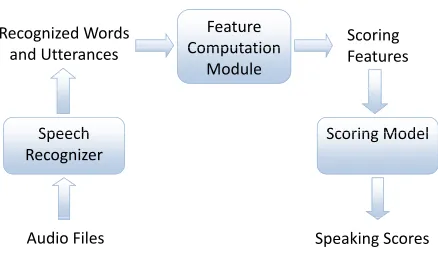
[image:4.612.319.538.190.320.2]This section describes the architecture of our auto-mated content scoring system, which is shown in
Figure 1. First, the test taker’s voice is recorded, and sent to the automatic speech recognition system. Second, the feature computation module takes the output hypotheses from the speech recognizer and generates the content features. The last component considers all the scoring features, and produces the final score for each spoken response.
Feature Computation
Recognized Words Scoring
Computation Module
and Utterances Features
Speech Scoring Model
Speech Recognizer
Scoring Model
Audio Files Speaking Scores
Figure 1: Architecture of the automated content scoring system.
us-ing ASR confidence scores.
5 Experimental Results
5.1 Data
The data we use for our experiments are from the Test of English as a Foreign LanguageR internet-based test (TOEFL iBT) in which test takers respond to several stimuli using spontaneous speech. This data set contains 24 topics, of which 8 are opinion-based tasks, and 16 are contextual-opinion-based tasks. The opinion-based tasks ask the test takers to provide information or opinions on familiar topics based on their personal experience or background knowl-edge. The purpose of these tasks is to measure the speaking ability of examinees independent of their ability to read or listen to English language. The contextual-based tasks engage reading, listening and speaking skills in combination to mimic the kinds of communication expected of students in campus-based situations and in academic courses. Test tak-ers read and/or listen to some stimulus materials and then respond to a question based on them. For each of the tasks, after task stimulus materials and/or test questions are delivered, the examinees are allowed a short time to consider their response and then pro-vide their responses in a spontaneous manner within either 45 seconds (for the opinion-based tasks) or 60 seconds (for the contextual-based tasks).
For each topic, we randomly select 1800 re-sponses for training, and 200 rere-sponses as develop-ment set for parameter tuning. Our evaluation data contains 1500 responses from the same English pro-ficiency test, which contain the same 24 topics. All of these data are scored on a 0-4 scale by expert hu-man raters. In our automated scoring system, we use a filtering model to identify responses which should have a score of 0, such as responses with a technical difficulty (e.g., equipment problems, high ambient noise), responses containing uncooperative behavior from the speakers (e.g., non-English speech, whis-pered speech). So in this paper we only focused on the responses with scores of 1-4. Statistics for this data set are shown in Table 1. As the table shows, the score distributions are similar across the train-ing, development, and evaluation data sets.
5.2 Speech recognizer
We use an ASR system containing a cross-word triphone acoustic model trained on approximately 800 hours of spoken responses from the same En-glish proficiency test mentioned above and a lan-guage model trained on the corresponding tran-scripts, which contain a total of over 5 million words. The Word Error Rate (WER) of this system on the evaluation data set is 33%.
5.3 Evaluation metric
To measure the quality of the developed features, we employ a widely used metric, the Pearson correla-tion coefficient (r). In our experiments, we use the value of the Pearson correlation between the feature values and the human proficiency scores for each spoken response.
5.4 Feature performance on transcripts
In Section 3.1, we introduced three features derived from the similarity between the test responses and the training responses for each score point. We first build the training samples for each topic, and then compare the test responses with their corresponding models. Three similarity measures are used for cal-culating the similarity scores, VSM, LSA, and the PMI-based method. In order to avoid the impact of recognition errors, we first evaluate these similarity methods and content features using the human tran-scripts. The Pearson correlation coefficients on the evaluation data set for this experiment are shown in Table 2. The parameters used during model build-ing, such as the weights for each score category in the feature Simcmb and the number of topicsk in
LSA, are all tuned on the development set, and ap-plied directly on the evaluation set.
The correlations show that even the simple vec-tor space model can obtain a good correlation of 0.48 with the human rater scores. The feature Simcmbperforms the best across almost all the test
setups, since it combines the information from all score categories. The PMI-based features outper-form the other two similarity methods when evalu-ated both on all responses or only on the contextual-based topics. We also observe that the correlations oncontextual-based tasks are much higher than on
Table 1: Summary statistics of training, development and evaluation data set.
Data sets Responses Speakers score avg score sd Score distribution (percentage %)
1 2 3 4
Train 43200 8000 2.63 0.79 1750 (4.1) 15128 (35.0) 20828 (48.2) 4837 (11.2)
Dev 4800 3760 2.61 0.79 215 (4.5) 1719 (35.8) 2295 (47.8) 499 (10.4)
Eval 1500 250 2.57 0.81 95 (6.3) 549 (36.6) 685 (45.7) 152 (10.1)
Table 2: Pearson correlations of the content features using human transcripts.
VSM LSA PMI
Simmax Sim4 Simcmb Simmax Sim4 Simcmb Simmax Sim4 Simcmb
ALL 0.46 0.32 0.48 0.32 0.38 0.45 0.18 0.51 0.53
Contextual 0.50 0.51 0.58 0.36 0.55 0.57 0.21 0.57 0.62
Opinion 0.37 0.03 0.25 0.29 0.14 0.22 0.06 0.42 0.51
the contextual-based tasks are more constrained to the materials provided with the test item, whereas the opinion-based tasks are relatively open-ended. Therefore, it is easier for the similarity measures to track the content, the topics, or the vocabulary usage of the contextual-based topics. Overall, the best cor-relations are obtained using the feature combining the similarity scores to each score category and the PMI-based methods to calculate the similarity. Here, the Pearson correlations are 0.53 for all responses, and 0.62 for the contextual-based tasks only.
We also investigated whether additional perfor-mance gains could be achieved by combining infor-mation from the three different content features to build a single overall content score, since the three features may measure disparate aspects of the re-sponse. The combination model we use is mul-tiple regression, in which the score assigned to a test response is estimated as a weighted linear com-bination of a selected set of features. The fea-tures are the similarity values to each score category (Simi, i ∈ {1,2,3,4}), calcuated using the three
similairty measures. In total we have 12 content features. The regression model is also built on the development set, and tested on the evaluation set. The correlation for the final model is 0.60 on all responses, which is significantly better than the in-dividual models (0.48 for VSM, 0.45 for LSA, and 0.53 for PMI). Compared to results reported in pre-vious work on similar speech scoring tasks but mea-suring other aspects of speech, our correlation re-sults are very competitive (Zechner and Xi, 2008;
Zechner et al., 2009).
5.5 Feature Performance on ASR output
The results shown in the previous section were ob-tained using human transcripts of test responses, and were reported in order to demonstrate the meaning-fulness of the proposed features. However, in prac-tical automated speech scoring systems, the only available text is the output of the ASR system, which may contain a large number of recognition errors. Therefore, in this section we show the performance of the content features extracted using ASR hy-potheses. Note that we still use the human tran-scripts of the training samples to train the models, the parameter values and the regression weights; however, we only use ASR output of the evaluation data for testing the feature performance. These cor-relations are shown in Table 3.
Table 3: Pearson correlations of the content features using ASR output.
VSM LSA PMI
Simmax Sim4 Simcmb Simmax Sim4 Simcmb Simmax Sim4 Simcmb
ALL 0.43 0.34 0.48 0.30 0.37 0.43 0.11 0.24 0.42
Contextual 0.49 0.53 0.58 0.34 0.54 0.57 0.16 0.31 0.53
[image:7.612.84.528.184.249.2]Opinion 0.30 0.05 0.07 0.25 0.12 0.15 0.05 0.17 0.27
Table 4: Pearson correlations of the content features using ASR output with confidence scores.
VSM LSA PMI
Simmax Sim4 Simcmb Simmax Sim4 Simcmb Simmax Sim4 Simcmb
ALL 0.43 0.36 0.48 0.30 0.40 0.45 0.11 0.39 0.51
Contextual 0.49 0.55 0.58 0.34 0.57 0.59 0.16 0.46 0.59
Opinion 0.30 0.24 0.25 0.25 0.18 0.20 0.05 0.32 0.40
on all responses).
In Section 4, we proposed using ASR confidence scores during feature extraction to introduce acous-tic level information and, thus, penalize responses for which the ASR output is less likely to be correct. Under this approach, all similarity scores are mul-tiplied by the average word confidence score con-tained in the test response. The performance of these enhanced features is provided in Table 4. Compared to the scores in Table 3, the enhanced features per-form better than the basic features that do not take the confidence scores into consideration. Using this approach, we can improve the correlation scores for most of the features, especially for the PMI-based features. These features had lower correlations be-cause of the recognition errors, but with the con-fidence scores, they outperform the other features when evaluated both on all responses or only on contextual-based responses. Note that the correla-tions for featureSimmaxremains the same because
the same average confidence scores for each test re-sponse is multiplied by the similarity scores to each of the score points, so the score point obtaining the highest similarity score is the same whether the con-fidence scores are considered or not. The correlation of the regression model also improves from 0.44 to 0.51 when the confidence scores are included. Over-all, the best correlations for the individual similarity features with the confidence scores are very close to those obtained using human transcripts, as shown in Tables 2 and 4: the difference is 0.53 vs. 0.51 for all responses, and 0.62 vs. 0.59 for contextual-based
tasks only.
Because all models and parameter values are trained on human transcripts, this experimental setup might not be optimal for using ASR outputs. For instance, the regression model does not outper-form the results of individual features using ASR outputs, although the confidence scores help im-prove the overall correlation scores. We expect that we can obtain better performance by using a regres-sion model trained on ASR transcripts, which can better model the impact of noisy data on the features. In our future work, we will build sample responses for each score category, tune the parameter values, and train the regression model all on ASR hypothe-ses. We hope this can solve the mismatch problem during training and evaluation, and can provide us even better correlation results.
6 Conclusion and Future Work
method VSM, and two corpus-based semantic simi-larity measures, LSA and PMI. Our experimental re-sults showed that all the features obtained good cor-relations with human proficiency scores if there are no recognition errors in the text transcripts, with the PMI-based method performing the best over three similarity measures. However, if we used ASR tran-scripts, we observed a marked performance drop for the PMI-based method. Although we found that VSM and LSA were very robust to ASR errors, the overall correlations for the ASR condition were not as good as using human transcripts. To solve this problem, we proposed to use ASR confidence scores to improve the feature performance, and achieved similar results as when using human transcripts.
As we discussed in Section 5, all models were trained using human transcripts, which might de-crease the performance when these models are ap-plied directly to the ASR outputs. In our future work, we will compare models trained on human transcripts and on ASR outputs, and investigate whether we should use matching data for training and evaluation, or whether we should not introduce noise during training in order to maintain the validity of the models. We will also investigate whether the content features can provide additional information for automated speech scoring, and help build better scoring systems when they are combined with other non-content features, such as the features represent-ing fluency, pronunciation, prosody, vocabulary di-versity information. We will also explore generating other features measuring the higher-level aspects of the spoken responses. For example, we can extract features assessing the responses’ relatedness to the stimulus of an opinion-based task. For contextual-based tasks, the test takers are asked to read or lis-ten to some stimulus material, and answer a ques-tion based on this informaques-tion. We can build models using these materials to check the correctness and relatedness of the spoken responses.
References
Yigal Attali and Jill Burstein. 2006. Automated essay scoring with e-raterR v.2.The Journal of Technology, Learning, and Assessment, 4(3):3–30.
Jared Bernstein, John De Jong, David Pisoni, and Brent Townshend. 2000. Two experiments on automatic
scoring of spoken language proficiency. In Proceed-ings of Integrating Speech Tech. in Learning (InSTIL). Jared Bernstein, Jian Cheng, and Masanori Suzuki. 2010a. Fluency and structural complexity as predic-tors of L2 oral proficiency. InProceedings of Inter-speech.
Jared Bernstein, Alistair Van Moere, and Jian Cheng. 2010b. Validating automated speaking tests. Lan-guage Testing, 27(3):355–377.
Lei Chen and Klaus Zechner. 2011a. Applying rhythm features to automatically assess non-native speech. In Proceedings of Interspeech.
Miao Chen and Klaus Zechner. 2011b. Computing and evaluating syntactic complexity features for automated scoring of spontaneous non-native speech. In Pro-ceedings of ACL-HLT.
Lei Chen, Klaus Zechner, and Xiaoming Xi. 2009. Im-proved pronunciation features for construct-driven as-sessment of non-native spontaneous speech. In Pro-ceedings of NAACL-HLT.
Catia Cucchiarini, Helmer Strik, and Lou Boves. 1997. Automatic evaluation of Dutch pronunciation by using speech recognition technology. InIEEE Workshop on Auotmatic Speech Recognition and Understanding. Catia Cucchiarini, Helmer Strik, and Lou Boves. 2000.
Quantitative assessment of second language learners’ fluency by means of automatic speech recognition technology. Journal of the Acoustical Society of Amer-ica, 107:989–999.
Catia Cucchiarini, Helmer Strik, and Lou Boves. 2002. Quantitative assessment of second language learners’ fluency: comparisons between read and spontaneous speech. Journal of the Acoustical Society of America, 111(6):2862–2873.
Maxine Eskenazi, Abeer Alwan, and Helmer Strik. 2009. Spoken language technology for education. Speech Communication, 51(10):831–1038.
Peter W. Foltz, Darrell Laham, and Thomas K. Landauer. 1999. The Intelligent Essay Assessor: Applications to educational technology. Interactive multimedia Elec-tronic Journal of Computer-Enhanced Learning, 1(2). Horacio Franco, Leonardo Neumeyer, Vassilios Di-galakis, and Orith Ronen. 2000. Combination of ma-chine scores for automatic grading of pronunciation quality. Speech Communication, 30(1-2):121–130. Thomas K Landauer, Peter W. Foltz, and Darrell Laham.
1998. Introduction to Latent Semantic Analysis. Dis-course Processes, 25:259–284.
Peter D. Turney. 2001. Mining the web for synonyms: PMI-IR versus LSA on TOEFL. In Proceedings of ECML.
Silke M. Witt and Steve J. Young. 2000. Phone-level pronunciation scoring and assessment for interac-tive language learning. Speech Communication, 30(1-2):95–108.
Klaus Zechner and Xiaoming Xi. 2008. Towards auto-matic scoring of a test of spoken language with het-erogeneous task types. In Proceedings of the Third Workshop on Innovative Use of NLP for Building Ed-ucational Applications.
Klaus Zechner, Derrick Higgins, and Xiaoming Xi. 2007. SpeechraterTM: A construct-driven approach to score spontaneous non-native speech. In Proceed-ings of the 2007 Workshop of the International Speech Communication Association (ISCA) Special Interest Group on Speech and Language Technology in Edu-cation (SLaTE).