Context-Dependent Alignment Models for Statistical Machine Translation
Jamie Brunning, Adri`a de Gispert and William Byrne
Machine Intelligence Laboratory
Department of Engineering, Cambridge University
Trumpington Street, Cambridge, CB2 1PZ, U.K.
{
jjjb2,ad465,wjb31
}
@eng.cam.ac.uk
Abstract
We introduce alignment models for Machine Trans-lation that take into account the context of a source word when determining its translation. Since the use of these contexts alone causes data sparsity prob-lems, we develop a decision tree algorithm for clus-tering the contexts based on optimisation of the EM auxiliary function. We show that our context-dependent models lead to an improvement in align-ment quality, and an increase in translation quality when the alignments are used in Arabic-English and Chinese-English translation.
1 Introduction
Alignment modelling for Statistical Machine Translation (SMT) is the task of determining translational correspon-dences between the words in pairs of sentences in parallel text. Given a source language word sequencefJ
1 and a
target language word sequenceeI
1, we model the
transla-tion probability asP(eI
1|f1J)and introduce a hidden
vari-ableaI
1representing a mapping from the target word
po-sitions to source word popo-sitions such thateiis aligned to fai. ThenP(e
I 1|f
j 1) =
P aI
1P(e
I 1, aI1|f
j
1)(Brown et al.,
1993).
Previous work on statistical alignment modelling has not taken into account the source word context when de-termining translations of that word. It is intuitive that a word in one context, with a particular part-of-speech and particular words surrounding it, may translate differently when in a different context. We aim to take advantage of this information to provide a better estimate of the word’s translation. The challenge of incorporating con-text information is maintaining computational tractability of estimation and alignment, and we develop algorithms to overcome this.
The development of efficient estimation procedures for context-dependent acoustic models revolutionised the field of Automatic Speech Recognition (ASR) (Young et
al., 1994). Clustering is used extensively for improv-ing parameter estimation of triphone (and higher order) acoustic models, enabling robust estimation of param-eters and reducing the computation required for recog-nition. Kannan et al. (1994) introduce a binary tree-growing procedure for clustering Gaussian models for triphone contexts based on the value of a likelihood ra-tio. We adopt a similar approach to estimate context-dependent translation probabilities.
We focus on alignment with IBM Model 1 and HMMs. HMMs are commonly used to generate alignments from which state of the art SMT systems are built. Model 1 is used as an intermediate step in the creation of more pow-erful alignment models, such as HMMs and further IBM models. In addition, it is used in SMT as a feature in Min-imum Error Training (Och et al., 2004) and for rescor-ing lattices of translation hypotheses (Blackwood et al., 2008). It is also used for lexically-weighted phrase ex-traction (Costa-juss`a and Fonollosa, 2005) and sentence segmentation of parallel text (Deng et al., 2007) prior to machine translation.
1.1 Overview
We first develop an extension to Model 1 that allows the use of arbitrary context information about a source word to estimate context-dependent word-to-word translation probabilities. Since there is insufficient training data to accurately estimate translation probabilities for less fre-quently occurring contexts, we develop a decision tree clustering algorithm to form context classes. We go on to develop a context-dependent HMM model for alignment. In Section 3, we evaluate our context-dependent mod-els on Arabic-English parallel text, comparing them to our baseline context-independent models. We perform morphological decomposition of the Arabic text using MADA, and use part-of-speech taggers on both lan-guages. Alignment quality is measured using Alignment Error Rate (AER) measured against a manually-aligned parallel text. Section 4 uses alignments produced by
our improved alignment models to initialise a statistical machine translation system and evaluate the quality of translation on several data sets. We also apply part-of-speech tagging and decision tree clustering of contexts to Chinese-English parallel text; translation results for these languages are presented in Section 4.2.
1.2 Previous and related work
Brown et al. (1993) introduce IBM Models 1-5 for align-ment modelling; Vogel et al. (1996) propose a Hidden Markov Model (HMM) model for word-to-word align-ment, where the words of the source sentence are viewed as states of an HMM and emit target sentence words; Deng and Byrne (2005a) extend this to an HMM word-to-phrase model which allows many-to-one alignments and can capture dependencies within target phrases.
Habash and Sadat (2006) perform morphological de-composition of Arabic words, such as splitting of pre-fixes and sufpre-fixes. This leads to gains in machine trans-lation quality when systems are trained on parallel text containing the modified Arabic and processing of Arabic text is carried out prior to translation. Nießen and Ney (2001a) perform pre-processing of German and English text before translation; Nießen and Ney (2001b) use mor-phological information of the current word to estimate hierarchical translation probabilities.
Berger et al. (1996) introduce maximum entropy mod-els for machine translation, and use a window either side of the target word as context information. Varea et al. (2002) test for the presence of specific words within a window of the current source word to form features for use inside a maximum entropy model of alignment.
Toutanova et al. (2002) use part-of-speech informa-tion in both the source and target languages to estimate alignment probabilities, but this information is not in-corporated into translation probabilities. Popovi´c and Ney (2004) use the base form of a word and its part-of-speech tag during the estimation of word-to-word transla-tion probabilities for IBM models and HMMs, but do not defined context-dependent estimates of translation prob-abilities.
Stroppa et al. (2007) consider context-informed fea-tures of phrases as components of the log-linear model during phrase-based translation, but do not address align-ment.
2 Use of source language context in
alignment modelling
Consider the alignment of the target sentencee=eI 1with
the source sentencef = fJ
1. Leta = aI1 be the
align-ments of the target words to the source words. Letcj be
the context information offjforj= 1, . . . , J. This
con-text information can be any information about the word,
e.g. speech, previous and next words, part-of-speech of previous and next words, or longer range con-text information.
We follow Brown et al. (1993), but extend their mod-elling framework to include information about the source word from which a target word is emitted. We model the alignment process as:
P(eI1, aI1, I|f1J, cJ1) =
P(I|f1J, cJ1) I Y
i=1 P(
ei|ai1, e i−1
1 , f1J, cJ1, I)
×P(ai|ei1−1, a1i−1, f1J, cJ1, I)
(1)
We introduce word-to-word translation tables that depend on the source language context for each word, i.e. the probability thatf translates toegivenf has contextcis t(e|f, c). We assume that the context sequence is given
for a source word sequence. This assumption can be relaxed to allow for multiple tag sequences as hidden processes, but we assume here that a tagger generates a single context sequencecJ
1 for a word sequence f1J.
This corresponds to the assumption that, for a context se-quence˜cJ
1,P(˜cJ1|f1J) =δcJ
1(˜c
J 1); hence
P(eI1, aI1|f1J) = X
˜ cJ
1
P(eI1, aI1,˜cJ1|f1J) = P(eI1, aI1|cJ1, f1J)
For Model 1, ignoring the sentence length distribution,
PM1(eI1, a1I|f1J, cJ1) =
1 (J+ 1)I
I Y
i=1
t(ei|fai, cai). (2)
Estimating translation probabilities separately for ev-ery possible context of a source word individually leads to problems with data sparsity and rapid growth of the translation table. We therefore wish to cluster source con-texts which lead to similar probability distributions. Let
Cfdenote the set of all observed contexts of source word f. A particular clustering is denoted
Kf ={Kf,1, . . . , Kf,Nf},
whereKf is a partition ofCf. We define a class
mem-bership functionµf such that for any contextc, µf(c)
is the cluster containingc. We assume that all contexts
in a cluster give rise to the same translation probability distribution for that source word, i.e. for a clusterK,
t(e|f, c) = t(e|f, c0)for all contextsc, c0 ∈ K and all
target wordse; we write this shared translation probabil-ity ast(e|f, K).
The Model 1 sentence translation probability for a given alignment (Equation 2) becomes
PM1(eI1, a1I|f1J, cJ1) =
1 (J+ 1)I
I Y
i=1
t(ei|fai, µf(cai)).
For HMM alignment, we assume that the transition prob-abilitiesa(ai|ai−1)are independent of the word contexts
and the sentence translation probability is
PH(eI1, a1I|f1J, cJ1) = I Y
i=1
a(ai|ai−1, J)t(ei|fai, µf(cai)).
(4) Section 2.1.1 describes how the context classes are deter-mined by optimisation of the EM auxiliary function. Al-though the translation model is significantly more com-plex than that of context-independent models, once class membership is fixed, alignment and parameter estimation use the standard algorithms.
2.1 EM parameter estimation
We train using Expectation Maximisation (EM), optimis-ing the log probability of the trainoptimis-ing set{e(s),f(s)
}S s=1
(Brown et al., 1993). Given model parametersθ0, we
es-timate new parametersθby maximisation of the EM
aux-iliary function
X
s,a
Pθ0(a|f(s),c(s),e(s)) log Pθ(e(s),a, I(s)|f(s),c(s)).
We assume the sentence length distribution and align-ment probabilities do not depend on the contexts of the source words; hence the relevant part of the auxiliary function is
X
e X
f X
c∈Cf
γ0(e|f, c) logt(e|f, c), (5)
where
γ0(e|f, c) =X s
I(s) X
i=1 J(s) X
j=1 h
δc(c(s)j )δe(e(s)i )δf(fj(s))
×Pθ0(ai=j|e(s),f(s),c(s)) i
Hereγ0 can be computed under Model 1 or the HMM,
and is calculated using the forward-backward algorithm for the HMM.
2.1.1 Parameter estimation with clustered contexts
We can re-write the EM auxiliary function (Equation 5) in terms of the cluster-specific translation probabilities:
X
e X
f |Kf| X
l=1 X
c∈Kf,l
γ0(e|f, c) logt(e|f, c)
=X
e X
f X
K∈Kf
γ0(e|f, K) logt(e|f, K) (6)
whereγ0(e|f, K) =X c∈K
γ0(e|f, c)
Following the usual derivation, the EM update for the class-specific translation probabilities becomes
ˆ
t(e|f, K) = Pγ0(e|f, K) e0γ0(e0|f, K)
. (7)
Standard EM training can be viewed a special case of this, with every context of a source word grouped into a sin-gle cluster. Another way to view these clustered context-dependent models is that contexts belonging to the same cluster are tied and share a common translation proba-bility distribution, which is estimated from all training examples in which any of the contexts occur.
2.2 Decision trees for context clustering
The objective for each source word is to split the contexts into classes to maximise the likelihood of the training data. Since it is not feasible to maximise the likelihood of the observations directly, we maximise the expected log likelihood by considering the EM auxiliary function, in a similar manner to that used for modelling contextual variations of phones for ASR (Young et al., 1994; Singer and Ostendorf, 1996). We perform divisive clustering in-dependently for each source wordf, by building a binary
decision tree which forms classes of contexts which max-imise the EM auxiliary function. Questions for the tree are drawn from a set of questionsQ = {q1, . . . , q|Q|}
concerning the context information off.
LetKbe any set of contexts off, and define
L(K) =X e
X
c∈K
γ0(e|f, c) logt(e|f, c)
=X
e X
c∈K
γ0(e|f, c) log P
c∈Kγ0(e|f, c) P
e0 P
c∈Kγ0(e0|f, c) .
This is the contribution to the EM auxiliary function of source wordf occurring in the contexts ofK. Letqbe
a binary question about the context of f, and consider
the effect on the partial auxiliary function (Equation 6) of splittingKinto two clusters using questionq. Define
Kq be the set of contexts inKwhich answer ‘yes’ toq
andKq¯be the contexts which answer ‘no’. Define the
objective function
Qf,q(K) = X
e X
c∈Kq
γ0(e|f, c) logt(e|f, c)
+X
e X
c∈Kq¯
γ0(e|f, c) logt(e|f, c)
=L(Kq) +L(Kq¯)
When the node is split using questionq, the increase in
objective function is given by
We chooseqto maximise this.
In order to build the decision tree forf, we take the set
of all contextsCf as the initial cluster at the root node.
We then find the questionqˆsuch thatQf,q(Cf)is
maxi-mal, i.e.
ˆ
q=arg max q∈Q
Qf,q(Cf)
This splitsCf, so our decision tree now has two nodes.
We iterate this process, at each iteration splitting (into two further nodes) the leaf node that leads to the great-est increase in objective function. This leads to a greedy search to optimise the log likelihood over possible state clusterings.
In order to control the growth of the tree, we put in place two thresholds:
• Timpis the minimum improvement in objective
func-tion required for a node to be split; without it, we would continue splitting nodes until each contained only one context, even though doing so would cause data sparsity problems.
• Toccis the minimum occupancy of a node, based on
how often the contexts at that node occur in the train-ing data; we want to ensure that there are enough ex-amples of a context in the training data to estimate accurately the translation probability distribution for that cluster.
For each leaf nodeland set of contextsKlat that node,
we find the questionqlthat, when used to splitKl,
pro-duces the largest gain in objective function:
ql = arg max q∈Q
[L(Kl,q) +L(Kl,¯q)−L(Kl)]
= arg max
q∈Q
[L(Kl,q) +L(Kl,¯q)]
We then find the leaf node for which splitting gives the largest improvement:
ˆ
l = arg max
l
[L(Kl,ql) +L(Kl,q¯l)−L(Kl)]
If the following criteria are both satisfied at that node, we split the node into two parts, creating two leaf nodes in its place:
• The objective function increases sufficiently
L(Kl,ql) +L(Kl,q¯l)−L(Kl)> Timp
• The occupancy threshold is exceeded for both child nodes:
X
e X
c∈Kl,x
γ0(e|f, c)> Toccforx=q,q¯
We perform such clustering for every source word in the parallel text.
sharesNNS · · · ·
bankNN · · ·
theDT · · ·
ofIN · · · · · ·
%PUNC · · · · · ·
12NN · · · · · ·
sellingVBG · · · · · ·
ofIN · · · ·
dealNN · · · ·
theDT · · · ·
Sfqp
NN
byE
NN
12
NN
%
PUNC
mn
IN
>
shm
NN
Albnk
NN
cityNN · · ·
theDT · · ·
inIN · · · ·
liquorNN · · · · ·
sellingVBG · · · · · · ·
wereVBD · · · · · · ·
ownersNNS · · · · · · ·
whoseWP$ · · · · · · ·
housesNNS · · · · ·
severalJJ · · · · · · ·
andCC · · · ·
w+
CC
mnAzl
NN
Edp
JJ
>
SHAbhA
NN
ybyEwn
VBP
Alxmwr
NN
fy
IN
Almdynp
[image:4.612.360.489.61.352.2]NN
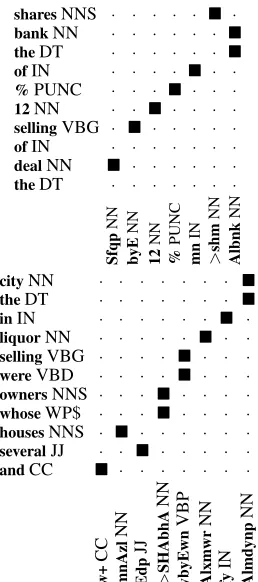
Figure 1: Alignment of the Englishsellingin different contexts. In the first, it is preceded byof and links to the infinitive of the Arabic verbbyE; in the second, it is preceded bywereand links to an inflected form of the same Arabic verb,ybyEwn.
3 Evaluation of alignment quality
Our models were built using the MTTK toolkit (Deng and Byrne, 2005b). Decision tree clustering was imple-mented and the process parallelised to enable thousands of decision trees to be built. Our context-dependent (CD) Model 1 models trained on context-annotated data were compared to the baseline context-independent (CI) mod-els trained on untagged data.
The models were trained using data allowed for the NIST 08 Arabic-English evaluation1, excluding the UN
collections, comprising 300k parallel sentence pairs, a to-tal of 8.4M words of Arabic and 9.5M words of English. The Arabic language incorporates into its words sev-eral prefixes and suffixes which determine grammatical features such as gender, number, person and voice. The MADA toolkit (Habash and Sadat, 2006) was used to perform Arabic morphological word decomposition and part-of-speech tagging. It determines the best analysis for each word in a sentence and splits word prefixes and suffixes, based on the alternative analyses provided by BAMA (Buckwalter, 2002). We use tokenisation scheme
‘D2’, which splits certain prefixes and has been reported to improve machine translation performance (Habash and Sadat, 2006). The alignment models are trained on this processed data, and the prefixes and suffixes are treated as words in their own right; in particular their contexts are examined and clustered.
The TnT tagger (Brants, 2000), used as distributed with its model trained on the Wall Street Journal portion of the Penn treebank, was used to obtain part-of-speech tags for the English side of the parallel text. Marcus et al. (1993) gives a complete list of part-of-speech tags pro-duced. No morphological analysis is performed for En-glish.
Automatic word alignments were compared to a manually-aligned corpus made up of the IBM Arabic-English Word Alignment Corpus (Ittycheriah et al., 2006) and the word alignment corpora LDC2006E86 and LDC2006E93. This contains 28k parallel text sentences pairs: 724k words of Arabic and 847k words of English. The alignment links were modified to reflect the MADA tokenisation; after modification, there are 946k word-to-word alignment links.
Alignment quality was evaluated by computing Align-ment Error Rate (AER) (Och and Ney, 2000) relative to the manual alignments. Since the links supplied con-tain only ‘sure’ links and no ‘possible’ links, we use the following formula for computing AER given reference alignment linksS and hypothesised alignment linksA: AER= 1− 2|S∩A|
|S|+|A|.
3.1 Questions about contexts
The algorithm presented in Section 2 allows for any infor-mation about the context of the source word to be consid-ered. We could consider general questions of the form‘Is
the previous word x?’ and‘Does word y occur within n
words of this one?’. To maintain computational
tractabil-ity, we restrict the questions to those concerning the part-of-speech tag assigned to the current, previous and next words. We do not ask questions about the identities of the words themselves. For each part-of-speech tagT, we ask the question‘Does w have tag T?’. In addition, we group part-of-speech tags to ask more general questions: e.g. the set of contexts which satisfies‘Is w a noun?’contains those that satisfy‘Is w a proper noun?’ and‘Is w a
sin-gular or mass noun?’. We also ask the same questions
of the previous and next words in the source sentence. In English, this gives a total of 152 distinct questions, each of which is considered when splitting a leaf node. The MADA part-of-speech tagger uses a reduced tag set, which produces a total of 68 distinct questions.
Figure 1 shows the links of the English source word
sellingin two different contexts where it links to different
words in Arabic, which are both forms of the same verb. The part-of-speech of the previous word is useful for
dis--4.22e+07 -4.2e+07 -4.18e+07 -4.16e+07 -4.14e+07 -4.12e+07 -4.1e+07 -4.08e+07 -4.06e+07 -4.04e+07
11 12 13 14 15 16 17 18 19 20
Log probability of training data
Iteration
CI Model 1 Threshold 10 Threshold 20 Threshold 60
-3.1e+06 -3.05e+06 -3e+06 -2.95e+06 -2.9e+06 -2.85e+06 -2.8e+06 -2.75e+06
11 12 13 14 15 16 17 18 19 20
Log probability of training data
Iteration
[image:5.612.312.529.58.370.2]CI Model 1 Threshold 10 Threshold 20 Threshold 60
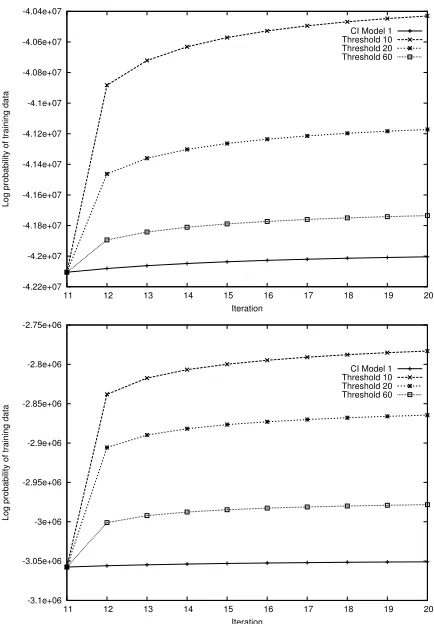
Figure 2: Increase in log probability of training data during training for varyingTimp, with Model 1, for Arabic to English
(top) and English to Arabic (bottom)
criminating between the two cases, whereas a context-independent model would assign the same probability to both Arabic words.
3.2 Training Model 1
Training is carried out in both translation directions. For Arabic to English, the Arabic side of the parallel text is tagged and the English side remains untagged; we view the English words as being generated from the Arabic words and questions are asked about the context of the Arabic words to determine clusters for the translation ta-ble. For English to Arabic, the situation is reversed: we used tagged English text as the source language and un-tagged Arabic text, with morphological decomposition, as the target language.
Standard CI Model 1 training, initialised with a uni-form translation table so thatt(e|f)is constant for all source/target word pairs(f, e), was run on untagged data
English question Frequency
Is Next Preposition 1523 Is Prev Determiner 1444 Is Prev Preposition 1209 Is Prev Adjective 864 Is Next Noun Singular Mass 772 Is Prev Noun Singular Mass 690 Is Next Noun Plural 597
Is Next Noun 549
Arabic question Frequency
Is Prev Preposition 1110 Is Next Preposition 993
Is Prev Noun 981
Is Next Noun 912
[image:6.612.69.278.60.284.2]Is Prev Coordinating Conjunction 627 Is Prev Noun SingularMass 607 Is Next Punctuation 603 Is Next Adjective Adverb 559
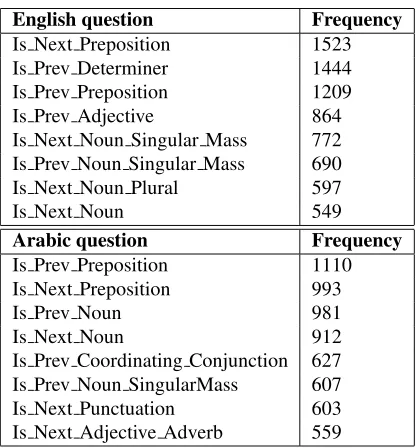
Table 1: Most frequent root node context questions
models were then evaluated using AER at each train-ing iteration. A number of improvement thresholdsTimp
were tested, and performance compared to that of models found after further iterations of CI Model 1 training on the untagged data. In both alignment directions, the log probability of the training data increases during training (see Figure 2). As expected, the training set likelihood increases as the thresholdTimpis reduced, allowing more
clusters and closer fitting to the data.
3.2.1 Analysis of frequently used questions
Table 1 shows the questions used most frequently at the root node of the decision tree when clustering con-texts in English and Arabic. Because they are used first, these are the questions that individually give the great-est ability to discriminate between the different contexts of a word. The list shows the importance of the left and right contexts of the word in predicting its translation: of the most common 50 questions, 25 concern the previous word, 19 concern the next, and only 6 concern the part-of-speech of the current word. For Arabic, of the most frequent 50 questions, 21 concern the previous word, 20 concern the next and 9 the current word.
3.2.2 Alignment Error Rate
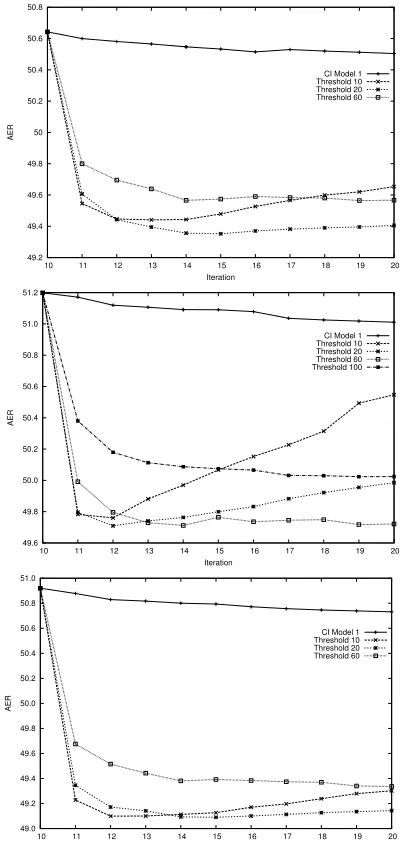
Since MT systems are usually built on the union of the two sets of alignments (Koehn et al., 2003), we consider the union of alignments in the two directions as well as those in each direction. Figure 3 shows the change in AER of the alignments in each direction, as well as the alignment formed by taking their union at corresponding thresholds and training iterations.
Timp Arabic-English (%) English-Arabic (%)
[image:6.612.309.523.62.127.2]10 30601 (25.33) 26011 (39.87) 20 11193 (9.27) 18365 (28.15) 40 1874 (1.55) 9104 (13.96) 100 307 (0.25) 1128 (1.73)
Table 2: Words [number (percentage)] with context-dependent translation for varyingTimp
3.2.3 Variation of improvement thresholdTimp
There is a trade-off between modelling the data accu-rately, which requires more clusters, and eliminating data sparsity problems, which requires each cluster to contain contexts that occur frequently enough in the training data to estimate the translation probabilities accurately. Use of a smaller thresholdTimpleads to more clusters per word
and an improved ability to fit to the data, but this can lead to reduced alignment quality if there is insufficient data to estimate the translation probability distribution accu-rately for each cluster. For lower thresholds, we observe over-fitting and the AER rises after the second iteration of CD training, similar to the behaviour seen in Och (2002). SettingTimp = 0results in each context of a word having
its own cluster, which leads to data sparsity problems. Table 2 shows the percentage of words for which the contexts are split into multiple clusters for CD Model 1 with varying improvement thresholds. This occurs when there are enough training data examples and sufficient variability between the contexts of a word that splitting the contexts into more than one cluster increases the EM auxiliary function. For words where the contexts are not split, all the contexts remain in the same cluster and pa-rameter estimation is exactly the same as for the unclus-tered context-independent models.
3.3 Training HMMs
Adding source word context to translation has so far led to improvements in AER for Model 1, but the perfor-mance does not match that of HMMs trained on untagged data; we therefore train HMMs on tagged data.
We proceed with Model 1 and Model 2 trained in the usual way, and context-independent (CI) HMMs were trained for 5 iterations on the untagged data. Statistics were then gathered for clustering at various thresholds, after which 5 further EM iterations were performed with tagged data to produce context-dependent (CD) HMMs. The HMMs were trained in both the Arabic to English and the English to Arabic directions. The log likelihood of the training set varies with Timp in much the same
way as for Model 1, increasing at each iteration, with greater likelihood at lower thresholds. Figure 4 shows how the AER of the union alignment varies with Timp
49.2 49.4 49.6 49.8 50 50.2 50.4 50.6 50.8
10 11 12 13 14 15 16 17 18 19 20
AER
Iteration
CI Model 1 Threshold 10 Threshold 20 Threshold 60
49.6 49.8 50.0 50.2 50.4 50.6 50.8 51.0 51.2
10 11 12 13 14 15 16 17 18 19 20
AER
Iteration
CI Model 1 Threshold 10 Threshold 20 Threshold 60 Threshold 100
49.0 49.2 49.4 49.6 49.8 50.0 50.2 50.4 50.6 50.8 51.0
10 11 12 13 14 15 16 17 18 19 20
AER
Iteration
[image:7.612.311.528.58.215.2]CI Model 1 Threshold 10 Threshold 20 Threshold 60
Figure 3: Variation of AER during Model 1 training for varying
Timp, for Arabic to English (top), English to Arabic (middle) and their union (bottom)
34.4 34.5 34.6 34.7 34.8 34.9 35.0 35.1 35.2 35.3
5 6 7 8 9 10
AER
Iteration CI HMM
[image:7.612.80.280.61.483.2]Threshold 10 Threshold 20 Threshold 60
Figure 4: AER of the union alignment for varyingTimpwith the HMM model
72 74 76 78 80
40 45 50 55 60
Precision
Recall p0=0.95
p0=0.00 p0=0.95
p0=0.00 English-Arabic CD HMM
English-Arabic CI HMM Arabic-English CD HMM Arabic-English CI HMM
Figure 5: Precision/recall curves for the context-dependent HMM and the baseline context-independent HMM, for Arabic to English and English to Arabic.p0varies from 0.00 to 0.95 in
steps of 0.05.
models produce alignments with a lower AER than the baseline model, and there is evidence of over-fitting to the training data.
3.3.1 Alignment precision and recall
The HMM models include anull transition probability,
p0, which can be modified to adjust the number of
align-ments to the null token (Deng and Byrne, 2005a). Where a target word is emitted from null, it is not included in the alignment links, so this target word is viewed as not being aligned to any source word; this affects the preci-sion and recall. The results reported above usep0= 0.2
for English-Arabic andp0= 0.4for Arabic-English; we
can tune these values to produce alignments with the low-est AER. Figure 5 shows precision-recall curves for the CD HMMs compared to the CI HMMs for both transla-tion directransla-tions. For a given value of precision, the CD HMM has higher recall; for a given value of recall, the CD HMM has higher precision.
We do not report F-score (Fraser and Marcu, 2006) since in our experiments we have not found strong cor-relation with translation performance, but we note that these results for precision and recall should lead to im-proved F-scores as well.
4 Evaluation of translation quality
We have shown that the context-dependent models pro-duce a decrease in AER measured on manually-aligned data; we wish to show this improved model performance leads to an increase in translation quality, measured by BLEU score (Papineni et al., 2001). In addition to the Arabic systems already evaluated by AER, we also report results for a Chinese-English translation system.
[image:7.612.71.290.535.686.2]direc-tion. HiFST, a WFST-based hierarchical translation sys-tem described in (Iglesias et al., 2009), was trained on the union of these alignments. MET (Och, 2003) was carried out using a development set, and the BLEU score evaluated on two test sets. Decoding used a 4-gram lan-guage model estimated from the English side of the entire MT08 parallel text, and a 965M word subset of monolin-gual data from the English Gigaword Third Edition.
For both Arabic and English, the CD HMM models were evaluated as follows. Iteration 5 of the CI HMM was used to produce alignments for the parallel text train-ing data: these were used to train the baseline system. The same data is aligned using CD HMMs after two further iterations of training and a second WFST-based translation system built from these alignments. The mod-els are evaluated by comparing BLEU scores with those of the baseline model.
4.1 Arabic to English translation
Alignment models were trained on the NIST MT08 Arabic-English parallel text, excluding the UN portion. The null alignment probability was chosen based on the AER, resulting in values of p0 = 0.05 for Arabic to
English andp0 = 0.10for English to Arabic. We
per-form experiments on the NIST Arabic-English transla-tion task. Themt02 05 tuneandmt02 05 testdata sets are formed from the odd and even numbered sentences of the NIST MT02 to MT05 evaluation sets respectively; each contains 2k sentences and 60k words. We use
mt02 05 tuneas a development set and evaluate the
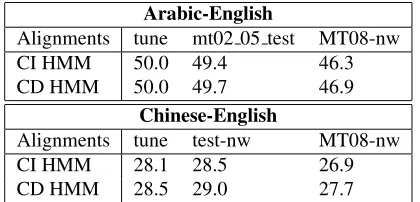
sys-tem on mt02 05 test and the newswire portion of the MT08 set,MT08-nw. Table 3 shows a comparison of the system trained using CD HMMs with the baseline sys-tem, which was trained using CI HMM models on un-tagged data. The context-dependent models result in a gain in BLEU score of 0.3 formt02 05 testand 0.6 for
MT08-nw.
4.2 Chinese to English translation
The Chinese training set was 600k random parallel text sentences of the newswire LDC collection allowed for NIST MT08, a total of 15.2M words of Chinese and 16.6M words of English. The Chinese text was tagged us-ing the MXPOST maximum-entropy part of speech tag-ging tool (Ratnaparkhi, 1996) trained on the Penn Chi-nese Treebank 5.1; the English text was tagged using the TnT part of speech tagger (Brants, 2000) trained on the Wall Street Journal portion of the English Penn treebank. The development settune-nwand validation settest-nw
contain a mix of the newswire portions of MT02 through MT05 and additional developments sets created by trans-lation within the GALE program. We also report results on the newswire portion of the MT08 set. Again we see an increase in BLEU score for both test sets: 0.5 for
test-Arabic-English
Alignments tune mt02 05 test MT08-nw CI HMM 50.0 49.4 46.3 CD HMM 50.0 49.7 46.9
Chinese-English
[image:8.612.308.518.63.164.2]Alignments tune test-nw MT08-nw CI HMM 28.1 28.5 26.9 CD HMM 28.5 29.0 27.7
Table 3: Comparison, using BLEU score, of the CD HMM with the baseline CI HMM
nwand 0.8 forMT08-nw.
5 Conclusions and future work
We have introduced context-dependent Model 1 and HMM alignment models, which use context information in the source language to improve estimates of word-to-word translation probabilities. Estimation of parame-ters using these contexts without smoothing leads to data sparsity problems; therefore we have developed decision tree clustering algorithms to cluster source word contexts based on optimisation of the EM auxiliary function. Con-text information is incorporated by the use of part-of-speech tags in both languages of the parallel text, and the EM algorithm is used for parameter estimation.
We have shown that these improvements to the model lead to decreased AER compared to context-independent models. Finally, we compare machine translation sys-tems built using our context-dependent alignments. For both Arabic- and Chinese-to-English translation, we report an increase in translation quality measured by BLEU score compared to a system built using context-independent alignments.
This paper describes an initial investigation into context-sensitive alignment models, and there are many possible directions for future research. Clustering the probability distributions of infrequently occurring may produce improvements in alignment quality, different model training schemes and extensions of the context-dependence to more sophisticated alignment models will be investigated. Further translation experiments will be carried out.
Acknowledgements
References
A. L. Berger, S. Della Pietra, and V. J. Della Pietra. 1996. A maximum entropy approach to natural language processing.
Computational Linguistics, 22(1):39–71.
Graeme Blackwood, Adri`a de Gispert, Jamie Brunning, and William Byrne. 2008. European language translation with weighted finite state transducers: The CUED MT system for the 2008 ACL workshop on SMT. InProceedings of the Third Workshop on Statistical Machine Translation, pages 131–134, Columbus, Ohio, June. Association for Computa-tional Linguistics.
Thorsten Brants. 2000. TnT – a statistical part-of-speech tag-ger. InProceedings of the 6th Applied Natural Language Processing Conference: ANLP-2000, Seattle, USA. Peter F. Brown, Vincent J. Della Pietra, Stephen A. Della Pietra,
and Robert L. Mercer. 1993. The mathematics of statistical machine translation: parameter estimation. Computational Linguistics, 19(2):263–311.
T. Buckwalter. 2002. Buckwalter Arabic morphological ana-lyzer.
Marta Ruiz Costa-juss`a and Jos´e A. R. Fonollosa. 2005. Improving phrase-based statistical translation by modifying phrase extraction and including several features. In Proceed-ings of the ACL Workshop on Building and Using Parallel Texts, pages 149–154, June.
Yonggang Deng and William Byrne. 2005a. HMM word and phrase alignment for statistical machine translation. InProc. of HLT-EMNLP.
Yonggang Deng and William Byrne. 2005b. JHU-Cambridge statistical machine translation toolkit (MTTK) user manual. Yonggang Deng, Shankhar Kumar, and William Byrne. 2007.
Segmentation and alignment of parallel text for statistical machine translation.Journal of Natural Language Engineer-ing, 13:3:235–260.
Alexander Fraser and Daniel Marcu. 2006. Measuring word alignment quality for statistical machine translation. Tech-nical Report ISI-TR-616, ISI/University of Southern Califor-nia, May.
Nizar Habash and Fatiha Sadat. 2006. Arabic preprocessing schemes for statistical machine translation. InHLT-NAACL. G. Iglesias, A. de Gispert, E. R. Banga, and W. Byrne. 2009. Hierarchical phrase-based translation with weighted finite state transducers. In Procedings of NAACL-HLT, 2009, Boulder, Colorado.
Abraham Ittycheriah, Yaser Al-Onaizan, and Salim Roukos. 2006. The IBM Arabic-English word alignment corpus, Au-gust.
A. Kannan, M. Ostendorf, and J. R. Rohlicek. 1994. Maxi-mum likelihood clustering of Gaussians for speech recogni-tion. Speech and Audio Processing, IEEE Transactions on, 2(3):453–455, July.
Philipp Koehn, Franz Josef Och, and Daniel Marcu. 2003. Sta-tistical phrase-based translation. InNAACL ’03: Proceed-ings of the 2003 Conference of the North American Chapter of the Association for Computational Linguistics on Human Language Technology, pages 48–54.
Mitchell P. Marcus, Mary Ann Marcinkiewicz, and Beatrice Santorini. 1993. Building a large annotated corpus of
English: the Penn Treebank. Computational Linguistics, 19(2):313–330.
Sonja Nießen and Hermann Ney. 2001a. Morpho-syntactic analysis for reordering in statistical machine translation. In
Proceedings of MT Summit VIII, pages 247–252, September. Sonja Nießen and Hermann Ney. 2001b. Toward hierarchical models for statistical machine translation of inflected lan-guages. In Proceedings of the workshop on Data-driven methods in machine translation, pages 1–8, Morristown, NJ, USA. Association for Computational Linguistics.
Franz Josef Och and Hermann Ney. 2000. A comparison of alignment models for statistical machine translation. In Pro-ceedings of the 18th conference on Computational Linguis-tics, pages 1086–1090.
F. Och, D. Gildea, S. Khudanpur, A. Sarkar, K. Yamada, A. Fraser, S. Kumar, L. Shen, D. Smith, K. Eng, V. Jain, Z. Jin, and D. Radev. 2004. A smorgasbord of features for statistical machine translation. InProceedings of NAACL. Franz Josef Och. 2002.Statistical Machine Translation: From
Single Word Models to Alignment Templates. Ph.D. thesis, Franz Josef Och.
Franz Josef Och. 2003. Minimum error rate training in statisti-cal machine translation. InACL ’03: Proceedings of the 41st Annual Meeting on Association for Computational Linguis-tics, pages 160–167.
Kishore Papineni, Salim Roukos, Todd Ward, and Wei-Jing Zhu. 2001. Bleu: a method for automatic evaluation of ma-chine translation. InProceedings of ACL, pages 311–318. Maja Popovi´c and Hermann Ney. 2004. Improving word
align-ment quality using morpho-syntactic information. InIn Pro-ceedings of COLING, page 310.
Adwait Ratnaparkhi. 1996. A maximum entropy model for part-of-speech tagging. In In Proceedings of the Confer-ence on Empirical Methods in Natural Language Processing, pages 133–142.
H. Singer and M. Ostendorf. 1996. Maximum likelihood suc-cessive state splitting.Proceedings of ICASSP, 2:601–604. Nicolas Stroppa, Antal van den Bosch, and Andy Way. 2007.
Exploiting source similarity for SMT using context-informed features. InProceedings of the 11th Conference on Theoreti-cal and MethodologiTheoreti-cal Issues in Machine Translation (TMI 2007), pages 231 – 240.
Kristina Toutanova, H. Tolga Ilhan, and Christopher D. Man-ning. 2002. Extensions to HMM-based statistical word alignment models. InProceedings of EMNLP, pages 87–94. Ismael Garc´ıa Varea, Franz J. Och, Hermann Ney, and Fran-cisco Casacuberta. 2002. Improving alignment quality in statistical machine translation using context-dependent max-imum entropy models. In Proceedings of COLING, pages 1–7.
Stephan Vogel, Hermann Ney, and Christoph Tillmann. 1996. HMM-based word alignment in statistical translation. In
Proceedings of COLING, pages 836–841.