Frames: A Corpus for Adding Memory
to Goal-Oriented Dialogue Systems
Layla El Asri∗ and Hannes Schulz∗ and Shikhar Sharma∗ and Jeremie Zumer∗ Justin Harris and Emery Fine and Rahul Mehrotra and Kaheer Suleman
Microsoft Maluuba
∗these authors contributed equally
Abstract
This paper proposes a new dataset,Frames, composed of 1369 human-human logues with an average of 15 turns per dia-logue. This corpus contains goal-oriented dialogues between users who are given some constraints to book a trip and assis-tants who search a database to find appro-priate trips. The users exhibit complex decision-making behaviour which involve comparing trips, exploring different op-tions, and selecting among the trips that were discussed during the dialogue. To drive research on dialogue systems towards handling such behaviour, we have anno-tated and released the dataset and we pro-pose in this paper a task calledframe track-ing. This task consists of keeping track of different semantic frames throughout each dialogue. We propose a rule-based baseline and analyse the frame tracking task through this baseline.
1 Introduction
Goal-oriented, information-retrieving dialogue sys-tems have been designed traditionally to help users find items in a database given a set of constraints (Singh et al., 2002; Raux et al., 2003; El Asri et al.,2014;Laroche et al., 2011). For instance, theLET’S GOdialogue system finds a bus sched-ule given a bus number and a location (Raux et al.,
2003).
Available resources for data-driven learning of such goal-oriented systems are often collected with an existing system (Henderson et al.,2014b; Ben-nett and Rudnicky,2002) and have been proposed to study one component of dialogue. Examples are the first three Dialogue State Tracking Challenges (DSTC,Williams et al.,2016) during which a
se-ries of datasets and tasks of increasing complexity were released. These shared tasks were essential to advance the state of the art on state tracking. Other resources have allowed to study and develop differ-ent approaches to spoken language understanding and entity extraction (Mesnil et al.,2013). As for dialogue management, simulators have been pro-posed (Schatzmann et al.,2006) but datasets are scarce.
In most datasets collected with an existing sys-tem, the dialogues consist of sequential slot-filling: the system requests constraints until it can query the database and return several results to the user. Then, the user can ask for more information about a given result or request other possibilities. As a consequence, the tasks and methods that were based on these datasets were defined according to this sequential slot-filling process
We propose the Framesdataset to study more complex dialogue flows and decision-making be-haviour. Our motivation comes from user studies in e-commerce which show that several information-seeking behaviours are exhibited by users who may come with a very well defined item in mind, but may also visit an e-commerce website with the intent to compare items and explore different pos-sibilities (Moe and Fader,2001;Saha et al.,2017). Supporting this kind of decision-making process in conversational systems implies addingmemory. Memory is necessary to track different items or preferences set by the user during the dialogue. For instance, consider product comparisons. If a user wants to compare different items using a dialogue system, then this system should be able to sepa-rately recall properties pertaining to each item.
vaca-tion packages containing round-trip flights and a hotel. Users were tasked with finding packages based on a few constraints such as a destination and a budget. The dataset has been fully annotated by human experts and is publicly available1.
Along with this dataset, we formalize a new task calledframe tracking. Frame tracking is an exten-sion of state tracking (Henderson,2015;Williams et al.,2016). In state tracking, the information sum-marizing the full dialogue history is compressed into a single semantic frame which contains prop-erties and values corresponding to the user’s pref-erences (e.g., destination city). In frame tracking, the dialogue agent must simultaneously track mul-tiple semantic frames (e.g., different destination cities; frames are defined formally in Section4.2) throughout the conversation.
2 Data Collection
We collected the Frames data over a period of 20 days with 12 participants, who worked either for one day, one week, or 20 days. The participants alternated between the user and wizard roles on a daily basis. Due to this rotation, we can assume that we deal with returning users who know how to use the system, and focus on the decision making process, skipping the phase where the user learns about the system capabilities. The domain for all dialogues is travel: specifically, finding a vacation package that fulfils certaina priorirequirements through a conversational search-and-compare pro-cess.
2.1 Wizard-Of-Oz Setting
Wizard-of-Oz (WOz) dialogues (Kelley, 1984;
Rieser et al., 2005; Wen et al., 2016) have the considerable advantage of exhibiting realistic be-haviours often beyond the capabilities of existing dialogue systems. Our setting is slightly differ-ent from the usual WOz setting because, in our case, users did not believe they were interacting with a dialogue system; they knew they were con-versing with fellow humans. We chose not to give templated answers to wizards because, apart from studying decision-making, we also wanted to study information presentation and dialogue man-agement. We work with text-based dialogues cause this engenders a more controlled wizard be-haviour, obviates handling time-sensitive turn tak-ing, and speech recognition noise.
1datasets.maluuba.com/Frames
2.2 Task Templates and Instructions
User-wizard dialogues took place on Slack.2 We deployed a Slack bot to pair up participants and record conversations. At the beginning of each dialogue, a user was paired with a wizard and given a new task. Tasks were built from templates like the following:
“Find a vacation between
[START DATE] and [END DATE]
for [NUM ADULTS] adults and
[NUM CHILDREN] kids. You leave
from[ORIGIN CITY]. You are travel-ling on a budget and you would like to spend at most $[BUDGET].”
Tasks were generated by drawing values (e.g., for BUDGET) from a database. We constructed our database of flight and hotel properties by hand to simulate what one would find on a standard travel booking site. Each template was assigned a proba-bility of success, and then constraint values were drawn in order to comply with this probability. For example, if 20 tasks were generated at probability 0.5, about 10 tasks would be generated with suc-cessful database queries and the other 10 would be generated such that the database returned no results for the constraints. This success mech-anism allowed us to emulate cases when a user would find nothing meeting her constraints. If a task was unsuccessful, the user either ended the dialogue or got an alternative task such as: “If nothing matches your constraints, try increasing your budget by $200.” We wrote 38 templates. 14 were generic like the one presented above and the other 24 included a background story to encourage role-playing from users and to keep them engaged. These templates were meant to add variety to the dialogues. The generic templates were also im-portant for the users to create their own character and personality. We found that the combination of the two types of templates prevented the task from becoming too repetitive. Notably, we distributed the role-playing templates throughout the data col-lection process to bring some novelty and surprise. We also asked the participants to write templates (13 of them) to keep them engaged in the task.
To control data collection, we gave a set of in-structions to the participants. The user inin-structions encouraged a variety of behaviours. As for the wizards, they were asked only to talk about the
database results and the task at hand. We also asked the wizards to perform untimely actions oc-casionally, for instance, to ask for information that the user has already provided. It is interesting from a dialogue management point of view to have ex-amples of bad behaviour and of how it impacts user satisfaction. At the end of each dialogue, the user provided a wizard cooperativity rating on a scale of 1 to 5. The wizard, on the other hand, was shown the user’s task and was asked whether she thought the user had accomplished it.
2.3 Search Interface And Suggestions
Wizards received a link to a search interface every time a user was connected to them. The search interface was a simple GUI with all the searchable fields in the database (see AppendixA). For every database search, up to 10 results were displayed, sorted by increasing price.
Another important property of human dialogue that we want to study with Frames is how to provide users with database information. When a set of user constraints leads to no results, users would bene-fit from knowing that relaxing a given constraint (e.g., increasing the budget by a reasonable amount) leads to results. We modelled this by displaying suggestions to the wizards when a database query returned no results. Suggestions were packages obtained by randomly relaxing one or more con-straints. It was up to the wizard to decide whether or not to use suggestions.
3 Statistics of the Corpus
Using the data collection process described above, we collected1369 dialogues. Figure1ashows the distribution of dialogue lengths in the corpus. The average number of turns is 15, for a total of19986 turnsin the dataset. A turn is defined as a Slack message sent by either a user or a wizard. Turns always alternate between user and wizard.
Figure1bshows the number of acts per dialogue turn. About 25% of the dialogue turns have more than one dialogue act. The turns without dialogue acts are turns where the user asked for something that the wizard could not provide,e.g., because it was not part of the database. We left such (rarely oc-curring) user turns unannotated, as they are usually followed up by the wizard saying she cannot pro-vide the required information. This rarely occurs, since our users are familiar with the capabilities of the “system” after only few dialogues.
Figure1cshows the distribution of user ratings. More than 70% of the dialogues have the maximum rating of 5. Figure 2 shows the occurrences of dialogue acts in the corpus. The dialogue acts are described in Table9. We present the annotation scheme in the following section.
4 Annotation
We manually annotated the Frames dataset with dialogue acts, slot types and values, references to other frames, and the ID of the currently active frame for each utterance. We also computed frame descriptions based on the labels of earlier turns.
4.1 Dialogue Acts, Slot Types, Slot Values
Most of the dialogue acts used for annotation are typical of the goal-oriented setting, such as inform and offer (Henderson et al., 2014b). We also introduced dialogue acts specifically for frame tracking, such as switch frame and request compare. The dialogue acts are listed in Table9.
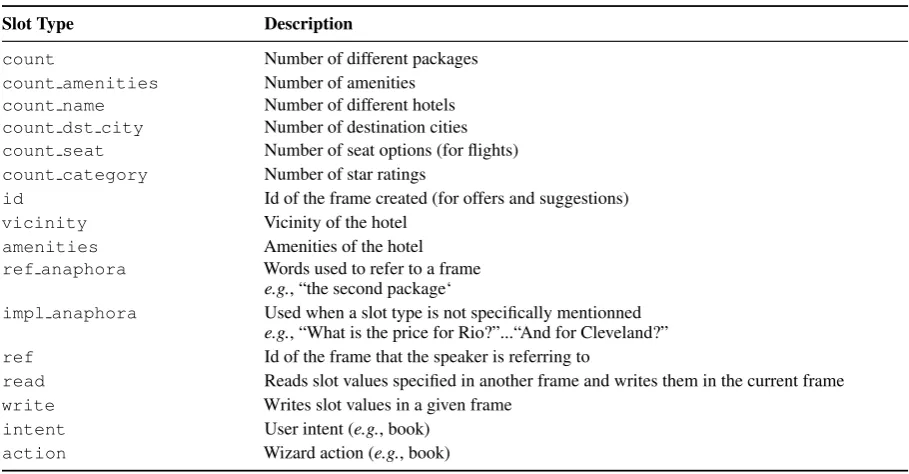
Our annotation uses three sets of slot types. The first set, listed in Tables7and8, corresponds to the fields of the database. The second set is listed in Ta-ble10and contains the slot types which we defined to describe specific aspects of the dialogue, such as intent, action, and count. The remaining slot types in Table10were introduced to describe frames and cross-references between them.
4.2 Frame Definition
Semantic frames form the core of our dataset. A semantic frame is defined by the following four components:
• User requests: slots whose values the user wants to know for this frame.
• User binary questions: user questions with slot types and slot values.
• Constraints: slots which have been set to a particular value by the user or the wizard. • User comparison requests: slots whose values
the user wants to know for this frame and one or more other frames.
3 8 13 18 23 28 33 38 43
Dialogue Length (Number of Turns)
0 2 4 6 8
Dialogues (%)
(a)
0 1 2 3 4 5 6 7 8 9
Number of Acts per Turn
0 10 20 30 40 50 60
Turns (%)
author user wizard
(b)
1 2 3 4 5
User Rating
0 20 40 60
Dialogues (%)
[image:4.595.87.517.55.168.2](c)
[image:4.595.84.526.213.316.2]Figure 1: Overview of the Frames corpus
Table 1: Dialogue excerpt with active frame annotation
Author Utterance Frame
User I’d like to book a trip to Atlantis from Caprica on Saturday, 1 August 13, 2016 for 8 adults. I have a tight budget of 1700.
Wizard Hi...I checked a few options for you, and unfortunately, we do not currently have any 1
trips that meet this criteria. Would you like to book an alternate travel option?
User Yes, how about going to Neverland from Caprica on August 13, 2 2016 for 5 adults. For this trip, my budget would be 1900.
Wizard I checked the availability for those dates and there were no trips available. 2
Would you like to select some alternate dates?
the wizard. The comparison requests and the bi-nary questions were added after analysing the di-alogues. The comparison requests correspond to the request comparedialogue act. This dia-logue act is used to annotate turns when a user asks to compare different results, for instance: “Could you tell me which of these resorts offers
free wifi?”. These questions possibly relate to several frames. Binary questions are questions with slot types and slot values, e.g., “In which part of the town is the hotel located?” (request act), or “Is the trip to Marseille cheaper than to Naples?” (request compare act), as well as allconfirmacts. Binary questions may concern one or several frames.
4.3 Frame Creation and Switching
Each dialogue starts in frame 1. New frames are in-troduced when the wizard offers or suggests
some-0 2000 4000 6000 8000 10000
Number of Occurrences
reject canthelp you_are_welcomehearmore request_comparerequest_alts goodbye moreinfoconfirm negateaffirm greetingsorry thankyouno_result suggest switch_framerequest offer inform
Act
Figure 2: Dialogue act occurrences in the corpus
thing, or when the user modifies pre-established slots. Thus, all values discussed during the dia-logue are recorded and the user can return to a pre-vious set of constraints at any point. An example is given in Table1: the frame number changes when the user modifies several slot values, namely, the destination city, the number of adults for the trip, and the budget. While modifying pre-established slots is supported by most dialogue systems, these rules allow us to clearly distinguishing creating frames from extending frames and thus define how the items in the dialogue memory, which the user can reference, are structured. Though frames are created for each offer or suggestion made by the wizard, theactiveframe can only be changed by the user so that the user has control over the dialogue. When creating frames, the annotator can explicitly mark which frame the new frame is derived from, which heuristically copies some of its content to the new frame. If not annotated, we assume it is derived from the currently active frame. If the user asks for more information about a specific offer or suggestion, the active frame is changed to the frame introduced with that offer or suggestion. This change of frame is indicated by aswitch frame act (see AppendixA). The rules for creating and switching frames are summarized in Table2.
[image:4.595.74.284.604.745.2]Table 2: Frequency of frame creation and switching events
Rule Type Author Rule Description Relative Frequency Absolute Frequency
Creation User Changing the value of a slot 31 % 2092
Wizard Making an offer or a suggestion 69 % 4762
Switching User Changing the value of a slot (it causes the dialogue to switch to that frame)
50 % 2092
Considering a wizard offer or suggestion 39 % 1635
Switching to an earlier frame by mentioning its slot values
11 % 458
this frame when the user decides to do so.
The other slot types are used to annotate cross-references between frames. A reference has two parts: the id of the frame it refers to and the slots and values that are used to refer to that frame (if any). For instance, ref[1{name=Tropic}]means that frame 1 is being referred to by the hotel name Tropic. If anaphora are used to refer to a frame, we annotated this with the slot ref anaphora (e.g., “This is too long” –inform(duration=too long, ref anaphora=this)). Inside anoffer dia-logue act, arefmeans that the frame correspond-ing to the offer is derived from another frame. This happens for instance when a wizard proposes a package with business or economy options. In this case, the business and economy offers are derived from the hotel offer.
The slot typesreadandwriteonly occur in-side a wizard’sinformact and are used by wiz-ards to provide relations between offers or sugges-tions: read is used to indicate which frame the values come from (and which slots are used to refer to this frame, if any), whilewriteindicates the frame where the slot values are to be written (and which slot values are used to refer to this frame, if any). If there is areadwithout awrite, the current frame is assumed as the storage for the slot values. A slot type without a value indicates that the value is the same as in the referenced frame, but was not mentioned explicitlye.g., “for the same price”.
Table 3 gives an example of how these slot types are used in practice: inform(
read=[7{dst city=Punta Cana,
category=2.5}]) means that the values
2.5andPunta Canaare to be read from frame 7, and to be written in the current frame. At this turn of the dialogue, the wizard repeats information from frame 7. The annotation
inform(breakfast=False,write=
[7{name=El Mar}]) means that the value
Falsefor breakfast is written in frame 7 and that frame 7 was identified in this utterance by the name of the hotelEl Mar.
The average number of frames created per di-alogue is 6.71 and the average number of frame switches is 3.58. Figure3shows boxplots for the number of frame creations and the number of frame changes in the corpus.
4.4 Annotation Reproducibility
Five trained experts annotated the dataset accord-ing to the above rules. To measure inter-annotator agreement, the experts annotated the same ran-domly chosen 10 dialogues. On this subset, we compute the inter-annotator agreement rate as the F1-score. Note that the commonly usedκstatistic cannot be directly applied here, since the anno-tation is not a multi-class classification problem. The provided F1 score also captures how much the annotators failed to annotate words or acts, or dis-agreed about the correct value. We report the mean and standard deviation over all possible pairing of annotators. On dialogue acts only, this score is 81.2 ±3.1, on slot values, it is 95.2±1.1, and on dia-logue acts, slot values, and content of referenced frames, it is 62.3±4.9.
frame changes
frames
0
10
20
30
Frames and Frame Changes
[image:5.595.317.497.592.727.2]Table 3: Annotation example with thewriteandreadslot types
Author Utterance Frame Annotation
Wizard I am only able to find hotels with a 6 inform(read=[7{dst city=Punta Cana,
2.5 star rating in Punta Cana for that time. category=2.5}]) User 2.5 stars will do. 11 inform(category=2.5)
Can you offer any additional activities?
Wizard Unfortunately I am not able to provide 11 sorry, canthelp
this information.
User How about breakfast? 11 request(breakfast)
Wizard El Mar does not provide breakfast. 11 inform(breakfast=False,write=[7{name=El Mar}])
id=0 (current)
id=1
dst city=Mannheim or city=Melbourne price=8000USD
id=2
dst city=New York or city=Melbourne
id=3 (new)
inform(dst city=Mannheim, budget=cheaper, flex=T)
Is there a cheaper package to Mannheim? I’m flexible with the dates.
Figure 4: Illustration of the frame tracking task. The model must choose, for each slot, which frame it is referring to, given the set of available frames, the previous active frame (bold), and the potential new frame (marked “(new)”).
5 Research Topics
Frames can be used to study many aspects of goal-oriented dialogue, from Natural Language Under-standing (NLU) to Natural Language Generation (NLG). In this section, we propose three topics that we believe are new and representative of Frames.
5.1 Frame Tracking 5.1.1 Definition
We proposeFrame trackingas an extension of state tracking (Henderson,2015) to a setting where sev-eral semantic frames are tracked simultaneously. In state tracking, the dialogue history is compressed into one semantic frame. The state tracker updates a probability distribution, for each slot, over the different possible values. Every time the user sets a new value, the probability distribution is updated. This architecture prevents the user from comparing options or returning to an item discussed earlier since the values for each slot are tracked separately. In frame tracking, a new value creates a new seman-tic frame. The frame tracking task is significantly harder as it requires, for each user utterance, iden-tifying the active frame as well as all the frames modified by the utterance. An example is provided in Fig.4.
Definition 1(Frame Tracking). At each user turnt, we assume access to the full dialogue historyH =
{f1, ..., fnt−1}, wherefiis a frame andnt−1is the number of frames created so far in the dialogue. For a user utteranceutat timet, we provide the following NLU labels: dialogue acts, slot types, and slot values. The goal of frame tracking is to predict if a new frame is created and to predict for each dialogue act thereflabels (possibly none) and theids of the frames referenced.
Predicting the frame that is referenced by a dia-logue act requires detecting if a new frame is cre-ated and recognizing a previous frame from the val-ues mentioned by the user (potentially synonyms, e.g., NYC for New York), or by using the user utterance directly. It is necessary in many cases to use the user utterance directly because users do not always use slot values to refer to previous frames. An example in the corpus is a user asking: “Which package has the soonest departure?”. In this case, the user refers to several frames (the pack-ages) without ever explicitly describing which ones. This phenomenon is quite common for dialogue acts such asswitch frame(979 occurrences in the corpus) andrequest compare(455 occur-rences in the corpus). These cases can only be resolved by working on the text directly and solv-ing anaphora.
Note that when talking with real users, a system would need to generate the frames dynamically during the dialogue. We propose the frame tracking task as a first step and we show in Section6.2that this simplified task entails many challenges.
5.1.2 Evaluation Metrics
pairs. The frame is the id of the referenced frame. Thekeyandvalueare respectively the type and the value of the slot used to refer to the frame (these can be null).
For frame creation, we compute the number of times the frame tracker correctly predicts that a frame is created or correctly predicts that a frame has not been created over the number of dialogue turns.
5.1.3 Related Work
In previous work, some limitations of sequential slot filling dialogue systems were addressed using goal-modeling (Crook and Lemon,2010;Crook et al.,2012;Misu et al.,2011), task tracking (Lee and Stent,2016) and memory-augmentation of clas-sical state tracking (Weston et al.,2015).
Crook and Lemon (2010);Crook et al.(2012) model the user goal as a subset of all possible slot value combinations and propose techniques to au-tomatically compress this huge space into a sum-mary space. Rewards, transitions, and observations of a POMDP system can then be projected to the reduced space, which facilitates policy learning.
Misu et al.(2011) propose a method for decision support in spoken dialogue systems that aids a user who is assumed to have an (unknown) weighted preference over the possible slot values and limited knowledge about alternatives. The authors employ a user simulator that outputs dialogue acts to learn a policy that optimizes the sum of the weights of the final user selection. The Frames dataset allows learning and evaluating these techniques on a large and more realistic text-based dataset. Additionally, the memorized frames would allow a dialogue sys-tem to compare disjunct goals or return to earlier states.
Recent approaches to state tracking have been suggested to go beyond the sequential slot-filling approach. An important contribution is the Task Lineage-based Dialog State Tracking (TL-DST) proposed byLee and Stent(2016). TL-DST is a framework that allows keeping track of tasks across different domains. Similarly to frame tracking,Lee and Stent propose building a dynamic structure of the dialogue containing different frames corre-sponding to different tasks. They defined different sub-tasks among whichtask frame parsingwhich is closely related to frame tracking except that they impose constraints on how a dialogue act can be assigned to a frame and a dialogue act can only re-late to one frame. Because of the lack of data,Lee
and Stent(2016) trained their tracking model on datasets released for DSTC (DSTC2 and DSTC3,
Henderson et al.,2014b,a). As a result, they could artificially mix different tasks,e.g., looking for a restaurant and looking for a pub, but they could not study how human beings switch between topics. In addition, this framework can switch between differ-ent tasks but does not handle comparisons between disjunct frames, which is an important aspect of frame tracking.
Another related approach was proposed byPerez and Liu(2016) who re-interpreted the state track-ing task as a question-answertrack-ing task. Their state tracker is based on a memory network (Weston et al.,2015) and can answer questions about the user goal at the end of the dialogue. They also propose adding functionalities such as keeping a list of the constraints expressed by the user during the dialogue.
The Frames dataset may be used to test and vali-date these approaches on real data. In addition, we propose the frame tracking task as benchmark and as a first step towards modelling complex decision-making behaviour.
5.2 Dialogue Management
Most of the time, the wizard would speak about the current frame to ask or answer questions. However, sometimes, the wizard would talk about previous frames. An example is given in Table11in Ap-pendixA. In the bold utterance in this dialogue, the wizard mentions a frame which is not the currently active frame. In order to reproduce this kind of behaviour, a dialogue manager would need to be able to identify potentially relevant frames for the current turn and to output actions for these frames.
Table11also illustrates another novelty. In the utterance in italics, the wizard actually performs two actions. The first action consists of inform-ing the user about the price of theregal resortand the second action consists of proposing another option,Hotel Globetrotter. Performing more than one action per turn is a challenge when using re-inforcement learning (Pietquin et al.,2011;Gaˇsi´c et al.,2012;Fatemi et al.,2016) and, to our knowl-edge, has only been tackled in a simulated setting (Laroche et al.,2009).
5.3 Natural Language Generation
Table 4: F1 scores for the NLU baseline (mean and standard deviation).
Dialogue Acts Slots
0.78±0.05 0.79±0.04
available flight is 1947.14USD.”In this case, the wizard informs the user that the database has no cheaper result than the one she is proposing. To imitate this behaviour, a natural language gener-ator (Oh and Rudnicky,2000;Wen et al., 2015;
Sharma et al.,2017) would need to reason over the database and decide how to tailor the results to the user and present them in a concise but sufficient way. Various strategies and their combinations can be employed, e.g. summarization, compari-son or recommendation (Rieser and Lemon,2009). A decision-theoretical foundation of such an ap-proach was presented byWalker et al.(2004). A data-driven approach to attribute selection for NLG as planning under uncertainty was proposed by
Rieser et al.(2014). The Frames dataset contains a larger set of dialogues as well as wizard-generated text with detailed annotations, which we believe will provide insight into when humans use which strategy and how they present the information.
6 Baselines
We developed baseline models for natural language understanding and frame tracking.
embedding function
york trigrams
bi - GRU bi - GRU
dense + softmax dense + softmax
tanh
Acts Slots
embeddings
#yo rk#
[image:8.595.76.292.101.131.2]Figure 5: Illustration of the NLU model for slots and acts prediction.
Table 5: Accuracy (%) of the Frame Tracking Base-lines (mean and standard deviation).
Rule-Based Random
Frame Creation 0.49±0.03 0.47±0.02 Frame Identification 0.24±0.02 0.18±0.02
6.1 Natural Language Understanding
We define the NLU task as dialogue act prediction and IOB (Inside, Outside, Beginning) tagging. The NLU model that we propose as baseline is illus-trated in Fig.5. We predict, for each word of the utterance, a pair of tags – one for the act and one for the slot. This model operates on character trigrams and is based on the robust named entity recognition model (Arnold et al.,2016) except that it has two heads instead of one: one head for the slot type (either a slot type or anOtag) as in the original model and one head for dialogue act prediction. These two parts share an embedding matrix for the input character trigrams.
We generated the IOB tags by matching the slot values in the manual annotations with the corre-sponding textual utterances. Note that the model only predicts IOB tags for slots whose values can be found in the text. Therefore, the prediction for slots such asintentor vicinities and amenities is not evaluated for this simple baseline. The act tags were also generated at the word level: for a given dialogue act with slot values, each word be-tween the slot value that occurred first in the text and the one that occurred last in the text was tagged with the corresponding act. For example, for the utteranceI am only able to find hotels with a 2.5 star rating in Punta Cana for that time., the words 2.5 star rating in Punta Canaare tagged with the informdialogue act. The other words are tagged withO.
The two parts of the model are trained simulta-neously, using a modified categorical crossentropy loss for both sets of outputs. We modify the loss to ignoreOlabels that are already predicted cor-rectly by the model. We introduce this modification becauseOlabels are far more frequent than other labels, and not limiting their contribution to the loss causes the model to degenerate to predicting Olabels for every word. The losses for both parts of the model are added together and the combined objective is optimized using ADAM (Kingma and Ba,2015).
[image:8.595.93.269.537.738.2]stan-dard deviation over ten leave-one-user-out splits of the Frames dataset. We had a total of 11 partici-pants who played the user role at least once during data collection. Two participants performed signifi-cantly fewer dialogues than the others. We merged the dialogues generated by these two participants (ids U21E41CQP and U23KPC9QV). For each of the resulting 10 users, we randomly split the com-bined dialogues of the nine others into training (80%) and validation (20%), and then tested on the dialogues from the held-out user.
6.2 Frame Tracking
We propose a rule-based frame tracking baseline which takes as input the dialogue acts with slot types and slot values but without the referenced frames (i.e., therefslots) as well as all the frames created so far during the dialogue. Based on this input, the tracker predicts thereftags (for frame identification, see Section5.1.2) for each dialogue act, and it predicts if a frame is created. We write f[k]to denote the value of slotkin framef. For an acta(k=v)in framef, the following rules are used:
•Create and switch to a new frame if f[k] is set andaisinform, butvdoes not matchf[k]. •Switch to frameg if a is switch frame and
g[k]matchesv. If no match is found, switch to the most recently created frame.3
•Assignrefto frameg ifacan have areftag, andg[k]matchesv. The most recently created frame is used in ambiguous cases. If no match is found, assignrefto the current frame.
We compare this baseline to random perfor-mance. For random performance, for each (di-alogue act, slot type) combination, we compute priors on the corpus for each time the user would refer to the current framevsa previous one. We sampled whether each slot referred to the current frame or another one based on that prior, and if it referred to another frame, the frame number for that other frame was sampled uniformly from the list of frames created so far.
Table5presents results for these baselines. We report results over 10 runs following the same eval-uation method as for the NLU model. Table 5
shows that the rule-based model performs only slightly better than random on frame identification
3a reasonable assumption since this case often happens
[image:9.595.306.526.98.178.2]when a wizard makes an offer and the user talks about it.
Table 6: Accuracy (%) of the rule-based baseline on sub-tasks of frame tracking.
With slots
Without slots
After an offer
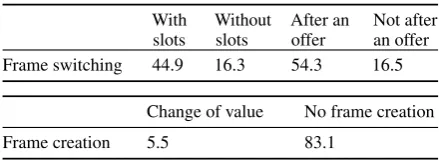
Not after an offer Frame switching 44.9 16.3 54.3 16.5
Change of value No frame creation
Frame creation 5.5 83.1
and performs similarly on frame creation. Table6
presents an analysis of the performance of the rule-based model. We report the accuracy of the frame tracking baseline on the most crucial sub-tasks of frame tracking for one fold. The top table shows that the most difficult tasks consist of assigning the correct frame to aswitch frameact when the act is not directly preceded by an offer and when the act has no slots. As discussed previously, when the act has no slots, it is important to consider the text and solve anaphora. When the act is directly preceded by an offer, the baseline assigns the pre-vious frame, which is the frame of the offer and which most of the time is the frame that the user switched to,e.g., to ask for more information about the offer. In terms of frame creation, the baseline has very poor performance in correctly predicting that a frame is created because the user changes the value of a previously set slot. These results demonstrate that frame tracking cannot be solved with simple rules and necessitates tackling many complex sub-tasks.
7 Conclusion
We introduced the Frames dataset: a corpus of human-human dialogues in a travel domain. This dataset contains complex user behaviour such as comparing between offers. We formalized the frame tracking task, which requires tracking si-multaneously several semantic frames during a dia-logue. We proposed a rule-based model for this task and analysed its performance. We release Frames in the hope of driving further research on complex decision-making in the dialogue community.
References
S. Arnold, F. A. Gers, T. Kilias, and A. L¨oser. 2016. Robust named entity recognition in idiosyncratic
do-mains. arXiv:1608.06757 [cs.CL].
Christina L. Bennett and Alexander I. Rudnicky. 2002.
The carnegie mellon communicator corpus. InProc.
Paul A Crook and Oliver Lemon. 2010. Representing uncertainty about complex user goals in statistical
dialogue systems. InProc. of SIGDIAL. pages 209–
212.
Paul A Crook, Zhuoran Wang, Xingkun Liu, and Oliver Lemon. 2012. A statistical spoken dialogue system using complex user goals and value directed com-pression. InProc. of EACL. Association for Compu-tational Linguistics, pages 46–50.
Layla El Asri, R´emi Lemonnier, Romain Laroche, Olivier Pietquin, and Hatim Khouzaimi. 2014. NAS-TIA: Negotiating Appointment Setting Interface. In
Proc. of LREC.
Mehdi Fatemi, Layla El Asri, Hannes Schulz, Jing He, and Kaheer Suleman. 2016. Policy networks with two-stage training for dialogue systems. InProc. of SIGDIAL.
M. Gaˇsi´c, M. Henderson, B. Thomson, P. Tsiak-oulis, and S. Young. 2012. Policy optimisation of POMDP-based dialogue systems without state space compression. InProc. of SLT.
M. Henderson, B. Thomson, and J. Williams. 2014a.
The Third Dialog State Tracking Challenge. In
Pro-ceedings of IEEE Spoken Language Technology.
Matthew Henderson. 2015. Machine learning for dia-log state tracking: A review. InFirst International Workshop on Machine Learning in Spoken Language Processing.
Matthew Henderson, Blaise Thomson, and Jason D. Williams. 2014b. The second dialog state tracking challenge. InProc. of SIGDIAL.
John F. Kelley. 1984. An iterative design methodology for user-friendly natural language office information
applications. ACM Transaction on Information
Sys-tems.
Diederik Kingma and Jimmy Ba. 2015. Adam: A
method for stochastic optimization. Proc. of ICLR
.
Romain Laroche, Ghislain Putois, Philippe Bretier, Martin Aranguren, Julia Velkovska, Helen Hastie, Simon Keizer, Kai Yu, Filip Jurˇc´ıˇcek, Oliver Lemon, and Steve Young. 2011. Report D6.4 : Final evalua-tion of classic towninfo and appointment scheduling systems. Technical report, CLASSIC Project.
Romain Laroche, Ghislain Putois, Philippe Bretier, and Bernadette Bouchon-Meunier. 2009. Hybridisation of expertise and reinforcement learning in dialogue systems. InProc. of Interspeech.
Sungjin Lee and Amanda Stent. 2016. Task lineages:
Dialog state tracking for flexible interaction. In
Proc. of SIGDIAL.
Gr´egoire Mesnil, Xiaodong He, Li Deng, and Yoshua
Bengio. 2013. Investigation of
recurrent-neural-network architectures and learning methods for
spo-ken language understanding. In Proc. of
Inter-speech.
Teruhisa Misu, Komei Sugiura, Tatsuya Kawahara, Kiyonori Ohtake, Chiori Hori, Hideki Kashioka, Hisashi Kawai, and Satoshi Nakamura. 2011. Mod-eling spoken decision support dialogue and
opti-mization of its dialogue strategy. Transactions on
Speech and Language Processing7(3):10.
Wendy W. Moe and Peter S. Fader. 2001. Uncovering
patterns in cybershopping. California Management
Review.
Alice H. Oh and Alexander I. Rudnicky. 2000. Stochas-tic language generation for spoken dialogue systems. In Proc. of ANLP/NAACL workshop on Conversa-tional Systems.
Julien Perez and Fei Liu. 2016. Dialog state tracking, a machine reading approach using memory network. InProc. of EACL.
Olivier Pietquin, Matthieu Geist, Senthilkumar Chan-dramohan, and Herv´e Frezza-Buet. 2011. Sample-efficient batch reinforcement learning for dialogue
management optimization. ACM Transaction on
Speech and Language Processing7(3):1–21.
Antoine Raux, Brian Langner, Allan Black, and Max-ine Eskenazi. 2003. LET’S GO: Improving Spoken Dialog Systems for the Elderly and Non-natives. In
Proc. of Eurospeech.
Verena Rieser, Ivana Kruijff-Korbayov, and Oliver
Lemon. 2005. A corpus collection and
annota-tion framework for learning multimodal clarificaannota-tion strategies. InProc. of SIGDIAL.
Verena Rieser and Oliver Lemon. 2009. Natural lan-guage generation as planning under uncertainty for
spoken dialogue systems. InProc. of EACL. pages
683–691.
Verena Rieser, Oliver Lemon, and Simon Keizer. 2014. Natural language generation as incremental plan-ning under uncertainty: adaptive information pre-sentation for statistical dialogue systems. Transac-tions on Audio, Speech and Language Processing
22(5):979–994.
A. Saha, M. Khapra, and K. Sankaranarayanan. 2017. Multimodal Dialogs (MMD): A large-scale dataset for studying multimodal domain-aware
conversa-tions.arXiv:1704.00200 [cs.CL].
Jost Schatzmann, Karl Weilhammer, Matt Stuttle, and Steve Young. 2006. A survey of statistical user sim-ulation techniques for reinforcement-learning of
dia-logue management strategies. The knowledge
Shikhar Sharma, Jing He, Kaheer Suleman, Hannes
Schulz, and Philip Bachman. 2017. Natural
lan-guage generation in dialogue using lexicalized and delexicalized data. Proc. of ICLR Workshop.
Satinder Singh, Michael Kearns, Diane Litman, and Marilyn Walker. 2002. Optimizing dialogue man-agement with reinforcement learning: experiments with the njfun system. Journal of Artificial Intelli-gence Research16:105–133.
M.a. Walker, S.j. Whittaker, A. Stent, P. Maloor, J. Moore, M. Johnston, and G. Vasireddy. 2004. Generation and evaluation of user tailored
re-sponses in multimodal dialogue. Cognitive Science
28(5):811–840.
Tsung-Hsien Wen, Milica Gasic, Nikola Mrksic, Lina Maria Rojas-Barahona, Pei-Hao Su, Stefan Ultes, David Vandyke, and Steve J. Young. 2016. A network-based end-to-end trainable task-oriented di-alogue system. InProc. of EACL.
Tsung-Hsien Wen, Milica Gasic, Nikola Mrkˇsi´c, Pei-Hao Su, David Vandyke, and Steve Young. 2015. Se-mantically conditioned lstm-based natural language generation for spoken dialogue systems. InProc. of EMNLP.
Jason Weston, Sumit Chopra, and Antoine Bordes.
2015. Memory networks.Proc. of ICLR.
A Annotation Details and Dialogue Example
Table 7: Searchable fields in the database of packages
Field Description
PRICE MAX Maximum price the user is willing to pay
PRICE MIN Minimum price defined by the user
DESTINATION CITY Destination city
MAX DURATION Maximum number of days for the trip
NUM ADULTS Number of adults
NUM CHILDREN Number of children
START DATE Start date for the trip
END DATE End date for the trip
ARE DATES FLEXIBLE Boolean value indicating whether or not the user’s dates are flexible. If True, then the search is broadened to 2 days beforeSTART DATEand 2 days afterEND DATE.
ORIGIN CITY Origin city
Table 8: Non-searchable fields in the database of packages
Field Description
Global Properties
PRICE Price of the trip including flights and hotel
DURATION Duration of the trip
Hotel Properties
NAME Name of the hotel
COUNTRY Country where the hotel is located
CATEGORY Rating of the hotel (in number of stars)
CITY City where the hotel is located
GUEST RATING Rating of the hotel by guests (in number of stars)
BREAKFAST, PARKING, WIFI, GYM, SPA Boolean value indicating whether or not the hotel offers this amenity.
PARK, MUSEUM, BEACH, SHOPPING, MARKET, AIRPORT, UNIVERSITY, MALL, CATHEDRAL, DOWNTOWN, PALACE, THEATRE
Boolean value indicating whether or not the hotel is in the vicinity of one of these.
Flights Properties
SEAT Seat type (economy or business)
DEPARTURE DATE DEP Date of departure to destination
DEPARTURE DATE ARR Date of return flight
DEPARTURE TIME DEP Time of departure to destination
ARRIVAL TIME DEP Time of arrival to destination
DEPARTURE TIME ARR Time of departure from destination
ARRIVAL TIME ARR Time of arrival to origin city
DURATION DEP Duration of flight to destination
[image:12.595.75.530.321.636.2]Table 9: List of dialogue acts in the annotation of Frames
Dialogue Act Speaker Description
inform User/Wizard Inform a slot value
offer Wizard Offer a package to the user
request User/Wizard Ask for the value of a particular slot
switch frame User Switch to a frame
suggest Wizard Suggest a slot value or package
that does not match the user’s constraints
no result Wizard Tell the user that the database returned no results
thankyou User/Wizard Thank the other speaker
sorry Wizard Apologize to the user
greeting User/Wizard Greet the other speaker
affirm User/Wizard Affirm something said by the other speaker
negate User/Wizard Negate something said by the other speaker
confirm User/Wizard Ask the other speaker to confirm a given slot value
moreinfo User Ask for more information on a given set of results
goodbye User/Wizard Say goodbye to the other speaker
request alts User Ask for other possibilities
request compare User Ask the wizard to compare packages
hearmore Wizard Ask the user if she’d like to hear more about a given package
you are welcome Wizard Tell the user she is welcome
canthelp Wizard Tell the user you cannot answer her request
[image:13.595.71.526.348.585.2]reject Wizard Tell the user you did not understand what she meant
Table 10: List of slot types not present in the database
Slot Type Description
count Number of different packages
count amenities Number of amenities
count name Number of different hotels
count dst city Number of destination cities
count seat Number of seat options (for flights)
count category Number of star ratings
id Id of the frame created (for offers and suggestions)
vicinity Vicinity of the hotel
amenities Amenities of the hotel
ref anaphora Words used to refer to a frame
e.g., “the second package‘
impl anaphora Used when a slot type is not specifically mentionned
e.g., “What is the price for Rio?”...“And for Cleveland?”
ref Id of the frame that the speaker is referring to
read Reads slot values specified in another frame and writes them in the current frame
write Writes slot values in a given frame
intent User intent (e.g., book)
action Wizard action (e.g., book)
Table 11: Dialogue excerpt where the wizard talks about a frame other than the active frame
Author Utterance
Wizard A 5 star hotel called the Regal Resort,
Wizard it has free wifi and a spa.
User dates?
Wizard Starts on august 27th until the 30th
User ok that could work. I would like to see my options in Santos as well
Wizard regal resort goes for$2800 or there is the Hotel
Globetrotter in Santos it has 3 stars and comes with
breakfast and wifi, it leaves on the 25th and returns on the 30th! all for$2000
User ahh I can’t leave until august 26 though
Wizard then i guess you might have to choose the Regal resort
[image:13.595.75.529.616.772.2]