An open-source tool for negation detection:
a maximum-margin approach
Martine Enger Erik Velldal
University of Oslo, Department of Informatics
{marenger,erikve,liljao}@ifi.uio.no
Lilja Øvrelid
Abstract
This paper presents an open-source toolkit for negation detection. It identifies nega-tion cues and their corresponding scope in either raw or parsed text using maximum-margin classification. The system design draws on best practice from the existing literature on negation detection, aiming for a simple and portable system that still achieves competitive performance. Pre-trained models and experimental results are provided for English.
1 Introduction
The task of negation detection has recently seen quite a bit of interest in the NLP community, in part spurred by the availability of annotated data and evaluation software introduced by the shared tasks at CoNLL 2010 (Farkas et al., 2010) and *SEM 2012 (Morante and Blanco, 2012). While many research-based systems have been devel-oped, with the aim of exploring features and al-gorithms to advance the state-of-the-art in terms of performance (Morante and Daelemans, 2009; Read et al., 2012; Lapponi et al., 2012; Packard et al., 2014; Fancellu et al., 2016), many of them are difficult to employ in practice, due to layered architectures and many dependencies, and further-more, most are simply not made publicly available in the first place.
In this paper, we present an open-source portable toolkit for automatic negation detection, with experimental results reported for English. The system is implemented in Python on top of PyStruct (M¨uller and Behnke, 2014), a library for structured prediction based on a maximum-margin approach. The system implements two stages of negation analysis, namely cue detection, which detects words that signal negation, such asno,not
andunfortunate, and scope resolution, which iden-tifies the span of the sentence that is affected by the negation. Our negation toolkit builds on exist-ing libraries that are actively maintained and easy to install, and the source1 is made freely
avail-able (GPL). While we make pre-trained classifiers available (for English), users will also be able to train their own models.
The system design is based on best practices from previous work, in particular systems from the 2012 *SEM shared task. In particular, we adopt the practice of solving scope resolution as a sequence labeling task (Morante and Daelemans, 2009; Lapponi et al., 2012; White, 2012) based on syntactic features (Read et al., 2012; Lapponi et al., 2012; Packard et al., 2014). In contrast to many of the previous systems that have used constituency-based representations (Read et al., 2012; Packard et al., 2014), we base our syntactic features on dependency representations, similar to the approach of Lapponi et al. (2012). For cue de-tection, on the other hand, simply using surface-oriented lexical features have been shown to be sufficient, and we here largely build on the specific approach described by Read et al. (2012; Velldal et al. (2012), using a binary SVM classifier.
The main goal of this work is to arrive at a lean and light-weight system with minimal use of extra heuristics beyond machine learned models. While achieving the highest performance was not our main goal, the results are competitive with previ-ously reported SoA results in the literature. More-over, the system can be employed with both raw and parsed input data.
2 Experimental set-up
The Conan Doyle corpus The data set we use for training and testing is the Conan Doyle
cor-1https://github.com/marenger/negtool
pus (Morante and Daelemans, 2012) as used in the 2012 *SEM shared task (Morante and Blanco, 2012), based on a CoNLL-style format. While the shared task also included detection of events and focus, we only focus on cues and scopes in this work. We use the same splits for training, devel-opment testing and held-out evaluation as supplied for the shared task. Examples (1)-(2) below show two examples taken from the corpus, where nega-tion cues are in bold and their scopes are under-lined. In (1), the cue is the adverbnot, whereas (2) provides an example of the affixal cueun.
(1) And yet it wasnotquite the last.
(2) Since we have been sounfortunate as to miss him and have no notion [. . . ]
The Conan Doyle corpus provides phrase struc-ture trees produced by the Charniak and John-son (2005) parser, and we have used the Stan-ford Parser (Manning et al., 2014) to convert these to Stanford basic dependency representations (de Marneffe et al., 2014) prior to training.
Evaluation We use the evaluation script of the 2012 *SEM shared task (Morante and Blanco, 2012) for measuring precision, recall and F-score. For scopes, it provides two different measures;
token-level and scope-level. For the token-level measure the evaluation is defined similarly as for cues, simply checking whether each token in the scope sequence is correctly labeled. For scopes on the other hand, a true positive requires both the entire scope sequence and cue to be correct.
Note that for the held-out results, our system is trained on both the development and training data combined.
System comparison In addition to providing baseline results for both cues and scopes, we also include the results for the UiO2system of Lapponi et al. (2012) from the *SEM shared task. Achiev-ing the best results for both cue and scope resolu-tion in the open track, it has guided much of the design of the current system. The cue classifica-tion component of UiO2was the same as for UiO1 (run 1) (Read et al., 2012) – the system that was ranked first in the shared task overall (though not for cue detection in isolation).
Maximum-margin learning for cues and scopes
While cue detection is here approached as a token-wise classification problem and scope resolution as sequence classification, they are both modeled
using a maximum-margin approach. Cue detec-tion is solved using a binary Support Vector Ma-chine (SVM) classifier (Vapnik, 1995). As is fairly common, scope resolution is solved as a sequence labeling task, applying a discriminative linear-chain Conditional Random Fields (CRF) model.However, in a conventional CRF, the pa-rameters are learned through maximum likelihood estimation. In PyStruct on the other hand, the pa-rameters are estimated through maximum-margin learning based on SVMs, resulting in what may be called a maximum-margin CRF.
System requirements The input given to the system can either be raw running text or parsed data in the CoNLL-X format (Buchholz and Marsi, 2006). If the user inputs raw text, we need to tokenize, tag and parse the text before we can classify the sentences. Because our training data uses PTB PoS-tags and Stanford dependencies (following conversion), we need a pipeline provid-ing the same standard, and hence use the CoreNLP tool (Manning et al., 2014). Beyond Python 2.7 or newer, the negation tool has the following depen-dencies: scikit-learn, PyStruct, NumPy, and Net-workX (in addition to CoreNLP unless pre-parsed input is provided).
3 Cue identification
The task of cue detection is to identify potential cue words and determine whether they function as negation cues in the given context. Cue detection is here solved using a binary SVM classifier and follows the filtering approach described by Vell-dal (2011) and Read et al. (2012) which means that not all words in the input text are presented to the classifier. Instead we extract a lexicon of known single-word cues from the training data and only attempt to disambiguate these (any other word will always be labeled as a non-cue). Additionally, a separate lexicon of affixal cues is also automat-ically extracted, consisting of affixes seen in the training data, viz. the prefixes{dis, im, in, ir, un}, the infixless, and the suffixless. The cue classi-fier is presented with any words that match either of these at the respective positions, e.g. words that have a prefix that matches any of the prefixes, e.g.
impatient andimage.
Development Held-out
P R F1 P R F1
[image:3.595.75.291.64.123.2]Baseline 90.68 84.39 87.42 87.10 92.05 89.51 UiO2 93.75 95.38 94.56 89.17 93.56 91.31 System 91.67 95.38 93.49 90.15 93.56 91.82
Table 1: Cue classification
word-by-word classification where all words are considered. It simplifies the problem in that much fewer instances need to be considered, thereby also greatly reducing the feature space, and also gives much more balanced classes.
Multi-word cues, like ‘by no means’ or ‘ nei-ther...nor’, are handled by a few simple post-processing rules, simply checking whether a given cue word forms part of a multi-word cue in the given context. Using a small stop-list, some forms like by and means are excluded from the list of candidate cue words considered by the classifier.
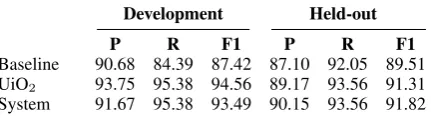
As a baseline we use a majority class classifier, labeling each word by its most frequent label in the training data. Table 1 shows that this simple base-line is already quite strong: With an F1 of 89.51 on the held-out data it outperforms 4 of the 12 sys-tems submitted for the *SEM shared task.
The feature configuration of the cue classifier is based on a grid search towards the development set mostly based on features previously described by Read et al. (2012; Velldal et al. (2012), tuning the SVM C parameter separately for each configura-tion. The final model uses the following features for each token to be classified: The word form, PoS and lemma of the token, as well as lemmas
± 1 position. For candidates of affixal cues we additionally extract the affix itself and character n-grams up to n=5 of the base-form that the af-fix attaches to (extracted from both the beginning and the end of the form). In terms of PyStruct configuration we use its BinaryClf model with the NSlackSSVM estimator, with theCregularization parameter set to 0.2.
The results are shown in Table 1. We see that there is a slight drop in F1-score when moving from the development set to the held-out set (from 93.49 to 91.82). Compared to UiO2, we see that while the recall of the two systems are identical, the precision of our system is almost 1 percent-age point higher. Overall, our cue classifier would have ranked third in the *SEM 2012 shared task.
4 Scope resolution
Our approach to scope resolution largely follows that of the UiO2 system of Lapponi et al. (2012) from the *SEM shared task, both in terms of the choice of machine learning algorithm, the in-ternal data representation and the set of features used to represent the negation scopes. Like them, we model scope resolution as a sequence label-ing task, maklabel-ing use of both lexical and syntac-tic information regarding the context of a negation cue. Just as for the cue classifier, we performed extensive tuning towards the development set for the maximum-margin CRF scope model – exper-imenting with different features, sequence labels, and hyper-parameters – finally arriving at the fol-lowing configuration:
Surface features: The word form, lemma (± 1 position), and PoS (±1 position)
Cue features: Cue type, left/right cue distance, and cue PoS.
Dependency features: Directed dependency dis-tance, dependency graph path.
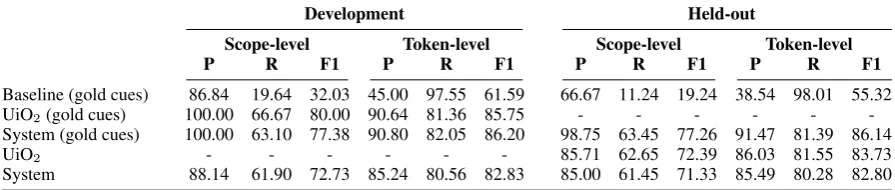
Note that the directed dependency path is the shortest path from the head of the cue to the cur-rent token. Internally, we employ the following label set to represent scopes: I, O, B, and C (In-side, Out(In-side, Beginning, and Cue). Note that the only post-processing performed after the CRF is ensuring that the cue is always out-of-scope and that the base of an affixal cue is always in-scope. In terms of PyStruct configuration we use its chain CRF model, with the FrankWolfeSSVM estima-tor, with theCregularization parameter set to 0.1. The results are presented in Table 2. As for the cue results in Table 1 we here too report the per-formance of the UiO2 system as a point of ref-erence. In addition, we also include results for a baseline corresponding to labeling the entire sen-tence as in-scope if it contains a (gold) negation cue. While this section focuses on scope predic-tion performance in isolapredic-tion using gold cues, Sec-tion 5 discusses the end-to-end results with scope resolution for predicted cues.
Development Held-out
Scope-level Token-level Scope-level Token-level
P R F1 P R F1 P R F1 P R F1
Baseline (gold cues) 86.84 19.64 32.03 45.00 97.55 61.59 66.67 11.24 19.24 38.54 98.01 55.32 UiO2(gold cues) 100.00 66.67 80.00 90.64 81.36 85.75 - - - -System (gold cues) 100.00 63.10 77.38 90.80 82.05 86.20 98.75 63.45 77.26 91.47 81.39 86.14
UiO2 - - - 85.71 62.65 72.39 86.03 81.55 83.73
[image:4.595.75.523.64.159.2]System 88.14 61.90 72.73 85.24 80.56 82.83 85.00 61.45 71.33 85.49 80.28 82.80
Table 2: Scope resolution, for both gold and predicted cues.
performance remains largely unchanged across the two test sets, with only a 0.12 percentage points decrease in F-score for the scope-level and 0.06 on the token-level.
Turning to the development results of the scope CRF model of UiO2 (on gold cues), we find that the scores are slightly higher than ours with re-spect to the scope-level, but slightly lower for the token-level. For the held-out evaluation data on the other hand, UiO2 scope results for gold cues were not reported, like for most of the other *SEM competition systems, unfortunately. However, the system description of the UiO1 system (Read et al., 2012) – implementing a hybrid approach com-bining manually defined rules and SVM-based ranking of constituent (sub-)trees – reports scope-level scores for gold cues on both the development and evaluation data. The same holds for the sys-tem of Packard et al. (2014), which combines the UiO1system with an additional layer of manually defined rules over Minimal Recursion Semantics structures created by an HPSG parser. For both of these systems we can observe a larger drop in F1 when moving from the development data to the evaluation data, with the UiO1/MRS-combination dropping from 82.5 to 78.7, and with the UiO1 system2 on its own dropping from 82.52 to 77.26
(compared to the drop from 77.38 to 77.26 in the case of our system). Regardless of the causes for these differences, it at least appears that our purely CRF-based system, with the tuning of the C parameter for the underlying maximum-margin model, does not suffer any overfitting effects. At the same time, we see that the combined sys-tem of Packard et al. (2014) achieves the high-est absolute scores, and we return to this point when discussing end-to-end results below.
Fi-2We here report results for ‘run II’ of UiO
1as submitted for the *SEM 2012 shared task, since this version of the sys-tem was optimized towards the development set just like in our set-up, while ‘run I’ was optimized by cross-validation on the training and development data combined.
nally, note that Fancellu et al. (2016) report scope results on the *SEM evaluation data (gold cues only) for a suite of different classifiers based on a bi-directional LSTM, with the best configura-tion obtaining a scope-level F-score of 77.77. In sum, we observe two things; (i) our scope clas-sifier achieves competetive performance, and (ii) despite the large differences in terms of types of approaches and architectures for the various scope systems considered here, there are not large differ-ences in terms of performance.
4.1 Error analysis
We performed an error analysis of our scope res-olution predictions over the development data us-ing gold cues. The analysis shows that our system struggles with discontinuous scopes, as in (3):
(3) It wasnot, I must confess, a very alluring prospect.
This is not surprising, seeing that several of the top performing systems implements dedicated post-processing modules for dealing with discontinu-ous scopes. The error analysis also reveals other types of recurring scope errors, including sen-tences that contains multiple negation cues with overlapping scopes (gold-standard). Moreover, we also observed that many of the sentences that are counted as false negatives with respect to the strict exact match scope-level measure often just have a single token that is incorrectly labeled, meaning that the overall scope is very close to being correct. This is reflected in the fact that the token-level F-score is roughly 10 percentage points higher than the scope-level F-score.
5 End-to-end results
with predicted cues. Errors from the cue classi-fier propagates to the scope classiclassi-fier which will attempt to predict scopes for false positive cues. Our end-to-end results would have ranked fourth in the *SEM 2012 shared task with respect to the relevant subtasks.
In the time passed since the shared task, the best published results on the evaluation data appears to be for the system of Packard et al. (2014). Build-ing on top of the UiO1 system, it obtains a scope-level F1 of 73.1. Depending on the goal, how-ever, F-score in isolation is not the only relevant dimension for system comparisons. The goal of the current work is to create a practically usable tool. For an applied and practical setting, it is also relevant to consider other system properties, like the number of dependencies, platform compatibil-ity, the degree of manual engineering – which can in turn affect how easy it will be to re-train the system on new data or porting the system to cope with other phenomena, the amount of required lin-guistic pre-processing, and so on. In the system of Packard et al. (2014), the underlying UiO1system (Read et al., 2012) is used for cue prediction and as a second source for scope-prediction. While UiO1 itself is already a highly engineered system – combining manually defined heuristics and sta-tistical ranking of constituent sub-trees – Packard et al. (2014) add a second layer of both (HPSG) parsing and rules (over MRS representations). In sum, the 1.77 point increase in F1 compared to the current system comes at the cost of substantially increased complexity. Importantly though, the full system pipeline is also not publicly available.3
For the BiLSTM scope classifier of Fancellu et al. (2016) discussed in Section 4, no results are re-ported for cue classification, and scope results are only reported for gold cues.4 Although the code
for the BiLSTM scope model is made available, end-to-end results can not be compared without a cue classifier.
3The paper of Packard et al. (2014) points to code for
replicating the reported experiments, but this only includes support for computing the final layer of ‘MRS crawling’. The system of Packard et al. (2014) also relies on cue- and scope predictions from the so-called UiO1 system of Read et al. (2012), however, and these predictions are only provided in the form of pre-computed system output for the *SEM shared task data; the underlying UiO1system is not itself available.
4In the system comparison reported by Fancellu et al.
(2016), the results of the *SEM shared task competition sys-tems are based on predicted cues while the results of Packard et al. (2014) and Fancellu et al. (2016) are for gold cues, mak-ing them not comparable.
6 Future work
One possible improvement of the system would be to extend the scope resolution with post-processing heuristics for targeting discontinuous scopes. The best overall system in the *SEM shared task implemented this (Read et al., 2012), and while the rules themselves require some linguistic understanding, they would be fairly straightforward to implement. There are also cer-tain multi-word cues occurring in the data set that are not covered by the heuristics currently imple-mented in the system.
Beyond the multi-word cue heuristics, our im-plementation is abstract in the sense that it is not hard-coded for negation, instead relying on mod-els to be learned automatically from any data us-ing a CoNLL style format similar to that of the *SEM shared task. Importantly, this means that the tool could be trained for other similar tasks, such as speculation detection, as long as cues and scopes are marked. One interesting direction here would be to convert the annotations of the Bio-Scope corpus (Vincze et al., 2008) to the format used by the Conan Doyle corpus. This would al-low training of both speculation and negation de-tection models for biomedical data, and also to test cross-domain effects. Such a conversion is not en-tirely trivial, however, as the resources differ not merely in terms of format but also the underly-ing annotation rules. Developunderly-ing such a mappunderly-ing could greatly benefit this research field, also mak-ing it possible to use data from different domains.
7 Conclusion
References
Sabine Buchholz and Erwin Marsi. 2006. CoNLL-X shared task on Multilingual Dependency Parsing. In
Proceedings of the Tenth Conference on Computa-tional Natural Language Learning, pages 149–164, New York, USA.
Eugene Charniak and Mark Johnson. 2005. Coarse-to-fine n-best parsing and maxent discriminative
reranking. InProceedings of the 43rd Annual
Meet-ing of the Association for Computational LMeet-inguis-
Linguis-tics, pages 173–180, Ann Arbor, MI, USA.
Marie-Catherine de Marneffe, Timothy Dozat, Na-talia Silveira, Katri Haverinen, Filip Ginter, Joakim Nivre, and Christopher D. Manning. 2014. Uni-versal Stanford dependencies. A cross-linguistic ty-pology. InProceedings of the International Confer-ence on Language Resources and Evaluation, pages 4585–4592, Reykjavik, Iceland.
Federico Fancellu, Adam Lopez, and Bonnie Weber. 2016. Neural Networks for Negation Scope
De-tection. In Proceedings of The 54th Annual
Meet-ing of the Association for Computational LMeet-inguis- Linguis-tics, pages 495–504, Berlin, Germany.
Richard Farkas, Veronika Vincze, Gyorgy Mora, Janos Csirik, and Gyrgy Szarvas. 2010. The CoNLL 2010 Shared Task: Learning to detect hedges and their
scope in natural language text. In Proceedings of
the 14th Conference on Natural Language Learning, pages 1–12, Uppsala, Sweden.
Emanuele Lapponi, Erik Velldal, Lilja Øvrelid, and
Jonathon Read. 2012. UiO2: Sequence-Labeling
Negation Using Dependency Features. In
Proceed-ings of the First Joint Conference on Lexical and Computational Semantics (*SEM), pages 319–327, Montreal, Canada.
Christopher D. Manning, Mihai Surdeanu, John Bauer, Jenny Finkel, Steven J. Bethard, and David Mc-Closky. 2014. The Stanford CoreNLP natural
lan-guage processing toolkit. In Proceedings of 52nd
Annual Meeting of the Association for Computa-tional Linguistics: System Demonstrations, pages 55–60, Baltimore, Maryland, USA.
Roser Morante and Eduardo Blanco. 2012. *SEM 2012 Shared Task: Resolving the Scope and
Fo-cus of Negation. In Proceedings of the First Joint
Conference on Lexical and Computational Seman-tics (*SEM), pages 265–274, Montreal, Canada. As-sociation for Computational Linguistic.
Roser Morante and Walter Daelemans. 2009. A met-alearning approach to processing the scope of nega-tion. InProceesings of the Thirteenth Conference on Computational Natural Language Learning, pages 21–29, Boulder, Colorado, USA.
Roser Morante and Walter Daelemans. 2012.
ConanDoyle-neg: Annotation of negation in Conan
Doyle stories. In Proceedings of the First Joint
Conference on Lexical and Computational Seman-tics (*SEM), pages 1563–1568, Montreal, Canada. Andreas C. M¨uller and Sven Behnke. 2014. PyStruct
- Learning Structured Prediction in Python. Journal of Machine Learning Research, 15:2055–2060. Woodley Packard, Emily M. Bender, Jonathon Read,
Stephan Oepen, and Rebecca Dridan. 2014. Sim-ple Negation Scope Resolution through Deep Pars-ing: A Semantic Solution to a Semantic Problem. In
Proceedings of the 52nd Annual Meeting of the As-sociation for Computational Linguistics, pages 69– 78, Baltimore, USA.
Jonathon Read, Erik Velldal, Lilja Øvrelid, and
Stephan Oepen. 2012. UiO1: Constituent-Based
Discriminative Ranking for Negation Resolution. In
Proceedings of the First Joint Conference on Lexical and Computational Semantics (*SEM), pages 310– 318, Montreal, Canada.
Vladimir N. Vapnik. 1995. The Nature of Statistical Learning Theory.Springer-Verlag.
Erik Velldal, Lilja Øvrelid, Jonathon Read, and Stephan Oepen. 2012. Speculation and negation:
Rules, rankers and the role of syntax.
Computa-tional Linguistics, 38:369–410.
Erik Velldal. 2011. Predicting speculation: A sim-ple disambiguation approach to hedge detection in
biomedical literature. Journal of Biomedical
Se-mantics, 2(5).
Veronika Vincze, Gyrgy Szarvas, Richrd Farkas, Gyrgy Mra, and Jnos Csirik. 2008. The BioScope corpus: biomedical texts annotated for uncertainty, negation and their scopes. BMC Bioinformatics, 9(11). James Paul White. 2012. UWashington: Negation
Resolution using Machine Learning Methods. In