Proceedings of the Fourth Joint Conference on Lexical and Computational Semantics (*SEM 2015), pages 193–198,
Multi-Level Alignments As An Extensible Representation Basis
for Textual Entailment Algorithms
Tae-Gil Noh([email protected])1,Sebastian Pad´o([email protected])2, Vered Shwartz([email protected])3,Ido Dagan([email protected])3,
Vivi Nastase([email protected])4,Kathrin Eichler([email protected])5, Lili Kotlerman([email protected])3, andMeni Adler([email protected])3
1Institute of Computational Linguistics, Heidelberg University, Germany 2Institute of Natural Language Processing, Stuttgart University, Germany
3Department of Computer Science, Bar-Ilan University, Israel 4Human Language Technologies, Fondazione Bruno Kessler, Italy
5Language Technology Lab, DFKI GmbH, Germany
Abstract
A major problem in research on Textual Entail-ment (TE) is the high impleEntail-mentation effort for TE systems. Recently, interoperable standards for annotation and preprocessing have been proposed. In contrast, the algorithmic level remains unstandardized, which makes compo-nent re-use in this area very difficult in prac-tice. In this paper, we introduce multi-level alignmentsas a central, powerful representa-tion for TE algorithms that encourages modu-lar, reusable, multilingual algorithm develop-ment. We demonstrate that a pilot open-source implementation of multi-level alignment with minimal features competes with state-of-the-art open-source TE engines in three languages.
1 Introduction
A key challenge of Natural Language Processing is to determine what conclusions can be drawn from a natural language text, a task known asTextual Entail-ment(TE, Dagan and Glickman 2004). The ability to recognize TE helps dealing with surface variability in tasks like Question Answering (Harabagiu and Hickl, 2006), Intelligent Tutoring (Nielsen et al., 2009), or Text Exploration (Berant et al., 2012). Open source implementations a number of TE algorithms have be-come available over the last years, including BIUTEE (Stern and Dagan, 2012) and EDITS (Kouylekov and Negri, 2010), which has made it much easier for end users to utilize TE engines.
At the same time, the situation is still more difficult for researchers and developers. Even though recently a common platform for TE has been proposed (Pad´o
et al., 2015) that standardizes important aspects like annotation types, preprocessing, and knowledge re-sources, it largely ignores the algorithmic level. In fact, TE algorithms themselves are generally not de-signed to be extensible or interoperable. Therefore, changes to the algorithms – like adding support for a new language or for new analysis aspect – are often very involved, if not impossible. This often forces the next generation of TE researchers to develop and implement their own core algorithms from scratch.
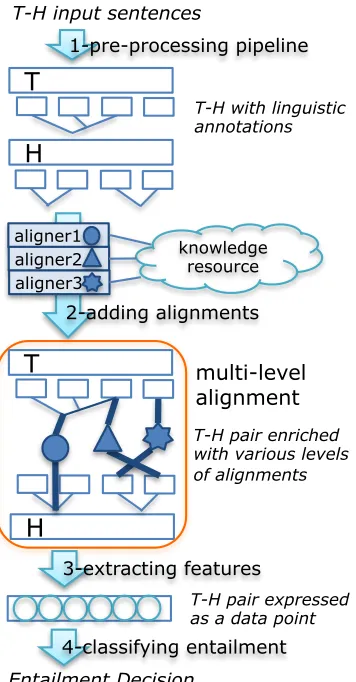
In this paper, we address this problem by propos-ing a schema for TE algorithms that revolves around a central representation layer calledmulti-level align-mentgeared towards encoding the relevant informa-tion for deciding entailment. The use of multi-level alignments encourages a modular, extensible devel-opment of TE algorithms that can be partitioned into “alignment producers” and “alignment consumers”. This enables for future researchers and developers to change analysis components or add new ones in a straightforward manner.
We also present evaluation results for a very simple TE algorithm based on multi-level alignments for English, German and Italian. It utilizes a minimal set of analyzers and four basic language-independent features. It can thus be regarded as a baseline of the performance achievable with this approach. The results can already compete with the best open-source engines available for each of the languages.
2 TE with Multi-Level Alignments
T
H
T-H with linguistic annotations
T-H pair enriched with various levels of alignments
H
T
3-extracting features
T-H pair expressed as a data point 4-classifying entailment T-H input sentences
Entailment Decision aligner1
aligner2 aligner3
multi-level alignment knowledge
resource
[image:2.612.89.267.74.415.2]2-adding alignments 1-pre-processing pipeline
Figure 1: Dataflow for TE algorithms based on multi level alignment
that alignment strength can be misleading (MacCart-ney et al., 2006), alignment was understood as an intermediate step whose outcome is a set of corre-spondences between parts of T and H that can be used to define (mis-)match features. Alignments can be es-tablished at the word level, phrase level (MacCartney et al., 2008), or dependency level (Dinu and Wang, 2009). Dagan et al. (2013) generalized this practical use to an architectural principle: They showed that various TE algorithms can be mapped onto a uni-versal alignment-based schema with six steps: pre-processing, enrichment, candidate alignment genera-tion, alignment selecgenera-tion, and classification.
Proposal. Our proposal is similar to, but simpler than, Dagan et al.’s. Figure 1 shows the data flow.
First, the text and the hypothesis are linguistically pre-processed. Then, the annotated T-H pair becomes
the input for various independent aligners, which have access to knowledge resources and can compute any evidence for or against entailment that can be represented as a weighted alignment between any linguistic levels of H and T. Note that this includes many analyses not normally treated as alignment, e.g. match or mismatch in negation or modality between parts of T and H. The union of all alignments forms the central data structure, theMulti-Level Alignments.
The next step is feature extraction. Features can be extracted on the basis of individual alignments, or from sets of alignments. We assume that the features form a vector describing the T-H pair, and that the last step is supervised entailment classification.
Discussion. The main difference to Dagan et al.’s schema is that we intentionally leave out the step ofalignment selectionwhich explicitly selects a sin-gle alignment for each part of H or T, typically the globally most probable one. Our decision to forgo selection is grounded in our design of multi-level alignments as a repository that supports coexistence of information from different sources. This has the following benefits: (a) aligners become decoupled in that adding a new aligner does not have a direct impact on other aligners; (b) alignments produced by different aligners can have different semantics, e.g. positive (match) or negative (mismatch); (c) inter-actions between alignments can still be captured by defining features in the feature extraction step.
In this manner, multi-level alignments serve as an abstraction layer that encourages the development of TE algorithms composed of small, self-contained modules that solve specialized tasks in TE recogni-tion. Each of these modules consists of two parts: an aligner, and a set of feature extractors. A priori, each module can be defined independently; to intro-duce interactions with other modules, it should be sufficient to extend the feature extractors.
3 Implementation and Evaluation
We describe an implementation of a pilot TE algo-rithm based on the Multi-Level Alignment approach and its evaluation in three languages (EN, DE, IT). The system is available as open-source.1
3.1 Technical Foundations
We implement the algorithm within an open source TE development platform (Pad´o et al., 2015). The platform provides various multilingual pre-processing pipelines and knowledge resources such as WordNet, VerbOcean, etc., under a shared API. For pre-processing, we use TreeTagger-based pipelines for all three languages.
Another important service provided by the plat-form is the ability of storing a wide range of linguistic annotations in a common, language-independent data representation. The platform uses UIMA CAS (Fer-rucci and Lally, 2004) as the data container, adopts the DKPro type system (de Castilho and Gurevych, 2014), and defines annotation types which can be extended in a controlled manner. We used this capa-bility to define a multilingual Multi-Level Alignment layer with little implementation effort.
3.2 A Minimal Set of Aligners
The pilot algorithm restricts itself to three aligners. All three are fully language-independent, even if two use language-specific knowledge resources.
Lexical Aligner. The lexical aligner adds an align-ment link for a pair of lemmas in T and H if it finds some kind of semantic relationships between them in a set of lexical resources. The link is directed, labeled (by the semantic relation, e.g. “synonym”, “antonym”) and weighted, with the weight indicating the strength of the relationship. Note that this aligner can on its own already produce alignment links with inconsistent semantics (positive and negative). For English, WordNet and VerbOcean were used as lexi-cal resources. Italian WordNet was used for Italian, and GermaNet and German DerivBase (Zeller et al., 2013) were used as lexical resources for German.
1As a part of Excitement Open Platform for Textual
En-tailment.https://github.com/hltfbk/EOP-1.2.1/ wiki/AlignmentEDAP1
Paraphrase Aligner. The paraphrase aligner con-centrates on surface forms rather than lemmas and can align sequences of them rather than just individ-ual tokens. It uses paraphrase tables, e.g. extracted from parallel corpora (Bannard and Callison-Burch, 2005). The alignment process is similar to the lexical aligner: any two sequences of tokens in T and H are aligned if the pair is listed in the resource. The align-ment links created by this aligner instantiate only one relation (“paraphrase”) but report the strength of the relation via the translation probability. We used the paraphrase tables provided by the METEOR MT evaluation package (Denkowski and Lavie, 2014), which are available for numerous languages.
Lemma Identity Aligner. This aligner does not use any resources. It simply aligns identical lem-mas between T and H and plays an important role in practice to deal with named entities.
3.3 A Minimal Feature Set
Similar to the aligners, we concentrate on a small set of four features in the pilot algorithm. Again, the features are completely language independent, even at the implementation level. This is possible because the linguistic annotations and the alignments, use a language-independent type system (cf. Section 3.1). All current features measure some form of cov-erage on the Hypothesis, i.e. the percentage of H that can be explained by T. The underlying hypoth-esis is that a higher coverage of H corresponds to a higher chance of entailment. Since parts-of-speech arguably differ in the importance of being covered, we compute coverage for four sets of words sepa-rately: (a), for all words; (b), for content words; (c), for verbs; (d), for proper names (according to the POS tagger). The features are defined on the union of all produced alignments: i.e., two words count as aligned if they were aligned by any aligner. Clearly, this is an overly simplistic (albeit surprisingly effec-tive) strategy. It can be considered a baseline for our approach that can be extended with many features that suggest themselves from the literature.
4 Experimental Evaluation
English German Italian
MultiAlign 67.0 64.5 65.4
BIUTEE 67.0 -
-TIE 65.2 63.1
-EDITS 63.6 - 62.6
[image:4.612.331.520.71.140.2]RTE3 median 61.8
Table 1: Accuracy evaluation on the RTE3 dataset
2007). The English dataset created for RTE-3 con-sists of 800 training and 800 testing T-H pairs. Later, the RTE-3 dataset was translated into both German and Italian (Magnini et al., 2014). It is the only Tex-tual Entailment dataset in multiple languages with the same content. The task is binary TE recognition, with baseline of 50% accuracy (balanced classes).
We trained and tested our Multi-Level Alignment approach (MultiAlign) on the RTE-3 dataset sepa-rately for each language. We compare against the other RTE systems from the platform by Pad´o et al. (2015), namely BIUTEE (Stern and Dagan, 2012), EDITS (Kouylekov and Negri, 2010), and TIE (Wang and Zhang, 2009). Each system is configured with its best known configurations. The pilot system sup-ports all three languages, while others support one (BIUTEE) or two languages (EDITS, TIE).
The results are shown in Table 1. The pilot system performs well in all three languages. It ties with BIU-TEE on English and it outperforms TIE and EDITS in their respective results on German and Italian. This is particularly notable since all three systems have gone through several years of development, while
MultiAlignis only a pilot implementation.
Evaluation 2: T-H pairs from Application Data. We perform the second evaluation on real-world ap-plication data from two apap-plication datasets: an en-tailment graph dataset (for English and Italian), and an e-mail categorization dataset (for German). En-tailment graph building is the task of constructing graphs that hierarchically structure the statements from a collection (Berant et al., 2012) for the ap-plication of Text Exploration. In TE-based e-mail categorization, the goal is to assign the right cate-gory to an email with TE, using the email as T and a category description as H. (Eichler et al., 2014).
Due to space constraints, we cannot evaluate these applications end-to-end. Instead, we focus on the
English German Italian
MultiAlign 69.2 72.4 69.5
BIUTEE 71.3 -
-TIE 67.3 72.4
-EDITS 66.6 - 65.6
Table 2: F1evaluation on application data
respective first step, the binary decision of entailment for individual T-H pairs. This task corresponds to RTE-3, and the main difference to Evaluation 1 is that these pairs come from real-world interactions and were produced by native speakers. All T-H pairs are sampled from application gold data which were manually constructed on the basis of anonymized cus-tomer interactions (Eichler et al. (2014) for German; Kotlerman et al. (2015) for English and Italian2).
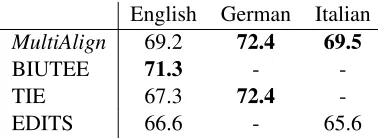
The sets are fairly large (5300 pairs for English, 1700 for Italian, 1274 for German), and were sampled to be balanced. We report F1 for comparability with non-balanced setups (our random baseline is F1=50).
Table 2 shows our evaluation results. MultiAlign
system beats EDITS for Italian (+4), and ties with TIE for German. On English, BIUTEE still outper-formsMultiAlign (-2). Thus,MultiAlign also per-forms acceptably on real-world data.
In sum, we find thatMultiAlignis already compet-itive with state-of-the-art open-source TE engines on three languages. MultiAlignis not only much less complex, but it is also a single system covering all three languages, without any language-specific opti-mizations. We interpret this as a positive sign for the future of the Multi-Level Alignment approach. Visualization. The platform also supports visual-ization of individual Text-Hypothesis pairs, showing the alignments that were created by the system as well as the features computed on the basis of the alignments. The visualization was built on the basis of the BRAT library.3
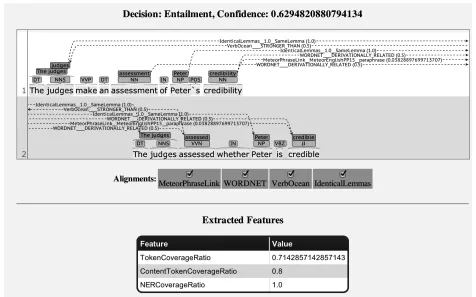
Figure 2 shows an example for the TextThe judges made an assessment of Peter’s credibility and the HypothesisThe judges assessed if Peter was credible. The top line shows the final prediction, Entailment, and the confidence (75%). The main part shows the Text and the Hypothesis below each other, connected
2Both datasets are publicly available.
[image:4.612.85.289.72.152.2]Figure 2: Screenshot of the Multi-Level Alignment Visualizer
by alignment links that are labeled with their source and their score. Note that the alignments can link individual words (assessmentandassessare aligned through a derivational link from WordNet) but also phrases (The two occurrences ofThe judgesin Text and Hypothesis are linked by virtue of being identical lemmas).
The three features currently used by the English system are are shown below. As can be seen, they aggregate very simple statistics about the alignments: 5 of 7 tokens in the hypothesis are covered, 4 out of 5 content words, and the one proper name is also aligned. This situation motivates nicely the use of those features: a relatively low alignment coverage on all tokens is still compatible with entailment as long as the crucial tokens are aligned.
This visualization enables end users to quickly take in the justification behind the system’s decision. Developers can inspect alignments and features for plausibility and detect possible bugs and assess the limitations of aligners and their underlying resources. For example, the current example shows a wrong
link produced by the VerbOcean resource between the nounjudgesin the Text and the verbassessedin the Hypothesis. The reason is that the nounjudges
is mistaken for an inflected form of the verbto judge
which indeed stands in aStronger-thanrelationship toto assess.
5 Conclusion
This paper proposed the use ofmulti-level alignments, a rich data structure allowing multiple alignments to co-exist. We argued that multi-level alignments are a suitable basis for developing Textual Entailment algo-rithms by virtue of providing a beneficial abstraction layer that supports extensible and modular entailment algorithms. A pilot TE algorithm developed in this schema showed performance comparable to much more sophisticated state-of-the-art open-source TE engines and is available as open source software.
Acknowledgments
References
Colin Bannard and Chris Callison-Burch. 2005. Para-phrasing with bilingual parallel corpora. In Proceed-ings of the 43rd Annual Meeting of the Association for Computational Linguistics, pages 597–604, Ann Arbor, MI.
Jonathan Berant, Ido Dagan, and Jacob Goldberger. 2012. Learning entailment relations by global graph structure optimization. Computational Linguistics, 38(1):73– 111.
Ido Dagan and Oren Glickman. 2004. Probabilistic tex-tual entailment: Generic applied modeling of language variability. InPASCAL workshop on Learning Methods for Text Understanding and Mining, Grenoble, France. Ido Dagan, Dan Roth, Mark Sammons, and Fabio Mas-simo Zanzotto. 2013.Recognizing Textual Entailment: Models and Applications. Number 17 in Synthesis Lec-tures on Human Language Technologies. Morgan & Claypool.
Richard Eckart de Castilho and Iryna Gurevych. 2014. A broad-coverage collection of portable NLP compo-nents for building shareable analysis pipelines. In Pro-ceedings of the Workshop on Open Infrastructures and Analysis Frameworks for HLT at COLING 2014, pages 1–11, Dublin, Ireland, August.
Michael Denkowski and Alon Lavie. 2014. Meteor uni-versal: Language specific translation evaluation for any target language. InProceedings of the Ninth Workshop on Statistical Machine Translation, pages 376–380, Bal-timore, MD.
Georgiana Dinu and Rui Wang. 2009. Inference rules and their application to recognizing textual entailment. In Proceedings of the 12th Conference of the European Chapter of the ACL, pages 211–219, Athens, Greece. Kathrin Eichler, Aleksandra Gabryszak, and G¨unter
Neu-mann. 2014. An analysis of textual inference in Ger-man customer emails. InProceedings of the Third Joint Conference on Lexical and Computational Semantics, pages 69–74, Dublin, Ireland.
David Ferrucci and Adam Lally. 2004. UIMA: An ar-chitectural approach to unstructured information pro-cessing in the corporate research environment. Natural Language Engineering, 10(3–4):327–348.
Danilo Giampiccolo, Bernardo Magnini, Ido Dagan, and Bill Dolan. 2007. The third PASCAL recognising textual entailment challenge. InProceedings of the ACL-PASCAL Workshop on Textual Entailment and Paraphrasing, pages 1–9, Prague, Czech Republic. Sanda Harabagiu and Andrew Hickl. 2006. Methods for
using textual entailment in open-domain question an-swering. InProceedings of the 21st International Con-ference on Computational Linguistics and 44th Annual
Meeting of the Association for Computational Linguis-tics, pages 905–912, Sydney, Australia.
Lili Kotlerman, Ido Dagan, Bernardo Magnini, and Luisa Bentivogli. 2015. Textual entailment graphs.Natural Language Engineering.
Milen Kouylekov and Matteo Negri. 2010. An open-source package for recognizing textual entailment. In Proceedings of the ACL 2010 System Demonstrations, pages 42–47, Uppsala, Sweden.
Bill MacCartney, Trond Grenager, Marie-Catherine de Marneffe, Daniel Cer, and Christopher D Manning. 2006. Learning to recognize features of valid textual entailments. InProceedings of the Human Language Technology Conference of the NAACL, pages 41–48, New York City, USA.
Bill MacCartney, Michel Galley, and Christopher D Man-ning. 2008. A phrase-based alignment model for nat-ural language inference. InProceedings of the Con-ference on Empirical Methods in Natural Language Processing, pages 802–811, Honolulu, Hawaii. Bernardo Magnini, Roberto Zanoli, Ido Dagan, Kathrin
Eichler, G¨unter Neumann, Tae-Gil Noh, Sebastian Pad´o, Asher Stern, and Omer Levy. 2014. The EX-CITEMENT open platform for textual inferences. In Proceedings of the ACL 2014 System Demonstrations, pages 43–48, Baltimore, MD.
Rodney D Nielsen, Wayne Ward, and James H Martin. 2009. Recognizing entailment in intelligent tutoring systems. Journal of Natural Language Engineering, 15(4):479–501.
Sebastian Pad´o, Tae-Gil Noh, Asher Stern, Rui Wang, and Roberto Zanoli. 2015. Design and realization of a modular architecture for textual entailment.Journal of Natural Language Engineering, 21(2):167–200. Asher Stern and Ido Dagan. 2012. BIUTEE: A modular
open-source system for recognizing textual entailment. InProceedings of the ACL 2012 System Demonstra-tions, pages 73–78, Jeju Island, Korea.
Rui Wang and Yi Zhang. 2009. Recognizing textual relatedness with predicate-argument structures. In Pro-ceedings of the Conference on Empirical Methods in Natural Language Processing, pages 784–792, Singa-pore.