EFFECT OF PHYSICOCHEMICAL CONDITIONS ON
RHEOLOGICAL PROPERTIES OF NATURAL HYDROCOLLOIDS
Ajay Kumar Sav* and Purnima Dhanraj Amin
Department of Pharmaceutical Sciences and Technology, Institute of Chemical Technology,
N.P. Marg, Matunga, Mumbai 400019, India.
ABSTRACT
In present study, effect of concentration, electrolyte and heating
conditions were investigated for selected four types of hydrocolloids,
namely fenugreek gum, guar gum and locust bean gum and Xanthan
gum on their rheological properties. The results revealed that
hydrocolloid concentration has profound effect on their viscosity;
increase in concentration increases the viscosity correspondingly. The
viscosity was follows the trend: GG>XG>LBG>FG. In presence of
certain electrolyte, viscosity of Xanthan gum and galactomannan
containing fenugreek gum, guar gum, locust bean reduced
significantly. It indicates interaction between polysaccharide and ions.
Hydrocolloids solubility and swellability increases on heating that led
to increase in viscosity in case of galactomannan containing gum whereas xanthan gum lost
its viscosity.
Keywords: Hydrocolloids, Fenugreek gum, Locust bean gum, Guar gum, Xanthan gum.
INTRODUCTION
The specific application of plant-derived polymers like such as pectins, alginates, starches,
guar gum, gum acacia, xanthan gum, karaya gum, tragacanth gum in pharmaceutical
formulations([1,2,3]) and due to their economical, readily available, non-toxic, capable of
chemical modifications, potentially biodegradable and biocompatible properties([4,5,6]) these
natural polymers are very much attractive to pharmaceutical and other allied industries. The
high water binding capacity and highly viscous solutions of hydrocolloids make them
effective thickeners and stabilizers in pharmaceutical and food industry. They also exhibits
some surface, interfacial and emulsifying property. The aim of current studies was to evaluate
Volume 3, Issue 4, 1260-1272. Research Article ISSN 2277 – 7105
Article Received on 18 April 2014,
Revised on 14 May 2014, Accepted on 07 June 2014
*Author for Correspondence
Ajay Kumar Sav
Department of Pharmaceutical
Sciences and Technology,
Institute of Chemical
Technology, N.P. Marg,
Matunga, Mumbai 400019,
the effect of different physico-chemical conditions like concentration, temperature and
presence of electrolyte on rheological property of hydrocolloids. Among all these
hydrocolloids for current studies, natural gums such as guar gum, xanthan gum, fenugreek
gum, locust bean gum were selected.
MATERIALS AND METHODS
Fenugreek gum (FG) isolated in house by reported method ([8]), Guar gum (GG) procured
from S.D. fine Chem Ltd, Mumbai, India, Locust bean gum (LBG) obtained as gift sample
from Lucid Colloids, Mumbai, India. Xanthan gum (XG) purchased from Signet chemicals,
Mumbai, India. Salts of Sodium Chloride, Calcium Chloride, Aluminum Chloride, Boric acid
were purchased from S.D. fine Chem Ltd,
Characterizations Of Hydrocolloids Physical Characteristics
Description: Organoleptic evaluation of the gums were carried out to determine the color, taste, odor, and the appearance.
pH of solution
A 1% w/v solution of the gum was prepared in purified water and the pH of dispersion was
measured.
Swelling Index
The test was performed by placing minimum amount of powder required to reach the 10 ml
mark in a 100 ml measuring cylinder. Distilled water was added slowly reach upto 100 ml
mark of the cylinder. The cylinder was then kept undisturbed for 24h, after period of storage
the final volume of swollen hydrocolloid was recorded. Initial volume was recorded as 10ml,
while the final volume was the volume up to which the gum powder has swelled. Swelling
index was determined using following equation.
Swelling Index: Final volume-Initial volume x100/final volume FTIR
FTIR studies was carried out to confirm the strucutre of hydrocolloids. FTIR spectra was
recorded for all the four gums GG, FG, LBG and XG. Samples were prepared in KBr disk by
FTIR spectrophotometer (Spectrum RX1, USA) . The scanning range was kept between 500
to 4000 cm–1 and the resolution was 4 cm–1.
Rheological property
Pharmaceutically acceptable hydrocolloids were characterized for their rheological property
using Brookfield Viscometer, RVT model, 230V, 50Hz make with a RVT spindle set. The
gums were studied for the effect of the following parameters on their rheological properties.
Effect of concentration on hydrocolloids viscosity
The effect of concentration on viscosity was studied by preparing solutions of three different
concentration viz. 0.5%, 1% and 1.5% of gums. Since gums hydrate slowly, the uniform
dispersions of gum was prepared by keeping stirring for 2h. Viscosity of 250 g sample was
measured using appropriate spindle (no. 27) at different rpm (shear rate). The viscosities were
calculated by applying the appropriate spindle factor to the dial reading at the respective
speeds.
Effect electrolytes on hydrocolloids viscosity
The effect of presence of electrolytes on the viscosity of 1% gum solution was studied. For
this monovalent, divalent, trivalent and tetravalent ions at three different concentrations viz.
0.5%, 1% and 2% were considered. Salts of Sodium Chloride as monovalent, Calcium
Chloride as divalent, Aluminum Chloride as trivalent, Boric acid as tetravalent ions were
used.
Effect of temperature on hydrocolloids viscosity
To study the effect of temperature on the rheological behavior of the gum, 1% gum solution
was exposed to various temperatures ranging from 30 ºC, 40 ºC, 50 ºC, 60 ºC and 80 ºC for 5
min on hot water bath. Further the gum solution was cooled to room temperature. The
readings were recorded at different shear rate and viscosity calculated by applying the
appropriate spindle factor to the dial reading at the respective rpm.
RESULTS AND DISCUSSION
Physical characteristics of different hydrocolloids are shown in Table 1. Results indicated
that guar gum and xanthan has higher viscosity as compared other two gums. Swelling
Table1. Physical characteristics of hydrocolloids
Physical property Fenugreek
gum Guar gum
Locust bean gum
Xanthan gum
Description White fibrous Buff colored
powder
Yellowish
white White to tan,
Viscosity of 1% solution
at 10 rpm (cps) 1800 5400 3000 5600
pH (1% solution) 6.24 6.28 5.2 6.7(6-8)
Swelling Index 85-90% 42-45% 45-50% 45-50%
FTIR
In FTIR spectra, absence of stretching band at 1700-1800 cm-1 region indicated that extracted
FG did not contain any carboxylic group. A stretching band in the region of 1000-1200 cm-1
due to presence of secondary alcohol conferred absence of uronic sugars or esters in the
structure (fig. 1a). FTIR spectrum of GG exhibits the characteristic absorption band at 3383
cm-1 and 2925 cm-1 due to O-H stretching vibrations of the polymer associated with C-H
stretching vibrations. Additional information from the characteristic absorption bands of GG
appears at 1401 cm-1 and 1025 cm-1 due to C-H bending and O-H bending vibrations Guar
gum (fig. 1b), Locust bean gum (fig. 1c) Xanthan gum (fig. 1d).
(a)
(c)
(d)
Fig.1. FTIR spectra of (a) Fenugreek gum, (b) Guar gum, (c) locust bean gum and (d) Xanthan gum
Effect of concentration
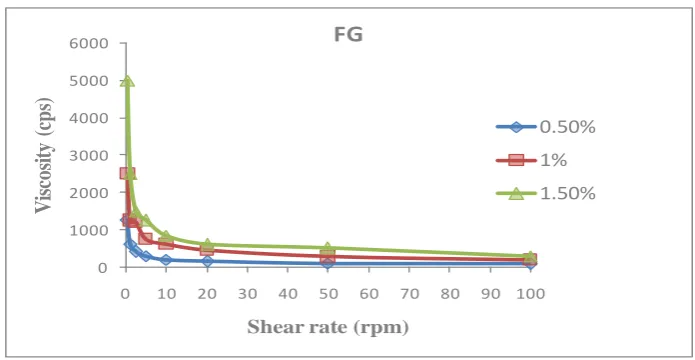
From the study it was concluded that with increase in gum concentration, the viscosity of all
the gum solutions were increase correspondingly, Fig.2. Graphical representation which is a
plot of Viscosity vs Shear rate, wherein viscosity of the gums recorded at different shear rate
indicated that gum solutions at all the used concentration level behave as shear thinnng
system. It means increase in shear rate produce thining or decrease in viscosity of the system.
Fenugreek gum, guar gum, locust bean gums are natural gums belonging to the class of
galactomannans. The molecular structure revealed that fenugreek gum has a galactose to
mannose ratio of 1:1 such that after every mannose unit a galactose unit is linked as a side
chain (galactose to mannose ratio 1:1), while in case of guar gum the galactose unit occurs
bean gum is 1:4. Galactose units are responsible for water solubility of the gum while
mannose units are responsible for water swellability. Thus owing to difference in galactose
and mannose content these gums tend to have different solubility and rheological behavior.
Fenugreek gum has higher solubility less swellability whereas guar gum and locust bean gum
have high viscosity due to more swellability. Xanthan gum is anionic in nature and has gel
like property, widely used in industry as thickener.
0 1000 2000 3000 4000 5000
0 20 40 60 80 100 120
V is cos it y (c ps )
Shear rate (rpm) Xanthan gum 0.50% 1% 1.50% 0 2000 4000 6000 8000 10000 12000
0 10 20 30 40 50 60 70 80 90 100
V is cos it y (c p s)
Shear rate (rpm)
Guar gum 0.50% 1% 1.50% 0 1000 2000 3000 4000 5000 6000
0 10 20 30 40 50 60 70 80 90 100
V is cos it y (c p s)
Shear rate (rpm)
LBG
0.50%
1%
0 1000 2000 3000 4000 5000 6000
0 10 20 30 40 50 60 70 80 90 100
V
is
cos
it
y
(c
p
s)
Shear rate (rpm) FG
0.50%
1%
[image:7.595.123.471.69.249.2]1.50%
Fig. 2. Effect of concentration on hydrocolloids viscosity
Effect of electrolytes on Guar gum viscosity
Difference in viscosity of 1% guar gum dispersion was observed by addition of monovalent
ion. Increase in viscosity observed with increased monovalent ion concentration and no
significant change in viscosity observed with divalent ion, Fig.3. Addition of trivalent ion,
reduces the viscosity of the 1% gum dispersion. This might be due to rise in pH value of
dispersion which causes depolymerisation of guar gum. Dispersion containing lower
concentration (0.5%) of the tetravalent ions showed higher viscosity as comapred to those
containing higher concentration of tetravelent ions (2%). It is reported that precipitation of
galactomannans using tetravalent ions; thereby reduction in viscosity at higher levels of
tetravalent ions can be attributed to this phenomenon. Similar results has been oberved for
locust bean gum.
0 1000 2000 3000 4000 5000 6000
0 20 40 60 80 100 120
V
is
cos
it
y
(c
p
s)
shear rate (rpm) Monovalent (NaCl)
0 1000 2000 3000 4000 5000 6000
0 20 40 60 80 100 120
V
is
cos
it
y
(c
p
s)
Shear rate (rpm) Divalent (CaCl2)
0.50%
1%
2%
Figure.3. Effect of electrolyte on guar gum viscosity
Effect of electrolyte on Xanthan gum viscosity
Results for effect of electrolytes on rheological profile of xanthan gum hydrocolloid are
depicted in Fig. 4. Mono and divalent ion has viscosity reducing effect . With trivalent ions,
might be resulted from anionic and cationic interaction between anionic xanthan gum and
cationic salts. However tetra valent ions has no effect on viscosity of xanthan gum.
0 1000 2000 3000 4000 5000 6000
0 20 40 60 80 100 120
V is cos it y (c p s)
Shear rate (rpm)
Monovalent (NaCl) 0.50% 1% 2% 0 4000 8000 12000 16000 20000
0 20 40 60 80 100
V is cos it y (c p s)
Shear rate (rpm)
Divalent (CaCl2)
0.50% 1% 2% 0 2000 4000 6000 8000 10000
0 20 40 60 80 100 120
V is cos it y (c p s)
Shear rate (rpm) Tetravalent (H3BO3)
0.50%
1%
2%
Fig.4 Effect of electrolyte on Xanthan gum viscosity
Effect of electrolyte on FG viscosity
Results for effect of electrolytes on rheological profile of fenugreek gum hydrocolloid are
in viscosity whereas higher concentration (2%) showed decrease in viscosity. Addition of
divalent ions, reduces the viscosity of original dispersion. Trivalent and tetravalent did not
contribute any sigificant effect on viscosity of original dispersion. Addition of electrolyte to
polysaccharide (galactomanann) solution introduces charge on polysaccharide that causes
dissociation of intermolecilar association and responsible for viscosity property.
0 500 1000 1500 2000 2500 3000
0 20 40 60 80 100 120
V is cos it y (c p s)
Shear rate (rpm)
Monovalent (NaCl) 1% 0.50% 2% 0 200 400 600 800 1000 1200 1400 1600
0 20 40 60 80 100 120
V is cos it y (c p s)
Shear rate (rpm) Divalent (CaCl2)
0.50% 1% 2% 0 1000 2000 3000 4000 5000 6000
0 20 40 60 80 100 120
V is cos it y (c p s)
Shear rate (rpm)
Trivalent (AlCl3)
0.50%
1%
0 200 400 600 800 1000 1200
0 20 40 60 80 100 120
V
is
cos
ity
(c
ps
)
Shear rate (rpm)
Tetra valent (H3BO3)
0.50% 1% 2%
Fig.5 Effect of trivalent electrolyte on fenugreek gum viscosity
Effect of temperature
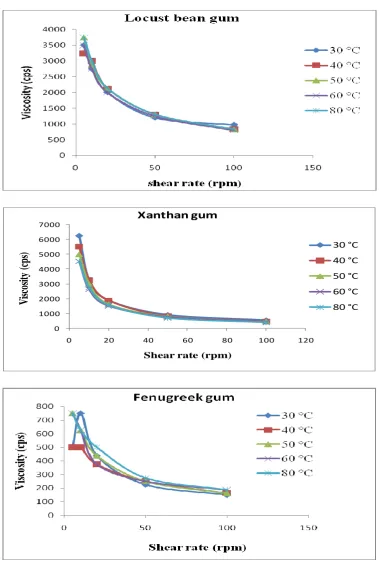
Galactomannan containing gums showed increased viscosity with increase in temperature.
This was due to increase solubility and swelling capacity of gums on heating, Fig.6. At higher
temperature hydrogen bonding between hydroxyl group of gum and water molecule increases
that leads to increase water solubility and swellability. Whereas xanthan gum viscosity
decreases as we increase the heating temperature from 30°C to 80ºC due to destruction of its
0 1000 2000 3000 4000 5000 6000 7000
0 20 40 60 80 100 120
V
isc
os
ity
(c
ps
)
Shear rate (rpm)
Xanthan gum
30 °C
40 °C
50 °C
60 °C
[image:12.595.108.492.62.626.2]80 °C
Fig. 6 Effect of temperature on hydrocolloids viscosity.
CONCLUSION
Study concluded that prior knowledge of effect of physicochemical conditions on rheological
properties of natural hydrocolloids can be helpful in determining best application of the
hydrocolloids in relevant food and pharmaceutical areas as their applications are due to
ACKNOWLEDGMENT
The authors are thankful to DBT, India for providing fellowship during research work.
REFERENCES
1. Pandey R, Khuller GK. Polymer based drug delivery systems for mycobacterial
infections. Curr Drug Deliv, 2004; 1(3): 195-20.
2. Chamarthy SP, Pinal R. Plasticizer concentration and the performance of a diffusion-
controlled polymeric drug delivery system. Colloids Surf A Physicochem Eng Asp, 2008;
331(1-2): 25-30.
3. Alonso-Sande M, Teijeiro D, Remuñán-López C, Alonso MJ. Glucomannan, a promising
for biopharmaceutical purposes. Eur J Pharm Biopharm, 2009; 72(2): 453-46
4. Satturwar PM, Fulzele SV, Dorle AK. Biodegradation and in vivo biocompatibility of
rosin: a natural film-forming polymer. AAPS PharmSci, 2003; 4(4):1-6.
5. Chaurasia M, Chourasia MK, Jain NK, Jain A, Soni V, Gupta Y, Jain SK. Cross-linked
Guar Gum microspheres: A viable approach for improved delivery of anticancer drugs for
the treatment of colorectal cancer. AAPS PharmSci, 2006; 7(3): E1-E9.
6. Chivate AA, Poddar SS, Abdul S, Savant G. Evaluation of Sterculia foetida gum as
Controlled release excipient. AAPS PharmSci, 2008; 9(1):197-04.
7. Malafaya PB, Silva GA, Reis RL. Natural-origin polymers as carriers and scaffolds for
biomolecules and cell delivery in tissue engineering applications. Adv Drug Deliv Rev,
2007; 59(4-5): 207-33.
8. Sav AR, Meer TS, Fule RA, Amin PD. Investigational studies on highly purified