EFFECTIVENESS OF STRUCTURED TEACHING PROGRAMME ON
KNOWLEDGE REGARDING PREVENTION OF SELECTED
NEONATAL INFECTIONS AMONG STAFF NURSES
Gayathri K. V.* and Rinu Abraham
Assistant Professor, Sri Devaraj Urs College of Nursing, Tamaka, Kolar.
ABSTRACT
Introduction: Most newborns enter the world healthy. But sometimes
infants develop conditions that require medical tests and treatment.
Newborns are particularly at risk for some diseases because their
immune system are not developed enough to fight the bacteria, viruses
and parasites that causes these infections. When newborns get sick,
they may need to spend time in hospital (NICU) to recover. Although
it’s frightening to see hospitalized, but it’s the best way for bringing
back to good health of a sick newborn.
Objectives of the study
1. Assess the knowledge of staff nurses regarding prevention of
selected neonatal infections by using a structured knowledge questionnaire.
2. Determine the effectiveness of structured teaching programme by comparing pretest and
post test knowledge scores of staff nurses.
3. Find out the association between knowledge scores of staff nurses regarding prevention of
selected neonatal infections with selected socio-demographic variables.
Materials and Methodology
Pre experimental, one group pre-test post-test design was used to conduct the study. 30 staff
nurses were selected by Non probability purposive sampling techniques who were working in
maternity and pediatric wards. Structured knowledge questionnaire was used to assess the
knowledge level among staff nurses. After pre-test, same day structured teaching programme
on prevention of selected neonatal infections was given to samples. Post test was
administered after 15 days of teaching programme using same structured knowledge
questionnaire. Data was analyzed by descriptive and inferential statistics.
Volume 7, Issue 3, 832-841. Research Article ISSN 2277– 7105
Article Received on 14 Dec 2017,
Revised on 03 Jan. 2017, Accepted on 24 Jan. 2018
DOI: 10.20959/wjpr20183-10853
*Corresponding Author
Gayathri K. V.
Assistant Professor, Sri
Devaraj Urs College of
Nursing, Tamaka, Kolar.
Findings
a. The findings of the study showed that the overall mean post-test score is 72.07% which is
significantly higher than the pre-test score of 45%. The‘t’ value obtained from paired‘t’
test was -10.46(p<0.05). This showed that there was a significant change in the
knowledge level after administering structured teaching programme.
b. The finding related to association between age and pre-test score revealed that the
obtained chi-square value (0.017) is lesser than the table value (3.84) at 0.05 level of
significance. Hence there was no significant association between age and pre-test
knowledge score.
c. The findings related to association between qualification and pre-test score revealed that
the obtained chi-square value (1.212) is lesser than the table value (3.84) at 0.05 level of
significance. Hence there was no significant association between qualification and
pre-test knowledge score.
d. The findings related to association between area of working and pre-test score revealed
that the obtained chi-square value (2.301) is lesser than the table value (5.99) at 0.05 level
of significance. Hence there was no significant association between the area of working
and pre-test knowledge score.
e. The findings related to association between years of experience and pre test score
revealed that the obtained chi-square value (3.409) is lesser than the table value (7.82) at
0.05 level of significance. Hence there was no significant association between the years
of experience and pre-test knowledge score.
Conclusion: The study emphasizes that structured teaching programme was very effective
among staff nurses in improving knowledge on prevention of neonatal infections, treatment,
promotion and early recovery of the sick newborn.
KEYWORDS: prevention, neonatal infections, structured teaching programme, staff nurses.
NICU.
INTRODUCTION
The child is the most precious possession of mankind, most loved and perfect in its innocent.
Neonatal period refers to the period from birth to first 28 days of life.[1] Early neonatal period
refers to first 7 days of life. While late neonatal period signifies the period from more than 7
Neonatal sepsis may be categorized as early-onset or late-onset. Onset is most rapid in
premature neonates. Early-onset sepsis is associated with acquisition of microorganisms from
the mother of newborns with early-onset sepsis. 85% present within 24 hours, 5% present at
24-48 hours, and a smaller percentage present within 48-72 hours. Late-onset sepsis occurs at
4-90 days of life and is acquired from the care giving environment.[3]
Transplacental infection or an ascending infection from the cervix may be caused by
organisms that colonize the mother’s genitourinary tract. The neonate acquires the
microorganisms as it passes through the colonized birth canal at delivery. The infant’s skin,
respiratory tract, conjunctiva, gastrointestinal tract, and umbilicus may become colonized
from the environment and such colonization to the possibility of late-onset sepsis from
invasive microorganisms. Vectors for such colonization may include vascular or urinary
catheters, other indwelling lines or contact with caregivers who have bacterial colonization.[4]
The vast majority of newborns enter the world healthy. But sometimes, infants develop
conditions that require medical tests and treatment. Newborns are particularly susceptible to
certain diseases, much more so than older children and adults. Their new immune systems
aren’t adequately developed to fight the bacteria, viruses, and parasites that cause these
infections. As a result, when newborns get sick, they may need to spend time in the hospital
or even the NICU to recover. Although it can be frightening to see the baby hospitalized. A
hospital stay is often the best way back to good health for a sick newborn.[5]
NEED FOR THE STUDY
The new born baby is very vulnerable to infection, because they lack in natural immunity and
take some time for the acquired immunity to develop. Their defense mechanisms are
immature and the skin is thin and easily damaged. Infection is one of the leading causes of
neonatal death in the developing countries. The infections may be acquired before, during or
soon after birth and some may be minor, while others are potentially damaging or life
threatening.[6]
Babies may acquire infections through the placenta from amniotic fluid as they transverse the
birth canal or after birth from sources such as careers hands, contaminated objects or droplet
infection. Preterm babies are more vulnerable as they have less well developed defense
responses. The reported incidence of neonatal sepsis varies from 7.1 to 38 per 1000 live
births in Asia and 30 per 1000 live births in India.[7]
As per UNICEF reports, more than one in five children who die within four weeks of birth is
an Indian, despite improvements in child mortality rates worldwide. Globally, the number of
children who die before their fifth birthday has dropped to a historic low of 9.7 million
annually, UNICEF said. South Asia accounts for 3.1 million and India for 2.1 million of these
deaths. UNICEF said in its annual State of the World’s Children report, nearly fifty percent
of Indian children who die before the age of five do not survive beyond the first 28 days, the
agency said. ‘India has the single highest share of neonatal deaths in the world,’ UNICEF
India representative, Gianni Murzi reported.[8]
Nursing personnel working in the neonatal unit should be knowledgeable and skillful in
prevention of neonatal infections. Nursing personnel are by group and constantly working
with the newborns in neonatal units. If nursing personnel fails to adopt the infection control
techniques, it will lead to septicemia and neonatal death. In order to reduce infant mortality
rate, the nursing personnel should be knowledgeable and skillful in providing infection free
nursing care.[9]
The researcher during her clinical experience found some nurses practicing aseptic
techniques in the neonatal unit which may lead to neonatal infection and depicted that nurses
had inadequate knowledge on the prevention of neonatal infections. Hence the investigator
found that there is a need for conducting this study.
METHODOLOGY
One group pre-test and post-test design was used to conduct the study. Based on the
objectives of the study 30 staff nurses who were working in maternity and paediatric wards
was selected by using purposive sampling technique.
INCLUSION CRITERIA
Staff nurses who have completed GNM or B.Sc Nursing and
1. Working in maternity and pediatric wards.
EXCLUSIVE CRITERIA
Staff nurses who
1. Have received any kind of related in-service education within 6 months duration.
2. Are not available at the time of data collection.
DATA COLLECTION METHOD
Data was collected using structured knowledge questionnaire, which consists of two sections.
Section A: consists of socio demographic variables and
Section B: consists of structured knowledge questionnaire on prevention of selected neonatal
infections.
DATA COLLECTION PROCEDURE
1. Written permission was obtained from Institution, Hospital Medical Superintendent.
2. Written consent was taken from the study participants.
3. Data was collected using structured knowledge questionnaire which was developed by the
investigator.
4. The data was collected for approximately one hour, and on the same day structured
teaching programme was administered for the duration of one hour.
5. After the interval of 15 days post test was conducted for the same sample using same
structured knowledge questionnaire for evaluating the effectiveness of structured teaching
programme.
6. Data was analyzed using descriptive and inferential statistics.
RESULTS
The findings of the study were mentioned under below categories
1. Findings related to socio-demographic variables of staff nurses
Table 1: showing the information of staff nurses who participated in the study. N=30
Sl. No. variables frequency percentage
1.
Age in years a. 21-30yrs b. 31-40yrs c. 41-50yrs d. Above 50yrs
23 07 0 0
77% 23% 0 0
2.
Qualification a. GNM
b. B.Sc Nursing
27 03
90% 10%
3. Area of working
b. Antenatal ward c. Postnatal ward d. Pediatric ward
00 13 11
00 44% 36%
4.
Years of experience a. 1-3yrs
b. 4-6yrs c. 7-9yrs d. Above 9yrs
20 06 01 03
67% 20% 3% 10%
Table 2: Findings related to distribution of study participants according to level of
knowledge. N=30.
Aspect GRADE
RESPONDENTS
PRE-TEST POST-TEST
frequency percentage frequency percentage
Knowledge score
Inadequate (<49%) 22 73% 02 7%
Moderate (50-69%) 08 27% 08 26%
[image:6.595.144.456.476.723.2]Adequate (>70%) 00 00 20 67%
Table 2: findings related to level of knowledge in pre-test showed that majority 22(73%) of
study participants were having inadequate knowledge related to prevention of selected
neonatal infections. In post-test the findings showed that 20(67%) had adequate knowledge,
08(26%) had moderate knowledge and 2(7%) had inadequate knowledge.
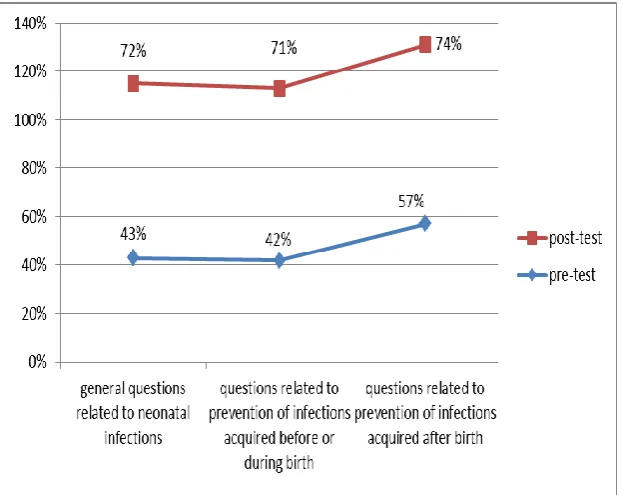
Findings related to distribution of mean knowledge score of study participants.
N=30
In pre-test (57%) of study participants had knowledge regarding questions related to
prevention of infections acquired after birth, (42%) had knowledge regarding prevention of
infections acquired before or during birth, (43%) had knowledge regarding general questions
related to neonatal infections.
In post-test, (74%) of study participants had knowledge regarding questions related to
prevention of infections acquired after birth, (71%) had knowledge regarding prevention of
infections acquired before or during birth and (72%) had knowledge regarding general
questions related to neonatal infections.
These findings showed that structured teaching programme was effective in increasing the
knowledge of study participants regarding prevention of neonatal infections.
Table 3: Findings related to overall pre-test and post-test mean percentage knowledge
scores.
N=30
Sl.No Knowledge Assessment
Max Score
Range Score
Knowledge Scores ‘t’ value df Inference Mean Mean% SD%
-10.46 29 P<0.05 *SS
1 PRE-TEST 40 11-23 18 45 2.612
2 POST-TEST 40 18-35 28.83 72.07 4.479
*SS=statistically significant
Table 3: the study findings revealed that the mean post-test score was 72.07% which was
significantly higher than the pre-test score 45%. Paired‘t’ value of pre-test and post-test of the
study samples was found to be significant at 0.05 level(t=-10.466). Thus, the findings
revealed that the structured teaching programme on prevention of neonatal infections was an
effective teaching method.
Findings related to association between socio-demographic variables and pre-test scores
The findings related to association between qualification and pre-test score revealed that the
obtained chi-square value (1.212) is lesser than the table value (3.84) at 0.05 level of
significance. Hence there was no significant association between qualification and pre-test
knowledge score. The findings related to association between area of working and pre-test
score revealed that the obtained chi-square value (2.301) is lesser than the table value (5.99)
at 0.05 level of significance. Hence there was no significant association between the area of
experience and pre test score revealed that the obtained chi-square value (3.409) is lesser than
the table value (7.82) at 0.05 level of significance. Hence there was no significant association
between the years of experience and pre-test knowledge score.
DISCUSSION
1. Findings related to demographic variables
The findings revealed that majority, 23(77%) of the study participants were under the age
group of 21-30years. Only 7(23%) were under the age group of 31-40 years. similar findings
were seen in the study done by Noronha(2004) which showed that majority of study
participants were under the age group of 21-30 years.
The study findings revealed that majority, 27(90%) of the study participants were qualified
with GNM and only 03(10%) were qualified with B.Sc nursing. Similar findings were seen in
the study done by Noronha(2004)[10] which showed that majority of study participants were
qualified with GNM.
The study findings revealed that majority, 13(44%) of study participants were wording in
postnatal ward, 11(36%) of study participants were working in pediatric ward and only
6(20%) were working in labor ward. Similar findings were seen in the study done by Glory
Prasad(2008)[11], which showed that majority of study participants were working in postnatal
ward.
The findings revealed that majority, 20(67%) of study participants were having 1-3 years of
experience, 6(20%) were having 4-6 years of experience, 3(10%) were having experience
above 9 years and only 1(3%) were having 7-9 years of experience. Similar findings were
seen in the study done by Noronha(2004)[10] which showed that majority of study participants
were having 1-3 years of experience.
II. Knowledge of study participants regarding prevention of neonatal infections
The study findings revealed that majority, 22(73%) of study participants had inadequate
knowledge, 8(27%) had moderate knowledge in pre-test. Whereas after implementing
structured teaching programme, in post-test 20(67%) of study participants had adequate
knowledge, 8(26%) had moderate knowledge and only 2(7%) had inadequate knowledge.
Therefore findings showed that most of the study participants had adequate knowledge after
Elizabeth(2009)[12] which showed that majority of the study participants had adequate
knowledge after administering structured teaching programme.
III. Effectiveness of structured teaching programme on prevention of neonatal
infections
The study findings revealed that the overall mean post-test score is 72.07% which is
significantly higher than the pre-test score 45%. Paired’t’ test of the study sample was found
to be significant at 0.05 level(t=-10.466). therefore the findings revealed that the structured
teaching programme on prevention of neonatal infections was an effective teaching strategy
to improve the knowledge of staff nurses. Similar findings was seen in the study done by
Nissi Elizabeth(2009)[12] which showed that the structured teaching programme was the best
teaching method as it enhances the knowledge of staff nurses on prevention of neonatal
infections.
IV. Association between pre-test knowledge scores and selected socio-demographic
variables
The study findings related to age revealed that the obtained chi-square value(0.017) is lesser
than the table value(3.84) at 0.05 level of significance. Hence there is no significant
association between the age and pre-test knowledge score. Similar findings was seen in the
study done by Nissi Elizabeth(2009)[12] which showed that there is no statistically significant
association between knowledge scores and age.
The study findings related to qualification revealed that the obtained chi-square (1.212) is
lesser than the table value (3.84) at 0.05 level of significance. Hence there is no significant
association between the qualification and pre-test knowledge score. Contradictory findings
were found in the study done by Nissi Elizabeth(2009)[12] which showed that there was
statistically significant association between knowledge scores and qualification.
The study findings related to area of working revealed that the obtained chi-square
value(2.301) is lesser than the table value(5.99) at 0.05 level of significance. Hence there is
no significant association between the area of working and pre-test knowledge score. Similar
findings was seen in the study done by Nissi Elizabeth(2009)[12] which showed that there is
The findings related year of experience revealed that the obtained chi-square value (3.409) is
lesser than the table value (7.82) at 0.05 level of significance. Hence there was no significant
association between the years of experience and pre-test knowledge score. Contradictory
findings were found in the study done by Nissi Elizabeth(2009)[12] which showed that there
was statistically significant association between knowledge scores and years of experience.
BIBILOGRAPHY
1. Singh M. Care of the Newborn. 6th edition. Newdelhi: Sagar Publication, 2004; 56-7: 225.
2. Marlow DR. Text book of pediatric Nursing. 6th edition. USA: W.B Saunders company,
1997; 371,422.
3. Ann L. Neonatal sepsis.[updated 15 Dec 2015]. Available from:
http://emedicine.medscape.com/atricle/978352-overview
4. 100 baby tips. Available from:
http://website.informer.com/visit?domain=100babytips.com
5. Liora C. Pediatric Emergency Medicine, Joe DiMaggio Children’s Hospital, Hollywood,
FL. Available from: https://medlineplus.gov/ency/article/007303.htm
6. Jacob A. A comprehensive textbook of Midwifery and Gynecological nursing. 2nd edition.
Newdelhi: Jaypee, 2008; 595-603.
7. Vishnu B. Hand washing practices in NICU. Indian Pediatrics, 52. [updated 15 may
2015]
Available from: http://medind.nic.in/ibv/t15/i5/ibvt15i5p382.pdf.
8. UNICEF. What works for children in south Asia. A newborn care: an overview.
Available from: https://www.unicef.org/rosa/Newborn.pdf.
9. Brady MT. Health care associated infections in the neonatal intensive care unit. American
academy of pediatrics, Nov, 2001; 5(3): 55-57.
10. Noronha JA. Effectiveness of teaching on episiotomy and perineal care among primipara
women of selected hospitals of Karnataka. The nursing journal of India, May, 2004;
16(5): 105-6.
11. Prasad G. Effectiveness of planned teaching programme on nursing management of first
stage of labor among staff nurses of a selected hospital in belgaum. Karnataka. Journal of
obstetrics and gynecology nursing, may, 2006; 12(2): 82-6.
12. Varghese NE. Effectiveness of structured teaching programme on knowledge and
practive regarding infection control measures in neonatal intensive care unit among