
HELGOL,/~NDER MEERESUNTERSUCHUNGEN Helgol~inder Meeresunters. 50, 131-175 (1996)
A r e v i e w of
Pseudo-nitzschia,
w i t h s p e c i a l r e f e r e n c e to
t h e S k a g e r r a k , N o r t h A t l a n t i c , a n d a d j a c e n t w a t e r s
G. R. Hasle 1, C. B. Lange 2 & E. E. Syvertsen 1
1 D e p a r t m e n t of Biology, M a r i n e Botany, U n i v e r s i t y of Oslo; P,O. B o x i 0 6 9 B l i n d e r n , N - 0 3 1 5 Oslo 3, N o r w a y
2Scripps Institution o f O c e a n o g r a p h y , G e o l o g i c a l R e s e a r c h Division 0215; La Jolla, C A 9 2 0 9 3 - 0 2 1 5 U S A
ABSTRACT: The Pseudo-nitzschia flora of the Skagerrak, North Atlantic, a n d a d j a c e n t waters, comprising P. pungens, P. multiseries, P. seriata, P. fraudulenta, P. heimii, P. delicatissirna, and P.pseudodeficatissima, has b e e n examined. Except for P. austrafis, all Pseudo-nitzschia species s h o w n to produce the toxin domoic acid are p r e s e n t in the area a l t h o u g h an o u t b r e a k of amnesic shellfish poisoning has n e v e r b e e n reported. For comparison of morphological a n d taxonomic characters, Pseudo-nitzschia seriata f. obtusa, P. australis, P. subfraudulenta, P. subpacifica, P. lineola, P. inflatula, a n d P. cuspidata h a v e b e e n i n c l u d e d in this investigation. Fine details of b a n d structure a n d poroid occlusions, previously ignored or unresolved, h a v e p r o v e n to add to the morphological distinction b e t w e e n P. pungens a n d P. multiseries, P. seriata a n d P. fraudulenta, P. seriata a n d P. australis, a n d P. delicatissima a n d P. pseudodelicatissima. Additional information on the structure of the proximal m a n t l e c o m p a r e d to that of the valve face has r e v e a l e d similarities in most of the species but differences b e t w e e n P. pungens a n d P. multiseries. The species' seasonal and long-term distributional patterns during the s a m p l i n g period (October 1978 t h r o u g h S e p t e m b e r 1993) in the S k a g e r r a k area are outlined. The greatest a b u n d a n c e s of P. seriata, a cold-water species most likely restricted to the n o r t h e r n h e m i s p h e r e , occurred in the spring, and those of the presum- ably cosmopolitan diatoms P. pungens, P. multiseries a n d P. pseudodelicatissirna, in the autumn. W h e r e a s P. multiseries seems to h a v e d e c r e a s e d in a b u n d a n c e in the 1990s, P. pseudodelicatissima has a p p a r e n t l y increased.
I N T R O D U C T I O N
P s e u d o - n i t z s c h i a H. P e r a g a l l o i n H. & M . P e r a g a l l o is p r e s e n t i n i n s h o r e , o f f s h o r e a n d o c e a n i c p l a n k t o n i n all b i o g e o g r a p h i c z o n e s ( H a s l e , 1972). S o m e d i a t o m i s t s f o l l o w H u s t e d t (1958) a n d c l a s s i f y P s e u d o - n i t z s c h i a a s a s e c t i o n of N i t z s c h i a H a s s a l l , w h e r e a s o t h e r s g i v e it t h e r a n k of g e n u s as d o n e b y P e r a g a l l o & P e r a g a l t o (1900).
132 G. R. Hasle, C. B. L a n g e & E. E. S y v e r t s e n
M o n t e r e y B a y , C a h f o r n i a in the a u t u m n of 1991. T h e o c c u r r e n c e w a s a c c o m p a n i e d b y mortalities of p e h c a n s a n d cormorants, w h i c h h a d fed on D A - c o n t a m i n a t e d a n c h o v i e s (Fritz et al., 1992). C u l t u r e s w e r e e s t a b l i s h e d a n d P. australis w a s s h o w n to b e a DA p r o d u c e r (Garrison et al., 1992; ViUac et al., 1993b). Pseudo-nitzschia deh'catissima (P. T. Cleve) H e i d e n has b e e n s h o w n to p r o d u c e small a m o u n t s of DA in c u l t u r e s (Smith et al., 1991); recently, also P. seriata (P. T. Cleve) H. P e r a g a l l o h a s b e e n f o u n d to p r o d u c e DA in cultures ( L u n d h o l m et al., I994). H o w e v e r , DA o u t b r e a k s in the field h a v e not b e e n t r a c e d b a c k to e i t h e r of t h e s e two species. T h e s e o b s e r v a t i o n s d e m o n s t r a t e t h e n e c e s s i t y of i d e n t i f i c a t i o n b e l o w t h e g e n e r i c l e v e l or s i z e - g r o u p ( "Nitzschia s e r / a t a " a n d "Nitzschia delicatissima" g r o u p s or c o m p l e x e s ; Hasle, 1965a) in o r d e r to effectively m o n i t o r field d i s t r i b u t i o n of d a n g e r o u s species.
Records of P. rnultiseries in E u r o p e a n coastal w a t e r s a r e scarce (Hasle, 1965a; ViUac et al., 1993a). Pseudo-nitzschia australis is not k n o w n from North Atlantic w a t e r s (Hasle, 1972, Fig. 2 as Nitzschia pseudoseriata). E v i d e n c e exists for a w i d e d i s t r i b u t i o n of P. pseudodelica~'ssima, P. delicatissima a n d P. seriata in N o r t h Atlantic w a t e r s (Hasle, 1965a; Hasle, 1972).
C a s e s of ASP h a v e n e v e r b e e n r e p o r t e d from E u r o p e a n waters, n e i t h e r h a d it b e e n r e p o r t e d from C a n a d i a n a n d N o r t h Pacific w a t e r s until 1987 a n d 1991, r e s p e c t i v e l y . The s u d d e n o u t b u r s t s of toxic b l o o m s in o t h e r p a r t s of the w o r l d s t i m u l a t e d a s e a r c h for i n f o r m a t i o n on the d i s t r i b u t i o n of Pseudo-nitzschia in E u r o p e a n waters.
A c c e s s to a c o m p r e h e n s i v e collection of s a m p l e s from the S k a g e r r a k ( L a n g e et al., 1992) g a v e a n o p p o r t u n i t y to e x a m i n e s e a s o n a l a n d l o n g - t e r m d i s t r i b u t i o n s in a n a r e a i n f l u e n c e d b y w a t e r m a s s e s from the N o r t h Sea, the N o r w e g i a n S e a a n d t h e Baltic Sea. B e c a u s e of b e t t e r i n s t r u m e n t a t i o n a n d / o r t e c h n i q u e n o w a v a i l a b l e to us, i n f o r m a t i o n on the fine structure of Pseudo-nitzschia s u p p l e m e n t a r y to that g i v e n b y H a s l e (1965a) could b e o b t a i n e d . Distinctive features of t h e g e n u s a n d s p e c i e s are d e s c r i b e d , a n d the d i s t r i b u t i o n of s p e c i e s r e c o r d e d from t h e S k a g e r r a k is g i v e n a n d c o m p a r e d w i t h o b s e r v a - tions from N o r w e g i a n coastal waters.
MATERIAL A N D M E T H O D S
The s t u d y m a t e r i a l c o n s i s t e d of n e t hauls c o l l e c t e d a l o n g a t r a n s e c t b e t w e e n s o u t h e r n N o r w a y (58 ~ 23' N, 08o49 , E) a n d the n o r t h e r n p a r t of S k a g e n , J u t l a n d , D e n m a r k (57 ~ 42' N, 09 ~ 45' E) (see L a n g e et al., 1992), from F e b r u a r y 1979 t h r o u g h S e p t e m b e r 1993. S a m p l e s o b t a i n e d prior to 1979 (May 1953, S e p t e m b e r 1966, s c a t t e r e d s a m p l e s from M a y 1967 t h r o u g h J u n e 1968, D e c e m b e r 1976, O c t o b e r - D e c e m b e r 1978) a n d from o t h e r s a m p h n g sites in the S k a g e r r a k w e r e also i n c l u d e d . S a m p l e s from o t h e r p a r t s of the w o r l d a n d u n i a l g a l cultures from t h e T r o n d h e i m s f j o r d , N o r w a y ( e s t a b h s h e d b y EES), Gulf of Mexico, t h e coasts of California a n d W a s h i n g t o n , U.S.A. (by t h e c o u r t e s y of G. A. Fryxell, T e x a s A & M Univ.) w e r e u s e d for c o m p a r a t i v e , m o r p h o l o g i c a l s t u d i e s . A d d i - tional m a t e r i a l w a s e x a m i n e d for i n f o r m a t i o n on t h e distribution of P s e u d o - n i t z s c h i a a l o n g the N o r w e g i a n coast, the N o r w e g i a n S e a a n d m o r e s o u t h e r n E u r o p e a n w a t e r s ,
T h e d i s t r i b u t i o n a l d a t a r e p r e s e n t m a i n l y p r e s e n c e or a b s e n c e . N o effort w a s m a d e , e i t h e r b y collection of s a m p l e s or b y p r e p a r a t i o n of d i a t o m shdes, to o b t a i n q u a n t i t a t i v e data. H i g h r e l a t i v e a b u n d a n c e s of s p e c i e s w e r e n o t e d , h o w e v e r .
A r e v i e w of Pseudo-nitzschia 133 (= S) a n d F r i e d r i c h - H u s t e d t - A r b e i t s p l a t z fiir D i a t o m e e n k u n d e in B r e m e r h a v e n (= BRM) has b e e n u s e d for lectotypification: T h e finder in use in the latter collection was m a d e by Carl Zeiss a n d is no l o n g e r p r o d u c e d (Simonsen, 1987, p. 5).
Light microscope observations (LM) on u n c l e a n e d material i n w a t e r m o u n t s provided information on the s h a p e of cells in girdle view a n d colony formation, b u t could b e u s e d only exceptionally for identification at the species level, especially w h e n cells lay i n girdle view. Phase contrast (Ph) with a Leitz O r t h o p l a n or a N i k o n Optiphot microscope, n e g a t i v e p h a s e contrast (BM 100x) for especially w e a k l y silicified structures, a n d differential i n t e r f e r e n c e contrast (DIC) with a N i k o n Optiphot microscope, were u s e d for e x a m i n a t i o n of a c i d - c l e a n e d m a t e r i a l m o u n t e d in Hyrax, Naphrax, or more seldom, in C o u m a r o n e . In critical cases, e.g. to d i s t i n g u i s h b e t w e e n the morphologically similar species, P. p u n g e n s ( G r u n o w ex P. T. Cleve) Hasle a n d P. multiseries, a n d P . p s e u d o - deficatissima a n d P. delicatissima (P. T. Cleve) H e i d e n , respectively, LM identification was c h e c k e d by e x a m i n a t i o n of a c i d - c l e a n e d material with transmission electron micros- copy (TEM = Jeol 100C, Jeol 100CX, JEM 1200EX). S c a n n i n g electron microscopy (SEM = JSM 6400) was u s e d to elucidate certain morphological details a l t h o u g h the SEM pictures are not i n c l u d e d here.
overlap
of
cell ends
valve girdle
view
view
, ,
interstria.-.-~~
stria(e)'-'~
~::l..--- fibula
~---- interspace~
q----=~
central interspace
, with central nodule
and raphe endings
134 G. R. Hasle, C. B. L a n g e & E. E. S y v e r t s e n
T h e t e r m i n o l o g y follows A n o n y m o u s (1975), Ross et al. (1979) a n d M a n n (1978, 1981). Thus, the terms ' k e e l p u n c t u m ' , ' p s e u d o n n d u l u s ' , 'intercostal m e m b r a n e ' and 'costa', u s e d by H a s l e (1965a), are r e p l a c e d by 'fibula', 'central n o d u l e ' 'stria" and 'interstria', r e s p e c t i v e l y (Fig. 1). T h e s p a c e b e t w e e n two fibulae is called t h e i n t e r s p a c e . a n d the s p a c e b e t w e e n the two central fibulae is called the central i n t e r s p a c e . A central i n t e r s p a c e consistently g r e a t e r t h a n the others i n d i c a t e s the p r e s e n c e of a c e n t r a l n o d u l e a n d c e n t r a l r a p h e endings.
A r g u m e n t a t i o n for r e t a i n i n g P s e u d o - n i t z s c h i a as a g e n u s of its own, b a s e d on c u r r e n t i n f o r m a t i o n on fine structure, has b e e n g i v e n by H a s l e (1993, 1994). H. P e r a g a l l o originally u s e d the spelling P s e u d o - N i t z s c h i a . T h e h y p h e n m u s t be r e t a i n e d (ICBN Art. 60.9, N o t e 2) b u t not the capitalization of the s e c o n d n a m e (ICBN Art. 60.2) ( G r e u t e r et al., 1994). A p r o p o s a l to p r o s c r i b e h y p h e n s in g e n e r i c n a m e s has not b e e n a p p r o v e d (P. C. Silva, p e r s o n a l communication), contrary to w h a t w a s e x p e c t e d w h e n the p a p e r b y H a s l e (1993) w a s p r e p a r e d .
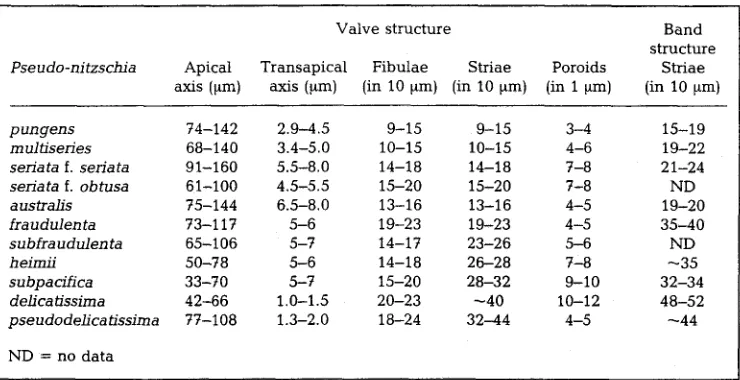
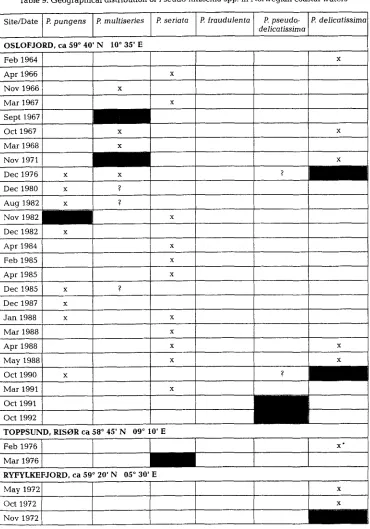
M o r p h o m e t r i c data are s u m m a r i z e d in T a b l e s 1 and 2, distributional d a t a from the S k a g e r r a k in T a b l e s 3-8, a n d distributional d a t a from the N o r w e g i a n c o a s t a l w a t e r s in T a b l e 9. T w o k e y s to species are p r e s e n t e d , o n e b a s e d on o b s e r v a t i o n s w i t h t h e light m i c r o s c o p e , a n d the other on o b s e r v a t i o n s w i t h the electron microscope. T h e k e y s show that fine structure alone is not sufficient to d i s c r i m i n a t e b e t w e e n all of t h e species o b s e r v e d , b u t n e e d s to be s u p p l e m e n t e d w i t h o b s e r v a t i o n s on v a l v e o u t l i n e (P. seriata a n d P. m u l t i s e r i e s ) a n d / o r n u m e r i c a l d a t a (P. h e i m f i and P. s u b p a c i f i c a ) .
Table 1. Morphometric data for Pseudo-nitzschia spp.
Pseudo-nitzschia Apical
axis (~.m)
Valve structure Band
structure
Transapical Fibulae Striae Poroids Striae
axis (~m) (in 10 ~m) (in 10 ~m) (in 1 ~m) (in 10 ~tm)
p u n g e n s 74-142
m ultiseries 68-140
seriata f. seriata 91-160
seriata f. obtusa 61-100
a ustr ahs 75-144
fraudulenta 73-1 i7
subfra udulen ta 65-106
heimii 50-78
subpacffica 33-70
defica tissima 42-66
pseudodelicatissima 77-108
ND = no data
2.9-4.5 9-15 9-15 3-4 15-19
3.4-5.0 10-15 10-15 4-6 19-22
5.5-8.0 14-18 14-18 7-8 21-24
4.5-5.5 15-20 15-20 7-8 ND
6.5-8.0 13-16 13-16 4-5 19-20
5-6 19-23 19-23 4-5 35-40
5-7 14-17 23-26 5-6 ND
5-6 14-18 26-28 7-8 ~35
5-7 15-20 28-32 9-10 32-34
1.0-1.5 20-23 ~40 10-12 48-52
Table 2. Distinctive specific features of Pseudo-nitzschia spp.
Pseudo-nitzschia seria
ta
multiseries australis pungens fraudulenta heimii subpacifica delicatissima subtraudulenta pse
u
dodelica
tissima
cuspidnta inflatula lineola ND
= no data Valve symmetry (tt axis} iso hetero Central Fibulae & striae Hymenate velum nodule equal unequal simple sectors in nr. in nr. Valve striae rows of poroids + + + + + + + + + + + + + + + + + + + + + + + + + + + + + + + + + + + + + + + + + + + + + +
3-4 3-4 2 2 2-3 2 2 2 2 1 1 1 1-2
Valvocop. striae height x width in nr, of poroids 4-6 • 2-3 4-5 • 2-3 3-5 x 3-4 1xl 10x2 3-4 x2 5-6x2
1• ND
4-6
x
2-3
ND ND ND
136 G. R. Hasle, C. B, L a n g e & E. E. S y v e r t s e n
P s e u d o - n i t z s c h i a H. P e r a g a l l o i n H. & M . P e r a g a l l o : 1900, e m e n d . H a s l e , 1 9 9 3 L e c t o t y p e : Pseudo-nitzschia seriata (P. T. Cleve) H. Peragallo in H. & M. Peragallo, chosen by Fryxell, Garza & Roelke, 1991, p, 241.
T h e g e n e r i c c h a r a c t e r s as s e e n w i t h LM a r e (i) strongly e l o n g a t e d cells in s t e p p e d colonies (formed b y o v e r l a p of cell ends), (ii) a s y m m e t r y a b o u t the a p i c a l p l a n e (in s o m e species), (iii) a s t r o n g l y e c c e n t r i c a l r a p h e s y s t e m w i t h central r a p h e e n d i n g s c o m m o n l y p r e s e n t , a n d (iv) two p l a t e - h k e c h l o r o p l a s t s lying s y m m e t r i c a l l y a b o u t t h e m e d i a n t r a n s a p i c a l p l a n e . The c i n g u l u m (the p o r t i o n of the g i r d l e a s s o c i a t e d w i t h a s i n g l e valve) is c o m p o s e d of a v a r y i n g n u m b e r of p e r f o r a t e d b a n d s , mostly three, a n d a n u n k n o w n n u m b e r of u n p e r f o r a t e d b a n d s ; all of t h e b a n d s are open. The b a n d s t a p e r g r a d u a l l y from the m i d r e g i o n of the cell t o w a r d s b o t h poles. At one p o l e a b a n d is s e e n a s two p o i n t e d e n d s a n d at the o p p o s i t e pole as a loop. T h e b a n d s b r e a k off easily at t h e loop a n d are t h e r e f o r e mostly p r e s e n t as h a l v e s in c l e a n e d material.
A d d i t i o n a l g e n e r i c c h a r a c t e r s s e e n w i t h EM are: (i) v a l v e striae with o n e to s e v e r a l rows of p o r o i d s with v e l a close to v a l v e exterior., (ii) i n t e r s t r i a e level w i t h the striae externally, a n d e x t e n d i n g i n t e r n a l l y into the cell l u m e n ; (iii) r a p h e not e l e v a t e d a b o v e the g e n e r a l level of the valve; (iv) r a p h e c a n a l walls w i t h o u t poroids; (v) s t r i a t e d b a n d s (in most s p e c i e s the striae are g r o u p s of poroids), with a n u n p e r f o r a t e d p a r s i n t e r i o r a n d a w i d e u n p e r f o r a t e d m a r g i n on the p a r s exterior, the size of the striae d e c r e a s i n g a b v a l - varly, a n d (vi) distal m a n t l e (the one f a r t h e s t a w a y from the r a p h e ; M a n n , 1978) d e m a r c a t e d from v a l v e face b y a strip of n o n - p e r f o r a t e d silica.
In contrast to the v a l v e face striae, t h e b a n d striae s e e m s u n k e n t o w a r d s t h e cell interior. T h e striae of t h e distal m a n t l e are c o n t i n u o u s with the v a l v e f a c e striae in structure a n d a l i g n m e n t . The p r o x i m a l m a n t l e (the one closest to the r a p h e ; M a n n , 1978) has, with a few exceptions, striae similar to those of v a l v e face, which are a l i g n e d e i t h e r w i t h the fibulae or i n t e r s p a c e s of the r a p h e , or with the v a l v e face striae.
RESULTS
The following P s e u d o - n i t z s c h i a t a x a w e r e e x a m i n e d in detail: P. p u n g e n s , P. m u l - tiseries, P. s e r i a t a f. s e r i a t a , P. f r a u d u l e n t a (P. T. Cleve) Hasle, a n d P. h e i m i i M a n g u i n of the "seriata c o m p l e x " ( t r a n s a p i c a l axis 3 - 4 ~m or more) a n d P. d e h ' c a t i s s i m a , a n d P. p s e u d o d e l i c a t i s s i m a of the " d e l i c a t i s s i m a c o m p l e x " ( t r a n s a p i c a l axis n a r r o w e r t h a n 3 - 4 ~m). In addition, P s e u d o - n i t z s c h i a s e r i a t a f. o b t u s a (Hasle) I-Iasle, P. a u s t r a l i s , P. s u b f r a u d u l e n t a (Hasle) Hasle, P. s u b p a c i f i c a (Hasle) H a s l e , P. l i n e o l a (P. T. Cleve) Hasle, P. i n f l a t u l a (Hasle) H a s l e a n d P. c u s p i d a t a (Hasle) H a s l e h a v e b e e n e x a m i n e d or r e f e r r e d to for c o m p a r i s o n . M o s t of the s p e c i e s c u r r e n t l y r e f e r r e d to P s e u d o - n i t z s c h i a a r e thus d e a l t with.
A r e v i e w of P s e u d o - n i t z s c h i a 137 KEY T O SPECIES
(based on light m i c r o s c o p e observations)
la. T r a n s a p i c a l axis w i d e r t h a n 3 [tm . . . 2
lb. T r a n s a p i c a l axis n a r r o w e r t h a n 3 `am . . . 9
2a. C e n t r a l l a r g e r i n t e r s p a c e p r e s e n t . . . 3
2b. C e n t r a l l a r g e r i n t e r s p a c e a b s e n t . . . 6
3a. Outline of v a l v e a s y m m e t r i c a l in the apical axis; one m a r g i n almost straight, the o t h e r c u r v e d . . . 4
3b. O u t l i n e of v a l v e s y m m e t r i c a l in the apical axis . . . 5
4a. F i b u l a e a n d interstriae d i s c e r n i b l e w i t h the light m i c r o s c o p e . . . P . h e i m f i 4b, F i b u l a e b u t not interstriae d i s c e r n i b l e with the light m i c r o s c o p e . . . . P . s u b p a c i f i c a 5a. V a l v e o u t l i n e l a n c e o t a t e ; m a r g i n s not parallel; fibulae and interstriae e q u a l in n u m b e r . . . P . f r a u d u l e n t a 5b. V a l v e outline with parallel m a r g i n s for the g r e a t e r part of the v a l v e l e n g t h ; fibulae a n d i n t e r s t r i a e u n e q u a l in n u m b e r . . . P . s u b f r m l d u l e n t a 6a. O u t l i n e of v a l v e a s y m m e t r i c a l in the apical axis; one m a r g i n almost straight, the other c u r v e d . . . P. s e r i a t a 6b. Outline of v a l v e s y m m e t r i c a l in t h e apical axis . . . 7
7a. P r e s e n c e of poroids in the striae d i s c e r n i b l e with the light m i c r o s c o p e . . P . p u n g e n s 7b. P r e s e n c e of poroids in the striae not d i s c e r n i b l e with the light m i c r o s c o p e . . . 8
8a. T r a n s a p i c a l axis w i d e r than 5 [tm; v a l v e apices rostrate; outline of s m a l l e r v a l v e s t e n d s to be a s y m m e t r i c a l in the apical axis . . . P . a u s t r a l i s 8b. T r a n s a p i c a l axis n a r r o w e r than 5 am; v a l v e outline l a n c e o l a t e with p o i n t e d (not rostrate) a p i c e s . . . P . m u l t i s e r i e s 9a. Cells in g i r d l e v i e w with t r u n c a t e apices; in v a l v e v i e w with r o u n d e d apices; v a l v e structure delicate, a n d central l a r g e r i n t e r s p a c e b a r e l y visible with the light micro- s c o p e . . . P . d e l i c a t i s s i m a 9b. Cells in girdle a n d v a l v e v i e w with p o i n t e d apices; fibulae a n d c e n t r a l l a r g e r i n t e r s p a c e clearly visible with the light m i c r o s c o p e . . . P . p s e u d o d e l i c a t i s s i m a KEY TO SPECIES (based on electron m i c r o s c o p e observations) la. Poroids w i t h simple h y m e n s ; central n o d u l e p r e s e n t or a b s e n t . . . 2
l b . Poroids w i t h c o m p l e x h y m e n s ; central n o d u l e p r e s e n t . . . 8
2a. Bands w i t h striae c o m p o s e d of a single r o w of poroids . . . 3
2b. Bands w i t h striae c o m p o s e d of g r o u p s of poroids . . . 4
3a. F i b u l a e a n d i n t e r s t r i a e e q u a l in n u m b e r ; central n o d u l e a b s e n t . . . P . p u n g e n s 3b. F i b u l a e a n d i n t e r s t r i a e u n e q u a l in n u m b e r ; central n o d u l e p r e s e n t . P . d e h ' c a t i s s i m a 4a. F i b u l a e a n d interstriae e q u a l in n u m b e r ; central n o d u l e a b s e n t . . . 5
4b. F i b u l a e a n d interstriae u n e q u a l in n u m b e r ; central n o d u l e p r e s e n t . . . 6
5a. V a l v e striae w i t h two rows of poroids . . . P . a u s t r a l i s 5b. V a l v e striae w i t h m o r e t h a n two rows of poroids . . . 7 6a. V a l v e striae, in g e n e r a l , ~ 28 in 10 `am w i t h __- 8 poroids in 1 ~ m . . . P . h e i m i i
138 G. R. Hasle, C. B. L a n g e & E. E. Syvertsen
7a. O u t l i n e of v a l v e symmetrical in the apical axis, valve apices p o i n t e d . P . r n u l t i s e r i e s
7b. O u t l i n e of valve a s y m m e t r i c a l in the apical axis, valve apices r o u n d e d . . . P . s e r i a t a
8a. F i b u l a e a n d interstriae e q u a l in n u m b e r . . . P . f r a u d u l e n t a
8b, F i b u l a e a n d interstriae u n e q u a l in n u m b e r . . . 9 9a. Valve striae with two rows of r o u n d i s h poroids . . . P. s u b f r a u d u l e n t a
9b. Valve striae with o n e row of s q u a r e poroids . . . P. p s e u d o d e l i c a t i s s i m a
P s e u d o - n i t z s c h i a p u n g e n s ( G r u n o w e x P. T. C l e v e ) H a s l e , 1 9 9 3 (Figs 3-6, 30-37, Tables 1-3)
B a s i o n y m : N i t z s c h i a p u n g e n s Gmnow ex P. T. Cleve, 1897a. T y p e l o c a l i t y : Yeddo Bay, Japan.
L e c t o t y p e : BRM W7/72a, Finder: 624.4; Hasle, 1995, Fig. 1.
M o r p h o 1 o g y ( L M ) : T h e coarsely sihcified cell is s p i n d l e - s h a p e d to l i n e a r with sharply p o i n t e d e n d s a n d a d e e p p e r v a l v a r axis (i.e. wide in girdle view). T h e overlap of cell e n d s i n colonies is ca one third of cell length. T h e cell is symmetrical w i t h respect to the apical p l a n e (transapical axis isopolar). T h e valve m a r g i n s are curved, a n d the valve e n d s distinctly p o i n t e d (Fig. 3). T h e interstriae are visible in water m o u n t s , in girdle as well as valve view. T h e n u m b e r s of fibulae a n d interstriae are equal; the i n t e r s t r i a e are so coarsely silicified that fibulae a n d interstriae are not readily discriminated, e s p e c i a l l y i n w a t e r mounts. A larger central i n t e r s p a c e is missing. T h e v a l v e face striae h a v e two rows of large poroids resolved with LM in well silicified a n d properly preserved, c l e a n e d a n d m o u n t e d s p e c i m e n s (acid-cleaned, Naphrax, Ph, Fig. 4). T h e b a n d s h a v e a r i b b e d a p p e a r a n c e ; the ribs are more widely s p a c e d in the central, wide part of t h e b a n d s t h a n closer to the n a r r o w e n d s (Figs 5, 6).
M o r p h o l o g y ( E M ) : The two rows of poroids of the valve face striae are s e p a r a t e d b y a n o n - p e r f o r a t e d space of a b o u t the s a m e w i d t h as the d i a m e t e r of the poroids. A s i n g l e poroid or a single row of poroids are occasionally p r e s e n t b e t w e e n two r e g u l a r rows (Figs 30, 31). T h e valve e n d s differ in structure, o n e e n d h a v i n g fewer poroids per stria t h a n the other (Figs 32, 33). T h e valves of a cell are a r r a n g e d so that each cell has one well areolated a n d o n e poorly areolated valve end. T h e valve m a n t l e is o n e poroid h i g h (Fig. 31). T h e proximal m a n t l e a n d the striae of the valve face differ in structure, the proximal m a n t l e b e a r i n g pairs of or single poroids a l i g n e d to a fibula or a n interspace, b u t s e l d o m to the rows of poroids of the valve face striae (Figs 30, 31, 34).
We lack o b s e r v a t i o n s on whole ceils. T h r e e c o n n e c t e d b a n d s , r e p r e s e n t i n g the entire c i n g u l u m or p a r t of it, h a v e b e e n p h o t o g r a p h e d , however. Each b a n d has o n e t r a n s v e r s e row of large poroids (each poroid = o n e s q u a r e or r o u n d i s h o p e n i n g s e e n w i t h LM) (Fig. 35). The v a l v o c o p u l a is s o m e w h a t w i d e r t h a n the two other b a n d s . The size of the poroids decreases a b v a l v a r l y (Fig. 35). T h e n a r r o w p o i n t e d e n d s as well as t h e loop i n the l i g u l a a r e a lack poroids (Fig. 36).
T h e v e l a of valve as well as b a n d poroids are h y m e n a t e (Mann, 1981), r e g u l a r l y perforated b y closely p a c k e d holes i n a strict h e x a g o n a l array (Fig. 37).
A r e v i e w of Pseudo-nitzsctna 139
H u s t e d t from a s u b s a m p l e of the s a m e m a t e r i a l r e c e i v e d from the P: T. C l e v e Collection in Stockholm. C l e v e (1897a, p. 24, Pl. 2, Fig. 23) g a v e the first description a n d illustration of the species r e f e r r i n g to the C l e v e & M611er slide a n d to G r u n o w as the author. T h e correct author citation is t h e r e f o r e G r u n o w ex C l e v e (ICBN Art. 46.4, G r e u t e r et al., 1994).
W h e n s e e n in girdle view, P. p u n g e n s m a y often h a v e b e e n confused w i t h P. seriata, w h i c h is m o r e f r e q u e n t l y r e c o r d e d in the literature. With LM, P. p u n g e n s can hardly be d i s t i n g u i s h e d from P. multiseries in girdle v i e w (e.g. Fig. 2 m i g h t illustrate P. p u n g e n s or P. multiseries). Pseudo-nitzschia p u n g i f o r m i s (Hasle) Hasle, has the s a m e v a l v e outline as P. p u n g e n s a n d P. multiseries, but has a central l a r g e r i n t e r s p a c e with a central n o d u l e and a m o r e w a r m - w a t e r distribution; it has not b e e n o b s e r v e d in the S k a g e r r a k or o t h e r E u r o p e a n w a t e r s (Hasle, 1972). As d i s c u s s e d below, P. p u n g e n s has a fairly u n i q u e
Table 3. Seasonal and interannual distribution pattern of Pseudo-nitzschia pungens
Jan Feb Mar Apr May Jun Jul Aug Sept Oct
1967
. . . ,
' 1 9 6 8 1 I I ....
i
Nov Dec
1978 1979 1980
081
i l
l
'
1982 , . :
1 9 8 3 ... ...
1984
I
F
1986
)i ); [ i ))iii))i)l
1 9 8 8 [}} } ) i
19901989 .. : ~N
1 9 9 1 ~ .
1 9 9 2 ~. ~ ~ -. ~.~,. ~i~/ ~ ~ I ~ .;~ X,;;-
1 9 9 3 ! 4 ~ i ~ i-:::~ ~ ~ :* ~
~ : - identification questionable ~... ~ . present
abundant
140 G. R. Hasle, C. B. L a n g e & E. E. S y v e r t s e n
position w i t h i n the " N i t z s c h i a s e r i a t a c o m p l e x " , j u d g i n g by the structure of t h e girdle a n d partly also by that of the proximal mantle.
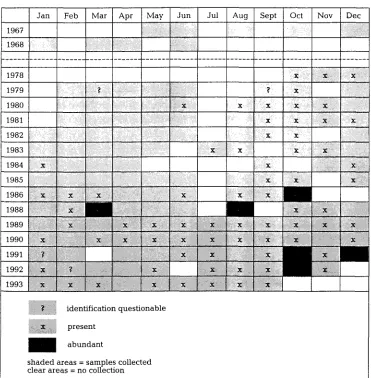
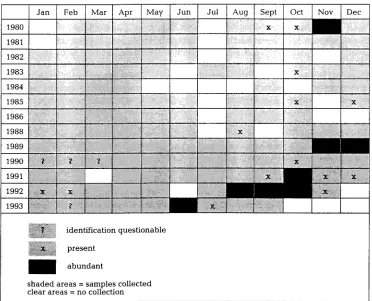
D i s t r i b u t i o n : T h e records from the S k a g e r r a k transect show a c e r t a i n shift m s e a s o n a l distribution p a t t e r n as w e l l as in relative a b u n d a n c e of P. p u n g e n s d u r i n g the s a m p l i n g p e r i o d (Table 3). It w a s not r e c o r d e d at all in 1967-1968. a n d from 1978 t h r o u g h 1985 it o c c u r r e d m a i n l y in the a u t u m n . A c h a n g e in the seasonal d i s t r i b u t i o n pattern s e e m s to h a v e a p p e a r e d since 1986. A l t h o u g h it still occurs in g r e a t e s t a b u n d a n c e s in the autumn, its o c c u r r e n c e has s p r e a d o v e r most of the year.
P s e u d o - n i t z s c h i a m u l t i s e r i e s ( H a s l e ) H a s l e , 1995
(Figs 2, 7-9, 38-44, Tables 1, 2, 4)
B a s i o n y m : N i t z s c h i a p u n g e n s f. m u l t i s e r i e s Hasle, 1974.
S y n o n y m : P s e u d o - n i t z s c h i a p u n g e n s f. m u l t i s e r i e s (Hasle) Hasle, 1993.
T y p e 1 o c a 1 i t y : Drobak, Oslofjord, Norway.
H o 1 o t y p e : IMBB (= Marine Botany, Department of Biology, Univ. of Oslo) no. 16, Hasle, 1995, Fig. 2.
M o r p h o 1 o g y ( L M ) : T h e cell is s p i n d l e - s h a p e d to linear in g i r d l e v i e w with sharply p o i n t e d e n d s (Fig. 2), l a n c e o l a t e in v a l v e v i e w (Fig. 7), a n d w i t h a n o v e r l a p of ca o n e third of cell l e n g t h in colonies (Fig. 2). Interstriae are d i s c e r n i b l e in w a t e r m o u n t s in girdle as w e l l as v a l v e view. F i b u l a e a n d interstriae are p r e s e n t in the s a m e n u m b e r , the fibulae b e i n g m o r e distinct t h a n the interstriae in a c i d - c l e a n e d m o u n t e d s p e c i m e n s (Fig. 7). A l a r g e r central i n t e r s p a c e is missing. T h e stria structure is u n r e s o l v a b l e with LM (Fig. 8, 100 DIC). T h e p e r f o r a t e d b a n d s s e e n in c l e a n e d m a t e r i a l of a c l o n a l culture (TkA2, Galveston) are n a r r o w and m o r e d e l i c a t e t h a n t h o s e of P. p u n g e n s (cf. Figs 6 a n d 9).
M o r p h o 1 o g y ( E M ) : T h e v a l v e face striae h a v e t h r e e to four s e p a r a t e d , irregu- lar rows of poroids (Fig. 38). T h o s e l o c a t e d close to the interstriae are s h g h t l y l a r g e r t h a n the others (Fig. 39). O n e of the two v a l v e e n d s has m o r e b r a n c h e d i n t e r s t r i a e t h a n the o t h e r (Pigs 40, 41).
T h e m a n t l e b e a r s striae two to t h r e e poroids high. T h e proximal a n d distal v a l v e m a n t l e s h a v e the s a m e structure, similar to that of the v a l v e face, a l t h o u g h often with f e w e r a n d m o r e i r r e g u l a r poroid rows t h a n those on v a l v e face (Fig. 38). T h e fibulae are shghtly d i s p l a c e d from the interstriae (Figs 40, 41), a n d the m a n t l e striae a r e a l i g n e d w i t h t h e r a p h e i n t e r s p a c e s (Pig. 38).
T h r e e c a t e g o r i e s of p e r f o r a t e d bands, differing in the size of the striae, w e r e f o u n d in u n i a l g a l cultures (Gulf of Mexico) as w e l l as in t h e S k a g e r r a k s a m p l e s from 1968 d o m i n a t e d b y P. m u l t i s e r i e s . W h e r e a s the v a l v o c o p u l a (Fig. 42) m a y h a v e four to f i v e poroids p e r stria in the p e r v a l v a r direction, t h e n u m b e r d e c r e a s e s a b v a l v a r l y in t h e other bands, as w e l l as t o w a r d s the cell ends, to o n e or n o n e (Figs 43, 44). E a c h of the s q u a r e or r e c t a n g u l a r " o p e n i n g s " s e e n with LM thus consists of s e v e r a l poroids. T h e u n p e r f o r a t e d m a r g i n s of all c a t e g o r i e s of b a n d s s e e m to h a v e a b o u t t h e s a m e width.
T h e poroids of the v a l v e as w e l l as of the b a n d s h a v e h y m e n a t e v e l a (Figs 39, 42-44). T a x o n o m y : T h e distinctive m o r p h o l o g i c a l c h a r a c t e r of R m u l L ' s e r i e s first r e a h z e d w a s the " m u l t i s e r i a t e " striae of the v a l v e face w i t h smaller p o r o i d s t h a n in P.
p u n g e n s . As s h o w n here, t h e s e two diatoms differ also in t h e structure of t h e v a l v e ends,
A r e v i e w of P s e u d o - n i t z s c h i a 141 Table 4. Seasonal and interannual distribution pattern of P s e u d o - n i t z s c h i a rnultiseries
J a n Feb Mar Apt May Jun Jul Aug Sept Oct Nov Dec
nW
iiiiiii!ii~::ii::~ili!!!!ii!iii!iiiiill
ii~iiiiiiiiiiiiiiiiii
ii[ii!!ii!iil !i!iiiiiiii}iiiiiiiii~ iiiii:iii!~i ~:~iiiiiii!i!iiiiiiiii~ iiiii!iiiiiiiiiiiiiiiiiiiiiiiiiiiiiiii i:iii:i:iiiiiii iii:iiiiiiiiiiiiiiiiii?iiii~ liiiiiiiiiiiiiiiiiiiiiii , ~!i~iiiii::ii~ !:!!i!}ii[iiiiiiii: ,iiiii!::;i;: ~iiiiiii}!i!}:i:i? ,iiiiiiiiiiiiiiiiiiiii~iiiiiiiiiiii ... ~ !
iii[iiiiiiiiiii[iii[ili~i~i~ii[[ii[[[iiiiiiiiiiJiiiii iiiii%i~ii~iiiiiiiiiii!![ I978
1979 1980 1981 1982
1983 Iii!!~!~!~ili!i!!!!!!ii~l
1984 1985 1986 1988 1989 1990 1991 1992 1993
iiiiiiiiiii!~ii~!~i!ii
~iii!iiiii
iiiiiiiiiiiiiiiiiiiiiiiiiiiiiiiii!~!'~i~iii
iiiiiiiiiiiiiiiii~i~i~i~i~i~i~i~i~iii~i~i~i~i~i~i~i~i~i~i~i~i~i~i~iJ~!~ii
84
84
~iiiiiiiii~iiiiiiiiiiiiiiiiiiiiii
... - ,,,,,,,,,,
iiiii~ii~ i~iiiiiii~iiiiiiiiiii
!ii!iiiiiiiiiiiiiiiiiiiiiiiiiiiiiiiii!iiiii!
i
iiiiiiiiiiiiZiiiiiiiiiiiii
iiiiiiiii~i~iiiiiiiiiiiiiiiiiiii~
,,,,,,,,,,,,,,,,,
,~,,,,,,
ii
Ili~!!~!
... "
84184184
: ,~i~i~i~i~iii~[~,
',,: ~,~i~!~i~i~i~:~
[,~i~i~iiiiiiiiiiiiiiiiiiiiiiiiiiiiiii~ fiiii~i~iiiiiiiiiiii!
' ' '"'"'"'""
iiiiiiiiiiiiii~i~ii!!~i!i. ~ii~:iiiiiiiiiiiiiiiiii iiiiiiiiiiiiiiiiiiiiiiiiiiiiiiiiiiiiiiiiiiiii!~ii ~
~,,,,,,,,: : ~E~`!!!~!!i!iii!i!i!i~iii~!!!!~!!!~!!!!!!~i!~!iiiii
~!i!!ii~l
% '!'!~!ii!ii~:
~,,,:,~,,,,,~,,,,,,,,,Ai~!!l~iiiiii
ii i~i ~li!i!~!'~i'~'!!i~!!~iiii~il
[ x x
... : [ ...
[ [ [ ~
;[[[[[[~[[[~![{
[[[[[ [[[
[[[[[;x [
[~[[:~ [ [ [[]:,[[[[[[[[
:, ... ,illl [[ [[[ [ [ ,
identification questionable
abundant
shaded areas = samples collected clear areas -- no collection
(Bates et al., 1993; D o u g l a s et al., 1993; M a n h a r t et al., 1995) c o r r o b o r a t e w i t h t h e m o r p h o l o g y a n d s u p p o r t t h e r a i s i n g of P. p u n g e n s f. m u l t i s e r i e s to s p e c i e s l e v e l (Hasle, 1995).
A p o s s i b l e s y n o n o m y b e t w e e n P. m u l t i s e n e s a n d N i t z s c h i a p u n g e n s v a t . a t l a n t i c a , d e s c r i b e d b y C l e v e (1897a, p. 24, P1. 2, Fig. 24) f r o m C o r u f i a H a r b o u r , S p a i n , m a y b e q u e s t i o n e d . T h e v a r i e t y d i f f e r e d from t h e n o m i n a t e o n e b y h a v i n g m o r e d e n s e l y s p a c e d striae. T y p e m a t e r i a l of N . p u n g e n s var. a t l a n t i c a h a s n o t b e e n f o u n d , a n d t h e p r o b l e m c a n t h u s n o t b e s o l v e d .
D i s t r i b u t i o n : P s e u d o - n i t z s c h i a m u l t i s e r i e s w a s t h e p r e d o m i n a n t s p e c i e s of t h e
142 G.R. Hasle, C. B. Lange & E, E. Syvertsen
1980s and in 1992 and 1993. The general trend in the seasonal distribution is its presence
in autumn through winter (Table 4).
P s e u d o - n i t z s c h i a s e r i a t a (P.T. C l e v e ) H. P e r a g a l l o i n H. & M. P e r a g a l l o , 1900
(Figs 10-14, 45-50, Tables 1, 2, 5)
P s e u d o - n i t z s c h i a s e r i a t a (P.T. C l e v e ) H . P e r a g a l l o f. s e r i a t a
B a s i o n y m : Nitzschia seriata P.T. Cleve, 1883.
T y p e 1 o c a 1 i t y : Tindingen, Greenland. L e c t o t y p e : $405, Hasle, 1994, Fig. 3.
M o r p h o 1 o g y ( L M ) : Cells in girdle view are l i n e a r to lanceolate, with p o i n t e d e n d s (Pig. 11). T h e overlap of cell e n d s in colonies is o n e third to a q u a r t e r of cell l e n g t h (Pigs 10, 11). T h e cell is a s y m m e t r i c a l with respect to the apical p l a n e (transapical axis heteropolar). O n e valve m a r g i n is curved, a n d the other straight (Pigs 10, 12), especially in the middle part of the valve. T h e v a l v e ends are slightly p r o l o n g e d with r o u n d e d poles (Pig. 12). The r a p h e m a y b e located on the straight or curved m a r g i n (Pigs 12, 14). T h e interstriae are d i s c e r n i b l e i n w a t e r m o u n t s in girdle (Pig. 11) as well as i n valve view. Interstriae a n d f i b u l a e are e q u a l in n u m b e r a n d i n d i s t i n g u i s h a b l e i n w a t e r m o u n t s ; i n cleaned, m o u n t e d m a t e r i a l the fibulae are more distinct t h a n the interstriae (Pigs 12-14). A central l a r g e r i n t e r s p a c e is m i s s i n g (Pig. 12).
The b a n d s m a y b e characterized as "striated" or "ribbed", h a v i n g o n e row of r e c t a n g u l a r o p e n i n g s (Pigs 13, 14).
M o r p h o 1 o g y ( T E M ) : T h e valve has three to four s e p a r a t e d rows of poroids p e r stria (Pig. 46). T h e poroids close to the interstriae are larger t h a n the others a n d more r e g u l a r in a p p e a r a n c e (Pigs 46, 47). T h e interstriae of o n e valve e n d are slightly more b r a n c h e d t h a n the other (Pig. 45).
T h e m a n t l e is two to three poroids high, with striae similar to those o n t h e v a l v e face b u t two to three e q u a l l y sized poroids w i d e (Pigs 46, 47). T h e fibulae a r e m o s t l y a l i g n e d with the interstriae, a n d the striae of the proximal m a n t l e with the r a p h e i n t e r s p a c e s
(Pig. 47).
T h r e e c o n n e c t e d striated b a n d s were r e p e a t e d l y found, occasionally w i t h a fourth n o n - p e r f o r a t e d b a n d a t t a c h e d (Pig. 48). T h e b a n d striae, well d e v e l o p e d o n the valvo- c o p u l a a n d the n e x t b a n d , h a v e two rows of poroids, occasionally with a third poroid b e t w e e n them, c o m p a r e d to the three to four poroid rows o n the valve. N e a r the c e n t r e of the cell the striae of the v a l v o c o p u l a h a v e four to six poroids in the p e r v a l v a r direction (Pigs 48, 49), g r a d u a l l y d e c r e a s i n g to two or o n e n e a r the poles (Pig. 45). T h e striae of the s e c o n d b a n d are a b o u t half as high, a n d the third b a n d has only o n e t r a n s v e r s e row of poroids (Pig. 48). T h e u n p e r f o r a t e d part of the pars exterior has a b o u t the s a m e w i d t h for all striated b a n d s .
T h e poroids of the valve as well as of the b a n d s h a v e h y m e n a t e v e l a (Pigs 47, 49). T a x o n o m y : No holotype of IV. seriata was f o u n d i n the P.T. C l e v e Collection.
O n e of the shdes l a b e l l e d " T i n d i n g e n , G r 6 n l a n d " h a s b e e n selected as a l e c t o t y p e a n d a
P. seriata s p e c i m e n encircled.
In valve view P. seriata f. seriata differs conspicuously from P. p u n g e n s a n d P. m u l -
t i s e r i e s b y valve outline. This character is often o b s c u r e d i n EM e x a m i n a t i o n s a n d the
A review of Pseudo-nitzschia 143
A t t e n t i o n has t h e n to be paid to the p o i n t e d e n d s of P. multiseries c o m p a r e d with the r o u n d e d e n d s of P. seriata (cf. Figs 40, 41, a n d 45).
Pseudo-nitzschia seriata f. obtusa differs from the n o m i n a t e form b y more obtuse valve ends, shorter apical a n d t r a n s a p i c a l axes (Fig. 15), somewhat more closely s p a c e d striae (Table 1), a n d the u s u a l a b s e n c e of poroids in the middle of the striae (Fig. 50). It should b e n o t i c e d that f. obtusa was n o t recorded from the Skagerrak, b u t only from further north ( N o r w e g i a n west coast from ca 63~ a n d n o r t h w a r d s d u r i n g the cold season) a l t h o u g h it was once o b s e r v e d off Helsingor d u r i n g winter, together with other "arctic" diatoms (Hasle, 1965a):
Pseudo-nitzschia australis (Synonym: Nitzschia pseudoseriata Hasle) m a y b e the species most easily confused with P. seriata. Its identity as a separate species has b e e n q u e s t i o n e d b y Rivera (1985) who c l a i m e d that N . p s e u d o s e r i a t a as well as N. seriata f.
1967 1968
Table 5. Seasonal and interannual distribution pattern of Pseudo-nitzschia seriata
Jan Feb Mar Apr May Jun Jul Aug Sept Nov Dec
,
1978 1979
1980
:
m
~,): ....1981
__198~
1~83
I
1984
m m
1986
1988
m
1989
... ~ :. :."!~;
1991 ~g4#~'~i? i
1992 N ,~:~,~,~,~,~:~ [))ii)))))))i))~i)~i) ))i)
...
... ...
'
;):,:
}
N
present
abundant
144 G. R. Hasle, C. B. L a n g e & E. E. Syvertsen
o b t u s a were s y n o n y m s of IV. s e n a t a . P s e u d o - n i t z s c h i a a u s t r a l i s is on a v e r a g e l a r g e r a n d
more coarsely structured t h a n P. s e r i a t a (Table 1). Larger s p e c i m e n s of P . a u s t r a l i s are s y m m e t r i c a l with respect to the apical plane, a n d the cell e n d s are s o m e w h a t rostrate (Fig. 16). T h e s e characters are less p r o n o u n c e d in smaller specimens. T h e b r a n c h i n g of the interstriae of the two valve e n d s of P. a u s t r a l i s (Figs 51.52} follows the p a t t e r n s e e n m
P. s e r i a t a f. s e r i a t a (Fig. 45). TEM studies of valve a n d b a n d s t r u c t u r e give further
e v i d e n c e for P. a u s t r a l i s as a species of its own. The striae on valve face b e a r only two rows of h y m e n a t e poroids (Table 2) s e p a r a t e d b y a wide u n p e r f o r a t e d s p a c e occasionally with a third poroid close to the r a p h e (Fig. 53). T h e m a n t l e is o n e to two p o r o i d s high, a n d the m a n t l e striae are two to three poroids wide (Figs 53, 54). The b a n d striae differ from those o n v a l v e face by h a v i n g more t h a n two rows of poroids, a n d from the b a n d striae of
P. s e r i a t a f. s e r i a t a by s h a p e a n d usually more rows of poroids (cf. Figs 48 a n d 55; Table
2). Three striated b a n d s a n d one n a r r o w u n p e r f o r a t e d b a n d a n d h y m e n a t e vela have b e e n o b s e r v e d in P. a u s t r a l i s (Figs 55, 56), as in P. s e r i a t a f. s e r i a t a .
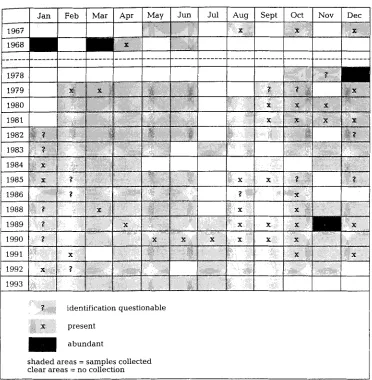
D i s t r i b u t i o n : P s e u d o - n i t z s c h i a ser~ata is a typical w i n t e r - s p r i n g species in the
S k a g e r r a k area, a l t h o u g h o b s e r v e d sporadically also in the a u t u m n . It w a s scarce in the 1967/68 s a m p l e s b u t occurred regularly d u r i n g the whole s a m p l i n g p e r i o d 1979-93 (Table 5) with greatest relative a b u n d a n c e s d u r i n g the s p r i n g diatom p e a k .
P s e u d o - n i t z s c h i a f r a u d u l e n t a (P. T. C l e v e ) Hasle, 1 9 9 3 (Figs 17-19, 57-61, Tables I, 2, 6)
B a s i o n y m : Mitzschia fraudulenta P. T. Cleve, 1897b.
S y n o n y m : P s e u d o - N i t z s c h i a seriata var. fraudulenta (P. T. Cleve) H. Peragallo in H: & M. Peragallo, 1900.
T y p e 1 o c a 1 i t y : Plymouth Harbour. L e c t o t y p e : SXV-21, Hasle, 1994, Fig. 4.
M o r p h o 1 o g y ( L M ) : Cells in girdle view are l i n e a r to l a n c e o l a t e , with p o i n t e d ends, a n d in valve view typically l a n c e o l a t e , the valve m a r g / n s b e i n g c u r v e d a n d g r a d u a l l y t a p e r i n g towards p o i n t e d ends. T h e overlap of cell e n d s in colonies is o n e sixth to ca o n e e i g h t h of cell l e n g t h (Fig. 17). F i b u l a e a n d interstriae are a p p r o x i m a t e l y e q u a l in n u m b e r s . Interstriae, b u t not fibulae, m a y b e d i s c e r n e d i n w a t e r m o u n t s u n d e r optimal conditions. T h e fibulae, a larger central i n t e r s p a c e a n d a c e n t r a l n o d u l e a r e m o r e distinct t h a n the interstriae w h e n a c i d - c l e a n e d v a l v e s m o u n t e d i n a m e d i u m of a h i g h refractive i n d e x are e x a m i n e d (Pig. 18). The b a n d structure is not resolved with LM (Fig. 19).
M o r p h o l o g y ( T E M ) : T h e valve striae h a v e two to three rows of closely p a c k e d s q u a r e poroids that fill out almost the w h o l e space b e t w e e n two i n t e r s t r i a e (Pigs 57, 58). O n e valve e n d has o n e or two o b l i q u e rows of poroids close to the apex, which are m i s s i n g o n the other e n d (Figs 59, 60). T h e m a n t l e is o n e to two poroids h i g h (Figs 57, 58). T h e fibulae are a l i g n e d with the valve face interstriae and, more i r r e g u l a r l y , with the striae or the interstriae of the proximal m a n t l e (Fig. 57). T h e central l a r g e r i n t e r s p a c e s p a n s three to four valve face striae (Fig. 57). T h e poroid v e l u m consists of a central irregular u n p e r f o r a t e d part with b r a n c h e s towards the periphery. B e t w e e n the b r a n c h e s are h y m e n a t e sectors (Fig. 58).
A review of P s e u d o - n i t z s c h i a 145
(Fig. 61), occasionally with a central third row of smaller poroids. The poroid occlusions are h e x a g o n a l h y m e n a t e a n d similar in size to the h y m e n a t e sectors of the valve poroids. A second, narrow, indistinctly structured, b a n d m i g h t be present, a n d a n u n k n o w n n u m b e r of n o n - p e r f o r a t e d bands.
T a x o n o m y : P s e u d o - n i t z s c h i a f r a u d u l e n t a as a species of its o w n a n d not a variety
of P. s e r i a t a is justified b y (i) the s y m m e t r i c a l valve outline, (ii) the larger central
i n t e r s p a c e with a central nodule, (iii) the more d e n s e l y spaced fibulae a n d striae, (iv) the larger valve poroids with h y m e n a t e sectors, (v) the valvocopula striae, with smaller poroids a n d more d e n s e l y spaced t h a n in P. s e r i a t a , a n d (vi) the a p p a r e n t l y single striated b a n d a n d several u n p e r f o r a t e d b a n d s .
P s e u d o - n i t z s c h i a s u b f r a u d u l e n t a is morphologically closely related to P. f r a u d u l e n t a
b u t has not b e e n recorded from the S k a g e r r a k with certainty, a l t h o u g h it does occur further south, in the North Atlantic (off the P o r t u g u e s e a n d the n o r t h w e s t e r n African coasts). P s e u d o - n i t z s c h i a s u b f r a u d u l e n t a differs from P. f r a u d u l e n t a in valve outline, the m a r g i n s b e i n g straight for a greater part of the valve l e n g t h (Fig. 62). The interstriae are more d e n s e l y s p a c e d t h a n in P. f r a u d u l e n t a , a n d more n u m e r o u s t h a n the fibulae (Table 1), T h e central larger interspace has the width of five valve striae (Fig. 62). The m a n t l e is
Table 6. Seasonal and interannual distribution pattern of P s e u d o - n i t z s c h i a f r a u d u l e n t a
Jan Feb Mar Apt May Jun
i!!iil iiiiiiiiiiiiiiiiiiiiiiiii!iiiiiiiiiiiiiii iiii!iiii iiiiiii~ii!/ii!i!iiiiiiiiiiiiiii~ iiii iii!i!i!iiiiiiiiiiiiiiiiiiiiiiiiiiiiiiiiiiiii iiiiiii!ili iii i!::,
1980
I
198~
[ '
1982 f 1 i I
~
I
1983 ... ...
Jul Aug Sept Oct Nov Dec
i i [ I
ii iiiiiiii iiiiiiiiiiiiiiiii~ ii [[
1984
...
1985
1986
l
I
t
I-
x :
1
. . .
! 988
D
I:
1989
i
1990
1992 I.;i,
1993 ,::.~i!~f~'i" ... ~ : i ~
iiiiiiiiiiiiii~i~iii: :::::::::::::::::::::
--'~; identification questionable
~ . present
abundant
146 G. R. Hasle, C. B. L a n g e & E. E. Syvertsen
o n e to two poroids high, a n d the vela of valve face a n d m a n t l e (Figs 63, 64) are structured as in P. f r a u d u l e n t a .
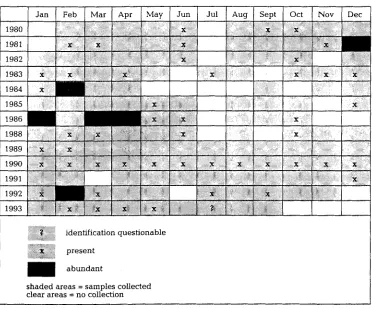
D i s t r i b u t i o n : P s e u d o - n i t z s c h i a f r a u d u l e n t a was recorded sporadically d u r i n g
the s a m p l i n g period 1980-93 a n d with o n e exception (November 1989) a l w a y s i n small c o n c e n t r a t i o n s (Table 6). U n l i k e P. s e n a t a f. s e n a t a , P. p u n g e n s a n d P. m u l t i s e r i e s , it is most likely i n t r o d u c e d from further south in the North Atlantic or from t h e N o r w e g i a n Sea,
P s e u d o - n i t z s c h i a h e i m i i M a n g u i n , 1957
(Pigs 20, 65-69, Tables 1 and 2)
S y n o n y m : Nitzschia h e i m i i (Manguin) Hasle, 1965a.
T y p e l o c a l i t y : The coast of Ad41ieLand. T y p e u n k n o w n .
M o r p h o 1 o g y ( L M ) : T h e cells from the S k a g e r r a k are a s y m m e t r i c a l (trans- apical axis heteropolar) in valve view with o n e valve m a r g i n almost straight, especially in the m i d d l e part, a n d the other convex. T h e valve e n d s are broadly r o u n d e d a n d n o t distinctly a s y m m e t r i c a l in s h a p e (Fig. 20). T h e fibulae, along either the c u r v e d or the straight margin, a n d the central l a r g e r i n t e r s p a c e are readily seen on c l e a n e d valves m o u n t e d in a m e d i u m of h i g h refractive i n d e x (Pig. 20). The interstriae are more closely spaced t h a n the fibulae a n d less distinct, a l t h o u g h discernible with LM (Pig. 20).
M o r p h o 1 o g y ( T E M ) : S p e c i m e n s e x a m i n e d from the S k a g e r r a k h a v e two rows of small poroids per valve stria s e p a r a t e d b y a wide u n p e r f o r a t e d space (Figs 65, 66, 69). T h e m a n t l e is structured as the valve face a n d is three to four poroids h i g h (Pig. 65). T h e striae of the proximal m a n t l e are slightly displaced from those of the v a l v e face (Figs 65, 68). The two central fibulae are w i d e l y spaced, the i n t e r s p a c e c o r r e s p o n d i n g to four or five valve face striae (Pigs 65, 67).
The v a l v o c o p u l a has r e c t a n g u l a r striae {Fig. 67), with two rows of three to four poroids in the p e r v a l v a r direction (Fig. 68). T h e valve as well as v a l v o c o p u l a vela are h y m e n a t e (Pigs 66, 68).
T a x o n o m y : T h e Antarctic d i a t o m M a n g u i n (1957) described as P. h e i m i i is larger (apical axis 104-117 ~m, t r a n s a p i c a l axis 5.5-6.5 ~m) a n d more coarsely s t r u c t u r e d (11-15 fibulae a n d 21-23 striae in 10 ~m) t h a n the s p e c i m e n s w e have i d e n t i f i e d as P. h e i m f i from the Skagerrak. A more d e h c a t e l y s t r u c t u r e d form of P. h e i m i i has b e e n recorded from the S u b a n t a r c t i c (40-50 ~ a n d in w a t e r s off Shetland, North Atlantic (Hasle, 1965a, 1972). A l t h o u g h it is s o m e w h a t l o n g e r a n d n a r r o w e r t h a n the S k a g e r r a k s p e c i m e n s , w e feel fairly c o n f i d e n t that the diatoms from the S k a g e r r a k a n d S h e t l a n d a n d , most hkely also from the Subantarctic, b e l o n g to the same taxon.
Due to the a s y m m e t r y of the valve, P s e u d o - n i t z s c h i a h e i m i i m a y b e c o n f u s e d with P.
s e r i a t a f. s e r i a t a w h e n s e e n i n w a t e r m o u n t s . However, e x a m i n a t i o n of a c i d - c l e a n e d
material in a m e d i u m of high refractive i n d e x r e a d i l y show the central l a r g e r i n t e r s p a c e a n d the g r e a t e r n u m b e r of interstriae t h a n fibulae. T h e distinction b e t w e e n P. h e i m f i a n d
P. f r a u d u l e n t a , s e e n with the h g h t microscope, d e p e n d s on the difference i n s y m m e t r y
a n d the less distinct a n d more d e n s e l y s p a c e d fibulae of P. f r a u d u l e n t a . T h e structure of the valve poroid occlusions is a further distinctive feature (cf Figs 58 a n d 66).
P s e u d o - n i t z s c h i a s u b p a c i f i c a (Figs 21, 22), recorded from n o r t h w e s t African a n d
A r e v i e w of P s e u d o - n i t z s c h i a 147 c h a r a c t e r s as P. h e i m f i i n c l u d i n g striated b a n d s (Hasle, 1965a, P1. 8, Fig. 4a), but is, on a v e r a g e , smaller (apical axis 33-70 ~m), w i d e r (transapical axis 5-7 ~m) a n d m o r e d e l i c a t e in structure (15-20 fibulae a n d 28-32 striae in 10 [~m).
D i s t r i b u t i o n : P s e u d o - n i t z s c h i a h e i m i i w a s r e c o r d e d in 1983, 1985, 1986, 1989
a n d 1990 in small c o n c e n t r a t i o n s in the late a u t u m n from the S k a g e r r a k station closest to the Danish coast a n d the o n e in t h e m i d d l e of the transect. In O c t o b e r 1990 it was, h o w e v e r , the d o m i n a n t P s e u d o - n i t z s c h i a species i n s a m p l e s collected at F l o d e v i g e n M a r i n e R e s e a r c h Station on the N o r w e g i a n south coast.
P s e u d o - n i t z s c h i a d e l i c a t i s s i m a (P. T. C l e v e ) H e i d e n i n H e i d e n & K o l b e , 1928
(Figs 23-25, 70-75, Tables 1, 2, 7)
B a s i o n y m : N i t z s c h i a d e l i c a t i s s i m a P. T. Cleve, 1897a.
S y n o n y m : N i t z s c h i a a c t y d r o p h i l a Hasle, 1965a.
T y p e l o c a l i t i e s : Atlantic, 63010 , N, 0036 , E; Spitzbergen; Sweden. N e o t y p e 1 o c a 1 i t y : Helder, the Netherlands, 7th May 1897.
N e o t y p e : S slide labelled " N i t z s c h i a d e l i c a t i s s i r n a , Helder 7/5-97", this paper, Fig. 23.
M o r p h o 1 o g y ( L M ) : P s e u d o - n i t z s c h i a d e l i c a t i s s i m a m a y be r e c o g n i z e d in gir-
dle v i e w by the e x t r e m e l y short overlap (ca o n e - n i n t h of cell length) of t h e cells, w h i c h are slightly sigmoid, narrow, a n d t r u n c a t e at their e n d s (Hasle, 1965a, P1.2, Fig. 10a). T h e cells are n a r r o w a n d l i n e a r in girdle as w e l l as v a l v e v i e w ; in v a l v e v i e w t h e y are slightly w i d e r in the m i d d l e a n d t a p e r towards r o u n d e d cell e n d s (Pigs 23-25). T h e fibulae, and o c c a s i o n a l l y the central l a r g e r interspace, are visible on c l e a n e d s p e c i m e n s m o u n t e d in a m e d i u m of a h i g h refractive i n d e x (Pig. 25), w h e r e a s the interstriae a n d the b a n d structure are not r e s o l v e d with the light m i c r o s c o p e (Ph, BM 100x).
M o r p h o 1 o g y ( T E M ) : T h e r e are a p p r o x i m a t e l y two interstriae for e a c h fibula a n d t h r e e striae for the central i n t e r s p a c e (Pigs 70-72). T h e striae h a v e two rows of t r i a n g u l a r to h e x a g o n a l poroids with h y m e n a t e v e l a (Pigs 72, 73). The a p p a r e n t variation in size a n d n u m b e r of poroids p r e s e n t m a y b e a result of d e g r e e of silicification. T h e r e is no n o t i c e a b l e d i f f e r e n c e in the structure of the two v a l v e e n d s (Pigs 70, 71). T h e m a n t l e is o n e poroid h i g h a n d b e a r s one row of l a r g e poroids that m a y b e split in two (Pigs 73, 74). T h e striae of the p r o x i m a l m a n t l e are a l i g n e d either w i t h v a l v e face striae or possibly m o r e often with the interstriae (Pigs 73, 74).
T h r e e s t r u c t u r e d a n d an u n k n o w n n u m b e r of u n s t r u c t u r e d b a n d s w e r e o b s e r v e d inside a single c i n g u l u m (Pig. 75). T h e v a l v o c o p u l a has o n e row of r e c t a n g u l a r poroids of a b o u t the s a m e w i d t h as the v a l v e striae but filled by h y m e n a t e v e l a (Pigs 74, 75). T h e v e l u m m a y b e split into a f e w i r r e g u l a r portions (Pig. 75) g i v i n g the i m p r e s s i o n of striae with closely p a c k e d poroids. T h e n e x t b a n d has a silicified rib r u n n i n g a l o n g the b a n d ' s length, s e p a r a t i n g the b a n d into two halves, e a c h o r n a m e n t e d with i r r e g u l a r poroids (Pigs 74, 75). T h e third b a n d in the a b v a l v a r direction has small s c a t t e r e d poroids (Pigs 74, 75).
Structural d i f f e r e n c e s s h o w n in Figs 73-75 m a y be d u e to s t a g e s in t h e mor- p h o g e n e s i s of t h e girdle (incomplete in Fig. 73 b u t fully d e v e l o p e d in Figs 74 a n d 75).
T a x o n o m y : M a t e r i a l from the localities C l e v e r e f e r r e d to in the d e s c r i p t i o n of P.
d e f i c a t i s s i m a has n e v e r b e e n found. A slide in N a t u r h i s t o r i s k a Riksmuseet, S e k t i o n e n f6r
148 G. R. Hasle, C. B. Lange & E. E. Syvertsen
labelled "Nitzschia delicatissima, Helder 7/5-97" in Cleve's handwriting has therefore been suggested as the neotype (Hasle, 1976). A specimen on this slide (Fig. 23) is presented here for comparison with the Skagerrak specimens (Figs 24, 25). Cleve (1897a, p. 24, P1. 2, Fig. 22} described and illustrated his species with a "central keel". The two valves of a single cell seldom separate, even during acid cleaning, and thus, when flattened on the slide, the specimens may easily be interpreted as having a central raphe. Pseudo-nRzschia delicatissima seems to be the only one of the smaller Pseudo- nitzschia species (the "delicatissima complex") that has simple hymenate vela like the much larger P. p u n g e n s , P. multiseries, P. seriata and P. heimii. Pseudo-nitzschia delicatissima is also more similar to the coarsely structured P. p u n g e n s with regard to
proximal mantle and valvocopula structure than to other delicate Pseudo-nitzschia
species.
Table 7. Seasonal and interannual distribution pattern of Pseudo-nitzschia deficatissirna
Jan Feb
1 9 8 0 1981 1982
1983 x ~
1985 i ~
1986
1988
1989 , ) ~ } ) ... 1990
1991 ~ i
1992
1993 ~ ~
Mar Apt May Jun Jul Aug Sept Oct Nov Dec
iiiiiii~iiiiii ~iiiiiiiiiiiiiiiiiii
[
[
l
iiiiii~ ~i~i~i~i~i~i~i~i~i~i~i~i~i~ ~ [ii~iiiii~ iiil :!i :
~. ))~i) )) ); i ~ ii . . . ... : ... ...
... ... i : i
identification questionable
I
I
~ = : present
~ abundant
shaded areas = samples collected clear areas = no collection
A r e v i e w of P s e u d o - n i t z s c h i a 149 S e p t e m b e r 1966, N o v e m b e r a n d D e c e m b e r 1978 ( F l ~ d e v i g e n M a r i n e R e s e a r c h S t a t i o n , N o r w e g i a n s o u t h coast), a n d i n D e c e m b e r 1967 a n d M a r c h 1968 w i t h i n t h e t r a n s e c t .
P s e u d o - n i t z s c h i a p s e u d o d e l i c a t i s s i m a ( H a s l e ) H a s l e , 1 9 9 3
(Figs 26-29, 76-81, Tables 1, 2, 8)
B a s i o n y m : N i t z s c h i a p s e u d o d e l i c a t i s s i m a Hasle, 1976.
S y n o n y m : N i t z s c h i a d e l i c a t u l a Hasle, 1965a, non N i t z s c h i a d e l i c a t u l a Skvortzow, 1946.
T y p e l o c a l i t y : D e n m a r k Strait.
H o 1 o t y p e : IMBB no. 23, this paper, Fig. 27.
M o r p h o l o g y ( L M ) : T h e c e l l s a r e l i n e a r to a l m o s t l i n e a r , t a p e r i n g t o w a r d s p o i n t e d e n d s i n g i r d l e as w e l l a s v a l v e v i e w (Figs 26, 27). T h e o v e r l a p of c e l l s i n c h a i n s is a b o u t o n e - e i g t h to o n e - n i n t h of c e l l l e n g t h . T h e f i b u l a e a n d a c e n t r a l l a r g e r i n t e r s p a c e w i t h a c e n t r a l n o d u l e a r e r e a d i l y s e e n o n c l e a n e d v a l v e s m o u n t e d i n a m e d i u m of a h i g h r e f r a c t i v e i n d e x (Figs 28, 29). T h e i n t e r s t r i a e of w e l l s i l i c i f i e d s p e c i m e n s m a y o c c a s i o n a l l y b e r e s o l v e d .
M o r p h o 1 o g y ( T E M ) : T h e r e a r e a p p r o x i m a t e l y t w o s t r i a e p e r f i b u l a . E a c h s t r i a is c o m p o s e d of o n e r o w of l a r g e s q u a r e p o r o i d s (Figs 76, 77). T h e v a l v e e n d s a r e s i m i l a r i n
Table 8. Seasonal a n d i n t e r a n n u a l distribution p a t t e r n of P s e u d o - n i t z s c h i a p s e u d o d e l i c a t i s s i m a
J a n Feb Mar Apr May J u n Jul A u g Sept Oct Nov Dec
1980 ...
1981 E l I ...
i
1982
.
1984 I;)}}}}}} [ ;:;: } I} 9 : [ }}}l ! ! , ... ... i 1 9 8 5
I
t
I
I
[
I
... ...'
'
...[ I I
r r
|
1 9 8 6 ...
1988 ' ': '
. . . . . . : . . .
i
i
1 9 8 9 . . . : . . . 9 .. . .
1990 I 1
~:~ :,:~..~ ~.~::: identification q u e s t i o n a b l e ~ p r e s e n t
~ a b u n d a n t
150 G. R. Hasle, C. B. Lange & E. E. Syvertsen
structure (Figs 78, 79}. The valve m a n t l e is o n e large r e c t a n g u l a r or r o u n d i s h poroid high (Fig. 76). T h e proximal valve m a n t l e poroids are u s u a l l y a h g n e d with the v a l v e face striae (Fig. 77). T h e central i n t e r s p a c e with the central n o d u l e corresponds to four striae (Fig. 77). The veta of the valve face poroids consist of a central u n p e r f o r a t e d or h y m e n a t e part, s u r r o u n d e d by five to eight h y m e n a t e sectors (Fig. 76). T h e vela of the m a n t l e poroids h a v e basically the same p a t t e r n e l o n g a t e d in pervalvar direction a n d w i t h more h y m e - n a t e sectors (Fig. 76).
T h e c i n g u l u m has three striated b a n d s , e a c h stria h a v i n g two to three rows of four to six poroids i n the pervalvar direction. T h e v a l v o c o p u l a is slightly wider t h a n the other b a n d s (Figs 80.81). A n a r r o w u n p e r f o r a t e d b a n d seems to form the e d g e of the c i n g u l u m (Fig. 81). T h e poroids of the b a n d striae are s h a p e d as the h y m e n a t e sectors of the valve vela (cf. Figs 76 a n d 811.
T a x o n o m y : P s e u d o - n i t z s c h i a p s e u d o d e l i c a t i s s i m a a n d P. d e l i c a t i s s i m a both a p p e a r in North E u r o p e a n i n s h o r e waters, s o m e t i m e s in the same sample. D i s c r i m i n a t i n g characters d i s c e r n i b l e with LM are p o i n t e d apices a n d l i n e a r valves in P. p s e u d o d e l i c a t i s - s i m a , c o m p a r e d to r o u n d e d apices, short overlap of cell e n d s a n d a slight w i d e n i n g of the central part of P. d e l i c a t i s s i m a . TEM o b s e r v a t i o n s of valve striae, m a n t l e a n d b a n d s further clarify the distinction b e t w e e n the two species.
P s e u d o - n i t z s c h i a p s e u d o d e l i c a t i s s i m a has also some r e s e m b l a n c e to P. l i n e o l a , P. i n f l a t u l a a n d P. c u s p i d a t a , the first two recorded from the n o r t h e r n p a r t of the North Atlantic a n d the latter as far north as off the P o r t u g u e s e coast. T h e r e are certain differences in valve outline of the species compared, a n d P. l i n e o l a (Hasle, 1965a, Pl. 13, Figs 11-14), P. i n f l a t u l a (Hasle, 1965a, P1. 13, Figs 7-10) a n d P. c u s p i d a t a ( u n p u b l i s h e d observations) all h a v e more simply s t r u c t u r e d poroid vela t h a n P. p s e u d o d e l i c a t i s s i m a .
D i s t r i b u t i o n : P s e u d o - n i t z s c h i a p s e u d o d e l i c a t i s s i m a was a b u n d a n t in a Skager- rak s a m p l e in D e c e m b e r 1976 as well as in N o v e m b e r 1980 (Table 8). T h e few records from the following years are from the a u t u m n . Since 1989 it has i n c r e a s e d in a b u n d a n c e (sometimes occurring in mass concentrations) a n d e x t e n d e d its o c c u r r e n c e from J u n e - D e c e m b e r .
DISCUSSION M o r p h o l o g y
P s e u d o - n i t z s c h i a species form a w e U - d e f i n e d group, d i s c r i m i n a t e d from o t h e r g e n e r a w i t h i n the family Bacillariaceae E h r e n b e r g b y a c o m b i n a t i o n of m o r p h o l o g i c a l a n d ecological features.
A r e v i e w of Pseudo-nitzschia 151 T h e formation of s t e p p e d colonies is the p r o m i n e n t character by w h i c h Pseudo- nitzschia is r e c o g n i z e d in fresh material. T h e cells of Bacillaria G m e l i n (of the same family) slide along each other in colonies to form a h n e a r array or to retract into a t a b u l a r array. W h e n forming a l i n e a r array, the similarity to a s t e p p e d colony is striking. A l t h o u g h similar m o v e m e n t s have to take place in



![Table 9 (continued]](https://thumb-us.123doks.com/thumbv2/123dok_us/456151.1539866/24.504.67.438.116.647/table-continued.webp)
