© 2014, IJCSMC All Rights Reserved 887
Available Online atwww.ijcsmc.com
International Journal of Computer Science and Mobile Computing
A Monthly Journal of Computer Science and Information Technology
ISSN 2320–088X
IJCSMC, Vol. 3, Issue. 6, June 2014, pg.887 – 897
RESEARCH ARTICLE
Different QoS Based MANET Reactive Routing
Protocol (DSR, TORA) using OPNET 14.5
Nisha Rani1, Lokeshwar2, Kuldeep Vats3
1
M.Tech Scholar, Department of ECE, RN College of Engineering & Management, Rohtak, Haryana, India
2
Assistant professor, Department of ECE, RN College of Engineering & Management, Rohtak, Haryana, India
3
B.E. (Honors), M.Tech (CSE), Department of Computer Science Engineering, Sonepat, Haryana, India
________________________________________________________________________________________________________
Abstract- MANET consists of mobile nodes which exchange information dynamically among them over wireless links. The most important element of MANET is Routing Protocols which are needed to handle dynamic communication and also find route so as to deliver data packets to the correct destination. Performance of routing protocols is an important issue because of dynamic nature of MANET. In this paper performance of DSR and TORA routing protocols is evaluated for FTP based application traffic on IEEE 802.11a WLAN Standard and 24 Mbps data rate. The network performance is evaluated by using OPNET simulator based on various quantitative metrics- Network Load, Throughput, Delay, Download response time, DSR total route replies sent, DSR routing traffic sent and received and Media Access Delay by varying physical characteristics and number of nodes. A comparative performance analysis of these protocols have been carried out in this paper and in the last conclusion will be presented which demonstrate that performance of routing protocols differs by varying the network and selection of accurate routing protocol according to the network ultimately influences the efficiency of the network in a magnificent way
KEY WORDS:- MANET, Reactive protocols, DSR, TORA and OPNET
© 2014, IJCSMC All Rights Reserved 888
1. INTRODUCTION
In wireless A Mobile Ad-hoc Network (MANET) is a set of wireless mobile nodes forming a dynamic and infrastructure less network. Thus it is also known to be a Self-configuring network formed with wireless connections using a set of wireless mobile nodes. Nodes can communicate with each other without any centralized authority or base stations that could manage the communication in the network. In MANET there is no physical connection between the mobile nodes so they follow the hop-to-hop method to forward the packets and communicate with any
other mobile node in the network. In MANETs, every node acts as a router, client and host as
well and its topology is dynamic as nodes join the network whenever there is need to transmit the data and leave the network when transmission gets over [1][2]. Thus the nodes are independent to move freely in the network and organize themselves according to the transmission requirements. For this reason the network topology of MANET is not static as it tends to change rapidly. For a communication of any two nodes, the destination node must lies within the radio range of the source node that wants to initiate the communication.
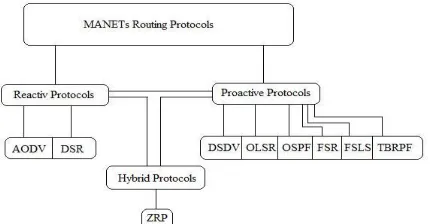
According to the researches in past years, various routing protocols for MANET have been proposed to improve the routing performance and reliability. Some of the promising MANET routing protocols among them are classified into three different categories according to their functionality.
1. Reactive protocols.
2. Proactive protocols.
3. Hybrid protocols.
The hierarchy of these protocols is shown below in the figure 1.
Fig. 1 MANETs Routing Protocols
© 2014, IJCSMC All Rights Reserved 889
2. REACTIVE OR ON DEMAND ROUTING PROTOCOLS
Reactive protocols are also known as on demand driven reactive protocols [3]. The fact they are known as reactive protocols implies that they do not initiate route discovery by themselves, until they are requested to find a route [4]. Thus these protocols setup routes when demanded. When a node wants to communicate with another node in the network, and the source node does not have a route to the node it wants to communicate with, reactive routing protocols will establish a route for the source to destination node.
2.1 DSR (Dynamic Source Routing)
Dynamic Source Routing Protocol is a reactive routing protocol and is called “on demand routing protocol” [5]. It is a source routing protocol that is why it is a simple and an efficient protocol. It can be used in multi hop wireless ad hoc networks [6]. The DSR network is totally self organizing and self configuring. The protocols is just compose of two mechanisms i.e. route discovery and route maintenance.
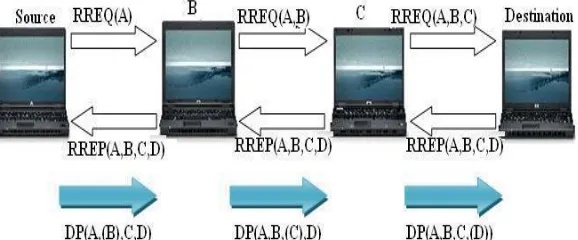
In route discovery, it has two messages i.e. route request (RREQ) and route reply (RREP). When a node wishes to send a message to a specific destination, it broadcast the RREQ packet in the network. The neighbor nodes in the broadcast range receive this RREQ message and add their own address and again rebroadcast it in the network. This RREQ message if reached to the destination, so that is the route to the specific destination. In the case if the message did not reached to the destination then the node which received the RREQ packet will look that previously a route used for the specific destination or not.
Figure 2 shows the route discovery procedure. When node A wish to send a data packet to the node D, It will first check its route cache that whether it has direct route to node D or not. If node A does not have a direct route to node D, then it will broadcast a RREQ message in the network. The neighbor node B will get the RREQ message. First node B will check its route cache that whether it have a direct route to the destination node D or not, If it finds a route to the destination node D. So it will send a RREP message to the source node A. In the reply of that message the source node A will start sending the data packets (DP) on the discovered route. If it didn‟t discover the route from node B to node D so it forwards the message RREQ to the next node C and store the route AB in the cache. The process is going on until the RREQ message reached to destination node D. The destination node D caches the routes AB, BC and CD in its memory and sends a RREP message to the source node A.
Fig 2.Route discovery procedure in MANET using DSR
© 2014, IJCSMC All Rights Reserved 890
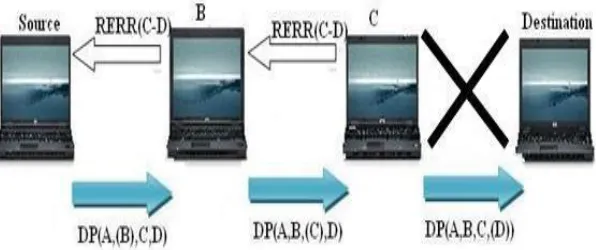
the communication network a route error message denoted by RERR is transmitted to the sender, that there is some problem in the transmission.
So the source gets the RERR packet in order to re initiate a new route discovery. By receiving the RERR message the nodes remove the route entries. Figure 3 shows the route maintenance procedure. The node A sends a message to destination node D. The message goes on up to the node C, while receiving the ACK message up to node B. When the node C forward the RREQ message to the node D and it does not receive the ACK message from node D. The node C recognizes that there is some problem in the transmission. So the node C sends a RRER message to the source node A. Which in return search for a new route to the destination node D.
Figure 3: Route maintenance procedure in MANET using DSR
2.2 TORA (Temporally Ordered Routing Algorithm)
TORA is also an on-demand reactive routing protocol. Its main objective is to limit control message propagation in the highly dynamic mobile computing environment. Each node has to initiate a query when it needs to send data to a particular destination thus TORA is a source-initiated routing protocol. TORA mainly performs three tasks and uses three kinds of messages to perform these tasks:
a) Route creation: Set up a route from a source to a destination using QRY message.
b) Route maintenance: Maintenance of the route during data transfer using UPD message. UPD
message is used both for creating and maintaining the routes.
c) Route erasure: Disconnecting the route when there is no data to transfer using CLR message.
3. SIMULATION MODEL
This paper represents two scenarios of 20 and 30 mobile nodes which are simulated for 1 hour by taking Reactive routing Protocols DSR and TORA and compared for evaluating the better performance between the two protocols using few QoS.
© 2014, IJCSMC All Rights Reserved 891
4. PARAMETERS SETUP
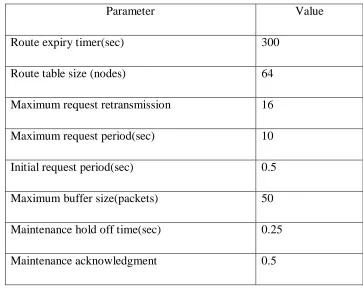
The parameters that have been used in the following experiments are summarized in following tables.
Table1. Wireless parameter values
WLAN MAC Address Auto assigned
BSS identifier Auto assigned
Physical characteristics OFDM(802.11a)
DATA rate 24 Mbps
Transmit power(W) 0.020
Packet reception power threshold -95
Short retry limit 7
Long retry limit 4
AP beacon interval(sec) 0.02
Maximum receiver lifetime(sec) 0.5
Buffer size(bits) 2560000
Simulation time 1 hour
© 2014, IJCSMC All Rights Reserved 892 Table 2 DSR Parameter values.
Parameter Value
Route expiry timer(sec) 300
Route table size (nodes) 64
Maximum request retransmission 16
Maximum request period(sec) 10
Initial request period(sec) 0.5
Maximum buffer size(packets) 50
Maintenance hold off time(sec) 0.25
Maintenance acknowledgment 0.5
Table 3. TORA parameter values.
Parameter Value
Mode of operation On-demand
OPT transmit internal(sec) 300
IP packet discard timeout(sec) 10
5. SIMULATION RESULTS
© 2014, IJCSMC All Rights Reserved 893 Fig 4 Total route replies sent with DSR
Fig 5 Routing traffic received with DSR
© 2014, IJCSMC All Rights Reserved 894
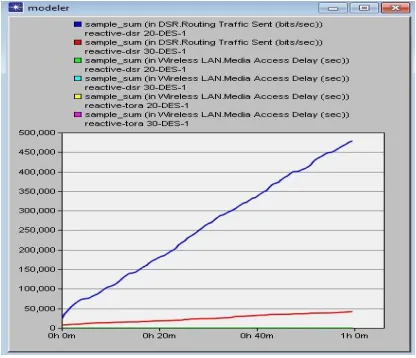
From figures (4-6), we conclude that routing traffic sent from base stations and received by users and Total route replies sent with DSR are greater in small network and smaller in larger network where number of users is more.
Fig 7 Download response time with FTP load.
Fig 8 Upload response time with FTP load.
AS shown in figures 7 and 8, upload and download response times are more in large network with TORA using FTP and small with DSR using FTP load in the same sized network.
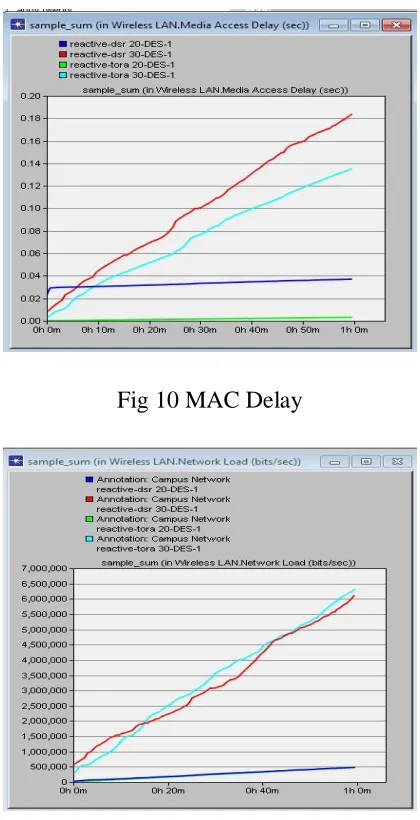
© 2014, IJCSMC All Rights Reserved 895 Fig 10 MAC Delay
Fig 11 Network load
© 2014, IJCSMC All Rights Reserved 896 Fig 12 Throughput
From figure 12, it is clear that throughput is higher with TORA than that with DSR. Also throughput increases with the decrease in no. of mobile nodes.
6. CONCLUSION
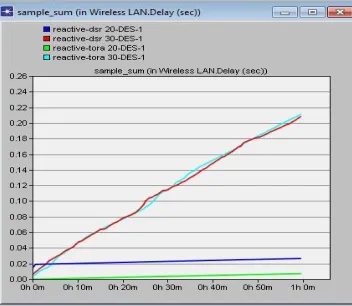
In this paper performance of Reactive DSR and TORA is evaluated for metrics like Network Load, Throughput, Delay, Upload and Download response time, DSR total route replies sent, DSR routing traffic sent and received and Media Access Delay by varying number of nodes and version of IEEE 802.11 WLAN Standard. From the above discussion we find out that TORA
performs best in each case in terms of media access delay, Delay and throughput. In terms of
Network load DSR is showing better results than TORA for 20 and 30 nodes with 802.11a
technology.
REFERENCES
[1] Pankaj Palta, Sonia Goyal,” Comparison of OLSR and TORA Routing Protocols Using OPNET Modeler”, International Journal of Engineering Research & Technology (IJERT), Vol. 1 Issue 5, July – 2012, ISSN: 2278-0181
[2] Perkins.C.E. Ad hoc Networking, Boston, Addison Wesley (2001)
[3] Zhou, L.D. and Haas, Z.J. (1999) “Securing Mobile ad hoc network”, IEEE Network
Magazine, Vol. 8, 2, pp. 16-23.
[4] Perkins, C.E. and Royer, E.M. (1999) “Ad-Hoc on Demand Distance Vector Routing”,
Proceedings of the 2nd IEEE Workshop on Mobile Computing Systems and Applications, pp.90-100.
[5] Johnson, D.B. and Maltz, D.A. (2001) „„DSR: The Dynamic Source Routing Protocol for
Multi-Hop Wireless Ad Hoc Networks‟‟, Computer Science Department Carnegie Mellon
© 2014, IJCSMC All Rights Reserved 897
[6] Uzoamaka, C.O. and Ajirioghene, O.R. (2009) “The Performance of DSR protocol for
MANETs Aspect of Cache Size and Cache Expiry Time” MEE 09:80 Master thesis BTH 2009.