Learning Summary Prior Representation for Extractive Summarization
Ziqiang Cao1,2∗ Furu Wei3 Sujian Li1,2 Wenjie Li4 Ming Zhou3 Houfeng Wang1,2 1Key Laboratory of Computational Linguistics, Peking University, MOE, China 2Collaborative Innovation Center for Language Ability, Xuzhou, Jiangsu, China
3Microsoft Research, Beijing, China
4Computing Department, Hong Kong Polytechnic University, Hong Kong
{ziqiangyeah, lisujian, wanghf}@pku.edu.cn
{furu, mingzhou}@microsoft.com [email protected]
Abstract
In this paper, we propose the concept of summary prior to define how much a sentence is appropriate to be selected into summary without consideration of its context. Different from previous work using manually compiled document-independent features, we develop a novel summary system called PriorSum, which applies the enhanced convolutional neu-ral networks to capture the summary prior features derived from length-variable phrases. Under a regression framework, the learned prior features are concate-nated with document-dependent features for sentence ranking. Experiments on the DUC generic summarization benchmarks show that PriorSum can discover different aspects supporting the summary prior and outperform state-of-the-art baselines.
1 Introduction
Sentence ranking, the vital part of extractive summarization, has been extensively investigated. Regardless of ranking models (Osborne, 2002; Galley, 2006; Conroy et al., 2004; Li et al., 2007), feature engineering largely determines the final summarization performance. Features often fall into two types: document-dependent features (e.g., term frequency or position) and document-independent features (e.g., stopword ratio or word polarity). The latter type of features take effects due to the fact that, a sentence can often be judged by itself whether it is appropriate to be included in a summary no matter which document it lies in. Take the following two sentences as an example:
1. Hurricane Emily slammed into Dominica on September 22, causing 3 deaths with its wind gusts up to 110 mph.
∗Contribution during internship at Microsoft Research
2. It was Emily, the hurricane which caused 3 deaths and armed with wind guests up to 110 mph, that slammed into Dominica on Tues-day.
The first sentence describes the major information of a hurricane. With similar meaning, the second sentence uses an emphatic structure and is some-what verbose. Obviously the first one should be preferred for a news summary. In this paper, we call such fact as summary prior nature1 and learn
document-independent features to reflect it. In previous summarization systems, though not well-studied, some widely-used sentence ranking features such as the length and the ratio of stop-words, can be seen as attempts to measure the summary prior nature to a certain extent. Notably, Hong and Nenkova (2014) built a state-of-the-art summarization system through making use of ad-vanced document-independent features. However, these document-independent features are usually hand-crafted, difficult to exhaust each aspect of the summary prior nature. Meanwhile, items rep-resenting the same feature may contribute differ-ently to a summary. For example, “September 22” and “Tuesday” are both indicators of time, but the latter seldom occurs in a summary due to uncer-tainty. In addition, to the best of our knowledge, document-independent features beyond word level (e.g., phrases) are seldom involved in current re-search.
The CTSUM system developed by Wan and Zhang (2014) is the most relevant to ours. It at-tempted to explore a context-free measure named certainty which is critical to ranking sentences in summarization. To calculate the certainty score, four dictionaries are manually built as features and a corpus is annotated to train the feature weights using Support Vector Regression (SVR).
How-1In this paper, “summary prior features” and “document-independent features” hold the same meaning.
ever, a low certainty score does not always rep-resent low quality of being a summary sentence. For example, the sentence below is from a topic about “Korea nuclear issue” in DUC 2004: Clin-ton acknowledged that U.S. is not yet certain that the suspicious underground construction project in North Korea is nuclear related. The under-lined phrases greatly reduce the certainty of this sentence according to Wan and Zhang (2014)’s model. But, in fact, this sentence can summarize the government’s attitude and is salient enough in the related documents. Thus, in our opinion, cer-tainty can just be viewed as a specific aspect of the summary prior nature.
To this end, we develop a novel summarization system called PriorSum to automatically exploit all possible semantic aspects latent in the sum-mary prior nature. Since the Convolutional Neural Networks (CNNs) have shown promising progress in latent feature representation (Yih et al., 2014; Shen et al., 2014; Zeng et al., 2014), PriorSum applies CNNs with multiple filters to capture a comprehensive set of document-independent fea-tures derived from length-variable phrases. Then we adopt a two-stage max-over-time pooling op-eration to associate these filters since phrases with different lengths may express the same as-pect of summary prior. PriorSum generates the document-independent features, and concatenates them with document-dependent ones to work for sentence regression (Section 2.1).
We conduct extensive experiments on the DUC 2001, 2002 and 2004 generic multi-document summarization datasets. The experimental results demonstrate that our model outperforms state-of-the-art extractive summarization approaches. Meanwhile, we analyze the different aspects sup-porting the summary prior in Section 3.3.
2 Methodology
Our summarization system PriorSum follows the traditional extractive framework (Carbonell and Goldstein, 1998; Li et al., 2007). Specifically, the sentence ranking process scores and ranks the sen-tences from documents, and then the sentence se-lection process chooses the top ranked sentences to generate the final summary in accordance with the length constraint and redundancy among the selected sentences.
Sentence ranking aims to measure the saliency score of a sentence with consideration of both
document-dependent and document-independent features. In this study, we apply an enhanced ver-sion of convolutional neural networks to automati-cally generate document-independent features ac-cording to the summary prior nature. Meanwhile, some document-dependent features are extracted. These two types of features are combined in the sentence regression step.
2.1 Sentence Ranking
PriorSum improves the standard convolutional neural networks (CNNs) to learn the summary prior since CNN is able to learn compressed rep-resentation ofn-grams effectively and tackle sen-tences with variable lengths naturally. We first introduce the standard CNNs, based on which we design our improved CNNs for obtaining document-independent features.
The standard CNNs contain a convolution oper-ation over several word embeddings, followed by a pooling operation. Let vi ∈ Rk denote the k
-dimensional word embedding of the ith word in
the sentence. Assumevi:i+j to be the
concatena-tion of word embeddingsvi,· · ·, vi+j. A
convo-lution operation involves a filter Wh
t ∈ Rl×hk,
which operates on a window of h words to pro-duce a new feature withldimensions:
ch
i =f(Wth×vi:i+h−1) (1)
wheref is a non-linear function andtanhis used like common practice. Here, the bias term is ignored for simplicity. Then Wh
t is applied to
each possible window ofh words in the sentence of length N to produce a feature map: Ch =
[ch
1,· · ·, chN−h+1]. Next, we adopt the
widely-used max-over-time pooling operation (Collobert et al., 2011) to obtain the final features cˆh from
Ch. That is, ˆch = max{Ch}. The idea behind
this pooling operation is to capture the most im-portant features in a feature map.
In the standard CNNs, only the fixed-length windows of words are considered to represent a sentence. As we know, the variable-length phrases composed of a sentence can better express the sen-tence and disclose its summary prior nature. To make full use of the phrase information, we design an improved version of the standard CNNs, which use multiple filters for different window sizes as well as two max-over-time pooling operations to get the final summary prior representation. Specif-ically, letW1
sizes from 1 to m, and correspondingly we can obtainmfeature mapsC1,· · ·,Cm. For each
fea-ture mapCi, We first adopt a max-over-time
pool-ing operationmax{Ci}with the goal of capturing
the most salient features from each window sizei. Next, a second max-over-time pooling operation is operated on all the windows to acquire the most representative features. To formulate, the docu-ment independent featuresxpcan be generated by:
xp = max{max{C1},· · ·,max{Cm}}. (2)
Kim (2014) also uses filters with varying win-dow sizes for sentence-level classification tasks. However, he reserves all the representations gen-erated by filters to a fully connected output layer. This practice greatly enlarges following parame-ters and ignores the relation among phrases with different lengths. Hence we use the two-stage max-over-time pooling to associate all these fil-ters.
Besides the features xp obtained through
the CNNs, we also extract several document-dependent features notated asxe, shown in Table
1. In the end, xp is combined with xe to
con-duct sentence ranking. Here we follow the regres-sion framework of Li et al. (2007). The sentence saliency y is scored by ROUGE-2 (Lin, 2004) (stopwords removed) and the model tries to esti-mate this saliency.
φ= [xp, xe] (3)
ˆ
y=wrT ×φ (4)
where wr ∈ Rl+|xe| is the regression weights.
We use linear transformation since it is convenient to compare with regression baselines (see Section 3.2).
Feature Description
POSITION The position of the sentence.
AVG-TF The averaged term frequency values of words in the sentence.
AVG-CF The averaged cluster frequency values of words in the sentence.
Table 1: Extracted document-dependent features.
2.2 Sentence Selection
A summary is obliged to offer both informative and non-redundant content. Here, we employ a simple greedy algorithm to select sentences, simi-lar to the MMR strategy (Carbonell and Goldstein, 1998). Firstly, we remove sentences less than 8
words (as in Erkan and Radev (2004)) and sort the rest in descending order according to the estimated saliency scores. Then, we iteratively dequeue one sentence, and append it to the current summary if it is redundant. A sentence is considered non-redundant if it contains more new words compared to the current summary content. We empirically set the cut-off of new word ratio to 0.5.
3 Experiments
3.1 Experiment Setup
In our work, we focus on the generic multi-document summarization task and carry out ex-periments on DUC 2001 2004 datasets. All the documents are from newswires and grouped into various thematic clusters. The summary length is limited to 100 words (665 bytes for DUC 2004). We use DUC 2003 data as the development set and conduct a 3-fold cross-validation on DUC 2001, 2002 and 2004 datasets with two years of data as training set and one year of data as test set.
We directly use the look-up table of 25-dimensional word embeddings trained by the model of Collobert et al. (2011). These small word embeddings largely reduces model param-eters. The dimension l of the hidden document-independent features is experimented in the range of[1,40], and the window sizes are experimented between 1 and 5. Through parameter experiments on development set, we setl= 20andm = 3for PriorSum. To update the weightsWh
t andwr, we
apply the diagonal variant of AdaGrad with mini-batches (Duchi et al., 2011).
For evaluation, we adopt the widely-used auto-matic evaluation metric ROUGE (Lin, 2004), and take ROUGE-1 and ROUGE-2 as the main mea-sures.
3.2 Comparison with Baseline Methods
To evaluate the summarization performance of Pri-orSum, we compare it with the best peer systems (PeerT, Peer26 and Peer65 in Table 2) participat-ing DUC evaluations. We also choose as baselines those state-of-the-art summarization results on DUC (2001, 2002, and 2004) data. To our knowl-edge, the best reported results on DUC 2001, 2002 and 2004 are from R2N2 (Cao et al., 2015), ClusterCMRW (Wan and Yang, 2008) and REG-SUM2 (Hong and Nenkova, 2014) respectively.
R2N2 applies recursive neural networks to learn
feature combination. ClusterCMRW incorporates the cluster-level information into the graph-based ranking algorithm. REGSUM is a word regres-sion approach based on some advanced features such as word polarities (Wiebe et al., 2005) and categories (Tausczik and Pennebaker, 2010). For these three systems, we directly cite their pub-lished results, marked with the sign “*” as in Ta-ble 2. Meanwhile, LexRank (Erkan and Radev, 2004), a commonly-used graph-based summariza-tion model, is introduced as an extra baseline. Comparing with this baseline can demonstrate the performance level of regression approaches. The baseline StandardCNN means that we adopt the standard CNNS with fixed window size for sum-mary prior representation.
To explore the effects of the learned summary prior representations, we design a baseline sys-tem namedReg Manualwhich adopts manually-compiled document-independent features such as NUMBER (whether number exist), NENTITY (whether named entities exist) and STOPRATIO (the ratio of stopwords). Then we combine these features with document-dependent features in Ta-ble 1 and tune the feature weights through LIB-LINEAR3support vector regression.
From Table 2, we can see that PriorSum can achieve a comparable performance to the state-of-the-art summarization systems R2N2, Cluster-CMRW and REGSUM. With respect to baselines, PriorSum significantly4outperforms Reg Manual
which uses manually compiled features and the graph-based summarization system LexRank. Meanwhile, PriorSum always enjoys a reasonable increase over StandardCNN, which verifies the ef-fects of the enhanced CNNs. It is noted that Stan-dardCNN can also achieve the state-of-the-art per-formance, indicating the summary prior represen-tation really works.
3.3 Analysis
In this section, we explore what PriorSum learns according to the summary prior representations. Since the convolution layer follows a linear regres-sion output, we apply a simple strategy to measure how much the learned document-independent fea-tures contribute to the saliency estimation. Specif-ically, for each sentence, we ignore its document-dependent features through setting their values as
3http://www.csie.ntu.edu.tw/˜cjlin/
liblinear/
4T-test withp-value≤0.05
Year System ROUGE-1 ROUGE-2
2001 PeerT 33.03 7.86
R2N2∗ 35.88 7.64
LexRank 33.43 6.09
Reg Manual 34.55 7.18 StandardCNN 35.19 7.63
PriorSum 35.98 7.89
2002 Peer26 35.15 7.64
ClusterCMRW∗ 38.55 8.65
LexRank 35.29 7.54
Reg Manual 34.81 8.12 StandardCNN 35.73 8.69
PriorSum 36.63 8.97
2004 Peer65 37.88 9.18
REGSUM∗ 38.57 9.75
LexRank 37.87 8.88
Reg Manual 37.05 9.34 StandardCNN 37.90 9.93
[image:4.595.314.517.60.253.2]PriorSum 38.91 10.07
Table 2: Comparison results (%) on DUC datasets.
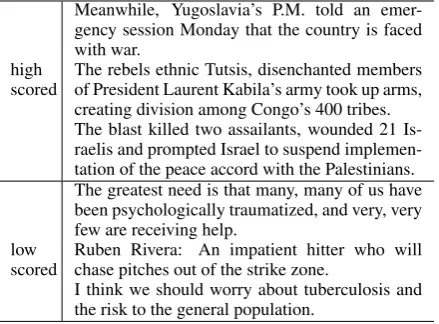
Meanwhile, Yugoslavia’s P.M. told an emer-gency session Monday that the country is faced with war.
high
scored The rebels ethnic Tutsis, disenchanted membersof President Laurent Kabila’s army took up arms, creating division among Congo’s 400 tribes. The blast killed two assailants, wounded 21 Is-raelis and prompted Israel to suspend implemen-tation of the peace accord with the Palestinians. The greatest need is that many, many of us have been psychologically traumatized, and very, very few are receiving help.
low
scored Ruben Rivera: An impatient hitter who willchase pitches out of the strike zone. I think we should worry about tuberculosis and the risk to the general population.
Table 3: Example sentences selected by prior scores.
zeros and then apply a linear transformation using the weight wr to get a summary prior score xp.
The greater the score, the more possible a sentence is to be included in a summary without context consideration. We analyze what intuitive features are hidden in the summary prior representation.
From Table 3, first we find that high-scored sentences contains more named entities and num-bers, which conforms to human intuition. By contrast, the features NENTITY and NUMBER in Reg Manual hold very small weights, only
[image:4.595.308.528.290.452.2]are difficult for human to generalize some spe-cific features. For instance, informal sentences seem to have more stopwords but the feature STO-PRATIO holds a relatively large positive weight in Reg Manual.
4 Conclusion and Future Work
This paper proposes a novel summarization sys-tem called PriorSum to automatically learn sum-mary prior features for extractive summariza-tion. Experiments on the DUC generic multi-document summarization task show that our pro-posed method outperforms state-of-the-art ap-proaches. In addition, we demonstrate the dom-inant sentences discovered by PriorSum, and the results verify that our model can learn different as-pects of summary prior.
Acknowledgments
We thank all the anonymous reviewers for their in-sightful comments. This work was partially sup-ported by National Key Basic Research Program of China (No. 2014CB340504), National Natural Science Foundation of China (No. 61273278 and 61272291), and National Social Science Founda-tion of China (No: 12&ZD227). The correspon-dence author of this paper is Sujian Li.
References
Ziqiang Cao, Furu Wei, Li Dong, Sujian Li, and Ming Zhou. 2015. Ranking with recursive neural net-works and its application to multi-document sum-marization. InAAAI-2015.
Jaime Carbonell and Jade Goldstein. 1998. The use of mmr, diversity-based reranking for reordering docu-ments and producing summaries. InProceedings of SIGIR, pages 335–336.
Ronan Collobert, Jason Weston, Lon Bottou, Michael Karlen, Koray Kavukcuoglu, and Pavel Kuksa. 2011. Natural language processing (almost) from scratch. The Journal of Machine Learning Re-search, 12:2493–2537.
John M Conroy, Judith D Schlesinger, Jade Goldstein, and Dianne P Oleary. 2004. Left-brain/right-brain multi-document summarization. In Proceedings of DUC.
John Duchi, Elad Hazan, and Yoram Singer. 2011. Adaptive subgradient methods for online learning and stochastic optimization. The Journal of Ma-chine Learning Research, 12:2121–2159.
G¨unes Erkan and Dragomir R Radev. 2004.
Lexrank: Graph-based lexical centrality as salience in text summarization. J. Artif. Intell. Res.(JAIR), 22(1):457–479.
Michel Galley. 2006. A skip-chain conditional random field for ranking meeting utterances by importance. InProceedings of EMNLP, pages 364–372.
Kai Hong and Ani Nenkova. 2014. Improving
the estimation of word importance for news multi-document summarization. InProceedings of EACL.
Yoon Kim. 2014. Convolutional neural
net-works for sentence classification. arXiv preprint arXiv:1408.5882.
Sujian Li, You Ouyang, Wei Wang, and Bin Sun. 2007. Multi-document summarization using support vec-tor regression. InProceedings of DUC.
Chin-Yew Lin. 2004. Rouge: A package for automatic evaluation of summaries. InProceedings of the ACL Workshop, pages 74–81.
Miles Osborne. 2002. Using maximum entropy for sentence extraction. InProceedings of ACL Work-shop on Automatic Summarization, pages 1–8. Yelong Shen, Xiaodong He, Jianfeng Gao, Li Deng,
and Gr´egoire Mesnil. 2014. Learning semantic rep-resentations using convolutional neural networks for web search. InCompanion publication of the 23rd international conference on World wide web com-panion, pages 373–374.
Yla R Tausczik and James W Pennebaker. 2010. The psychological meaning of words: Liwc and comput-erized text analysis methods. Journal of language and social psychology, 29(1):24–54.
Xiaojun Wan and Jianwu Yang. 2008. Multi-document summarization using cluster-based link analysis. In
Proceedings of SIGIR, pages 299–306.
Xiaojun Wan and Jianmin Zhang. 2014. Ctsum: ex-tracting more certain summaries for news articles. InProceedings of the 37th international ACM SIGIR conference on Research & development in informa-tion retrieval, pages 787–796. ACM.
Janyce Wiebe, Theresa Wilson, and Claire Cardie. 2005. Annotating expressions of opinions and emo-tions in language. Language resources and evalua-tion, 39(2-3):165–210.
Wen-tau Yih, Xiaodong He, and Christopher Meek. 2014. Semantic parsing for single-relation question answering. InProceedings of ACL.