Modelling function words improves unsupervised word segmentation
Mark Johnson1,2, Anne Christophe3,4, Katherine Demuth2,6 and Emmanuel Dupoux3,5 1Department of Computing, Macquarie University, Sydney, Australia
2Santa Fe Institute, Santa Fe, New Mexico, USA 3Ecole Normale Sup´erieure, Paris, France 4Centre National de la Recherche Scientifique, Paris, France 5Ecole des Hautes Etudes en Sciences Sociales, Paris, France 6Department of Linguistics, Macquarie University, Sydney, Australia
Abstract
Inspired by experimental psychological findings suggesting that function words play a special role in word learning, we make a simple modification to an Adaptor Grammar based Bayesian word segmenta-tion model to allow it to learn sequences of monosyllabic “function words” at the beginnings and endings of collocations of (possibly multi-syllabic) words. This modification improves unsupervised word segmentation on the standard Bernstein-Ratner (1987) corpus of child-directed En-glish by more than 4% token f-score com-pared to a model identical except that it does not special-case “function words”, setting a new state-of-the-art of 92.4% to-ken f-score. Our function word model as-sumes that function words appear at the left periphery, and while this is true of languages such as English, it is not true universally. We show that a learner can use Bayesian model selection to determine the location of function words in their lan-guage, even though the input to the model only consists of unsegmented sequences of phones. Thus our computational models support the hypothesis that function words play a special role in word learning. 1 Introduction
Over the past two decades psychologists have in-vestigated the role that function words might play in human language acquisition. Their experiments suggest that function words play a special role in the acquisition process: children learn function words before they learn the vast bulk of the asso-ciated content words, and they use function words to help identify context words.
The goal of this paper is to determine whether computational models of human language acqui-sition can provide support for the hypothesis that
function words are treated specially in human language acquisition. We do this by comparing two computational models of word segmentation which differ solely in the way that they model function words. Following Elman et al. (1996) and Brent (1999) our word segmentation models identify word boundaries from unsegmented se-quences of phonemes corresponding to utterances, effectively performing unsupervised learning of a lexicon. For example, given input consisting of unsegmented utterances such as the following:
j u w ɑ n t t u s i ð ə b ʊ k
a word segmentation model should segment this as ju wɑnt tu si ðə bʊk, which is the IPA representation of “you want to see the book”.
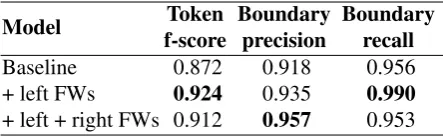
We show that a model equipped with the abil-ity to learn some rudimentary properties of the target language’s function words is able to learn the vocabulary of that language more accurately than a model that is identical except that it is inca-pable of learning these generalisations about func-tion words. This suggests that there are acqui-sition advantages to treating function words spe-cially that human learners could take advantage of (at least to the extent that they are learning similar generalisations as our models), and thus supports the hypothesis that function words are treated spe-cially in human lexical acquisition. As a reviewer points out, we present no evidence that children use function words in the way that our model does, and we want to emphasise we make no such claim. While absolute accuracy is not directly relevant to the main point of the paper, we note that the models that learn generalisations about function words perform unsupervised word segmentation at 92.5% token f-score on the standard Bernstein-Ratner (1987) corpus, which improves the previ-ous state-of-the-art by more than 4%.
As a reviewer points out, the changes we make to our models to incorporate function words can be viewed as “building in” substantive informa-tion about possible human languages. The model
that achieves the best token f-score expects func-tion words to appear at the left edge of phrases. While this is true for languages such as English, it is not true universally. By comparing the pos-terior probability of two models — one in which function words appear at the left edges of phrases, and another in which function words appear at the right edges of phrases — we show that a learner could use Bayesian posterior probabilities to deter-mine that function words appear at the left edges of phrases in English, even though they are not told the locations of word boundaries or which words are function words.
This paper is structured as follows. Section 2 describes the specific word segmentation mod-els studied in this paper, and the way we ex-tended them to capture certain properties of func-tion words. The word segmentafunc-tion experiments are presented in section 3, and section 4 discusses how a learner could determine whether function words occur on the left-periphery or the right-periphery in the language they are learning. Sec-tion 5 concludes and describes possible future work. The rest of this introduction provides back-ground on function words, the Adaptor Grammar models we use to describe lexical acquisition and the Bayesian inference procedures we use to infer these models.
1.1 Psychological evidence for the role of function words in word learning
Traditional descriptive linguistics distinguishes
function words, such as determiners and prepo-sitions, from content words, such as nouns and verbs, corresponding roughly to the distinction be-tween functional categories and lexical categories of modern generative linguistics (Fromkin, 2001). Function words differ from content words in at least the following ways:
1. there are usually far fewer function word types than content word types in a language 2. function word types typically have much
higher token frequency than content word types
3. function words are typically morphologically and phonologically simple (e.g., they are typ-ically monosyllabic)
4. function words typically appear in peripheral positions of phrases (e.g., prepositions typi-cally appear at the beginning of prepositional phrases)
5. each function word class is associated with specific content word classes (e.g.,
deter-miners and prepositions are associated with nouns, auxiliary verbs and complementisers are associated with main verbs)
6. semantically, content words denote sets of objects or events, while function words de-note more complex relationships over the en-tities denoted by content words
7. historically, the rate of innovation of function words is much lower than the rate of innova-tion of content words (i.e., funcinnova-tion words are typically “closed class”, while content words are “open class”)
Properties 1–4 suggest that function words might play a special role in language acquisition because they are especially easy to identify, while property 5 suggests that they might be useful for identifying lexical categories. The models we study here focus on properties 3 and 4, in that they are capable of learning specific sequences of monosyllabic words in peripheral (i.e., initial or final) positions of phrase-like units.
A number of psychological experiments have shown that infants are sensitive to the function words of their language within their first year of life (Shi et al., 2006; Hall´e et al., 2008; Shafer et al., 1998), often before they have experienced the “word learning spurt”. Crucially for our pur-pose, infants of this age were shown to exploit frequent function words to segment neighboring content words (Shi and Lepage, 2008; Hall´e et al., 2008). In addition, 14 to 18-month-old children were shown to exploit function words to constrain lexical access to known words - for in-stance, they expect a noun after a determiner (Cau-vet et al., 2014; Kedar et al., 2006; Zangl and Fernald, 2007). In addition, it is plausible that function words play a crucial role in children’s acquisition of more complex syntactic phenom-ena (Christophe et al., 2008; Demuth and McCul-lough, 2009), so it is interesting to investigate the roles they might play in computational models of language acquisition.
1.2 Adaptor grammars
set of parameters, if the set of possible subtrees of the adapted nonterminals is infinite). Adaptor grammars are useful when the goal is to learn a potentially unbounded set of entities that need to satisfy hierarchical constraints. As section 2 ex-plains in more detail, word segmentation is such a case: words are composed of syllables and be-long to phrases or collocations, and modelling this structure improves word segmentation accuracy.
Adaptor Grammars are formally defined in Johnson et al. (2007b), which should be consulted for technical details. Adaptor Grammars (AGs) are an extension of Probabilistic Context-Free Grammars (PCFGs), which we describe first. A
Context-Free Grammar(CFG)G= (N, W, R, S) consists of disjoint finite sets ofnonterminal sym-bols N and terminal symbols W, a finite set of
rules R of the form A→α where A ∈ N and
α ∈ (N ∪W)⋆, and astart symbolS ∈ N. (We assume there are no “ϵ-rules” inR, i.e., we require that|α| ≥1for eachA→α∈R).
AProbabilistic Context-Free Grammar(PCFG) is a quintuple (N, W, R, S,θ) where N, W, R
and S are the nonterminals, terminals, rules and start symbol of a CFG respectively, andθis a vec-tor of non-negative reals indexed by R that sat-isfy∑α∈RAθA→α = 1 for eachA ∈ N, where
RA = {A→α : A→α ∈ R} is the set of rules expandingA.
Informally, θA→α is the probability of a node labelled A expanding to a sequence of nodes la-belledα, and the probability of a tree is the prod-uct of the probabilities of the rules used to con-struct each non-leaf node in it. More precisely, for eachX∈N∪W a PCFG associates distributions
GX over the set of trees TX generated by X as follows:
If X ∈ W (i.e., if X is a terminal) then GX is the distribution that puts probability 1 on the single-node tree labelledX.
IfX ∈N (i.e., ifXis a nonterminal) then:
GX=
∑
X→B1...Bn∈RX
θX→B1...BnTDX(GB1, . . . , GBn) (1)
where RX is the subset of rules in R expanding nonterminalX ∈N, and:
TDX(G1, . . . , Gn)
(
..
X
.
t1 .
tn .
. . . )
= ∏n i=1
Gi(ti).
That is, TDX(G1, . . . , Gn) is a distribution over the set of trees TX generated by nonterminal X, where each subtreeti is generated independently
fromGi. The PCFG generates the distributionGS over the set of treesTSgenerated by the start sym-bolS; the distribution over the strings it generates is obtained by marginalising over the trees.
In a Bayesian PCFG one puts Dirichlet priors Dir(α)on the rule probability vectorθ, such that there is one Dirichlet parameter αA→α for each ruleA→α ∈R. There are Markov Chain Monte Carlo (MCMC) and Variational Bayes procedures for estimating the posterior distribution over rule probabilitiesθ and parse trees given data consist-ing of terminal strconsist-ings alone (Kurihara and Sato, 2006; Johnson et al., 2007a).
PCFGs can be viewed as recursive mixture models over trees. While PCFGs are expres-sive enough to describe a range of linguistically-interesting phenomena, PCFGs are parametric models, which limits their ability to describe phe-nomena where the set of basic units, as well as their properties, are the target of learning. Lexi-cal acqusition is an example of a phenomenon that is naturally viewed as non-parametric inference, where the number of lexical entries (i.e., words) as well as their properties must be learnt from the data.
It turns out there is a straight-forward modifica-tion to the PCFG distribumodifica-tion (1) that makes it suit-ably non-parametric. As Johnson et al. (2007b) explain, by inserting a Dirichlet Process (DP) or Pitman-Yor Process (PYP) into the generative mechanism (1) the model “concentrates” mass on a subset of trees (Teh et al., 2006). Specifically, an Adaptor Grammar identifies a subsetA ⊆ N
of adapted nonterminals. In an Adaptor Gram-mar the unadapted nonterminals N \ A expand via (1), just as in a PCFG, but the distributions of the adapted nonterminalsAare “concentrated” by passing them through a DP or PYP:
HX=
∑
X→B1...Bn∈RX
θX→B1...BnTDX(GB1, . . . , GBn)
GX= PYP(HX, aX, bX)
HereaX andbX are parameters of the PYP asso-ciated with the adapted nonterminalX. As Gold-water et al. (2011) explain, such Pitman-Yor Pro-cesses naturally generate power-law distributed data.
richer” behaviour causes the distribution of sub-trees to follow a power-law (the power is speci-fied by theaX parameter of the PYP). The PCFG rules expanding an adapted nonterminal X de-fine the “base distribution” of the associated DP or PYP, and theaX andbX parameters determine how much mass is reserved for “new” trees.
There are several different procedures for infer-ring the parse trees and the rule probabilities given a corpus of strings: Johnson et al. (2007b) describe a MCMC sampler and Cohen et al. (2010) describe a Variational Bayes procedure. We use the MCMC procedure here since this has been successfully ap-plied to word segmentation problems in previous work (Johnson, 2008).
2 Word segmentation with Adaptor Grammars
Perhaps the simplest word segmentation model is theunigram model, where utterances are modeled as sequences of words, and where each word is a sequence of segments (Brent, 1999; Goldwater et al., 2009). A unigram model can be expressed as an Adaptor Grammar with one adapted non-terminalWord(we indicate adapted nonterminals by underlining them in grammars here; regular ex-pressions are expanded into right-branching pro-ductions).
Sentence→Word+ (2)
Word→Phone+ (3)
The first rule (2) says that a sentence consists of one or more Words, while the second rule (3) states that aWordconsists of a sequence of one or morePhones; we assume that there are rules ex-pandingPhoneinto all possible phones. Because
Wordis an adapted nonterminal, the adaptor gram-mar memoisesWordsubtrees, which corresponds to learning the phone sequences for the words of the language.
The more sophisticated Adaptor Grammars dis-cussed below can be understood as specialis-ing either the first or the second of the rules in (2–3). The next two subsections review the Adaptor Grammar word segmentation models pre-sented in Johnson (2008) and Johnson and Gold-water (2009): section 2.1 reviews how phonotac-tic syllable-structure constraints can be expressed with Adaptor Grammars, while section 2.2 re-views how phrase-like units called “collocations” capture inter-word dependencies. Section 2.3 presents the major novel contribution of this paper
by explaining how we modify these adaptor gram-mars to capture some of the special properties of function words.
2.1 Syllable structure and phonotactics The rule (3) models words as sequences of inde-pendently generated phones: this is what Gold-water et al. (2009) called the “monkey model” of word generation (it instantiates the metaphor that word types are generated by a monkey randomly banging on the keys of a typewriter). However, the words of a language are typically composed of one or more syllables, and explicitly modelling the in-ternal structure of words typically improves word segmentation considerably.
Johnson (2008) suggested replacing (3) with the following model of word structure:
Word→Syllable1:4 (4)
Syllable→(Onset)Rhyme (5)
Onset→Consonant+ (6)
Rhyme→Nucleus(Coda) (7)
Nucleus→Vowel+ (8)
Coda→Consonant+ (9)
Here and below superscripts indicate iteration (e.g., a Wordconsists of 1 to 4 Syllables), while an Onset consists of an unbounded number of
Consonants), while parentheses indicate option-ality (e.g., a Rhyme consists of an obligatory
Nucleus followed by an optional Coda). We as-sume that there are rules expanding Consonant
andVowel to the set of all consonants and vow-els respectively (this amounts to assuming that the learner can distinguish consonants from vowels). Because Onset, Nucleus and Coda are adapted, this model learns the possible syllable onsets, nu-cleii and coda of the language, even though neither syllable structure nor word boundaries are explic-itly indicated in the input to the model.
Grammar: (4) is replaced with (10–11) and (12– 17) are added to the grammar.
Word→SyllableIF (10)
Word→SyllableI Syllable0:2SyllableF (11)
SyllableIF→(OnsetI)RhymeF (12)
SyllableI→(OnsetI)Rhyme (13)
SyllableF→(Onset)RhymeF (14)
OnsetI→Consonant+ (15)
RhymeF→Nucleus(CodaF) (16)
CodaF→Consonant+ (17)
In this grammar the suffix “I” indicates a word-initial element, and “F” indicates a word-final el-ement. Note that the model simply has the abil-ity to learn that different clusters can occur word-peripherally and word-internally; it is not given any information about the relative complexity of these clusters.
2.2 Collocation models of inter-word dependencies
Goldwater et al. (2009) point out the detrimental effect that inter-word dependencies can have on word segmentation models that assume that the words of an utterance are independently gener-ated. Informally, a model that generates words in-dependently is likely to incorrectly segment multi-word expressions such as “the doggie” as single words because the model has no way to capture word-to-word dependencies, e.g., that “doggie” is typically preceded by “the”. Goldwater et al show that word segmentation accuracy improves when the model is extended to capture bigram depen-dencies.
Adaptor grammar models cannot express bi-gram dependencies, but they can capture similiar inter-word dependencies using phrase-like units that Johnson (2008) calls collocations. John-son and Goldwater (2009) showed that word seg-mentation accuracy improves further if the model learns a nested hierarchy of collocations. This can be achieved by replacing (2) with (18–21).
Sentence→Colloc3+ (18)
Colloc3→Colloc2+ (19)
Colloc2→Colloc1+ (20)
Colloc1→Word+ (21)
Informally,Colloc1,Colloc2andColloc3define a nested hierarchy of phrase-like units. While not
designed to correspond to syntactic phrases, by ex-amining the sample parses induced by the Adaptor Grammar we noticed that the collocations often correspond to noun phrases, prepositional phrases or verb phrases. This motivates the extension to the Adaptor Grammar discussed below.
2.3 Incorporating “function words” into collocation models
The starting point and baseline for our extension is the adaptor grammar with syllable structure phonotactic constraints and three levels of collo-cational structure (5-21), as prior work has found that this yields the highest word segmentation to-ken f-score (Johnson and Goldwater, 2009).
Our extension assumes that the Colloc1 −
Colloc3constituents are in fact phrase-like, so we extend the rules (19–21) to permit an optional se-quence of monosyllabic words at the left edge of each of these constituents. Our model thus captures two of the properties of function words discussed in section 1.1: they are monosyllabic (and thus phonologically simple), and they appear on the periphery of phrases. (We put “function words” in scare quotes below because our model only approximately captures the linguistic proper-ties of function words).
Specifically, we replace rules (19–21) with the following sequence of rules:
Colloc3→(FuncWords3)Colloc2+ (22)
Colloc2→(FuncWords2)Colloc1+ (23)
Colloc1→(FuncWords1)Word+ (24)
FuncWords3→FuncWord3+ (25)
FuncWord3→SyllableIF (26)
FuncWords2→FuncWord2+ (27)
FuncWord2→SyllableIF (28)
FuncWords1→FuncWord1+ (29)
FuncWord1→SyllableIF (30)
This model memoises (i.e., learns) both the in-dividual “function words” and the sequences of “function words” that modify the Colloc1 −
..
Sentence
.
Colloc3 .
FuncWords3 .
FuncWord3 .
you .
FuncWord3 .
want .
FuncWord3 .
to .
Colloc2 .
Colloc1 .
Word .
see .
Colloc1 .
FuncWords1 .
FuncWord1 .
the .
Word .
[image:6.595.307.529.62.130.2]book
Figure 1: A sample parse generated by the “func-tion word” Adaptor Grammar with rules (10–18) and (22–30). To simplify the parse we only show the root node and the adapted nonterminals, and replace word-internal structure by the word’s or-thographic form.
This grammar builds in the fact that function words appear on the left periphery of phrases. This is true of languages such as English, but is not true cross-linguistically. For comparison purposes we also include results for a mirror-image model that permits “function words” on the right periphery, a model which permits “function words” on both the left and right periphery (achieved by changing rules 22–24), as well as a model that analyses all words as monosyllabic.
Section 4 explains how a learner could use Bayesian model selection to determine that func-tion words appear on the left periphery in English by comparing the posterior probability of the data under our “function word” Adaptor Grammar to that obtained using a grammar which is identi-cal except that rules (22–24) are replaced with the mirror-image rules in which “function words” are attached to the right periphery.
3 Word segmentation results
This section presents results of running our Adap-tor Grammar models on subsets of the Bernstein-Ratner (1987) corpus of child-directed English. We use the Adaptor Grammar software available from http://web.science.mq.edu.au/˜mjohnson/ with the same settings as described in Johnson and Goldwater (2009), i.e., we perform Bayesian inference with “vague” priors for all hyperpa-rameters (so there are no adjustable pahyperpa-rameters in our models), and perform 8 different MCMC runs of each condition with table-label resampling for 2,000 sweeps of the training data. At every 10th sweep of the last 1,000 sweeps we use the model to segment the entire corpus (even if it is only trained on a subset of it), so we collect
[image:6.595.64.298.66.170.2]Model f-scoreToken Boundaryprecision Boundaryrecall Baseline 0.872 0.918 0.956 + left FWs 0.924 0.935 0.990 + left + right FWs 0.912 0.957 0.953 Table 1: Mean token f-scores and boundary preci-sion and recall results averaged over 8 trials, each consisting of 8 MCMC runs of models trained and tested on the full Bernstein-Ratner (1987) cor-pus (the standard deviations of all values are less than 0.006; Wilcox sign tests show the means of all token f-scores differp <2e-4).
800 sample segmentations of each utterance. The most frequent segmentation in these 800 sample segmentations is the one we score in the evaluations below.
3.1 Word segmentation with “function word” models
Here we evaluate the word segmentations found by the “function word” Adaptor Grammar model described in section 2.3 and compare it to the base-line grammar with collocations and phonotactics from Johnson and Goldwater (2009). Figure 2 presents the standard token and lexicon (i.e., type) f-score evaluations for word segmentations pro-posed by these models (Brent, 1999), and Table 1 summarises the token and lexicon f-scores for the major models discussed in this paper. It is interest-ing to note that addinterest-ing “function words” improves token f-score by more than 4%, corresponding to a 40% reduction in overall error rate.
When the training data is very small the Mono-syllabic grammar produces the highest accuracy results, presumably because a large proportion of the words in child-directed speech are monosyl-labic. However, at around 25 sentences the more complex models that are capable of finding multi-syllabic words start to become more accurate.
It’s interesting that after about 1,000 sentences the model that allows “function words” only on the right periphery is considerably less accurate than the baseline model. Presumably this is be-cause it tends to misanalyse multi-syllabic words on the right periphery as sequences of monosyl-labic words.
0.00 0.25 0.50 0.75 1.00
1 10 100 1000 10000
NumberWofWtrainingWsentences
TokenWf-score
Model
Monosyllables
Baseline
+WleftWFWs
+WrightWFWs
+WleftW+WFWs
0.00 0.25 0.50 0.75 1.00
1 10 100 1000 10000
NumberWofWtrainingWsentences
LexiconWf-score
Model
Monosyllables
Baseline
+WleftWFWs
+WrightWFWs
[image:7.595.83.518.72.336.2]+WleftW+WrightWFWs
Figure 2: Token and lexicon (i.e., type) f-score on the Bernstein-Ratner (1987) corpus as a function of training data size for the baseline model, the model where “function words” can appear on the left pe-riphery, a model where “function words” can appear on the right pepe-riphery, and a model where “function words” can appear on both the left and the right periphery. For comparison purposes we also include results for a model that assumes that all words are monosyllabic.
is larger than about 1,000 sentences both models are equally accurate.
3.2 Content and function words found by “function word” model
As noted earlier, the “function word” model gen-erates function words via adapted nonterminals other than the Wordcategory. In order to bet-ter understand just how the model works, we give the 5 most frequent words in each word category found during 8 MCMC runs of the left-peripheral “function word” grammar above:
Word: book, doggy, house, want, I
FuncWord1: a, the, your, little1,in
FuncWord2: to, in, you, what, put
FuncWord3: you, a, what, no, can
Interestingly, these categories seem fairly rea-sonable. TheWord category includes open-class nouns and verbs, the FuncWord1 category in-cludes noun modifiers such as determiners, while the FuncWord2 and FuncWord3 categories in-clude prepositions, pronouns and auxiliary verbs.
1The phone ‘l’ is generated by both Consonant and
Vowel, so “little” can be (incorrectly) analysed as one syl-lable.
Thus, the present model, initially aimed at seg-menting words from continuous speech, shows three interesting characteristics that are also ex-hibited by human infants: it distinguishes be-tween function words and content words (Shi and Werker, 2001), it allows learners to acquire at least some of the function words of their language (e.g. (Shi et al., 2006)); and furthermore, it may also al-low them to start grouping together function words according to their category (Cauvet et al., 2014; Shi and Melanc¸on, 2010).
4 Are “function words” on the left or right periphery?
re-lated to the question of the direction of syntac-tic headedness in the language, and an accurate method for identifying the location of function words might be useful for initialising a syntac-tic learner. Experimental evidence suggests that infants as young as 8 months of age already ex-pect function words on the correct side for their language — left-periphery for Italian infants and right-periphery for Japanese infants (Gervain et al., 2008) — so it is interesting to see whether purely distributional learners such as the ones studied here can identify the correct location of function words in phrases.
We experimented with a variety of approaches that use a single adaptor grammar inference pro-cess, but none of these were successful. For ex-ample, we hoped that given an Adaptor Gram-mar that permits “function words” on both the left and right periphery, the inference procedure would decide that the right-periphery rules simply are not used in a language like English. Unfortu-nately we did not find this in our experiments; the right-periphery rules were used almost as often as the left-periphery rules (recall that a large fraction of the words in English child-directed speech are monosyllabic).
In this section, we show that learners could use Bayesian model selection to determine that func-tion words appear on the left periphery in English by comparing the marginal probability of the data for the left-periphery and the right-periphery mod-els.
Instead, we used Bayesian model selection techniques to determine whether left-peripheral or a right-peripheral model better fits the un-segmented utterances that constitute the training data.2 While Bayesian model selection is in
prin-ciple straight-forward, it turns out to require the ra-tio of two integrals (for the “evidence” or marginal likelihood) that are often intractable to compute.
Specifically, given a training corpusDof unseg-mented sentences and model families G1 andG2 (here the “function word” adaptor grammars with left-peripheral and right-peripheral attachment re-spectively), the Bayes factorK is the ratio of the marginal likelihoods of the data:
K = P(P(DD||GG1) 2)
2Note that neither the left-peripheral nor the right-peripheral model is correct: even strongly left-headed lan-guages like English typically contain a few right-headed con-structions. For example, “ago” is arguably the head of the phrase “ten years ago”.
0 2000 4000 6000
1 10 100 1000 10000
Number of training sentences
[image:8.595.312.515.70.269.2]log Bayes factor
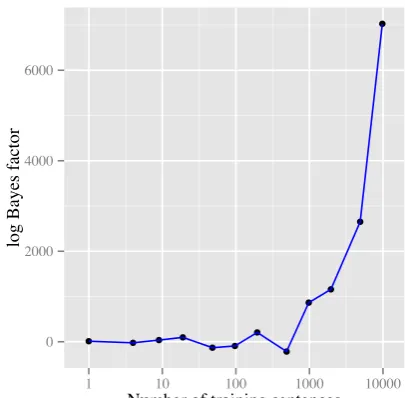
Figure 3: Bayes factor in favour of left-peripheral “function word” attachment as a function of the number of sentences in the training corpus, cal-culated using the Harmonic Mean estimator (see warning in text).
where the marginal likelihood or “evidence” for a modelGis obtained by integrating over all of the hidden or latent structure and parametersθ:
P(D|G) =
∫
∆P(D,θ |G)dθ (31) Here the variableθranges over the space∆of all possible parses for the utterances inDand all pos-sible configurations of the Pitman-Yor processes and their parameters that constitute the “state” of the Adaptor GrammarG. While the probability of any specific Adaptor Grammar configurationθis not too hard to calculate (the MCMC sampler for Adaptor Grammars can print this after each sweep through D), the integral in (31) is in general in-tractable.
Textbooks such as Murphy (2012) describe a number of methods for calculatingP(D|G), but most of them assume that the parameter space∆ is continuous and so cannot be directly applied here. The Harmonic Mean estimator (32) for (31), which we used here, is a popular estimator for (31) because it only requires the ability to calcu-lateP(D,θ |G)for samples fromP(θ |D, G):
P(D|G) ≈
(
1
n
n
∑
i=1
1 P(D,θi |G)
)−1
D, G), which can be generated by the MCMC pro-cedure.
Figure 3 depicts how the Bayes factor in favour of left-peripheral attachment of “function words” varies as a function of the number of utter-ances in the training dataD(calculated from the last 1000 sweeps of 8 MCMC runs of the cor-responding adaptor grammars). As that figure shows, once the training data contains more than about 1,000 sentences the evidence for the left-peripheral grammar becomes very strong. On the full training data the estimated log Bayes factor is over 6,000, which would constitute overwhelming evidence in favour of left-peripheral attachment.
Unfortunately, as Murphy and others warn, the Harmonic Mean estimator is extremely unstable (Radford Neal calls it “the worst MCMC method ever” in his blog), so we think it is important to confirm these results using a more stable estima-tor. However, given the magnitude of the differ-ences and the fact that the two models being com-pared are of similar complexity, we believe that these results suggest that Bayesian model selec-tion can be used to determine properties of the lan-guage being learned.
5 Conclusions and future work
This paper showed that the word segmentation accuracy of a state-of-the-art Adaptor Grammar model is significantly improved by extending it so that it explicitly models some properties of function words. We also showed how Bayesian model selection can be used to identify that func-tion words appear on the left periphery of phrases in English, even though the input to the model only consists of an unsegmented sequence of phones.
Of course this work only scratches the surface in terms of investigating the role of function words in language acquisition. It would clearly be very interesting to examine the performance of these models on other corpora of child-directed English, as well as on corpora of child-directed speech in other languages. Our evaluation focused on word-segmentation, but we could also evaluate the ef-fect that modelling “function words” has on other aspects of the model, such as its ability to learn syllable structure.
The models of “function words” we investi-gated here only capture two of the 7 linguistic properties of function words identified in section 1 (i.e., that function words tend to be monosyllabic, and that they tend to appear phrase-peripherally), so it would be interesting to develop and explore
models that capture other linguistic properties of function words. For example, following the sug-gestion by Hochmann et al. (2010) that human learners use frequency cues to identify function words, it might be interesting to develop computa-tional models that do the same thing. In an Adap-tor Grammar the frequency distribution of func-tion words might be modelled by specifying the prior for the Pitman-Yor Process parameters asso-ciated with the function words’ adapted nontermi-nals so that it prefers to generate a small number of high-frequency items.
It should also be possible to develop models which capture the fact that function words tend not to be topic-specific. Johnson et al. (2010) and Johnson et al. (2012) show how Adaptor Gram-mars can model the association between words and non-linguistic “topics”; perhaps these models could be extended to capture some of the semantic properties of function words.
It would also be interesting to further explore the extent to which Bayesian model selection is a useful approach to linguistic “parameter setting”. In order to do this it is imperative to develop better methods than the problematic “Harmonic Mean” estimator used here for calculating the evidence (i.e., the marginal probability of the data) that can handle the combination of discrete and continuous hidden structure that occur in computational lin-guistic models.
As well as substantially improving the accuracy of unsupervised word segmentation, this work is interesting because it suggests a connection be-tween unsupervised word segmentation and the in-duction of syntactic structure. It is reasonable to expect that hierarchical non-parametric Bayesian models such as Adaptor Grammars may be useful tools for exploring such a connection.
Acknowledgments
References
N. Bernstein-Ratner. 1987. The phonology of parent-child speech. In K. Nelson and A. van Kleeck, ed-itors, Children’s Language, volume 6, pages 159– 174. Erlbaum, Hillsdale, NJ.
M. Brent. 1999. An efficient, probabilistically sound algorithm for segmentation and word discovery. Machine Learning, 34:71–105.
E. Cauvet, R. Limissuri, S. Millotte, K. Skoruppa, D. Cabrol, and A. Christophe. 2014. Function words constrain on-line recognition of verbs and nouns in French 18-month-olds. Language Learn-ing and Development, pages 1–18.
A. Christophe, S. Millotte, S. Bernal, and J. Lidz. 2008. Bootstrapping lexical and syntactic acquisi-tion. Language and Speech, 51(1-2):61–75.
S. B. Cohen, D. M. Blei, and N. A. Smith. 2010. Vari-ational inference for adaptor grammars. InHuman Language Technologies: The 2010 Annual Confer-ence of the North American Chapter of the Associa-tion for ComputaAssocia-tional Linguistics, pages 564–572, Los Angeles, California, June. Association for Com-putational Linguistics.
K. Demuth and E. McCullough. 2009. The prosodic (re-)organization of childrens early English articles. Journal of Child Language, 36(1):173–200.
J. Elman, E. Bates, M. H. Johnson, A. Karmiloff-Smith, D. Parisi, and K. Plunkett. 1996. Rethink-ing Innateness: A Connectionist Perspective on De-velopment. MIT Press/Bradford Books, Cambridge, MA.
V. Fromkin, editor. 2001. Linguistics: An Introduction to Linguistic Theory. Blackwell, Oxford, UK.
J. Gervain, M. Nespor, R. Mazuka, R. Horie, and J. Mehler. 2008. Bootstrapping word order in prelexical infants: A japaneseitalian cross-linguistic study. Cognitive Psychology, 57(1):56 – 74.
S. Goldwater, T. L. Griffiths, and M. Johnson. 2009. A Bayesian framework for word segmentation: Ex-ploring the effects of context. Cognition, 112(1):21– 54.
S. Goldwater, T. L. Griffiths, and M. Johnson. 2011. Producing power-law distributions and damping word frequencies with two-stage language models. Journal of Machine Learning Research, 12:2335– 2382.
P. A. Hall´e, C. Durand, and B. de Boysson-Bardies. 2008. Do 11-month-old French infants process ar-ticles? Language and Speech, 51(1-2):23–44. J.-R. Hochmann, A. D. Endress, and J. Mehler. 2010.
Word frequency as a cue for identifying function words in infancy.Cognition, 115(3):444 – 457.
M. Johnson and S. Goldwater. 2009. Improving non-parameteric Bayesian inference: experiments on un-supervised word segmentation with adaptor gram-mars. In Proceedings of Human Language Tech-nologies: The 2009 Annual Conference of the North American Chapter of the Association for Compu-tational Linguistics, pages 317–325, Boulder, Col-orado, June. Association for Computational Linguis-tics.
M. Johnson, T. Griffiths, and S. Goldwater. 2007a. Bayesian inference for PCFGs via Markov chain Monte Carlo. In Human Language Technologies 2007: The Conference of the North American Chap-ter of the Association for Computational Linguistics; Proceedings of the Main Conference, pages 139– 146, Rochester, New York. Association for Compu-tational Linguistics.
M. Johnson, T. L. Griffiths, and S. Goldwater. 2007b. Adaptor Grammars: A framework for specifying compositional nonparametric Bayesian models. In B. Sch¨olkopf, J. Platt, and T. Hoffman, editors, Ad-vances in Neural Information Processing Systems 19, pages 641–648. MIT Press, Cambridge, MA. M. Johnson, K. Demuth, M. Frank, and B. Jones.
2010. Synergies in learning words and their refer-ents. In J. Lafferty, C. K. I. Williams, J. Shawe-Taylor, R. Zemel, and A. Culotta, editors,Advances in Neural Information Processing Systems 23, pages 1018–1026.
M. Johnson, K. Demuth, and M. Frank. 2012. Exploit-ing social information in grounded language learn-ing via grammatical reduction. In Proceedings of the 50th Annual Meeting of the Association for Com-putational Linguistics, pages 883–891, Jeju Island, Korea, July. Association for Computational Linguis-tics.
M. Johnson. 2008. Using Adaptor Grammars to iden-tify synergies in the unsupervised acquisition of lin-guistic structure. InProceedings of the 46th Annual Meeting of the Association of Computational Lin-guistics, pages 398–406, Columbus, Ohio. Associ-ation for ComputAssoci-ational Linguistics.
Y. Kedar, M. Casasola, and B. Lust. 2006. Getting there faster: 18- and 24-month-old infants’ use of function words to determine reference. Child De-velopment, 77(2):325–338.
K. Kurihara and T. Sato. 2006. Variational Bayesian grammar induction for natural language. In Y. Sakakibara, S. Kobayashi, K. Sato, T. Nishino, and E. Tomita, editors,Grammatical Inference: Al-gorithms and Applications, pages 84–96. Springer. K. P. Murphy. 2012.Machine learning: a probabilistic
perspective. The MIT Press.
speech. Journal of Speech, Language and Hearing Research, 41(4):874.
R. Shi and M. Lepage. 2008. The effect of functional morphemes on word segmentation in preverbal in-fants.Developmental Science, 11(3):407–413. R. Shi and A. Melanc¸on. 2010. Syntactic
categoriza-tion in French-learning infants. Infancy, 15(517– 533).
R. Shi and J. Werker. 2001. Six-months old infants’ preference for lexical words. Psychological Science, 12:71–76.
R. Shi, A. Cutler, J. Werker, and M. Cruickshank. 2006. Frequency and form as determinants of func-tor sensitivity in English-acquiring infants. The Journal of the Acoustical Society of America, 119(6):EL61–EL67.
Y. W. Teh, M. Jordan, M. Beal, and D. Blei. 2006. Hi-erarchical Dirichlet processes. Journal of the Amer-ican Statistical Association, 101:1566–1581. R. Zangl and A. Fernald. 2007. Increasing