Multi-Pass Decoding With Complex Feature Guidance for Statistical
Machine Translation
Benjamin Marie LIMSI-CNRS, Orsay, France Lingua et Machina, Le Chesnay, France
Aur´elien Max
LIMSI-CNRS, Orsay, France Univ. Paris Sud, Orsay, France [email protected]
Abstract
In Statistical Machine Translation, some complex features are still difficult to in-tegrate during decoding and usually used through the reranking of the k-best hy-potheses produced by the decoder. We propose a translation table partitioning method that exploits the result of this reranking to iteratively guide the decoder in order to produce a new k-best list more relevant to some complex features. We report experiments on two transla-tion domains and two translatransla-tions direc-tions which yield improvements of up to 1.4 BLEU over the reranking baseline us-ing the same set of complex features. On a practical viewpoint, our approach al-lows SMT system developers to easily integrate complex features into decoding rather than being limited to their use in one-timek-best list reranking.
1 Introduction
State-of-the-art Phrase-Based Statistical Machine Translation (PBSMT) systems can use a large number of feature functions decomposable into lo-cal scores to efficiently evaluate the partial hy-potheses built during decoding. However, some feature functions are difficult to integrate into the decoder mainly because they are not easily decom-posable, very costly to compute and/or only avail-able after complete hypotheses have been posited. Usually such complex features are used through the rescoring and reranking of thek-best transla-tion hypotheses produced by the decoder (Och et al., 2004). Although this reranking pass is per-formed over the best part of the decoder search space, it is limited by the actual diversity ex-pressed in thek-best list. Additionally, reranking being performed on a list generated by a simpler
set of features, it may not have access to hypothe-ses that can best exploit the potential of the com-plex features used. We describe a translation ta-ble partitioning approach that exploits the result of such a reranking to iteratively guide the de-coder to produce new hypotheses that are more relevant to the complex features used. To this end, we focus in this work on the simple exploitation of the disagreement between hypotheses ranked best according to the decoder and to our feature-rich decoder. In particular, we seek to provide the next-pass decoder with separate translation ta-bles that either contain bi-phrases that are unique to the decoder’s best or to the reranker’s one-best, in the hope that it will tend, in a soft man-ner, to exploit the preferences expressed by the complex features, and to otherwise explore alter-native translation choices. Such a comparison is then iteratively repeated, until convergence on a development set between the new pass of the de-coder and a reranker trained on the full set of hypotheses generated thus far. On the test data, this procedure thus produces after each iteration a new decodern-best, as well as an iteration-specific new reranker best hypothesis. We report consis-tent improvements of translation quality over a strong reranking baseline using the same features on 2 different domains and 2 translation directions. The remainder of this article is organized as fol-lows: we first briefly review related work (Sec-tion 2), then introduce our approach (Sec(Sec-tion 3), describe our experiments (Section 4), and finally discuss our results and present our future work (Section 5).
2 Related Work
Chen et al. (2008a; 2008b) expand thek-best list of the decoder using three methods. One of them involves re-decodings using models trained on the decoder k-best list to integrate posterior knowl-edge during the next re-decoding. The newk-best
list produced by the decoder is concatenated to the original one and then reranked with complex fea-tures, which yields improvements over a rerank-ing performed on the original k-best list. The reranking pass is done out of the loop and the re-decodings do not exploit the reranking result that used the complex features.
Recently, we proposed a rewriting system that explores in a greedy fashion the neighborhood of the one-best hypothesis found by the reranking pass using complex features, assuming that a bet-ter hypothesis can be very close to this seed hy-pothesis (Marie and Max, 2014). Nevertheless, this rewriting only explores a small search space, limited by the greedy search algorithm that con-centrates on individual, local rewritings.
Other works proposed methods to produce more diverse lists of hypotheses by iteratively encourag-ing the decoder to produce translations that are dif-ferent from the previous one (Gimpel et al., 2013) or by making small changes to the scoring func-tion to extractk-best lists from other parts of the search space (Devlin and Matsoukas, 2012). Some useful diversity can be obtained as these hypothe-ses can be combined using SMT system combina-tion or help to better train reranking systems. But in spite of the introduction of more diversity, these methods do not guarantee that eventually lists con-taining hypotheses that are more relevant to com-plex features will be obtained.
3 Translation Table Partitioning
3.1 Exploiting the Reranking Pass Result Because all bi-phrases initially belong to the same translation table, they share their feature weights after tuning. Our main idea is to partition the set of bi-phrases by putting aside, in new translation tables, possibly misused bi-phrases according to the reranking with complex features of the decoder k-best list (Rerank). This partitioning gives to subsequent tunings the opportunity to assign more adapted weights to the features of these specific groups of bi-phrases. Intuitively, if theRerank
one-best hypothesis is different from that of the initial decoder, the bi-phrases that account for the differences should have received different weights to encourage the decoder to either choose them or instead avoid them.
To achieve the partitioning of the translation ta-ble we compare the Rerank one-best hypothe-sis to the decoder one-best and compute their
dif-ferences. On the one hand, there are n-grams from the decoder one-best hypothesis that are not found any more in the Rerank one-best; on the other hand, there are n-grams that only exist in the Rerank one-best hypothesis. Since the decoder produces word alignments between the source sentence to translate and its hypotheses, we can extract all the bi-phrases from the transla-tion table that are compatible with thesen-grams and their alignments. Each set of bi-phrases ex-tracted from n-grams1 either appearing (IN) or disappearing (OUT) in the Rerankone-best hy-pothesis compared to the decoder’s, is moved to a specific translation table. Then a new tuning is performed for each relevant partitioning configu-ration.
The described translation table partioning pro-cedure can be performed iteratively as each new decoding can be followed byRerankon the new k-best list generated. The differences between
Rerankand the decoder one-bests are extracted anew and put in new translation tables at each it-eration.2 Iterations are performed until no more improvements of the BLEU score are obtained by
Rerankon a development set. The decoder is re-tuned andRerank is re-trained after each itera-tion3 to obtain more specific and updated weights for each old or new translation table. Finally, at test time, the learned weights corresponding to the current iteration are applied.
3.2 Located Tokens
As a token can appear more than once in an input text and in a sentence, and because complex fea-tures are computed locally, the source tokens are
located: an identifier is concatenated to each token to make them unique in the source text to translate. Tokens of source phrases in the translation table are also located, meaning that each bi-phrases is duplicated to cover all located tokens. This proce-dure allows our approach to differentiate changes betweenMoses andRerankone-best hypothe-ses at the token level by taking context into
ac-1In decoders phrases typically have a fixed maximum length, which corresponds to our maximum value forn.
2So, if both types of translation tables are extracted at each iteration, 3 iterations would produce 6 translation tables in addition to the remainder of the initial one. Note that a bi-phrase can in fact be present in more than one translation table after several iterations.
a means of transport safer is the subway .
le@0 moyen@1 de@2 transport@3 le@4 plus@5 sˆur@6 c’@7 est@8 le@9 m´etro@10 .@11
the safest means of transport is the subway . source
Rerank Moses
source OUT IN
le@0 a the
le@0 moyen@1 a means moyen@1 de@2 transport@3 a means of transport
[image:3.595.94.506.64.183.2]le@4 plus@5 sˆur@6 safer safest
Figure 1: Example ofINandOUTtranslation tables extraction from then-grams that differ between the
RerankandMosesone-best hypotheses.
count. An example ofINandOUTtranslation ta-bles extraction with located tokens is presented in Figure 1.
4 Experiments
4.1 Data
We ran experiments on two translation tasks for different domains: the WMT’14 Medical trans-lation task (medical) and the WMT’11 news translation task (news) for the language pair Fr-En on both directions. For both tasks we trained two strong baseline systems using data provided by WMT4. Statistics about the training, develop-ment and testing data are presented in Table 1.
Tasks Corpus Sentences Tokens (Fr-En)
news traindev 2,52512M 383M - 318M73k - 65k
test 3,003 85k - 74k
medical traindev 4.9M500 91M - 78M12k - 10k
test 1,000 26k - 21k
in-domain LM 146M - 78M
[image:3.595.74.291.459.573.2]for both tasks LM 2.5B - 6B
Table 1: Data used in our experiments.
4.2 MT system
For our experiments we used theMoses phrase-based SMT toolkit (Koehn et al., 2007) with de-fault settings and features, including the five fea-tures from the translation table, and kb-mira
tuning (Cherry and Foster, 2012). Rerank is trained usingkb-miraon the 1,000-best list gen-erated byMoseson the development set with the
4http://www.statmt.org/wmt14
distinct-nbest parameter to have no dupli-cates. Testing is also performed on distinct 1,000-best lists. Rerank uses all the decoder features along with the following complex features:
• MosesNorm: all decoder features and the
Moses score normalized by the hypothesis length
• NNM: bilingual and monolingual neural net-work models with a structured output layer (SOUL) (Le et al., 2012)
• POSLM: 6-gram POS language model • WPP: count-based word posterior
probabil-ity (Ueffing and Ney, 2007)
• TagRatio: ratio of translation hypothesis by number of source tokens tagged as: verb, noun or adjective
• Syntax: depth, number of nodes and num-ber of unary rules of the syntactic parse nor-malized by the hypothesis length (Carter and Monz, 2011)
• IBM1: IBM1 features (Och et al., 2004; Hildebrand and Vogel, 2008)
Part-of-speech tagging and syntactic parsing were respectively performed with the Stanford Part-of-speech Tagger (Toutanova and Manning, 2000) and the Shift-Reduce parser of Zhu et al.(2013). We report the individual performance of each feature set in Table 2 and the Rerank
0 1 2 3 4 iteration
35 40 45 50 55 60
BLEU
[image:4.595.87.273.74.223.2]Moses 1-best Rerank 1-best 1,000-best average 1,000-best oracle
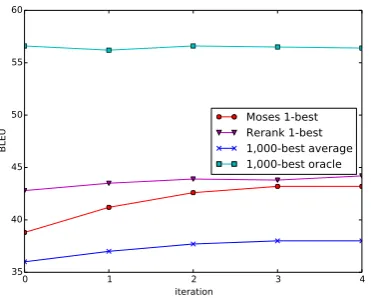
Figure 2: BLEU score evolution over iterations for the IN configuration on the test set of the
medicalEn→Fr translation task.
baseline. Among the other feature sets,POSLM performs well, especially for the medical task with an improvement of 0.3 and 0.5 BLEU for En→Fr and Fr→En, respectively.
Some types of our complex features have already been used during decoding, although sometimes for a very important cost (Schwartz et al., 2011). Our feature sets are to be considered only as ex-perimental parameters, as any other feature types usually used during reranking could also be used.
Features En→medicalFr Fr→En En→FrnewsFr→En
Moses 38.8 37.1 31.1 28.6
+MosesNorm 38.9 37.2 31.1 28.7
+NNM 41.9 38.9 32.5 29.8
+POSLM 39.2 37.7 31.1 28.9
+WPP 39.1 37.1 31.2 28.6
+TagRatio 38.9 37.3 31.1 28.8
+Syntax 38.8 37.2 31.2 28.9
+IBM1 39.1 37.2 30.9 28.8
[image:4.595.75.288.444.568.2]Rerank 42.8 40.1 32.5 29.9
Table 2: Reranking results for each set of features added individually;Rerankuses the full set.
4.3 Results
Table 3 presents our results for different transla-tion table partitransla-tioning configuratransla-tions. For each configuration, results are presented for the last iteration of the multi-pass decoding performed by Moses and the reranking of its k-best list by the Rerank system using complex features. First, we observe for the baseline systems that
Rerank outperforms Moses for all translation tasks and directions, especially onmedicalwith
improvements of 3.0 and 4.0 BLEU respectively for Fr→En and En→Fr. These improvements il-lustrate the strong potential of our set of complex features to provide more accurate scores for trans-lation hypotheses than the set of features used dur-ing the initial decoddur-ing.
All studied configurations yield improvements with multi-passMosesover theMosesbaseline, showing the advantage of extracting from the main translation table misused bi-phrases according to a reranking pass done with complex features. As illustrated by Figure 2, the multi-pass decoding quickly reduces the gap in BLEU score between our multi-passMosesandRerankone-best hy-potheses. Although the 1,000-best oracle remains at the same level over the iterations, the 1,000-best average score5 increases by 2 BLEU at the last iteration over the first 1,000-best hypotheses produced by Moses, pointing out a strong im-provement of the average quality of the 1,000-best hypotheses. However, except for the IN
configuration on medical En→Fr, multi-pass
Moses does not bring improvements by itself over the Rerank baseline. Nevertheless, multi-passMosescoupled withRerankdoes improve overRerankbaseline for all configurations on all translation tasks. These consistent improvements over the Rerank baseline demonstrate the abil-ity of our procedure to help the Moses decoder to producek-best lists of better quality which are more suitable to our complex features.
The IN configuration, which puts in a trans-lation table all bi-phrases in the one-best hy-pothesis of Rerank that do not belong to the
Mosesone-best hypothesis, performs the best for all translation tasks: multi-passRerankyields a 1.4 BLEU improvement over the Rerank base-line on medical En→Fr, and 0.7 BLEU on
news En→Fr. Improvements are lower, but nonetheless consistent, for the Fr→En direction, with +0.9 and +0.5 BLEU respectively on the
medical and news tasks. The OUT configu-ration yields smaller improvements in compari-son, meaning that putting aside (a few) first-ranked bi-phrases downgraded by Rerank is less use-ful in order to produce better k-best lists with
Moses. Using in the same system both IN and
Configuration devmedicaltestEn→# iter.Fr devmedicaltestFr→# iter.En devnewstestEn→# iter.Fr devnewstestFr→En# iter.
baseline RerankMoses 40.943.9 38.842.8 - 41.344.2 40.137.1 - 28.527.1 32.531.1 - 29.128.0 29.928.6
-OUT RerankMoses 43.345.3 41.843.8 4 43.044.5 40.538.7 3 28.527.9 32.931.8 1 29.228.5 30.329.2 1
IN RerankMoses 45.145.7 43.244.2 4 43.645.0 41.039.9 3 28.828.4 33.232.4 2 29.328.6 30.429.3 2
INandOUT RerankMoses 44.845.3 43.542.4 4 44.542.8 38.740.6 3 28.328.7 32.132.9 2 28.829.3 29.230.4 2
Table 3: Results for different translation table partitioning configurations. OUT: configuration with a translation table containing bi-phrases of theMoses1-best not in theRerank1-best.IN: configuration with a translation table containing bi-phrases of the Rerank1-best not in theMoses1-best. For all configuration the main translation table is still used but does not contain the extracted bi-phrases.
OUTiteration-specific translation tables (“INand
OUT”) yields a performance situated between us-ingINandOUTseparately, but which still consis-tently improves over the baselineRerank.
5 Discussion and future work
We have presented a method for guiding a phrase-based decoder with translation tables partitioned on the basis of k-best list reranking making use of complex features. Our results showed consis-tent improvements in BLEU score over a strong
Rerankbaseline using the same features. We ex-perimented with a simple criterion for iteratively partitioning the original phrase table of the sys-tem, and found that focusing on providing the next iteration decoder with the bi-phrases that were prefered at first rank byRerank(IN) performed best.6
We now intend to study how to better take ad-vantage of the expected characteristics of ourIN
andOUTtables, possibly by adding more features to our iteration-specific tables, or by exploiting information on bi-phrases computed on the full reranked lists. For our future work, we also plan to study approaches that can enhance thediversityin the k-best lists (Chatterjee and Cancedda, 2010; Gimpel et al., 2013) between each iteration of the multi-pass decoding to train a betterRerank
after each decoding pass. Another area for im-provement lies in the addition of yet more com-plex features, for instance to allow a better
dis-6Interestingly, a control experiment showed that using iteration-specific tables yields slightly better performance than fusioning all bi-phrases of a given type in a non iteration-specific table, possibly allowing later tunings to prefer the contents of the most recent, and possibly more reliable tables.
course coherence modelling over iterations (Ture et al., 2012; Hardmeier et al., 2012). Going fur-ther, we could study the effect of using other hy-potheses instead of theRerankone-best to per-form the comparison with theMosesone-best hy-pothesis. For instance, we can reasonably expect that making this comparison with the output of a rewriting system, such as the one proposed in our previous work (Marie and Max, 2014), could ex-tract more misused and useful bi-phrases on which to base our translation table partitioning since this rewriting system’s output is usually better than the
Rerankone-best and not in thek-best list of the decoder.
Acknowledgments
The authors would like to thank the anonymous re-viewers for their helpful comments, Quoc Khanh Do for his assistance on using SOUL, and Li Gong and Nicolas P´echeux for providing the authors with data used in the experiments. The work of the first author is supported by a CIFRE grant from French ANRT.
References
Simon Carter and Christof Monz. 2011. Syntactic Discriminative Language Model Rerankers for Sta-tistical Machine Translation. Machine Translation, 25:317–339.
Samidh Chatterjee and Nicola Cancedda. 2010. Min-imum error rate training by sampling the transla-tion lattice. InProceedings of EMNLP, Cambridge, USA.
Self-Enhancement. InProceedings of ACL, short papers, Columbus, USA.
Boxing Chen, Min Zhang, Aiti Aw, and Haizhou Li. 2008b. Regenerating Hypotheses for Statistical Ma-chine Translation. In Proceedings of COLING, Manchester, UK.
Colin Cherry and George Foster. 2012. Batch Tun-ing Strategies for Statistical Machine Translation. In Proceedings of NAACL, Montr´eal, Canada.
Jacob Devlin and Spyros Matsoukas. 2012. Trait-based Hypothesis Selection for Machine Transla-tion. InProceedings of NAACL, Montr´eal, Canada. Kevin Gimpel, Dhruv Batra, Chris Dyer, Gregory
Shakhnarovich, and Virginia Tech. 2013. A Sys-tematic Exploration of Diversity in Machine Trans-lation. InProceedings of EMNLP, Seatlle, USA. Christian Hardmeier, Joakim Nivre, and J¨org
Tiede-mann. 2012. Document-wide decoding for phrase-based statistical machine translation. In Proceed-ings of EMNLP-CoNLL, Jeju Island, Korea. Almut Silja Hildebrand and Stephan Vogel. 2008.
Combination of machine translation systems via hy-pothesis selection from combined n-best lists. In Proceedings of AMTA, Honolulu, USA.
Philipp Koehn, Hieu Hoang, Alexandra Birch, Chris Callison-Burch, Marcello Federico, Nicola Bertoldi, Brooke Cowan, Wade Shen, Christine Moran, Richard Zens, Chris Dyer, Ondrej Bojar, Alexandra Constantin, and Evan Herbst. 2007. Moses: Open Source Toolkit for Statistical Machine Translation. InProceedings of ACL, demo session, Prague, Czech Republic.
Hai-Son Le, Alexandre Allauzen, and Franc¸ois Yvon. 2012. Continuous Space Translation Models with Neural Networks. In Proceedings of NAACL, Montr´eal, Canada.
Benjamin Marie and Aur´elien Max. 2014. Confidence-based Rewriting of Machine Translation Output. InProceedings of EMNLP, Doha, Qatar. Franz Josef Och, Daniel Gildea, Sanjeev Khudanpur,
Anoop Sarkar, Kenji Yamada, Alex Fraser, Shankar Kumar, Libin Shen, David Smith, Katherine Eng, Viren Jain, Zhen Jin, and Dragomir Radev. 2004. A Smorgasbord of Features for Statistical Machine Translation. In Proceedings of NAACL, Boston, USA.
Lane Schwartz, Chris Callison-Burch, William Schuler, and Stephen Wu. 2011. Incremental syn-tactic language models for phrase-based translation. InProceedings of ACL, Portland, USA.
Kristina Toutanova and Christopher D. Manning. 2000. Enriching the Knowledge Sources Used in a Maximum Entropy Part-of-speech Tagger. In Pro-ceedings of EMNLP, Hong Kong.
Ferhan Ture, Douglas W. Oard, and Philip Resnik. 2012. Encouraging consistent translation choices. InProceedings of NAACL, Montr´eal, Canada. Nicola Ueffing and Hermann Ney. 2007.
Word-Level Confidence Estimation for Machine Transla-tion. Computational Linguistics, 33(1):9–40. Muhua Zhu, Yue Zhang, Wenliang Chen, Min Zhang,