Proceedings of the 57th Annual Meeting of the Association for Computational Linguistics, pages 5358–5362 5358
A Prism Module for Semantic Disentanglement
in Name Entity Recognition
Kun Liu1,*,† Shen Li2,* Daqi Zheng2 Zhengdong Lu2 Sheng Gao1 Si Li1
{liukun, gaosheng, lisi}@bupt.edu.cn {shen, da, luz}@deeplycurious.ai
1Beijing University of Posts and Telecommunications
2Deeplycurious.ai
Abstract
Natural Language Processing has been per-plexed for many years by the problem that multiple semantics are mixed inside a word, even with the help of context. To solve this problem, we propose a prism module to dis-entangle the semantic aspects of words and re-duce noise at the input layer of a model. In the prism module, some words are selectively re-placed with task-related semantic aspects, then these denoised word representations can be fed into downstream tasks to make them eas-ier. Besides, we also introduce a structure to train this module jointly with the downstream model without additional data. This module can be easily integrated into the downstream model and significantly improve the perfor-mance of baselines on named entity recogni-tion (NER) task. The ablarecogni-tion analysis demon-strates the rationality of the method. As a side effect, the proposed method also provides a way to visualize the contribution of each word.
1
1 Introduction
In Nature Language Processing (NLP), words con-tribute differently to different tasks. Therefore, attention-based models pay more attention on im-portant words than unimim-portant words. Since the information that is unrelated to the task can be re-garded as noise, unimportant words contain more noise than important words do. From this perspec-tive, attention is a noise reduction mechanism.
Hard attention and soft attention are two main types of attention mechanisms which are proposed in (Xu et al.,2015). Hard attention mechanism se-lects some important tokens from input sequence
∗
Kun Liu and Shen Li contributed equally to this work.
†
Work performed when Kun Liu worked as an intern in Deeplycurious.ai.
1Our code is available at https://github.com/
liukun95/Prism-Module
and ignore others. This will lead to the loss of necessary information which exists in the ignored tokens. By contrast, in soft attention mechanism, a probability distribution which reflects the impor-tance of tokens is calculated over each token of the input sequence. However, since there is more use-less information than useful information in unim-portant words, it should be noted that noise could be kept more, when those words are assigned with non-zero probabilities. Overall, both two attention mechanisms have drawbacks in noise reduction.
Attention mechanism is firstly applied in Com-puter Vision (CV) (Mnih et al.,2014) where pixels are the basic units. However, in NLP, the mini-mum unit is not word but sense. Therefore, NLP tasks need a noise reduction method at a finer granularity than attention mechanism.
Normally, various aspects of semantics are en-tangled in word embeddings (Bengio et al.,2003; Mikolov et al.,2013). However, only some of the aspects are needed in specific tasks and other dundant aspects can be regarded as noise. To re-duce the noise, entangled word embeddings can be replaced with distributed representations of dis-entangled semantic aspects. Considering that it could be hard to find the corresponding semantics for each aspect, we call them abstract aspects.
to reduce noise from different aspects. As a side effect, the interpretability of models is improved since different abstract aspects could represent dif-ferent semantics.
We introduce a method to train this mod-ule jointly with downstream model without extra training data. During training, the prism module learns to find the proper words to be replaced for each abstract aspect and also learns the embed-dings of abstract aspects which can represent the task-related semantics of words. Furthermore, we introduce a novel trick to reduce the high variance in training brought by REINFORCE method.
The prism module can be easily integrated into downstream model to reduce noise and improve performance. We evaluate our method on NER task. Results show that our model outperforms the baseline by a substantial margin.
2 Related Work
Attention-based models achieve the state of the art performance in a broad range of NLP tasks. Although soft attention is more popular, hard at-tention is found to be more effective with good training (Xu et al.,2015). Hard attention has been successfully applied in computer vision (Ba et al., 2014;Mnih et al.,2014) but the application is lim-ited in NLP.Lei et al.(2016) proposed a novel type of hard attention and apply it to improve the in-terpretability of models. However, the accuracy is not improved. Inspired by this, our proposed method can also be understood as hard-attention based but improves the accuracy successfully.
In addition to improving accuracy, attention-based models also improve the interpretability by showing the inner working of neural networks (Rush et al., 2015;Rockt¨aschel et al., 2015; Lei et al.,2016). Disentangling provides another way to improve the interpretability by extracting infor-mation from different aspects of the input. Lin et al.(2017) propose a multi-aspect self-attention to disentangle the latent semantic information of the input sentence. Jain et al. (2018) propose a model to learn disentangled representations of texts for 4 given biomedical aspects. Our proposed method can be regarded as the combination of the above two types of methods to improve the inter-pretability of the model.
3 Model
3.1 Prism Module
The target of this module is to get the sentences with less noise by replacing some of the words with abstract aspects. In a sentence, since each word has different semantics and contributes dif-ferently to the task, the key is to calculate the prob-ability distribution over possible replacements.
Given a sentenceX, which havenwords
X = (w1, w2, w3,· · ·wn) (1)
where wi is the embedding of the i-th word in
the sentence. We also have m different abstract aspects which representmaspects of semantics
A= (a1, a2, a3,· · ·am) (2)
whereaiis the embedding of thei-th abstract
as-pect.
We apply bidirectional LSTM to the input sen-tence, which could capture some dependency be-tween words.
− →
ht=
−−−−→
LST M(wt,
− →
ht−1) (3)
←−
ht=
←−−−−
LST M (wt,
←−
ht+1) (4)
where−→h tand ←−
h tdenote the hidden states. We
useht, the concatenation of − →
h tand ←−
h tas the
an-notation of words. All nhidden states are anno-tated as the matrix
H = (h1, h2, h3,· · ·hn) (5)
We define binary variable si,j ∈ 0,1 which
in-dicates whetherj-th word wj is replaced byi-th
abstract aspect ai or not. Then, the probabilities
P with shape ofm-by-ncan be computed, where each elementpi,jis the probability ofsi,j = 1. P
is calculated as:
P=sigmoid(W HT+b) (6)
pi,j=p(si,j= 1|X) (7)
Here,W is the weight with the size ofm-by-2h
andbis the bias.
si,j is the random variable with multinoulli
dis-tribution parametrized bypi,j. To get the replaced
sentences, we sample S0 according to the proba-bility distributionpi,j
S0=
s01,1 · · · s01,n
..
. . .. ...
s0m,1 . . . s0m,n
where i-th row of the matrix indicates which words in a sentence are replaced with i-th ab-stract aspect. After replacing the words with the guide of S0, we obtain m replaced sentences (X10, X20, X30 · · · Xm0 )where each one is denoised from different aspect. Then, these parallel sen-tences including m denoised sentences and the original sentence are used as the input of the downstream model.
3.2 Model Training
The prism module is trained jointly with down-stream model. The parameters in the model can be divided into two parts, θo for downstream model
andθafor prism module.
The objective for optimizing θo is to improve
the prediction accuracy of the model. Since the input of the model includes both the word em-beddings and abstract aspect emem-beddings, the loss function for parametersθois
L(θo) =L(θo, X, y) +L θo, X, S 0
, y (9)
The objective for optimizing θa is to replace
proper words with proper abstract aspects. Be-cause of the discrete variablesi,j, the loss function
is non-differentiable for the parameters θa. We
use the policy gradient/REINFORCE (Williams, 1992) to optimize θa. Since we expect that not
only the downstream model is well trained, but also the replaced sentences can achieve favorable performance in downstream task, the loss function
L(θo)is used as rewardR. The objective function
forθais:
L(θa) =Es∼p(Rlog (p(s|X))) (10)
Besides, we also introduce a penalization term Ω (A) proposed by Lin et al. (2017) to diversify the abstract aspects which are expected to repre-sent different direpre-sentangled aspects.
Ω (A) =
AbAb
T−
I
2
F
(11)
wherekkF denotes the Frobenius norm of a ma-trix,I stands for the identity matrix andAbis cal-culated by normalizing eachaiofA.
Considering that we sample theS0according to the probability distribution to simplify the expec-tation, for all parameters, the loss function L is:
L=L(θo) +L(θa) + Ω (A)
=L(θo, X, y) +L θo, X, S0, y
+L(θo) log p S0|X+ Ω (A)
(12)
3.3 Normalization of Reward
High variance is one of the disadvantages of RE-INFORCE method, which makes models difficult to converge. No exception, our model also suf-fers from the same problem. We propose a novel method to reduce the variance and stabilize the training process. We normalize the rewards by making them have the mean of 0 and variance of 1.
µ← 1
m m
X
i=1
Ri (13)
σ2← 1
m m
X
i=1
(Ri−µ)2 (14)
c
Ri←R√i−µ
σ2 (15)
where meanµand varianceσare calculated over each mini-batch. Rbi denotes the normalized re-ward. The loss L becomes
L=L(θo, X, y) +L θo, X, S 0
, y
+cRi log p S
0
|X
+ Ω (A) (16)
4 Experiments
We evaluate the effectiveness of our noise reduc-tion method on NER task.
Dataset: CoNLL 2003 (Sang and De Meulder, 2003) is used as our dataset.
Baseline: Yang et al. (2018) compare the performance of twelve neural sequence labeling models in NER task and the architecture CNN-BiLSTM (Bi-directional LSTM)-CRF (Ma and Hovy,2016) achieves the best result (F1). There-fore, we use this model as our baseline.
Figure1shows our model where the prism mod-ule is integrated into CNN-BiLSTM-CRF archi-tecture. The sentence is fed into the prism module and the output of this module is m(e.g.,3) sen-tences which are denoised from different aspect. These m+ 1 parallel sentences including the m
denoised sentences and the original sentence are fed into BiSTM+CRF network to predict the la-bels. Besides, only the original sentence is used in testing.
4.1 Model Configuration
a3 w2 a3 a3 w5 w6
p31 p32 p33 p34 p35 p36
w1 BiLSTM
w2 w3 w4 w5 w6 p21 p22 p23 p24 p25 p26
Feed Forward
BiLSTM+CRF
p11 p12 p13 p14 p15 p16 w1 a2 w3 w4 w5 a2
Sampling w1 w2 a1 w4 w5 w6
Testing Training
[image:4.595.101.260.59.293.2]Noise Reduction Module
Figure 1: CNN-BiLSTM-CRF architecture with prism module. w1, w2... denote the concatenation of origi-nal word embeddding and character-level representa-tion which is computed by CNN.
Model F1
Baseline (Ma and Hovy,2016) 91.2 Multi-aspect hard attention 91.5 Random replacement 91.5 Single aspect 91.3
Our method 91.8
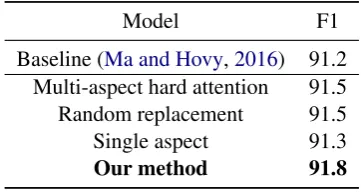
Table 1: NER F1 score of baseline, three ablation ex-periments and our model on test data of CoNLL-2003.
4.2 Result and Analysis
The experimental results are shown in Table 1. Our model outperforms the baseline by a clear margin.
To prove the effectiveness of our prism module, we design three ablation experiments:
Multi-aspect hard attention: Instead of placing the words with abstract aspects, we re-place the embeddings of selected words with zero vectors. This method can be regarded as a type of multi-aspect hard attention where some of the words are ignored.
[image:4.595.310.524.63.139.2]Random replacement: Instead of learning to select the words to be replaced guided by the downstream task, we select the words to be re-placed randomly for each abstract aspect. It is a kind of data noising technique which is similar to the method proposed in (Xie et al.,2017) with
Figure 2: Heat map forS0
multiple aspects.
Single aspect:In our model, one word could be replaced with different abstract aspects in differ-ent denoised sdiffer-entences. In this experimdiffer-ent, there is only one denoised sentence where each word could only be replaced with the abstract aspect of the maximum probability.
Our model has better performance than three ablation experiments as shown in Table 1. The results indicate that (1) The trainable embeddings of each abstract aspect can capture the informa-tion which is valuable for the task. (2) Our model can learn to replace words properly guided by the downstream task (e.g., NER). (3) For each word, more than one aspect of semantics are task-related. Additionally, considering that the first two abla-tion experiments improve F1 by 0.3% but the last one only improves 0.1%, multi-aspect denoising is important for the prism module.
4.3 Visualization
We visualize the matrix S0 by drawing the heat map of each row vector as shown in Figure2. In this example, japan and china are location enti-ties. Each row corresponds to one abstract as-pect and each element indicates whether this word is replaced. The heat map shows that each ab-stract aspect replaces some of words to keep cer-tain task-related semantics and filter out other in-formation. Since the abstract aspects represent different meanings respectively, the selections of words vary between rows which indicates noise is reduced from different aspects. From the heat map, we can also learn that a word can be replaced with multiple abstract aspects and this process is the disentanglement of semantics.
5 Conclusion
[image:4.595.90.271.364.460.2]prism module jointly with existing model and no extra data is needed. Considering REINFORCE method is used in training, a novel method is in-troduced to reduce the variance of rewards. As a result, our model outperforms the baseline by a clear margin and the ablation analysis proves the effectiveness of our method. As a side effect, this module also improves the interpretability of mod-els. Since our prism module can be easily inte-grated into existing models, it can be applied in a wide range of neural architectures.
References
Jimmy Ba, Volodymyr Mnih, and Koray Kavukcuoglu. 2014. Multiple object recognition with visual atten-tion. arXiv preprint arXiv:1412.7755.
Yoshua Bengio, R´ejean Ducharme, Pascal Vincent, and Christian Jauvin. 2003. A neural probabilistic lan-guage model. Journal of machine learning research, 3(Feb):1137–1155.
Sarthak Jain, Edward Banner, Jan-Willem van de Meent, Iain J Marshall, and Byron C Wallace. 2018. Learning disentangled representations of texts with application to biomedical abstracts. arXiv preprint arXiv:1804.07212.
Tao Lei, Regina Barzilay, and Tommi Jaakkola. 2016. Rationalizing neural predictions. arXiv preprint arXiv:1606.04155.
Zhouhan Lin, Minwei Feng, Cicero Nogueira dos San-tos, Mo Yu, Bing Xiang, Bowen Zhou, and Yoshua Bengio. 2017. A structured self-attentive sentence embedding. arXiv preprint arXiv:1703.03130.
Xuezhe Ma and Eduard Hovy. 2016. End-to-end sequence labeling via bi-directional lstm-cnns-crf.
arXiv preprint arXiv:1603.01354.
Tomas Mikolov, Kai Chen, Greg Corrado, and Jef-frey Dean. 2013. Efficient estimation of word representations in vector space. arXiv preprint arXiv:1301.3781.
Volodymyr Mnih, Nicolas Heess, Alex Graves, et al. 2014. Recurrent models of visual attention. In
Advances in neural information processing systems, pages 2204–2212.
Tim Rockt¨aschel, Edward Grefenstette, Karl Moritz Hermann, Tom´aˇs Koˇcisk`y, and Phil Blunsom. 2015. Reasoning about entailment with neural attention.
arXiv preprint arXiv:1509.06664.
Alexander M Rush, Sumit Chopra, and Jason We-ston. 2015. A neural attention model for ab-stractive sentence summarization. arXiv preprint arXiv:1509.00685.
Erik F Sang and Fien De Meulder. 2003. Intro-duction to the conll-2003 shared task: Language-independent named entity recognition. arXiv preprint cs/0306050.
Ronald J Williams. 1992. Simple statistical gradient-following algorithms for connectionist reinforce-ment learning. Machine learning, 8(3-4):229–256.
Ziang Xie, Sida I Wang, Jiwei Li, Daniel L´evy, Aiming Nie, Dan Jurafsky, and Andrew Y Ng. 2017. Data noising as smoothing in neural network language models. arXiv preprint arXiv:1703.02573.
Kelvin Xu, Jimmy Ba, Ryan Kiros, Kyunghyun Cho, Aaron Courville, Ruslan Salakhudinov, Rich Zemel, and Yoshua Bengio. 2015. Show, attend and tell: Neural image caption generation with visual atten-tion. InInternational conference on machine learn-ing, pages 2048–2057.