Learning to Explain Entity Relationships in Knowledge Graphs
Nikos Voskarides∗University of Amsterdam
Edgar Meij
Yahoo Labs, London
Manos Tsagkias
904Labs, Amsterdam
Maarten de Rijke
University of Amsterdam
Wouter Weerkamp
904Labs, Amsterdam
Abstract
We study the problem of explaining re-lationships between pairs of knowledge graph entities with human-readable de-scriptions. Our method extracts and en-riches sentences that refer to an entity pair from a corpus and ranks the sentences ac-cording to how well they describe the re-lationship between the entities. We model this task as a learning to rank problem for sentences and employ a rich set of fea-tures. When evaluated on a large set of manually annotated sentences, we find that our method significantly improves over state-of-the-art baseline models.
1 Introduction
Knowledge graphs are a powerful tool for support-ing a large spectrum of search applications includ-ing rankinclud-ing, recommendation, exploratory search, and web search (Dong et al., 2014). A knowl-edge graph aggregates information around enti-ties across multiple content sources and links these entities together, while at the same time provid-ing entity-specific properties (such as age or em-ployer) and types (such as actor or movie).
Although there is a growing interest in au-tomatically constructing knowledge graphs, e.g., from unstructured web data (Weston et al., 2013; Craven et al., 2000; Fan et al., 2012), the prob-lem of providing evidence on why two entities are related in a knowledge graph remains largely unaddressed. Extracting and presenting evidence for linking two entities, however, is an impor-tant aspect of knowledge graphs, as it can enforce trust between the user and a search engine, which in turn can improve long-term user engagement, e.g., in the context of related entity recommenda-tion (Blanco et al., 2013). Although knowledge
∗This work was carried out while this author was visiting Yahoo Labs.
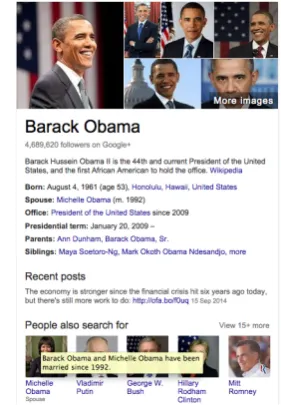
[image:1.595.339.480.298.501.2]graphs exist that provide this functionality to a certain degree (e.g., when hovering over Google’s suggested entities, see Figure 1), to the best of our knowledge there is no previously published re-search on methods for entity relationship explana-tion.
Figure 1: Part of Google’s search result page for the query “barack obama”. When hovering over the related entity “Michelle Obama”, an explana-tion of the relaexplana-tionship between her and “Barack Obama” is shown.
In this paper we propose a method for explain-ing the relationship between two entities, which we evaluate on a newly constructed annotated dataset that we make publicly available. In par-ticular, we consider the task of explaining rela-tionships between pairs of Wikipedia entities. We aim to infer a human-readable description for an entity pair given a relationship between the two entities. Since Wikipedia does not explicitly de-fine relationships between entities we use a knowl-edge graph to obtain these relations. We cast our task as a sentence ranking problem: we automat-ically extract sentences from a corpus and rank
them according to how well they describe a given relationship between a pair of entities. For rank-ing purposes, we extract a rich set of features and use learning to rank to effectively combine them. Our feature set includes both traditional informa-tion retrieval and natural language processing tures that we augment with entity-dependent fea-tures. These features leverage information from the structure of the knowledge graph. On top of this, we use features that capture the presence in a sentence of the relationship of interest. For our evaluation we focus on “people” entities and we use a large, manually annotated dataset of sen-tences.
The research questions we address are the fol-lowing. First, we ask what the effectiveness of state-of-the-art sentence retrieval models is for explaining a relationship between two entities (RQ1). Second, we consider whether we can im-prove over sentence retrieval models by casting the task in a learning to rank framework (RQ2). Third, we examine whether we can further improve per-formance by using relationship-dependent models instead of a relationship-independent one (RQ3). We complement these research questions with an error and feature analysis.
Our main contributions are a robust and effec-tive method for explaining entity relationships, de-tailed insights into the performance of our method and features, and a manually annotated dataset.
2 Related Work
We combine ideas from sentence retrieval, learn-ing to rank, and question answerlearn-ing to address the task of explaining relationships between entities.
Previous work that is closest to the task we ad-dress in this paper is that of Blanco and Zaragoza (2010) and Fang et al. (2011). First, Blanco and Zaragoza (2010) focus on finding and ranking stences that explain the relationship between an en-tity and a query. Our work is different in that we want to explain the relationship between two enti-ties, rather than a query. Fang et al. (2011) explore the generation of a ranked list of knowledge base relationships for an entity pair. Instead, we try to select sentences that describe a particular relation-ship, assuming that this is given.
Our approach builds on sentence retrieval, where one retrieves sentences rather than docu-ments that answer an information need. Docu-ment retrieval models such as tf-idf, BM25, and
language modeling (Baeza-Yates et al., 1999) have been extended to tackle sentence retrieval. Three of the most successful sentence retrieval methods are TFISF (Allan et al., 2003), which is a vari-ant of the vector space model with tf-idf weight-ing, language modeling with local context (Mur-dock, 2006; Fern´andez et al., 2011), and a recur-sive version of TFISF that accounts for local con-text (Doko et al., 2013). TFISF is very competi-tive compared to document retrieval models tuned specifically for sentence retrieval (e.g., BM25 and language modeling (Losada, 2008)) and we there-fore include it as a baseline.
Sentences that are suitable for explaining rela-tionships can have attributes that are important for ranking but cannot be captured by term-based re-trieval models. One way to combine a wide range of ranking features is learning to rank (LTR). Re-cent years have witnessed a rapid increase in the work on learning to rank, and it has proven to be a very successful method for combining large num-bers of ranking features, for web search, but also other information retrieval applications (Burges et al., 2011; Surdeanu et al., 2011; Agarwal et al., 2012). We use learning to rank and represent each sentence with a set of features that aim to capture different dimensions of the sentence.
Question answering (QA) is the task of provid-ing direct and concise answers to questions formed in natural language (Hirschman and Gaizauskas, 2001). QA can be regarded as a similar task to ours, assuming that the combination of entity pair and relationship form the “question” and that the “answer” is the sentence describing the relation-ship of interest. Even though we do not follow the QA paradigm in this paper, some of the features we use are inspired by QA systems. In addition, we employ learning to rank to combine the devised features, which has recently been successfully ap-plied for QA (Surdeanu et al., 2011; Agarwal et al., 2012).
3 Problem Statement
can-didate sentences Sij = {sij1, . . . , sijk} that refer
to ⟨ei, ej⟩ and to impose a ranking on the sen-tences inSij. The relationr has the general form
⟨type(ei),terms(r),type(ej)⟩, wheretype(e)is the type of the entitye(e.g.,PersonorActor) and terms(r) are the terms of the relation (e.g., CoCastsWithorIsSpouseOf).
We are left with two specific tasks: (1) extract-ing candidate sentences Sij, and (2) rankingSij, where the goal is to have sentences that provide a perfect explanation of the relationship at the top position of the ranking. The next section describes our methods for both tasks.
4 Explaining Entity Relationships
We follow a two-step approach for automatically explaining relationships between entity pairs. First, in Section 4.1, we extract and enrich sen-tences that refer to an entity pair ⟨ei, ej⟩ from a corpus in order to construct a set of candidate sen-tences. Second, in Section 4.2, we extract a rich set of features describing the entities’ relationship rand use supervised machine learning in order to rank the sentences in Sij according to how well they describe the relationshipr.
4.1 Extracting candidate sentences
To create a set of candidate sentences for a given entity pair and relationship, we require a corpus of documents that is pertinent to the entities at hand. Although any kind of document collection can be used, we focus on Wikipedia in this paper, as it provides good coverage for the majority of entities in our knowledge graph.
First, we extract surface forms for the given en-tities: the title of the entity’s Wikipedia article (e.g., “Barack Obama”), the titles of all redirect pages linking to that article (e.g., “Obama”), and all anchor text associated with hyperlinks to the ar-ticle within Wikipedia (e.g., “president obama”). We then split all Wikipedia articles into sentences and consider a sentence as a candidate if (i) the sentence is part of either entities’ Wikipedia arti-cle and contains a surface form of, or a link to, the other entity; or (ii) the sentence contains sur-face forms of, or links to, both entities in the entity pair.
Next, we apply two sentence enrichment steps for (i) making sentences self-contained and read-able outside the context of the source document and (ii) linking the sentences to entities. For (i),
we replace pronouns in candidate sentences with the title of the entity. We apply a simple heuristic for the people entities, inspired by (Wu and Weld, 2010):1 we count the frequency of the terms “he”
and “she” in the article for determining the gender of the entity, and we replace the first appearance of “he” or “she” in each sentence with the entity’s title. We skip this step if any surface form of the entity occurs in the sentence.
For (ii), we apply entity linking to provide links from the sentence to additional entities (Milne and Witten, 2008). This need arises from the fact that not every sentence in an article contains ex-plicit links to the entities it mentions, as Wikipedia guidelines only allow one link to another article in the article’s text.2 The algorithm takes a sentence
as input and iterates over n-grams that are not yet linked to an entity. If an n-gram matches a surface form of an entity, we establish a link between the n-gram and the entity. We restrict our search space to entities that are linked from within the source article of the sentence and from within articles to which the source article links. This way, our entity linking method achieves high precision as almost no disambiguation is necessary.
As an example, consider the sentence “He gave critically acclaimed performances in the crime thriller Seven. . . ” on the Wikipedia page for Brad Pitt. After applying our enrichment steps, we obtain “Brad Pitt gave critically acclaimed performances in the crime thriller Seven. . . ”, making the sentence human read-able and link to the entities Brad Pitt and Seven (1995 film).
4.2 Ranking sentences
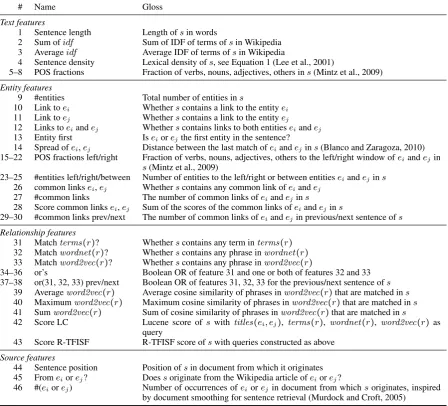
After extracting candidate sentences, we rank them by how well they describe the relationship of interest r between entities ei and ej. There are many signals beyond simple term statistics that can indicate relevance. Automatically construct-ing a rankconstruct-ing model usconstruct-ing supervised machine learning techniques is therefore an obvious choice. For ranking we use learning to rank (LTR) and rep-resent each sentence with a rich set of features. Ta-ble 1 lists the features we use. Below we provide
1We experimented with the Stanford co-reference
reso-lution system (Lee et al., 2011) and Apache OpenNLP and found that they were not able to consistently achieve the level of effectiveness that we require.
2http://en.Wikipedia.org/wiki/
# Name Gloss Text features
1 Sentence length Length ofsin words
2 Sum ofidf Sum of IDF of terms ofsin Wikipedia 3 Averageidf Average IDF of terms ofsin Wikipedia
4 Sentence density Lexical density ofs, see Equation 1 (Lee et al., 2001)
5–8 POS fractions Fraction of verbs, nouns, adjectives, others ins(Mintz et al., 2009) Entity features
9 #entities Total number of entities ins
10 Link toei Whetherscontains a link to the entityei 11 Link toej Whetherscontains a link to the entityej 12 Links toeiandej Whetherscontains links to both entitieseiandej 13 Entity first Iseiorejthe first entity in the sentence?
14 Spread ofei,ej Distance between the last match ofeiandejins(Blanco and Zaragoza, 2010) 15–22 POS fractions left/right Fraction of verbs, nouns, adjectives, others to the left/right window ofeiandejin
s(Mintz et al., 2009)
23–25 #entities left/right/between Number of entities to the left/right or between entitieseiandejins 26 common linksei,ej Whetherscontains any common link ofeiandej
27 #common links The number of common links ofeiandejins 28 Score common linksei,ej Sum of the scores of the common links ofeiandejins
29–30 #common links prev/next The number of common links ofeiandejin previous/next sentence ofs Relationship features
31 Matchterms(r)? Whetherscontains any term interms(r) 32 Matchwordnet(r)? Whetherscontains any phrase inwordnet(r) 33 Matchword2vec(r)? Whetherscontains any phrase inword2vec(r)
34–36 or’s Boolean OR of feature 31 and one or both of features 32 and 33 37–38 or(31, 32, 33) prev/next Boolean OR of features 31, 32, 33 for the previous/next sentence ofs
39 Averageword2vec(r) Average cosine similarity of phrases inword2vec(r)that are matched ins 40 Maximumword2vec(r) Maximum cosine similarity of phrases inword2vec(r)that are matched ins 41 Sumword2vec(r) Sum of cosine similarity of phrases inword2vec(r)that are matched ins
42 Score LC Lucene score of s withtitles(ei, ej), terms(r), wordnet(r), word2vec(r) as query
43 Score R-TFISF R-TFISF score ofswith queries constructed as above Source features
44 Sentence position Position ofsin document from which it originates 45 Fromeiorej? Doessoriginate from the Wikipedia article ofeiorej?
[image:4.595.78.527.64.470.2]46 #(eiorej) Number of occurrences ofeiorejin document from whichsoriginates, inspired by document smoothing for sentence retrieval (Murdock and Croft, 2005)
Table 1: Features used for sentence ranking.
a brief description of the more complex ones.
Text features This feature type regards the im-portance of the sentence sat the term level. We compute the density ofs(feature 4) as:
density(s) = 1
K⋅ (K+1)
n
∑
j=1
idf(tj) ⋅idf(tj+1) distance(tj, tj+1)2
, (1)
where K is the number of keyword terms in s and distance(tj, tj+1) is the number of non-keyword terms between non-keyword terms tj and tj+1. We treat stop words and numbers insas non-keywords and the remaining terms as non-keywords. Features 5–8 capture the distribution of part-of-speech tags in the sentence.
Entity features These features partly build on (Tsagkias et al., 2011; Meij et al., 2012) and
de-scribe the entities and are dependent on the knowl-edge graph. Whethereiorejis the first appearing entity in a sentence might be an indicator of impor-tance (feature 13). The spread ofei andej in the sentence (feature 14) might be an indicator of their centrality in the sentence (Blanco and Zaragoza, 2010). Features 15–22 capture the distribution of part-of-speech tags in the sentence in a window of four words aroundeiorejins(Mintz et al., 2009), complemented by the number of entities between, to the left of, and to the right of the entity pair (features 23–25).
(fea-ture 26) and the number of common links (fea(fea-ture 27) as features. We score a common linklbetween eiandej using:
score(l, ei, ej) =sim(l, ei) ⋅sim(l, ej), (2)
wheresim(⋅,⋅)is defined as the similarity between two Wikipedia articles, computed using a vari-ant of Normalized Google Distance (Witten and Milne, 2008). Feature 28 then measures the sum of the scores of the common links.
Previous research shows that using surrounding sentences is beneficial for sentence retrieval (Doko et al., 2013). We therefore consider the number of common links in the previous and next sentence (features 29–30).
Relationship features Feature 31 indicates whether any of the relationship-specific terms oc-curs in the sentence. Only matching the terms in the relationship may have low coverage since terms such as “spouse” may have many synonyms and/or highly related terms, e.g., “husband” or “married”. Therefore, we use WordNet to find synonym phrases ofr(feature 32); we refer to this method aswordnet(r).
Alternatively, we use word embeddings to find such similar phrases (Mikolov et al., 2013). Such embeddings take a text corpus as input and learn vector representations of words and phrases con-sisting of real numbers. Given the setVr consist-ing of the vector representations of all the relation-ship terms and the setV which consists of the vec-tor representations of all the candidate phrases in the data, we calculate the distance between a can-didate phrase represented by a vectorvi ∈ V and the vectors inVras:
distance(vi, V) =cos⎛
⎝vi,v∑j∈Vr
vj⎞⎠, (3)
where ∑vj∈Vrvj is the element-wise sum of the vectors in Vr and the distance between two vec-torsv1andv2is measured using cosine similarity.
The candidate phrases inV are then ranked using Equation 3 and the top-mphrases are selected, re-sulting in features 33, 39, 40, and 41; we refer to the ranked set of phrases that are selected using this procedure asword2vec(r).
In addition, we employ state-of-the-art retrieval functions and include the scores for queries that are constructed using the entitieseiandej, the re-lation r, wordnet(r), and word2vec(r). We use
the titles of the entity articles titles(e) to repre-sent the entities in the query and two ranking func-tions, Recursive TFISF (R-TFISF) and LC,3
(fea-tures 42–43). TFISF is a sentence retrieval model that determines the level of relevance of a sentence sgiven a queryqas:
R(s, q) = ∑
t∈q
log(tft,q+1)⋅
log(tft,s+1) ⋅log(0.n5++1sf
t), (4)
where tft,q and tft,s are the number of occur-rences of term t in the queryq and the sentence s respectively, sft is the number of sentences in whichtappears, andnis the number of sentences in the collection. R-TFISF is an improved ex-tension of the TFISF method (Doko et al., 2013), which incorporates context from neighboring sen-tences in the ranking function:
Rc(s, q) = (1−µ)R(s, q)+ (5) µ[Rc(sprev(s), q) +Rc(snext(s), q)],
where µ is a free parameter and sprev(s) and snext(s)indicate functions to retrieve the previous and next sentence, respectively. We use a maxi-mum of three recursive calls.
Source features Here, we refer to features that are dependent on the source document of the sen-tences. We have three such features.
5 Experimental setup
In this section we describe the dataset, manual an-notations, learning to rank algorithm, and evalu-ation metrics that we use to answer our research questions.
5.1 Dataset
We draw entities and their relationships from a proprietary knowledge graph that is created from Wikipedia, Freebase, IMDB, and other sources, and that is used by the Yahoo web search engine. We focus on “people” entities and relationships between them.4 For our experiments we need to
select a manageable set of entities, which we ob-tain as follows. We consider a year of query logs 3In preliminary experiments R-TFISF and LC were the
best performing among a pool of sentence retrieval methods.
4Note that, except for the co-reference resolution step
from a large commercial search engine, count the number of times a user clicks on a Wikipedia ar-ticle of an entity in the results page and perform stratified sampling of entities according to this dis-tribution. As we are bounded by limited resources for our manual assessments, we sample 1 476 en-tity pairs that together with nine unique relation-ship types form our experimental dataset.
We use an English Wikipedia dump dated July 8, 2013, containing approximately 4M articles, of which 50 638 belong to “people” entities that are also in our knowledge graph. We extract sentences using the approach described in Section 4.1, re-sulting in 36 823 candidate sentences for our enti-ties. On average we have 24.94 sentences per en-tity pair (maximum 423 and minimum 0). Because of the large variance, it is not feasible to obtain ex-haustive annotations for all sentences. We rank the sentences using R-TFISF and keep the top-10 sen-tences per entity pair for annotation. This results in a total of 5 689 sentences.
Five human annotators provided relevance judg-ments, manually judging sentences based on how well they describe the relationship for an entity pair, for which we use a five-level graded rele-vance scale (perfect, excellent, good, fair, bad).5
Of all relevance grades 8.1% is perfect, 15.69% excellent, 19.98% good, 8.05% fair, and 48.15% bad. Out of 1 476 entity pairs, 1 093 have at least one sentence annotated as fair. As is common in information retrieval evaluation, we discard entity pairs that have only “bad” sentences. We examine the difficulty of the task for human annotators by measuring inter-annotator agreement on a subset of 105 sentences that are judged by 3 annotators. Fleiss’ kappa isk=0.449, which is considered to be moderate agreement.
5.2 Machine learning
For ranking sentences we use a Random Forest (RF) classifier (Breiman, 2001).6 We set the
num-ber of iterations to 300 and the sampling rate to 0.3. Experiments with varying these two parame-ters did not show any significant differences. We also tried several feature normalization methods, none of them being able to significantly
outper-5
https://github.com/nickvosk/acl2015- dataset-learning-to-explain-entity-relationships
6In preliminary experiments, we contrasted RF with
gra-dient boosted regression trees and LambdaMART and found that RF consistently outperformed other methods.
Baseline NDCG@1 NDCG@10 ERR@1 ERR@10 B1 0.7508 0.8961 0.3577 0.4531 B2 0.7511 0.8958 0.3584 0.4530 B3 0.7595 0.8997 0.3696 0.4600 B4 0.7767 0.9070 0.3774 0.4672
B5 0.7801 0.9093 0.3787 0.4682
Table 2: Results for five baseline variants. See text for their description and significant differences.
form the runs without feature normalization. We obtain POS tags using the Stanford part-of-speech tagger and filter out a standard list of 33 English stopwords. For the word embeddings we use word2vec and train our model on all text in Wikipedia using negative sampling and the con-tinuous bag of words architecture. We set the size of the phrase vectors to 500 andm=30.
5.3 Evaluation metrics
We employ two main evaluation metrics in our experiments, NDCG (J¨arvelin and Kek¨al¨ainen, 2002) and ERR (Chapelle et al., 2009). The for-mer measures the total accumulated gain from the top of the ranking that is discounted at lower ranks and is normalized by the ideal cumulative gain. The latter models user behavior and mea-sures the expected reciprocal rank at which a user will stop her search. We consider these ranking-based graded evaluation metrics at two cut-off points: position 1, corresponding to showing a sin-gle sentence to a user, and 10, which accounts for users who might look at more results. We report on NDCG@1, NDCG@10, ERR@1, ERR@10, and Exc@1, which indicates whether we have an “excellent” or “perfect” sentence at the top of the ranking. Likewise, Per@1 indicates whether we have a “perfect” sentence at the top of the ranking (not all entity pairs have an excellent or a perfect sentence).
We perform 5-fold cross validation and test for statistical significance using a paired two-tailed t-test. We depict a significant difference in perfor-mance forp<0.01with▲(gain) and▼(loss) and forp<0.05with△(gain) and▽(loss). Boldface indicates the best score for a metric.
6 Results and Analysis
Has one # pairs # sentences Method NDCG@1 NDCG@10 ERR@1 ERR@10 Exc@1 Per@1
fair 1 093 4 435 B5 0.7801 0.9093 0.3787 0.4682 – –
LTR 0.8489▲ 0.9375▲ 0.4242▲ 0.4980▲ – –
good 1 038 4 285 B5 0.7742 0.9078 0.3958 0.4894 – –
LTR 0.8486▲ 0.9374▲ 0.4438▲ 0.5208▲ – –
excellent 752 3 387 B5 0.7455 0.8999 0.4858 0.5981 0.7314 –
LTR 0.8372▲ 0.9340▲ 0.5500▲ 0.6391▲ 0.8298▲ –
perfect 339 1 687 B5 0.7082 0.8805 0.6639 0.7878 0.7729 0.6136
[image:7.595.74.525.63.185.2]LTR 0.8150▲ 0.9245▲ 0.7640▲ 0.8518▲ 0.8909▲ 0.7227▲
Table 3: Results for the best baseline (B5) and the learning to rank method (LTR).
smoothing (LM), BM25, TFISF, and Recursive TF-ISF (R-TFISF). We follow related work and setµ=0.1for R-TFISF,k=1andb=0for BM25 andµ=250for LM (Fern´andez et al., 2011).
In our experiments, a queryqis constructed us-ing various combinations of surface forms of the two entitieseiandejand the relationshipr. Each entity in the entity pair can be represented by its title, the titles of any redirect pages pointing to the entity’s article, the n-grams used as anchors in Wikipedia to link to the article of the entity, or the union of them all. The relationshiprcan be repre-sented by the terms in the relationship, synonyms inwordnet(r), or by phrases inword2vec(r).
First, we fix the way we represent r. Base-line B1 does not include any representation of r in the query. B2 includes the relationship terms ofr, while B3 includes the relationship terms ofr and the synonyms inwordnet(r). B4 includes the terms ofrand the phrases inword2vec(r), and B5 includes the relationship terms ofr, the synonyms in wordnet(r) and the phrases in word2vec(r). Combining these variations with the entity repre-sentations, we find that all combinations that use the titles as representation and R-TFISF as the retrieval function outperform all other combina-tions.7 This can be explained by the fact that titles
are least ambiguous, thus reducing the possibility of accidentally referring to other entities. BM25 and LC perform almost as well as R-TFISF, with only insignificant differences in performance.
Table 2 shows the best performing combination of each baseline, i.e., varying the representation of r and using titles and R-TFISF. B4 and B5 are the best performing baselines, suggesting that
word2vec(r)andwordnet(r)are beneficial. B5 significantly outperforms all baselines except B4.
We also experiment with a supervised
combina-7We omit a full table of results due to space constraints.
tion of the baseline rankers using LTR. Here, we consider each baseline ranker as a separate feature and train a ranking model. The trained model is not able to outperform the best individual baseline, however.
6.1 Learning to rank sentences
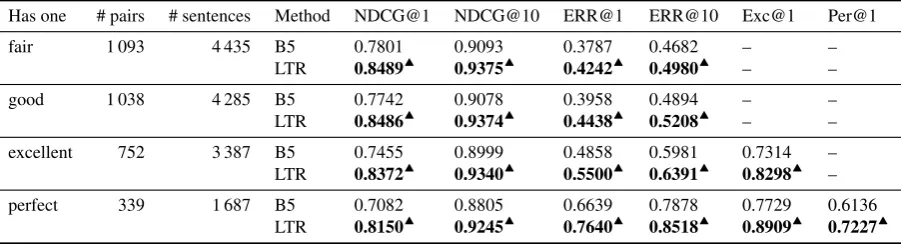
Next, we provide the results of our method us-ing the features described in Section 4.2, explorus-ing whether our learning to rank (LTR) approach im-proves over sentence retrieval models (RQ2). We compare an LTR model using Table 1’s features against the best baseline (B5). Table 3 shows the results. Each group in the table contains the results for the entity pairs that have at least one candidate sentence of that relevance grade for B5 and LTR.
We find that LTR significantly outperforms B5 by a large margin. The absolute performance dif-ference between LTR and B5 becomes larger for all metrics as we move from “fair” to “perfect,” which shows that LTR is more robust than the baseline for entity pairs that have at least one high quality candidate sentence. LTR ranks the best possible sentence at the top of the ranking for
∼83% of the cases for entity pairs that contain an “excellent” sentence and for∼72% of the cases for entity pairs that contain a “perfect” sentence.
Note that, as indicated in Section 5.1, we dis-card entity pairs that have only “bad” sentences in our experiments. For the sake of complete-ness, we report on the results for all entity pairs in our dataset—including those without any relevant sentences—in Table 4.
6.2 Relationship-dependent models
Has one # pairs # sentences Method NDCG@1 NDCG@10 ERR@1 ERR@10 Exc@1 Per@1
- 1 476 5 689 B5 0.5776 0.6733 0.2804 0.3467 – –
[image:8.595.70.526.154.303.2]LTR 0.6285▲ 0.6940▲ 0.3155▲ 0.3694▲ – –
Table 4: Results for the best baseline (B5) and the learning to rank method (LTR), using all entity pairs in the dataset, including those without any relevant sentences.
Relationship # pairs # sentences NDCG@1 NDCG@10 ERR@1 ERR@10
⟨MovieActor,CoCastsWith,MovieActor⟩ 410 1 403 0.8604 0.9436 0.3809 0.4546
⟨TvActor,CoCastsWith,TvActor⟩ 210 626 0.8729 0.9482 0.3271 0.3845
⟨MovieActor,IsDirectedBy,MovieDirector⟩
⟨MovieDirector,Directs,MovieActor⟩ 112 492 0.8795 0.9396 0.4709 0.5261
⟨Person,isChildOf,Person⟩
⟨Person,isParentOf,Person⟩ 108 716 0.8428 0.9081 0.6395 0.7136
⟨Person,isPartnerOf,Person⟩
⟨Person,isSpouseOf,Person⟩ 155 877 0.8623 0.9441 0.6153 0.6939
⟨Athlete,PlaysSameSportTeamAs,Athlete⟩ 98 321 0.8787 0.9535 0.3350 0.3996 Average results over all data 1 093 4 435 0.8661 0.9395 0.4615 0.5287
LTR (Table 3; fair) 0.8489 0.9375 0.4242 0.4980
Table 5: Results for relationship-dependent models. Similar relationships are grouped together.
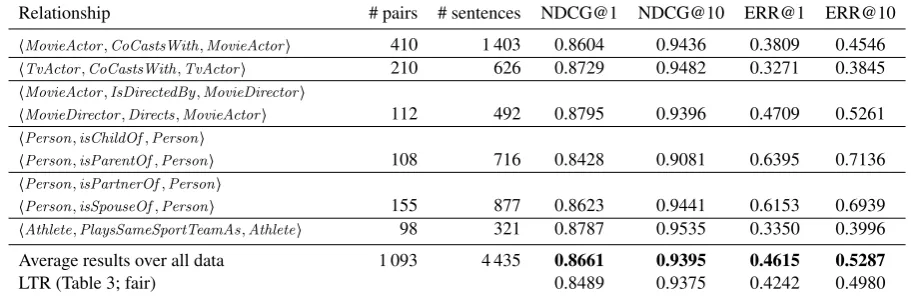
idea was investigated in the context of QA for as-sociating question and answer types (Yao et al., 2013). To answer (RQ3) we examine whether learning a relationship-dependent model improves over learning a single model for all types. We split our dataset per relationship type and train a model per type using 5-fold cross-validation within each. Table 5 shows the results.8 Our method is
ro-bust across different relationships in terms of NDCG. However, we observe some variation in ERR as this metric is more sensitive to the bution of relevant items than NDCG—the distri-bution over relevance grades varies per relation-ship type. For example, it is much more likely to find candidate sentences that have a high relevance grade for⟨Person,isSpouseOf,Person⟩than for
⟨Athlete, PlaysSameSportTeamAs, Athlete⟩ in our dataset. We plan to address this issue by ex-ploring other corpora in the future.
The second-to-last row in Table 5 shows the av-eraged results over the different relationship types, which is a significant improvement over LTR at p < 0.01 for all metrics. This method ranks the best possible sentence at the top of the ranking for
∼85% of the cases for entity pairs that contain an “excellent” sentence (∼2% absolute improvement over LTR) and for ∼75% of the cases for entity pairs that contain a “perfect” sentence (∼3% abso-lute improvement over LTR).
8We omit Exc@1 and Per@1 due to space constraints.
6.3 Feature type analysis
Next, we analyze the impact of the feature types. Table 6 shows how performance varies when re-moving one feature type at a time from the full feature set. Relationship type features are the most important, although entity type features are impor-tant as well. This indicates that introducing fea-tures based on entities identified in the sentences and the relationship is beneficial for this task. Fur-thermore, the limited dependency on the source feature type indicates that our method might be able to generalize in other domains. Finally, text type features do contribute to retrieval effective-ness, although not significantly. Note that calcu-lating the sentence features is straightforward, as none of our features requires heavy linguistic anal-ysis.
Features NDCG@1 NDCG@10 ERR@1 ERR@10
All 0.8661 0.9395 0.4615 0.5287
All∖text 0.8620 0.9372 0.4606 0.5274 All∖source 0.8598 0.9372 0.4582 0.5261 All∖entity 0.8421▽ 0.9282▼ 0.4497 0.5202▽ All∖relation 0.8183▼ 0.9201▼ 0.4352▼ 0.5112▼
Table 6: Results using relationship-dependent models, removing individual feature types.
6.4 Error analysis
[image:8.595.310.524.588.662.2]ac-tors that costar in movies also being partners) but the selected sentence covers only one of the re-lationships.9 For example,Liza Minnelliis
the daughter of Judy Garland, but they have also costarred in a movie, which is the relationship of interest. The model ranks the sentence “Liza Minnelli is the daughter of singer and actress Judy Garland. . . ” at the top, while the most relevant sentence is: “Judy Garland performed at the Lon-don Palladium with her then 18-year-old daughter Liza Minnelli in November 1964.”
Sentences that contain the relationship in which we are interested, but for which this cannot be directly inferred, are another source of error. Consider, for example, the following sentence, which explains directorChristopher Nolan directed actor Christian Bale: “Jackman starred in the 2006 film The Prestige, directed by Christopher Nolan and costarring Christian Bale, Michael Caine, and Scarlett Johansson”. Even though the sentence contains the relationship of in-terest, it focuses on actorHugh Jackman. The sentence “In 2004, after completing filming for The Machinist, Bale won the coveted role of Bat-man and his alter ego Bruce Wayne in Christopher Nolan’s Batman Begins. . . ”, in contrast, refers to the two entities and the relationship of interest di-rectly, resulting in a higher relevance grade. Our method, however, ranks the first sentence on top, as it contains more phrases that refer to the rela-tionship.
7 Conclusions and Future Work
We have presented a method for explaining rela-tionships between knowledge graph entities with human-readable descriptions. We first extract and enrich sentences that refer to an entity pair and then rank the sentences according to how well they describe the relationship. For ranking, we use learning to rank with a diverse set of fea-tures. Evaluation on a manually annotated dataset of “people” entities shows that our method sig-nificantly outperforms state-of-the-art sentence re-trieval models for this task. Experimental results also show that using relationship-dependent mod-els is beneficial.
In future work we aim to evaluate how our method performs on entities and relationships of 9The annotators marked sentences that do not refer to the
relationship of interest as “bad” but indicated whether they describe another relationship or not. We plan to account for such cases in future work.
any type and popularity, including tail entities and miscellaneous relationships. We also want to in-vestigate moving beyond Wikipedia and extract candidate sentences from documents that are not related to the knowledge graph, such as web pages or news articles. Employing such documents also implies an investigation into more advanced co-reference resolution methods.
Our analysis showed that sentences may cover different relationships between entities or differ-ent aspects of a single relationship—we aim to ac-count for such cases in follow-up work. Further-more, sentences may contain unnecessary infor-mation for explaining the relation of interest be-tween two entities. Especially when we want to show the obtained results to end users, we may need to apply further processing of the sentences to improve their quality and readability. We would like to explore sentence compression techniques to address this. Finally, relationships between en-tities have an inherit temporal nature and we aim to explore ways to explain entity relationships and their changes over time.
Acknowledgments
This research was partially supported by the Eu-ropean Community’s Seventh Framework Pro-gramme (FP7/2007-2013) under grant agreement nr 312827 (VOX-Pol), the Netherlands Organi-sation for Scientific Research (NWO) under pro-ject nrs 727.011.005, 612.001.116, HOR-11-10, 640.006.013, 612.066.930, CI-14-25, SH-322-15, Amsterdam Data Science, the Dutch national pro-gram COMMIT, the ESF Research Network Pro-gram ELIAS, the Elite Network Shifts project funded by the Royal Dutch Academy of Sciences (KNAW), the Netherlands eScience Center under project nr 027.012.105, the Yahoo! Faculty Re-search and Engagement Program, the Microsoft Research PhD program, and the HPC Fund.
References
development in informaion retrieval, pages 314– 321. ACM.
Ricardo Baeza-Yates, Berthier Ribeiro-Neto, et al. 1999. Modern information retrieval, volume 463. ACM press New York.
Roi Blanco and Hugo Zaragoza. 2010. Finding sup-port sentences for entities. In Proceedings of the 33rd international ACM SIGIR conference on Re-search and development in information retrieval, pages 339–346. ACM.
Roi Blanco, Berkant Barla Cambazoglu, Peter Mika, and Nicolas Torzec. 2013. Entity recommendations in web search. InThe Semantic Web–ISWC 2013, pages 33–48. Springer.
Leo Breiman. 2001. Random forests. Mach. Learn., 45(1):5–32.
Christopher J.C. Burges, Krysta Marie Svore, Paul N. Bennett, Andrzej Pastusiak, and Qiang Wu. 2011. Learning to rank using an ensemble of lambda-gradient models. InYahoo! Learning to Rank Chal-lenge, pages 25–35.
Olivier Chapelle, Donald Metzler, Ya Zhang, and Pierre Grinspan. 2009. Expected reciprocal rank for graded relevance. InProceedings of the 18th ACM conference on Information and knowledge manage-ment, pages 621–630. ACM.
Mark Craven, Dan DiPasquo, Dayne Freitag, Andrew McCallum, Tom Mitchell, Kamal Nigam, and Se´an Slattery. 2000. Learning to construct knowledge bases from the world wide web. Artificial Intelli-gence, 118(1–2):69–113.
Alen Doko, Maja ˇStula, and Darko Stipaniˇcev. 2013. A recursive TF-ISF based sentence retrieval method with local context. International Journal of Ma-chine Learning and Computing, 3(2):195–200. Xin Dong, Evgeniy Gabrilovich, Geremy Heitz, Wilko
Horn, Ni Lao, Kevin Murphy, Thomas Strohmann, Shaohua Sun, and Wei Zhang. 2014. Knowl-edge vault: A web-scale approach to probabilistic knowledge fusion. InProceedings of the 20th ACM SIGKDD International Conference on Knowledge Discovery and Data Mining, KDD ’14, pages 601– 610. ACM.
James Fan, Raphael Hoffman, Aditya Kalyanpur, Se-bastian Riedel, Fabian Suchanek, and Pratim Partha Talukdar, 2012. Proceedings of the Joint Workshop on Automatic Knowledge Base Construction and Web-scale Knowledge Extraction (AKBC-WEKEX), chapter Proceedings of the Joint Workshop on Auto-matic Knowledge Base Construction and Web-scale Knowledge Extraction (AKBC-WEKEX). Associa-tion for ComputaAssocia-tional Linguistics.
Lujun Fang, Anish Das Sarma, Cong Yu, and Philip Bohannon. 2011. Rex: explaining relationships be-tween entity pairs. Proceedings of the VLDB En-dowment, 5(3):241–252.
Ronald T Fern´andez, David E. Losada, and Leif Az-zopardi. 2011. Extending the language model-ing framework for sentence retrieval to include local context.Information Retrieval, 14(4):355–389. Lynette Hirschman and Robert Gaizauskas. 2001.
Nat-ural language question answering: the view from here. Natural Language Engineering, 7(04):275– 300.
Kalervo J¨arvelin and Jaana Kek¨al¨ainen. 2002. Cu-mulated gain-based evaluation of IR techniques.
ACM Transactions on Information Systems (TOIS), 20(4):422–446.
Gary Geunbae Lee, Jungyun Seo, Seungwoo Lee, Han-min Jung, Bong-Hyun Cho, Changki Lee, Byung-Kwan Kwak, Jeongwon Cha, Dongseok Kim, JooHui An, et al. 2001. SiteQ: Engineering high performance QA system using lexico-semantic pat-tern matching and shallow NLP. InTREC.
Heeyoung Lee, Yves Peirsman, Angel Chang, Nathanael Chambers, Mihai Surdeanu, and Dan Ju-rafsky. 2011. Stanford’s multi-pass sieve corefer-ence resolution system at the CoNLL-2011 shared task. InProceedings of the Fifteenth Conference on Computational Natural Language Learning: Shared Task, pages 28–34. Association for Computational Linguistics.
David E. Losada. 2008. A study of statistical query expansion strategies for sentence retrieval. In Pro-ceedings of the SIGIR 2008 Workshop on Focused Retrieval, pages 37–44.
Edgar Meij, Wouter Weerkamp, and Maarten de Rijke. 2012. Adding semantics to microblog posts. In
Proceedings of the fifth ACM international confer-ence on Web search and data mining, pages 563– 572. ACM.
Tomas Mikolov, Ilya Sutskever, Kai Chen, Greg S. Cor-rado, and Jeff Dean. 2013. Distributed representa-tions of words and phrases and their compositional-ity. InAdvances in Neural Information Processing Systems, pages 3111–3119.
David Milne and Ian H. Witten. 2008. Learning to link with Wikipedia. In Proceedings of the 17th ACM conference on Information and knowledge manage-ment, pages 509–518. ACM.
Mike Mintz, Steven Bills, Rion Snow, and Dan Ju-rafsky. 2009. Distant supervision for relation ex-traction without labeled data. InProceedings of the Joint Conference of the 47th Annual Meeting of the ACL and the 4th International Joint Conference on Natural Language Processing of the AFNLP: Vol-ume 2-VolVol-ume 2, pages 1003–1011. Association for Computational Linguistics.
and Empirical Methods in Natural Language Pro-cessing, pages 684–691. Association for Computa-tional Linguistics.
Vanessa Graham Murdock. 2006. Aspects of Sentence Retrieval. Ph.D. thesis, University of Massachusetts Amherst.
Mihai Surdeanu, Massimiliano Ciaramita, and Hugo Zaragoza. 2011. Learning to rank answers to non-factoid questions from web collections. Computa-tional Linguistics, 37(2):351–383.
Manos Tsagkias, Maarten de Rijke, and Wouter Weerkamp. 2011. Linking online news and social media. InWSDM 2011: Fourth ACM International Conference on Web Search and Data Mining. ACM, February.
Jason Weston, Antoine Bordes, Oksana Yakhnenko, and Nicolas Usunier. 2013. Connecting language and knowledge bases with embedding models for re-lation extraction. In Proceedings of the 2013 Con-ference on Empirical Methods in Natural Language Processing, EMNLP 2013.
Ian Witten and David Milne. 2008. An effective, low-cost measure of semantic relatedness obtained from wikipedia links. In Proceeding of AAAI Workshop on Wikipedia and Artificial Intelligence: an Evolv-ing Synergy, AAAI Press, Chicago, USA, pages 25– 30.
Fei Wu and Daniel S Weld. 2010. Open information extraction using wikipedia. In Proceedings of the 48th Annual Meeting of the Association for Compu-tational Linguistics, pages 118–127. Association for Computational Linguistics.