521
PhraseCTM: Correlated Topic Modeling on Phrases within Markov
Random Fields
Weijing Huang1, Tengjiao Wang1, Wei Chen1, Siyuan Jiang2, Kam-Fai Wong1,3
1 Key Lab of High Confidence Software Technologies (MOE),
School of EECS, Peking University, Beijing, China
2Department of Computer Science and Engineering, University of Notre Dame, USA 3Department of Systems Engineering and Engineering Management,
The Chinese University of Hong Kong, Hong Kong
{huangweijing,tjwang,pekingchenwei}@pku.edu.cn, [email protected], [email protected]
Abstract
Recent emerged phrase-level topic mod-els are able to provide topics of phrases, which are easy to read for humans. But these models are lack of the ability to cap-ture the correlation struccap-ture among the discovered numerous topics. We propose a novel topic model PhraseCTM and a two-stage method to find out the correlated top-ics at phrase level. In the first stage, we train PhraseCTM, which models the gen-eration of words and phrases simultane-ously by linking the phrases and compo-nent words within Markov Random Fields when they are semantically coherent. In the second stage, we generate the correla-tion of topics from PhraseCTM. We eval-uate our method by a quantitative exper-iment and a human study, showing the correlated topic modeling on phrases is a good and practical way to interpret the un-derlying themes of a corpus.
1 Introduction
In recent years, topic modeling on phrases has been developed for providing more interpretable topics (El-Kishky et al., 2014; Kawamae, 2014;
He, 2016). They represent each topic as a list of phrases, which are easy to read for humans. For example, the topic represented in “grounding con-ductor,grounding wire,aluminum wiring,neutral ground, ...” is easier to read than the topic with words “ground,wire,use,power,cable,wires, ...”, although they are both about the topic of house-hold electricity.
But when the number of topics grows, it’s hard to review all the topics, even they are represented in phrases. The correlation structure is introduced by CTM (Blei and Lafferty,2005) to figure out the
correlated relationship between topics and group the similar topics together. And the correlated top-ics mined from the scientific papers (Blei and Laf-ferty, 2007), news corpus (He et al., 2017), and social science data (Roberts et al.,2016), showed their practical utility on grasping the semantic meaning of text documents.
However, it’s nontrivial to apply CTM directly on phrases. The reasons are mainly due to two facts: (1) phrases are much less than words in each document; (2) similar to LDA (Tang et al.,
2014), CTM doesn’t perform well on short doc-uments. Therefore, CTM needs more contextual information to build a good enough model, rather than only using the extracted phrases.
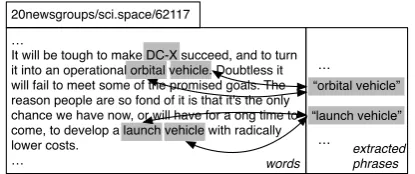
To find out the correlated topics at phrase level, we take full advantage of contextual information about the phrases. Firstly, the topic of a phrase in a document is highly related to the topics of other words and phrases in the same document. Secondly, some phrases’ meaning can be implied from their component words. Taking a document in Figure1as an example, the phrase “orbital ve-hicle” shares the same topic as the word “ DC-X” (a reusable spaceship), as well as its compo-nent words “orbital”, and “vehicle”, which are all about the topic ofspace exploration. The assump-tion that the words within the same phrase tend to have the same latent topic is directly used by PhraseLDA (El-Kishky et al., 2014). Note that not all the phrases always have the same topic as their component words (e.g., the newspaper
20newsgroups/sci.space/62117
extracted phrases words
…
…
…
It will be tough to make DC-X succeed, and to turn it into an operational orbital vehicle. Doubtless it will fail to meet some of the promised goals. The reason people are so fond of it is that it's the only chance we have now, or will have for a ong time to come, to develop a launch vehicle with radically lower costs.
…
“orbital vehicle”
[image:2.595.75.283.68.155.2]“launch vehicle”
Figure 1: An example of phrases’ contextual infor-mation. The phrases and words marked gray are about the same topic. The arrows show the top-ics of the phrases and their component words tend to be same, which tendency are modeled within Markov Random Field.
Based on these two kinds of contextual informa-tion, we propose a novel topic model PhraseCTM and a two-stage method. In the first stage, we train PhraseCTM, which (1) double counts the phrases as two parts, one as the phrase itself, the other as the component words; (2) models the generation of words and phrases simultaneously by linking the phrases and component words within Markov Random Fields when they are semantically coher-ent; (3) uses the logistic normal distribution to rep-resent the correlation among the topics, like a pre-vious method CTM. In the second stage, we gen-erate the correlation of topics from PhraseCTM.
We evaluate our method on five datasets by a quantitative experiment and a human study, show-ing that the correlated topic modelshow-ing on phrases is a good way to interpret the underlying themes of a corpus.
2 Related Works
There are two orthogonal lines of research stud-ies related to our work. (1) With the development of phrase extraction techniques (El-Kishky et al.,
2014;Liu et al.,2015;Shang et al.,2018), several topic models based on extracted phrases are pro-posed to provide high-quality phrase-level topics, such as PhraseLDA (El-Kishky et al.,2014), and TPM (He, 2016). Because of the quality of ex-tracted phrases, PhraseLDA performs better than previous n-gram method TNG (Wang et al.,2007), which combines phrase extraction and topic mod-eling together. (2) CTM (Blei and Lafferty,2005) uses the logistic normal distribution (Aitchison,
1982) to replace the Dirichlet prior, so it can cap-ture the correlated struccap-ture of topics. And the ex-periments in the further works (Chen et al.,2013;
Roberts et al., 2016; He et al., 2017) showed its usefulness in exploring the text corpus by using
the correlated word-level topics. Note that our work is not a simple combination of these two methods, because the existing topic models on phrases lack the ability to capture the correlation structure while CTM cannot be directly applied on phrases due to the sparseness of phrases in each document. And as we used Markov Random Fields (Kindermann and Snell, 1980), our work is different from previous ones (Daume III,2009;
Sun et al.,2009;Xie et al.,2015) because we don’t put all links into Markov Random Fields but only choose the semantic coherent links.
3 The proposed method
By preparing data as described in the subsection
3.1, our method is carried out in two stages, shown in the subsection3.2, and3.3respectively.
3.1 Semantically Coherent Links for MRF
Given the input data in the form of raw text doc-uments, we transform each document into the format as “words, phrases, semantically coherent links between phrases and component words”. Ex-tracting words is trivial, and exEx-tracting phrases can be conducted by using an existing tool, e.g., AutoPhrase (Shang et al.,2018). In this process, each extracted phrase is counted twice, one as the phrase itself (represented in the phrase vocabu-lary), the other is divided into component words (represented in the word vocabulary).
In a given document, we denote thei-th phrase as wi(P), and its component words as wl(i). We
use the Equation (1) to determine the semantic coherent score betweenwi(P) andwl(i) by
utiliz-ing NPMI (Bouma, 2009) . The NPMI metric is defined upon two word types as NPMI(x, y) = logpp(x(x,y)p(y))/(−logp(x, y)), where p(x) is
esti-mated by the document frequency |d(Dx)|, and
p(x, y) = |d(x)D∩d(y)|.
s(w(iP),wl(i)) = min
j,k∈l(i){NPMI(wj, wk)} (1)
1 suggests that the phrase and its component words should be aligned to the same topic in whole cor-pus. By a reasonable thresholdτ, we can add the semantically coherent link for wi(P) and wl(i), if
s(w(iP),wl(i))> τ. In practice, we setτ to 0.4.
Assuming the topic of the phrase w(iP) is zi(P)
and the topics of words wl(i) are zl(i), when they have the above mentioned semantically co-herent link, we put zi(P) and zl(i) in a Markov Random Field. More specifically, for z(iP) and
zj, j ∈ l(i), there’s the edge potential function
exp{κ·I(z(iP)=zj)/|l(i)|}, whereκis the weight
to adjust how much the link is introduced to con-straint the topics to be same. In the following ex-periment,κis set to be10−3.
3.2 PhraseCTM
In the first stage, when given the prepared data as described in subsection 3.1, we are going to train better correlated phrase-level topics β(P). The contextual information of phrases include (i) words in the same document, and (ii) their com-ponent words within semantically coherent links. Part (ii) has been modeled in the previous subsec-tion. For part (i), we let the phrases and words in a same document d share the topic parameter
ηd, which is aK-dimension vector sampled from
a Gaussian distribution N(µ,Σ). Like CTM, Σ is the covariance matrix, modeling the correlation between topics.
As a part of MRF, the unary potential on the topic node zd,i(P) or zd,j is defined by a
logistic-normal distribution like CTM p(zd,j = k|ηd) =
expηd,k/∑kexpηd,k. Therefore, the joint
distri-bution of topics over the phrases and the words in documentdare defined as the following equa-tion, whereAd(ηd)is used for normalization, and NLd is the number of semantically coherent links
in documentd.
p(zd, z( P) d |ηd) =
1
Ad(ηd) Nd ∏
m=1
p(zd,m|ηd)
· N∏d(P)
i=1
p(z(d,iP)|ηd)·exp{ NLd
∑
i=1
( κ
|l(d, i)| ∑
j∈l(d,i)
I(z(d,iP)=zd,j))}
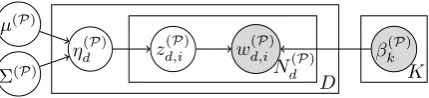
The whole generation process is illustrated in Figure2(a). We train PhraseCTM by variational inference like CTM. The different part lies in the phrases and component words which are in seman-tically coherent links. For these phrases, we use
Eq. (2) to update the variational parametersφ(d,iP)
for the latent topic zd,i(P) of the phrasewd,i(P). For the phrases that are not in semantically coherent links, we use the Eq. (3), which is same as the original CTM’s variational inference. In Eqs. (2) and (3),λdis the variational parameter forηdsuch
thatηd,k∼ N(λd,k, νd,k2 ).
ˆ
φ(d,i,kP) ∝β (P)
k,wiexp(λd,k+ κ
|l(d, i)| ∑
j∈l(d,i)
φd,j,k) (2)
ˆ
φ(d,i,kP) ∝β (P)
k,wiexp(λd,k) (3)
Similarly, the variational parameters for the component words in semantically coherent links are updated by Eq. (4), while other words are up-dated by Eq. (5). In this way, PhraseCTM intro-duces the impact from words and phrases on each other by Markov Random Fields.
ˆ
φd,i,k∝βk,wiexp(λd,k+ κ
|l(d, j)|φ
(P)
d,j,k), i∈l(d, j) (4)
ˆ
φd,i,k ∝βk,wiexp(λd,k) (5)
µ
Σ
ηd
zd,j wd,j βk
z(d,iP) w(d,iP) βk(P)
D Nd
Nd(P) K
(a) The first stage: training on our proposed model Phra-seCTM. When observed wordsWand phrasesW(P), we learn
word topicsβ, and phrase topicsβ(P)
.
µ(P)
Σ(P)
η(dP) z(d,iP) w(d,iP) βk(P)
D
Nd(P) K
(b) The second stage: inferring the phrase topics’ correlation. When given the phrasesW(P), and the phrase topics β(P)
learned from the first stage, we infer the phrase-level topics’ covarianceΣ(P)as the correlation result.
Figure 2: Illustration of two stages of our method
3.3 Generation of Phrase Topics’ Correlation
In the second stage, we aim to get the correla-tion forβ(P). It cannot be directly derived from Σ, which has also been learned in the first stage, becauseΣ consists the impact from word topics. Thus, givenW(P)andβ(P), we use the variational inference again to learnΣ(P)as the illustration of
Figure2(b). Finally, the correlation matrix can be
computed bycorr(P)(i, j) = Σ( P) i,j √
[image:3.595.312.527.500.549.2]|V| |V(P)| |W| |W(P)| |D| |W|/|D| |W(P)|/|D|
20 Newsgroup 22,787 4,245 1,361,843 51,024 18,828 72.3 2.7
Argentina@Wiki 20,847 5,505 1,052,674 98,502 8,617 122.2 11.4
[image:4.595.91.507.61.139.2]Mathematics@Wiki 43,779 27,371 6,062,815 594,704 27,947 216.9 21.3 Chemistry@Wiki 76,265 67,979 11,346,781 1,546,088 60,375 187.9 25.6 PubMed Abstracts 34,125 24,233 11,274,350 968,928 99,214 113.6 9.8
Table 1: The statistics of the datasets. In average, phrases appear more sparse than words. Phrases are extracted by AutoPhrase (Shang et al.,2018).
4 Experiments
PhraseCTM is supposed to get benefits from two aspects: (1) generating high-quality phrase-level topics; (2) providing the correlation among phrase topics to help users to understand the underlying themes of a corpus. To check the first claim, we compare PhraseCTM with existing topic models on phrases. To evaluate the second claim, we design a user study to compare PhraseCTM with standard CTM that runs only on words.
Datasets. We choose several public text cor-pora, including20Newsgroups(Lang,1995), sub-sets ofEnglish Wikipedia, a subset ofPubMed Ab-stracts (Varmus et al., 1999). Due to efficiency problem, we do not test on the whole Wikipedia corpus. We construct the Mathematics, Chem-istry, andArgentinasubsets of English Wikipedia as (Huang et al.,2017). For each corpus, we ex-tract the phrases by the implementation1 of Au-toPhrase (Shang et al., 2018), and build the se-mantically coherent links as subsection3.1. More specifically, in phrase extraction process, we set the minimum support as 5, and leave other pa-rameters in AutoPhrase as its suggestion. In aver-age, each document of the resulted20Newsgroups
only contains 2.7 phrases while 72.3 words, show-ing that phrases are much less than words. More statistics about the datasets are shown in Table1.
4.1 Quantitative Result
Baselines. We compare with PhraseLDA ( El-Kishky et al.,2014), the state-of-the-art model on phrases. Besides that, we run plain LDA and plain CTM2 directly on the extracted phrases (without
considering the impact of words). To check the effectiveness of MRF, we run a variant version PhraseCTM(-) by removing all the semantically coherent links from PhraseCTM. We also run a n-gram based topic model TNG (Wang et al.,2007),
1https://github.com/shangjingbo1226/
AutoPhrase
2https://github.com/blei-lab/ctm-c
which has already been implemented in Mallet3. All the topic numbers are set to be 100. For plain LDA and PhraseLDA, we setβ= 0.005. For plain CTM and TNG, we use the default settings in their existing implementations. Since TNG combines phrase extraction and topic modeling together, we run it on the raw datasets.
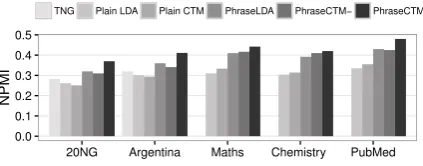
We use the NPMI metric (Bouma,2009) to eval-uate the semantic coherence of top-10 phrases in each topic (K=100), by taking the entire English Wikipedia as the reference corpus. Roder (2015) has shown that the NPMI metric is highly corre-lated to human topic coherence ratings, so it’s nat-ural to use it to show how PhraseCTM improves the quality of topics. Although we have already used NPMI in the semantic coherent score for finding semantically coherent links, it does not in-fluence the rationality of the metric used for topic evaluation, because the semantic coherent score is defined upon two word types while the NPMI score on topics is defined upon two phrase types.
0.0 0.1 0.2 0.3 0.4 0.5
20NG Argentina Maths Chemistry PubMed
NPMI
TNG Plain LDA Plain CTM PhraseLDA PhraseCTM− PhraseCTM
Figure 3: The quality of the learned topics.
The result is shown in Figure 3. Due to the computational costs, TNG cannot scale up to large datasets. Plain LDA and plain CTM performs not well on the datasets because of the sparsity of phrases in each document, while TNG per-forms better than them as it can utilize more words as its contextual information. PhraseCTM(-) is comparable to PhraseLDA in the experiment. PhraseLDA also utilizes all the contextual infor-mation with the assumption that the words in a phrase have the same topic. But this assumption
[image:4.595.313.525.490.573.2]politics sports film&television railway economics hub topic latin american countries
natural resources agriculture latin america recent years argentine government world war twentieth century latin america latin american south american puerto rico mexico city boca juniors world cup fifa world cup
river plate copa libertadores argentine football football club torneo argentino football team argentine football
asso-ciation summer olympics
south american world championship pan american games
olympic games communist party socialist party political party working class peronist youth military coup national reorganization -process armed forces military dictatorship military junta human rights dirty war military dictatorship crimes against hum-
anity political prisoners justicialist party vice president lower house arturo frondizi centrist radical civic
radical civic union justicialist party socialist party running mate civic coalition argentine television radio station cris morena soap opera argentine telenovela latin america latin american takes place commercial success film festival argentine film film premiered argentine drama film
[image:5.595.76.531.63.270.2]international film -festival silver condor ferrocarriles argentinos national government trenes argentinos argentine state passenger services railway line railway station trenes argentinos argentine state passenger services central bank economic crisis free trade foreign investment argentine peso yerba mate metric tons agricultural products food processing argentine beef natural gas water supply water resources drinking water public works paraguay river rand mcnally uruguay river hydroelectric power power station 10 35 45 30 20 15 31 64 51 26 17 81 75 94 0 71 9 1 28
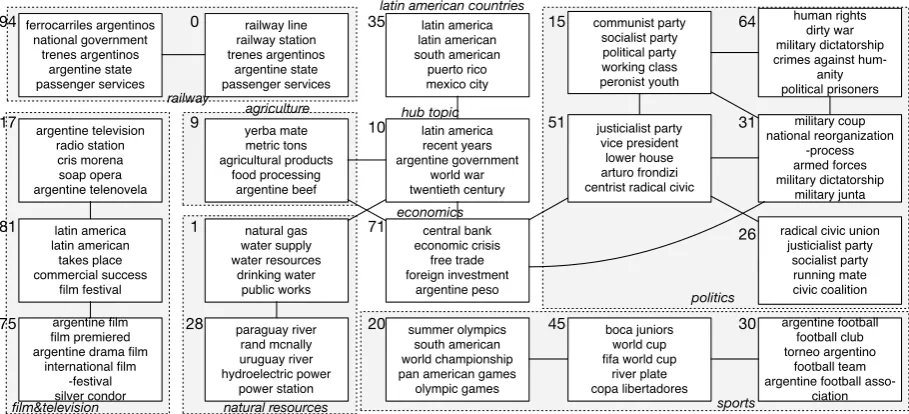
Figure 4: A part of the topic graph (K=100) generated by our method on the Argentina-related Wikipedia pages, where each node shows the top-5 phrases in each topic, and edges connect correlated topics. The left-aligned numbers in the graph represent the topic ID.
is too strong, which can be adjusted by our intro-duced semantically coherent links in MRF. This experiment demonstrates that our method has gen-erated high-quality phrase-level topics.
4.2 Human Study
To compare the correlated topics at different level, we directly run CTM on words. Trained on
Argentina@Wiki and Maths@Wiki by CTM and PhraseCTM respectively, we outputted the topics with top-10 words/phrases in each topic and the correlation of topics for 10 human annotators, and asked them to label the topics. The duration of consuming time for topic labeling is a quite use-ful metric to check whether the topics are easy to understand for human annotators. It’s based on our following observation in the human study: the confused topic may consume more time to give it an appropriate label, while the good one is easy to understand for human and consumes less time.
There are 2 groups of annotators. The annotators in Group A got the CTM re-sult on Maths@Wiki and PhraseCTM’s on Ar-gentina@Wiki. The annotators in Group B got the results in the opposite setting. The labeling pro-cess was logged to calculate the accumulated time. The labeling time to reach 50 accurate topics’ la-bels on PhraseCTM is much less than the labeling time on CTM. In average, the annotators spent 7.1 minutes on PhraseCTM while 13.2 minutes on the others, which is listed in Table2. In Figure 3, it’s easy to label the topics in top right corner as
poli-CTM PhraseCTM
Maths Argentina Maths Argentina
Group A 12.4 - - 7.5
Group B - 14.0 6.7
-In Average 13.2 7.1
Table 2: Human time consumption on topic label-ing for correlated topics generated by CTM and PhraseCTM, measured in minutes.
tics. And the edges in the figure illustrate the cor-relation between topics. As an example, the edge between the topic 71 and the topic 31 represents that the economics and the politics in Argentina is related, helping users to understand the corpus.
5 Conclusion
We provide a new topic model PhraseCTM to make the Correlated Topic Modeling available for phrase-level topics. PhraseCTM utilizes more contextual information of phrases, and put them within Markov Random Fields, so it can provide high-quality correlated topics at phrase level. The experiments show that the correlated topic model-ing on phrases is a practical tool to interpret the underlying themes of a corpus. In future, we will optimize the efficiency of PhraseCTM to scale it up to large datasets.
Acknowledgments
[image:5.595.313.524.326.382.2]References
John Aitchison. 1982. The statistical analysis of com-positional data. Journal of the Royal Statistical So-ciety. Series B (Methodological), 44(2):139–177.
David M. Blei and John D. Lafferty. 2005. Correlated topic models. InProceedings of the 18th Interna-tional Conference on Neural Information Processing Systems, NIPS’05, pages 147–154. MIT Press.
David M. Blei and John D. Lafferty. 2007. A corre-lated topic model of science. The Annals of Applied Statistics, 1(1):17–35.
Gerlof Bouma. 2009. Normalized (pointwise) mutual information in collocation extraction. In Proceed-ings of the German Society for Computational Lin-guistics & Language Technology, pages 31–40.
Jianfei Chen, Jun Zhu, Zi Wang, Xun Zheng, and Bo Zhang. 2013. Scalable inference for logistic-normal topic models. InAdvances in Neural Infor-mation Processing Systems 26, pages 2445–2453.
Hal Daume III. 2009. Markov random topic fields. In
Proceedings of the ACL-IJCNLP 2009 Conference Short Papers, pages 293–296. Association for Com-putational Linguistics.
Ahmed El-Kishky, Yanglei Song, Chi Wang, Clare R. Voss, and Jiawei Han. 2014. Scalable topical phrase mining from text corpora. InProceedings of the VLDB Endowment, volume 8, pages 305–316. VLDB Endowment.
Junxian He, Zhiting Hu, Taylor Berg-Kirkpatrick, Ying Huang, and Eric P. Xing. 2017. Efficient correlated topic modeling with topic embedding. In Proceed-ings of the 23rd ACM SIGKDD International Con-ference on Knowledge Discovery and Data Mining, KDD’17, pages 225–233. ACM.
Yulan He. 2016. Extracting topical phrases from clinical documents. In Proceedings of the Thir-tieth AAAI Conference on Artificial Intelligence, AAAI’16, pages 2957–2963. AAAI Press.
Weijing Huang, Tengjiao Wang, Wei Chen, and Yazhou Wang. 2017. Category-level transfer learning from knowledge base to microblog stream for accurate event detection. In International Conference on Database Systems for Advanced Applications, DAS-FAA’17, pages 50–67. Springer.
Noriaki Kawamae. 2014. Supervised n-gram topic model. In Proceedings of the 7th ACM Interna-tional Conference on Web Search and Data Mining, WSDM ’14, pages 473–482. ACM.
Ross Kindermann and J Laurie Snell. 1980. Markov random fields and their applications, volume 1. American Mathematical Society.
Ken Lang. 1995. Newsweeder: Learning to filter net-news. InProceedings of the 12th International Con-ference on Machine Learning, pages 331–339.
Jialu Liu, Jingbo Shang, Chi Wang, Xiang Ren, and Ji-awei Han. 2015. Mining quality phrases from mas-sive text corpora. InProceedings of the 2015 ACM SIGMOD International Conference on Management of Data, SIGMOD ’15, pages 1729–1744. ACM.
Tomas Mikolov, Ilya Sutskever, Kai Chen, Greg S Cor-rado, and Jeff Dean. 2013. Distributed representa-tions of words and phrases and their compositional-ity. InAdvances in Neural Information Processing Systems 26, pages 3111–3119.
Margaret E. Roberts, Brandon M. Stewart, and Edoardo M. Airoldi. 2016. A model of text for experimentation in the social sciences. Journal of the American Statistical Association, 111(515):988– 1003.
Michael R¨oder, Andreas Both, and Alexander Hinneb-urg. 2015. Exploring the space of topic coherence measures. InProceedings of the Eighth ACM Inter-national Conference on Web Search and Data Min-ing, WSDM ’15, pages 399–408. ACM.
Jingbo Shang, Jialu Liu, Meng Jiang, Xiang Ren, Clare R Voss, and Jiawei Han. 2018. Automated phrase mining from massive text corpora. IEEE Transactions on Knowledge and Data Engineering.
Yizhou Sun, Jiawei Han, Jing Gao, and Yintao Yu. 2009. itopicmodel: Information network-integrated topic modeling. InNinth IEEE International Con-ference on Data Mining, pages 493–502. IEEE.
Jian Tang, Zhaoshi Meng, Xuanlong Nguyen, Qiaozhu Mei, and Ming Zhang. 2014. Understanding the limiting factors of topic modeling via posterior con-traction analysis. InProceedings of the 31st Interna-tional Conference on Machine Learning, pages 190– 198.
Harold Varmus, David Lipman, and Patrick Brown. 1999. Pubmed central: an nih-operated site for elec-tronic distribution of life sciences research reports.
Xuerui Wang, Andrew McCallum, and Xing Wei. 2007. Topical n-grams: Phrase and topic discov-ery, with an application to information retrieval. In
Proceedings of the 2007 Seventh IEEE International Conference on Data Mining, ICDM ’07, pages 697– 702. IEEE.