Proceedings of the Workshop on Deep Learning Approaches for Low-Resource NLP, pages 19–24
19
Multi-task learning for historical text normalization: Size matters
Marcel Bollmann, Anders Søgaard, Joachim Bingel
Dept. of Computer Science University of Copenhagen
Denmark
{marcel,soegaard,bingel}@di.ku.dk
Abstract
Historical text normalization suffers from small datasets that exhibit high variance, and previous work has shown that multi-task learning can be used to leverage data from related problems in order to obtain more robust models. Previous work has been limited to datasets from a specific lan-guage and a specific historical period, and it is not clear whether results generalize. It therefore remains an open problem,when
historical text normalization benefits from multi-task learning. We explore the ben-efits of multi-task learning across 10 dif-ferent datasets, representing difdif-ferent lan-guages and periods. Our main finding— contrary to what has been observed for other NLP tasks—is that multi-task learn-ing mainly works when target task data is very scarce.
1 Introduction
Historical text normalization is the problem of translating historical documents written in the ab-sence of modern spelling conventions and making them amenable to search by today’s scholars, pro-cessable by natural language processing models, and readable to laypeople. In other words, his-torical text normalization is a text-to-text genera-tion, where the input is a text written centuries ago, and the output is a text that has the same contents, but uses the orthography of modern-day language. In this paper, we limit ourselves to word-by-word normalization, ignoring the syntactic differences between modern-day languages and their historic predecessors.
Resources for historical text normalization are scarce. Even for major languages like English and German, we have very little training data for
in-ducing normalization models, and the models we induce may be very specific to these datasets and not scale to writings from other historic periods— or even just writings from another monastery or by another author.
Bollmann and Søgaard (2016) and Bollmann et al. (2017) recently showed that we can obtain more robust historical text normalization models by exploiting synergies across historical text nor-malization datasets and with related tasks. Specif-ically, Bollmann et al.(2017) showed that multi-task learning with German grapheme-to-phoneme translation as an auxiliary task improves a state-of-the-art sequence-to-sequence model for his-torical text normalization of medieval German manuscripts.
Contributions We studywhenmulti-task
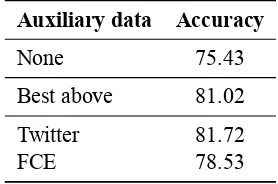
learn-ing leads to improvements in historical text nor-malization. Specifically, we evaluate a state-of-the-art approach to historical text normalization (Bollmann et al.,2017) with and without various auxiliary tasks, across 10 historical text normal-ization datasets. We also include an experiment in English historical text normalization using data from Twitter and a grammatical error correction corpus (FCE) as auxiliary datasets. Across the board, we find that, unlike what has been observed for other NLP tasks,multi-task learning only helps when target task data is scarce.
2 Datasets
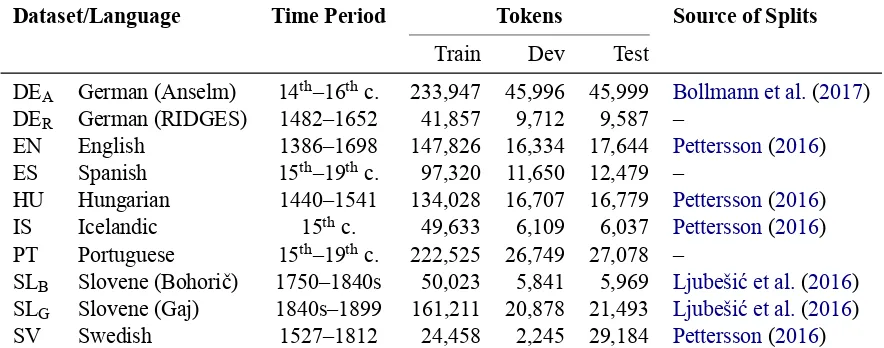
We consider 10 datasets from 8 different lan-guages: German, using the Anselm dataset (taken from Bollmann et al., 2017) and texts from the RIDGES corpus (Odebrecht et al., 2016)1; En-glish, Hungarian, Icelandic, and Swedish (from
Pettersson, 2016); two versions of Slovene using different alphabets (Bohorič or Gaj; fromLjubešić
Dataset/Language Time Period Tokens Source of Splits
Train Dev Test
DEA German (Anselm) 14th–16thc. 233,947 45,996 45,999 Bollmann et al.(2017)
DER German (RIDGES) 1482–1652 41,857 9,712 9,587 –
EN English 1386–1698 147,826 16,334 17,644 Pettersson(2016)
ES Spanish 15th–19thc. 97,320 11,650 12,479 –
HU Hungarian 1440–1541 134,028 16,707 16,779 Pettersson(2016)
IS Icelandic 15thc. 49,633 6,109 6,037 Pettersson(2016)
PT Portuguese 15th–19thc. 222,525 26,749 27,078 –
SLB Slovene (Bohorič) 1750–1840s 50,023 5,841 5,969 Ljubešić et al.(2016) SLG Slovene (Gaj) 1840s–1899 161,211 20,878 21,493 Ljubešić et al.(2016)
[image:2.595.78.520.65.239.2]SV Swedish 1527–1812 24,458 2,245 29,184 Pettersson(2016)
Table 1: Historical datasets used in our experiments
et al., 2016); as well as Spanish and Portuguese texts from the Post Scriptum corpus (Vaamonde,
2017)2.
For the Anselm dataset, we concatenate the individual training, development, and test sets from Bollmann et al. (2017) to obtain a single dataset. For RIDGES, we use 16 texts and ran-domly sample 70% of all sentences from each text for the training set, and 15% for the dev/test sets. The Spanish and Portuguese datasets consist of manually normalized subsets of the Post Scrip-tum corpus; here, we randomly sample 80% (train) and 10% (dev/test) of all sentences per century represented in the corpus. Dataset splits for the other languages are taken fromPettersson (2016) andLjubešić et al.(2016).
We preprocessed all datasets to remove punctua-tion, perform Unicode normalizapunctua-tion, replace dig-its that do not require normalization with a dummy symbol, and lowercase all tokens.
Table 1 gives an overview of all historical datasets, the approximate time period of histori-cal texts that they cover, as well as the size of the dataset splits. Note that, to the best of our knowledge, the Spanish, Portuguese, and Ger-man RIDGES datasets have not been used in the context of automatic historical text normalization before.
Table2additionally gives some examples of his-torical word forms and their gold-standard normal-izations from each of these datasets.3
2
http://ps.clul.ul.pt
3Note that normalization guidelines differ between the
datasets, and normalizations do not always constitute a mod-ern word form—e.g. in the case of extinct lexemes—or the correct inflected form in the given context.
3 Experimental setup
Model We use the same encoder–decoder
archi-tecture with attention as described in Bollmann et al.(2017).4 This is a fairly standard model con-sisting of one bidirectional LSTM unit in the en-coder and one (unidirectional) LSTM unit in the decoder. The input for the encoder is a single his-torical word form represented as a sequence of characters and padded with word boundary sym-bols; i.e., we only input single tokens in isola-tion, not full sentences. The decoder attends over the encoder’s outputs and generates the normalized output characters.
Hyperparameters We use the same
hyperpa-rameters across all our experiments: The dimen-sionality of the embedding layer is 60, the size of the LSTM layers is set to 300, and we use a dropout rate of 0.2. We use the Adam optimizer (Kingma and Ba,2014) with a character-wise cross-entropy loss. Training is done on mini-batches of 50 sam-ples with early stopping based on validation on the individual development sets. The hyperparam-eters were set on a randomly selected subset of 50,000 tokens from each of the following datasets: English, German (Anselm), Hungarian, Icelandic, and Slovene (Gaj).
Multi-task learning Bollmann et al.(2017) also
describe a multi-task learning (MTL) scenario where the encoder–decoder model is trained on two datasets in parallel. We perform similar exper-iments on pairwise combinations of our datasets.
DEA deſe diese wort wort ſpricht spricht vnſer unser liber lieber here herr iheſus jesus criſtus christus czu zu eyme einem iczlychen ieteslichen menſchen menschen
DER ſeind
sind ſÿ sie doch doch alle alle auſz aus den den vier vier elementen elementen gemiſchet gemischt vnd und eins eins feüchter feuchter deñ denn das das ander andere EN whan when your your graciouse gracious erthely earthly persoune person from from your your inward inward spirit spirit ys is dessolued dissolved ES anque aunque tomeys toméis mui muy mucho mucho travajo trabajo tengola téngola guardada guardada pa para quando cuando dios dios sea sea servido servido HU o ő zauoc szavuk ėſmė ismét felèmèluē felemelvén kèzdėnc̣ kezdének ſirńoc sírniuk èlmēnèc elmenjek èzèkèt ezeket tolga toldja ez ez a a noemi noémi azeꝛt azért iouo jöve IS þá þá sem sem hanz hans gödverk góðverk voru voru i í og og þá þá vrdu urðu hanns hans gödverk góðverk miklu miklu þýngre þyngri enn en ill ill PT cõ com a a poenetencia penitência que que lhe lhe derão deram pera para avisar avisar aos aos snres senhores do do sancto santo oficio ofício
SLB ter
ter ne ne bodi bodi nevéren neveren zhe če ſe se zherna črna perſt prst premozhi premoči tezhe teče od od nje nje rjav rjav mòk mok
SLG in
in privéže priveže na na vsak vsak konec konec niti niti drobtino drobtino kruha kruha in in verže vrže vse vse kokóšem kokošim breskevno breskvino vkuhanje vkuhanje lovre lovre SV blef blev av av rätten rätten afsagdt avsagt det det en en syyn syn och och rådhgångh rådgång nu nu nästkommande nästkommande wårdagh vårdag hållas hållas
Table 2: Examples of input tokens (first line) and reference normalization (second line) for each of the historical datasets.
The question we ask here is whether training on pairs of datasets can improve over training on datasets individually, which pairings yield the best results, and what properties of the datasets are most predictive of this. In other words, we are interested inwhenmulti-task learning works.
In the multi-task learning setting, the two datasets—or “tasks”—share all parts of the encoder–decoder model except for the final prediction layer, which is specific to each dataset. This way, most parts of the model are forced to learn language-independent representations. This is different from Luong et al. (2015) and related work in machine translation, where typically only the encoder or the decoder is shared. We do not explore these alternatives here.
During training, we iterate over both our datasets in parallel in a random order, with each parameter update now being based on 50 samples from each dataset. Since datasets are of differ-ent sizes, we define an epoch to be a fixed size of 50,000 samples. Validation is performed for both datasets after each epoch, and model states are saved independently for each one if its vali-dation accuracy improved. This means that even if the ideal number of epochs is different for the
datasets, only the best state for each dataset will be used in the end. Training ends only after the validation accuracy foreach dataset has stopped improving.
Sparse data scenario The training sets in our
experiments range from ca. 25,000 to 230,000 to-kens. Generally, historical text normalization suf-fers from scarce resources, and our biggest datasets are considered huge compared to what scholars typically have access to. Creating gold-standard normalizations is cumbersome and expensive, and for many languages and historic periods, it is not feasible to obtain big datasets. Therefore, we also present experiments on reduced datasets; instead of taking the full training sets, we only use the first 5,000 tokens from each one.
Dataset Full Sparse
Single MTL Single MTL
DEA 88.00 87.78 65.99 71.93
DER 86.05 87.81 70.04 74.25
EN 93.95 93.46 75.43 81.02
ES 94.41 94.32 82.50 86.59
HU 89.43 88.56 49.21 54.86
IS 84.83 86.67 69.52 72.73
PT 93.45 93.36 78.61 81.97
SLB 90.12 91.81 82.39 86.35
SLG 94.79 94.53 89.54 91.03
[image:4.595.346.485.63.155.2]SV 88.48 89.90 79.24 82.14
Table 3: Normalization accuracy (in percent) us-ing the full or sparse trainus-ing sets, both for the single-task setup and the best-performing multi-task (MTL) setup.
4 Results
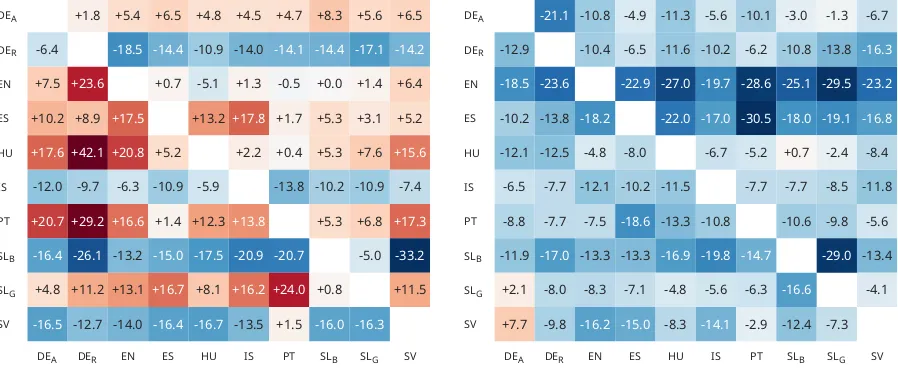
We evaluate our models using normalization ac-curacy, i.e., the percentage of correctly normal-ized word forms. Table3compares the accuracy scores of our single-task baseline models and for multi-task learning, in both the full and the sparse data scenario. For multi-task learning, we report the test set performance of the best target-auxiliary task pair combination, as evaluated on develop-ment data. Figure 1 visualizes the results for all pairwise combinations of the multi-task mod-els; here, we show the error reduction of multi-task learning over our single-multi-task baseline to better highlight by how much the MTL setup changes the performance.
Full datasets We make two observations about
the results for the full data scenario (the left side of Fig.1): (i) the usefulness of multi-task learning depends more on the dataset that is being evalu-ated than the one it is trained together with; and (ii) for most datasets, multi-task learning is detri-mentalrather than beneficial.
One hypothesis about multi-task learning is that its usefulness correlates with either synergistic or complementary properties of the datasets. In other words, it is conceivable that the performance on one dataset improves most with an MTL setup when it is paired with another dataset that is ei-ther (i) very similar, or (ii) provides an additional signal that is useful for, but not covered in, the first dataset. The results in Figure 1 show that
Auxiliary data Accuracy
None 75.43
Best above 81.02
Twitter 81.72
[image:4.595.83.283.64.242.2]FCE 78.53
Table 4: Normalization accuracy for English (sparse): Single and MTL from Table3; and with non-historical auxiliary datasets (Twitter & FCE).
there can indeed be considerable variation depend-ing on the exact dataset combination; e.g., the error reduction on Slovene (Bohorič) ranges from 5% (when paired with the Gaj dataset) to 33.2% (when paired with Swedish). At the same time, the ques-tion whether multi-task learning helps at all seems to depend mostly on the dataset being evaluated. With few exceptions, for most datasets, the error rate either always improves or always worsens, in-dependently of the auxiliary task.
Considering the dataset statistics in Table 1, it appears that the size of the training corpus is the most important factor for these results. The four corpora that consistently benefit from MTL— German (RIDGES), Icelandic, Slovene (Bohorič), and Swedish—also have the smallest training sets, with about 50,000 tokens or less. For other tasks, different patterns have been observed (Martínez Alonso and Plank,2017;Bingel and Sø-gaard,2017); see Sec.5.
Sparse datasets In the sparse data scenario
where only 5,000 tokens are used for training (right side of Fig.1), MTL almost always leads to im-provements over the single-task training setup. This further confirms the hypothesis that multi-task learning is beneficial for historical text nor-malization when the target task dataset is small.
English with non-historical auxiliary data We
D E A D E R E N E S H U I S P T S L B S L G S V D E A
D E R
E N
E S
H U
I S
P T
S L B
S L G
S V
+ 1 . 8 + 5 . 4 + 6 . 5 + 4 . 8 + 4 . 5 + 4 . 7 + 8 . 3 + 5 . 6 + 6 . 5
- 6 . 4 - 1 8 . 5 - 1 4 . 4 - 1 0 . 9 - 1 4 . 0 - 1 4 . 1 - 1 4 . 4 - 1 7 . 1 - 1 4 . 2
+ 7 . 5 + 2 3 . 6 + 0 . 7 - 5 . 1 + 1 . 3 - 0 . 5 + 0 . 0 + 1 . 4 + 6 . 4
+ 1 0 . 2 + 8 . 9 + 1 7 . 5 + 1 3 . 2 + 1 7 . 8 + 1 . 7 + 5 . 3 + 3 . 1 + 5 . 2
+ 1 7 . 6 + 4 2 . 1 + 2 0 . 8 + 5 . 2 + 2 . 2 + 0 . 4 + 5 . 3 + 7 . 6 + 1 5 . 6
- 1 2 . 0 - 9 . 7 - 6 . 3 - 1 0 . 9 - 5 . 9 - 1 3 . 8 - 1 0 . 2 - 1 0 . 9 - 7 . 4
+ 2 0 . 7 + 2 9 . 2 + 1 6 . 6 + 1 . 4 + 1 2 . 3 + 1 3 . 8 + 5 . 3 + 6 . 8 + 1 7 . 3
- 1 6 . 4 - 2 6 . 1 - 1 3 . 2 - 1 5 . 0 - 1 7 . 5 - 2 0 . 9 - 2 0 . 7 - 5 . 0 - 3 3 . 2
+ 4 . 8 + 1 1 . 2 + 1 3 . 1 + 1 6 . 7 + 8 . 1 + 1 6 . 2 + 2 4 . 0 + 0 . 8 + 1 1 . 5
- 1 6 . 5 - 1 2 . 7 - 1 4 . 0 - 1 6 . 4 - 1 6 . 7 - 1 3 . 5 + 1 . 5 - 1 6 . 0 - 1 6 . 3
D E A D E R E N E S H U I S P T S L B S L G S V D E A
D E R
E N
E S
H U
I S
P T
S L B
S L G
S V
- 2 1 . 1 - 1 0 . 8 - 4 . 9 - 1 1 . 3 - 5 . 6 - 1 0 . 1 - 3 . 0 - 1 . 3 - 6 . 7
- 1 2 . 9 - 1 0 . 4 - 6 . 5 - 1 1 . 6 - 1 0 . 2 - 6 . 2 - 1 0 . 8 - 1 3 . 8 - 1 6 . 3
- 1 8 . 5 - 2 3 . 6 - 2 2 . 9 - 2 7 . 0 - 1 9 . 7 - 2 8 . 6 - 2 5 . 1 - 2 9 . 5 - 2 3 . 2
- 1 0 . 2 - 1 3 . 8 - 1 8 . 2 - 2 2 . 0 - 1 7 . 0 - 3 0 . 5 - 1 8 . 0 - 1 9 . 1 - 1 6 . 8
- 1 2 . 1 - 1 2 . 5 - 4 . 8 - 8 . 0 - 6 . 7 - 5 . 2 + 0 . 7 - 2 . 4 - 8 . 4
- 6 . 5 - 7 . 7 - 1 2 . 1 - 1 0 . 2 - 1 1 . 5 - 7 . 7 - 7 . 7 - 8 . 5 - 1 1 . 8
- 8 . 8 - 7 . 7 - 7 . 5 - 1 8 . 6 - 1 3 . 3 - 1 0 . 8 - 1 0 . 6 - 9 . 8 - 5 . 6
- 1 1 . 9 - 1 7 . 0 - 1 3 . 3 - 1 3 . 3 - 1 6 . 9 - 1 9 . 8 - 1 4 . 7 - 2 9 . 0 - 1 3 . 4
+ 2 . 1 - 8 . 0 - 8 . 3 - 7 . 1 - 4 . 8 - 5 . 6 - 6 . 3 - 1 6 . 6 - 4 . 1
[image:5.595.75.524.71.256.2]+ 7 . 7 - 9 . 8 - 1 6 . 2 - 1 5 . 0 - 8 . 3 - 1 4 . 1 - 2 . 9 - 1 2 . 4 - 7 . 3
Figure 1: Percentage change of error of MTL over single-task models; rows are targets, columns auxiliary data. Left:full data;right: sparse data. Blue scores are improvements, reds increases in error.
5 Related work and conclusion
There has been considerable work on multi-task sequence-to-sequence models for other multi-tasks (Dong et al., 2015; Luong et al., 2015; Elliott and Kádár, 2017). There is a wide range of de-sign questions and sharing strategies that we ig-nore here, focusing instead on under what circum-stances the approach advocated in (Bollmann et al.,
2017) works.
Our main observation—that the size of the tar-get dataset is most predictive of multi-task learning gains—runs counter previous findings for other NLP tasks (Martínez Alonso and Plank,2017; Bin-gel and Søgaard, 2017). Martínez Alonso and Plank(2017) find that the label entropy of the aux-iliary dataset is more predictive; Bingel and Sø-gaard (2017) find that the relative differences in the steepness of the two single-task loss curves is more predictive. Both papers consider sequence tagging problems with a small number of labels; and it is probably not a surprise that their findings do not seem to scale to the case of historical text normalization.
Acknowledgments
This research was supported by ERC Starting Grant LOWLANDS No. 313695 as well as by Trygfonden. Parts of this research were carried out by the first author at the Ruhr-Universität Bochum, Germany, supported by Deutsche Forschungsge-meinschaft (DFG), Grant DI 1558/4.
References
Joachim Bingel and Anders Søgaard. 2017. Identify-ing beneficial task relations for multi-task learnIdentify-ing in deep neural networks. InProceedings of the 15th Conference of the European Chapter of the Associa-tion for ComputaAssocia-tional Linguistics: Volume 2, Short Papers, pages 164–169. Association for Computa-tional Linguistics.
Marcel Bollmann, Joachim Bingel, and Anders Sø-gaard. 2017. Learning attention for historical text normalization by learning to pronounce. In Pro-ceedings of the 55th Annual Meeting of the Associa-tion for ComputaAssocia-tional Linguistics (Volume 1: Long Papers), pages 332–344. Association for Computa-tional Linguistics.
Marcel Bollmann and Anders Søgaard. 2016. Im-proving historical spelling normalization with bi-directional LSTMs and multi-task learning. In Pro-ceedings of COLING 2016, the 26th International Conference on Computational Linguistics: Techni-cal Papers, pages 131–139. The COLING 2016 Or-ganizing Committee.
Daxiang Dong, Hua Wu, Wei He, Dianhai Yu, and Haifeng Wang. 2015. Multi-task learning for mul-tiple language translation. In Proceedings of the 53rd Annual Meeting of the Association for Compu-tational Linguistics and the 7th International Joint Conference on Natural Language Processing (Vol-ume 1: Long Papers), pages 1723–1732. Association for Computational Linguistics.
Bo Han and Timothy Baldwin. 2011. Lexical normal-isation of short text messages: Makn sens a #twit-ter. InProceedings of the 49th Annual Meeting of the Association for Computational Linguistics: Hu-man Language Technologies, pages 368–378. Asso-ciation for Computational Linguistics.
Diederik P. Kingma and Jimmy Ba. 2014. Adam: A method for stochastic optimization. CoRR, abs/1412.6980.
Nikola Ljubešić, Katja Zupan, Darja Fišer, and Tomaž Erjavec. 2016. Normalising Slovene data: historical texts vs. user-generated content. InProceedings of the 13th Conference on Natural Language Process-ing (KONVENS 2016), volume 16 ofBochumer Lin-guistische Arbeitsberichte, pages 146–155, Bochum, Germany.
Minh-Thang Luong, Quoc V. Le, Ilya Sutskever, Oriol Vinyals, and Lukasz Kaiser. 2015. Multi-task sequence to sequence learning. volume abs/1511.06114.
Héctor Martínez Alonso and Barbara Plank. 2017.
When is multitask learning effective? semantic se-quence prediction under varying data conditions. In
Proceedings of the 15th Conference of the European Chapter of the Association for Computational Lin-guistics: Volume 1, Long Papers, pages 44–53. As-sociation for Computational Linguistics.
Carolin Odebrecht, Malte Belz, Amir Zeldes, Anke Lüdeling, and Thomas Krause. 2016. RIDGES Her-bology: designing a diachronic multi-layer corpus.
Language Resources and Evaluation, pages 1–31.
Eva Pettersson. 2016.Spelling Normalisation and Lin-guistic Analysis of Historical Text for Information Extraction. Doctoral dissertation, Uppsala Univer-sity, Department of Linguistics and Philology, Upp-sala.
Gael Vaamonde. 2017. Userguide for digital edition of texts in P. S. Post Scriptum. Technical report. Trans-lated by Clara Pinto.