© Associated Asia Research Foundation (AARF)
A Monthly Double-Blind Peer Reviewed Refereed Open Access International e-Journal - Included in the International Serial Directories.
Page | 92
COMPARATIVE STUDY OF CONSUMPTION OF OMEGA-3 AND ITS
RELATION TO CHRONIC DISEASES IN VEGETARIANS AND
NON-VEGETARIANS
Dr. Rekha Battalwar
Associate Professor, Department of Food, Nutrition & Dietetics, Sir Vithaldas Thackersey College of Home Science (Autonomous), S.N.D.T Women’s University, Juhu Tara Road,
Mumbai, India 400049.
Sonali Desai
Student of Master’s of Science in Dietetics and Food Science Management, IGNOU, New Delhi.
ABSTRACT:
Background: Omega-3 PUFAs are plant-derived [α-linolenic acid] or marine-derived
[eicosapentaenoic acid and docosahexaenoic acid]. Omega-3 fatty acids prevent or reduce the
severity of multitude of diseases.
AIM: To perform a comparative study of consumption of omega-3 and its relation to chronic
diseases in vegetarians and non-vegetarians.
METHODOLOGY: Sample size taken for study was 100(50 males and 50 females) from age
group 30-50 years. Predesigned questionnaire was used. Anthropometric measurements were
taken. Three-day dietary recall was collected. IBM SPSS software 20.0 version was used for
analysis. Data was analyzed using t-test and chi-square association test. P <0.05 was
considered statistically significant.
RESULTS: Mean waist circumference in cm, weight in kg, hip circumference in cm, BMI, waist-to-hip ratio was more in non-vegetarian study participants (p<0.05). Mean energy intake,
International Research Journal of Natural and Applied Sciences
ISSN: (2349-4077) Impact Factor- 5.46, Volume 5, Issue 4, April 2018
Website- www.aarf.asia, Email : [email protected] , [email protected]
© Associated Asia Research Foundation (AARF)
A Monthly Double-Blind Peer Reviewed Refereed Open Access International e-Journal - Included in the International Serial Directories.
Page | 93
protein intake, consumption of EPA, DHA, and total omega-3 consumption was more in
non-vegetarian study participants (p<0.05). Analysis of chronic diseases in study population showed
36.0% vegetarian study population and 22.0% non-vegetarian study population having chronic
diseases. Vegetarians who had less consumption of omega-3 had higher incidence of chronic
diseases as compared to non-vegetarians who had higher consumption of omega-3 (p<0.05).
CONCLUSION: The study findings showed consumption of energy, protein, EPA, DHA, and total omega-3 was higher in non-vegetarian study participants. Vegetarians who had less consumption of omega-3 had higher incidence of chronic diseases as compared to
non-vegetarians who had higher consumption of omega-3 (p<0.05).
Keywords: Alpha-linolenic acid, polyunsaturated fatty acids, Eicosapentaenoic acid, Docosahexaenoic acid, Omega-3 fatty acids.
I. INTRODUCTION
Nutrients must be obtained through a judicious choice and combination of a variety of foodstuffs from different food groups (Saunders AV et al., 2013). The emerging agenda of chronic diseases and injuries should be a political priority and central to national consciousness, if universal health care is to be achieved (Patel V.et al., 2011). Omega-3 PUFA are synthesized by dietary shorter-chained omega-3 fatty acid alpha-linolenic acid (ALA) to form the more important long-chain omega-3 fatty acids: eicosapentaenoic acid (EPA) and docosahexaenoic (DHA) (Giuseppe Grosso et al., 2014). Fish and fish oils are the most concentrated sources of EPA and DHA, individuals who do not eat fish or fish oils (e.g., vegans and non-fish-eating vegetarians and meat-eaters) could be at risk of low or inadequate n-3 PUFA status(Ailsa A Welch, 2010). Omega-3 fatty acids exert anti-inflammatory properties through different mechanisms (Mohebi-Nejad, A. et al., 2014). Increased intake of very long-chain (n-3) fatty acids is associated with a
© Associated Asia Research Foundation (AARF)
A Monthly Double-Blind Peer Reviewed Refereed Open Access International e-Journal - Included in the International Serial Directories.
Page | 94
including the physical decline associated with aging (Stewart Jeromson et al., 2015).The Omega-3 Index has been shown to be an independent risk predictor for cardiac disease, cellular aging, and cognitive dysfunction (Clemens von Schacky, 2014).
II. METHODOLOGY: Comparativestudy was carried on 100 study participants (50 vegetarian and 50 non-vegetarian participants) from age group 30-50 years. Inclusion criteria considered the subjects who were educated, middle income group, and were in the age group 30-50 years. The exclusion criteria considered the subjects from low income group and who were uneducated. Predesigned questionnaire was used. Anthropometric measurements were collected using standard tools. Three-day dietary recall taken included two weekdays and one weekend. Analysis was performed using IBM SPSS software 20.0 version. The data was analyzed using t-test and chi-square association test. P <0.05 was considered to be statistically significant.
© Associated Asia Research Foundation (AARF)
A Monthly Double-Blind Peer Reviewed Refereed Open Access International e-Journal - Included in the International Serial Directories.
Page | 95 ANTHROPOMETRIC MEASUREMENT
Table I: Anthropometric measurements of 100 study participants
Veg/Nonveg Age
(years )
No of member s in family Height (cm) Waist circumferenc e (cm) Waist to hip ratio Weight (kg) Hip circumferenc e (cm) BMI Kg/m 2 Veg
Mean 38.30 3.36 162.0 78.24 0.81 64.06 96.00 24.62
N 50 50 50 50 50 50 50 50
Std. Deviatio n
5.036 1.025 9.091 7.427 0.056 8.716 4.794 3.428
Non-Veg
Mean 40.74 3.44 163.06 83.94 0.840 69.32 99.64 26.10
N 50 50 50 50 50 50 50 50
Std. Deviatio n
5.989 0.760 8.677 6.106 0.039 6.545 4.702 2.460
Total
Mean 39.52 3.40 162.5 81.09 0.827 66.69 97.82 25.36
N 100 100 100 100 100 100 100 100
Std. Deviatio n
5.640 .899 8.857 7.346 0.049 8.111 5.066 3.060
t-value
-2.205 -.443 -.596 -4.19 -2.660 -3.412 -3.833 -2.480
df 98 98 98 98 98 98 98 98
p-value 0.03* 0.65 0.55 0.0* 0.009* 0.001* 0.01* 0.01*
© Associated Asia Research Foundation (AARF)
A Monthly Double-Blind Peer Reviewed Refereed Open Access International e-Journal - Included in the International Serial Directories.
[image:5.612.71.544.58.332.2]Page | 96 Table II: Nutrient intake of study population
Nutrients Categories N Mean Standard Deviation
t-value df p-value
Energy(Kcal) Veg 50 1498.5 80.925 -2.131 98 0.001*
Non-Veg 50 1503.2 76.16 Carbohydrates(
g)
Veg 50 225.18 15.25
.628 98 0.531
Non-Veg 50 217.06 10.85
Proteins(g) Veg 50 40.68 6.95 -3.013 98 0.003*
Non-Veg 50 47.68 5.38
Fats(g) Veg 50 48.34 4.12 -1.913
98 0.248 Non-Veg 50 49.36 5.40
ALA(mg) Veg 50 308.58 16.42 -.698 98 0.487
Non-Veg 50 335.40 18.77
EPA(mg) Veg 50 0.00 .000 -4.441 98 0.000*
Non-Veg 50 33.42 2.67
DHA(mg) Veg 50 0.00 .000 -4.899 98 0.000*
Non-Veg 50 90.58 5.52 TotalOmega3(m
g)
Veg 50 308.58 16.42
-3.299 98 0.001* Non-Veg 50 462.68 25.13
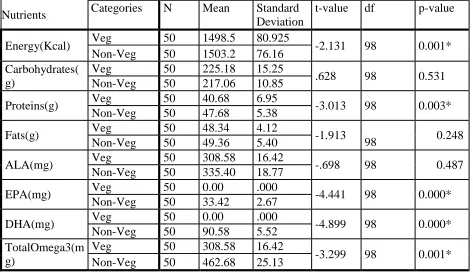
According to Table II, mean energy intake (p<0.05) was more in non-vegetarian (1503.2 Kcal) study participants as compared to vegetarian (1498.5 Kcal) study participants. Carbohydrate intake (p>0.05) was found to be more in vegetarian (225.18 gm) study participants as compared to (217.06 gm) in non-vegetarian study participants. Protein intake (p<0.05) is found to be high in non-vegetarian (47.68 gm) study participants as compared to vegetarian (40.68 gm) study participants. Fat intake (p>0.05) was found to be high in non-vegetarian (49.36 gm) study participants as compared to vegetarian (48.34 gm) study participants.
© Associated Asia Research Foundation (AARF)
A Monthly Double-Blind Peer Reviewed Refereed Open Access International e-Journal - Included in the International Serial Directories.
[image:6.612.72.437.56.277.2]Page | 97 Figure I: Omega-3 intake in study population
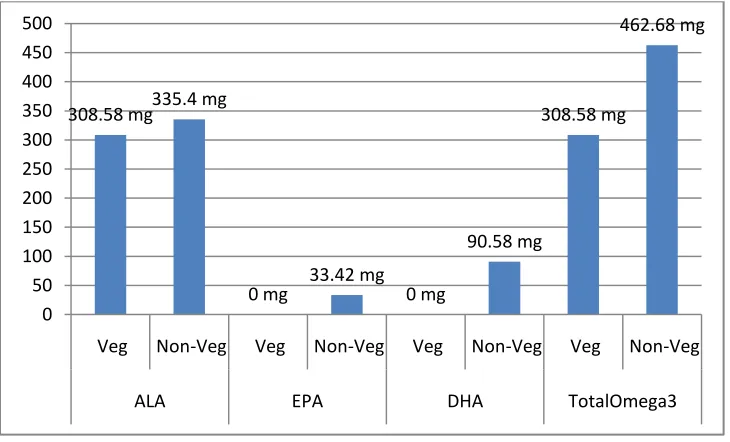
Figure I shows ALA intake to be 335.40 mg in non-vegetarian study participants and 308.58 mg in vegetarian study participants, (p>0.05). The mean total Omega-3 intake was 308.58 mg in vegetarian and 462.68 mg in non-vegetarian study population (p<0.05).
Consumptions of the plant version of omega-3 fats, alpha-linolenic acid, are also low in vegans. Adequate intake of n-3 fats is associated with a reduced incidence of heart disease and stroke (Philip J Tuso, MD; 2013).
Vegan diets are relatively deficient in the long-chain omega-3 fatty acids docosahexaenoic acid (DHA) and eicosapentaenoic acid (EPA), which are found largely in fish, seafood and eggs (M Amit; 2010).
308.58 mg335.4 mg
0 mg 33.42 mg 0 mg
90.58 mg
308.58 mg
462.68 mg
0 50 100 150 200 250 300 350 400 450 500
Veg Non-Veg Veg Non-Veg Veg Non-Veg Veg Non-Veg
© Associated Asia Research Foundation (AARF)
A Monthly Double-Blind Peer Reviewed Refereed Open Access International e-Journal - Included in the International Serial Directories.
[image:7.612.162.454.58.208.2] [image:7.612.119.490.397.622.2]Page | 98 Figure II: Chronic diseases in study population
Figure II shows incidence of chronic diseases to be 36.0% in the vegetarian study population and 22% in the non-vegetarian study population (p>0.05).
Fish consumption was associated with a lower risk of metabolic syndrome. The intake of long-chain n-3 FAs was inversely associated with self-reported T2D. Experimental studies reported that fish or fish oil supplements may improve insulin secretion and insulin sensitivity (Marushka L, et al.,2017).
Figure III: Types of chronic diseases in vegetarian and non-vegetarian study population
0% 20% 40%
Veg
Non-veg 36%
22%
Chronic diseases
0.0% 10.0% 20.0% 30.0% 40.0% 50.0%
60.0% 52.9%
35.3%
29.4% 29.4%
27.3%
45.5%
27.3%
0.0%
Veg
© Associated Asia Research Foundation (AARF)
A Monthly Double-Blind Peer Reviewed Refereed Open Access International e-Journal - Included in the International Serial Directories.
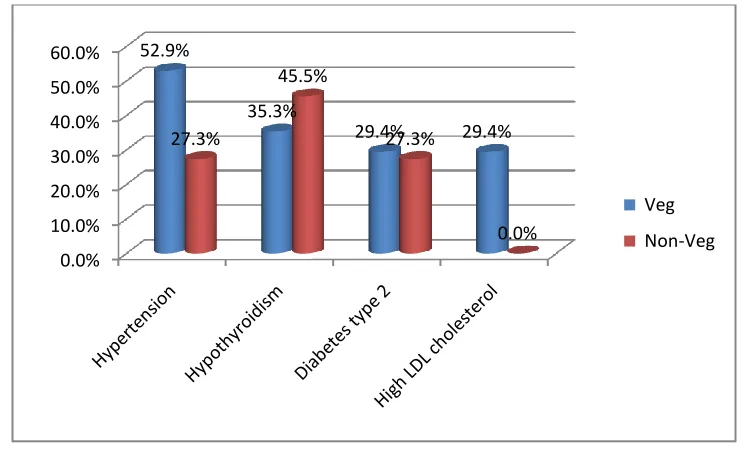
[image:8.612.73.380.160.346.2]Page | 99 Figure III shows 52.9% vegetarians and 27.3% non-vegetarians suffered from hypertension, 29.4% vegetarians and 27.3% non-vegetarians suffered from diabetes type 2, 35.3% vegetarians and 45.5% vegetarians suffered from hypothyroidism, 29.4% vegetarians and 0.0% non-vegetarians suffered from high LDL cholesterol(p>0.05).
Figure IV: Relation between omega-3 intake and chronic diseases
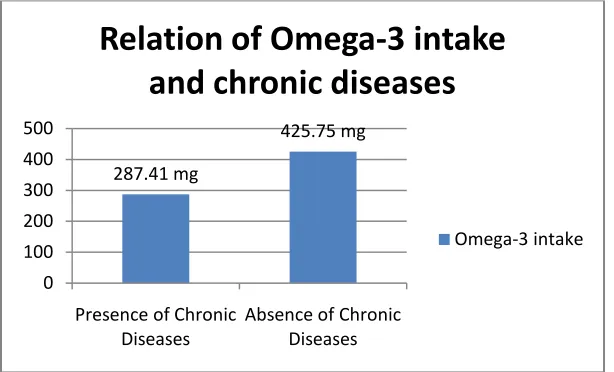
Figure IV shows the study population having chronic diseases to have mean Omega-3 intake 287.41 mg, ±123.986 which is less as compared to mean omega-3 intake of 425.75 mg, ±270.324 in study population not having incidence of chronic diseases(p<0.05).
Dietary omega-3 long-chain polyunsaturated fatty acids (LCPUFA), eicosapentaenoic acid (EPA, 20:5n-3) and docosahexaenoic acid (DHA, 22:6n-3), have been associated with a decreased risk of chronic disease, in particular cardiovascular mortality and cognitive decline (Ken D. Stark et.al, 2016).
IV. CONCLUSION
It can be concluded from the study that the anthropometric measurements are higher in the non-vegetarian study population than non-vegetarian study population. The nutrient intake regarding energy, protein, EPA, DHA, and Total Omega-3 was higher in the non-vegetarian study population than vegetarian study population. Vegetarians who had less consumption of omega-3 had higher incidence of chronic diseases as compared to non-vegetarians who had higher
287.41 mg
425.75 mg
0 100 200 300 400 500
Presence of Chronic Diseases
Absence of Chronic Diseases
Relation of Omega-3 intake
and chronic diseases
© Associated Asia Research Foundation (AARF)
A Monthly Double-Blind Peer Reviewed Refereed Open Access International e-Journal - Included in the International Serial Directories.
Page | 100
consumption of omega-3 (p<0.05). There exists a relation between the mean Omega-3 intake and incidence of chronic diseases.
The World Health Organization (WHO) recommended a regular fish consumption (1–2 servings/week; providing 200–500 mg/serving of EPA and DHA) for the general population, as being protective against coronary heart disease and ischemic stroke ( J. A. Tur et al.,2012).
REFERENCES
Amit M (2010) “Vegetarian diets in children and adolescents. Paediatr Child Health”; 15(5):303–314. [PubMed: 21532796]
Chen, C., Yang, Y., Yu, X., Hu, S., & Shao, S. (2017). Association between omega‐3 fatty acids consumption and the risk of type 2 diabetes: A meta‐analysis of cohort studies. Journal of Diabetes Investigation, 8(4), 480–488.
Giuseppe Grosso, Fabio Galvano, Filippo Caraci(2014)”Omega-3 fatty acids and depression:Scientific Evidence and biological mechanisms”Oxid Med CellLongev:313570
Mohebi-Nejad, A., & Bikdeli, B. (2014). “Omega-3 Supplements and Cardiovascular
Diseases”. Tanaffos, 13(1), 6–14.
Marushka L, Batal M, Sharp D, Schwartz H, Ing A, Fediuk K, Black A, Tikhonov C, and Chan HM. 2017. Fish consumption is inversely associated with type 2 diabetes in Manitoba First Nations communities. FACETS 2: 795–818.
© Associated Asia Research Foundation (AARF)
A Monthly Double-Blind Peer Reviewed Refereed Open Access International e-Journal - Included in the International Serial Directories.
Page | 101
Patel V, Chatterji S, Chisholm D, Ebrahim S, Gopalakrishna G, Mathers C, Mohan V, Prabhakaran D, Ravindran RD, Reddy KS (2011) Chronic diseases and injuries in India. Lancet 2011 Jan 29;377(9763):413-28. Epub 2011 Jan 10.
P. C. Calder( 2012) “Mechanisms of action of (n-3) fatty acids,” The Journal of Nutrition, vol. 142, no. 3, pp. 592S–599S,.
Saunders AV, Davis BC & Garg ML (2013) “Omega-3 polyunsaturated fatty acids and vegetarian diets”. Med J Aust. Aug 19;199(4 Suppl):S22-6.
Tuso, P. J., Ismail, M. H., Ha, B. P., & Bartolotto, C. (2013). Nutritional Update for Physicians:
Plant-Based Diets. The Permanente Journal, 17(2), 61–66.
Tur, J., Bibiloni, M., Sureda, A., & Pons, A. (2012). Dietary sources of omega 3 fatty acids:Public health risks and benefits. British Journal of Nutrition, 107(S2), S23-S52.
Von Schacky, C. (2014). Omega-3 Index and Cardiovascular Health. Nutrients, 6(2), 799–814.
Stark KD, Van Elswyk ME, Higgins MR, Weatherford CA, Salem N Jr(2016) Global survey of the omega-3 fatty acids, docosahexaenoic acid and eicosapentaenoic acid in the blood stream of healthy adults.Prog Lipid Res. 2016 Jul;63:132-5
Stewart Jeromson, Lain J., Gallagher, D Lee Hamilton ( 2015)”Omega-3 fatty acids and skeletal
muscle health” Mar Drugs;13(11):6977-7004