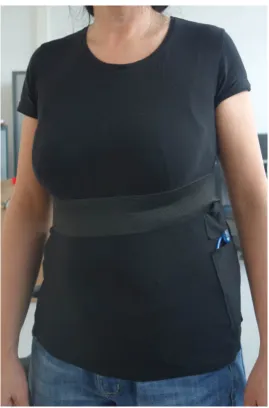
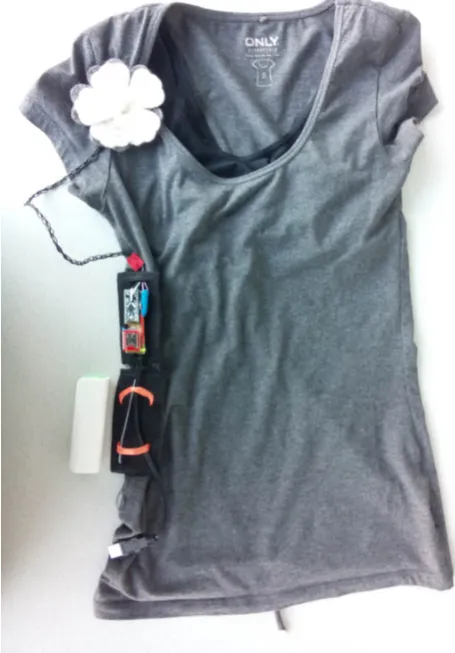
isabel pfab
a wearable intervention for
posture improvement
msc. thesis
Human Media Interaction, University of Twente 2016, January
graduation committee
Dr. A. H. Mader
website:
http://www.isa-pfab.com/
e-mail:
A B S T R A C T
Incorrect posture is a problem that becomes increasingly wide-spread in today’s world. It can lead to short and long term pain in the back and neck areas, and has further been linked to depression. Modern lifestyle fa-cilitates poor posture, especially because of the increasing amount of time people spend sitting. Even individuals that are considered physically active often still spend a considerable amount of time in sedentary behaviours.
Seated posture is therefore critically important and deserves more atten-tion. Typically, people reside in unhealthy hunched-over or slouching po-sitions, especially when interacting with screens. A poor seated posture can also affect a person’s posture while standing and walking. Muscle memory plays an important role in this, as the body gets used to being incorrectly positioned. Therefore, to correct ones posture and avoid the aforementioned risks, a correct sitting and standing position has to be estab-lished and trained. Wearable technology can be a means to achieve this aim by constantly measuring the wearer’s body posture and giving feedback on correct or incorrect posture.
In the course of this project, a concept for a smart garment that can detect incorrect posture and communicate it to the user, who then can correct her posture, is developed. This thesis reports on issues of posture and how to measure it and the applicability of wearable solutions in this context. The novel aspect of our approach is that posture is measured on the front of the body. It is based on the idea that every human has a ‘flexpoint’, a point where the body bends when one slouches. In other words: it is impossible to have a poor posture and keep the front of the body straight. We con-firmed this hypothesis on a sample of 50participants and then developed an intervention based on it.
The resulting prototype was designed in an iterative process, and a final version was evaluated in terms of its effect on posture. Four participants wore the prototype over a time span of three weeks. It was found that the design clearly has a subjective effect on posture, and an expert also confirmed an objective improvement.
The evaluation further expanded our knowledge about a desirable user ex-perience, leading to suggestions for future design iterations. Overall, the design can be considered to achieve Wearability Level2: “System is wear-able, but changes may be necessary, further investigation is needed”. In conclusion, the developed design shows potential, but leaves room for fur-ther improvements.
A C K N O W L E D G E M E N T S
I would like to express my great appreciation to Angelika Mader, who has been much more than just my daily supervisor. Her support and extraordi-narily active involvement have motivated me throughout this project. With-out her it would not have been possible. I would like to thank Christian Willemse for taking extensive time to guide me in designing the evaluation study and providing feedback on this report. I am also grateful to Kristin Neidlinger, who has been so kind to let me continuously pick her brain dur-ing her stay as artist in residence and has been a great source of inspiration to me. I would further like to thank Bart Klaassen and Dirk Heylen for their advice and assistance. I could not have had a better graduation committee.
Special thanks to all participants in my user studies, especially Khiet Truong, for being the first guinea pig and putting so much thought into providing feedback, and the four lovely ladies who have patiently been wearing the prototypes for several weeks and provided so much helpful insights and suggestions. I greatly appreciate the assistance I have received from awe-some professionals in areas I lack expertise, especially in terms of electrical engineering - Loek Gijben and Edwin Dertien - and physiotherapy - Rik Schurink and Matthias Hilgers.
C O N T E N T S
1 introduction 1
1.1 Setting . . . 1
1.2 Problem statement . . . 1
1.3 Research questions . . . 3
1.4 Approach . . . 3
2 context 7 2.1 Wearables . . . 7
2.2 Posture . . . 19
2.3 State of the art . . . 25
3 ideation 31 3.1 Expert Interviews . . . 31
3.2 Creative ideas (Flashes of inspiration) . . . 32
3.3 Rapid Prototyping session . . . 35
3.4 Conclusion: Statement of the product idea . . . 35
4 specification 37 4.1 Use case scenario . . . 37
4.2 Flexpoint study . . . 37
4.3 Sensor Selection . . . 38
4.4 Feedback Studies . . . 39
4.5 Iterative Development of prototypes . . . 41
4.6 Conclusion: Final specifications . . . 52
5 realisation 55 5.1 Hardware . . . 55
5.2 Software . . . 55
5.3 Textile . . . 57
6 evaluation 59 6.1 Method . . . 60
6.2 Procedure . . . 62
6.3 Results . . . 63
6.4 Discussion and Conclusion . . . 70
7 discussion and conclusion 73 7.1 Future work . . . 74
bibliography 77
a software 83
b consent forms 91
c information broschure and prototype manual 95
d daily questionnaire 97
e interview questions 99
f script briefing 103
L I S T O F F I G U R E S
Figure1 Creative Technology Design Process . . . 4
Figure2 Maslow’s Revised Hierarchy of Needs . . . 9
Figure3 Demands of the body [25] . . . 12
Figure4 Ideal standing posture . . . 19
Figure5 Natural curves of the spine . . . 21
Figure6 Diagram of the hip bone . . . 22
Figure7 Four types of postural alignment . . . 22
Figure8 Non-ideal seated posture and three proposed ideal seated postures [36] . . . 22
Figure9 Visual Reference for Posture Evaluation. Showing a person with a depressive episode and during remis-sion. [3] . . . 24
Figure10 Posture Theory Diagram . . . 25
Figure11 Prior work using strain sensors . . . 26
Figure12 Bend Sensors investigated in [6] . . . 27
Figure13 Prior work using IMUs . . . 27
Figure14 Clip shaped posture trainer devices . . . 28
Figure15 Alternative posture trainers . . . 29
Figure16 Interaction Suit Posture Sensors . . . 32
Figure17 Pressure sensitive shoe sole . . . 33
Figure18 Setup to rapidly test posture measurement by sitting bone pressure . . . 34
Figure19 Concept sketches for the Mechanical posture correc-tion idea . . . 34
Figure20 Bodyshapes with descriptions, as presented to the participants . . . 38
Figure21 Considered Sensors, from left to right: custom Velo-stat / conductive mesh bend sensor, VeloVelo-stat / tape bend sensor, stretchy conductive fabric stretch sen-sor, conductive jersey stretch sensen-sor, piezoresistive flex sensor . . . 39
Figure22 Hall Effect Sensor Neoprene Hinge . . . 40
Figure23 Results of the preferred feedback study . . . 41
Figure24 Potential positions for vibration feedback . . . 42
Figure25 Sketches for first iteration . . . 43
Figure26 First iteration . . . 43
Figure27 Sketches for second iteration, V1 . . . 45
Figure28 Iteration2.0 . . . 46
Figure29 Sketches for Iteration2.1 . . . 47
Figure30 Iteration2.1 . . . 48
Figure31 Sketches for third iteration . . . 49
Figure32 Third iteration . . . 50
Figure33 Iteration4.0 . . . 51
Figure34 Circuit board . . . 56
Figure35 Butterfly Patch to distribute vibrations . . . 57
Figure36 Resulting prototype . . . 58
Figure37 Setup for Intake and Closing Interviews . . . 62
Figure38 Before and after stills per participant . . . 66
Figure39 Mood results participant01 . . . 67
Figure40 Mood results participant02 . . . 67
Figure41 Mood results participant03 . . . 68
Figure42 Mood results participant04 . . . 68
Figure43 Consent Form1 . . . 92
Figure44 Consent Form2 . . . 93
Figure45 Information Sheet . . . 96
Figure46 Sketches01-05 . . . 106
Figure47 Sketches06-09 . . . 107
Figure48 Sketches10-15 . . . 108
Figure49 Sketches16-21 . . . 109
Figure50 Sketches22-27 . . . 110
Figure51 Sketches28-33 . . . 111
Figure52 Sketches34-39 . . . 112
L I S T O F T A B L E S
Table1 Levels of Wearability [32] . . . 16
Table2 Input Interfaces by Origin [35] . . . 18
Table3 Output Interfaces by Sense [35]. . . 18
Table4 Posture awareness . . . 64
Table5 Observations and Days of Wearing . . . 64
Table6 Items of the Daily Questionnaire . . . 98
Table7 Questions asked during the intake interview . . . 100
Table8 Questions asked during the closing interview . . . . 101
1
I N T R O D U C T I O N
1.1
setting
The document at hand describes the execution of a final project for the mas-ters programme Human Media Interaction at the University of Twente, the Netherlands. Human Media Interaction (HMI) is a two-year programme that aims to combine knowledge, technical expertise and skills from a range of disciplines to create interactive systems that automatically respond to a users behaviour, emotions and social cues and make appropriate decisions on what action to take.
During the masters programme I have developed an interest in the topic of wearable technologies and smart garments as a new platform for inter-esting user experiences. Due to their inherent closeness to the user, these kinds of devices enable new interaction possibilities, as well as more inti-mate user experiences. Wearables therefore have the potential to overcome limitations of other interfaces in terms of continuous presence and intimacy, especially when it comes to behavioural changes. For these reasons I de-cided early that I wanted to focus my final project on the development of life-enhancing wearable devices.
The initial idea for this project came from Kristin Neidlinger, founder of Sensoree. The San Francisco based company crafts wearable technology and interactive installations which promote a concept called extimacy - ex-ternalized intimacy. On her first visit at the University of Twente, we brain-stormed together with Angelika Mader, who has been closely involved in earlier explorations of wearables and is also the daily supervisor for this project, on interesting projects for collaboration. Kristin mentioned the idea of a posture enhancing wearable she had ‘lying in the drawer’ for a while.
The novel aspect of her approach is that posture is measured on the front of the body. It is based on the idea that every human has a ‘flexpoint’, a point where the body bends when one slouches. In other words: it is impos-sible to have a poor posture and keep the front of the body straight. This idea showed potential, but Kristin did not have the time to pursue it further. Since the issue of poor posture is one that concerns myself, it was quickly decided that this would be worth further investigation.
1.2
problem statement
There are many factors in modern lifestyle that can be related to causes of poor postures. Especially the increasingly sedentary behaviour, in particular time spent sitting, needs to be mentioned here. Even individuals that meet or exceed the public health guidelines for physical activity often still spend
a considerable amount of time in sedentary behaviours.
A recent survey at the Gallery building [1] showed that66.6% of people sit at their desk for more than six hours a day, 50% even sit more than eight hour. Taking breaks to get up and move are often forgotten as people fo-cus intensely on their work. This kind of behaviour is not specific to the surveyed group, though. With the shift towards a knowledge based society, more and more jobs become sedentary - people sit at a desk the entire work-day in front of a computer. Furthermore, extensive sitting often expands into leisure time. On top of all of that sitting at work, people usually sit during meals as well as while commuting in a car or public transport. Once at home, watching television, reading or playing games on the computer or console are popular pastimes that are all performed seated.
Seated posture is therefore critically important and deserves more attention. Typically, people reside in unhealthy hunched-over or slouching positions, especially when interacting with screens. This can be related to seemingly ubiquitous neck and shoulder pain [2], from which70% of survey partici-pants in the gallery suffer. A poor seated posture can also affect a person’s posture while standing and walking.
Postural dysfunction or poor posture has many other negative effects, both physically and mentally. Apart from the aforementioned pain in neck and shoulders, but also the lower back, it has negative influence on internal func-tioning of the body. Because weight and thus pressure is not optimally dis-tributed over the body, it cannot function properly. This influences breath-ing, blood flow and digestion.
On the mental side, poor posture and in particular slouching have been linked to depressive disorders [3] and lack of confidence. This in turn in-fluences perception by others and can have serious consequences for career and personal life. Poor posture also results in higher stress levels [4]. It is important to note in this context that posture is not just a passive indicator of mental states, but can reciprocally affect the mental states and behavior of an individual [5].
In our initial exploration of the issue in form of informal conversations with friends and colleagues, two key aspects became clear: first of all, people pay very little attention to posture until they experience the described negative effects. Secondly, people do lack perception of how correct posture even feels. We therefore feel there is a need to increase awareness of ones posture throughout the day and provide guidance on when someone sits in an un-healthy posture.
1.3 research questions 3
1.3
research questions
The starting point for this work, the overall question addressed in this the-sis is formulated as: “How can we design an effective wearable intervention for posture improvement based on the flexpoint hypothesis?”
There are three distinct aspects following from this question, which need to be addressed in order to find a satisfactory solution. First of all, we want to address issues of posture and how to improve it. To be able to do so, we need to gain an understanding of the topic. The second aspect of the overall question is concerned with designing a wearable device. Finally, once an intervention has been designed, it needs to be evaluated. Evaluation thus forms the third aspect.
1. Posture Questions
a) What is the ideal human posture? b) What types of poor posture are there?
c) What is the state of the art in measuring posture?
d) Does the flexpoint hypothesis hold? i. Does the flexpoint exist?
ii. Which types of poor posture can be measured at the flex-point?
e) Which type of technology can be used to measure posture at the flexpoint?
2. Design Questions
a) What are the factors that influence user experience of wearables? b) What is a desirable user experience for this project?
i. Which type of feedback is appropriate? ii. Which form factor is appropriate?
c) What are the design decisions?
3. Evaluation Questions
a) How to design a user study that evaluates effects on posture? b) Does the design have the intended effect on the wearer’s posture?
1.4
approach
1.4 approach 5
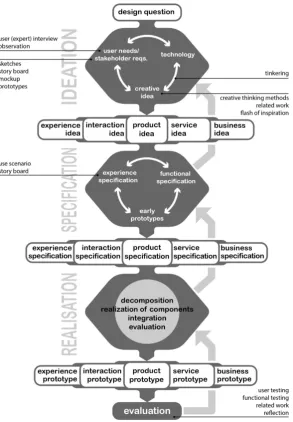
Figure 1 illustrates the overall picture: the design process consists of four
phases; ideation, specification, realisation and evaluation. The first two phases typically happen in a non-linear manner: the starting point for a project can lay in a creative idea, be rooted in exploration of novel appli-cations for existing technologies (tinkering) or, as in the current case, from a user or stakeholder perspective. Within the ideation phase, all of these aspects should be explored. In this exploration, the design space is first broadened (divergence) and then narrowed (convergence) to generate a de-fined product idea. In the current work, we separated related work, which is typically part of ideation, into a different chapter to improve the structure of the report. Nevertheless, it has informed the ideation process just as much as expert interviews, sketches, rapid prototyping and flashes of inspiration.
During specification, a series of prototypes is produced and evaluated in terms of functionality and experience. These prototypes may be discarded, improved or merged together. Again, a divergence - convergence process is applied. This phase results in specifications for a final prototype. In this work, we began with a use case scenario and confirmation of the flexpoint hypothesis, before diving into details, such as selection of appropriate sen-sors and feedback. Based on these decisions, an iterative series of prototypes has been developed and tested.
In the realisation phase, a prototype is developed based on the insights from specification. For a smart garment, this means decomposition into aspects of software, hardware and textile. These are being realised one by one, and then integrated with each other. One peculiarity of this work is that the pro-totype does not completely conform with all user experience specifications, and is not fully integrated. The electronics can be completely detached from the textile parts. This was necessary to appropriate the prototype for evalu-ation.
2
C O N T E X T
2.1
wearables
This section addresses Design Question2a, “What are the factors that
influ-ence user experiinflu-ence of wearables?” by means of a literature survey. The identified factors are used throughout this thesis to structure discussions of user experience.
2.1.1 Definition
Wearable technologies pose one of the most promising trends in human media interaction [9]. Utilised in a wide variety of application areas, their most general purpose is to enhance the quality of life. Due to their in-herent closeness to the user a whole range of new interaction possibilities is enabled. Therefore, wearable devices could overcome the limitations of current interfaces [10]. They thus have the potential to add value in terms of functionality and performance when compared to other technologies [11].
The terms ‘wearable technology’, ‘wearable devices’, and ‘wearables’ all re-fer to electronic technologies or computers that are incorporated into items of clothing and accessories which can comfortably be worn on the body [12]. Other definitions add that these technologies mediate their user and their environment [13] and let the user access information anytime and anywhere [14]. In other words, we refer to a worn system that is capable of sensing and communicating with environmental and the wearer’s conditions and stimuli [15].
2.1.2 Dimensions of Wearable User Experience
In prior efforts, we have identified five dimensions that shape the user ex-perience of any wearable. These dimensions - area of application, human aspects, wearability, technology and design process - form a suitable frame-work to discuss the existing frame-work considered, as well as to frame the de-velopment of our own prototype. They are outlined in the following para-graphs with respect to the topic of this thesis.
Application areas
The first dimension of wearable user experience we discuss is the area of application. It determines the context of any wearable device, and thus has a high contribution to the user experience. This is the case for human as well as technological factors. Application is even likely to influence the process in which the device is designed. In the present case of a wearable device for posture improvement, there are three possible application areas that could be addressed:
the sport/fitness sector promotes an active lifestyle, in which wear-ables can serve to monitor fitness, navigate outdoors, regulate body tem-perature as well as measure and optimise sporting performance. One dis-tinguishing aspect of these devices when compared to e.g., wearables for wellness applications is that they are not necessarily worn all the time, but rather for specific activities. Measuring and providing feedback on posture could enable athletes and sportspeople to keep proper form. Examples of sport applications in which posture plays an important role are rowing [16] and strength training, i.e. weight lifting [17].
the medical sector includes applications related to professional medi-cal and health care. Wearables can be useful in this sector by providing doctors assistance in diagnosing diseases and monitoring reactions to med-ication. They are also expected to increase patient mobility by freeing them from bulky machines, e.g., by monitoring vital signs. To use wearables in these applications, they are required to conform to medical equipment reg-ulations that are, for instance, not required in wellness products. A posture enhancing wearable for the medical sector could be relevant for two distinct user groups: on the one hand patients, which experience physiological or psychological issues caused by poor posture, such as structural deformity of the spine or shoulder, back or neck pain [18], or are in rehabilitation [7]. On the other hand, it could assist medical professionals throughout their workday. Especially nurses frequently experience occupational lower back pain.
the wellness sector aims at a healthy overall lifestyle and general well-being of the wearer. It includes cases for physiological monitoring, weight and energy monitoring, emotion monitoring, eye care, gait/posture correc-tion, massage and sleep monitoring. Wellness related wearables are often worn continuously throughout the day. This sector is particularly interest-ing for the development of a wearable posture improvement device, as pos-ture has a significant influence on overall well-being [19] and there are less restrictions when compared to the medical sector.
Human Aspects
Human aspects pose the second dimension of wearable user experience we consider. No matter the application area, incorporation of knowledge about the wearer is of major importance for acceptance and thus spreading of wearable technologies [20]. In this section, we look at how wearables can address fundamental human needs, cover factors that influence acceptance like cognitive attitudes, demographic and social aspects, show potential pur-poses of smart garments and identify peculiarities of usability.
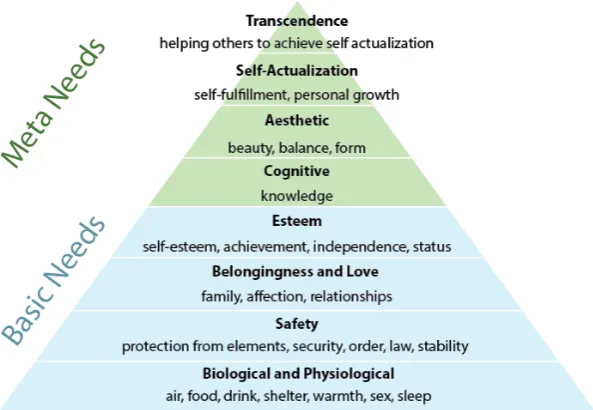
user needs According to Maslow’s revised Hierarchy of Needs (see Fig-ure 2) there are two levels of human needs, basic and meta, along which
2.1 wearables 9
Figure 2:Maslow’s Revised Hierarchy of Needs
However, other researchers point out that basic needs are generally fulfilled in the developed world, so people are striving to satisfy higher order meta needs [11]. These include cognitive and aesthetic needs, self-actualisation and self-transcendence. Thus, a transition can be observed from making and marketing a product to developing non-tangible concepts that satisfy the demand of higher order needs, such as ideas, sensory and emotional fulfilment, cultural experiences and entertainment which stimulate the in-tellect.
We argue that all wearable devices tend to cater meta needs. The vast major-ity of devices facilitates cognitive needs, in particular knowledge and self-awareness, by collecting information about the wearer and making them accessible. In this manner, self-actualisation can be triggered, as illustrated by the quantified-self movement. Further, the distinguishing factor for wear-ables, their integration with clothing and jewelry, brings in a responsibility to at least consider aesthetic needs. This of course does not exclude that lower level needs can be addressed. From our observations, different appli-cation areas typically relate to different user needs. In particular, medical wearables attend to biological and physiological needs, whereas wellness assumes that lower level needs are already fulfilled and aims at meta-level needs, especially self-actualisation. Sport / fitness combines these two.
demographic characteristics and technical experience Age and gen-der are the most influential demographic characteristics when it comes to dealing with any sort of technology. While Buenaflor and Hee-Cheol [20] define technical experience as a separate aspect for technology acceptance, we argue that technical experience is often determined by demographic cir-cumstances and can thus be included here.
Younger people who grew up with computers typically find it easier to adapt to new advancements than elderly. It is an interesting question whether this is also the case for wearable technologies. Especially devices used for monitoring, which do not require additional user interaction besides being worn, might be very suitable for older individuals and other people that have little familiarity with technology. No technical experience is required to attire clothing, a process they are well familiar with.
When it comes to gender, men were found to be more accepting of wearable technology than women [20]. This is also visible in many of the commer-cially available wearable devices, such as smart watches or fitness tracker bands. Their design can often be considered quite male-oriented. However, there is a movement of fashionable wearables, especially for wellness and glamour applications, which are targeted towards women. In our opinion it is therefore questionable whether these findings are to be generally accepted or whether the wearables used in this study were simply not designed with female users in mind.
social aspects Three social aspects were identified as important to ac-ceptance of wearables: social influences, culture and personal privacy [20]. This means that the opinions of one’s surroundings shape how a device is perceived, as well as how much personal information is shared.
purpose The functionality of a wearable device is contextual depending on its purpose [22] and application area. Since we are looking at high-level purposes of devices from a human perspective, rather than a functional one, we included this factor in the human aspects rather than the application area dimension. High-level functions of wearable technology have been in-vestigated in PSFK’s ‘Future of Wearable Tech Report’ [23]. By analysing currently available wearable products, they forecast the following key func-tions of (near) future wearable devices:
• Support- Data-Streamed Care manages ones personal health
• Record- catalogue ones personal experience to a Cloud Memory
• Nudge- Responsive Coaching leads to better behaviour
• Communicate - connected experiences promote Long Distance Togeth-erness
• Verify - password provided by ones Authenticated Self
• Control - interact with the world through an On-board Interface
• Augment - enhance natural abilities through Augmented Sensory Per-ception
2.1 wearables 11
• Mirror - reflect ones well-being through an Emotional Mirror
• Align - Biometrically attuned systems personalize ones surroundings
The boldfaced items are the purposes a wearable for posture improvement could take on.
usability One of the concerns that consumers often have of new technol-ogy products is that they become more difficult to use and adapt to with increased sophistication [11]. Ensuring good usability is therefore one of the main objectives when designing wearable user experiences. Nugroho and Beilharz explain that simplicity is of high importance in creating a user-friendly wearable device, because a user’s ability to navigate the device influences the user’s engagement, as well as impression of interactivity and responsiveness of the device [22]. Ease of use is also one of the determining factors for technology acceptance [20].
As indicated earlier, we believe that wearables have the potential to become more usable than other technologies, especially for inexperienced users. This of course implies that we consider interaction design for wearables. Interaction, as in the exchange of information between wearer and device, is mainly determined by the chosen input and output modalities. We look in more detail at possible modalities in relation to technologies. Because of the unique relationship between people and their clothing, a new paradigm of interaction possibilities is opened. Yet, it seems that the majority of current products simply adopt mobile interaction design and apply this to wearable devices. This means that the great advantage of wearables, namely being much more connected to a user’s physical body than any mobile device, is not utilised.
We propose that usability can be significantly improved when wearables incorporate interaction patterns known from clothing. Many forms of such interactions in which usability is addressed from a garment perspective are imaginable: first, one could use classic garment interfaces such as buttons or zippers. Second, one could use interactions people have with their clothing as basis. For example, there is a project in which pulling down a shirt’s sleeves and playing with, a common pacifying behaviour, is used as basis for interaction. The designers extend the calming effect of this action by triggering heating elements in the back and shoulder areas. We consider this as exemplary in terms of ease of use, because the interaction happens naturally to the extent of being subconscious. Moreover, it is possible to move away from focusing solely on the user’s hand for interaction. The closeness to the body allows for usage of physiological measurements as input.
Wearability
Figure 3:Demands of the body [25]
such as women wearing high heels may render this point to be debatable, it seems obvious that designs should at least not aim to be discomforting to the wearer.
Gemperle et al. [26] were the first to determine thirteen wearability guide-lines that have since been widely accepted. These guideguide-lines concern place-ment on the human body, form language, human moveplace-ment, proxemics (hu-man perception of space), size variation, attachment, containment, weight, accessibility, sensory interaction, temperature, aesthetics and long-term use. According to [24] wearability includes thermal and moisture management, flexibility, mobility, and durability, with an extra emphasis on sizing and fit.
Bryson [25] highlights the importance of wearability for successful adapta-tion and acceptance of smart fashion. He classified the ‘demands of the body’ that should be considered to ensure wearability. He distinguishes between anatomical, physiological and psychological demands, but points out that the inter-relationship between these considerations is highly com-plex in the design of smart clothing and wearable technology. A complete overview of the demands can be seen in Figure 3. In this classification,
wearability consists of comfort, durability, aesthetic considerations, sensu-ality and (perception of) reliability. Extending his work with insights from further sources, we arrived at three factors that make up the wearability di-mension: comfort, durability and aesthetics and fashion. These are outlined in the following paragraphs.
2.1 wearables 13
‘Thermophysiological Comfort’ relates to the way in which clothing affects heat, moisture, and air transfers as well as the way in which the body in-teracts with clothing. There are three thermal aspects of designing objects for the body - functional, biological, and perceptual [26]. A proper thermal regulation is necessary to comply with physiological demands of the body [25]. Thermophysiological comfort is one of the aspects where new devel-opments in material sciences, such as new smart textiles can bring major advantages. By changing physical properties of textiles using nanotechnol-ogy, functionality that supports thermal regulation can be integrated and provide improved comfort.
‘Sensorial or Neurophysiological Comfort’ relates to how users feel when clothing comes into contact with the skin, the aspect Bryson calls ‘sensual-ity’. Again, the level of comfort is largely influenced by material choices, but also fit and form language. Sensorial comfort is highly important to user ex-periences. Because wearables are so close to the body, the ‘feel’ may become even more important than the ‘look’. Sensory evaluation of fabric handle and other tactile properties is of high importance [27]. Stiffness, thickness and smoothness of materials are some of the properties to be considered for neurophysiological comfort.
Further, not all human bodies are the same, but to be comfortable wearables must meet the anatomical demands of each individual wearer’s body [24]. While this is the case for regular clothing as well, it is new to the field of electronics. There are two approaches to size variations: either making use of established clothing size systems, or designing a flexible solution that fits all. This can be established by using adjustable or flexible parts. For the same reason, design for the human body requires a humanistic form language [26]. This means taking the wearers body shape into considera-tion and designing organic shapes. For example forming a concavity on the inside surface touching the body to accept human convexities. The form language is therefore closely related to the location of the wearable on the human body, and relevant to sensorial comfort.
Finally, ‘Body-movement Comfort‘ relates to the ability of clothing to allow free movement, reduce burden, and to support the body. The human body moves at any given point in time due to human activities like breathing or walking. Wearables design must consider movement as a constraint to the shape of the wearable, as it should not hinder movement [26]. Further as-pects that can constrain body-movement comfort are placement on the body, weight and attachment to the body, as well as proxemics.
The weight of a wearable device can heavily influence the level of comfort experienced by the wearer [14]. Apart from individual differences, the lo-cation of the device on the body determines the maximum weight that can be attached without hindering movement or increasing the energy cost too much. Proxemics refers to the human perception of space. Wearable devices should stay within the wearers intimate space, so that perceptually they be-come a part of the body [26]. The intimate space ranges from touching to about46cm from the body, thus this limit should not be exceeded.
durability Wearables must be built to allow long-term use. This refers to both long continuous wearing, which is often limited by power supply, and long-term durability. Clothing should withstand harsh conditions during laundering and everyday use [15], and thus so should wearables. The spe-cific requirements for long-term use depend on the application area of the wearable: both in terms of frequency of use and surrounding conditions. To illustrate, a sports related wearable might only be worn during the sportive activity, thus has a lower frequency of use than a device that is worn contin-uously. It must however be able to withstand the surrounding conditions, such as release of moisture or heat generated by the body.
Wearables contain electronic and other components that require proper pro-tection from damage to ensure a seamless user experience. These compo-nents may also influence the form of the wearable, e.g., by size requirements, and must therefore be considered in the design process. For example, the electronic components of current commercial wearables, like smart watches or fitness trackers are typically tightly contained within a more sturdy ma-terial. It, however, results in rigid pieces. This brings us to another aspects of durability for wearables: flexibility. Electronic components are typically rigid and do not withstand bending or flexing, whereas textiles are typi-cally flexible and can be deformed without issues. This naturally creates challenges for creators that need to find a way to combine these two worlds.
Special attention with regards to durability must also be given to wiring and connections. While wires may be flexible, they are often considered the weakest part of any wearable. Therefore, there is considerable work to replace traditional wires with textile-based networks in smart clothing. Techniques include conductive fibers, yarns, fabrics, embroidery, and opti-cal fibers [15]. While some of these approaches may work well for industri-ally produced devices, the materials available to makers are of questionable durability, so that standard wires are still frequently used.
aesthetics and fashion Since clothing is a fashion item, there is an identified need for innovative design and fantasy in the creation of fash-ionable wearables to excite the wearer [28]. Aesthetics can have a strong effect on the acceptance and adoption of clothing, and thus of wearable de-vices [15]. Though not technically unwearable, devices may be perceived as so ugly by the user that they are psychologically damaging or become objects of derision [25]. As established earlier, we defend the point that all wearables should appeal to the human need for aesthetics.
2.1 wearables 15
which refers to the meta need for aesthetics, and fashion as something pop-ular in the sense of trends, which relates more to the wearer’s basic need for belongingness. In this thesis, we refer to fashion in the first sense, though it needs to be acknowledged that trends certainly influence the appearance of wearable devices.
Fashion is inextricably implicated in constructions and reconstructions of identity: through appearance style, individuals announce who they are and who they hope to become [30]. This seems to be particularly the case for females. As Woodward puts it: “It is apparent that clothing does not simply reflect the self or identity. Instead, by virtue of being a material form that woman can look at, hold and put on their bodies, clothing gives women a sense that they have a self and indeed that they can change it" [31, p. 157]. The way one dresses is thus a metaphor for identity; this extends to wear-able technologies and smart garments as well.
The intersection between wearable technologies and identity is one of the most interesting aspects of the topic. Wearables have the potential to allow expression of identity in new ways, unachievable by regular clothing. This highlights once again the importance of considering the wearer in the design of wearable technologies:
• Who is the person that will wear this device?
• Which identity does the wearer aim to take on? How does this device assist in constructing this identity?
With regards to a posture improvement garment, aesthetics and fashion shape two distinct aspects: first, the design of the garment itself, its form factor and materials. Second, we aim to support the wearer in constructing a more healthy and confident identity by means of a better posture.
measuring wearability One interesting question when it comes to wear-ability is how to measure or confirm it. According to Knight et al [32], there are five levels of wearability, defined by energy cost, biomechanical effect on the body and comfort. These levels can be found in Table 1. The
au-thors determine energy cost by measuring heart rate and relative perceived exertion. Biomechanical effects on posture, localised pain and discomfort make up the second category. Comfort relates to being ’generally wearable’ and not impairing the wearer’s vision. While we question whether the pro-posed measures are exhaustive and always applicable, defining wearability levels can be useful for evaluation. Only products that acquire the first level should be taken to market.
Technology
Table 1:Levels of Wearability [32]
Wearability Level (WL)
Description
WL1 System is wearable
WL2 System is wearable, but changes may be necessary, further investigation is needed
WL3 System is wearable, but changes are advised, uncomfort-able
WL4 System is not wearable, fatiguing, very uncomfortable
WL5 System is not wearable, extremely stressful, and poten-tially harmful
integrated circuits and data management The term ’integrated cir-cuit’ describes electronic circuits formed on a small piece of semiconducting material, which perform the same function as a larger circuit made from dis-crete components. Integrated circuits can function as microprocessor, com-puter memory, amplifier, oscillator, timer or counter. Integrated circuits are used in virtually all electronic equipment today and have revolutionised the world of electronics due to their low price. They play a key role in wearable technology, as they allow for small-sized components. A particular inte-grated circuit is categorised as either linear (analog) or digital, depending on its intended application.
There are several specific platforms available that address factors of wear-ability, such as durability and being washable. These integrated circuit systems typically include microprocessors and sensors. Adafruit’s Lilypad, Flora and Gemma microcontrollers are examples of such systems, which are available for rapid prototyping and DIY smart garments. In commercial products, custom integrated circuits are used, optimised for the correspond-ing functionality of the product. There has further been work on integrated circuits that could be applied directly to the human skin. Cho et al [15] add that active research on textile-based integrated circuits is required to advance the quality and comfort of wearable technology.
The amount of computing power required for a given wearable strongly depends on the type and amount of data collected by the device. The com-plexity of the required computations also plays an important role here. De-signers and engineers should consider different case-specific requirements to make appropriate choices when it comes to data management. Many wearable devices outsource heavy computation to other devices, such as smartphones or the cloud servers. This allows for usage of simpler and cheaper integrated circuits in the device itself, while the user can still bene-fit from advanced features.
2.1 wearables 17
commonly, rechargeable batteries are used for wearables. However, conven-tional power supply is known to have a short lifetime, as well as being bulky, heavy, and rigid [15]. New developments in energy-harvesting technologies might resolve this issue in the future. When it comes to energy harvest-ing for wearables, science and industry are currently focusharvest-ing on solar cells, thermoelectric harvesting and piezoelectric harvesting [33].
communication While there are stand-alone products out there, most wearable devices use a form of communication in the sense of transferring information or power to other devices. Communication can be either short or long range. Short range communication in this context refers to com-munication between different components of one or more wearables worn by one person. Short range communication can be wired or wireless, using technologies like infrared or Bluetooth. Long range communication refers to communication between several users [15]. Long range communication re-quires wireless connections. Popular technologies for this purpose include Wi-Fi and the Global System for Mobile communications (GSM).
interfaces From a user perspective, interfaces have the most visible im-pact of all technological factors mentioned. They determine the way the user interacts with the device, and thus often influence the form factor. In-terfaces can be distinguished between input and output modalities. Which input and output modalities should be used for a wearable depend on the desired application and functionality: the nature of the task at hand and the information to be managed [34]. Both input and output interfaces of wear-ables can be classified by the amount of cognitive load they require from the user [34]. The higher the cognitive load, the more attention is required by the user to interface with the device. Different functionalities of a wearable device can necessitate higher or lower cognitive load.
Seymour [35] compiled an extensive list of possible input modalities, which can be found in Table2. She divides inputs between those originating from
the wearer and those from the environment. Cho et al [15] introduce the modalities that can capture these inputs. They address (textile-based) but-tons and keyboards, sensors, speech recognition and others. All of these input modalities can be distinguished between active and passive input tech-nologies. Passive input devices collect data unobtrusively without conscious action from the user, and thus in general have a low cognitive load. Buttons and keyboards, by comparison, require active manipulation and attention from the wearer, and thus have a higher cognitive load.
Sensors can cover a broad range of data related to the wearer or the environ-ment. In fact, there are sensors for each of the inputs listed by Seymour [35]. While many wearable devices make use of embedded traditional sensor sys-tems, there are also textile-based sensors, which have the added benefit of being highly comfortable to the wearer. Textile sensors are typically smart fibres that can be directly applied to textiles [35].
Table 2:Input Interfaces by Origin [35]
Origin Inputs
Person pressure bend motion biometric data sound
visuals humidity proximity orientation displacement smell
acceleration
Environment light humidity sound temperature smoke
micro- particles visual
Table 3:Output Interfaces by Sense [35].
Sense Output
Visual LEDs, thermochromic inks, photochromic inks, EL wires, E-ink, (alphanumeric) displays
Sound speakers, buzzers
Touch motors/actuators, shape memory alloys, conduc-tive yarns, conducconduc-tive fabrics
2.2 posture 19
Figure 4:Ideal standing posture
2.2
posture
This section sets out to answer Posture Questions 1a “What is the ideal
human posture?” 1b“What types of poor posture are there?” and1c“What
is the state of the art in measuring posture?”.
definition Posture is the mechanical relationship of the parts of the body to each other. It can be divided into static posture (at rest or without antic-ipated movement, e.g. lying, sitting or standing), and dynamic posture (in action or anticipation of action). It changes with positions and movements of the body, and is influenced by many factors, including general health, sex, body build, strength, personal habits, environment and mood [19].
In1946, the Posture Committee of the American Orthopedic Association de-fined good posture as ‘that state of muscular and skeletal balance which pro-tects the supporting structures of the body against injury and progressive deformity irrespective of the attitude in which these structures are work-ing and restwork-ing. Under these conditions the muscles will function most efficiently and the optimum positions are afforded for the thoracic and ab-dominal organs’. Another definition emphasises that it aims to ‘involve a minimal amount of stress and strain and which is conducive to maximal efficiency in the use of the body’ [36].
1. Forces of gravity are evenly distributed through the body so all joints are in their neutral zone
2. There will be minimal wear and tear on these structures and the natu-ral balance and correct length of muscles is maintained
3. Movement patterns are normal and all vital organs are properly placed, not constricted and therefore can function efficiently
4. The line of gravity passes through a point on a level with and imme-diately in front of the second sacral vertebra (the centre of gravity).
This means, that when viewed from the side:
• The head is in neutral position
• The spine retains its natural curves
• The pelvis is in neutral, anterior superior iliac spine lies in a parallel line with the posterior superior iliac spine
• The knee joints are in neutral and not hyper extended
• The lower leg is vertical and orthogonal to the sole of the foot
And, when viewed from the front or back:
• The line of gravity should bisect the body into two equal halves with body weight evenly distributed between the feet and the kneecaps face forwards
Figure5describes the natural curves of the spine that should be retained in
ideal standing posture. Clinical literature described the ideal spinal curva-ture as a slight lordosis at lumbar and slight kyphosis at the thoracic regions [36].
There are several forms of incorrect posture, in which the spinal curves de-viate from the ideals described above. Figure7shows three common issues:
Kyphosis-Lordosis, flat back and sway-back. All three of them can addition-ally be acompanied by so-called ’forward head’ posture, a dysfunction in which the head is shifted forward compared to a neutral position.
seated posture While there is a well-established ideal for standing pos-ture, a consensus on the ideal seated posture is lacking. Textbooks on mus-culoskeletal assessment are used as a basis for ergonomic advice, but they appear to advocate three different spinal curve combinations. These are described below and can be seen in Figure 8, together with the definitely
non-ideal ’slump’ or ’slouch’ posture.
1. a flat lower thoracic and lumbar posture or a flat lumbar posture with backrest support
2. lordosis at both lower thoracic and lumbar regions (long lordosis)
2.2 posture 21
Figure 6:Diagram of the hip bone
Figure 7:Four types of postural alignment
2.2 posture 23
Claus et al [36] found that it was easier for their participants to get into the slump, flat and long lordosis postures, whereas manual assistance was needed to get into the short lordosis posture. The authors did not find spe-cific physiological benefits of one of these porposed ideal postures over the others. A study which relied on the evaluation of295European physiother-apists found that the experts considered the long and short lordosis seated postures to be ideal [37].
causes and effects of poor posture Poor posture is defined as any prolonged deviations from the "neutral spine" [18]. It is often caused by mus-cle imbalance, which means that certain musmus-cles get tight or shorten while others lengthen and weaken. Today, posture issues are commonly related to unhealthy sedentary behaviour, especially in combination with computer usage. Sitting for extended periods of time causes tight hip flexors, which pulls the pelvis forward, causing Kyphosis-lordosis. Further, people tend to hunch over their keyboard and stretch the head towards the screen, which leads to tight chest muscles causing forward-head posture or rounded shoul-ders. Additionally, sitting in a prolonged deviation from the neutral spine flexes the lower back, which pressures the lumbar spines, causing muscle cramps, nerve blocking and decreased blood flow. This, in turn, can lead to lower back pain and leg pain. Thus, there is evidence that addressing these postures may help reduce lower back pain [37].
But there are many other causes for poor posture: Pain or past injuries can cause poor posture, as people tend to overcome pain by changing their body position, which can become a habit. Being overweight can facilitate poor posture, as the added weight changes the body’s center of gravity. Genetic predisposition, low nutritional state, lack of awareness of correct posture, poor core stability / fitness and even wearing high heels are further poten-tial reasons one may develop poor posture.
Moreover, poor posture has long been linked to several psychological is-sues, negative emotions, feelings of stress and lack of motivation [5]. These can be both causes and effects of poor posture. Participants experimentally positioned in a slumped-over, relative to upright, physical posture showed significantly lower persistence on a standard learned helplessness task and rated themselves higher on stress levels [4]. They were also perceived as more depressed and helpless by others. Patients presenting depressive episodes showed a marked increase in kyphosis, which was also reduced during remission. Kyphosis affects the muscles, reducing the flexibility of anterior thorax (intercostal) muscles, upper limb muscles originating from the thorax (minor and major pectoralis, latissimus dorsi and anterior ser-ratus muscles) and cervical spine muscles (levator scapulae and trapezius muscles) [3].
Figure 9:Visual Reference for Posture Evaluation. Showing a person with a depres-sive episode and during remission. [3]
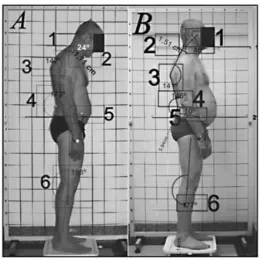
In some cases, the reference points are marked with adhesive dots or small balls [3]. Points typically investigated are: lateral malleoli; head of the fibula; greater trochanter of the femur; anterior and posterior superior iliac spine; cervical spine (at C7); thoracic spine (at T3, T6, T9and T12); lumbar spine (at L3and L5); sacral spinous processes; and inferior scapular angle. Some of these reference points were also marked with small balls (15cm in diame-ter): anterior and posterior superior iliac spine; thoracic spine (at T3, T6, T9 and T12), lumbar spine (at L3and L5); cervical spine (at C7); and acromion. This can be seen in Figure9.
A study has shown that the accuracy of manual assessment has an average probability of misclassification of 30.1%, compared to measurements from an optical motion capture system [38]. Further, this method provides only a momentary ‘snapshot’ impression, and is not suitable for continuous ob-servation and real-time feedback. It is also possible that people correct their posture towards a more socially acceptable version rather than posing nat-urally. There are video camera- and Kinect-based automated systems for posture classification, which have shown to be more accurate than observa-tion by professionals [39], [18]. Most relevant for this project, there has been substantial work on using wearable devices for posture classification. These are described in Section2.3.
flexpoint hypothesis The flexpoint hypothesis was inspired by the ‘Pos-ture Theory Diagram’, as shown in Figure 10. On this diagram, it can be
seen that the front of the body compresses during slouching. We call the point on which this happens the ‘Flexpoint’ of a person. The hypothesis consists of three parts, which are addressed in this thesis:
2.3 state of the art 25
Figure 10:Posture Theory Diagram
2. The position of the flexpoint can be measured.
3. Slouching can be detected by measuring the amount of bending at the flexpoint.
2.3
state of the art
2.3.1 Wearable coaching
The topic of wearable coaching is relatively new. Asselin et al [40] imple-mented a wearable computing platform consisting of an array of sensors and application software to motivate users to reach fitness goals and prevent harm in a real-time environment. The system consists of an accelerometer and a heart rate monitor, which enable detection of the performed exercise and exertion. Custom software uses the data to provide interactive audio feedback for motivation, prevent harm and warn user of overexertion, log-ging of exercise data. It also uses exercise history to optimise progress.
(a)[41] (b)[42]
Figure 11:Prior work using strain sensors
is not perceived as intrusive will be adopted. While not directly targeted at coaching posture, we consider the insights gained in this study to be rele-vant for all types of wearable coaching systems, including for this thesis.
2.3.2 Wearable posture assessment
The common thread across systems is to detect an undesired behavior that is known to increase the risk developing musculoskeletal symptoms and to provide a user intervention to attempt to change behavior [39]. A long-term field analysis of seated posture thus requires that the user be fitted with a simple, easy-to- use, wearable posture monitor that requires neither alter-ation of the work environment nor the use of a computalter-ationally complex data processor [6]. Existing research falls into three categories: elongation sensors, bend sensors, and inertial sensors.
strain and elongation sensors Mattmann et al [41] examined the use of textile strain sensors directly integrated into a tight-fitting garment to de-tect upper body positions. In a study with eigth participtants posing in27 different postures, they found this approach to be feasible at a detection rate of 65% for a new user and up to 97% accuracy with a user-specific setting. Similarly, De Rossi et al [42] measured trunk posture with a sensorised leo-tard that incorporates a multitude of strategically placed elongation sensors. Their work, however, has not been evaluated formally, as it is intended only as a proof of concept to demonstrate the feasibility of creating smart gar-ments capable of monitoring human posture. Both works can be seen in Figure11.
flex and bend sensors Dunne et al [6] measured seated posture us-ing flex sensors along the spine. They found that measurus-ing bend across the area of the spine between the C7 and L4 vertebrae provides the best indication of goodness of posture across a varied subject population. They further compared four different flex and bend sensors: a polypyrrole-coated open-cell foam sensor, two piezo-resistive sensors, and a plastic optical fiber sensor. These can be seen in Figure12. While only the foam sensor was
ex-cluded for lack of accuracy, the authors used the optical fiber sensor as this was available in a format long enough to cover the aforementioned spinal area.
2.3 state of the art 27
Figure 12:Bend Sensors investigated in [6]
(a)[7] (b)[18]
Figure 13:Prior work using IMUs
movement [6]. As accelerometers are only capable of measuring accelera-tion, they are less well-suited to detecting position or slow movements, and they are often used in conjunction with orientation sensors such as gyro-scopes. There are self-contained systems that combine these sensors, called inertial measurement units (IMUs), that are frequently utilised, e.g. in the recent work of Wang et al. [7] and Wong et al [18]. Both approached use multiple IMUs integrated into garments, located on the back of the wearer to measure spinal curvature. They can be seen in Figure13.
2.3.3 Real-time feedback on posture
There are few studies that evaluate the effect instant feedback can have on posture. To our knowledge, the first one has been conducted in 1970 by O’Brien and Azrin [43]. They administered feedback in form of a mild vi-brotactile stimulus to the shoulder when participants slouched. They found that all participants slouched less when stimulation was provided. In their conclusion, they highlight the impact of motivation for posture correction to the success of the intervention.
(a)LumoLift (b)iPosture (c)Prana
Figure 14:Clip shaped posture trainer devices
Wong et al [18] developed an IMU-based smart garment, which detects changes in posture with regards to curvature variation of the spine to fa-cilitate posture training. The garment provides acoustic feedback in form of five short repetitions of a tone from a buzzer. In total, this feedback lasts ap-proximately two seconds. Their results showed that the device could reduce time spent in prolonged poor postures of the spine by40%.
2.3.4 Commercially available products
There are several commercially available wearable devices for posture im-provements. All of them are built on the premise outlined in the previous section, that real-time feedback can help users to improve their posture. The LumoLift, iPosture, and Prana devices are quite similar: they all take shape as a clip that can be attached to the wearer’s everyday clothing. They mea-sure posture using IMUs and provide haptic feedback using vibration mo-tors. They can be seen in Figure14.
Upright is a device in form of a small silicone stick that is attached to the wearer’s lower back using adhesive tabs. It combines an IMU with a specially-designed strain sensor to detect slouching. Upright too utilises vi-bration feedback. LumoLift, Prana and Upright additionally include a Blue-tooth module, which allows pairing with the respective mobile application. Further, there is the Spidermed II, which also utilises an IMU, but provides audible feedback when poor posture is detected. These two devices can be seen in Figure15.
2.3 state of the art 29
(a)Upright (b)Spidermed II
3
I D E A T I O N
3.1
expert interviews
During ideation, a series of unstructured interviews with experts have been conducted. Especially in the early stages of this phase it appeared more important to let them speak, rather than following a prepared set of ques-tions. This approach allowed to find out which aspects they empathised, and also to learn about new aspects that might not have come up else. The interviews served as introduction to understanding posture and as basis for initial brainstorming. As a general conclusion, the interviews highlighted the potential and novelty of the flexpoint approach, and provided valuable background knowledge to start outlining the project.
3.1.1 Kristin
Of essential importance were first interviews with Kristin, who introduced the initial idea and the flexpoint hypothesis as introduced in Section 2.2.
Prior to the interviews, Kristin, who has a background in physical ther-apies, had already rapidly tested the idea using off-the-shelf flex sensors. She found that a flex sensor, attached to the sternum, could provide an indication of a persons posture in the sense of standing or sitting up tall. She further found that the sensor needs to be tightly attached to the body, which is not intuitive at that location. We replicated and extended some of her results in a rapid prototyping session.
3.1.2 Physiotherapists - Matthias and Rik
To be able to address the issue of poor posture it was important to gather background knowledge on posture. Questions like “What is correct and in-correct posture?”, “Which types of inin-correct posture exist?” and “How can people learn to adjust themselves to a correct posture?” required input from experts on the field. Further, the general possibility of measuring posture on the front of the body. Two physiotherapists, Matthias Hilgers and Rik Schurink, were consulted on these questions.
Matthias, who was consulted first, provided detailed instructions on how to achieve ’ideal’ posture. He particularly emphasised on positioning of the feet and distributing body weight evenly. He also explained four different common types of incorrect posture that were treated in Section 2.2: sway
back, lumbar lordosis, thoracic kyphosis and forward head.
The interview with Rik focused on seated posture, but also covered his take on the flexpoint hypothesis. He explained that the ideal seated posture is a very personal issue that varies from person to person, which explains the lack of consensus found in literature. He considered the flexpoint hypoth-esis as relevant and a reasonable approach. He pointed out that it has not
Figure 16:Interaction Suit Posture Sensors
been considered by physiotherapists because they cannot treat the front of the body. He further emphasised the necessity to test whether a flexpoint measurement would also be suitable to detect misplacement of the shoul-ders, as this is one of the most common issues of people that sit too much and work with computers.
3.1.3 Bart
Bart Klaassen is pursuing a PhD at the Biomedical Signals and Systems re-search chair at the University of Twente. His expertise are in motion capture, fitness and rehabilitation, currently he is developing a wearable system for monitoring stroke patients in the home environment [45]. In an initial meet-ing, we discussed aspects of posture, existing technologies that are used to measure posture as well as areas of application for the product. The main issue of existing posture measurement devices, as the one that can be seen in Figure16, he identified was the price and thus availability to users.
Ap-plication areas he envisioned were the sports and particularly bodybuilding sector, but also rehabilitation for e.g. stroke patients.
3.2
creative ideas (flashes of inspiration)
In the early ideation phase, a large amount of ideas were generated. These were not necessarily limited to the flexpoint hypothesis, but also diverged into other means of measuring posture using smart garments. While the main purpose of this idea generation was inspiration, we found that sev-eral approaches were worth reporting. These could potentially be used to augment and enrich a flexpoint-based posture garment.
3.2.1 Posture socks / shoe soles
3.2 creative ideas (flashes of inspiration) 33
Figure 17:Pressure sensitive shoe sole
pressure on both feet, but also over the individual foot. The heel, balls of the foot and big toe should evenly press into the ground. This could be measured by distributing pressure sensors on a shoe sole or the sole of a sock. The readings from these sensors should then be equalised by distributing the body weight evenly. For hygiene and wearability aspects, the socks idea was discarded quickly. The shoe sole idea however seems appropriate, as it turned out these already exist for medical and research purposes, as depicted in Figure17.
3.2.2 Posture panties
The concept of posture panties is rooted in yoga, where one learns that to sit correctly, both sitting bones should be placed on the ground. Again, pres-sure is to be spread equally on both sides. In a similar fashion to the shoe soles concept, pressure sensors below the sitting bones could be utilised to measure. The idea was developed in discussion with Kristin and Angelika, and hinted in interviews with the physiotherapists, who both said that cor-rect positioning and the ability to move the sitting bones are essential for healthy sitting.
The idea was rapidly tested with Bart, who has access to the above men-tioned pressure sensitive soles. For testing, we placed two Xsens MTw CE prototypes under the sitting bones, which utilise a custom Zigbee based protocol to wirelessly stream sensor values to a computer in real time. This setup, which can be seen in Figure 18, was tested on potential sitting
sur-faces of differing structure. In particular we tested on the hard ground, a soft couch and an intermediate office chair. On each ground, several correct and incorrect postures were formed.
As a result of this testing, measuring posture in this manner was possible only in a limited way. On the hard surface, sensor readings were accurate and clear, whereas the softer surfaces swallowed the effect, and readings were not conclusive. Further, the setup detected only whether one was balanced on the sides, but not whether one was e.g. slouching.
3.2.3 Mechanical posture correction
proto-Figure 18:Setup to rapidly test posture measurement by sitting bone pressure
Figure 19:Concept sketches for the Mechanical posture correction idea
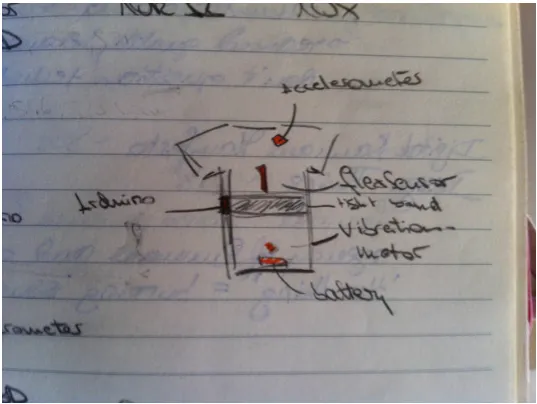
type, takes this to a new extreme. A stretch sensor attached to the front shoulders measures whether it is being stretched to a certain degree, indi-cating correct posture / shoulder position. If this is not the case, a motor is activated that pulls loops around the shoulders back and down. The concept is illustrated in Figure19.
3.2.4 Necklace and earring set for forward-head detection
3.3 rapid prototyping session 35
magnets. The distance between the sensor and the magnet determines the wearers posture.
3.3
rapid prototyping session
The initial exchange with Kristin led to a rapid prototyping session to gain understanding of the explorations she already made and potentially gain further insights. In this session, we first recreated her experiment by simply holding a piezoresistive flex sensor to the sternum. After posing in various forms of poor posture, the issue of attachment to the body was addressed.
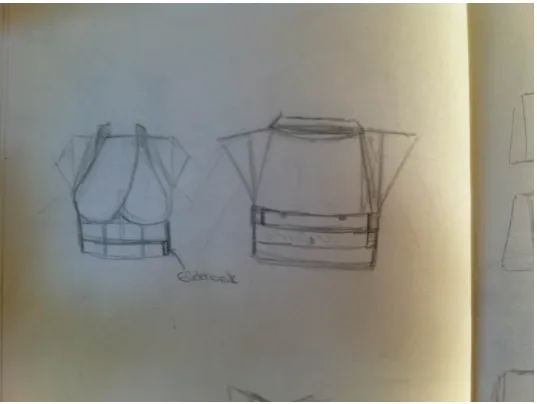
To suit the female body shape, the sensor was embedded into a cone-shaped piece of fabric, which was then attached to an elastic underbust belt. Wear-ing this construct confirmed the difficulty of attachWear-ing the sensor firmly on the sternum location. Two thin elastic bands reaching from the top of the cone around the neck were used to correct this. This design however was found to be inappropriate for comfort as well as aesthetic reasons.
As an alternative method of sensing posture, using a stretch sensor to mea-sure distance between the shoulder blades was tested. We found it to be capable of detecting poor shoulder position. However, it seemed that this type of sensor might miss certain forms of poor posture. It was concluded that it might be useful to use a stretch sensor in the shoulder area to aug-ment measuring at the flexpoint using a flex sensor.
Finally, the topic of appropriate and desirable feedback was addressed. All options as presented in Section2.1.2were discussed. Vibration seemed most
appropriate given its low level of obtrusiveness. For rapid testing, vibrating electronic toothbrushes were used. By holding a toothbrush to different points along the spine, several potential locations for feedback were identi-fied.
3.4
conclusion: statement of the product idea
Based on the insights drawn from the context and ideation phase, the prod-uct idea is formulated as:
“A garment which measures posture based on the flexpoint hypothesis and provides real-time feedback to the wearer for wellness applications.” The reasoning of this idea, which already includes certain design decisions, is described in the following paragraphs:
a garment As discussed in Chapter 2, a wearable device or smart
gar-ment is suitable for posture monitoring as it is location independent and allows for continuous observation and feedback.
which measures posture based on the flexpoint hypothesis As dis-cussed in Chapter 2, posture has a profound impact on both physiological
distinction from prior work as reported in Chapter2. A rapid prototyping
session has confirmed the potential of the hypothesis. This work sets out to further investigate the existence of the flexpoint and its location.
and provides real-time feedback to the wearer Real-time feedback on posture can improve overall posture and reduce posture related discom-forts, as explained in Chapter 2. By learning how correct posture feels,
muscle memory can be trained so that it becomes more natural to sustain a correct posture over time. Which output modalities are most appropriate for the given product is one of the questions investigated in this work.
for wellness applications As pointed out in Chapter 2, the wellness
sector is particularly interesting for the development of such a product. Not only has posture influence on several aspects of general wellness, but the sector also aims at prevention of discomforts, such as the ones that could be caused by ongoing poor posture. A wellness application also entails that the product should be comfortable and that feedback should serve as a ’gentle reminder’, rather than a punishment for negative behaviour.
![Figure 3: Demands of the body [25]](https://thumb-us.123doks.com/thumbv2/123dok_us/9793710.480531/22.595.174.495.70.297/figure-demands-of-the-body.webp)