http://wrap.warwick.ac.uk
Original citation:
Krokhin, A. A. and Larose, B. (2004) Maximum constraint satisfaction on diamonds.
University of Warwick. Department of Computer Science. (Department of Computer
Science Research report). CS-RR-408
Permanent WRAP url:
http://wrap.warwick.ac.uk/61323
Copyright and reuse:
The Warwick Research Archive Portal (WRAP) makes this work by researchers of the
University of Warwick available open access under the following conditions. Copyright ©
and all moral rights to the version of the paper presented here belong to the individual
author(s) and/or other copyright owners. To the extent reasonable and practicable the
material made available in WRAP has been checked for eligibility before being made
available.
Copies of full items can be used for personal research or study, educational, or
not-for-profit purposes without prior permission or charge. Provided that the authors, title and
full bibliographic details are credited, a hyperlink and/or URL is given for the original
metadata page and the content is not changed in any way.
A note on versions:
The version presented here is a working paper or pre-print that may be later published
elsewhere. If a published version is known of, the above WRAP url will contain details
on finding it.
Andrei Krokhin1 and Benoit Larose2
1
Department of Computer Science University of Durham Durham, DH1 3LE, UK
2
Department of Mathematics and Statistics Concordia University
Montr´eal, Qc, Canada, H3G 1M8
Abstract. In this paper we study the complexity of the (weighted) max-imum constraint satisfaction problem (Max CSP) over an arbitrary fi-nite domain. In this problem, one is given a collection of weighted con-straints on overlapping sets of variables, and the goal is to find an as-signment of values to the variables so as to maximize the total weight of satisfied constraints.Max Cut is a typical example of aMax CSP
problem.Max CSPisNP-hard in general; however, some restrictions on
the form of constraints may ensure tractability. Recent results indicate that there is a connection between tractability of such restricted prob-lems and supermodularity of the allowed constraint types with respect to some lattice ordering of the domain. We prove several results confirm-ing this. Diamonds are the smallest lattices in terms of the number of comparabilities, and so are as unordered as a lattice can possibly be. In the present paper, we study Max CSP on diamond-ordered domains.
We show that if all allowed constraints are supermodular with respect to such an ordering then the problem can be solved in polynomial (in fact, in cubic) time. We also prove a partial converse: if the set of allowed constraints includes a certain small family of binary supermodular con-straints on such a lattice, then the problem is tractable if and only if all of the allowed constraints are supermodular; otherwise, it isNP-hard.
Keywords: maximum constraint satisfaction problem, complexity, algorithms, supermodularity, lattice order
1
Introduction
The main object of our study in this paper is the maximum constraint satis-faction problem (Max CSP) where one is given a collection of constraints on
can be represented in this framework, and it can also be used to model optimiza-tion problems arising in more applied settings, such as database design [11].
The Max-CSP framework has been well-studied in the Boolean case, that is, when the set of values for the variables is{0,1}. Many fundamental results have been obtained, containing both complexity classifications and approximation properties (see, e.g., [10, 18, 20]). In the non-Boolean case, a number of results have been obtained that concern approximation properties (see, e.g., [11, 14]). However, the study of efficient exact algorithms and complexity for subproblems of non-BooleanMax CSPhas started only very recently [8, 21], and the present
paper is a contribution towards this line of research.
We study a standard parameterized version of theMax CSP, in which
re-strictions may be imposed on the types of constraints allowed in the instances. The most well-known examples of such problems areMaxk-SatandMax Cut.
In particular, we investigate which restrictions make such problemstractable, by allowing a polynomial time algorithm to find an optimal assignment. This set-ting (in several variations) has been extensively studied and completely classified in the Boolean case [6, 10, 20]. In contrast, we consider here the case where the set of possible values is an arbitrary finiteset. Let us now formally define these problems.
LetD denote afiniteset with|D|>1. Let R(Dm) denote the set of allm-ary
predicatesoverD, that is, functions fromDmto{0,1}, and letRD=S∞m=1R (m)
D .
Also, let Z+denote the set of all non-negative integers.
Definition 1. A constraint over a set of variables V ={x1, x2, . . . , xn} is an
expression of the form f(x) where
– f ∈R(Dm)is called theconstraint predicate; and – x= (xi1, . . . , xim) is called theconstraint scope.
The constraintf is said to besatisfied on a tuple a= (ai1, . . . , aim)∈D
m if
f(a) = 1.
Definition 2. For a finite F ⊆ RD, an instance of Max CSP(F) is a pair
(V, C)where
– V ={x1, . . . , xn} is a set of variables taking their values from the setD;
– C is a collection of constraintsf1(x1), . . . , fq(xq) overV, wherefi∈ F for
all1≤i≤q; each constraintfi(xi)is assigned a weight̺i∈Z+.
The goal is to find an assignment φ:V →D that maximizes the total weight of satisfied constraints, that is, to maximize the function f :Dn →Z+, defined by
f(x1, . . . , xn) =
Pq
i=1̺i·fi(xi).
Example 1. The Max Cut problem is the problem of partitioning the set of
vertices of a given undirected graph with weighted edges into two subsets so as to maximize the total weight of edges with ends being in different subsets. Letneq2
be the binary predicate on{0,1}such that neq2(x, y) = 1⇔x6=y. ThenMax
Cutproblem is the same asMax CSP({neq2}). To see this, think of vertices of
a given graph as of variables, and apply the predicate to every pair of variables
x, y such that (x, y) is an edge in the graph. Letfdicut be the binary predicate
on{0,1} such thatfdicut(x, y) = 1⇔x= 0, y = 1. ThenMax CSP({fdicut})
is essentially the problemMax Dicut which is the problem of partitioning the
vertices of a digraph with weighted arcs into two subsets V0 and V1 so as to
maximize the total weight of arcs going from V0 to V1. It is well known that
bothMax Cut andMax DicutareNP-hard.
The main research problem we will study in this paper is the following:
Problem 1. What are the setsF such thatMax CSP(F) is tractable?
For the Boolean case, Problem 1 was solved in [9]. It appears that Boolean problems Max CSP(F) exhibit a dichotomy in that such a problem either is
solvable exactly in polynomial time or else isNP-hard (which cannot be taken for granted because of Ladner’s theorem). The paper [9] also describes the boundary between the two cases.
Versions of Problem 1 for other non-Boolean constraint problems (including decision, quantified, and counting problems) have been actively studied in the last years, with many classification results obtained (see, e.g., [1–4, 17]). Expe-rience in the study of various forms of constraint satisfaction (see, e.g., [2, 3]) has shown that the more general form of such problems, in which the domain is an arbitrary finite set, is often considerably more difficult to analyze than the Boolean case.
The algebraic combinatorial property of supermodularity (see Section 2) is a well-known source of tractable maximization problems [5, 15]. In combinatorial optimization, this property (or the dual property of submodularity) is usually considered on subsets of a set or on distributive lattices [5, 19]. However, it can be considered on arbitrary lattices, and this has proved useful in operational re-search [22]. Very recently [8], this general form of supermodularity was proposed as the main tool in tackling Problem 1. Indeed, for |D|= 2, this property was shown [8] to completely characterize the tractable cases of Max CSP
(origi-nally, the characterization was obtained [9] in a different form), and moreover, this property also essentially characterizes the tractable cases for|D|= 3 [21].
Interestingly, the relevance of an ordering of the domain is not suggested in any way by the formulation of Problem 1. In this paper we further investigate the role of ordering in the study of Max CSP, and then we determine the
complexity of Max CSPassuming that the domain has a lattice ordering, but
the order is a diamond order, that is, it is as loose as a lattice order can possibly be.
clarify the role that ordering plays in this approach. In Section 4 we describe the structure of supermodular predicates on diamonds, which we use in Section 5 to show thatMax CSPwith such constraints can be solved in cubic time. In
Sec-tion 6 we show that a certain small set of supermodular constraints on diamonds gives rise toNP-hard problems when extended with any non-supermodular con-straint.
2
Preliminaries
In this section we discuss the well-known combinatorial algebraic property of supermodularity [22] which will play a crucial role in classifying the complexity ofMax CSPproblems.
A partial order on a setDis called alattice orderif, for everyx, y∈D, there exists a greatest lower boundx⊓y(called themeetofaandb) and a least upper boundx⊔y (called thejoin). The corresponding algebraL= (D,⊓,⊔) is called alattice. It is well-known that any finite latticeLhas a greatest element 1L and
a least element 0L. A lattice is calleddistributive (also known as aring family)
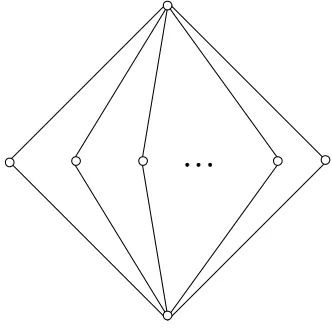
if it can be represented by subsets of a set, the operations being set-theoretic intersection and union. Ann-diamond(or simply a diamond), denotedMn, is a
lattice on an (n+ 2)-element set such that allnelements inMn\ {0Mn,1Mn}
[image:5.595.224.390.401.565.2]are pairwise incomparable. The Hasse diagram of Mn is given in Fig. 1. Since
Fig. 1.A diamond latticeMn.
every element of any lattice must be comparable with both the top and the bottom elements, diamonds are as unordered as lattices can possibly be. The middle elements ofMn are calledatoms. Note that, for every distinct atoms a
that a distributive lattice cannot containM3 (and hence any Mn with n≥3)
as a sublattice. In the literature (e.g., [12]), the lattice M3 is often called the
diamond. For more information on lattices and orders, see [12].
For tuplesa= (a1, . . . , an),b= (b1, . . . , bn) inDn, leta⊓banda⊔bdenote
the tuples (a1⊓b1, . . . , an⊓bn) and (a1⊔b1, . . . , an⊔bn), respectively.
Definition 3. Let L be a lattice onD. A function f :Dn →Ris called super-modular onL if it satisfies
f(a) +f(b)≤f(a⊓b) +f(a⊔b) (1)
for all a,b ∈ Dn, and f is called submodular on L if the inverse inequality
holds. The set of all supermodular predicates on Lwill be denoted SpmodL.
It is easy to see that f is supermodular on a lattice if and only if −f is submodular on it. Also, it follows directly from the definition that f is super-modular on Lif and only if it is supermodular on its dual latticeL∂ (obtained
by reversing the order).
The standard definition of sub- and supermodular (set) functions [5, 15] cor-responds to the special case of the above definition when |D|= 2. Recall that a chain is a totally ordered lattice. Sub- and supermodular functions on finite chains have been studied in combinatorial optimization under the name of Monge and inverse Monge matrices and arrays (see survey [5]). Note that chains and diamonds represent “opposite” types of lattices: chains have all possible compa-rabilities, while diamonds have as few comparabilities as possible.
The following results have been previously obtained in classifying the com-plexity of Max CSP.
Theorem 1 ([8]).IfF is supermodular on some distributive lattice onD, then
Max CSP(F)is tractable.
Call a problemMax CSP(F)trivialif, for somea∈D, f(a, . . . , a) = 1 for
allf ∈ F (clearly, in this case all constraints in any instance can be satisfied).
Theorem 2 ([8, 10]).LetD={0,1},F ⊆RD, and assume thatMax CSP(F)
is non-trivial. If F ⊆ SpmodC for some chain C on D then Max CSP(F) is
tractable. Otherwise, Max CSP(F)isNP-hard.
Call a valued ∈ D redundant for F if, when replacing this value by some other (fixed) value in any assignmentφ, one would satisfy all constraints satisfied byφ. Hence, ifdis redundant for F then it can be ignored andMax CSP(F)
reduces to a similar problem over domain D\ {d}.
Theorem 3 ([21]). Let D = {0,1,2}, F ⊆ RD, and assume that there are
no redundant values for F. If F ⊆ SpmodC for some chain C on D then
In the next section we will show that Theorems 2 and 3 (as stated) cannot be generalized to larger domains because non-chain lattices must also play a role.
Proofs of all theorems cited above in this section enjoyed support of known re-sults on classical submodular (set) functions and on Monge matrices and arrays. However, if we are unable to represent the lattice operations by set-theoretic ones then the analysis of supermodular functions becomes significantly more difficult. We will now consider a form of supermodular constraints that can be defined on any lattice.
Definition 4. A predicatef ∈R(Dn)will be called2-monotone3on a posetP on
D if it can be expressed as follows
f(x) = 1⇔((xi1 ⊑ai1)∧. . .∧(xis⊑ais))∨((xj1⊒bji)∧. . .∧(xjt ⊒bjt)) (2)
where x= (x1, . . . , xn),ai1, . . . , ais, bj1, . . . , bjt ∈D, and either of the two
dis-juncts may be empty (i.e., the value ofs ort may be zero).
It is straightforward to check every 2-monotone predicate on a lattice is supermodular on it. The next theorem is, to the best of our knowledge, the only one available on the complexity of supermodular constraints on arbitrary lattices.
Theorem 4 ([8]). Let L be a lattice on a finite set D. If F consists of 2-monotone predicates onL, thenMax CSP(F) is tractable.
3
The role of ordering
In this section we prove results clarifying the role of ordering in the analysis of the complexity of Max CSP and of the structure of supermodular predicates
on lattices.
The next proposition shows that Theorem 4 cannot be generalized to non-lattice posets, and, therefore, non-lattice orders seem to play a special role in the study ofMax CSP.
Proposition 1. Let P be a non-lattice poset. IfF contains all at most binary 2-monotone constraints onP then Max CSP(F) isNP-hard.
Proof. SinceP is not a lattice, there are two elementsa, bin P which either do not have a greatest lower bound or do not have a least upper bound. Assume thata⊓bdoes not exist, the other case is dual. Consider first the case whenaand
bhave no common lower bound at all. It is easy to see that, in this case,aandb
can be chosen to be minimal elements inP. Then it is easy to see that the binary predicate (x⊑a)∧(y ⊑ b) is 2-monotone on P and, moreover, this predicate is satisfied on a unique tuple which is (a, b). Hence this predicate can simulate
fdicut (see Example 1), and the problem is NP-hard. Let us now consider the
3
case whenaand bhave a common lower bound. It then follows that they have two maximal common lower boundsc andd. LetP′ be the subposet ofP such
thatx∈ P′ ⇔(x⊒c)∧(x⊒d). Clearly,P′ is non-empty, since it contains both
aand b. Moreover, P′ is not a lattice, since, by the choice ofc, d, the elements
aandbhave no common lower bound (and, in fact, are minimal) inP′.
Now we reduceMax CSP({fdicut}) toMax CSP(F). Assume that the
do-main for Max CSP({fdicut}) is{a, b}where aplays the role of 0 andbthat of
1. Letg ∈ F be such thatg(x, y) = 1⇔[(x⊑a)∧(y⊑b)]. Take an arbitrary instanceIofMax CSP({fdicut}). LetW be the total weight of all constraints in
I, plus 1. Modify I to an instanceI′ ofMax CSP(F) as follows: replace every
constraintfdicut(x, y) byg(x, y) with the same weight, and, for every variablex
inI, add constraintsx⊒candx⊒dwith weightW each. It is easy to see that any optimal solution to I is also an optimal solution to I′. It is clear that the
large-weight constraints force all values in an optimal solution toI′ to be inP′.
Moreover, the choice ofg implies that there is always an optimal solution toI′
which uses only values aandb. Clearly, this solution would also be optimal for
I. ⊓⊔
The next proposition shows that classes of supermodular predicates on two different lattices are pairwise incomparable, up to duality. As a consequence, if we want to prove that supermodularity on lattices gives rise to tractable Max CSPproblems then we cannot excludeanylattice from our analysis (except that
mutually dual lattices can be identified).
Proposition 2. LetL1 andL2be finite lattices on the same base set, andL16= L2,L∂2. Then there exists an at most binary predicatef which is 2-monotone on L1 but not supermodular onL2.
Proof. Fori= 1,2, let⊑i,⊓iand⊔i denote the order and the operations ofLi,
respectively.
Suppose first that there exists a pair of elements{a, b}that are incomparable in L1 but a < b in L2. Consider the predicate f defined by f(x, y) = 1 if and
only if (x, y) ≥1 (a, b) or (x, y) ≤1 (b, a). Then f is 2-monotone on L1, and
f(a, a) =f(b, b) = 0 shows that it is not supermodular onL2.
Now we consider the case where every pair comparable inL2 is also
compa-rable inL1. There are two possibilities: (i) suppose there exist elementsa, b, c, d
such thata <1banda <2b, and alsoc <1dandd <2c. Consider the predicate
f defined byf(x, y) = 1 if and only if (x, y)≤1(a, c). Obviously, it is 2-monotone
onL1. However, inL2we have that (a, c)⊔2(b, d) = (b, c), (a, c)⊓2(b, d) = (a, d),
andf(a, d) +f(b, c) = 0 whilef(a, c) +f(b, d) = 1 sof is not supermodular on
L2.
(ii) It remains to check the case whereL1is an extension ofL2 orL∂2. Since
obviously a predicate is supermodular (2-monotone) on a lattice if and only if it is supermodular (2-monotone) on its dual, it suffices to consider, without loss of generality, the case where L1 is an extension of L2. There exists a pair of
elements u≤1 v that are incomparable in L2: then the predicatef defined by
if w = u⊔2 v then v <2 w implies that v <1 w and hence f(w) = 0 while
f(u) +f(v) = 2. ⊓⊔
Now we are able to show that Theorems 2 and 3 (as stated above) cannot be generalized to larger domains.
Corollary 1. If |D| ≥4 then there existsF ⊆RD such thatMax CSP(F)is
tractable but F 6⊆SpmodC for any chainC on D.
Proof. LetL be the following lattice onD: arbitrarily choose the top element, then choose two other elements and make them incomparable, then let all other elements form a chain lying below the first three elements. It is easy to see that, for |D| ≥ 4,L is a distributive lattice which is not a chain. By Proposition 2, the setF of all binary predicates onLis not supermodular on any chain onD.
HoweverMax CSP(F) is tractable by Theorem 1. ⊓⊔
4
The structure of supermodular predicates on diamonds
In the rest of this paper we consider supermodular constraints on diamondsMn
which are non-distributive lattices when n ≥ 3. Throughout the rest of this paper, letLbe an arbitrary (fixed)n-diamond,n≥2.
In this section, we describe the structure of supermodular predicates onLby representing them as logical formulas involving constants (elements of L) and the order relation⊑ofL.
For a subsetD′ ⊆D, letuD′ denote the predicate such that u
D′(x) = 1⇔
x∈D′. The following lemma can be easily derived directly from the definition of supermodularity.
Lemma 1. A unary predicate uD′ is in Spmod
L if and only if either both
0L,1L∈D′ or else |D′| ≤2 and at least one of 0L,1L is in D′.
Theorem 5. Every predicate f(x1, . . . , xn)in SpmodL, such that f takes both
values 0 and 1, can be represented as one of the following logical implications:
1. [(xi⊑a1)∨. . .∨(xi⊑al)] =⇒ (xi⊑0L)where theaj’s are atoms;
2. ¬(y⊒c) =⇒ (z⊑d)whereyandzare some subsequences of(x1, . . . , xn),
andc, dare tuples of elements of L (of corresponding length) such that c
contains no0L anddno1L;
3. [(xi ⊑b1)∨ · · · ∨(xi ⊑bk)∨ ¬(y ⊒ c)] =⇒ (xi ⊑a) where the bj’s are
atoms,y does not containxi, anda6= 1L;
4. ¬(xi⊒b) =⇒ [¬(xi⊒a1)∧ · · · ∧ ¬(xi⊒al)∧(y⊑c)] where theaj’s are
atoms,y does not containxi, andb6= 0L;
5. ¬(y⊒c) =⇒ falsewhereyis a subsequence of(x1, . . . , xn)andccontains
no0L;
6. true =⇒ (y⊑c) wherey is a subsequence of(x1, . . . , xn) andccontains
Conversely, every predicate that can be represented in one of the above forms belongs toSpmodL.
Example 2. The unary predicate of type (1) above is the same as uD′ where
D′ = D\ {a1, . . . , al}. The predicates uD′ ∈ Spmod
L with |D′| ≤ 2 are the
unary predicates of types (5) and (6).
Remark 1. Note that constraints of types (2),(5), and (6) are 2-monotone onL, while constraints of types (3) and (4) (and most of those of type (1)) are not.
Proof. It is straightforward to verify that all the predicates in the list are actually supermodular. Now we prove the converse. Consider first the case where the pred-icatef is essentially unary, i.e., there is a variablexi such thatf(x1, . . . , xn) =
uD′(xi) for some D′ D. If D′ ={x: x⊑a} or D′ ={x: x⊒a} for some
atomathen f is of the form (5) or (6); otherwise both 0L and 1L are in D′ by
Lemma 1, and if a1, . . . , al denote the atoms of the lattice that are not in D′,
then it is clear thatf is described by the implication (1).
Now we may assume thatf is not essentially unary. If it is 2-monotone, then it is easy to see that f must be described by an implication of type (2), (5) or (6). So now we assume thatf is not essentially unary and it is not 2-monotone; we prove that it is described by an implication of type (3) or (4). We require a few claims:
Claim 0.The setX of all tuplesusuch thatf(u) = 1is a sublattice ofLn, i.e.
is closed under join and meet.
This follows immediately from the supermodularity off.
Claim 1.There exist indices 1≤i1, . . . , ik, j1, . . . , jl≤n, atomse1, . . . , ek and
b1, . . . , bl ofL such that f(x) = 1 if and only if
[¬(xi1 ⊒e1)∧ · · · ∧ ¬(xik ⊒ek)]
_
[¬(xj1 ⊑b1)∧ · · · ∧ ¬(xjl⊑bl)].
Notice first that the set Z of tuplesusuch that f(u) = 0 is convexin Ln,
i.e. if u ⊑ v ⊑ w with f(u) = f(w) = 0 then f(v) = 0. To show this we construct a tuplev′ as follows: for each coordinateiit is easy to find an element
vi′ such that vi⊓vi′=ui andvi⊔vi′ =wi. Hencev⊓v′=uandv⊔v′ =w so
by supermodularity of f neitherv nor v′ is in X. It follows in particular that
neither 0Ln nor 1Ln is inZ; indeed, if 0Ln∈Z, letabe the smallest element in
X (the meet of all elements inX), which exists by Claim 0. SinceZ is convex it follows that every element aboveais inX so f is 2-monotone, a contradiction. The argument for 1Ln is identical.
Now letw∈Z be minimal, and letv⊑w. As above we can find a tuplev′
such thatv⊔v′=w; by supermodularity off it follows thatv=w orv′=w.
It is easy to deduce from this that there exists a coordinate s such that ws is
an atom of L and wt= 0L for all t 6=s. A similar argument shows that every
Since Z is convex, we have that f(x) = 0 if and only if x is above some minimal element of Z and below some maximal element of Z; Claim 1 then follows immediately.
For each index i ∈ {i1, . . . , ik} that appears in the expression in Claim 1,
there is a corresponding condition of the form
¬(xi⊒es1)∧ · · · ∧ ¬(xi⊒esr);
let Ii denote the set of elements of L that satisfy this condition. Obviously
it cannot contain 1L and must contain 0L. Similarly, define for each indexj ∈ {j1, . . . , jl}the setFjof all elements ofLthat satisfy the corresponding condition
of the form
¬(xj⊑bt1)∧ · · · ∧ ¬(xj⊑btq);
it is clear that 0L6∈Fj and 1L ∈Fj.
The condition of Claim 1 can now be rephrased as follows:f(x) = 1if and only if xi ∈ Ii for all i ∈ {i1, . . . , ik} or xj ∈ Fj for all j ∈ {j1, . . . , jl}. It is
straightforward to verify that sincef is not 2-monotone, one of theIi or one of
theFj must contain 2 distinct atoms. We consider the first case, and we show
that the predicatef is of type (4). The case where someFj contains two atoms
is dual and will yield type (3).
Claim 2.Suppose thatIicontains distinct atomscanddfor somei∈ {i1, . . . , ik}.
Then (a)iis the only index with this property, (b){j1, . . . , jl}={i}and (c)Fi
does not contain 2 distinct atoms.
We prove (b) first. We have that
f(0L, . . . ,0L, c,0L, . . . ,0L) =f(0L, . . . ,0L, d,0L, . . . ,0L) = 1
(where c and d appear in the i-th position) and by supermodularity it follows thatf(0L, . . . ,0L,1L,0L, . . . ,0L) = 1 also. SinceIidoes not contain 1L, we have
that xj ∈ Fj for each j ∈ {j1, . . . , jl}; sinceFj never contains 0L, (b) follows
immediately. Since{j1, . . . , jl} is non-empty, (a) follows immediately from (b).
Finally, ifFicontained distinct atoms then by dualising the preceding argument
we would obtain that{i1, . . . , ik}={i}from which it would follow thatf would
be essentially unary, contrary to our assumption. This concludes the proof of the claim.
Letb denote the minimal element inFi, and for each indexs∈ {i1, . . . , ik}
different fromi letcs denote the (unique) maximal element ofIs; then we can
describef as follows:f(x) = 1 if and only if
[xi∈Ii∧(y⊑c)]∨(xi⊒b)
whereyis a tuple of variables different fromxi andcis the tuple whose entries
are thecsdefined previously. It remains to rewrite the conditionxi∈Ii. Suppose
first that there exists at least one atom ofLoutsideIi, and leta1, . . . , aldenote
as an implication). Now for the last possibility, whereIicontains all ofDexcept
1L; then it is easy to see thatf can be described by the following:
[¬(xi⊒b)∧(y⊑c)]∨(xi⊒b)
and this completes the proof of the theorem. ⊓⊔
We remark that the preceding theorem can be extended to give a similar characterisation of the supermodular constraints on lattices in the larger class of so-calledrelatively complemented lattices.
5
Supermodular constraints on diamonds are tractable
In this section we prove the main tractability result of this paper.
Theorem 6. If F ⊆SpmodL thenMax CSP(F)can be solved (to optimality)
inO(t3· |L|3+q3)time wheret is the number of variables andqis the number
of constraints in an instance.
Construction.
Let F ⊆SpmodL. LetI ={ρ1·f1(x1), . . . , ρq ·fq(xq)}, q≥1, be an instance
of weightedMax CSP(F), over a set of variablesV ={x1, . . . , xt}, and let∞
denote an integer greater thanPρi. For each constraintfi, fix a representation
as described in Theorem 5. In the following construction, we will refer to the type offiwhich will be a number from 1 to 6 according to the type of representation.
Every condition of the form (y ⊑ c) will be read as V(xis⊑cis), and every
condition of the form ¬(y ⊒ c) as W¬(xis⊒cis), where is runs through the
indices of variables in y. Moreover, we replace every (sub)formula of the form
¬(x⊒1L) byWni=1¬(x⊒ai) wherea1, . . . , an are the atoms ofL.
We construct a digraphGI as follows:
– The vertices ofGI are as follows
• {T, F} ∪ {xd |x∈V, d∈ L} ∪ {x¯d|x∈V, d∈ Lis an atom} ∪ {ei,e¯i |
i= 1,2, . . . , q}4.
For eachfi of type (5), we identify the vertexei withF. Similarly, for each
fi of type (6), we identify the vertex ¯ei withT.
– The arcs ofGI are defined as follows:
• For each atomcinLand for eachx∈V, there is an arc fromx0L toxc
with weight∞, and an arc from ¯xc tox1L with weight∞;
• For each pair of distinct atomsc, din Land for eachx∈V, there is an arc fromxc to ¯xd with weight∞;
• For eachfi, there is an arc from ¯ei toei with weight ρi;
• For eachfi of types (1-4), and each subformula of the form (x⊑a) or
¬(x⊒ a) in the consequent of fi, there is an arc from ei to xa or ¯xa,
respectively, with weight∞;
4
• For each fi of types (1-4), and each subformula of the form (x ⊑ a)
or ¬(x ⊒ a) in the antecedent of fi, there is an arc from xa or ¯xa,
respectively, to ¯ei, with weight∞;
• For eachfiof type (5), and each subformula of the form ¬(x⊒a) in it,
there is an arc from ¯xa to ¯ei with weight ∞;
• For eachfi of type (6), and each subformula of the form (x⊑a) in it,
there is an arc fromei toxa with weight ∞;
Arcs with weight less than∞will be calledconstraintarcs.
It is easy to see thatGI is a digraph with sourceT (corresponding totrue)
and sink F (corresponding to false). Note that paths of non-constraint arcs between vertices corresponding to any given variablex∈V precisely correspond to logical implications that hold between the corresponding assertions.
Proof. We will show how the problem can be reduced to the well-known tractable problemMin Cut.
Let I = {ρ1 ·f1(x1), . . . , ρq ·fq(xq)}, q ≥ 1, be an instance of weighted Max CSP(F), over a set of variablesV ={x1, , . . . , , xn}.
Define thedeficiencyof an assignment φ as the difference betweenPqi=1ρi
and the evaluation of φ on I. In other words, the deficiency of φ is the total weight of constraints not satisfied byφ. We will prove that minimal cuts inGI
exactly correspond to optimal assignments to I. More precisely, we will show that, for each minimal cut in GI with weight ρ, there is an assignment for I
with deficiency at mostρ, and, for each assignment toI with deficiencyρ′, there is a cut inGI with weightρ′.
The semantics of the construction ofGIwill be as follows: the vertices of the
form xa or ¯xa correspond to assertions of the form x⊑aor ¬(x⊒a),
respec-tively, and arcs denote implications about these assertions. Given a minimal cut inGI, we will call a vertexxareachingifFcan be reached from it without
cross-ing the cut. Furthermore, if a vertexxa is reaching then this will designate that
the corresponding assertion is false, and otherwise the corresponding assertion is true. A constraint is not satisfied if and only if the corresponding constraint arc crosses the cut.
LetC be a minimal cut in GI. Obviously, C contains only constraint arcs.
First we show that, for every variablex∈V, there is a unique minimal element
a∈ Lsuch that xa is non-reaching. All we need to show is the following: ifc, d
are distinct atoms such that both xc and xd are both non-reaching then so is
x0L. Assume that, on the contrary, x0L is reaching. Then there is a path from
x0L toF not crossing the cut. By examining the arcs ofGI, it is easy to notice
that such a path has to go through a vertex ¯xa for some atoma∈ L. However,
we have an arc from at least one of verticesxc, xd to ¯xa, and hence at least one
of this vertices would have a path toF not crossing the cut, a contradiction. Note that, for everyx∈V, there no arcs coming out ofx1L. Hence, for every
Define an assignmentφC as follows:
φC(x) is the unique minimal element asuch thatxa is non-reaching.
We now make some observations. Note that, for all x∈V anda∈ L, we have thatφC(x)⊑aif and onlyxa is non-reaching. Moreover, if ¯xa is reaching then,
for each atomb6=a, we have an arc fromxbto ¯xameaning thatφC(x)6⊑b, and
henceφC(x)⊒a. Furthermore, if ¯xa is non-reaching thenφC(x)6=a. Indeed, if
φC(x) =a then xb is reaching for all atomsb 6=a, and, since every path from
xb to F has to go through a vertex ¯xc for somec, we have that ¯xc is reaching.
Thenc6=a, and there is an arc fromxa to ¯xc, soxa is reaching, a contradiction.
To summarize,
– if a node of the formxa or ¯xa is reaching then the corresponding assertion
is falsified by the assignmentφC;
– if a node of the formxa is non-reaching thenφC(x)⊑a;
– if a node of the form ¯xa is non-reaching then the truth value of the
corre-sponding assertion is undecided.
Suppose that a constraint arc corresponding to a constraintfi is not in the
cut. We claim thatfi is satisfied by the assignmentφC. To show this, we will go
through the possible types offi.
If fi is of type (1), (2), (5), or (6), then the claim is straightforward. For
example, let fi be of type (1). If the nodex0L corresponding to the consequent
is reaching, then so are all nodes corresponding to the antecedent. Hence, all atomic formulas are falsified by the assignmentφC, and the implication is true.
Ifx0L is non-reaching, then φC(x) = 0L, and the constraint is clearly satisfied.
The argument for types (2), (5), (6) is very similar.
Letfi be of type (3). Then, if the node corresponding to the consequent is
non-reaching then the consequent is satisfied by φC, and so the constraint is
satisfied. If this node is reaching then every node corresponding to the disjuncts in the antecedent is reaching. Then both antecedent and consequent are falsified byφC, and the constraint is satisfied.
Letfi be of type (4), that is, of the form
¬(xi⊒b) =⇒ [¬(xi ⊒a1)∧ · · · ∧ ¬(xi⊒al)∧(y⊑c)].
If a node corresponding to some conjunct in the consequent is reaching, then the node corresponding to the antecedent is also reaching. SoφC(xi)⊒b, and
the constraint is satisfied. More generally, if the node corresponding to the an-tecedent is reaching then the constraint is satisfied regardless of what happens with the consequent. Assume that all nodes corresponding to conjuncts in the consequent and in the antecedent are non-reaching. Then the conjunct (y⊑c) is satisfied by φC. Furthermore, we know (see the observations above) that
φC(xi) 6= b, and also that φC(xi) =6 as for 1 ≤ s ≤ l. If φC(xi) = 1L then
both the antecedent and the consequent offi are false, and hencefi is satisfied.
Conversely, letφbe an assignment toI, and letK be the set of constraints inI that are not satisfied by φ. Consider any path fromT toF. It is clear that if all constraints corresponding to constraint arcs on this path are satisfied, then we have a chain of valid implications starting fromtrueand finishing at false. Since this is impossible, at least one constraint corresponding to such an arc is not satisfied by φ. Hence, the constraints arcs corresponding to constraints in
K form a cut inGI. Furthermore, by the choice ofK, the weight of this cut is
equal to the deficiency ofφ.
It follows that the standard algorithm [16] for theMin Cut problem can
be used to find an optimal assignment for any instance of Max CSP(F). This
algorithm runs in O(k3) wherek is the number of vertices in the graph. Since
the number of vertices inGI is at most 2(1 +t· |D|+q), the result follows. ⊓⊔
6
A partial converse
We will now prove a partial converse to Theorem 6.
The following theorem shows that, in order to establish that a given function
f is supermodular on a given lattice, it is sufficient to prove supermodularity of certain unary and binary functions derived fromf by substituting constants for variables. This result was proved in [13] for submodular functions on lattices, but clearly it is also is true for supermodular functions becausef is supermodular if and only if−f is submodular.
Theorem 7 ([13]).An n-ary functionf is supermodular on Lif and only if it satisfies inequality (1) for alla,b∈ Ln such that
– ai =bi with one exception, or
– ai = bi with two exceptions, and, for each i, the elements ai and bi are
comparable inL.
Theorem 8. Let F contain all at most binary 2-monotone predicates on L. If F ⊆ SpmodL then Max CSP(F) is tractable. Otherwise, Max CSP(F) is
NP-hard.
Proof. If F ⊆ SpmodL then the result follows from Theorem 6. Otherwise,
there is a predicatef ∈ F such that f 6∈SpmodL. First, we prove that we can
assumef to be at most binary. By Theorem 7, we can substitute constants for all but at most two variables in such a way that the obtained predicate f′ is
not supermodular on L. We now show thatf′ can be assumed to be inF. We
will consider the case when f′ is binary, the other case (when f′ is unary) is
similar. Assume without loss of generality thatf′(x
1, x2) =f(x1, x2, a1, . . . , ap),
and reduce Max CSP(F ∪ {f′}) to Max CSP(F). Let I be an instance of Max CSP(F ∪ {f′}) and W the total weight of all constraints in I, plus 1.
Transform I into an instanceI′ ofMax CSP(F) as follows:
– replacef′ withf
– keep the same first two variables as in the original constraint – introduce fresh variablesyi
1, . . . , ypi for the lastnvariables.
2. For every new variable ysi introduced in step 1, add
– a constraintysi ⊒as with weightW, and
– a constraintyi
s⊑as, with weightW.
Clearly this transformation can be performed in polynomial time, and the constraints added in step two above ensure that, in every optimal solution to
I′, every variableyi
stakes the valueas. Hence, optimal solutions to I and toI′
precisely correspond to each other. So, indeed,f can be assumed to be at most binary. We consider the two cases separately.
Case 1. f is unary.
By Lemma 1,f =uD′ for some non-emptyD′ ⊆Dsuch that either 0L,1L6∈D′
or else |D′| >2 and at least one of 0L,1L is not in D′. Iff =u{a} where a is
an atom then we choose another atom b and consider the predicate u{1L,a,b}.
Note that the predicate u{1L,b} is 2-monotone on L (and hence belongs to F),
andu{1L,a,b}(x) =u{1L,b}(x) +f(x). Hence, we may assume thatu{1L,a,b}∈ F,
since, in any instance, this predicate can be replaced by the sum above. It follows that we can now assume that f =uD′ where two distinct atoms a, bbelong to
D′, but at least one of 0L,1L (say, 0L) does not. We will show how to reduce
Max CSP({fdicut}) (see Example 1) to Max CSP(F). Assume that the the
domain D for Max CSP({fdicut}) is {a, b} where a plays the role of 0 and b
that of 1. Letg∈ F be such thatg(x, y) = 1⇔[(x⊑a)∧(y⊑b)].
Take an arbitrary instanceIofMax CSP({fdicut}). Replace each constraint
fdicut(x, y) by g(x, y) with the same weight. Let W be the total weight of all
constraints inI plus 1. For every variablexinI, add the constraintf(x) with weightW and denote the obtained instance byI′. Note that any solution toI′
that assigns 0L to any variable is suboptimal because it violates one of the
large-weight constraints. Moreover, if a solution assigns a value d to some variable, andd6∈ {a, b}, thendcan be changed to one ofa, bwithout decreasing the total weight of the solution. Hence, there is an optimal solution toI′ which uses only
valuesaandb. Clearly, this solution is also optimal forI. The other direction is similar, since any optimal solution toI is also an optimal solution toI′, or else
the transformation of solutions toI′ such as described above would produce a
better solution toI. Case 2. f is binary.
Note that, by Theorem 7, if we cannot use case 1 then the tuples a = (a1, a2)
and b= (b1, b2) witnessing non-supermodularity of f can be chosen in such a
way that ai and bi are comparable for i = 1,2. For i = 1,2, define functions
ti:{0,1} → {ai, bi} by the following rule:
– ifai⊏bi thenti(0) =ai andti(1) =bi;
– ifbi⊏ai thenti(0) =bi andti(1) =ai.
Then it is easy to check that the binary function g′ ∈ R{0,1} such that
need unary functions c′0, c′1 on {0,1} which are defined as follows: c′i(x) is 1 if
x=iand 0 otherwise. It follows from Theorem 2 thatMax CSP(F′) on{0,1},
whereF′={g′, c′
0, c′1}, isNP-hard. (Note that that we includec′0, c′1 to ensure
that Max CSP(F′) is non-trivial). We will give a polynomial time reduction
from this problem toMax CSP(F).
In the reduction, we will use functionshi(x, y),i= 1,2, defined by the rule
hi(x, y) = 1⇔((x⊑0)∧(y⊑ti(0)))∨((x⊒1)∧(y⊒ti(1))).
It is easy to see that these functions are 2-monotone on L. In the rest of the proof we identify 0L,1Lwith the corresponding elements 0,1 from the domain of F′. Other functions used in the reduction areu
{0},u{1},u{0,1},u{a1,b1},u{a2,b2}.
By Lemma 1, all these functions are supermodular onL, and, in fact, they are 2-monotone.
Letf′(x
1, , . . . , , xn) =
Pq
i=1ρi·fi′(xi) be an instanceI′ ofMax CSP(F′),
over the set V = {x1, . . . , xn} of variables. Let W =
P
ρi+ 1. Construct an
instanceIofMax CSP(F) containing all variables fromV and further variables
and constraints as follows.
– For every 1≤i≤q such thatfi′(xi) =g′(xj1, xj2), introduce • two new variablesyi
j1, y
i j2, • constraintg(yi
j1, y
i
j2) with weightρi, • constraintsu{a1,b1}(y
i
j1), u{a2,b2}(y
i
j2), each with weightW, • constraintsh1(xj1, y
i
j1), h2(xj2, y
i
j2), each with weightW;
– for every 1≤i≤q such thatfi′(xi) =c′0(xj1), introduce constraint c0(xj1)
with weightρi;
– for every 1≤i≤q such thatfi′(xi) =c′1(xj1), introduce constraint c1(xj1)
with weightρi;
– for every variablexi∈V, introduce constraintc01(xi) with weightW.
It is easy to see thatI can be built fromI′ in polynomial time. Letlbe the
number of constraints with weightW in I.
For every assignmentφ′ to I′, let φbe an assignment to I which coincides
withφ′onV, and, for every variableyi
js (s= 1,2), setφ(y
i
js) =ts(φ ′(x
js)). It is
easy to see thatφsatisfies all constraints of weightW. Moreover, every constraint of the form c′
i(xj1), i ∈ {0,1}, in I
′ is satisfied if and only the corresponding
constraintci(x′j1) inIis satisfied. It follows from the construction of the function
g′ and the choice of functionshi andc01inI that a constraintfi′(xi) inI′ with
the constraint functiong′ is satisfied if and only if the corresponding constraint with constraint functionginI is satisfied. Hence, if the total weight of satisfied constraints inI′isρthen the total weight of satisfied constraints inIisl·W+ρ.
In the other direction, it is easy to see that every optimal assignment φ
to I satisfies all constraints of weight W, therefore its weight is l·W +ρ for some ρ < W. In particular, it follows that φ(x) ∈ {0,1} for every x∈ V. Let
φ′ be an assignment to I′ that is the restriction of φ to V. Then the total
all constraints of the form hi, ¯ci, and c01 are satisfied, that all variables yjis,
s = 1,2, take values in the corresponding sets {as, bs}, and these values can
always be recovered from the values of the variables xjs by using the functions
ts. Thus, optimal assignments toI and toI′ exactly correspond to each other,
and the result follows. ⊓⊔
7
Conclusion
We have proved that the Max CSP problem for constraints that are
super-modular on diamonds is tractable. This is the first result about tractability of all supermodular constraints on non-distributive lattices. One natural ex-tension of this line of research is to establish similar results for other classes of non-distributive lattices. It would interesting to explore methods of proving tractability of Max CSP other than via a reduction to submodular set
func-tion minimizafunc-tion (as in [8]) or via an explicit descripfunc-tion of predicates (as in this paper). Can the technique of multimorphisms [6, 7] be effectively used in the study of non-Boolean Max CSP? Another interesting direction for future
work is to study approximability of hardMax CSPproblems. It is known that,
for |D| ≤3, all hard problems Max CSP(F) are APX-complete [10, 21], that
is, they do not admit a polynomial-time approximation scheme. Is this true for larger domains?
Acknowledgments
Part of this research was conducted when the first author was employed at the University of Warwick, and the second author was visiting this university. This work was partially supported by the UK EPSRC grant GR/T05325/01.
References
1. F. B¨orner, A. Bulatov, P. Jeavons, and A. Krokhin. Quantified constraints: Algo-rithms and complexity. InCSL’03, volume 2803 of LNCS, pages 58–70, 2003. 2. A. Bulatov. A dichotomy theorem for constraints on a 3-element set. InFOCS’02,
pages 649–658, 2002.
3. A. Bulatov. Tractable conservative constraint satisfaction problems. InLICS’03, pages 321–330, 2003.
4. A. Bulatov and V. Dalmau. Towards a dichotomy theorem for the counting con-straint satisfaction problem. InFOCS’03, pages 562–571, 2003.
5. R.E. Burkard, B. Klinz, and R. Rudolf. Perspectives of Monge properties in opti-mization. Discrete Applied Mathematics, 70:95–161, 1996.
6. D. Cohen, M. Cooper, and P. Jeavons. A complete characterization of complexity for Boolean constraint optimization problems. In CP’04, volume 3258 ofLNCS, 2004.
8. D. Cohen, M. Cooper, P. Jeavons, and A. Krokhin. Identifying efficiently solvable cases of Max CSP. InSTACS’04, volume 2996 ofLNCS, pages 152–163, 2004. 9. N. Creignou. A dichotomy theorem for maximum generalized satisfiability
prob-lems. Journal of Computer and System Sciences, 51:511–522, 1995.
10. N. Creignou, S. Khanna, and M. Sudan.Complexity Classifications of Boolean Con-straint Satisfaction Problems, volume 7 ofSIAM Monographs on Discrete Mathe-matics and Applications. 2001.
11. M. Datar, T. Feder, A. Gionis, R. Motwani, and R. Panigrahy. A combinatorial algorithm for MAX CSP. Information Processing Letters, 85(6):307–315, 2003. 12. B.A. Davey and H.A. Priestley. Introduction to Lattices and Order. Cambridge
University Press, 2nd edition, 2002.
13. B.L. Dietrich and A.J. Hoffman. On greedy algorithms, partially ordered sets, and submodular functions. IBM Journal of Research and Development, 47(1):25–30, 2003.
14. L. Engebretsen and V. Guruswami. Is constraint satisfaction over two variables always easy? Random Structures and Algorithms, 25(2):150–178, 2004.
15. S. Fujishige. Submodular Functions and Optimization, volume 47 of Annals of Discrete Mathematics. North-Holland, 1991.
16. A. Goldberg and R.E. Tarjan. A new approach to the maximum flow problem. J. ACM, 35:921–940, 1988.
17. M. Grohe. The complexity of homomorphism and constraint satisfaction problems seen from the other side. InFOCS’03, pages 552–561, 2003.
18. J. H˚astad. Some optimal inapproximability results. J. ACM, 48:798–859, 2001. 19. S. Iwata, L. Fleischer, and S. Fujishige. A combinatorial strongly polynomial
algorithm for minimizing submodular functions. J. ACM, 48(4):761–777, 2001. 20. P. Jonsson. Boolean constraint satisfaction: Complexity results for optimization
problems with arbitrary weights. Theoret. Comput. Sci., 244(1-2):189–203, 2000. 21. P. Jonsson, M. Klasson, and A. Krokhin. The approximability of three-valued Max
CSP. Submitted for publication, 2004.