The Human Capital Scan
A study about implementation and effectiveness of The
Human Capital Scan
UNIVERSITEIT TWENTE.
&
Master thesis
II
UNIVERSITEIT TWENTE.
Faculty School of Management & Governance.
Master Business Administration, track ‘Human Resource Management’
The Human Capital Scan
A study about implementation and effectiveness of The Human Capital Scan
Hengelo, June 6, 2014.
Author:
F. Breukers
Student number:
0210463
Address:
Van Ostadestraat 10
7556 EZ Hengelo (o)
[email protected]
Telephone:
+31652071968
In cooperation with:
VNO-NCW Midden
Supervisors VNO-NCW Midden:
A.F.A. Oostermeijer (Rob)
M.L. Schuijer (Martine)
Supervisors Universiteit Twente: 1
st: J.C. Looise (Jan Kees)
2
nd: A.A.M. Wognum (IDA)
III
Preface
This master thesis is written to complete the master Business Administration at the University of Twente. In cooperation with VNO-NCW Midden I got a unique opportunity to write my master thesis about a topic that is actual and important. This master thesis gave me the opportunity to combine practical problems with literature. A master thesis where practice and theory go hand in hand made it a real challenge. I am thankful that I had the opportunity to pursue this challenge.
The development of the Human Capital Scan started before this master thesis. Paul Franken finished his master thesis about the development of the Human Capital Scan in February 2013. I would like to thank him for his views and insight in the early stages of my start of the master thesis.
I would like to thank Jan Kees Looise as my supervisor of the University of Twente who guided me throughout the period with useful feedback on the content of this master thesis. I would like to thank Ida Wognum as well, as my second supervisor of the University of Twente. As second supervisor, a new fresh pair of eyes gave structural feedback about the outline of the master thesis. The fresh new look on the master thesis improved the structure of the master thesis in general.
At VNO-NCW Midden, I would like to thank Rob Oostermeijer and Martine Schuijer for the opportunity to write my master thesis for VNO-NCW Midden. The support from start till end on all practical aspects has made it possible for the Human Capital Scan to be in the current state it is in now.
Last but not least, I would like to thank all the companies who participated in the case study. I hope in the end, the invested time will be little compared to the results the Human Capital Scan will achieve.
IV
Abstract
VNO-NCW Midden and Universiteit Twente believe that the shortage of (technological) personnel will be more and more problematic in the future. The Human Capital Scan (HCS) is developed to address this problem, by developing a business scan to make businesses and (local) governments aware of this problem. The HCS was developed by P. Franken from the Universiteit Twente in cooperation with VNO-NCW Midden. Different indicators were formed to measure the human capital of a business. The indicators of the content of human capital are: education, training, experience and innovativeness. The indicators related to the flow of human capital are: turnover, internal flow, recruitment, size flexible workforce and age of employees. These indicators map the human capital at businesses to get an overview of the different aspects of human capital. Before the HCS can be applied, theoretical foundations need to be analysed. The theory will discuss business scans in general to get a better understanding followed by applying it to the HCS. A research question is formed and three sub questions are formed answer to research question:
How can business scans be effectively implemented and applied?
I. What is the theoretical foundation of business scans and which criteria does it have to meet?
II. Case study: Does the HCS meet the criteria formulated in the theory?
III. What can be recommended to effectively implement the HCS?
To answer that question, business scans in general are analysed. The action research cycle is one of the main theoretical foundations. Step 0 creating a felt need, step 1 collect data, step 2 share data, step 3 work on data, step 4 plan and step 5 act. After the cycle, the action gets revised and the cycle starts over. But this cycle on itself needs criteria in topic of business scans to make sure the cycle can successfully be applied. These criteria which are formed are based on literature.
1. Motivation, awareness and commitment 2. Environment
3. Role of the facilitator 4. Internal design aspects 5. Feedback and Follow up
V Not only general business scans are analysed on how they can be effectively be implemented and applied but a case study is also formed to put the different criteria and the action research cycle in practice. The HCS, formed by Franken (2013) at VNO-NCW Midden and the University of Twente is tested as a case study. The HCS is developed as web based tool in this case study. The purpose of the case study is to apply the action research cycle and the accompanied criteria (the procedure) in practice. The results of the case study and the answering of the research question are to be used to apply and implement the HCS at VNO-NCW Midden for the businesses of The Netherlands. The main goal is to create awareness and to hand solutions to businesses. Creating metadata and to have a stable product for commercial ends are other goals. Together with Universiteit Twente and VNO-NCW Midden we strive towards achieving these goals.
The case study shows that the ‘felt need’ that needs to be established before businesses participate is a critical point. At the case study various potential respondents did not have the ‘felt need’ to participate and did not recognize the problem. The nature of the case study, which is a pilot, might be demotivating. Another demotivating factor to participate in the pilot is the lack of benchmarking in the pilot. Creating the ‘felt need’ is the most important aspect to initiate the process. When the HCS is launched, the nature of the business scan changes with more opportunities. Promoting the HCS on platforms such as magazines and websites and benchmarking different businesses. Simple word to mouth of different respondents who participated about their experiences is an important aspect as well. The results show the non-response of respondents and shows especially that respondents do not want to invest time yet. Different explanations such as, position of the respondent in the organisation, lack of information at businesses, length and duration of participation regarding the lack of ‘felt need’ will be discussed. Different recommendations will be given regarding the launch of the HCS, in topics such as, benchmarking, subjective and objective questions, the facilitator and the constant change the HCS will be going through.
VI
Tables and contents
Preface ...III Abstract ... IV Tables and contents ... VI
1. Introduction ...1
1.1 The human capital scan ...1
1.2 Thoughtful application and follow up ...2
1.3 Aspects of the research question ...2
1.4 Practical and theoretical relevance ...3
1.5 Outline of the master thesis ...3
2. Theoretical background ...4
2.1 Theoretical foundation of business scans ...4
2.1.1 Introduction in action research ...4
2.1.2 Action research and experiential learning ...5
2.1.3 How does the process of action research work? ...6
2.1.4 Action research and Business scans ...7
2.2 Benchmarking ...8
2.2.1 Benchmarking in general ...8
2.2.2 Pitfalls and limitations of benchmarking ... 11
2.3 Developing criteria’s for implementing business scans ... 12
2.3.1 Motivation, awareness and commitment... 12
2.3.2 Environment ... 14
2.3.3 What is the role of the facilitator ... 15
2.3.4 The design of the business scan ... 15
2.3.4.1 Length and order ... 15
2.3.4.2 Business scans on the web ... 16
2.3.5 Feedback and Follow up ... 18
2.4 Conclusion and criteria recapitulation ... 19
3. Methodology ... 22
3.1 The case study... 22
3.2 Human Capital Scan as case study ... 22
3.3 The respondents ... 24
VII
3.5 Business scan criteria and the Human Capital Scan ... 25
3.5.1 Motivation awareness and commitment ... 25
3.5.2 Labour market and environment ... 26
3.5.3 The role of the facilitator ... 27
3.5.4 Internal design aspects ... 28
3.5.5 Feedback and follow up ... 28
3.6 Methodology Recapitulation ... 29
4. Results ... 30
4.1 Step 0: Felt need ... 30
4.2 Step 1: Collect data ... 34
4.3 Step 2: Share data ... 36
4.4 Step 3: Work on data ... 36
4.5 Step 4 and 5: Plan and Act ... 37
4.6 Concluding the results ... 37
5. Discussion ... 38
5.1 Interpretation of results ... 38
5.2 Limitations ... 40
6. Recommendations ... 43
7. Conclusion ... 46
8. References ... 49
9. Appendix... 52
Appendix I ... 52
Appendix II ... 59
Apendix III ... 65
Appendix IV ... 67
Appendix V ... 95
Respondent 1 ... 95
Respondent 2 ... 95
Respondent 3 ... 96
1
1. Introduction
This chapter discusses the motive of the human capital scan (HCS) and this master thesis. A research question is formulated and sub questions to support the research question, practical and theoretical relevance will be discussed. The last paragraph consists of an outline for this master thesis.
1.1
The human capital scan
In the current time of economic crisis businesses do not invest in new projects or technology and are focused on surviving on the short term (Syntens, 2012)(Novum, 2012). The economic crisis has impact on every sector or region. A pitfall for these companies is however that they have short term mentality and habits. Problems will be handled in the future and they will come up in a later stage rather than to take care of the problems in the present. The human capital of a company will experience problems in a later stage regarding shortage of technological personnel. The main goal is to create awareness and to hand solutions to businesses. Creating metadata and to have a stable product for commercial ends are other goals. Universiteit Twente and VNO-NCW Midden are working together to achieve this goal.
In a previous master thesis by Paul Franken, a Human Capital Scan (HCS) was developed (Franken, 2013). A literature review was executed and different indicators were identified. The indicators of the content of human capital are: education, training, experience and innovativeness. The indicators related to the flow of human capital are: turnover, internal flow, recruitment, size flexible workforce and age of employees. The HCS was formed with these indicators as core points of the scan and the scan maps the future of the human capital at the companies too. Objective and subjective questions are asked with respect to the different indicators, as well for questions about the future review (except for the innovation category which was only covered with subjective questions). The last part of the HCS is focussed on the strategic aspect of human capital.
This thesis focuses on the effective application of business scans in general, and the application of the HCS developed by Franken in particular. Business scans are tools, like checklists or surveys, offered to businesses by external parties (consultancy bureaus, science or branch organisations) to evaluate their approach in a specific matter or to compare it with other organisations (benchmarks). Business scans can take different forms depending on the goal. A short survey can be used to find out what a business opinion is about a matter, but it can also be a broad benchmark program with follow up programs.
2
1.2 Thoughtful application and follow up
The practical side contains the execution of a web-based survey regarding the company’s human capital. The literature is based on formulating different criteria that make business scans in general effective. Questions of the survey are based on the HCS as developed by Franken (2013).
To give respondents of the survey a reason to participate, an incentive in form of a standardized advice will be given. The standard advice is the first of three steps of the feedback and follow up procedure that ultimately will be offered to organisations. The two other steps are ‘advanced advice’ and ‘workshops’. These last two steps will be part of a more commercial aspect and advice will be given how to realize these two steps. This research will focus on business scans and its origins in action research, the process of distributing and implementing a (web-based) survey, and the feedback in a later stage. In the outline of the master thesis, paragraph 1.5, the instrument and procedure will be further explained.
This concludes to the research question:
How can business scans be effectively implemented and applied?
1.3 Aspects of the research question
Implementation and effectiveness are keywords in this research question and can both be seen in
three different aspects. The implementation can be seen as pre-implementation, the tool/scan itself and post-implementation. The pre-implementation focuses on the motivation of potential respondents, the implementation of the tool/scan itself will be checked for viability and compared with other tools/scans and the post-implementation focuses on feedback to the respondents. These two implementation phases are part of the whole procedure, while the HCS itself is the instrument in this procedure. Paragraph 1.5, the outline of the master thesis, will explain this in depth. Criteria will be developed to reinforce effective implementation. Effective implementation is the extent, to which a goal is reached. In case of the HCS, the goal is to create awareness for upcoming shortage of (technical) personnel and hand solutions.
Three different sub questions are formulated, the first sub question is based on the theory of business scans, the second sub question is regarding to a case study and the third sub question is based on the evaluation of the case study.
I. What is the theoretical foundation of business scans and which criteria does it have to meet?
II. Case study: Does the HCS meet the criteria formulated in the theory?
3
1.4 Practical and theoretical relevance
The practical relevance of this master thesis is to create awareness within companies regarding their personnel strategies and the corresponding (future) lack of technical employees. This master thesis tries to map the effects this phenomenon can have for individual firms but also for the (region) economy. The collection of data in general can be of critical impact for VNO-NCW Midden to influence government decisions regarding education and the labour market needs. The theoretical relevance of this master thesis is to look in depth into the part of initiating business scans and its feedback. A business scan is a tool that has a consultancy angle and scientifically there is not much theory about the execution. Scientific phenomena such as action research and benchmarking will map the different aspects of business scans from a scientific angle. The different criteria of business scans are based on literature and will together be the underlying theory for business scans.
1.5 Outline of the master thesis
The next chapter will gather theoretical background about business scans. The roots of business scans in action research and benchmarking will be discussed in depth. The HCS is an instrument in a procedure, chapter two will explain how the instrument itself (the HCS) is placed in the procedure or process of implementing it. After the theoretical foundation of business scans is discussed, different criteria are formed to support an effective implementation of the business scan. The first sub research question is: What is the theoretical foundation of business scans and which criteria does it
have to meet? This sub research question is answered at the end of chapter two.
Chapter three discusses the methodology in depth. A case study (pilot) has been conducted to review the implementation. The chapter discusses different choices in the implementation and reviews validity and reliability of the (case study of the) HCS. The different criteria formed in the theory will be mirrored to the case study.
Chapter four discusses the results of the case study. Results of the procedure and including instrument of the case study (HCS) will be given. The results will be analysed and the non-response results will be placed in perspective of the instrument and the whole implementation procedure. The steps from the action research procedure will be discussed and previous formed criteria as they are discussed in chapter three will be concluded in this chapter. The sub question is: Case study: Does the
HCS meet the criteria formulated in the theory? This sub question will be answered at the end of this
chapter.
Chapter five is the discussion and it will continue the discussion ended at chapter three about reliability and validity of the HCS after the initial case study. The results of chapter four will be discussed here and different limitations of the instrument and procedure will be given.
Chapter six includes the recommendations and will include information to answer sub question three: What can be recommended to effectively implement the HCS? These recommendations are based on the results and the experiences of the case study of the HCS.
Chapter seven is the conclusion. The conclusion will answer the main research question: How can
business scans be effectively implemented and applied? The three sub questions will be answered
4
2. Theoretical background
This chapter discusses the theoretical foundation of business scans. Aspects of different research methods will be discussed and various criteria for business scans will be formed. This theoretical background will support the case study of the HCS for its implementation. The sub questions that will be answered is: What is the theoretical foundation of business scans and which criteria does it have to meet?
2.1 Theoretical foundation of business scans
The foundation of business scans lies in the field of research in action research. This paragraph discusses the action research and discusses best practices for the process of action research.
2.1.1 Introduction in action research
Action research is a practice that is fundamental for this research. Reason and Bradbury (2001, p 2.) describe action research as:
A participatory, democratic process concerned with developing practical knowing in the pursuit of worthwhile human purposes, grounded in a participatory worldview which we believe is emerging at this historical moment. It seeks to bring together action and reflection, theory and practice, in participation with others, in the pursuit of practical solutions to issues of pressing concern to people, and more generally the flourishing of individual persons and their communities.
Action research is part of an implementation process, the basic model underpins most organisational change interventions (Hayes, 2010). Acting and researching at the same time, we do something, we verify if it worked as expected. If it did not, we analyse what happened and what we might do differently. If necessary we repeat the process of act review act review etcetera. The name action research is an outcome of its natural cycle, action (act, change) and research (review, understanding) (Dick, 2002). Action research perspectives can be found in the early labour-organising traditions both in the US and Europe starting in 1940 (Hayes, 2010). Lewin developed the action research model in the 1940s when he identified the need for social scientists to base their theory building on research into practical problems (Hayes, 2010).
Lewin’s assertion (1951) that ‘there is nothing so practical as a good theory’ is argued by Brydon-Miller, Greenwood, and Maguire (2003)
5
2.1.2 Action research and experiential learning
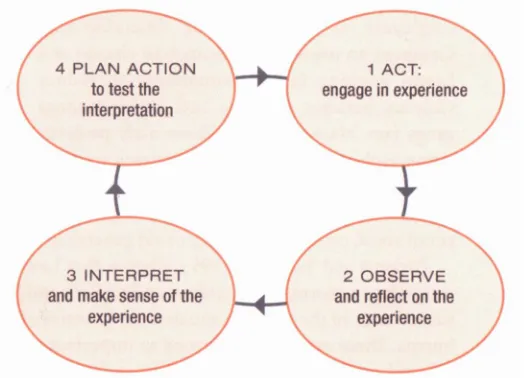
Kolb (1984) elaborated the previously mentioned three-stage model of Lewin. The original model by Lewin consists of unfreeze, change and refreeze where Kolb translates that model into a four stage experiential learning model (Figure 1). Kolb (1984) articulated a theory of experiential learning that conceptualises learning as a four-stage cycle, which translates experience into concepts that are used to guide the choice of new experiences (Hayes, 2010).
The first stage involves the basis, engaging in immediate concrete experience to move on to the second stage where this will be observed and reflected to. Stage three, the interpretation of the observations, is a process of theorising so new implications for action can be deduced. The hypotheses and implications then serve as guide when planning for the last stage, which tests the interpretation and acts to create new experiences (Hayes, 2010).
[image:12.595.71.333.330.519.2]The following figure and note are each adapted from the ‘The Theory and Practice of Change Management’ (Hayes, 2010, p. 326).
Figure 1. The experiential learning model.
6
2.1.3 How does the process of action research work?
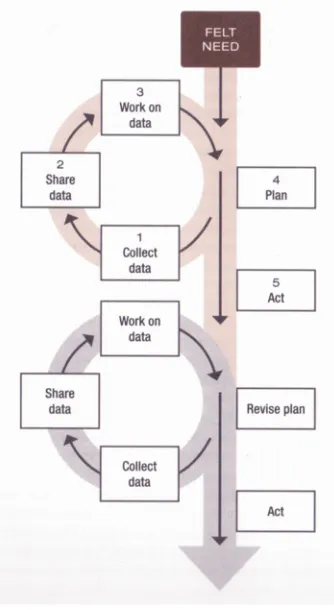
The classic model of action research consists of collecting and analysing data about the nature of the problem, taking action to change and afterwards observing the effects of the action. This is a cycle, since after the observing the effects of the action, a new action might be required to start the process again. Lewin (1946) argued that before data is collected or analysed, there must be a ‘felt need’ that a change is necessary. This ‘felt need’ does not always have to come from people inside an organisation, a facilitator, as discussed in the previous paragraph, can be an ‘awareness creator’ to transfer the felt need to people in the organisation. When the ‘felt need’ is established, the five-step cycle starts. Figure 2 shows the action research process.
Step one is data gathering for diagnosis. Collecting data about the problem can be done in several ways, such as interviews, questionnaires, observations and reference to performance data and other records (Hayes, 2010). Step two is feedback of the data to the client group. Often members of the problem-solving group are delegated to investigate particular aspects of the problem or an external facilitator collects data on behalf of the group (Hayes, 2010). The feedback needs to reach the whole problem-solving group. Step three is the discussion of the data and diagnosis of the problem. One of the defining features of action research is that the problem solving members collaborate with each other and with an external facilitator to review the data and clarify issues (Hayes, 2010). Step four is the action planning, identifying possible interventions to improve the situation and selecting a preferred way forward (Hayes, 2010). The fifth and last step of the process is the implementation of the action plan, this involves taking action to improve the situation (Hayes, 2010). The evaluation might suggest ways to refine the original implementation. The process continues based on new information which leads to alternative actions (Hayes, 2010).
7
Figure 2. The action research process.
2.1.4 Action research and Business scans
In this paragraph the process of business scans will be discussed with action research and experiential learning as basis.
As discussed in the previous paragraph, action research always starts with a ‘felt need’. The planning and collection of data stages of action research can be executed in different ways. Business scans are more than collecting data, it is a process to gain participants and to guide them after collecting the data with solutions. A business scan is an instrument that has its roots in the action research.
As discussed in the previous paragraph, the target group of a particular business scan will create a ‘felt need’ because of themselves or because of the facilitator of the business scan. This step of creating awareness is vital for the interest in a business scan. Therefore, a business scan is a lot broader than just a questionnaire or survey in the early stages of action research.
Business scans can take different forms depending on the goal. Regarding data collection, a short survey can be used to find out what a business opinion is about a matter, but it can also be a broad benchmark program with follow up programs. A lot of Business scans have the form of a survey to collect data. A questionnaire or survey collects data but from an action research perspective this is already a step too far. The felt need needs to be established before the collection of data can start. Business scans are much more than just a questionnaire or survey in this matter.
8 patterns, benchmark your business or foresee upcoming problems. Depending on the goal, the data will be shared and worked with. Theoretical foundation can be used to explain and recognise particular patterns within a business and benchmarking the data with other respondents can give different insights in the performance of a business. The last stages of action research describe to plan and act. A business scan could reach its end here but not necessarily. A business scan and its facilitator can help formulate their plans for action and test them through implementation (Mumford, 1965). The business scan and the person or group who carries it out takes on the role of a facilitator rather than prescriber of solutions. This concludes that business scans in general can be much more than just a survey or just a benchmarking method. It can be a much broader process following its theoretical foundation in the action research and experiential learning.
2.2 Benchmarking
This paragraph discusses the benchmarking phenomenon as feedback for respondents. It discusses its origin, its rising popularity, pitfalls and limitations.
2.2.1 Benchmarking in general
9
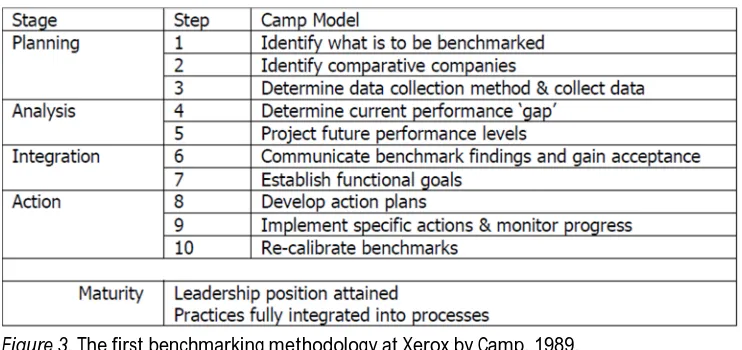
[image:16.595.70.441.108.283.2]The following figure is adapted from the Centre for Organizational Excellence Research (Mann, 2011, p. 1).
Figure 3. The first benchmarking methodology at Xerox by Camp, 1989.
The following figure and note are adapted from the Centre for Organizational Excellence Research (Mann, 2011, p. 2).
Figure 4. Number of published articles in ProQuest (1990-2004) on tools and techniques
(Thawesaengskulthai, N and J. Tannock, 2008).
The definition of benchmarking is debatable, Blythe (2006, p. 367) describes benchmarking as “the
process of comparing each element of the value chain, including company departments, with the most successful equivalent element in equivalent value chains.” Johnson, Scholes, and Whittington
(2008, p. 116) consider benchmarking “as a way of understanding how an organization’s strategic
capability, in terms of internal processes, compare with those of other organizations.” Mann (n.d., p.
[image:16.595.119.415.367.585.2]10 performance. Mann’s core definition added with the three steps of the process make a comprehensive definition: “Benchmarking focuses on learning from the experience of others and can
be defined as identifying, adapting, and implementing the practices that produce the best performance results.” The definition from Camp (1989) himself describes benchmarking as: “the search for industry best practices that will lead to superior performance” Camp (1989, p. 1). Camp’s
own definition does not contain the application or implementation of the benchmarking and focuses as well on the search and comparison. This makes the definition of Mann (n.d.) most comprehensive.
Camp does however distinguish four different types of benchmarking in his definition, internal, competitive, functional and generic. Internal benchmarking compares operations among functional parts within the same organisation. Competitive benchmarking compares with a direct competitor, functional benchmarking obtains information about industry leaders in certain functional aspects of management or service, regardless of what industry they are in. Generic benchmarking is looking for the ‘best of the best’ by extending functional benchmarking to any function, regardless of whether your organisation has it or not (Sharp, n.d.).
Mann (2011) has a different view and distinguishes two forms of benchmarking, formal and informal benchmarking. Informal benchmarking can be used by everyone, it does not follow a process or procedure. It refers to the type of benchmarking everyone does at work, often unconsciously, involving comparing and learning from behaviours and practices of others (Mann, 2011). The internet, networking, talking with colleagues and consulting experts are all examples of learning from
informal benchmarking.
Formal benchmarking consists of two types according to Mann (2011), performance benchmarking and best practice benchmarking. Performance benchmarking describes the comparison of performance data obtained from studying similar processes or activities (Mann, 2011). Best practice benchmarking describes the comparison of performance data obtained from studying similar processes or activities. Identifying, adapting and implementing the practices that produced the best performance results (Mann, 2011).
11 According to Johnson et al. (2008) the importance of benchmarking is, not so much in the detailed ‘mechanics’ of comparison but in the impact that these comparisons might have on behaviours. In other research of Camp years later (2004), a survey was conducted to get insight into emerging benchmarking developments. The purpose of this study was to get an overview of the importance of different developments such as, capture, sharing, and dissemination of best practices and the influence of technology, including computers, databases and networks (Camp, Andersen, 2004). One of the most significant findings in the survey is regarding transferring of best practices. The respondents show high concern in developing a process and mechanisms for transferring best practices after identifying them (Camp, Andersen 2004). With the benchmark methodology from Camp (1989) (Figure 3.) he concludes 15 years later that the transferring and implementation are of high concern. Mann (2011) claims that a disciplined approach is needed while using benchmark methodology and does not go into depth into the implementation concerns.
2.2.2 Pitfalls and limitations of benchmarking
Using benchmarking adequately, and matching the type(s) of benchmarking that suits the company, with a well thought methodology should lead to superior performance. However, there are some pitfalls and limitations of benchmarking. Johnson et al. (2008) discuss two major dangers, measurement distortion and surface comparisons. Measurement distortion implies that benchmarking can lead to a situation where ‘you get what you measure’. This may not be what is intended strategically, it can therefore result in changes in behaviour that are unintended or dysfunctional. Surface comparisons imply that benchmarking compares inputs, outputs or outcomes, it does not identify any reasoning for good or poor performance. Underlying reasoning is not shown but if well directed, benchmarking could encourage managers to seek out these reasons and hence understand how competences could be improved (Johnson et al., 2008). Blythe (2006) describes five difficulties regarding benchmarking as well. First, it is often very difficult to obtain truly accurate data on the functioning of other companies. Second, even when data is available, it may be difficult to decide which the critical factors in the competitors’ success are. Third, at a conceptual level it would seem strange to allow the firm’s quality control to be dictated by other companies. Fourth, if benchmarking is adopted by everybody, it will stifle innovation. And finally, the costs incurred in bringing all departments up to the best standards of all other companies are likely to be high, which will inevitably have an effect on prices.
Sharp (n.d.) focuses his article on the public sector but focuses on the tool benchmarking as a commercial tool being used in the public sector and non-profit sector. Nevertheless his conclusion claims that the success of benchmarking will probably rest upon careful and selective application of the method in those areas its being used in. Whereas Sharp keeps conclusion quite on the surface, there is more than that.
12 the future, video content about best practices can be more quickly understood and assessed for relevance compared to written data (Mann, 2011).
The development of benchmarking works both sides, organisations expect more as well from benchmarking in the future. The expectations of the solutions and best practices exchange process will increase, expectations about the acceleration of the process are inevitable. Organisations and economies will improve at a much faster rate because of the developments in communication technology (development in benchmarking as well). The speed of exchanging information will rapidly increase which means that decisions have to be made faster as well. Hasted decisions might be problematic in the future but Mann (2011) concludes in this aspect the same as Sharp (n.d.) concludes, earlier in this paragraph: “I am convinced that a disciplined approach using benchmark methodology will always have its place alongside an informal approach to benchmarking.” (Mann, 2011, p. 7) The challenge for organisations is to decide which type of benchmarking fits the situation. A disciplined and slower approach will be required for the largest opportunities for improvements. Speed is in that case less relevant where breakthrough improvements could have a huge impact on the bottom-line (Mann, 2011). Where speed is essential, a more informal and faster approach of benchmarking will be used. Issues or opportunities that need to be tackled in a shorter period of time, with the understanding that faster approaches are riskier and less likely to produce as large a gain (Mann, 2011).
2.3 Developing criteria’s for implementing business scans
This paragraph will describe different criteria for business scans to make the implementation of the scan effective. These criteria will be applied in chapter four, the case study.
2.3.1 Motivation, awareness and commitment
Before a business scan will be used, a few factors will influence the choice of potential businesses to participate. The business scan needs to reach the appropriate group of respondents and the facilitator needs to put effort in the response rate. The companies need to have certain motivation and commitment to participate and stay participating during the course of the business scan. Awareness must be created that the business scan has a positive influence on their business. A ‘felt need’ must be created at the businesses.
13 Shadish et al (2002) describes six possibilities which help locating the target population of the research:
- Preexperimental surveys to locate and characterise potential participants; - Pipeline studies to follow what happens to them over time;
- Pilot tests of the solicitation procedures to see who will learn about the experiment and who will attend if eligible;
- Intake specialists who aggressively recruit potential participants;
- Efforts to learn what features of the intervention cause people to decline to enrol.
When the number of eligible participants is lower than anticipated, a researcher has four different efforts in his or hers toolbox that can result in a higher response rate of survey:
- Extend the time frame for the research;
- Divert additional resources to intensifyoutreach efforts;
- Alter eligibility requirements so that more participants are eligible; - Terminate the research.
These efforts from Shadish et al. (2002) will result in a (chance on a) higher response rate. The termination is a last resort if the costs do not outweigh the risks.
Groves, Cialdini, and Couper (1992) formulated different factors that influence respondent motivation and commitment. These factors are based on the survey participation part of business scans. The ‘felt need’ phenomenon from action research is not included here and will influence respondent motivation and commitment positively.
Societal-level factors
A society has a set of global characteristics that has an impact on survey participation. Both the respondent and interviewer operate in this context formed by the societal-level factors (Groves et al. 1992). For example, the degree of social responsibility felt by a respondent may be affected by such factors as the legitimacy of social institutions and the degree of social cohesion (Goyder, 1987). Expectations get influenced by both the interviewer and the respondent because of these factors, but also determine what persuasion strategies the interviewer uses and what decision-making strategies the respondent uses (Groves, et al. 1992). Another aspect is the ‘oversurveying’ phenomenon described by Schleifer in 1986. The amount of surveys and its legitimacy have an influence on the respondent’s perception. Especially since the internet makes it easier to distribute a survey. This has a negative impact on the survey-taking climate in a society.
Attributes of the survey design
14 communication between the interviewer and respondent, as well as the selection of persuasion strategies (Groves, 1978). The respondent rule can permit multiple householders (or organizations) to be alternative respondents or restrict the choice to just one. The length of the survey being requested is a basic indicator of the burden of participation. Finally, the topic of the survey helps determine the respondent’s level of knowledge and interest in the interview (Steeh, 1981). The topic of the survey or business scan is a reason for companies to get interested and start developing a ‘felt need’.
Characteristics of the sample person
The characteristics described by Groves et al. (1992) are based upon households rather than organisations. The factors such as age, gender, income and health status etc. are not causal to the participation decision in households. The factors might influence the respondent that can produce a set of psychological predispositions that affects the survey. For organisations, these factors will be even less relevant due to the split perception of work and personal life.
Attributes of the interviewer
An interviewer’s prior experience affects the skill and confidence the interviewer approaches the potential respondents. Experienced interviewers tend to achieve higher level of cooperation due to behaviours proven to be effective (Groves et al. 1992). Interviewers report as well that the current state of mind has a big impact on the outcome on point of contact and is crucial for their success (Groves et al. 1992). The characteristics of the sample person described above can be reflected on the interviewer’s psychological state as well, motivation tiredness etcetera (Groves et al. 1992). Finally, Groves et al. (1992) describe the next phenomenon:
"Observable sociodemographic characteristics of the interviewer (race, age, gender, etc.) are believed to affect the 'script' evoked in the householder’s mind at the first contact with the interviewer. At that moment, the householder is making judgments about the purposes of the visit."
Respondent-interviewer interaction
It is when a respondent and interviewer interact that all above factors start counting. The interviewers own ability, expectations, features of the design, characteristics of the immediate environment and society determines the strategies to persuade the sample person (Groves et al. 1992). When full participation fails to obtain, the inferential value of the method is threatened (Groves et al. 1992).
2.3.2 Environment
15 for information gathering for the researcher. However, information gathering from the surveyor or facilitator can still be valuable in addition to the business scan’s purpose, which is analysing a business. The metadata can be used for other purposes, such as analysing whole business sectors or regions. Data collected from all participants can give insight in for example different patterns in business sectors or regions. This information can be analysed for organizations or governments who are interested in a particular environment. They can use the data as an environment scan to gain information.
2.3.3 What is the role of the facilitator
As described before, the person or group who carries out the business scan needs to take on the role of facilitator rather than prescriber of solutions. The facilitator helps the businesses/respondents to manage the business scan. Mumford (2001) describes the role of the facilitator and the following descriptions are based on his research.
Requirements of the facilitator are to familiarise the respondents/businesses with methods that are to be used and help them to mould these to their own requirements. The facilitator also assists to resolve conflicts of interest and to make sure that important aspects of the business scan are not forgotten. The facilitator makes in no circumstances any decisions for the respondents or businesses, they are the decision takers and the researcher will always place the interest of the businesses first. The role of the facilitator is to encourage the respondents and businesses to systematically analyse their own problems and to help them moving forward towards completion of the task. There needs to be a ‘felt need’ created by the facilitator when there is contact between the facilitator and the business. The communication role of the facilitator is important for the follow-up. A key factor for successful action research is to ensure that all interested parties in a change are always informed of what is taking place. Individual meetings, group meetings, electronic mail and information providing documents can be ways to communicate change. The facilitator can often take the place of a central source to be responsible of the communication.
2.3.4 The design of the business scan
2.3.4.1 Length and order
16 research itself will never get outdated but the technological developments open up new opportunities and threats. In the next paragraph these different technological advantages and disadvantages will be discussed.
Another aspect concerning an attribute of the survey design is the order of the questions. The order of the questions has little effect on the initial willingness to participate, but they are likely to affect the likelihood of seeing the survey through completion (Crawford, Couper, and Lamias (2001). In the research of Crawford et al. (2001) it was clear that the open-ended items in the survey played a key role in the relatively high abandonment. The fact that a respondent has to put more effort in formulating a response is enough demotivation to continue beyond this point of the survey. Open-ended items then might be better positioned in the end of the survey. The respondent is far progressed in the survey and has motivation to not let the already invested time go to waste. The respondent has an easier time answering the first questions whereas he or she will feel more comfortable continuing. High abandonment should be more contained that way.
2.3.4.2 Business scans on the web
There is a lot of potential in a survey based on the web (Cobanoglu, Warde, and Moreo, 2000). According to Dillman (1999), the most significant advances in the survey methodology during the twentieth century were the introduction of random sampling in the 1940s and telephone interviewing in the 1970s. Researchers today are witnessed similar advances in the field of survey methodology with the introduction of technology-based surveys such as the internet in 2000 (Cobanoglu et al, 2000).
A benefit of a survey on the web is that it is less time consuming than to meet the respondents in person. If the respondents are high level individuals in the organisations such as CEO’s and senior management, it saves the businesses time and there for money. More practical forms of saving money by executing a survey on the web are publishing costs, distribution costs, and survey collection costs (Schmidt, 1997). All These costs are obsolete since there is no tangible product. Time consuming data entry errors can be eliminated through automated data checking at the time of data collection, and administrators have immediate access to data as it is received, allowing them to track the data collection process (Schmidt, 1997).
Making a web based survey not only cheaper and less time consuming but also resulting in higher validity.
Another benefit is the access to a large population of individuals. The Netherlands has (together with Switzerland) the highest fixed broadband internet connections per 100 habitants in the world (around 60, in June 2012)(OECD, n.d.). The potential reach of respondents is there for high whenever a web survey is being used.
17 Other common pitfalls such as, incomplete or unacceptable responses, multiple submissions, and security and data integrity can easily be countered. A web based survey can have different kinds restrictions. Such as, being unable to skip questions and not be able to fill in percentages above 100. Multiple submissions can be prevented; the respondent can get a unique hyperlink which is attached to the respondents e-mail address. This way, multiple submissions are not possible and by distributing the survey through e-mail, the respondent can access the survey with any computer (desktop, laptop, tablet, mobile phone) and still have the data updated, on all platforms on the same time. The last pitfall, security and data integrity can be ensured by SSL (Secure Sockets Layer) which is a cryptographic protocol that provides communication security over the internet and is a basic need for web surveys.
An appropriate written survey software program has options to minimise or completely avoid these pitfalls as described above. But there are more
The web-based version is not the only option to distribute a survey. A mail survey by postal services was the equivalent before the internet and has its own pros and cons. According to Crawford et al. (2001), sample persons can peruse the entire questionnaire and make informed judgments about participation based on the content, length, design, and other elements of the instrument. In a web-based survey this information is not available to sample persons until they decide to visit the survey site and begin the survey (Crawford et al., 2001). Many of the standard tools available to the mail survey researcher (e.g., type of postage, type of envelop, personalized signature, use of legitimizing letterhead, inclusion of incentives) do not have direct electronic equivalents. In comparison, web-based surveys are similar to interview-administered surveys, because the initial decision to participate is based on relatively limited information conveyed in the advance letter or communicated by the interviewer (Groves and Couper, 1998). Remarkable is the conclusion of Crawford et al. (2001) which claims that information about the content of the survey is typically not a key part of the initial decision calculus. However, there are factors that manipulate the perceived burden of the task and thereby on the likelihood of accepting a survey invitation; these factors are much likely the ones Schmidt (1997) describes in his research. Those who were told the survey would take less time, those who received an automated password, and those who received more frequent reminders were all more likely to accept the invitation.
If all questions in a web based survey are listed on one page, the respondent can make a more informed decision about participation based on the content of the survey. When the web based survey is interactive, such information comes gradually. Therefore an interactive web based survey can show a high level of abandonment due to the perceived burden of the survey in progress, even indicate which particular items are responsible (Jeavons, 1998). As discussed in the previous paragraph, the research of Crawford et al. (2001) showed that the open- ended items in the survey played a key role in the relatively high abandonment rates. There is no interviewer present to motivate respondents to continue with the web based survey, therefore new ways must be found to maintain motivation and interest.
18 paper. Another reason may be that paper can be set aside a lot easier to continue later. Crawford et al. (2001) claim: “Although web surveys do not require single-sitting completion, the burden of
resuming a partially completed survey may be greater, as the respondent has to recover the e-mail invitation, URL, and password to re-enter the site.” The flexibility of the respondent is less compared
to a survey on paper. In conclusion, the challenge for web survey designers is to find ways to get respondents to sign on to the survey site and to keep respondents motivated to complete the survey once begun (Crawford et al., 2001).
The findings suggest that web surveys are different from mail surveys and that procedures which may work for the latter may not translate well to the former (Crawford et al., 2001). As discussed in paragraph 2.3.1, the different factors from Groves et al. (1992) influence the motivation. A business scan, what it is initially about, has the process of developing a ‘felt need’ before the survey is conducted. This ‘felt need’ has overall a positive influence on the perceived burden.
Another important aspect of web surveys is the progress indicator. Web surveys often have a progress indicator telling the respondent how far he or she progressed in the survey. Contrary to expectations, Crawford et al. (2001) found a negative effect of the use of a progress indicator. An estimated time of completion is often given as information beforehand. If open-ended questions, which are harder to formulate and take more time, are in the start of the survey, the progress indicator might give a wrong indication. The slow start off and low progression on the progress indicator would let the respondent believe that the estimated time is far more than beforehand was informed, which will lead to higher levels of break off (Crawford et al., 2001). This happens since most of the progress indicators are designed to track to amount of questions answered and not the amount of time that elapsed, this creates a false sense of a higher burden. Crawford et al (2001) conclude their research with the knowledge that the progress indicator should be used with caution as it may sometimes backfire but they remain convinced that the progress indicator in general serves a useful purpose (Crawford et al., 2001).
In the end a web survey is cheaper, faster and better in terms of reliability than its precursors. But a web survey has a lot of drawbacks that need attention as discussed in this paragraph. A web survey needs to be executed very thoroughly to get the best results.
2.3.5 Feedback and Follow up
Business scans are tools, like checklists or surveys, offered to businesses by external parties (consultancy bureaus, science or branch organisations) to evaluate their approach in a specific matter or to compare it with other organisations (benchmarks). Business scans can take different forms depending on the goal.
19 to participate further. The enhanced benchmarking method does not stop its process once data is compared, it not only gives insight but it offers solutions and keeps track of progression.
Standard business scans report back to the respondent, with an advice or data comparison and then the process stops. Advanced business scans can go a bit more in depth and further, the goal of the business scan decides how to organise it. Is the goal of the business scan only for creating awareness or does it include giving an advice to the decision making process? From action research point of view the business scan will eventually cause action at the respondent. The facilitator of the business scan will still be involved in the action process.
Advice reports will stimulate this action and can give an indication where the decision making process should focus on. The value of the advice reports can be the amount of data collected from other respondents to compare to or the relationship with the theory. Findings in literature can expose problematic situations and make the respondent aware.
2.4 Conclusion and criteria recapitulation
The sub research question that needs to be answered is:
What is the theoretical foundation of business scans and which criteria does it have to meet?
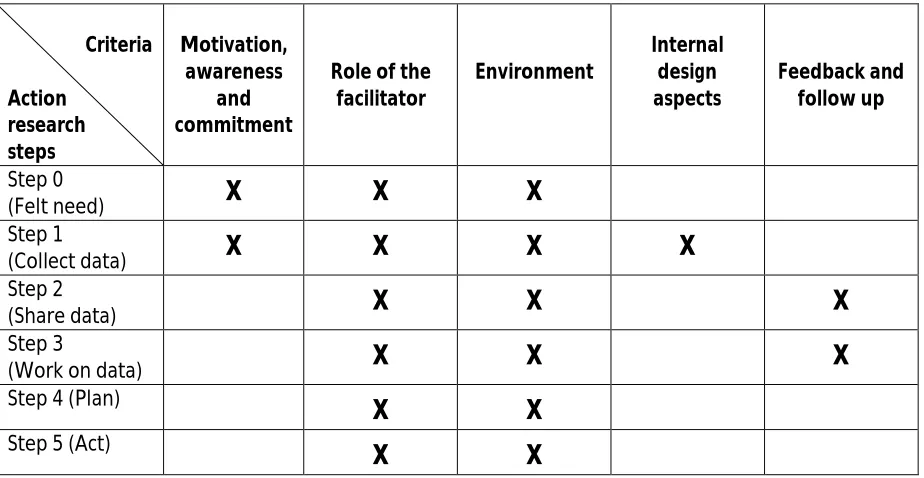
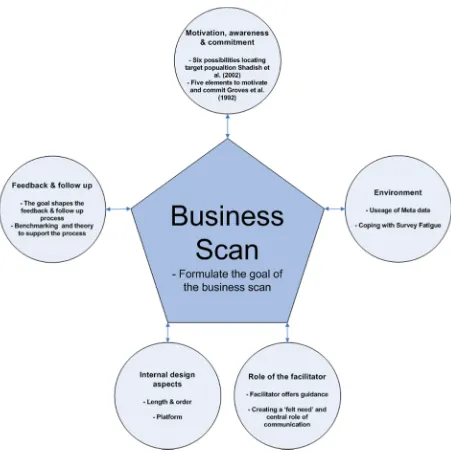
20 The facilitator and environment always are influence the process, the extent of the influence depends on the particular respondent.
Table 1
Action research steps and corresponding criteria.
Criteria
Action research steps
Motivation, awareness
and commitment
Role of the facilitator
Environment
Internal design aspects
Feedback and follow up
Step 0
(Felt need)
x
x
x
Step 1
(Collect data)
x
x
x
x
Step 2
(Share data)
x
x
x
Step 3
(Work on data)
x
x
x
Step 4 (Plan)
x
x
Step 5 (Act)
x
x
21 When applying these different criteria to a particular business scan, the action research cycle puts the business scan in perspective of the whole process from start to end. The business scan is an instrument to initially collect data (step 1 of the action research cycle). The process before and after the collection of data is supported by the different criteria discussed above. The benchmarking is explained in depth to reinforce the ‘work on data’ step in the action research and to emphasise the importance of benchmarking for information when taking action.
Figure 5. Overview of business scan criteria. The figure illustrates the different business scan criteria with their
22
3. Methodology
This chapter discusses the case study as in-depth examination method and discusses the validity and reliability. The previous formed criteria will be discussed for the HCS.
3.1 The case study
A case study is an in-depth examination of a single instance or some social phenomenon according to Babbie (2007). According to Babbie social researchers speak of a case study when attention is focused on only one or a few instances. Researcher Robert K. Yin defines the case study research method as “an empirical inquiry that investigates a contemporary phenomenon within its real-life
context; when the boundaries between phenomenon and context are not clearly evident; and in which multiple sources of evidence are used” (Yin, 1984, p. 23). Yin describes his definition of a case
study more in detail compared to Babbie, he describes specifically that it is in real-life context and that the boundaries between phenomenon and context are not clearly evident.
A case study is categorised in nonexperimental designs, and therefore not an experiment. An experiment explores the effects of a manipulating variable and its purpose is to generate clear causal conclusions (Shadish et al. 2002). The use of case studies in general is to combine reasoning, observation, and falsification procedures in order to rule out threats to internal validity (Shadish et al. 2002). Another reason to use a case study method is that case studies are believed to be broader than experiments in types of information they yield (Shadish et al. 2002).
Babbie (2007) describes the purpose of a case study as an example to be descriptive or to yield explanatory insights. Since there is no treatment procedure involved the case studies purpose is to yield those explanatory insights. These in general explanatory insights (described by Babbie, 2007) and in depth explained by Shadish et al. (2002), give the researcher the opportunity to look into the particular case to test its viability. The case study allows the researcher to in depth analyse different aspects of a single case compared to its underlying theory.
3.2 Human Capital Scan as case study
Franken (2013) created the HCS in its early stage. He did a pre-test concerning the comprehensiveness of the questions and focusing mainly on the formulation of the questions. In this master thesis the methodology is not necessarily based on the formulation of the questions but on the process of how to implement these questions and its follow up. The case study of the HCS in this master thesis will give insight in different aspects of implementing a business scan.
This methodology will not go into the different forms of validity like construct validity and content validity since they have been guaranteed by Franken’s research. Due to his thorough research the amount of changes in the HCS will be minor.
23
“For example, they (case studies in general resp.) can inform readers about such useful and diverse matters as how pertinent problems were formulated by the stakeholders, what the substantive theories of the intervention are, how well implemented the intervention components were, what distal, as well as proximal, effects there have been, and what processes explain the pattern of obtained results. ”
In this instance, the HCS can be tested with the in the theory designed criteria of business scans. The advantages of the case study method are its applicability to real-life, contemporary, and applied to human situations (Soy, 1997). The criteria of business scans go more or less hand in hand with the advantages of the case study method. Running multiple case studies will give in depth situation on different criteria if the HCS is successfully designed and implemented. The information from the case studies can test the applicability to real-life and human situations.
In chapter one, the HCS is introduced in general. There are some aspects that need close attention to fully understand the process the HCS went through. First of all, the Human Capital Scan will be web based. Franken (2013) developed the HCS but did not make it operational on the web. The pros and cons have been discussed in paragraph 2.3.4.2. The main reason to have the HCS web based is a practical one. In Appendix I, the HCS is shown, this is the HCS after it had changes regarding the phrasing of the questions and the style. With the amount of respondents and data that needs to be collected to have adequate benchmarking results, the respondents need to go in the hundreds. It is practical impossible to conduct all scans in person for an organisation as VNO-NCW Midden. Distributing through postal services could be an option but with in-depth talks with the communication department of VNO-NCW Midden we decided that companies would not encourage postal services. With the access to advanced survey designs on the web, the decision is therefore made to base the HCS on the web.
The relationship between business scans in general and action research have already been discussed in paragraph 2.1.4. Thus, the HCS can be mirrored to the action research process. In Figure 2 the action research process is shown. Step zero is establishing the ‘felt need’ which needs to be established at the respondents of the HCS. Step one, ‘Collect data’, is the initial participation of the respondent and completing the HCS. Step two ‘Share data’ is a report back to the respondent with his or hers own results and theory aspects which either support or contradict the results. Step three ‘Work on data’ is the process of analysing the data further and benchmarking it with other respondents/businesses in the region or sector. This step includes a report back to the respondents containing this information. Step four ‘Plan’ is a step which is not fully set in stone just yet. Although, the general idea of this step is to plan a procedure to act on the results of the HCS. The facilitator will play a central role in facilitating this procedure in a form of a workshop with other respondents and / or a face to face talk. Step five ‘Act’ is up to the company to act towards the new information.
24 Appendix II). The follow up procedure after the initial feedback will include benchmarking results, but can only be executed if enough respondents participated to make the benchmarking reliable and valuable. A template is added in the appendix to visualise this part of the process (Appendix IV). The template shows a big report containing all data from the HCS. It contains all information of other participants in the respondents sector or region. The workshops and / or face to face talks will be related to the two advice reports. These meetings will discuss the different results in depth with the respondent.
3.3 The respondents
In the case study of the HCS, the sample group was 19 respondents/businesses, consisting of eight respondents/businesses who participated previously in Franken’s research and 11 new businesses. The selection process of these 19 respondents to participate in the case study was performed by the communication department of VNO-NCW Midden. Selection was partly randomised, the 11 new businesses were random assigned and the other eight businesses were from previous contact with Franken (2013). All the respondents are members of VNO-NCW Midden. Shadish et al. (2002) described four different efforts that can result in a higher response rate. Extending the time frame for the research is one of these efforts. Diverting additional resources to intensify outreach efforts is another effort described by Shadish et al. (2002). In combination with other contact points after the initial contact, the response rate of the HCS could go up. A second and third contact point over an extended time frame was performed. At the third contact point, additional resources were used to intensify outreach efforts by letting VNO-NCW Midden contact the remaining respondents. All other contacts were facilitated by the student facilitator. The (non-)response of these contacts will be analysed to evaluate (the implementation of) the HCS. Low response rates, might indicate lack of motivation or information at the companies. The results chapter (chapter four) will discuss this in depth.
There was only one respondent per business contacted. This respondent is positioned in the senior management of the particular company, it is not a random employee. The consequences of subjective questions and reliability in general will be discussed in the next paragraph.
3.4 Validity and reliability
As discussed before, Franken (2013) researched the questions itself and the composition of the questions. Construct and content validity are guaranteed by Franken’s (2013) research. That leaves the other aspects of validity and reliability to discuss.
25 the setup of the HCS on the web and not necessarily provide solid data to the respondents. The few respondents will be used to design templates and to find flaws in the implementation. Looking at metadata and benchmarking, the respondents need to be in the hundreds to come up with reliable data.
The subjective questions in the HCS need to be approached with caution. These questions are opinions of only one person per company and cannot be a decisive factor to get to conclusions on large or personal scale. The purpose of the subjective questions is only to explore the respondent’s opinion and approach towards his / her company. Another process is the collection of metadata, all the data of all respondents combined to map the Human Capital situation per sector or region. This metadata is only reliable after hundreds of participations to ensure reliability. The subjective questions will not be taken into account when analysing metadata. Since there are multiple ways to formulate opinions, it is unreliable to have one person in a company formulating an opinion about the company and to interpret it as a fact.
The case study tests a lot of practical aspects. Making the HCS operational and to run the case study gives a closer look at the practical side of the implementation. Examples of these practical aspects are phrasing the questions, organising distribution and convenience of participating. A sample group of 19 for a case study is clearly not a test for reliability of the data itself. The answering of the questions gives the facilitator insights in how the questions are interpreted. The case study tests the scan’s validity to see if it gives the right information to analyse.
The different criteria formed in the theory will in the next paragraph be applied to the web based HCS and its process. The criteria will be judged on the case study of the HCS in the results chapter.
3.5 Business scan criteria and the Human Capital Scan
This paragraph will discuss the different criteria formed in chapter two, such as motivation, awareness and commitment (paragraph 2.3.1). Other criteria are the labour market and the environment (paragraph 2.3.2) of the case study, followed by the role of the facilitator (paragraph 2.3.3) and the internal design aspects (2.3.4). The last criteria that will be discussed are regarding feedback and follow up (paragraph 2.3.5).
3.5.1 Motivation awareness and commitment
Shadish et al. (2002) described six possibilities to locate target population for research. The eight respondents who previously participated in Franken’s (2013) research were contacted again to participate in the case study. The preexperimental research to locate and characterize potential
participants is described by Shadish et al. (2002). The new respondents got randomly selected by
VNO-NCW Midden and are all members of VNO-NCW Midden as well. Efforts to learn what features
of the intervention cause people to decline to enrol are another possibility. This possibility is based on