Failure Modes and Effects Analysis
The application of a cost-based FMEA
Author: Huub Besten
Table of Contents
1
Introduction
4
1.1 General company description 5
1.2 Current state of Risk management 5
1.3 Research Design 5
1.4 Reading guide 6
2
Failure Modes and Effects Analysis
8
2.1 Definition 8
2.2 General concept of FMEA 8
2.3 Key components explained 9
2.4 Types of FMEA 10
2.5 Strengths 11
2.6 Weaknesses 12
2.7 Solutions 13
2.8 Application at the company 14
2.9 Conclusion 15
3
Method
16
3.1 Data collection 16
3.2 Data analysis 17
3.3 Mitigation 18
4
Production process
19
4.1 Production steps 20
4.2 Cleanroom 20
4.3 Supporting functions 21
5
Results
22
5.1 Identifying critical processes and potential risks 22
5.2 Process of risk prioritization 23
5.3 List of Failure Modes 24
5.4 Process insights for possible solutions 28
6
Conclusion and Discussion
30
6.1 Conclusion 30
References
32
Appendix A
33
Management Summary
This thesis describes the process of making a failure modes and effects analysis (FMEA) for a company. It explores the concept FMEA, then the application of the tool for the company and it ends with the conclusion based on the FMEA and recommendations for the company.
The facility uses a highly technical process to fill vials with medicinal products. The medicines are supplied by the mother company in bulk. The company currently does a lot to improve its process. They want a FMEA to get an overview of the threats to the entire process and recommendations how to reduce these risks. The main question for this thesis is: On which operational risks should the company focus in its risk management according to FMEA, in order to reduce the risks to the critical processes?
FMEA traditionally uses the variables Occurence, Severity and Detection to rank different threats. A threat gets a rating between 1 and 10 on all three variables and these numbers are then multiplied to get the risk priority number (RPN). Ranking the variables based on their RPN gives a list of the biggest threats. In this case a cost-based version of FMEA is used, because this should give a more accurate estimate of the risks. In this cost-based version the expected times a failure will occur in a given year is multiplied by the expected costs per failure. This gives an estimate of the costs per failure per year. In this case, the costs that are considered are: the value of medicinal product being lost in the production process, the cost of repairs to machinery or the process and the costs of having downtime in which no production can take place.
For the company this resulted in a list of 103 potential failures which were all ranked according to their potential costs. The top 15 Failure Modes are discussed in more detail in chapter 5.3.
Making the FMEA gave al lot of insight in the process, this resulted in three possible solutions that affect several of the top 15 Failure Modes. These possible solutions are: qualify the two lyophilizers to do each others work, try qualifying back-suppliers for several products and add a sever to the building automation system.
1
Introduction
This Bachelor thesis is written for the Bachelor Business Administration. This thesis is written in combination with an internship. The company wants a risk analysis for the facility. The goal of this internship is to give the company a risk analysis that is as accurate as possible and help them improve their risk management. This thesis describes the process of making that risk analysis. The first part starts with a brief description of the company and the current state of risk management. This leads to a description of the Research Design and the last part of this chapter is a reading guide.
1.1
General company description
Due to privacy reasons the company description in this version will be very short. It is a facility that employs about 60 people. It is a production facility. There are supporting functions, but no sales or R&D departments. It is a highly technical production process.
1.2
Current state of Risk management
The mother company of the company required the facility to perform a risk analysis for its operational risks. The facility currently does a lot to reduce risks. For example there is an inventory of spare parts, there are in-house mechanics to do maintenance. In general there seems to be an attitude to look for improvements on the process. For these improvements specific risk analysis are performed, however there is no overall risk analysis for the entire plant.
The goal of the risk analysis is to bring insight in the biggest threats to the ability to continue production. Targeting efforts to mitigate risks at these biggest threats should help improve the contingency of production.
Therefore the company set the following requirements for the risk analysis:
• A clear overview of the critical processes and systems needed for production.
• An overview of the current risks, their sizes and the mitigations in place.
• Recommendations to reduce risks.
• A document that can be updated to facilitate future risk analysis.
There are numerable tools available for performing a risk analysis. In this case the company has decided it wants to use FMEA, because it would meet all the criteria.
1.3
Research Design
In this part the research question and the scope of the research are discussed. Together these form the outline for the thesis.
1.3.1 Research Question
Based on the current state of risk management and the goals for the risk analysis, the following research question is formulated:
To formulate an answer to the research question, three questions are used. The sub-questions are:
1. How does FMEA work and how can it be applied to the company?
2.What are the critical processes and operational risks to these processes at the company?
3. How should these risks be prioritized according to FMEA?
1.3.2 Definitions
In this thesis the following definitions are used for the key terms that are mentioned in the research question.
FMEA
FMEA stands for Failure Modes and Effects Analysis. It is a tool to identify and prioritize potential risks in organisations. There are several types of FMEA. A more detailed definition of FMEA is given in chapter 2.1.
Critical process
An important part of the risk analysis is identifying the critical processes at the company. The term critical is used deliberately in this sentence. The company wants to know what the threats are to the processes that are vital for production. Targeting these processes should ultimately improve the contingency of production. Something is critical to the process if the production process cannot run without it.
Operational risks
In this thesis operational risks are threats that have a direct impact on the production process of the company. An example of a threat that has a direct impact on the production process is operating errors on a machine. This can cause breakdowns of that machine or a bad product as result. An example of a threat that does not have a direct impact is low salaries. Low salaries may cause an unmotivated workforce, which could lead to personnel neglecting rules regarding the use of a machine, resulting in operating errors. In this case low salaries are considered a possible underlying reason for the occurrence of operating errors and can therefore be considered as a solution if the aim is to reduce operating errors.
1.3.3 Scope
As stated in the research question, the risk analysis and this thesis focuses on the operational risks to the facility. Operational risks are direct threats to the production process. Not considered are for example organizational risks, like a lack of staff or a lack of finance. Furthermore only the single facility is considered to be in the scope of this thesis. This means that problems originating elsewhere, like a lack of bulk materials supplied by the mother company, are not considered. The scope of the risk analysis is the whole of the facility. This leads to an analysis of the entire facility, meaning a very broad analysis.
1.4
Reading guide
2
Failure Modes and Effects Analysis
This chapter will answer the first sub-question. It will discuss FMEA from a theoretical standpoint. It starts with a definition, followed by the general and original concept of FMEA. Next two different types of FMEA are presented, followed by a description of the key concepts of FMEA. Then the strengths and weaknesses are described. In the final part the application of FMEA to the company will be described.
2.1
Definition
There is not a generally accepted definition of FMEA. Although different authors have used various descriptions of FMEA, they use similar concepts. These concepts are explained and used here to form a definition for this thesis. FMEA is called a tool (Rhee & Ishii, 2002), a technique (Prasad, 1990) or a method (Kmenta & Ishii, 2000). These terms are all very similar in their meaning and together they cover what FMEA is. Furthermore all the authors describe three other components. The first is some kind of risk or failure. Karim, Smith & Halgamuge (2006) describe “potential risks in the design phase”. Kmenta & Ishii (2000) describe “potential failures of a product or design”. Second the authors all use the term prioritization. The third is some way to address these failures or risks. Bradley & Guerrero (2011) call it “to mitigate the effects of failures”. Kmenta & Ishii (2000) describe it as “to improve reliability”. Karim, Smith & Halgamuge (2006) call it “ to continually improve their product quality and reliability”. These are the three components that define FMEA, although the exact words differ per author. To conclude, in this thesis following definition will be used, which is a combination of the concepts above: FMEA is a tool to help prioritize risks and mitigate the highest risks in order to improve quality and reliability.
2.2
General concept of FMEA
The FMEA tool was not derived from a theory and then put into practice. It originated in practice and researchers then studied it. The first account of FMEA in practice is by the US military in 1949 (Wang, 2011). It gained worldwide attention when total quality management took over the automotive industry, since total quality management also promoted the use of this tool (Johnson & Khan, 2003). Most standards and manuals used for performing a FMEA are still derived from the military protocol or the automotive industry protocol (Bradley & Guerrero, 2011). Later on FMEA was used in probably every field of business imaginable, which can be illustrated by the fact that it is part of the ISO 9000 standard (Johnson & Khan, 2003). This certificate for quality of production is used worldwide and it is so widely accepted that companies demand their suppliers to have this certificate, like the car manufacturers that Johnson & Khan (2003) examined.
The following short description of the FMEA process is based on the FMEA manual written by Palady (1995).
line of product Y. The more specific your target of analysis is, the more detailed information is needed, but the outcomes will also be more specific.
When the target of analysis is determined, the next step is listing the Failure Modes. Failure modes are a description of a state in which the process is failing. The next step is analyzing the Failure modes, in order to prioritize them. For every Failure mode, there are three components that, when combined, give an indication of the overall risk. These three components are Severity, Occurrence and Detection. Of course Severity deals with the consequences when the failure occurs. Occurrence is about the chance that the failure will occur. Detection is about the chance the failure is discovered, either before the product leaves the production facility or before the customer uses the product. To quantify these three variables, for each of them a scale is used, normally ranging from one to ten, with ten being the biggest threat. The next step is to multiply the three scores, which gives the RPN. RPN stands for Risk Priority Number. The Failure modes can than be ranked by RPN. The Failure mode with the highest RPN is the biggest risk and should be addressed first. For FMEA a datasheet is used, an example of such a datasheet can be found in Appendix A. In the next section the key components of a FMEA will be discussed in more detail.
2.3
Key components explained
2.3.1 Failure Modes
Failure Modes are a description of a state in which the process is failing. Listing the Failure Modes is the first step in a FMEA. Although it may seem like a simple task, it is the basis of a good FMEA. It is easy to mistake causes or effects for Failure Modes. Whether something is a Failure Mode, cause or effect is also connected to the scope of the FMEA. The cause of a Failure Modes in a broadly scoped FMEA may be a Failure Mode itself in a narrowly scoped FMEA. For example when analysing an entire production line, breakdown of machine X can be a Failure Mode, and a potential cause is a defect in component Y. When analysing the breakdown of machine X, component Y can be a Failure Mode, and a defect in part Z can be a potential cause. Clearly defining cause and effect will help listing the right Failure Modes. The input you use to help you brainstorm all the Failure Modes depends on the type of FMEA you are making. This will be discussed further in chapter 2.4.
2.3.2 Severity
2.3.3 Occurrence
For Occurrence a scale is constructed, just like the scale of Severity. Occurrence is about the probability that a failure will occur. The scale can be constructed with descriptions like the Severity scale (i.e. 10 is “failure is inevitably” 1 is “highly unlikely”). Kmenta & Ishii (2000) add the option of numerical descriptions like defect parts per million (i.e. 10 is “one of every two parts is defect” 1 is “one in one and a half million parts is defect). Where Severity is related to the effects, Occurrence is related to the causes of a failure. It is not about the probability that an effect will occur, but the probability that a Failure Mode will occur (Kmenta & Ishii, 2000). For example Occurrence is the chance that a fire will start, not the chance that the complete building will burn down.
2.3.4 Detection
The definition of Detection is less obvious than that of Severity and Occurrence. Two distinct parts of detection are named by Palady (1995), Rhee & Ishii (2002) and Kmenta & Ishii (2000). The first is the possibility to detect a failure while the product is still within the company; the second is the possibility that a customer detects a failure. Which definition should be used or how both should be combined is not clear, because these authors remove Detection as a variable in the calculating the RPN. This will be further explained in the chapter about weaknesses. For Detection a scale should be constructed where 1 is a high chance of detection and 10 is a low chance of detection.
2.3.5 Risk Priority Number
The Risk Priority Number (RPN) is, as it suggests, about prioritizing Failure Modes. The RPN is calculated by multiplying Severity, Occurrence and Detection or
RPN = S x O x D.
If scales ranging from one to ten are used, this means RPN’s range from 1 till 1000. The Failure Mode with the highest RPN should be addressed first. When corrective actions are taken, a new RPN should be calculated for that Failure Mode. The Failure Mode with the highest remaining RPN should be addressed next (Palady, 1995). In this way FMEA becomes a process of continuing improvements, always targeting the biggest risks.
Goel & Graves (2007) suggest a threshold value for RPN should be set. This means that after actions has been taken and the new RPN is below this threshold, it is considered an acceptable risk and will not be addressed again.
2.4
Types of FMEA
There are two different types of FMEA, depending on the situation in which FMEA is applied. Authors describe the Process and the Design FMEA (Palady, 1995; Goel & Graves, 2007). Process and Design FMEA are fundamentally different in the type of failures that are being examined and they both use a different way of listing the Failure Modes. Both will be discussed in the following section.
2.4.1 Design FMEA
FMEA is performed early in the design process and repeated several times during this process, it can greatly increase the quality of the design. The main goal of the Design FMEA is to improve the design of the product. To improve a design it is necessary to be able to think outside the box. If a part of a product creates a huge risk you want to be able to change the entire part or even drop it and find a different solution to deliver the same functions. Therefore in the Design FMEA the functional approach is used for brainstorming about Failure modes. This means the function that the product should perform is the Failure Mode, this will be discussed in more detail in the next section. Another reason to use a functional approach is because a list of components or parts is not always available and can change during the early stages of the design process (Palady, 1995) (Kmenta, Fitch & Ishii, 1999).
Functional approach
The functional approach means that the functions that the product should fulfill are identified in order to determine possible Failure Modes (Palady, 1995). For example, the functions that should be fulfilled by a package used for packing ice tea are holding the ice tea, being resealable, providing space for name and marketing prints and standing up straight. A product can potentially fail in all its functions, so all functions are Failure Modes. The possible Failure Modes are based on expert knowledge, comparable situations and common sense. Historical data is often not available, therefore it has a strong focus on potential failures.
2.4.2 Process FMEA
Process FMEA is used to analyze a production process. The main goal of Process FMEA is not to improve the product, but to improve the process. A production process does not always deliver the product as it was designed, nor is it up and running 100% of the time. Ultimately this should create a process with minimal down time and with a consistent quality of the end product. In Process FMEA the hardware approach is used to list Failure Modes. The hardware approach means listing all the machines or components needed for a process or a step in the process. This will be discussed in more detail in the next section. The components are known and will not change much. Often there are large data sets on potential failures and probability of occurrence available (Palady, 1995).
The Hardware Approach
The hardware approach means listing all the machines or components needed for a process or a step in the process. Each machine or component is a Failure Mode (Palady, 1995). After considering how each component or machine can fail, the consequences for the system or product are considered. In this method there is more attention for data. There are databases that give a chance of failure for all kinds of components and machines. Especially larger companies often have their own logbooks with information on breakdowns and product failure incidents. This means that the list of Failure Modes is a combination of failures that already occurred in the past and potential failures.
2.5
Strengths
The first thing that comes to mind when thinking about the strengths of FMEA is about the results of the tool. Prasad (1990) states that FMEA can create huge cost savings, because it is able to detect failures early. Prevention is better than cure is an old saying and FMEA gives a framework for a company to work on preventing failures in a product before they occur (Kmenta, Fitch & Ishii, 1999). However, these qualities of FMEA are based on case studies. I could find only one quantative empirical study to support the use of FMEA. Karim, Smith & Halgamuge (2008) did a survey research among Australian manufacturers1.
On a personal note, I think it is odd that, for a tool that has become part of the internationally accepted ISO 9000 standard (Johnson & Khan, 2003), so little quantative empirical evidence is available. More quantative empirical evidence to support these conclusions is desirable.
FMEA can also have less tangible benefits. Using FMEA can help to improve corporate culture. FMEA stimulates a “do it right first time” attitude and a pursuit to perfection (Prasad, 1990). It also enables a company to create continuous improvement and it helps with the allocation of resources (Kmenta, Fitch & Ishii, 1999). A corporate culture like this can make a real difference in the performance.
A strength not related to results, but to the tool itself is emphasized by Franseschini & Galetto (2001) and by Bradley & Guerrero (2011). This is the simplicity of FMEA. It is not necessary to have extensive training on FMEA. An hour or two of proper explanation of the tool and anyone can use it (Palady, 1995). This means you can draw on all the knowledge in your company. For example you can use the experience and knowledge of a mechanic specialized in the maintenance of one machine to analyze the risks associated with that machine.
2.6
Weaknesses
In this part two mayor criticisms on FMEA are discussed. These suggest that there are fundamental en theoretical problems with FMEA. These problems apply to both Process and Design FMEA’s
2.6.1 Detection
The first criticism is the component Detection. Palady (1995) states that increasing Detection is a “reactive approach” and decreasing Severity or Occurrence is a “proactive approach”. In other words, increasing Detection does not really solve the problem. It should therefore only be used when Severity and Occurrence cannot be reduced anymore. Palady (1995) suggests leaving detection out of FMEA for this reason and that RPN should be calculated by multiplying Severity
1
and Occurrence. Kmenta & Ishii (2000) agree with Palady and add the argument that Detection is not a component of risk. This is confirmed by Kaplan (1997) in his work about risk. He distinguishes three components of risk: What can happen? What is the chance that it will happen? What are the consequences when it happens? All of the authors that mention the problems with Detection suggest removing the variable in one way or another.
2.6.2 Calculation of RPN
The second mayor criticism is about the calculation of RPN. There is criticism on the multiplication of the three variables of RPN and on the use of scales. The multiplication of the variables is criticized in three ways. The first argument is based on measurement theory (Bradley & Guerrero, 2011) and is about the multiplication of ordinal values. An ordinal value is a rank-order of attributes. This means that 5 is more than 4, but we don’t know how much the difference is (Babbie, 2007). Therefore a multiplication of these values gives no meaningful results. This is supported by Rhee and Ishii (2002) and Kmenta & Ishii (2000). The second argument against the use of multiplication is the assumption that all three variables are of equal importance and the third is the fictitious increase of resolution (Franseschini & Galetto, 2001). The fictitious increase of resolution means that RPN is represented on a 1-1000 scale, but not all values on this scale are a possible outcome (i.e. prime numbers). This leads to the false conclusion that a RPN of 200 would be twice as risky as a RPN of 100. The last criticism is on the use of scales. Using scales reduces the accuracy of your estimate. This is because an estimate of 0.1 and an estimate of 0.9 will both be noted as a 1 on the scale. If you need to cover a wide range with the scale, the scale cannot be enlarged to create a difference between the two, because there is a limited amount of scalenumbers available.
2.7
Solutions
The solutions for the weaknesses of FMEA can be divided into two categories: solutions with a mathematical approach and solutions with a Life-Cycle-Cost approach. These solutions are based on theoretical studies or cases studies of Design FMEA’s. No case studies of Process FMEA’s with these solutions were found. First the Mathematical approach will be discussed, followed by the Life-Cycle-Cost approach.
2.7.1 Mathematical approach
Many papers are written about solving the problems with calculating RPN. Most of these use fuzzy logic (Franseschini & Galetto, 2001). Bradley & Guerrero (2011) suggest using a data-elicitation technique. Both aim to produce a prioritization of Failure Modes while using valid mathematical operations for the existing scales. In these solutions the three criteria are assigned a weighing factor to address the problem that all three factors are not equally important in real life. These solutions have two disadvantages. First they increase the difficulty of making a FMEA. One needs serious understanding of mathematics to use these fuzzy logic solutions and in an FMEA team you cannot expect everyone to have this knowledge. The increase in difficulty also increases the time it takes to make a FMEA. Second, they still use Detection as an input variable.
2.7.2 Life-Cycle-Cost FMEA
of a product or part of a product. The expected costs of a Failure mode are calculated by multiplying the probability that a failure will occur with the expected costs of a failure. Rhee & Ishii (2002) state that expected costs of a failure should include labor costs, material costs and opportunity costs. By comparing the expected costs of different alternatives for a product function, the best design solution can be chosen. If we compare this method to the original FMEA, both use concepts of Severity and Occurrence, but the operationalization is different. The advantages of Life-Cycle-Cost FMEA, is that it solves the problems stated by the two mayor criticisms. Detection is not considered a variable in Life-Cycle-Cost FMEA. The problem with scales and multiplication is solved, because probability and costs are ratio values i.e. 10 percent chance is twice as often as 5 percent and 10 dollar is twice as much as 5 dollar (Babbie, 2007). This means that multiplying is no longer a problem. One disadvantage of Life-Cycle-Cost FMEA is that not all effects of a failure mode can be translated to costs. For example what would be the costs of a fatal casualty as a consequence of a Failure Mode? FMEA is used in fields where these questions are an issue. For example Rath (2008) describes the application of FMEA for radiation therapy in a hospital.
2.8
Application at the company
In this part first the conditions for the FMEA at the company will be discussed. Based on these conditions the type of FMEA that is best suited for the situation is chosen.
2.8.1 Conditions
At FMEA at the company is used to analyze an existing process. The goal is to identify the operational risks to this process. The process at the company is very technical. That means most of the risks are in the breakdown or failure of a machine. The facility relies heavily on the mother company. After negotiation the mother company sets the budget and the facility has to execute the budget.
2.8.2 Process or Design
The FMEA used for the company is a Process FMEA because this fits the goal of analyzing an existing process. According to the theory about Process FMEA a Hardware approach is used to list the failure modes. In this case the hardware approach is applicable to most of the Failure Modes, since many are in the form of a breakdown of a machine. Some exceptions are made for this hardware approach. Since the company wants a broad analysis of all the threads to operational risks, a few Failure Modes will be added based on the Functional approach.
2.8.3 Cost-Based FMEA
In order to obtain a more accurate FMEA, for the company a Cost-Based FMEA will be used instead of a traditional FMEA. In the Cost-Based FMEA no RPN is calculated. Instead the expected costs of a Failure Mode (EC) is calculated. For Failure Mode X this will be called ECfmx. To calculate this two variables are needed. The first is the Occurrence. This will be called Ofmx. The second variable is the expected costs of a Failure Mode when it occurs. This will be called Sfmx. For Sfmx all the expected costs of a Failure Mode will be added up. These variables give us the following formula for calculating ECfmx:
According to the theory this is the most accurate form of FMEA, but it also suits the company’s situation very well. The FMEA will not only prioritize which is the biggest risk, but it will also give estimated costs. These costs cannot be considered real costs, since they also contain potential costs. The expression in costs will still give someone, who is only presented the results of the FMEA, an impression of the size of the risk. In modern business, decisions are often made based on costs. Expressing the Failure Modes in costs can help the facility in its negotiations with the mother company.
The existing theory on Cost-Based FMEA is the Life-Cycle-Cost FMEA. That is a Design FMEA and it looks at the costs of a Failure Mode in the entire life span of the design. At the company this is not possible, since it is the analysis of an existing situation. It is also not clear how long each machine will remain in operation. Therefore the Cost-Based FMEA in this case will look at the expected costs of a Failure Mode per year.
2.9
Conclusion
3
Method
The previous chapter explained which type of FMEA is suitable to use for the company. This chapter will describe how this was applied to the company’s case. First it will describe how the data was gathered and after that it will describe how this data was used.
3.1
Data collection
This part will describe how the necessary data for the Cost-Based-Process FMEA was gathered at the company. First the input for the Failure Modes will be described, followed by the input for scoring these Failure Modes.
Failure Modes were listed using the hardware approach Some Failure Modes were added that the hardware approach misses. For example natural disasters. These are operational risks for the facility, so should be included. The company wanted a Fishbone diagram. This breaks a process down in to its major parts and these parts are then broken down further (Appendix D). In the Fishbone all the machines and critical parts of the process are represented, therefore it is used as input for the FMEA. The Fishbone was constructed after tours and explanations of the process. In the FMEA sheet the Failure Modes were listed in categories. These categories are the same categories as in the fishbone. For example all the machines needed to perform the Quality Control are in one category.
Ashley & Armitage (2010) did research to determine the best process for scoring Severity, Occurrence and Detection for Failures Modes by comparing the two most used practices: individual scoring and group consensus. Ashley & Armitage (2010) favour the group concensus, but in the casestudy at the company a slightly different approach for scoring the variables was chosen. At the company a group discussion was not feasible for two reasons. The FMEA covers all operational risks at the company. Therefore in assembling a team for the group discussion, there would be only place for one expert on every subject. Otherwise the group would become to large to work effectively. In a assembled group with one expert on a subject, the benefits of group discussion would be largely diminished, because the other group members would consign to the opinion of the expert. The second reason why a group discussion was not feasible was the time schedule of the potential group members. Besides, when a machine broke down while a meeting was scheduled, the mechanic and possibly some other group members would have to give priority to fixing the machine.
This resulted in the following approach. I met with experts on all relevant subjects and discussed the input they had. The input consisted of estimates to determine the Ofmx and the Sfmx that are needed to calculate the Estimated Costs of every Failure Mode. By meeting the experts and discussing their estimates the risk was diminished that Failure Modes would be interpreted differently by various people. They all get the same explanation of the Failure Modes. If a specific estimate was debatable, the final score was chosen using arguments. I believe this is more accurate then calculating a mean.
company. Patrick van N. is the head of the Quality Control department. His area of expertise is about the biochemical part of the process and how the process conditions are tested. Michael E. works on Quality Assurance, work involves the qualifications and regulations for the production process. Erik van H. is a mechanic that has been with the company for over a decade. He knows all the machines inside out. Erik van B. is business support manager at the company. He manages the supporting functions like finances, HRM and facilities. He was my supervisor, he guided me in general and explained the expectations and ideas from the company.
A major input was the historic log of machine failures from the mechanical department. A hardware approach often relies on this kind of information. The log was very helpful, but was not very accurate. Failures would be listed double, sometimes three different parts are changed before the real cause is found and all are listed as separate failures. It was not possible to say: there are four listings of this machine on average the last 3 years in the log, so the estimated time of occurrence this year is four. Every breakdown needed to be looked into, in order to asses its value and meaning for the machines estimated breakdown chances and consequences. Another source used to estimate occurrences is the Dutch meteorology institute (KNMI), because it has information on natural causes like earthquakes and storms.
3.2 Data analysis
This part will explained how I calculated the expected costs of a Failure Mode using the collected data. The formula I used is as described in chapter 2:
ECfmx = Ofmx X Sfmx
It is important to remember these are expected, potential and opportunity costs. They cannot be treated as real costs. An easy example is the earthquake, it might never actually happen and if it doesn’t happen there are no costs.
Ofmx
Ofmx is the estimated number of times a Failure Mode will occur in a year or the chance that the Failure Mode will occur in a year.
Sfmx
I calculated Sfmx by adding up three components that make up the costs of a failure at the company. These are the costs of repair (CR), the costs of losing medicinal material (CM) and the costs of down time (CDT). CR and CM are estimated in Euros. CR are the total costs of repair, for example spare parts and (specialized) labour costs. For CM a 100% certain loss of a full batch is set at 16 million euro. This is the approximated value of the medicine the facility produces the most. All other medicines are for clinical trials and although their monetary value is less, chances are that losing a batch will cause delays in these hugely expensive clinical trials. Calculating the possible delays of these trials and the costs involved is impossible, since they vary for each clinical trial. Therefore for these batches the same value (16 million euro for a complete batch lost) is accepted as appropriate.
production weeks per year (the other weeks are shut downs for holidays or scheduled preventative maintenance) the number of available slots per year is 802. The constant is the costs of a production slot (CPS).With a budget of 89 million euro per year for the facility this leaves a cost per slot of 111.250 euro.
This leads to the following formula for calculating Sfmx.
Sfmx = CM + CR + (DT x CPS)
After applying this to every Failure Mode, the result is a data sheet with every Failure Mode and its costs. In FMEA the last step is prioritizing the Failure Modes. In this case the Failure Mode with the highest costs is given the highest priority. A datasheet with the Failure Modes listed in order of costs, starting with the highest, can be found in Appendix C.
3.3
Mitigation
The company already has taken numerous actions to reduce risks, that ranges from having spare parts ready to having redundancy build in by using two machines. These actions are called mitigations. The mitigations are taking into account when estimating effects or occurrences of a Failure Mode. The company wanted insight in the effect of the current mitigations. Therefore, in the FMEA sheets the calculation of Sfmx is done twice. First as if there were currently no mitigations in place and secondly with the current mitigations in place. This was done because the company specifically asked for it. Personally I don’t think calculating a unmitigated version is a useful addition. As Ashley & Armitage (2010) already showed, scoring Failure Modes is subjective and depending on the individuals doing it. Where scoring Failure Modes in the current situation is difficult, scoring Failure Modes in a hypothetical situation without mitigations is pretty much guess work.
2
4
Production process
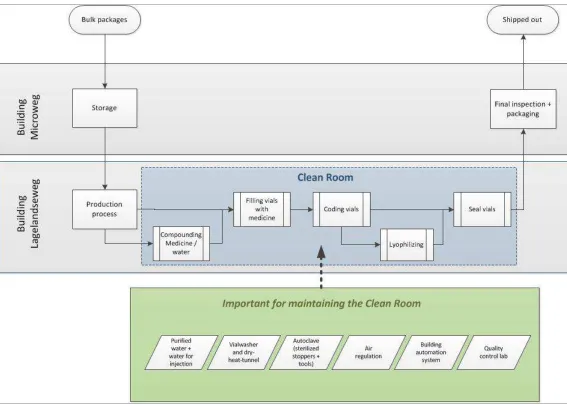
[image:19.595.20.587.285.691.2]The risk analysis as done at the company is focused on risks to the operational process. This means that all risks are taken into account that are of (potential) influence on an excellent operation of the main production process: dividing bulk materials of medicine into separate units. For a good understanding of the potential risks, insight in this main operational process is needed. Therefore in this chapter the production process at the company will be described, starting from the moment the bulk materials arrive at the company and ending when the finished product is shipped out. To make clear what this explanation is about, an illustration of the whole process is given in figure 2.
As this figure shows, the company has two buildings at the facility: one will be called X and one Y. The bulk packages arrive at building X. Here the medicines are stored until they are needed for production. To assure the quality, the bulk packages need to be stored at specific temperatures. Therefore there are different kind of machines at building X to facilitate this, like refrigerators, freezers and ultra low freezers. Other equipment needed in this stage is equipment to transfer the packages, like forklifts.
4.1
Production steps
The production facility is located in building Y. After storage at building X, the bulk products are transported to this location for the next step in the process: production. All activities in this part of the process take place in the clean room. This clean room is necessary to meet the regulatory requirements for safe production.
Independent of the type of medicine, three steps are always taken in the production process: 1. Filling vials with medicine by using the high speed filler (HSF).
2. Coding the vials; after being filled in the HSF, the vials travel through the tray loader to the coding machine where the vials are labeled. A label with production data is required by law because of quality assurance.
3. Sealing this vials; the last stage of production is sealing the vials by putting a cap on top of it. Subsequently the product leaves the cleanroom.
Depending on the type of medicine another one or two steps can be added: compounding the medicine with water (this means that the medicine is carefully weight and then mixed with a cleaned water called water for injection). Another possible step is lyophilizing. Some medicines need this separate activity in the production process. The company has two lyophilizers. These machines use a combination of temperature and pressure to draw out all the water in a product.
After finishing this production process, the filled vials are transported to building X again, where a final inspection take place. This inspection is normally done mechanical. It can also be done manually. Manual inspection is only used as a backup in case the mechanical inspection is not working properly.
After the inspection, the vials are packed. This packaging is done manually. A packaging machine is on site, but not yet operational. After packaging, the medicine is ready to be shipped out.
4.2
Cleanroom
To maintain the above production process operable there are some supporting parts that need to function. The first and very important one is the cleanroom. To keep this at the required standards (for example in regard to sterility), there are a lot of machines necessary.
production of pure steam, WFI and PW is depending on de presence of steam made from regular water. This is called plant steam and made by the plant steam boiler.
To maintain the sterility in the whole process, all material used in the process as well as all necessary equipment that enter the cleanroom needs to be sterilized. For example, the HSF needs vials to put the medicine in. To make sure the vials are completely sterile they go through the vialwasher first and then through the dry-heat-tunnel. The HSF also needs stoppers. These are rubber plugs that are used for closing the vial after filling. These stoppers, like all materials that enter the cleanroom, go through the autoclave before entering the cleanroom.
The cleanroom works with several air pressure levels in different compartments. This creates an airflow directed away from the most critical compartment, where the HSF is, to the surrounding compartments that are less critical. This helps keeping the place clean. Several machines are needed to maintain this situation. A vacuum machine, eight air handling units (AHU), a heating ventilation and air conditioning machine (HVAC) and an air compressor. These machines create the right pressure with clean air at the right temperature.
4.3
Supporting functions
Another supporting part to maintain the above production process operable is the Quality Control department. This is a lab that tests all kinds of the materials and conditions inside and outside the cleanroom, so it can be proven that the product is produced under the required circumstances. This can be medicine from a batch, a sample from the cleanroom or from inside the autoclave etcetera. The Quality Control (QC) department uses a long list of machines to test all the different samples. In order to test all the necessary parameters, almost 30 different machines are used.
5
Results
The first part of this chapter will answer the second sub-question as it will describe the critical processes that where identified and the potential threats within these critical processes. The second part will answer the third sub-question by focussing on the process of prioritizing the operational risks that the company should focus on. The third part will focus on the outcomes of this prioritization and will explain the scoring process on individual Failure Modes. The last part will present some possible solutions that emerged in the process.
5.1
Identifying critical processes and potential risks
In order to list the operational risks, a Fishbone diagram was constructed. This is a diagram that structures the process into categories and identifies potential risks within these categories. These categories are the critical processes needed for production at the company. Within each category several potential risks can be identified. The categories and potential risks are used as input for the FMEA. The Fishbone diagram can be found in appendix D. The Fishbone diagram was constructed after a detailed look into the entire production process. All the departments of the company gave a “tour”, showing what they did, how the did it and what they needed to be able to do it. In this part all the categories will given with a short explanations of what is in the given category. A complete list of all the potential risks within the Fishbone can be seen in column B in the FMEA sheet (Appendix B).
Buildings: In this category are all the external threats to the buildings as a whole. These are natural disasters like earthquakes, but also failure in standard supplies like electricity or water.
Water Treatment: In this category are all the forms of treated water that are necessary in the process. These are forms of purified water, but also different sorts of steam. Each of these different types of treated water requires different machines.
Filling: This category is the part in which the actual filling of the vials is done. These machines are at the core of the process. These are for example the filling machine itself, but also the machine that puts the caps on the vials.
Equipment preparation: This category contains the machines that are necessary to sterilize the equipment needed in the cleanroom. The equipment can be vials, stoppers, caps etcetera.
Ingredient preparation: Some of the medicines need a special preparation before they can be filled. This can be compounding with water, but also thawing a frozen bulk product. This requires for example scales and filters.
People: In this category are the threats to the production due to human resources. This can be human mistakes made during production, but also illness or people leaving the company.
Storage and distribution: In this category is everything that is needed to store and transport both the raw materials and the finished product. This is mostly about keeping materials at the right temperature. Examples are freezers, but also forklifts.
Cleanroom: In order to maintain the cleanroom, a range of different machines are required. Most have to do with handling air in one way or another.
Documentation and monitoring: In this category are all the threats to the automation part of the process. Documenting different variables is needed for accountability after the process and monitoring is used for changes during the process. These require sensors and server for example.
Quality Control: The quality control department takes samples of almost everything during, after and before production. These samples are then tested on a lot of different equipment to assure a safe product. This contains a range of biochemical lab equipment.
Materials: The materials needed for production are sourced from other companies, any threats to the availability of these materials are in this category. The materials vary from vials and labels to cleaning products and gowning materials.
5.2
Process of risk prioritization
The previous part explained how 103 potential threats were identified. The goal of this research is to identify the threats that the company should focus on in their risk management efforts. In other words: to prioritize the potential threats from biggest to smallest risk. This is what the FMEA is used for. The FMEA prioritizes the threats according to the expected costs (ECfmx). The first step in the FMEA process is identifying the Failure Modes. Every operational risk is called a Failure Mode in the FMEA. This is column B in Appendix B. All the Failure Modes are scored on Occurrence (Ofmx),costs of repair(CR), costs of material lost(CM) and downtime(DT). The CR, CM and DT are used to calculate the Severity (Sfmx). And the expected costs (ECfmx) of each Failure Mode are calculated by multiplying Ofmx and Sfmx.
5.3
List of Failure Modes
In this part the results of the FMEA are presented. The top 15 Failure Modes is given, followed by the insights gained from the process of making the FMEA that give a first indication for possible solutions to reduce risks.
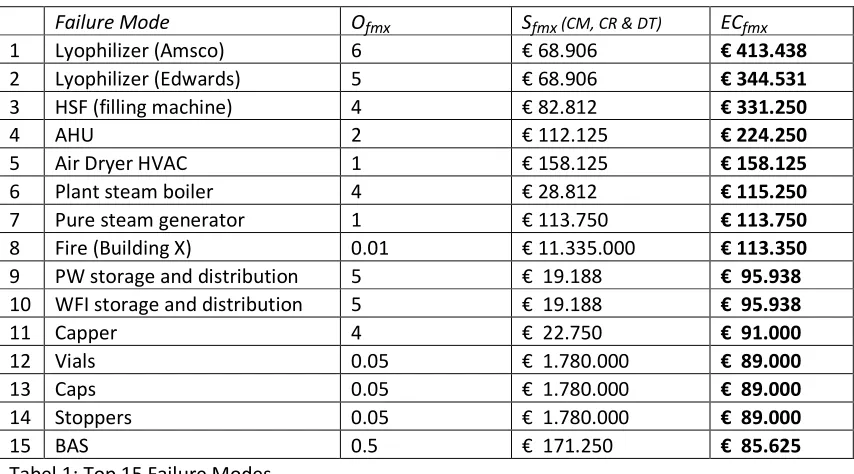
The top 15 Failure modes are presented in table with their Ofmx, Sfmx and ECfmx. Ofmx is the number of times a Failure Modes is expected to occur during a year. The Sfmx is the Severity, these are the expected costs per occurrence of a Failure Mode. This number is made up from the costs of material loss (CM), the costs of repair (CR) and the costs of downtime (DT). Multiplying the Severity and Occurrence gives the total expected costs of a Failure Mode per year: the ECfmx. Each of these Failure Modes are discussed in detail in order to explain the scores on the different variables in calculating ECfmx, compared to other Failure Modes.
Top 15 Failure Modes
Failure Mode Ofmx Sfmx (CM, CR & DT) ECfmx
1 Lyophilizer (Amsco) 6 € 68.906 € 413.438
2 Lyophilizer (Edwards) 5 € 68.906 € 344.531
3 HSF (filling machine) 4 € 82.812 € 331.250
4 AHU 2 € 112.125 € 224.250
5 Air Dryer HVAC 1 € 158.125 € 158.125
6 Plant steam boiler 4 € 28.812 € 115.250
7 Pure steam generator 1 € 113.750 € 113.750
8 Fire (Building X) 0.01 € 11.335.000 € 113.350
9 PW storage and distribution 5 € 19.188 € 95.938
10 WFI storage and distribution 5 € 19.188 € 95.938
11 Capper 4 € 22.750 € 91.000
12 Vials 0.05 € 1.780.000 € 89.000
13 Caps 0.05 € 1.780.000 € 89.000
14 Stoppers 0.05 € 1.780.000 € 89.000
[image:24.595.83.510.336.573.2]15 BAS 0.5 € 171.250 € 85.625
Tabel 1: Top 15 Failure Modes
1. Amsco Lyophilizer: This is one of the two lyophilizers. The machine draws water out of the product by using pressure and temperature. The material is in the vial at this stage, but the vial is not fully closed in order to draw out the water. This means that if the machine breaks down during a production run, the medicinal material is at a risk. The chance of losing product in this way is not very high, because the machine is closely monitored and tested before use.
breakdowns would result in losing a batch of product. The costs of repair (CR) for this machine are high, since often expensive mechanics need to be hired in order to repair the machine. The downtime (DT) per breakdown is low. This has two reasons. First, the average repair time is not very long. Second, not all products need lyophilizing in this machine, so production might be able to continue even if this machine is out of production.
Occurence: The machine does have a lot of break downs.
2. Edwards Lyophilizer: The Edwards Lyophilizer and the Amsco are similar machines, only the brand differs. The two machines are listed as two different Failure Modes, because they are not interchangeable. Since both machines work slightly different the results can be slightly different. Therefore only one machine is qualified for each type of medicine. This means the process is only approved using that specific machine and using the other would mean it is illegal to use the product.
Severity: The expected consequences of breaking down are the same as for the Amsco.
Occurrence: The difference between the two estimates is in the expected number of breakdowns. The difference in expectance is based on the number of breakdowns in history. The Edwards has broken down a little les often than the Amsco.
3. High Speed Filler (HSF): The HSF is the machine that actually fills the vials with medicine. It is very important that the machine works sterile and that the right amount of medicine is put in the vial. The machine also puts a stopper on the vial after filling. This is like a rubber plug that seals the vial. Like the lyophilizers, if the machine breaks down during a production run, medicinal product might be lost.
Severity: Although the repair time normally isn’t very long, the down time (DT) is average, because without it production is completely impossible. The costs of repair (CR) are high due to the complexity of this machine. The costs of material lost (CM) are average because breakdowns often occur during test runs rather than production runs.
Occurrence: The machine breaks down quite frequently.
4. Air Handling Unit (AHU): There are eight identical machines called AHU. They use filters to clean the air and together they maintain the correct air pressures in the different compartments of the cleanroom. Therefore they are treated as one Failure Mode.
Severity: Chance of losing material (CM) is high, because losing pressure will compromise cleanroom conditions fast. If it happens during production there is little chance that the batch will still be useable. Costs of repair (CR) and downtime (DT) are not very high, since the machines are not very complex and spare parts are easier to come by.
5. Air Dryer HVAC (HVAC): Where the AHU’s regulate the airpressure in the cleanroom, the HVAC regulates the air temperature and humidity before entering the cleanroom.
Severity: The downtime (DT) is average since spare parts are not always available. Costs of repair are average, since the machine does have some complexity to it. The costs of material (CM) is high, because compromised cleanroom conditions during production leads to unusable product.
Occurrence: The chance of this machine breaking down is smaller than the AHU’s, but still average.
6. Plant Steam Boiler: The plant steam boiler creates steam out of normal tap water. This steam is not directly used in the production process, but is required to allow other machines to function.
Severity: Because the steam is not directly used in the production process, the chance of losing medicinal product (CM) is effectively zero. Without the plant steam production is not possible. Several other critical machines are depending on the availability of the steam. The down time (DT) is average and the costs of repair (CR) are not very high.
Occurrence: It breaks down frequently.
7. Pure Steam Generator: The pure steam generator creates cleaner steam than the plant steam boiler. It creates steam from purified water. It uses plant steam to create this.
Severity: The pure steam is not used by machines directly handling the product, therefore there is no chance of losing any medicinal product (CM). The autoclave needs the pure steam to function. This means that production without it is not possible. Downtime (DT) is high due to the complexity of the machine. The costs of repair (CR) are average.
Occurrence: The chance of breakdown is average.
8. Fire at building X: The risk of a fire in the buildings are considered two different Failure Modes. This is done because the chance of a fire occurring is not the same in each building and most of all, the consequences are different.
Severity: Building X has no sprinkler system, where Y does. This means that if a fire occurs at X, chances are high that it cannot be extinguished in an early stage. Furthermore, at Y there is only the amount of medicine used for production. At X there can be a lot more in storage waiting for production or shipment after production. Therefore the costs of losing medicinal product (CM) are extremely high at X. A fire at X will create a long downtime (DT) for the production at Y, because the medicinal material and the materials needed for production, like vials and cappers cannot be replaced on short notice. The costs of repair (CR) are in this case rebuilding or renovating the building after the fire. These costs are extremely high.
fire. Compared to other Failure Modes the occurrence is very low, but it is considerably higher than the occurrence of fire at Y.
9. PW storage and distribution. The Osmotron machine produces purified water (PW). This is pumped in a loop for storage and distribution. The water must be pumped around continuously to keep it from spoiling.
Severity: If the loop breaks down, no medicinal material will be lost (CM).
Production is impossible without it, since key machines depend on the purified water. This downtime (DT) will not be very long and costs of repair (CR) are average.
Occurrence: The storage and distribution loop breaks down frequently.
10.WFI storage and distribution. The Pharmastill produces water for injection (WFI). The storage and distribution loop is similar to the PW storage and distribution loop, but they are two separate loops.
Severity: The severity is estimated to be exactly the same as PW storage and distribution.
Occurrence: The chance of this Failure Mode occurring is estimated to be the same as the PW storage and distribution.
11.Capper: The capper is the machine that puts a cap on top of the vial after it comes from the HSF.
Severity: Because there is already a stopper on the vial at this point of the process there will be no medicinal product lost (CM) if it breaks down. Costs of repairs (CR) are cheap. There will be downtime (DT) in production if this machine breaks down, but it will not be very long.
Occurrence: Breakdowns occur often.
12.Vials: Vials are present at all the critical parts of the process. The threat that is considered in this Failure Mode is the supply of vials. The supplier of vials needs to be qualified for the process. Also the machines handling the vials, like the vialwasher or the HSF, have very little tolerances. This means that the vials must have exactly the right size. Changes on the supply side can influence the size of the vial. When the current supplier tried to produce the same vials at a different production location, they couldn’t get them to be exactly the same.
Severity: There is no risk of losing medicinal product (CM), no repair costs (CR), but the downtime (DT) is very high.
Occurrence: The chance of problems with the supply of vials occurring suddenly is small.
13.Caps: The caps are put on the vial after the actual filling process.
Severity: The expected consequences are the same as the vials. The requirements on these caps are high, because they need to guarantee that the vial is sealed. Acquiring a new supplier on these caps is expected to be as difficult as a supplier for vials.
14.Stoppers: the stoppers can be described as rubber plugs put in the vials after filling and before the cap is put on.
Severity: The expected consequences are the same as the vials. The requirements on these stoppers are high, because they need to seal the vial. Acquiring a new supplier on these stoppers is expected to be as difficult as a supplier for vials.
Occurrence: The expected occurrence is the same as for the vials.
15.BAS: BAS is the building automation system. This is the system that monitors outputs from different sensors that are in and around the cleanroom. If any are outside preset limits, the system gives an alarm. This is used to solve problems as they occur during production. Some settings for the cleanroom can be adjusted by this system. This can make the difference between losing a batch or not. The data is also used to account for the correct production conditions.
Severity: If the system fails during a production run, there is a chance that the medicinal product (CM) is lost. The system runs on a single server and there is no backup for this server. The downtime (DT) is high due to the complexity of the system. This complexity makes it also necessary to hire expensive specialists to fix problems, which means the costs of repair (CR) are high.
Occurrence: The expected chance of failure is low.
5.4
Process insights for possible solutions
Performing the FMEA gives a lot of insights in the production process. The standard procedure after making a FMEA is the following: start at the highest Failure Mode, analyze its causes and solutions, implement the solutions and move on to the next Failure Mode. This is a time consuming process. Besides, a lower ranking Failure Mode may have a solution that is more cost-effective than a higher ranking Failure Mode. This depends on the size of the contributing factors to the expected costs.
An important insight that resulted from the process FMEA is the insight in the largest contributing factors. At the company there are three contributing factors to reduce risks that have a major influence on six Failure Modes in the top 15. The possible solutions for the contributing factors could enable the company to reduce the risks of these six Failure Modes. Therefore they are expected to be some of the most viable options to reduce risks. A deeper analysis should show the viability and cost-effectiveness of all three options before implementation.
• First the two lyophilizers that are on top of the list. The threat of the lyophilizers would be reduced severely if both machines would be qualified for all types of medicine. Qualifying them to do each others work would cause a tremendous reduction of downtime.
• Second the supply of vials, caps and stoppers. For each of these materials, the company relies on a different supplier, but for all materials there is only one supplier qualified. Qualifying a second supplier will greatly reduce the downtime if a problem occurs with one of these suppliers.
6
Conclusion and Discussion
6.1
Conclusion
In this conclusion the research question will be answered:
On which operational risks should the company focus in its risk management according to FMEA, in order to reduce the risks to the critical processes?
To answer the research question a theoretical analysis of FMEA is done. This enabled the selection of the best type of FMEA for the company. The selected type of FMEA is a Cost-Based-Process FMEA. This is suited for the high tech process at the company. The RPN problems in traditional FMEA are overcome and the cost-based out come is expected to be easier to interpret for people not directly involved.
After selecting the type of FMEA it is necessary to identify the potential risks. To do this, first the processes at FMEA were mapped, followed by a Fishbone diagram to assess the threats to these processes. This resulted in a total of 103 operational risks for the processes at the company. The risks are in different parts of the process and were therefore categorised accordingly. Each risk is a Failure Mode in the FMEA.
After identifying the potential risks as Failure Modes, the Failure Modes need to be prioritized. To make a prioritization all Failure Modes are assessed on four key factors in the risk. These are the potential loss of medicinal product, the repair costs, the down time and the frequency of occurrence. This leads to an estimation of the expected costs per Failure Mode per year. This estimation of expected costs is used to prioritize the Failure Modes. The top priority should be given to the Failure Modes with the highest expected costs. This resulted in a list of 15 Failure Modes that the company should focus its risk management efforts on.
Another result of the FMEA process is the three potential solutions: Qualifying the lyophilizers to do each others work, finding extra suppliers and a back-up server for the BAS. The process of making the FMEA gave insight in how much these solutions contributed to the estimation of the costs. The three solutions can reduce the risks of six Failure Modes in the Top 15. They are considered so promising that they should be given priority in further analysis. Instead of starting with analysing the first in the top 15 Failure Modes, the advise for the company is to first make a more detailed analysis of the cost-effectiveness of these solutions.
This leads to the answer of the main research question: the company should focus first on the 3 potential solutions that affect six of the main Failure Modes. After adjusting the FMEA for the results of these efforts, it should focus on individual Failure Modes that remain on top of the list.
6.2 Recommendations
6.2.1 Focus the efforts in Risk Management
The company should approach reducing risks in a structured way. That means prioritizing which threats should be addressed first. According to traditional FMEA, the company should start at the top and work down the list to reduce risks. However, there are some arguments why efforts to reduce risks might be directed to Failure Modes in a different order. First, for some Failure Modes reducing the risk might be very difficult or expensive. In that case it can pay off to direct resources to Failure Modes where the decrease in risk per investment is higher. Second, sometimes the difference in expected costs between two Failure Modes is very small. Since it is based on estimates, the accuracy is not high enough to guarantee these small differences are matching reality. Last there can be outside influences that can affect the order in which Failure Modes are addressed. For example there is a plan to build an new building at the site of building Y to house the entire operation. This would completely change failure mode 8. Whether or not this will happen in the near future depends on the mother company.
Given these arguments the company can deviate from the exact order of the Top 15, but the company should choose which Failure Modes to direct efforts to right now and which Failure Modes are addressed at a later time.
6.2.2 Analyze the in house mechanical knowledge
The complicated machines at the company often require expensive mechanics to be hired. At the same time the company has its own mechanics. Some of these mechanics work there for more than 10 years. This experience might enable them to do more in house if they were given the opportunity. This could be of major influence to the repair costs and the downtime. It is worth investigating whether this would be effective and reduce costs.
6.2.3 Make the FMEA a continuous process