
2465
Self-Discriminative Learning for Unsupervised Document Embedding
Hong-You Chen∗1, Chin-Hua Hu∗1, Leila Wehbe2, Shou-De Lin1
1Department of Computer Science and Information Engineering, National Taiwan University 2Machine Learning Department, Carnegie Mellon University
{b03902128, r07922028}@ntu.edu.tw, [email protected], [email protected]
Abstract
Unsupervised document representation learn-ing is an important task providlearn-ing pre-trained features for NLP applications. Unlike most previous work which learn the embedding based on self-prediction of the surface of text, we explicitly exploit the inter-document infor-mation and directly model the relations of doc-uments in embedding space with a discrimi-native network and a novel objective. Exten-sive experiments on both small and large pub-lic datasets show the competitiveness of the proposed method. In evaluations on standard document classification, our model has errors that are relatively 5 to 13% lower than state-of-the-art unsupervised embedding models. The reduction in error is even more pronounced in scarce label setting.
1 Introduction
Rapid advance in deep methods for natural lan-guage processing has contributed to a growing need for vector representation of documents as in-put features. Applications for such vector repre-sentations include machine translation (Sutskever et al.,2014), text classification (Dai and Le,2015), image captioning (Mao et al.,2015), multi-lingual document matching (Pham et al.,2015), question answering (Rajpurkar et al.,2016), and more. This work studies unsupervised training for encoders that can efficiently encode long paragraph of text into compact vectors to be used as pre-trained fea-tures. Existing solutions are mostly based on the assumption that a good document embedding can be learned through modeling theintra-document information by predicting the occurrence of terms inside the document itself. We argue that such an assumption might not be sufficient to obtain
mean-∗
Equally contribution.
ingful a document embedding as they do not con-siderinter-document relationships.
Traditional document representation models such as Bag-of-words (BoW) and TF-IDF show competitive performance in some tasks (Wang and
Manning, 2012). However, these models treat
words as flat tokens which may neglect other use-ful information such as word order and semantic distance. This in turn can limit the models effec-tiveness on more complex tasks that require deeper level of understanding. Further, BoW models suf-fer from high dimensionality and sparsity. This is likely to prevent them from being used as input features for downstream NLP tasks.
Continuous vector representations for docu-ments are being developed. A successful thread of work is based on the distributional hypothesis, and use contextual information for context-word predictions. Similar to Word2Vec (Mikolov et al.,
2013), PV (Le and Mikolov, 2014) is optimized by predicting the next words given their contexts in a document, but it is conditioned on a unique document vector. Word2Vec-based methods for computing document embeddings achieve state-of-the-art performance on document embedding. Such methods rely on one strong underlying as-sumption: it is necessary to train the document embedding to optimize the prediction of the tar-get words in the document. In other words, the objective requires the model to learn to predict the target words in surface text. We argue that there are several concerns with such a self-prediction as-sumption.
con-cept ofmachine learningbecomes less critical in the embedding. However, if the corpus contains documents from different areas of computer sci-ence, then the concept ofmachine learningshould be encoded in any document relevant to it. We therefore claim thatthe embedding of a document should not only depend on the document itself but also the other documents in the corpus, even though previous work seldom makes this consid-eration.
In addition, accurate predictions at the lexicon or word level do not necessarily reflect that the ”true semantics” have been learned. For example, in IMDB dataset review No.10007:
”... the f ather did such a good job.”
Obviously, good can be replaced with synonyms like nice without significantly altering the mean-ing of the sentence. However, since the syn-onyms are treated as independent tokens in PV and Doc2VecC, the lexicongoodmust be predicted ex-actly. Moreover, to accurately predict the final word job, the embedding probably only needs to know thatdid a good jobis a very common phrase, without having to understand the true meaning of job. This example shows that in order to accu-rately predict a local lexicon, the embedding might opt to encode the syntactic relationship instead of true semantics. Enforcing document embeddings to make predictions at the word level could be too strong of an objective. More specifically, we argue that the true semantics should not only depend on a small context, but also the relations with other training documents at document level.
To address the above concerns we propose a novel model for learning document embedding un-supervisedly. In contrast with previous work (PV and Doc2Vec), we model documents according to two aspects.
First, we abandon the concept of context word prediction when training an embedding model. Instead we propose a self-supervision learning framework to model inter-document information. Conceptually, we use the embedding to determine whether a sentence belongs to a document. Our encoder is equipped with a discriminator to clas-sify whether a sentence embedding is derived from a document given that document’s embedding. This explicitly enforces documents to be spread reasonably in the embedding space without any la-bels so that they can be discriminated. To the best
of our knowledge, this is the first deep embedding work to explicitly model the inter-document rela-tionship.
Second, in our approach the predictions are in-ferred at the sentence level. This avoids the effect of only predicting the surface meaning in word level (e.g. good vs. nice). Unlike previous work, our model is explicitly optimized to represent doc-uments as combinations of sequence embedding beyond words seen in training.
Below we summarize the key contributions:
• We present a deep and general framework and a novel objective for learning document representation unsupervisedly. Our models are end-to-end, easy to implement, and flexi-ble to extend.
• We perform experiments through sentiment analysis and topic classification to show that our model, referred to as self-discriminative document embedding (SDDE), is competitive to the state-of-the-art solutions based on tra-ditional context-prediction objectives.
• Our extensive experiments quantitatively and qualitatively show that SDDE learns more ef-fective features that capture more document-level information. To the best of our knowl-edge, SDDE is the first deep network to model inter-instance information at docu-ment level.
• We further propose to evaluate unsupervised document embedding models in weakly-supervised classification. That is, lots of un-labeled documents with only few labels at-tached to some of them, which is a realistic scenario that unsupervised embedding could be particularly useful.
2 Related Work
Here we give an overview of other related meth-ods on learning unsupervised text representations. Besides BoW and TF-IDF, Latent Dirichlet Al-location models (Deerwester et al., 1990; Blei et al., 2003) leverage the orthogonality of high-dimensional BoW features by clustering a prob-abilistic BoW for latent topics.
Several models extend from Word2Vec
(Mikolov et al., 2013), using context-word
a document embedding matrix in memory and is jointly trained. The required training parameters are linear to the number of documents and thus prohibit PV from being trained on a large corpus. Moreover, expensive inference for new documents is required during testing. To address the above concerns, Doc2VecC (Chen,2017) combines PV and a denoising autoencoder (DEA) (Chen et al.,
2012) with BoW vectors as global document in-formation instead. The final document embedding are then produced by simply averaging the jointly trained word embedding.
Another thread of work uses two-stage pipelines to construct sentence/document embedding from pre-trained word embedding. Arora et al.(2017) propose post-processing weighting strategies on top of word embedding to build sentence represen-tations. WME (Wu et al.,2018) propose a random feature kernel method based on distance between pairs of words, which also shows inter-document information helps. However, the cost scales with the size of training samples such that it is hard to be applied on large-scale dataset.
There have been more embedding work on sen-tences compared to documents. These approaches mostly learn the sentence embedding by model-ing the sentence-level (Kiros et al., 2015; Tang et al., 2017b,a; Logeswaran and Lee, 2018) or word-level (Pagliardini et al.,2018;Kenter et al.,
2016;Arora et al., 2018) distribution hypothesis (Harris,1954;Polajnar et al.,2015) in a large or-dered corpus. We note that the main difference be-tween learning embedding for sentences and doc-uments is that docdoc-uments are not ordered in a cor-pus. Some other work model sentences with RNN autoencoders (Hill et al.,2016a;Gan et al.,2017). Documents often refer to long-length text contain-ing multiple sentences, which might be hard to model with RNNs (Pascanu et al.,2013;Jing et al.,
2017) and time-consuming on large corpus.
3 Model and Design Rationale
To facilitate downstream tasks, a document em-bedding is required to compress useful features into a compact representation. It is not an easy task to learn discriminable features unsupervisedly since validation information is not accessible for training. We first introduce some notations:
• V: the training corpus vocabulary of size|V|;
• X ={X1,· · ·, Xn}: a training corpus of
docu-ment sizen=|X |, in which each documentXi
is a set of sentencesSi;
• Si = {s1i,· · ·,s
|xi|
i }: a document divided into
a set of sentences, of set size |Si|, in which each sentencesji ∈ R|V|×Tjcontains a sequence of variable length Tj of word one-hot vectors
w1j,· · ·,wTj
j , each in R|V|×1. S is the set of
total sentences
n S
i=1
Si in the training corpus, of
sizem=|S|;
• hw: the size of the word embedding and U ∈
Rhw×|V|: the word embedding projection ma-trix. We useuw to denote the column inUfor
wordw
• hs: the size of the sentence embedding andes∈
Rhs: the embedding of sentences.
• di ∈ Rhs: documentXi’s embedding.
Our goal is to learn a functionF : X → Rhs×n that maps documentXi todiunsupervisedly.
Next, we formulate how SDDE represents a document, then introduce our self-discriminative learning procedure we use to train it.
3.1 Document Representation
We consider a document as mean of sentences, i.e., breaking a document into several subse-quences. We demonstrate several benefits of the design in SDDE. First, decomposing long docu-ments into shorter but reasonable semantic unit (e.g., sentences) makes encoding easier and faster since they can be processed in parallel. Simi-lar concepts of modeling documents hierarchically have shown benefits in some supervised tasks such as text classification (Yang et al., 2016). It also makes the model insensitive to document length, which is important because length varies greatly in real documents (see Table1).
In training, we further propose to represent a document during training using the average of only a subset of its sentences. This special sentence-level dropout is beneficial for training by creating up to |Xi|
q
For a documentXi = {sji}, orSi, the
embed-ding is derived from averaging the respective rep-resentations of subsequences. Noted as:
di =
1 q
q X
j=1, s∼PSi(s)
ejs, (1)
where
es=E(s), (2)
where a sentence encoderE is introduced to pro-duce sentence embedding forsji. In practice, sen-tences can be obtained by simply segmenting doc-uments with punctuation. In testing, the document embedding is obtained by averaging all the sen-tences in which:
d= 1
|Si|
X
∀s∈Si
es. (3)
We note that averaging subsequences differs from averaging of words in two aspects. First, each sentence is encoded individually before be-ing averaged, allowbe-ing incorporation of word or-der into design rationale at least in a reasonable range. Second, subsequences may have different lengths that reveal syntactic information. To il-lustrate, BoW/mean-of-word models suffer from ambiguously modeling two different documents which are similar in word distributions but differ in some aspects of interest. Mean-of-sentence model avoids such concern by modeling documents at the sentence level. It could be expected that it is much less likely to find two documents with similar sen-tence distribution than similar word distribution. Mean-of-sentences formulation can be smoothly reduced to mean-of-word models (by treating each word as a sentence) or pure sequence models (by treating each document as a very long sentence).
3.2 Self-Discriminative Learning
Unlike PV or Doc2VecC which emphasize mod-eling distributional information within individual documents, we model relations across documents. The basic idea is that we hope to learn an embed-ding for each sentence in the document as well as a discriminator that determines whether a sentence belongs to a document. Self-discriminative learn-ing uses a discriminator networkD to determine whether a sentence belongs to a document. The aim is to learn a suitable embedding and a good discriminator to determine if a sentence belongs to
Algorithm 1 Self-Discriminative Learning for Unsupervised Document Embedding
Input:DocumentsX ={Xi}n1,p,k,hw,hs.
Output: FunctionF : X → Rhs that maps text of a document to an embeddingd∈ Rhs.
1: ComputeS =
n S
i=1
Sifrom setSiof eachXi.
2: Create and initializeD,U.
3: Create and initializeEas in Eq.5or Eq.6.
4: whilenot convergedo:
5: fori= 1, . . . , ndo 6: SamplesfromSi.
7: Geteps←E(s)as a positive sample.
8: Samples1i, . . . ,sqi fromSi\ {s}.
9: forj= 1, . . . , qdo
10: Getejs←E(sji)
11: end for
12: Getdiwith Eq.1given{ejs}qj=1.
13: for`= 1, . . . , kdo
14: Samples0`fromS \ Si.
15: Gete`s0 ←E(s0`)as a negative sample.
16: end for
17: Compute Eq.4givendi,eps,{e`s0}k`=1.
18: Backprop and update forE,D,U.
19: end for
20: end while
21: ReturnF(E,U),
a document. The overall procedure is summarized in Algorithm1.
We propose an objective that explicitly opti-mizes SDDE towards representing a document with mean of (encoded) sentences. To optimize the discriminator D, we formulate it as a binary classifier that takes pairs of document embedding
dof a documentXiand a sentence embeddinges, (d, es), as inputs. The discriminator is asked to discriminate using d whether the sentence s be-longs to the documentXi or the other documents
X0∈ X \ {Xi}. The loss then becomes:
log(1−D(d,eps)) +
k X
`=1
E s0∼PS,
s0∈S/ i
h
log(D(d,e`s0)) i
,
(4) for each document with one positive sample eps andknegative samples of sentenceses0, wheres0 are not in the sentence setSi ofXi, as s0 ∈ S/ i.
Note thateps is not used ford otherwise it would be trivial to be solved by the discriminator.
be understood as unsupervisedly mimicking su-pervised inference without knowledge of any label information by treating sentences from other doc-uments as fake/negative samples. One main con-cern that it is possible to find similar sentences in two different documents. Our discriminator par-ticularly addresses this issue by optimizing for the most discriminative sentences rather than similar ones that might not be critical to shape the em-bedding. To minimize the loss, the encoder would tend to preserve the most essential feature to facil-itate the discriminator to push away any two doc-uments, which should encourage the embedding points spread even more widely across the space. This in turn should result in more ease in down-stream tasks: for example in learning a decision hyperplane in a classification task.
3.3 Sentence Encoder
Next, we narrow down to sentence encoder E. Given a sequence of word one-hot vectors as a sen-tences = [w1, . . . ,wT], we project them into an embedding layerUto retrieve their corresponding word embedding. Note that the word embedding are trained jointly.
Our first method uses:
E(s) =φ(ReLU(G(Ust))), (5)
where G is a single-layer RNN encoder using GRU cells to process the word embedding se-quences andφis a linear transform for dimension
hsof sentence embedding.
Our second method, we use a schema of mean-of-word for advantage of fast generation, we av-erage the word embeddingwwithin a sentences
along time axis as AVG encoder:
E(s) =φ(ReLU( 1
|s|
|s|
X
i=1
Uwti)), (6)
Let us stress that the role of encoderEis to extract local feature from every sentence, and the over-all objective encourages SDDE to represent docu-ments as mean of sentence embedding.
3.4 Discriminator
An undesired pitfall comes from a learned weak encoder with a powerful discriminator causing the embedding produced by the encoder useless for downstream tasks. To avoid such a pitfall, we
Dataset #Class #Train / #Test Doc Length Sent Length
[image:5.595.357.476.164.214.2]IMDB 2 75k / 25k 124.6±8,856.7 11.6±105.5 Yelp P. 2 560k / 38k 70.0±4,117.8 8.2±48.7 AG’s News 4 120k / 7.6k 27.2±66.1 11.8±66.7 DBPedia 14 560k / 70k 32.8±231.3 9.7±68.6
Table 1: Statistics of the datasets. Length of document and sentence in words (mean±variance), which could be high for real-world scenarios such as online reviews.
Dataset k p hw hs
IMDB 1 3 100 100
Yelp P. 1 3 300 500 AG’s News 3 1 100 100 DBPedia 4 2 300 500
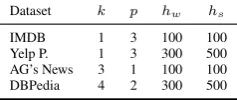
Table 2: Hyperparameters used in experiments. The document embedding trained with the same hyperpa-rameters are used for all the evaluations without task-specific tuning.
adopt lightweight network structures for discrimi-nators. For the IMDB datasets, we find inner prod-uct (dV)tE(s) with a learnable matrixV suffi-cient. For the other datasets in Table1, two fully-connected layers with ReLU activations in latent are used.
3.5 Sampling Sentences
We relate our method to the Negative Sampling (Mikolov et al.,2013) technique which is a simpli-fied objective of softmax approximation (Mikolov et al., 2013; Mnih and Teh, 2012; Zoph et al.,
2016). Negative sampling has been used as an efficient and effective technique in learning word embedding. We reformulate it to train document embedding by sampling in sentence level, which is easy to implement and efficient to train just like Word2Vec (Mikolov et al.,2013).
In practice, when training with mini-batches the documents for negative samples are from the same mini-batch, which requires small extra computa-tion efforts.
SDDE requires a similar number of parameters as Doc2VecC does, but much less than PV. In ad-dition, the sentence encoder is flexible and can in-corporate other techniques of text processing such as attention methods.
4 Experiments
4.1 Setup
a summary. Only the training splits are used in training embedding with subsampled training split for cross-validations.
[image:6.595.343.489.62.176.2]We preprocess the datasets by normalizing the text to lower class and replacing words appearing less than 10 times with a UNK token. Out-of-vocabulary words in testing set are also replaced. All our baseline models use the same input data. To define the sentences for experiment, we uti-lize the sentence tokenizer from NLTK. For the documents containing only one sentence we sim-ply divide it into multiple subsequences for sam-pling. We use RMSProp method for optimiza-tion. Dropout 50% of input to the discriminator. Weights are random-uniformly initialized between [-1, 1].
The other hyperparameters are summarized in Table2. All the models use the same embedding size for fair comparison. The trained document embedding are used for all the evaluations without specific tuning.
4.2 Evaluation
Generally, it is not easy to evaluate an unsuper-vised embedding model. In Section4.3 and4.4, we evaluate the performance on standard docu-ment classification following the common prac-tice used by previous work (Chen,2017;Wu et al.,
2018;Arora et al.,2017): a classification task with a linear SVM (Fan et al.,2008) trained on the la-bels in each dataset. Next, we study unsupervised document embedding on two novel aspects. In Section 4.5, we study a weakly-supervised clas-sification setting that fits the realistic scenario of using unsupervised embedding with only a few la-bels. In Section4.6, we provide a metric to eval-uate the effectiveness of modeling inter-document information.
4.3 Sentiment Analysis with IMDB Dataset
We first compare our models with the others state-of-the-art competitors. RNN-LM (Mikolov et al.,
2010) and Skip-thought (Kiros et al., 2015) are RNN-based. SIF (Arora et al.,2017), W2V-AVG (Mikolov et al.,2013), and WME (Wu et al.,2018) are two-stage approach that post-processing on word embedding. We collect the results reported on the widely-used benchmark sentiment classifi-cation dataset IMDB. For PV, we use Gensim im-plementation (Reh˚uˇrek and Sojkaˇ ,2010); versions
https://www.nltk.org/
Model Error%
Skip-thought* (Kiros et al.,2015) 17.4 SIF (GloVe) (Arora et al.,2017) 15.0 RNN-LM* (Mikolov et al.,2010) 13.6 W2V-AVG* (Mikolov et al.,2013) 12.7 DEA* (Chen et al.,2012) 12.5
PV-DM 20.0
PV-DBoW 12.0
WME (Wu et al.,2018) 11.5 Doc2VecC* (Chen,2017) 11.7
SDDE-AVG 10.6
SDDE-RNN 10.2
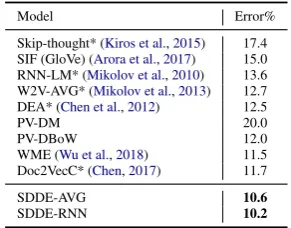
Table 3: Sentiment Classification on IMDB Bench-mark. *Results are collected fromChen(2017).
Pred SDDE-RNN Doc2VecC True False True False
#Sent 14.8 14.7 14.5 14.8
Table 4: Mean of #sentence per document in IMDB dataset, in groups of classification correctness.
of both Distributed Memory (DM) and Distributed Bag of Words (DBoW) are reported. For differ-ent encoders in SDDE, AVG is for averaging word embedding and RNN is for the RNN encoder.
Self-Discriminative Learning is Effective From the experiment result in Table3, we can see that our self-discriminative learning is effective and superior on the document embedding models for both AVG and RNN versions. SDDE-RNN achieves best accuracy on IMDB dataset 1.5% margin against Doc2VecC.
Study the Property of SDDE Unlike previous work modeling documents on the word or short context level, SDDE operates on the sentence level. We study the false and true predictions output by SVM upon SDDE in comparison with Doc2VecC. Table5show some examples that have the largest difference. We observed SDDE can better capture contradicting or contrasting opin-ions. We observe some wrong predictions (Row 3) are due to the ambivalent reviews. SDDE is in-sensitive to the number of sentences; we found the effect of the number of sentences per document was trivial as shown in Table4.
4.4 Large-Scale Document Classification on More Dataset
au-Label: 1 i don t even like watching those late night talk shows , but i found this one really interesting . i imagine it s probably close to the truth — it feels like an honest account , if that means anything . kinda feel for the people somewhat when you watch it . a nice movie for a saturday night .
SDDE: 0.89 Doc2VecC: 0.27
Label: 0 i m a boorman fan but this is arguably his least successful film . comedy has never been his strong suit , and here his attempts at screwball farce are clumsily done . still , it s almost worth seeing for boorman s eye for talent : this is one of uma thurman s first starring roles , and as always she is ravishing to watch . on a sad side note boorman wrote the script with his daughter ,<UNK>who died a couple years ago .
SDDE: 0.12 Doc2VecC: 0.75
Label: 0 michael dudikoff stars as joe armstrong a martial artist who fights ninjas who are stealing weapons from the u s army , in this entertaining yet admittedly brainless martial arts actioner , which is hampered by too many long pauses without action , but helped by some high energy action<UNK>as well as steve james performance .
[image:7.595.304.526.170.336.2]SDDE: 0.77 Doc2VecC: 0.10
Table 5: IMDB Examples with scores 0 to 1 for negative to positive assigned by SVM.
Model Yelp P. AG DBP.
PV-DM 17.6 39.6 21.6
PV-DBoW 12.1 16.8 10.4 Word2Vec AVG 8.0 14.2 2.7
SIF 8.4 13.8 2.9
Doc2VecC 7.4 10.4 2.0
SDDE-RNN 8.7 12.7 8.6
[image:7.595.103.261.329.377.2]SDDE-AVG 6.7 9.8 1.8
Table 6: Testing error rate (%) with standard classifi-cation on public datasets. Bold text indicates passing hypothesis test with p-value<0.05 with different ran-dom initialization.
Model IMDB Yelp P. AG DBP.
Doc2VecC 12.5 11.5 13.9 3.6 PV-DBoW 13.7 18.6 13.9 13.1
SDDE 11.7 10.0 10.0 2.9
Table 7: Testing error (%) in weakly-supervised set-ting. Only 1k labeled data per class were used.4.5).
thors . We use SIF to generate document embed-ding with Word2Vec trained on each dataset as its inputs.
Results are shown in Table 6. SDDE-AVG performs slightly better across different dataset. We hypothesis SDDE gets larger improvement on IMDB dataset since SDDE can handle longer doc-uments better by exploiting sentence embeddings. On the other hand, the RNN version of SDDE per-forms significantly worse than the word-averaging version. We may remind the reader that state-of-the-art unsupervised document embedding models are not RNN-based. The effects of word order are still unclear. Wieting and Gimpel(2017) provides a study of sentence embedding. We hypothesize that it may be difficult for an RNN encoder to learn to incorporate multi-domain information in datasets with many classes (e.g., DBpedia) unsu-pervisedly. This would be our future work.
4.5 Classification with Few Labeled Data
Next, we consider a more real-world weakly-supervised learning scenario: classification on the
https://github.com/mchen24/iclr2017 https://github.com/PrincetonML/SIF
(a) IMDB
(b) AG’s news
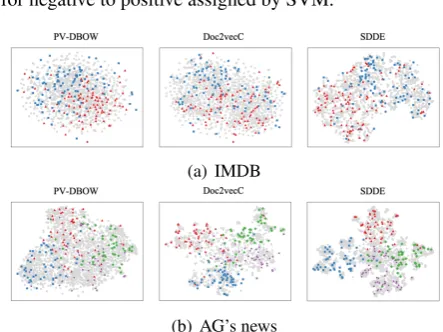
Figure 1: t-SNE embedding Visualizations of weakly-supervised learning experiments in Section4.5. Col-ored points are labeled training data in the experiments and gray points are the unlabeled testing documents.
datasets we have used in previous experiments, but this time only when very few labels are available.
We hypothesize that SDDE is particularly use-ful for classification with few labels since the self-discriminative learning has exploited the possible features to map the text onto the embedding space properly during the representation learning phase. The embedding is expected to be more discrim-inable to facilitate finding the classification deci-sion hyperplanes with fewer labeled data.
Figure 2: Weakly-supervised learning on datasets in Table1. Training with [10, 20, 30, 40, 50, 100, 1000] instances per class (X-axis) and computing the accuracy on the whole testing set (Y-axis).
Model IMDB Yelp P. AG DBP.
Metric A E A-E A E A-E A E A-E A E A-E
Doc2VecC .78 .76 .02 .52 .49 .03 .57 .46 .11 .60 .40 .20 Word2Vec AVG .86 .85 .01 .54 .51 .03 .57 .44 .13 .75 .61 .14 PV-DBoW .28 .27 .01 .11 .10 .01 .71 .60 .09 .45 .36 .09
[image:8.595.139.461.203.275.2]SDDE .36 .27 .09 .14 .08 .06 .20 .01 .19 .58 -.03 .61
Table 8: Distances of Intra & Inter-class cosine similarity. A for IntraCos and E for InterCos, note that they cannot be compared across different models. Instead, distance A-E defined in Equation7is reported to study a method’s effectiveness of modeling inter-document features. The higher the number the better.
4.6 Distance of Intra&Inter-Class Pairwise Cosine Similarity
Definition We examine our assumption of the ability of SDDE to model inter-document feature. Similar to (Hill et al., 2016b), we consider pair-wise cosine similarity between documents with topic labels, this allows us to quantitatively eval-uate unsupervised document embedding at inter-document level. Our assumption is that: if pair-wise similarity between documents is calculated based on different kinds of embedding, the bet-ter embedding results should comply with the properties of both high similarities between those documents within the same underlying class, de-noted asIntraCos(d, d0)and low similarities be-tween document pairs from different classes, or
InterCos(d,d˜). The mean distance:
mean(IntraCos)−mean(InterCos), (7)
is considered as our metric to avoid simply max-imizing IntraCos or minmax-imizing InterCos.
SDDE Provides High SeparationTable8shows the evaluation. The distances (Eq. 7) for the base-line models are small, which support our assump-tion that these methods are not able to model inter-document features properly. On the other hand, distances for SDDE are significantly larger. With the classification experiments, we believe SDDE better preserves meaningful inter-document fea-tures. Figure3shows some meaningful clusters in SDDE in the World class as cohesive sub-classes.
Figure 3: SDDE-AVG t-SNE visualization of class ”World” in AG News dataset testing set. Titles of docu-ments are shown. Meaningful clusters such as (A) dis-aster, (B) election, and (C) war.
5 Conclusion
[image:8.595.330.497.330.553.2]for real-world scarcely-labeled scenarios, and our future work will focus on joint training of repre-sentations for semi-supervised learning.
Acknowledgements
This material is based upon work supported by Mi-crosoft Research Asia (MSRA) grant, and by Tai-wan Ministry of Science and Technology (MOST) under grant number 108-2634-F-002 -019.
References
Sanjeev Arora, Yingyu Liang, and Tengyu Ma. 2017. A simple but tough-to-beat baseline for sentence em-beddings. InICLR.
Sanjeev Arora, Yingyu Liang, Tengyu Ma, Mikhail Khodak, Nikunj Saunshi, and Brandon Stewart. 2018.A la carte embedding: Cheap but effective in-duction of semantic feature vectors. InProceedings of the 56th Annual Meeting of the Association for Computational Linguistics, ACL 2018, Melbourne, Australia, July 15-20, 2018, Volume 1: Long Papers, pages 12–22.
David M. Blei, Andrew Y. Ng, and Michael I. Jordan. 2003. Latent dirichlet allocation. Journal of Ma-chine Learning Research, 3:993–1022.
Minmin Chen. 2017. Efficient vector representation for documents through corruption. InICLR.
Minmin Chen, Zhixiang Eddie Xu, Kilian Q. Wein-berger, and Fei Sha. 2012. Marginalized denoising autoencoders for domain adaptation. InICML.
Andrew M. Dai and Quoc V. Le. 2015. Semi-supervised sequence learning. InNIPS, pages 3079– 3087.
Scott Deerwester, Susan T. Dumais, George W. Fur-nas, Thomas K. Landauer, and Richard Harshman. 1990. Indexing by latent semantic analysis. JASIS, 41(6):391–407.
Rong-En Fan, Kai-Wei Chang, Cho-Jui Hsieh, Xiang-Rui Wang, and Chih-Jen Lin. 2008. Liblinear: A library for large linear classification. JMLR, pages 1871–1874.
Zhe Gan, Yunchen Pu, Ricardo Henao, Chunyuan Li, Xiaodong He, and Lawrence Carin. 2017. Learning generic sentence representations using convolutional neural networks. InEMNLP.
Zellig S. Harris. 1954. Distributional structure. WORD, 10(2-3):146–162.
Felix Hill, Kyunghyun Cho, and Anna Korhonen. 2016a. Learning distributed representations of sen-tences from unlabelled data. InNAACL HLT, pages 1367–1377.
Felix Hill, KyungHyun Cho, Anna Korhonen, and Yoshua Bengio. 2016b. Learning to understand phrases by embedding the dictionary. TACL, 4:17– 30.
Li Jing, Caglar Gulcehre, John Peurifoy, Yichen Shen, Max Tegmark, Marin Soljacic, and Yoshua Bengio. 2017.Gated orthogonal recurrent units: On learning to forget.CoRR, abs/1706.02761.
Tom Kenter, Alexey Borisov, and Maarten de Rijke. 2016. Siamese CBOW: optimizing word embed-dings for sentence representations. InACL.
Ryan Kiros, Yukun Zhu, Ruslan Salakhutdinov, Richard S. Zemel, Antonio Torralba, Raquel Urta-sun, and Sanja Fidler. 2015. Skip-thought vectors. InNIPS, pages 3294–3302.
Quoc V. Le and Tomas Mikolov. 2014.Distributed rep-resentations of sentences and documents. InICML, pages 1188–1196.
Lajanugen Logeswaran and Honglak Lee. 2018. An efficient framework for learning sentence represen-tations. InICLR.
Andrew L. Maas, Raymond E. Daly, Peter T. Pham, Dan Huang, Andrew Y. Ng, and Christopher Potts. 2011. Learning word vectors for sentiment analy-sis. InThe 49th Annual Meeting of the Association for Computational Linguistics: Human Language Technologies, Proceedings of the Conference, 19-24 June, 2011, Portland, Oregon, USA, pages 142–150.
Junhua Mao, Wei Xu, Yi Yang, Jiang Wang, Zhiheng Huang, and Alan Yuille. 2015. Deep captioning with multimodal recurrent neural networks (m-rnn). InICLR.
Tomas Mikolov, Martin Karafi´at, Luk´as Burget, Jan Cernock´y, and Sanjeev Khudanpur. 2010. Recur-rent neural network based language model. In IN-TERSPEECH 2010, 11th Annual Conference of the International Speech Communication Association, Makuhari, Chiba, Japan, September 26-30, 2010, pages 1045–1048.
Tomas Mikolov, Ilya Sutskever, Kai Chen, Greg Cor-rado, and Jeffrey Dean. 2013. Distributed represen-tations of words and phrases and their composition-ality. InNIPS, pages 3111–3119.
Andriy Mnih and Yee Whye Teh. 2012. A fast and sim-ple algorithm for training neural probabilistic lan-guage models. In Proceedings of the 29th Inter-national Conference on Machine Learning, ICML 2012, Edinburgh, Scotland, UK, June 26 - July 1, 2012.
NAACL-HLT 2018, New Orleans, Louisiana, USA, June 1-6, 2018, Volume 1 (Long Papers), pages 528– 540.
Razvan Pascanu, Tomas Mikolov, and Yoshua Bengio. 2013. On the difficulty of training recurrent neural networks. InICML, pages 1310–1318.
Hieu Pham, Minh-Thang Luong, and Christopher D. Manning. 2015. Learning distributed representa-tions for multilingual text sequences. In NAACL-HLT, pages 88–94.
Tamara Polajnar, Laura Rimell, and Stephen Clark. 2015. An exploration of discourse-based sentence spaces for compositional distributional semantics. In Proceedings of the First Workshop on Linking Computational Models of Lexical, Sentential and Discourse-level Semantics, pages 1–11. Association for Computational Linguistics.
Pranav Rajpurkar, Jian Zhang, Konstantin Lopyrev, and Percy Liang. 2016. Squad: 100,000+ questions for machine comprehension of text. InEMNLP.
Radim ˇReh˚uˇrek and Petr Sojka. 2010. Software Frame-work for Topic Modelling with Large Corpora. In Proceedings of the LREC 2010 Workshop on New Challenges for NLP Frameworks, pages 45–50, Val-letta, Malta. ELRA. http://is.muni.cz/
publication/884893/en.
Ilya Sutskever, Oriol Vinyals, and Quoc V. Le. 2014. Sequence to sequence learning with neural net-works. InNIPS, pages 3104–3112.
Shuai Tang, Hailin Jin, Chen Fang, Zhaowen Wang, and Virginia R. de Sa. 2017a. Rethinking skip-thought: A neighborhood based approach. In Pro-ceedings of the 2nd Workshop on Representation Learning for NLP, Rep4NLP@ACL 2017, Vancou-ver, Canada, August 3, 2017, pages 211–218.
Shuai Tang, Hailin Jin, Chen Fang, Zhaowen Wang, and Virginia R. de Sa. 2017b. Trim-ming and improving skip-thought vectors. CoRR, abs/1706.03148.
Sida Wang and Christopher D. Manning. 2012. Base-lines and bigrams: Simple, good sentiment and topic classification. InThe 50th Annual Meeting of the As-sociation for Computational Linguistics, Proceed-ings of the Conference, July 8-14, 2012, Jeju Island, Korea - Volume 2: Short Papers, pages 90–94.
John Wieting and Kevin Gimpel. 2017. Revisiting re-current networks for paraphrastic sentence embed-dings. InProceedings of the 55th Annual Meeting of the Association for Computational Linguistics, ACL 2017, Vancouver, Canada, July 30 - August 4, Vol-ume 1: Long Papers, pages 2078–2088.
Lingfei Wu, Ian En-Hsu Yen, Kun Xu, Fangli Xu, Avinash Balakrishnan, Pin-Yu Chen, Pradeep Ravikumar, and Michael J. Witbrock. 2018. Word mover’s embedding: From word2vec to document
embedding. InProceedings of the 2018 Conference on Empirical Methods in Natural Language Pro-cessing, Brussels, Belgium, October 31 - November 4, 2018, pages 4524–4534.
Zichao Yang, Diyi Yang, Chris Dyer, Xiaodong He, Alex Smola, and Eduard Hovy. 2016. Hierarchical attention networks for document classification. In NAACL HLT, pages 1480–1489.
Xiang Zhang, Junbo Zhao, and Yann LeCun. 2015. Character-level convolutional networks for text clas-sification. InNIPS, pages 649–657.
![Figure 2: Weakly-supervised learning on datasets in Table 1. Training with [10, 20, 30, 40, 50, 100, 1000] instancesper class (X-axis) and computing the accuracy on the whole testing set (Y-axis).](https://thumb-us.123doks.com/thumbv2/123dok_us/1386403.672894/8.595.330.497.330.553/figure-supervised-learning-datasets-training-instancesper-computing-accuracy.webp)
