Consultation on proposed VRT restructuring
to include CO
2-emissions differentiation
Comhar Sustainable Development Council Recommendations
28
thFebruary 2007
11
Consultation on proposed VRT restructuring to include CO2-emissions differentiation
– Comhar SDC submission, 28 February 2007
Introduction
Comhar – Sustainable Development Council (SDC) made recommendations in December 2006 regarding the content and modalities of the 2007 Budget in which we emphasised the importance of ensuring that our quality of life in general, and in regard to environmental and social domains in particular, is protected and enhanced.2 Fiscal decisions are the key shapers of economic, social and environmental performance. If the signals at this level do not actively promote sustainable behaviour, no amount of rhetoric or programmes in other areas will be effective. In this regard, the first Comhar SDC recommendation to the 2007 Budget was to “Carbon proof all new fiscal measures to ensure that they do not incentivise a rise in greenhouse gas emissions and other pressures on the environment, and ideally encourage reduction” and targeted transport taxes and stamp duty in particular. Therefore we welcome the initiative of Budget 2007 to revise the VRT and motor tax systems to take account of the CO2 emissions of cars and we address the VRT issue in this response to the
consultation.
The road transport sector is the main source of growth in Irish greenhouse gas emissions. Unless this trajectory can be modified, it will be impossible for us to contribute usefully to the abatement of greenhouse gasses and to reduce our dependence on imported oil. There are many facets to changing the trajectory, including congestion prices, which manage demand on roads to the point that it flows freely and buses can operate effectively, more clustering of households and jobs in the vicinity of public transport nodes so high quality cost-effective and frequent mobility services can be provided. However, one key to moving quickly to make our new fleet more fuel and environmentally efficient is to change the taxes we pay to buy and operate a car.
The EU Commission has proposed that vehicle taxes in the European Union be restructured on the basis of CO2 emissions as soon as possible.3 While holding revenue from vehicle
taxes constant and therefore not affecting public revenues, this can provide an incentive to consumers to shift their purchase preferences to low-carbon emitting vehicles. Ireland has high vehicle registration taxes (VRT) compared with other countries and therein lies an opportunity to utilise this tax base to influence the consumer vehicle purchasing behaviour. The objective of restructuring the vehicle tax system to take account of CO2 emissions is to
change the growth trajectory of fuel use and carbon emissions in the transport sector by moving towards a fuel and carbon efficient car fleet. Rather than the current system of assigning vehicle tax rates by engine size, tax rates should be determined by the CO2
emissions produced by the vehicle. CO2 emissions bands with associated vehicle tax rates
should be established, which in turn should be aligned with car labelling to improve consumer information and lead to further CO2 emissions reductions. It is important that
vehicles be taxed by CO2 emissions performance rather than any particular technology,
which is currently the case with the VRT reduction for hybrid and flexi-fuel vehicles, so that the best vehicle performance is incentivised and there is no market distortion.
In this submission, we have reviewed the Options proposed by the Department of Finance for restructuring the VRT system and proposed CO2-differentiated VRT rates that could
provide CO2 emissions reductions with the current (2005) vehicle stock in Ireland yet remain
revenue neutral.
2
See www.comhar-nsdp.ie
3
Comhar SDC Review of Department of Finance VRT Options
Option 1 retains the structure of the current system by estimating the VRT as a function of vehicle engine size and price with new engine size bands added. While there is a relationship between engine CO2 emissions and its size, it is indirect and therefore without
including the CO2 emissions explicitly in the tax estimation, it is possible that the tax will not
be effective in achieving its goal of promoting the purchase of low CO2-emitting vehicles.
Besides, it does not take into account advanced technologies that have lower emissions despite larger engines. Therefore Comhar SDC does not consider Option 1 to be a good reform of the VRT system at this time.
Options 2-4 incorporate a more direct link between vehicle CO2 emissions and VRT and this
is welcomed. We concur with the consultation paper authors that Option 2 is not optimal since under this system it is possible that a vehicle with a larger engine size can pay lower VRT than a vehicle with a smaller engine size and the same CO2 emissions. Inconsistencies
can therefore arise, leading to possible market distortions where for example it may be more advantageous to purchase a vehicle with a larger engine than with a smaller engine but with the same CO2 emissions. This would not represent a benefit from an environmental
perspective and therefore we feel should not be rewarded accordingly. However, one advantage associated with Option 2 is the increased number of CO2 emissions bands
included in the system.
In Option 3 the seven CO2 emissions bands in Option two are grouped together so that there
are essentially only three CO2 emissions bands used to classify the three engine bands into
lower, medium and higher CO2 emissions categories for VRT purposes. In Option 4 the
same system is used with five engine size bands, leading to a total of fifteen VRT categories or seven VRT rates. Option 3 contains very little CO2-differentiation and while the authors
consider Option 4 to be a step in the right direction, problems still remain with the system proposed. First, in terms of CO2 emissions there would still be anomalies for both options 3
and 4, where for example a vehicle with a small engine of less than 1400cc and high CO2
emissions (above 191g/km) would pay a lower VRT percentage than a vehicle with a larger engine (above 1901cc) and lower CO2 emissions (even below146g/km in Option 4).
Second, the CO2 emissions bands are too wide in Options 3 and 4. The objective of the
CO2-differentiation of tax regimes is to encourage consumers to purchase more fuel-efficient
vehicles. Sometimes this may mean encouraging consumers to switch their purchase from a higher fuel-consuming vehicle class to a lower class. However in many cases it may not be practicable to change vehicle class and therefore the objective is to encourage consumers to reflect upon their vehicle purchase and choose the most efficient vehicle within that vehicle class. The CO2 emissions bands proposed in Options 3 and 4 have a very wide range; there
is no incentive to purchase a vehicle with CO2 emissions of 146g/km over one with 190g/km
if the same engine size. In recent years, as some manufacturers have implemented more fuel efficiency-related technological improvements than others, the fuel efficiency range within a vehicle class has grown. For example, in the subcompact petrol vehicle size class (Ford Focus, Volkswagen Golf etc. size), CO2 emissions range from approximately 140g/km
to over 200g/km, measured with the standard driving test cycle. Consumers should be encouraged to purchase the best in class and reward manufacturers that have better fuel efficiencies. Otherwise the main objective of the CO2-differentiated VRT is not achieved.
Comhar SDC recommendations
Comhar SDC considers that a CO2-differentiated vehicle tax must have the objective of
sending a clear message to consumers regarding the important parameters when choosing a vehicle and provide an incentive to act upon this message. We do not believe that it is useful to continue to base VRT rates on engine sizes. As already discussed above, inconsistencies arise in such cases, where higher CO2 emissions with smaller engine sizes
appear to be any real environmental advantage associated with inclusion of engine size as a parameter for the purpose of estimating VRT.
The Department’s proposal states that it is not desirable to create a system based solely on vehicle CO2 emissions because (a) it is too difficult to predict; (b) the VRT system should be
changed on a phased basis; (c) there are other environmental costs associated with passenger cars such as health and accident costs, road congestion, building costs, and noise. While these reasons for not basing the VRT solely on CO2 emissions may be valid,
they do not clarify why engine size should continue to be included in the system. As modern engines become more technologically advanced there are many indications that the relationship between engine size, fuel consumption, and other environmental parameters will become more complex. Engines may be smaller yet more powerful and fuel consuming4. The environmental performance and impact on society will depend more on the fuel technology and design of the vehicle rather than the engine size metric.
VRT applies only to new vehicles. Therefore in terms of air pollutant emissions, all vehicles sold (of all engine sizes), of a given fuel type, have been certified to pass the latest air quality emissions standards and should produce approximately the same emissions per kilometre driven. If the objective is to provide incentives for consumers to purchase vehicles with more advanced emissions after-treatment technology (post Euro 4) then this will need to be explicitly given as a parameter in the tax regime. For example, diesel particulate filters (DPF) could be encouraged – there is currently no vehicle available in Ireland for sale with a DPF due to the lack of incentives in the Irish market although they are widely available in many countries such as Germany, Austria and France. Alternatively vehicles sold with more advanced emissions after-treatment technology than required by regulation, for example the proposed Euro 5 standards could be incentivised in tandem with CO2-differentiated taxes.
Therefore Comhar SDC recommends that vehicle taxes be based on CO2-differentiated
taxes, without engine sizes, yet including an incentive for advanced emissions after-treatment technologies. There should be sufficient CO2-differnetiation to encourage
consumers to purchase the most efficient vehicle within a vehicle segment class. In this regard, we wonder whether it might not be practical to align the Irish VRT CO2 emissions
bands with those already in use to estimate vehicle excise duty in the UK, with an additional band to split their wide middle band, i.e. replace band C 120-150g/km with two bands of 121-135g/km and 136-150g/km. This makes sense given the longer-term target of the EU strategy to reduce the CO2 emissions of new cars to 120g/km.
It may be difficult to predict exact revenue from future vehicle taxes, with or without CO2
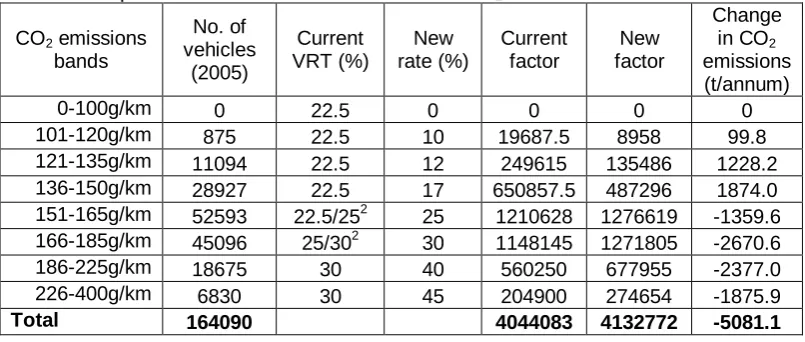
-differentiation, since they are a function of the quantity, price and type of vehicles sold in the future. However, an estimate may be made based on the fleet profile from 20055. In any case a certain amount of uncertainty will exist in estimations of future tax revenues regardless of the tax system used. Sustainable Energy Ireland has kept records for the past five years on the numbers of vehicles sold in each CO2 emissions band. Table 1 below gives
an example of VRT rates that could be applied based on CO2 emissions bands only.
A factor is calculated from the value of the number of new vehicles sold multiplied by the VRT percentage rates using the current and new VRT rates. For the VRT to remain budget neutral, we can use this factor to check that the new factor remains approximately equivalent to the factor with the current VRT rates (assuming that vehicle prices remain constant). In the estimation below it is assumed that there is an elasticity of CO2 emissions intensity of the
fleet with respect to vehicle taxes -0.116. This means that a change (increase) in vehicle taxes of 10% will cause consumers to change their purchasing behaviour to reduce CO2
emissions intensity of the fleet by 1.1%.
4
See for example the new Volkswagen Golf GT, which has a petrol direct injection engine of 1.4L, can produce 170bhp, and consumes 7.3L/100km over the standard driving test cycle.
5
The latest to which the author has access.
6
The results presented in Table 1 show the reduction of CO2 emissions achieved through
restructuring of the VRT system, based on the current vehicle fleet in Ireland. It is clear that there are significant gains that can be made by restructuring the vehicle tax system to a CO2
[image:5.595.72.475.156.327.2]emissions basis. This measure is designed to be revenue neutral – i.e. the revenue to the Exchequer remains the same as before.
Table 1: Proposal to restructure VRT rates and CO2 emissions saved.
CO2 emissions
bands
No. of vehicles
(2005)
Current VRT (%)
New rate (%)
Current factor
New factor
Change in CO2
emissions (t/annum)
0-100g/km 0 22.5 0 0 0 0
101-120g/km 875 22.5 10 19687.5 8958 99.8
121-135g/km 11094 22.5 12 249615 135486 1228.2
136-150g/km 28927 22.5 17 650857.5 487296 1874.0
151-165g/km 52593 22.5/252 25 1210628 1276619 -1359.6
166-185g/km 45096 25/302 30 1148145 1271805 -2670.6
186-225g/km 18675 30 40 560250 677955 -2377.0
226-400g/km 6830 30 45 204900 274654 -1875.9
Total 164090 4044083 4132772 -5081.1
Notes:
1. Vehicle emissions and number data from Fergal O’Leary (EPSSU, Sustainable Energy Ireland) are gratefully acknowledged.
2. Petrol and diesel respectively. It can be seen that when the VRT rate is allocated according to CO2
emissions bands that there is a variation in some cases between petrol and diesel values. This is mainly because diesel vehicles tend to produce lower CO2 emissions for the same engine size.
In conclusion, Comhar SDC welcomes the initiative of the Department of Finance to incorporate CO2 emissions differentiation into the VRT system. We find that there is no
necessity to continue to retain engine capacity as a parameter to estimate VRT rates. Table 1 above provides an example of new VRT rates that could be applied as a function of CO2
emissions alone or in tandem with a discount for vehicles containing advanced emissions after-treatment technology.
Regardless of VRT rates chosen, it is important that a clear message be sent to consumers regarding the significance of the fuel economy of vehicles. To this end it is extremely important that the same CO2-differentiated classification be used for the purposes of VRT,
Annex
UK excise duty rates based on CO2 emissions bands
Vehicles registered on or after 1st March 2001
Diesel Car TC 49
Petrol Car TC 48
Alternative Fuel Car TC 59
Bands
CO2
Emission Figure (g/km) *
12 months
rate £
6 months
rate £
12 months
rate £
6 months
rate £
12 months
rate £
6 months
rate £
Band A Up to 100 0.00 - 0.00 - 0.00
-Band B 101 to 120 50.00 - 40.00 - 30.00
-Band C 121 - 150 110.00 60.50 100.00 55.00 90.00 49.50
Band D 151 - 165 135.00 74.25 125.00 68.75 115.00 63.25
Band E 166 - 185 160.00 88.00 150.00 82.50 140.00 77.00
Band F 186 - 225 195.00 107.25 190.00 104.55 180.00 99.00
Private Vehicles registered on or after 23rd March 2006