Multi-Granularity Chinese Word Embedding
Rongchao Yin†‡, Quan Wang†‡, Rui Li†‡, Peng Li†‡∗, Bin Wang†‡
†Institute of Information Engineering, Chinese Academy of Sciences, Beijing 100093, China ‡University of Chinese Academy of Sciences, Beijing 100049, China
{yinrongchao,wangquan,lirui,lipeng,wangbin}@iie.ac.cn
Abstract
This paper considers the problem of learning Chinese word embeddings. In contrast to En-glish, a Chinese word is usually composed of characters, and most of the characters them-selves can be further divided into components such as radicals. While characters and radical-s contain rich information and are capable of indicating semantic meanings of words, they have not been fully exploited by existing word embedding methods. In this work, we propose multi-granularity embedding(MGE) for Chi-nese words. The key idea is to make full use of such word-character-radical composition, and enrich word embeddings by further incorpo-rating finer-grained semantics from characters and radicals. Quantitative evaluation demon-strates the superiority of MGE in word sim-ilarity computation and analogical reasoning. Qualitative analysis further shows its capabili-ty to identify finer-grained semantic meanings of words.
1 Introduction
Word embedding, also known as distributed word representation, is to represent each word as a real-valued low-dimensional vector, through which the semantic meaning of the word can be encoded. Re-cent years have witnessed tremendous success of word embedding in various NLP tasks (Bengio et al., 2006; Mnih and Hinton, 2009; Collobert et al., 2011; Zou et al., 2013; Kim, 2014; Liu et al., 2015; Iyyer et al., 2015). The basic idea behind is to learn the distributed representation of a word using its con-text. Among existing approaches, the continuous bag-of-words model (CBOW) and Skip-Gram mod-el are simple and effective, capable of learning word embeddings efficiently from large-scale text corpo-ra (Mikolov et al., 2013a; Mikolov et al., 2013b).
∗Corresponding author: Peng Li.
Besides the success in English, word embedding has also been demonstrated to be extremely useful for Chinese language processing (Xu et al., 2015; Yu et al., 2015; Zhou et al., 2015; Zou et al., 2013). The work on Chinese generally follows the same idea as on English, i.e., to learn the embedding of a word on the basis of its context. However, in contrast to English where words are usually taken as basic semantic units, Chinese words may have a complicated composition structure of their seman-tic meanings. More specifically, a Chinese word is often composed of several characters, and most of the characters themselves can be further divided in-to components such as radicals (部首).1Both
char-acters and radicals may suggest the semantic mean-ing of a word, regardless of its context. For exam-ple, the Chinese word “吃饭 (have a meal)” con-sists of two characters “吃(eat)” and “饭(meal)”, where “ 吃 (eat)” has the radical of “口 (mouth)”, and “饭(meal)” the radical of “饣(food)”. The se-mantic meaning of “吃饭” can be revealed by the constituent characters as well as their radicals.
Despite being the linguistic nature of Chinese and containing rich semantic information, such word-character-radical composition has not been fully ex-ploited by existing approaches. Chen et al. (2015) introduced a character-enhanced word embedding model (CWE), which learns embeddings jointly for words and characters but ignores radicals. Sun et al. (2014) and Li et al. (2015) utilized radical informa-tion to learn better character embeddings. Similarly, Shi et al. (2015) split characters into small compo-nents based on the Wubi method,2and took into
ac-count those components during the learning process. In their work, however, embeddings are learned on-ly for characters. For a word, the embedding is gen-erated by simply combining the embeddings of the constituent characters. Since not all Chinese
word-1https://en.wikipedia.org/wiki/Radical (Chinese characters) 2https://en.wikipedia.org/wiki/Wubi method
回家
(go back home) (meet friends)会友 口(eat) 饣(food)
回(go back)
家(home)
会(meet)
友(friends) 吃饭 (have a meal)
hidden layer
[image:2.612.74.299.58.176.2]Word embeddings Character embeddings Radical embeddings Hidden layer
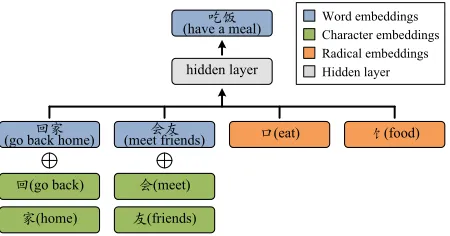
Figure 1: A simple illustration of MGE, where embeddings are learned jointly for words, characters, and radicals. Given a sequence of words{“回家(go back home)”, “吃饭(have a meal)”, “会友(meet friends)”}, MGE predicts the central word “吃饭” by using 1) the embedding composed by each context word and its constituent characters, and 2) the embedding asso-ciated with each radical detected in the target word.
s are semantically compositional (e.g., transliterated words such as “苏打(soda)”), embeddings obtained in this way may be of low quality for these words.
In this paper, aiming at making full use of the se-mantic composition in Chinese, we propose multi-granularity embedding(MGE) which learns embed-dings jointly for words, characters, and radicals. The framework of MGE is sketched in Figure 1. Given a word, we learn its embedding on the basis of 1) the context words (blue bars in the figure), 2) their con-stituent characters (green bars), and 3) the radicals found in the target word (orange bars). Compared to utilizing context words alone, MGE enriches the embeddings by further incorporating finer-grained semantics from characters and radicals. Similar ideas of adaptively using multiple levels of embed-dings have also been investigated in English recent-ly (Kazuma and Yoshimasa, 2016; Miyamoto and Cho, 2016).
We evaluate MGE with the benchmark tasks of word similarity computation and analogical reason-ing, and demonstrate its superiority over state-of-the-art metods. A qualitative analysis further shows the capability of MGE to identify finer-grained se-mantic meanings of words.
2 Multi-Granularity Word Embedding
This section introduces MGE based on the contin-uous bag-of-words model (CBOW) (Mikolov et al., 2013b) and the character-enhanced word embedding
model (CWE) (Chen et al., 2015).
MGE aims at improving word embedding by leveraging both characters and radicals. We denote the Chinese word vocabulary asW, the character vo-cabulary asC, and the radical vocabulary asR. Each
wordwi ∈ Wis associated with a vector embedding
wi, each character ci ∈ C a vector embedding ci,
and each radicalri∈ Ra vector embeddingri.
Giv-en a sequGiv-ence of wordsD = {w1,· · ·, wN}, MGE
predicts each wordwi ∈ D conditioned on 1)
con-text words in a sliding window with sizeℓ, denoted
asWi ={wi−ℓ, ...wi−1, wi+1, ..., wi+ℓ}, 2)
charac-ters in each context wordwj ∈ Wi, denoted asCj,
and 3) radicals in the target wordwi, denoted asRi.
See Figure 1 for a simple illustration.
More specifically, given the corpusD, MGE max-imizes the overall log likelihood as follows:
L(D) = ∑
wi∈D
logp(wi|hi). (1)
Herehi is a hidden vector composed by the
embed-dings of context words, constituent characters, and radicals, defined as:
hi=
1 2
[ 1
|Wi| ∑
wj∈Wi (
wj⊕
1
|Cj| ∑
ck∈Cj
ck )
+ 1
|Ri| ∑
rk∈Ri
rk ]
. (2)
For each context wordwj ∈ Wi, a word-character
composition(wj ⊕ |C1j|∑c∈Cjc) is first generated
by the embeddings ofwj and its constituent
charac-tersCj. These word-character compositions are then
combined with the radical embeddings inRito
pre-dict the target word.|Wi|/|Ri|/|Cj|is the cardinality
ofWi/Ri/Cj, and ⊕is the composition operation.3
Givenhi, the conditional probabilityp(wi|hi)is
de-fined by a softmax function:
p(wi|hi) = exp(h
⊤
i wi)
∑
wi′∈Wexp(h⊤i wi′)
. (3)
We use negative sampling and stochastic gradient descent to solve the optimization problem.
Note that 1) Not all Chinese words are semantical-ly compositional, e.g., transliterated words and enti-ty names. For such words we use neither characters nor radicals. 2) A Chinese character usually plays
3There are a variety of options for⊕, e.g., addition and
different roles when it appears at different positions within a word. We follow (Chen et al., 2015) and design a position-based MGE model (MGE+P). The key idea of MGE+P is to keep three embeddings for each character, corresponding to its appearance at the positions of “begin”, “middle”, and “end”. For details, please refer to (Chen et al., 2015).
3 Experiments
We evaluate MGE with the tasks of word similarity computation and analogical reasoning.
3.1 Experimental Setups
We select the Chinese Wikipedia Dump4for
embed-ding learning. In preprocessing, we use the THU-LAC tool5 to segment the corpus. Pure digit
word-s, non-Chinese wordword-s, and words whose frequencies are less than 5 in the corpus are removed. We further crawl from an online Chinese dictionary6 and build
a character-radical index with 20,847 characters and 269 radicals. We use this index to detect the radical of each character in the corpus. As such, we get a training set with 72,602,549 words, 277,200 unique words, 8,410 unique characters, and 256 unique rad-icals. Finally, we use THULAC to perform Chinese POS tagging on the training set and identify all enti-ty names. For these entienti-ty names, neither characters nor radicals are considered during learning. Actual-ly, Chen et al. (2015) categorized non-compositional Chinese words into three groups, i.e., transliterat-ed words, single-morpheme multi-character words, and entity names. In their work, they used a human-annotated corpus, manually determining each word to be split or not. Since human annotation could be time-consuming and labor intensive, we just consid-er automatically identified entity names.
We compare MGE with CBOW (Mikolov et al., 2013b)7 and CWE (Chen et al., 2015)8. Both CWE
and MGE are extensions of CBOW, with the for-mer taking into account characters and the latter fur-ther incorporating radical information. We furfur-ther consider position-based CWE and MGE, denoted as CWE+P and MGE+P, respectively.We follow (Chen
4http://download.wikipedia.com/zhwiki 5http://thulac.thunlp.org/
6http://zd.diyifanwen.com/zidian/bs/ 7https://code.google.com/p/word2vec/ 8https://github.com/Leonard-Xu/CWE
Method WordSim-239 WordSim-293
k= 100 k= 200 k= 100 k= 200
CBOW 0.4917 0.4971 0.5667 0.5723
CWE 0.5121 0.5197 0.5511 0.5655
CWE+P 0.4989 0.5026 0.5427 0.5545
MGE 0.5670 0.5769 0.5555 0.5659
[image:3.612.318.535.56.143.2]MGE+P 0.5511 0.5572 0.5530 0.5692
Table 1:Results on word similarity computation.
et al., 2015) and use the same hyperparameter set-ting. For all the methods, we set the context window size to 3, and select the embedding dimensionkin
{100, 200}. During optimization, we use 10-word negative sampling and fix the initial learning rate to 0.025.
3.2 Word Similarity Computation
This task is to evaluate the effectiveness of embed-dings in preserving semantic relatedness between t-wo t-words. We use the 240 and WordSim-296 datasets9 provided by Chen et al. (2015) for
e-valuation, both containing Chinese word pairs with human-labeled similarity scores. On WordSim-240 there is a pair containing new words (i.e., words that have not appeared in the training set), and on WordSim-296 there are 3 such pairs. We remove these pairs from both datasets, and accordingly get WordSim-239 and WordSim-293.
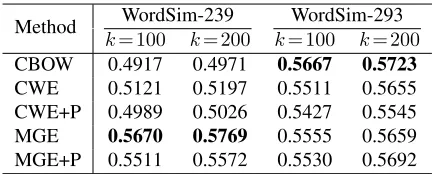
We compute the Spearman correlation coefficient (Myers et al., 2010) between the similarity scores given by the embedding models and those given by human annotators. For the embedding models, the similarity score between two words is calculated as the cosine similarity between their embeddings. The Spearman correlation coefficient is a nonparametric measure of rank correlation, assessing how well the relationship between two variables can be described. The results are shown in Table 1.
From the results, we can see that 1) On WordSim-239, MGE(+P) performs significantly better than CWE(+P), which in turn outperforms CBOW. This observation demonstrates the superiority of incor-porating finer-grained semantics, particularly from radicals. For example, MGE performs much better on word pairs such as “银行(bank)” and “钱 (mon-ey)”, in which the two words share the same radi-cal of “钅(gold)”. 2) On WordSim-293, MGE(+P)
0.46 0.48 0.5 0.52 0.54 0.56 0.58 0.6
3 4 5 6 7
S
p
ea
rm
an
c
o
rr
el
at
io
n
c
o
ef
fi
ci
en
t
[image:4.612.77.294.55.172.2]context window size CBOW CWE MGE
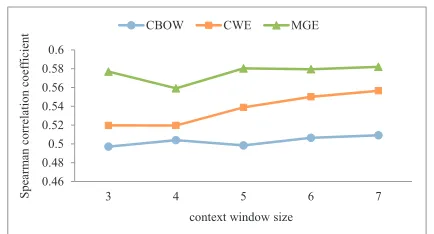
Figure 2: Word similarity computation results with different context window sizes on WordSim-239 (k= 200).
performs equally well as CWE(+P), but both are s-lightly worse than CBOW. The reason may be that WordSim-293 contains a great many of word pairs in which the two words belonging to different domain-s, e.g., “公鸡 (rooster)” and “航程(flying range)”. These pairs usually get low human-labeled similari-ty scores. However, splitting the words in such pairs into characters, and further the characters into radi-cals will not help to effectively identify the dissimi-laritybetween them.10
We further investigate the influence of the context window size in word similarity computation. Fig-ure 2 gives the results of CBOW, CWE, and MGE on WordSim-239, with the context window size set in{3,4,5,6,7}. The results indicate that MGE per-forms consistently better than CBOW and CWE on this dataset, unaffected by varying the context win-dow size.
3.3 Word Analogical Reasoning
This task evaluates the effectiveness of embeddings in capturing linguistic regularities between pairs of words, in the form of “伦敦(London) :英国 (Eng-land)≈巴黎 (Paris) : 法国 (France)”. We use the dataset provided by Chen et al. (2015) for evalua-tion. It contains 1,124 analogies categorized into 3 types: 1) capitals of countries (677 groups); 2) s-tates/provinces of cities (175 groups); and 3) family relations (272 groups). All the words in this dataset
10This observation is inconsistent with that reported in (Chen
et al., 2015), which shows that CWE outperforms CBOW on WordSim-296. The reason may be that Chen et al. (2015) used a human-annotated corpus for embedding learning, and manually determined each word to be split or not. In contrast, we use the publicly available Chinese Wikipedia data, and automatically segment the corpus and identify entity names (words that are not to be split), without human annotation.
Method Total Capital State Family
CBOW 0.7498 0.8109 0.8400 0.5294
CWE 0.7248 0.8375 0.8541 0.3566
CWE+P 0.7391 0.8065 0.8114 0.5147
MGE 0.7524 0.8804 0.8686 0.3529
MGE+P 0.7720 0.8685 0.8857 0.4485 Table 2:Results on word analogical reasoning (k= 200).
are covered by the training set.
For each analogy “a : b ≈ c : d”, we create a
question “a:b≈c: ? ”, and predict the answer as:
d∗=argmaxw∈Wcos (b−a+c,w). Herea, b, c,
ware the word embeddings, andcos(·,·)the cosine similarity. The question is considered to be correctly answered ifd∗ =d. We use accuracy as the
evalua-tion metric, and report the results in Table 2. The results indicate that 1) MGE(+P) substantial-ly outperforms the baseline methods on almost all types of analogies (except for the Family type). This again demonstrates the superiority of incorporating radical information. 2) For the Capital and State types, all the words are entity names for which nei-ther characters nor radicals are used. MGE(+P) still outperforms the baselines on these two types, show-ing its capability to learn better embeddshow-ings even for non-compositional words. 3) On the Family type, both MGE(+P) and CWE(+P) perform worse than CBOW. This may be caused by the inappropriate de-composition of family words into characters. Con-sider, for example, the question “叔叔(uncle) : 阿 姨(aunt)≈王子(prince) : ? ”. If we split “王子” into “王(king)” and “子(son)”, we will more likely to predict “ 女王 (queen)” rather than the correc-t answer “公主 (princess)”, since “女王” contains the character “女 (daughter)” which is usually the antonym of “子(son)”.
3.4 Case Study
Besides quantitative evaluation, this section further provides qualitative analysis to show in what man-ner the semantic meaning of a radical, character and word can be captured by their embeddings.
[image:4.612.322.530.56.131.2]MGE
潜泳(underwater swimming),畅泳(swimming happily) 爬泳(front crawl swimming),泳手(swimmer)
泳术(swimming skill),冬泳(winter swimming) 裸泳(swimming skill),田径(track and field)
CWE
潜泳(underwater swimming),畅泳(swimming happily) 爬泳(front crawl swimming),田径(track and field) 泳手(swimmer),习泳(learn to swim)
冬泳(winter swimming),泳术(swimming skill)
CBOW
[image:5.612.72.304.56.197.2]田径(track and field),跳高(high jump) 跳水(diving),跳绳(rope skipping) 划船(boating),撑竿跳(pole vaulting) 皮划艇(canoeing),体操(gymnastics)
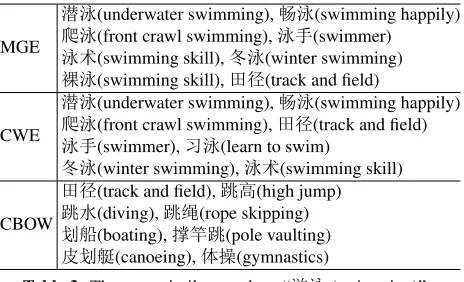
Table 3:The most similar words to “游泳(swimming)”.
Radical 疒(illness)
佝(rickets)痼(chronic disease)
Closest 偻(bending one’s back)疠(epidemic disease) characters痨(tuberculosis)淬(quenching)
疥(scabies)痔(hemorrhoids) 佝偻(rickets)癣疥(ringworm scabies)
Closest 痘疤(pock)瘴疠(communicable subtropical disease) words 疮痍(traumata)疮疤(scar)
痲疹(measles)疱疮(pemphigus)
Table 4:The most similar characters/words to “疒(illness)”.
capturing finer-grained semantics that are more spe-cific to the word. The top words discovered by them are semantically related to “游泳 (swimming)” it-self, e.g., “潜泳 (underwater swimming)” and “爬 泳(front crawl swimming)”. But the top words dis-covered by CBOW are just other types of sports in parallel with “游泳(swimming)”, e.g., “跳高(high jump)” and “跳水(diving)”. 2) MGE performs even better than CWE by further incorporating the radical information. The less relevant word “ 田径(track and field)” is ranked 4th by CWE. But after introduc-ing the radical “氵(water)”, MGE can successfully rank “泳手(swimmer)”, “泳术(swimming skill)”, and “冬泳(winter swimming)” before it. All these words contain the radical “氵(water)” and are more relevant to “游泳(swimming)”.
We further take the radical “疒(illness)” as an ex-ample, and list the most similar characters and words discovered by MGE in Table 4. The similarity be-tween a radical and a character/word is also defined as the cosine similarity between their embeddings. From the results, we can see that almost all the char-acters and words are disease-related, e.g., “佝 (rick-ets)”, “痨 (tuberculosis)”, and “癣疥(ringworm s-cabies)”, and most of them share the same radical “疒(illness)”. This observation demonstrates the
ra-tionality of embedding Chinese words, characters, and radicals into the same vector space, and measur-ing their similarities directly in that space. Note that this operation might be problematic for English. For example, it could be hard to figure out what kind of similarity there is between the character “i” and the word “ill”. But for Chinese, this problem might be alleviated since characters and radicals themselves contain rich semantic information.
4 Conclusion and Future Work
In this paper we propose a new approach to Chinese word embedding, referred to as multi-granularity
embedding (MGE). MGE improves word
embed-ding by further leveraging both characters and radi-cals, and hence makes full use of the word-character-radical semantic composition. Experimental results on word similarity computation and analogical rea-soning demonstrate the superiority of MGE over state-of-the-art methods. A qualitative analysis fur-ther shows that by incorporating radical information MGE can identify finer-grained semantic meanings of words.
As future work, we would like to 1) Investigate more complicate composition manners among radi-cals, characters, and words, e.g., a hierarchical struc-ture of them. 2) Explore the semantic composition of higher level language units such as phrases, sen-tences, and even documents.
5 Acknowledgement
We would like to thank the anonymous reviewers for their insightful comments and suggestions. This research is supported by the National Natural Sci-ence Foundation of China (grant No. 61402465 and No. 61402466) and the Strategic Priority Research Program of the Chinese Academy of Sciences (grant No. XDA06030200).
References
Yoshua Bengio, Holger Schwenk, Jean-S´ebastien Sen´ecal, Fr´ederic Morin, and Jean-Luc Gauvain. 2006. Neural probabilistic language models. In Innovations in Machine Learning, pages 137–186. Xinxiong Chen, Lei Xu, Zhiyuan Liu, Maosong Sun, and
word embeddings. InProceedings of the 24th Inter-national Conference on Artificial Intelligence, pages 1236–1242.
Ronan Collobert, Jason Weston, L´eon Bottou, Michael Karlen, Koray Kavukcuoglu, and Pavel Kuksa. 2011. Natural language processing (almost) from scratch. The Journal of Machine Learning Research, 12:2493– 2537.
Mohit Iyyer, Varun Manjunatha, Jordan Boyd-Graber, and Hal Daum´e III. 2015. Deep unordered compo-sition rivals syntactic methods for text classification. InProceedings of the 53rd Annual Meeting of the As-sociation for Computational Linguistics and the 7th International Joint Conference on Natural Language Processing, pages 1681–1691.
Hashimoto Kazuma and Tsuruoka Yoshimasa. 2016. Adaptive joint learning of compositional and non-compositional phrase embeddings. InProceedings of the 54th Annual Meeting of the Association for Com-putational Linguistics.
Yoon Kim. 2014. Convolutional neural networks for sen-tence classification. InProceedings of the 2014 Con-ference on Empirical Methods in Natural Language Processing, pages 1746–1751.
Yanran Li, Wenjie Li, Fei Sun, and Sujian Li. 2015. Component-enhanced chinese character embeddings. In Proceedings of the 2015 Conference on Empirical Methods in Natural Language Processing, pages 829– 834.
Xiaodong Liu, Jianfeng Gao, Xiaodong He, Li Deng, Kevin Duh, and Ye-Yi Wang. 2015. Representation learning using multi-task deep neural networks for se-mantic classification and information retrieval. In Pro-ceedings of the 2015 Conference of the North Ameri-can Chapter of the Association for Computational Lin-guistics: Human Language Technologies, pages 912– 921.
Tomas Mikolov, Ilya Sutskever, Kai Chen, Greg S Corra-do, and Jeff Dean. 2013a. Distributed representations of words and phrases and their compositionality. In Advances in Neural Information Processing Systems 26, pages 3111–3119.
Tomas Mikolov, Wen-tau Yih, and Geoffrey Zweig. 2013b. Linguistic regularities in continuous space word representations. InProceedings of the 2013 Con-ference of the North American Chapter of the Associa-tion for ComputaAssocia-tional Linguistics: Human Language Technologies, pages 746–751.
Yasumasa Miyamoto and Kyunghyun Cho. 2016. Gat-ed word-character recurrent language model. arXiv preprint arXiv:1606.01700.
Andriy Mnih and Geoffrey E. Hinton. 2009. A scalable hierarchical distributed language model. InAdvances
in Neural Information Processing Systems 21, pages 1081–1088.
Jerome L Myers, Arnold Well, and Robert Frederick Lorch. 2010. Research design and statistical analy-sis. Routledge.
Xinlei Shi, Junjie Zhai, Xudong Yang, Zehua Xie, and Chao Liu. 2015. Radical embedding: Delving deeper to chinese radicals. InProceedings of the 53rd Annu-al Meeting of the Association for ComputationAnnu-al Lin-guistics and the 7th International Joint Conference on Natural Language Processing, pages 594–598. Yaming Sun, Lei Lin, Nan Yang, Zhenzhou Ji, and
Xiao-long Wang, 2014. Radical-Enhanced Chinese Char-acter Embedding, chapter Proceedings of the 21st In-ternational Conference on Neural Information Pro-cessing, pages 279–286.
Ruifeng Xu, Tao Chen, Yunqing Xia, Qin Lu, Bin Liu, and Xuan Wang. 2015. Word embedding composition for data imbalances in sentiment and emotion classifi-cation. Cognitive Computation, 7(2):226–240. Mo Yu, Matthew R. Gormley, and Mark Dredze. 2015.
Combining word embeddings and feature embeddings for fine-grained relation extraction. InProceedings of the 2015 Conference of the North American Chapter of the Association for Computational Linguistics: Hu-man Language Technologies, pages 1374–1379. Guangyou Zhou, Tingting He, Jun Zhao, and Po Hu.
2015. Learning continuous word embedding with metadata for question retrieval in community question answering. InProceedings of the 53rd Annual Meet-ing of the Association for Computational LMeet-inguistics and the 7th International Joint Conference on Natural Language Processing, pages 250–259.