Proceedings of the 2019 Conference on Empirical Methods in Natural Language Processing and the 9th International Joint Conference on Natural Language Processing, pages 3720–3729,
3720
Summary Cloze: A New Task for Content Selection in Topic-Focused
Summarization
Daniel Deutsch and Dan Roth
Department of Computer and Information Science University of Pennsylvania
{ddeutsch,danroth}@seas.upenn.edu
Abstract
A key challenge in topic-focused summariza-tion is determining what informasummariza-tion should be included in the summary, a problem known as content selection. In this work, we pro-pose a new method for studying content se-lection in topic-focused summarization called thesummary clozetask. The goal of the sum-mary cloze task is to generate the next sen-tence of a summary conditioned on the begin-ning of the summary, a topic, and a reference document(s). The main challenge is deciding what information in the references is relevant to the topic and partial summary and should be included in the summary. Although the cloze task does not address all aspects of the traditional summarization problem, the more narrow scope of the task allows us to collect a large-scale datset of nearly 500k summary cloze instances from Wikipedia. We report ex-perimental results on this new dataset using various extractive models and a two-step ab-stractive model that first extractively selects a small number of sentences and then abstrac-tively summarizes them. Our results show that the topic and partial summary help the models identify relevant content, but the task remains a significant challenge.
1 Introduction
Topic-focused multi-document summarization
(MDS) has long been a goal for natural language
processing (Dang, 2005, 2006). In contrast to
generic summarization, topic-focused summa-rization systems attempt to summarize a set of reference documents with respect to a specific topic or information need.
Recent research on summarization has mostly focused on generic summarization, in part due
to the size of the available datasets. Work on
topic-focused summarization (Lin and Bilmes,
2011;Ma et al., 2016;Feigenblat et al., 2017) is
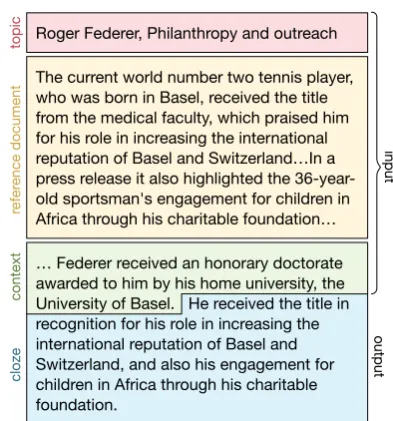
… Federer received an honorary doctorate awarded to him by his home university, the University of Basel. He received the title in recognition for his role in increasing the international reputation of Basel and Switzerland, and also his engagement for children in Africa through his charitable foundation.
Roger Federer, Philanthropy and outreach
The current world number two tennis player, who was born in Basel, received the title from the medical faculty, which praised him for his role in increasing the international reputation of Basel and Switzerland…In a press release it also highlighted the 36-year-old sportsman's engagement for children in Africa through his charitable foundation…
topic
refer
ence document
context
cloze
input
[image:1.595.315.512.219.430.2]output
Figure 1: Given a topic, reference document, and a par-tial summary (the context), the objective of the sum-mary cloze task is to predict the next sentence of the summary, known as the cloze.
largely based on the DUC 2005 and 2006 datasets
(Dang, 2005, 2006), which are orders of
magni-tude smaller than comparable generic
summariza-tion datasets (Nallapati et al.,2016;Grusky et al.,
2018). Because the available corpora are so small, it is difficult to use them to train recent state-of-the-art summarization systems, which require large amounts of training data.
Instead of focusing on the full topic-focused MDS problem, we address one aspect of the task
known ascontent selection, the problem of
decid-ing what information should be included in the
summary (Nenkova,2006b). Narrowing the scope
of the problem makes it easier to collect a large-scale dataset that is tailored to the specific task and thus build upon recent work on summarization.
we call thesummary clozetask (§2). Given a topic, a partial summary, and a reference document(s), the goal of the summary cloze task is to produce the next sentence in the summary (referred to as
thecloze). The underlying assumption of the task
is that the content of the cloze is known to come from the reference document, and thus the primary challenge of the task is to decide what informa-tion in the reference document(s) is relevant to the topic and partial summary. An example instance
of the summary cloze task is presented in Figure1.
Then, we collected a new large-scale summary cloze dataset from Wikipedia, called the
WIKI-CITE dataset (§3). Each paragraph in Wikipedia
can be viewed as a topic-focused summary of the references cited within the paragraph, where the topic is defined as the article title and section headings. The citations provide supervision at the sentence-level that indicates where the content of the preceding sentence came from. We scraped hundreds of thousands of Wikipedia articles and corresponding references to collect nearly 500k
summary cloze instances.1
With a new task definition and corresponding large-scale dataset, we then propose an extrac-tive model and a two-step abstracextrac-tive model, both of which are based on recent successful work on generic summarization (§4). The extractive model combines representations of the topic and partial summary with representations of the document sentences through an attention mechanism to ex-tract one reference sentence. The two-step model first reduces the length of the input data by ex-tractively selecting a small number of sentences, then abstractively summarizes them using a coder that has an initial hidden state which de-pends on the partial summary. Our experimental
results (§6) show that the topic and context help
the models identify relevant information, but the task remains a significant challenge.
The contributions of this work are three-fold: (1) We formalize the summary cloze task as a method to develop content selection models for topic-focused summarization; (2) we release
the WIKICITE dataset, which contains nearly
500k summary cloze instances collected from Wikipedia; and (3) we propose sensible baseline extractive and abstractive models for content se-lection in topic-focused summarization.
1Available for download athttp://cogcomp.org/
page/publication_view/880
2 The Summary Cloze Task
One of the main challenges for a topic-focused MDS system is selecting what content from the reference documents to include in the summary. Intuitively, this decision largely depends on the topic itself and the content of the summary gener-ated thus far. Therefore, being able to predict the next sentence of a summary is an important com-ponent of a full topic-focused MDS system and a worthwhile task on its own. With this motiva-tion in mind, we now formally define the summary cloze task.
Task Definition Given a partial summary (the
context) and a reference document or documents
(the references), the goal of the summary cloze
task is to generate the next sentence of the sum-mary (the cloze). It is assumed that the informa-tion in the cloze comes from the provided refer-ence documents. This is the most general defini-tion of the summary cloze task. However, because we are interested in topic-focused summarization, in this work, it is also assumed that a high-level
topic is provided as input, such as in Figure1.
One advantage that the summary cloze task has over the traditional topic-focused MDS problem is the availability of data. Topic-focused MDS re-quires collecting example summaries of a set of documents about a particular topic. This data is hard to collect from human annotators and is dif-ficult to find occurring naturally. The cloze task requires sentence-level supervision for which we were able to collect a large-scale dataset using Wikipedia (§3). By conditioning the cloze gen-eration on a partial summary and working at the sentence-level, we are able to get around the prob-lem of data scarcity.
Evaluation Evaluating summary cloze models
is challenging; The difficulties of evaluating
sum-marization systems (Nenkova, 2006a) still persist
for the summary cloze task. We propose for the
main evaluation metric to be ROUGE (Lin,2004),
which has been shown to be an effective metric
for summarization (Owczarzak et al.,2012).
Ad-ditionally, for abstractive models we use perplex-ity to quantify how likely the ground-truth cloze is according to the model.
It is desirable to have a good automatic evalua-tion metric that could capture the coherence of the model’s cloze with the context in such situations. However, developing such an automatic metric for measuring summary coherence that correlates well with human judgments is an open problem for summarization in general, and thus we leave it for future work.
3 The WikiCite Dataset
In order to build content selection models, we col-lected a large-scale dataset of summary cloze in-stances using Wikipedia.
Wikipedia as a Summary Each paragraph in a
Wikipedia article can be viewed as a topic-focused multi-document summary. Many Wikipedia arti-cles have citations to external sources that provide supporting evidence for the information within the article. The articles’ paragraphs can be viewed as summarizing the documents cited within the paragraph with respect to the page entity and section headings, which together form the topic
of the summary. Since the citations are at the
sentence-level, they provide supervision that iden-tifies where the information in the preceding sen-tence came from, and thus can be used to generate summary cloze instances.
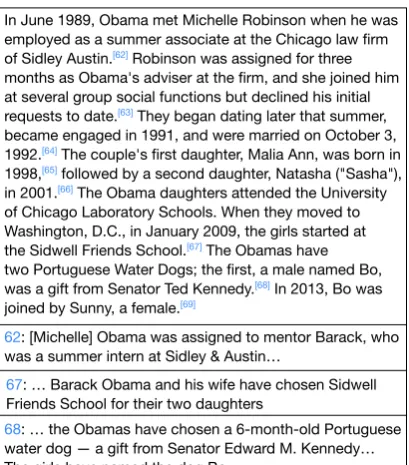
For example, consider a paragraph from the “Family and personal life” section of Barack
Obama’s Wikipedia page, presented in Figure 2.
Nearly all of the sentences in the paragraph are supported with citations, and these citations con-tain the same information written in the paragraph. Each sentence with a citation can be used to pro-duce a summary cloze instance where the pre-ceding sentences are the context and the topic is “Barack Obama, Family and personal life.” Al-though not all paragraphs on Wikipedia are as
well-cited as the example in Figure 2, only one
citation is necessary to create a cloze instance.
Dataset Collection To collect a summary cloze
dataset, we first parsed the articles and citations from the January 2019 Wikipedia dump. Only ar-ticles marked with the category “Living people” were kept because these articles are more likely to have reference documents which can be scraped automatically. The reference document HTMLs were collected from 12 months of Common Crawl
data.2 Then, the text of each document was
ex-2http://commoncrawl.org/
In June 1989, Obama met Michelle Robinson when he was employed as a summer associate at the Chicago law firm
of Sidley Austin.[62] Robinson was assigned for three
months as Obama's adviser at the firm, and she joined him at several group social functions but declined his initial
requests to date.[63] They began dating later that summer,
became engaged in 1991, and were married on October 3,
1992.[64] The couple's first daughter, Malia Ann, was born in
1998,[65] followed by a second daughter, Natasha ("Sasha"),
in 2001.[66] The Obama daughters attended the University
of Chicago Laboratory Schools. When they moved to Washington, D.C., in January 2009, the girls started at
the Sidwell Friends School.[67] The Obamas have
two Portuguese Water Dogs; the first, a male named Bo,
was a gift from Senator Ted Kennedy.[68] In 2013, Bo was
joined by Sunny, a female.[69]
62: [Michelle] Obama was assigned to mentor Barack, who was a summer intern at Sidley & Austin…
68: … the Obamas have chosen a 6-month-old Portuguese water dog — a gift from Senator Edward M. Kennedy… The girls have named the dog Bo…
[image:3.595.314.519.60.293.2]67: … Barack Obama and his wife have chosen Sidwell Friends School for their two daughters
Figure 2: A paragraph from the “Family and personal life” section of Barack Obama’s Wikipedia page and selected excerpts from the cited documents which pro-vide supporting epro-vidence.
tracted from the HTML using unfluff.3
In order to filter low-quality instances (e.g., HTML was a 404 page, the body text was incor-rectly extracted, etc.), we labeled around 500 in-stances based on whether or not the reference doc-ument provided supporting evidence for the corre-sponding cloze. We trained a simple linear classi-fier with length and BM25 features that achieved an F1 score of 85 to filter the data. The remain-ing data was split between trainremain-ing, 10k valida-tion, and 10k testing instances, ensuring that no reference document or Wikipedia article appears in more than one set.
The dataset statistics compared to those of the DUC 2005 and 2006 datasets are presented in
Ta-ble 1. Other than the number of instances, the
biggest differences between the two datasets are the length of the reference documents and
top-ics. The WIKICITE documents are significantly
longer, over double the length DUC documents at one standard deviation above the mean. The DUC topics, which are generally text that describe an information need, are much longer than the
WIKI-CITEtopics, which are high-level topic keywords.
Examples from the dataset are provided in Ap-pendix A.
3https://github.com/ageitgey/
Statistic WikiCite DUC 2005+ DUC 2006
#Instances 486,015 100
#Document Tokens 1083.2 (2105.0) 723.3 (629.0)
#Document Sents 51.4 (137.1) 30.7 (30.1)
#Topic Tokens 5.7 (3.4) 29.5 (11.3)
#Context Tokens 65.5 (56.1)
-#Context Sents 2.8 (2.3)
-#Cloze/Summ. Tokens 24.6 (12.0) 277.8 (19.9)
#Cloze/Summ. Sents 1 13.5 (3.4)
Table 1: The WIKICITE and DUC 2005 and 2006 dataset statistics. The average values are reported with standard deviations in parentheses.
4 Content Selection Models
We propose two sensible extensions to successful single-document summarization systems for the summary cloze task, an extractive model and a two-step abstractive model.
4.1 Extractive Model
The extractive model is based on those presented
in Kedzie et al. (2018). The base model works
as follows. For every sentence xi in the
refer-ence document, a sentrefer-ence-level representationhi
is created by a sentence encoder (e.g., by averag-ing word vectors, by usaverag-ing a recurrent neural net-work, etc.). Then, a sentence extractor creates a document-level representation for each sentence
di, for example, by running a second RNN over
the sentence-level representations. The document-level representation is passed through a multi-layer perceptron and a sigmoid unit to calculate the probability of extracting a particular sentence under the model.
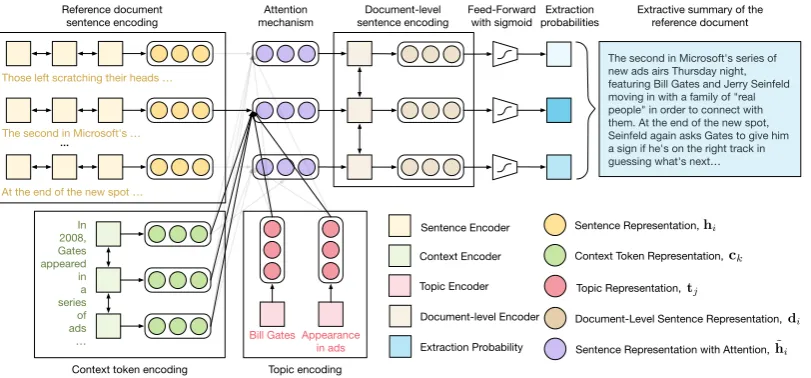
Adding Topics and Context We extended the
standard extractive model by incorporating the topic and context information through an attention mechanism. First, each of the individual topics is
encoded into a vector representation tj by
aver-aging the word vectors for each word in topic j.
Then, a bidirectional RNN encodes the context
to-kens into a vector representationckfor each token.
The topic and context token representations are combined with the sentence-level sentence representations through an attention mechanism. Specifically, an attention score is computed
be-tween eachhiand the topic and context
represen-tations. Then, the subsequent attention scores are used to create a weighted sum of the topic and
con-text representations,ai.
Finally, the sentence representation h˜i that
in-cludes the attention mechanism is computed as
˜
hi=Wa[hi;ai] (1)
whereWais a matrix of learned parameters.
In this extended version of the model,h˜iis used
to compute the extraction probabilities instead of
hi. A graphical representation of the full
extrac-tive model is presented in Figure3.
Training & Inference To convert the
abstrac-tive clozes into extracabstrac-tive reference sentence
la-bels, we follow the procedure of Nallapati et al.
(2017) and greedily select reference sentences that maximize ROUGE-1 recall until no more sen-tences improve the score. The training objective is the weighted negative log-likelihood of the labels
with the same weighting asKedzie et al. (2018).
At inference, the sentence with the highest proba-bility of extraction is selected.
4.2 Two-Step Abstractive Model
Since the reference documents in the WIKICITE
dataset are rather long (see Table 1), we chose
to use a two-step approach to build an abstractive system for the summary cloze task.
Extractive Step The first step uses the same
ex-tractive model from the previous subsection to sig-nificantly reduce the amount of input text. Instead of selecting just one sentence at inference, the ex-tractive model repeatedly selects sentences until a pre-specified number of words has been met. Then, only the sentences which were extracted are passed as input to the abstractive step.
Abstractive Step For the abstractive step, we
extended the Pointer-Generator + Coverage
net-work (See et al.,2017) for single-document
sum-marization to include the context.
The Pointer-Generator network is built on a sequence-to-sequence model with attention. The reference document is encoded using an RNN, and the summary is produced using a second RNN. The model is augmented with a copy mechanism by including a soft switch that allows the atten-tion distribuatten-tion to influence the decoder’s proba-bility distribution over the vocabulary, thus mak-ing it easier to copy words from the input.
Those left scratching their heads …
At the end of the new spot … The second in Microsoft's …
…
In 2008, Gates appeared in a series of ads …
The second in Microsoft's series of new ads airs Thursday night, featuring Bill Gates and Jerry Seinfeld moving in with a family of "real people" in order to connect with them. At the end of the new spot, Seinfeld again asks Gates to give him a sign if he's on the right track in guessing what's next…
Sentence Representation, Sentence Encoder
Context Encoder Context Token Representation,
Sentence Representation with Attention, Topic Representation,
Document-level Encoder Document-Level Sentence Representation,
Bill Gates Appearance in ads
Topic Encoder
Extraction Probability
hi
<latexit sha1_base64="+6kkaep2Lb0B/hCvTkKPhsiIVAI=">AAAB83icbVBNS8NAFHypX7V+VT16WSyCp5KIoMeiF48VbC00oWy2m3bpZhN2X4QS+je8eFDEq3/Gm//GTZuDtg4sDDPv8WYnTKUw6LrfTmVtfWNzq7pd29nd2z+oHx51TZJpxjsskYnuhdRwKRTvoEDJe6nmNA4lfwwnt4X/+MS1EYl6wGnKg5iOlIgEo2gl348pjsMoH88GYlBvuE13DrJKvJI0oER7UP/yhwnLYq6QSWpM33NTDHKqUTDJZzU/MzylbEJHvG+pojE3QT7PPCNnVhmSKNH2KSRz9fdGTmNjpnFoJ4uMZtkrxP+8fobRdZALlWbIFVscijJJMCFFAWQoNGcop5ZQpoXNStiYasrQ1lSzJXjLX14l3Yum5za9+8tG66asowoncArn4MEVtOAO2tABBik8wyu8OZnz4rw7H4vRilPuHMMfOJ8/ZtCR6A==</latexit>
<latexit sha1_base64="+6kkaep2Lb0B/hCvTkKPhsiIVAI=">AAAB83icbVBNS8NAFHypX7V+VT16WSyCp5KIoMeiF48VbC00oWy2m3bpZhN2X4QS+je8eFDEq3/Gm//GTZuDtg4sDDPv8WYnTKUw6LrfTmVtfWNzq7pd29nd2z+oHx51TZJpxjsskYnuhdRwKRTvoEDJe6nmNA4lfwwnt4X/+MS1EYl6wGnKg5iOlIgEo2gl348pjsMoH88GYlBvuE13DrJKvJI0oER7UP/yhwnLYq6QSWpM33NTDHKqUTDJZzU/MzylbEJHvG+pojE3QT7PPCNnVhmSKNH2KSRz9fdGTmNjpnFoJ4uMZtkrxP+8fobRdZALlWbIFVscijJJMCFFAWQoNGcop5ZQpoXNStiYasrQ1lSzJXjLX14l3Yum5za9+8tG66asowoncArn4MEVtOAO2tABBik8wyu8OZnz4rw7H4vRilPuHMMfOJ8/ZtCR6A==</latexit>
<latexit sha1_base64="+6kkaep2Lb0B/hCvTkKPhsiIVAI=">AAAB83icbVBNS8NAFHypX7V+VT16WSyCp5KIoMeiF48VbC00oWy2m3bpZhN2X4QS+je8eFDEq3/Gm//GTZuDtg4sDDPv8WYnTKUw6LrfTmVtfWNzq7pd29nd2z+oHx51TZJpxjsskYnuhdRwKRTvoEDJe6nmNA4lfwwnt4X/+MS1EYl6wGnKg5iOlIgEo2gl348pjsMoH88GYlBvuE13DrJKvJI0oER7UP/yhwnLYq6QSWpM33NTDHKqUTDJZzU/MzylbEJHvG+pojE3QT7PPCNnVhmSKNH2KSRz9fdGTmNjpnFoJ4uMZtkrxP+8fobRdZALlWbIFVscijJJMCFFAWQoNGcop5ZQpoXNStiYasrQ1lSzJXjLX14l3Yum5za9+8tG66asowoncArn4MEVtOAO2tABBik8wyu8OZnz4rw7H4vRilPuHMMfOJ8/ZtCR6A==</latexit>
<latexit sha1_base64="+6kkaep2Lb0B/hCvTkKPhsiIVAI=">AAAB83icbVBNS8NAFHypX7V+VT16WSyCp5KIoMeiF48VbC00oWy2m3bpZhN2X4QS+je8eFDEq3/Gm//GTZuDtg4sDDPv8WYnTKUw6LrfTmVtfWNzq7pd29nd2z+oHx51TZJpxjsskYnuhdRwKRTvoEDJe6nmNA4lfwwnt4X/+MS1EYl6wGnKg5iOlIgEo2gl348pjsMoH88GYlBvuE13DrJKvJI0oER7UP/yhwnLYq6QSWpM33NTDHKqUTDJZzU/MzylbEJHvG+pojE3QT7PPCNnVhmSKNH2KSRz9fdGTmNjpnFoJ4uMZtkrxP+8fobRdZALlWbIFVscijJJMCFFAWQoNGcop5ZQpoXNStiYasrQ1lSzJXjLX14l3Yum5za9+8tG66asowoncArn4MEVtOAO2tABBik8wyu8OZnz4rw7H4vRilPuHMMfOJ8/ZtCR6A==</latexit>
tj
<latexit sha1_base64="0QWFXCSUEAKXeS2U7XNlLPhZp7E=">AAAB83icbVDLSsNAFL2pr1pfVZduBovgqiQi6LLoxmUF+4CmlMl00o6dTMLMjVBCf8ONC0Xc+jPu/BsnbRbaemDgcM693DMnSKQw6LrfTmltfWNzq7xd2dnd2z+oHh61TZxqxlsslrHuBtRwKRRvoUDJu4nmNAok7wST29zvPHFtRKwecJrwfkRHSoSCUbSS70cUx0GY4WzwOKjW3Lo7B1klXkFqUKA5qH75w5ilEVfIJDWm57kJ9jOqUTDJZxU/NTyhbEJHvGepohE3/WyeeUbOrDIkYaztU0jm6u+NjEbGTKPATuYZzbKXi/95vRTD634mVJIiV2xxKEwlwZjkBZCh0JyhnFpCmRY2K2FjqilDW1PFluAtf3mVtC/qnlv37i9rjZuijjKcwCmcgwdX0IA7aEILGCTwDK/w5qTOi/PufCxGS06xcwx/4Hz+AHqokfU=</latexit>
<latexit sha1_base64="0QWFXCSUEAKXeS2U7XNlLPhZp7E=">AAAB83icbVDLSsNAFL2pr1pfVZduBovgqiQi6LLoxmUF+4CmlMl00o6dTMLMjVBCf8ONC0Xc+jPu/BsnbRbaemDgcM693DMnSKQw6LrfTmltfWNzq7xd2dnd2z+oHh61TZxqxlsslrHuBtRwKRRvoUDJu4nmNAok7wST29zvPHFtRKwecJrwfkRHSoSCUbSS70cUx0GY4WzwOKjW3Lo7B1klXkFqUKA5qH75w5ilEVfIJDWm57kJ9jOqUTDJZxU/NTyhbEJHvGepohE3/WyeeUbOrDIkYaztU0jm6u+NjEbGTKPATuYZzbKXi/95vRTD634mVJIiV2xxKEwlwZjkBZCh0JyhnFpCmRY2K2FjqilDW1PFluAtf3mVtC/qnlv37i9rjZuijjKcwCmcgwdX0IA7aEILGCTwDK/w5qTOi/PufCxGS06xcwx/4Hz+AHqokfU=</latexit>
<latexit sha1_base64="0QWFXCSUEAKXeS2U7XNlLPhZp7E=">AAAB83icbVDLSsNAFL2pr1pfVZduBovgqiQi6LLoxmUF+4CmlMl00o6dTMLMjVBCf8ONC0Xc+jPu/BsnbRbaemDgcM693DMnSKQw6LrfTmltfWNzq7xd2dnd2z+oHh61TZxqxlsslrHuBtRwKRRvoUDJu4nmNAok7wST29zvPHFtRKwecJrwfkRHSoSCUbSS70cUx0GY4WzwOKjW3Lo7B1klXkFqUKA5qH75w5ilEVfIJDWm57kJ9jOqUTDJZxU/NTyhbEJHvGepohE3/WyeeUbOrDIkYaztU0jm6u+NjEbGTKPATuYZzbKXi/95vRTD634mVJIiV2xxKEwlwZjkBZCh0JyhnFpCmRY2K2FjqilDW1PFluAtf3mVtC/qnlv37i9rjZuijjKcwCmcgwdX0IA7aEILGCTwDK/w5qTOi/PufCxGS06xcwx/4Hz+AHqokfU=</latexit>
<latexit sha1_base64="0QWFXCSUEAKXeS2U7XNlLPhZp7E=">AAAB83icbVDLSsNAFL2pr1pfVZduBovgqiQi6LLoxmUF+4CmlMl00o6dTMLMjVBCf8ONC0Xc+jPu/BsnbRbaemDgcM693DMnSKQw6LrfTmltfWNzq7xd2dnd2z+oHh61TZxqxlsslrHuBtRwKRRvoUDJu4nmNAok7wST29zvPHFtRKwecJrwfkRHSoSCUbSS70cUx0GY4WzwOKjW3Lo7B1klXkFqUKA5qH75w5ilEVfIJDWm57kJ9jOqUTDJZxU/NTyhbEJHvGepohE3/WyeeUbOrDIkYaztU0jm6u+NjEbGTKPATuYZzbKXi/95vRTD634mVJIiV2xxKEwlwZjkBZCh0JyhnFpCmRY2K2FjqilDW1PFluAtf3mVtC/qnlv37i9rjZuijjKcwCmcgwdX0IA7aEILGCTwDK/w5qTOi/PufCxGS06xcwx/4Hz+AHqokfU=</latexit>
ck
<latexit sha1_base64="uSCypJxdC1eusWXXZ1tZf846MJE=">AAAB83icbVBNS8NAFHypX7V+VT16WSyCp5KIoMeiF48VbC00oWy2m3bpZhN2X4QS+je8eFDEq3/Gm//GTZuDtg4sDDPv8WYnTKUw6LrfTmVtfWNzq7pd29nd2z+oHx51TZJpxjsskYnuhdRwKRTvoEDJe6nmNA4lfwwnt4X/+MS1EYl6wGnKg5iOlIgEo2gl348pjsMoZ7PBZFBvuE13DrJKvJI0oER7UP/yhwnLYq6QSWpM33NTDHKqUTDJZzU/MzylbEJHvG+pojE3QT7PPCNnVhmSKNH2KSRz9fdGTmNjpnFoJ4uMZtkrxP+8fobRdZALlWbIFVscijJJMCFFAWQoNGcop5ZQpoXNStiYasrQ1lSzJXjLX14l3Yum5za9+8tG66asowoncArn4MEVtOAO2tABBik8wyu8OZnz4rw7H4vRilPuHMMfOJ8/YjWR5Q==</latexit>
<latexit sha1_base64="uSCypJxdC1eusWXXZ1tZf846MJE=">AAAB83icbVBNS8NAFHypX7V+VT16WSyCp5KIoMeiF48VbC00oWy2m3bpZhN2X4QS+je8eFDEq3/Gm//GTZuDtg4sDDPv8WYnTKUw6LrfTmVtfWNzq7pd29nd2z+oHx51TZJpxjsskYnuhdRwKRTvoEDJe6nmNA4lfwwnt4X/+MS1EYl6wGnKg5iOlIgEo2gl348pjsMoZ7PBZFBvuE13DrJKvJI0oER7UP/yhwnLYq6QSWpM33NTDHKqUTDJZzU/MzylbEJHvG+pojE3QT7PPCNnVhmSKNH2KSRz9fdGTmNjpnFoJ4uMZtkrxP+8fobRdZALlWbIFVscijJJMCFFAWQoNGcop5ZQpoXNStiYasrQ1lSzJXjLX14l3Yum5za9+8tG66asowoncArn4MEVtOAO2tABBik8wyu8OZnz4rw7H4vRilPuHMMfOJ8/YjWR5Q==</latexit>
<latexit sha1_base64="uSCypJxdC1eusWXXZ1tZf846MJE=">AAAB83icbVBNS8NAFHypX7V+VT16WSyCp5KIoMeiF48VbC00oWy2m3bpZhN2X4QS+je8eFDEq3/Gm//GTZuDtg4sDDPv8WYnTKUw6LrfTmVtfWNzq7pd29nd2z+oHx51TZJpxjsskYnuhdRwKRTvoEDJe6nmNA4lfwwnt4X/+MS1EYl6wGnKg5iOlIgEo2gl348pjsMoZ7PBZFBvuE13DrJKvJI0oER7UP/yhwnLYq6QSWpM33NTDHKqUTDJZzU/MzylbEJHvG+pojE3QT7PPCNnVhmSKNH2KSRz9fdGTmNjpnFoJ4uMZtkrxP+8fobRdZALlWbIFVscijJJMCFFAWQoNGcop5ZQpoXNStiYasrQ1lSzJXjLX14l3Yum5za9+8tG66asowoncArn4MEVtOAO2tABBik8wyu8OZnz4rw7H4vRilPuHMMfOJ8/YjWR5Q==</latexit>
<latexit sha1_base64="uSCypJxdC1eusWXXZ1tZf846MJE=">AAAB83icbVBNS8NAFHypX7V+VT16WSyCp5KIoMeiF48VbC00oWy2m3bpZhN2X4QS+je8eFDEq3/Gm//GTZuDtg4sDDPv8WYnTKUw6LrfTmVtfWNzq7pd29nd2z+oHx51TZJpxjsskYnuhdRwKRTvoEDJe6nmNA4lfwwnt4X/+MS1EYl6wGnKg5iOlIgEo2gl348pjsMoZ7PBZFBvuE13DrJKvJI0oER7UP/yhwnLYq6QSWpM33NTDHKqUTDJZzU/MzylbEJHvG+pojE3QT7PPCNnVhmSKNH2KSRz9fdGTmNjpnFoJ4uMZtkrxP+8fobRdZALlWbIFVscijJJMCFFAWQoNGcop5ZQpoXNStiYasrQ1lSzJXjLX14l3Yum5za9+8tG66asowoncArn4MEVtOAO2tABBik8wyu8OZnz4rw7H4vRilPuHMMfOJ8/YjWR5Q==</latexit>
di
<latexit sha1_base64="zrkZPirrGIVueyZrRFQfEezjaVg=">AAAB83icbVBNS8NAFHypX7V+VT16WSyCp5KIoMeiF48VbC00oWy2L+3SzSbsboQS+je8eFDEq3/Gm//GTZuDtg4sDDPv8WYnTAXXxnW/ncra+sbmVnW7trO7t39QPzzq6iRTDDssEYnqhVSj4BI7hhuBvVQhjUOBj+HktvAfn1BpnsgHM00xiOlI8ogzaqzk+zE14zDKh7MBH9QbbtOdg6wSryQNKNEe1L/8YcKyGKVhgmrd99zUBDlVhjOBs5qfaUwpm9AR9i2VNEYd5PPMM3JmlSGJEmWfNGSu/t7Iaaz1NA7tZJFRL3uF+J/Xz0x0HeRcpplByRaHokwQk5CiADLkCpkRU0soU9xmJWxMFWXG1lSzJXjLX14l3Yum5za9+8tG66asowoncArn4MEVtOAO2tABBik8wyu8OZnz4rw7H4vRilPuHMMfOJ8/YLSR5A==</latexit>
<latexit sha1_base64="zrkZPirrGIVueyZrRFQfEezjaVg=">AAAB83icbVBNS8NAFHypX7V+VT16WSyCp5KIoMeiF48VbC00oWy2L+3SzSbsboQS+je8eFDEq3/Gm//GTZuDtg4sDDPv8WYnTAXXxnW/ncra+sbmVnW7trO7t39QPzzq6iRTDDssEYnqhVSj4BI7hhuBvVQhjUOBj+HktvAfn1BpnsgHM00xiOlI8ogzaqzk+zE14zDKh7MBH9QbbtOdg6wSryQNKNEe1L/8YcKyGKVhgmrd99zUBDlVhjOBs5qfaUwpm9AR9i2VNEYd5PPMM3JmlSGJEmWfNGSu/t7Iaaz1NA7tZJFRL3uF+J/Xz0x0HeRcpplByRaHokwQk5CiADLkCpkRU0soU9xmJWxMFWXG1lSzJXjLX14l3Yum5za9+8tG66asowoncArn4MEVtOAO2tABBik8wyu8OZnz4rw7H4vRilPuHMMfOJ8/YLSR5A==</latexit>
<latexit sha1_base64="zrkZPirrGIVueyZrRFQfEezjaVg=">AAAB83icbVBNS8NAFHypX7V+VT16WSyCp5KIoMeiF48VbC00oWy2L+3SzSbsboQS+je8eFDEq3/Gm//GTZuDtg4sDDPv8WYnTAXXxnW/ncra+sbmVnW7trO7t39QPzzq6iRTDDssEYnqhVSj4BI7hhuBvVQhjUOBj+HktvAfn1BpnsgHM00xiOlI8ogzaqzk+zE14zDKh7MBH9QbbtOdg6wSryQNKNEe1L/8YcKyGKVhgmrd99zUBDlVhjOBs5qfaUwpm9AR9i2VNEYd5PPMM3JmlSGJEmWfNGSu/t7Iaaz1NA7tZJFRL3uF+J/Xz0x0HeRcpplByRaHokwQk5CiADLkCpkRU0soU9xmJWxMFWXG1lSzJXjLX14l3Yum5za9+8tG66asowoncArn4MEVtOAO2tABBik8wyu8OZnz4rw7H4vRilPuHMMfOJ8/YLSR5A==</latexit>
<latexit sha1_base64="zrkZPirrGIVueyZrRFQfEezjaVg=">AAAB83icbVBNS8NAFHypX7V+VT16WSyCp5KIoMeiF48VbC00oWy2L+3SzSbsboQS+je8eFDEq3/Gm//GTZuDtg4sDDPv8WYnTAXXxnW/ncra+sbmVnW7trO7t39QPzzq6iRTDDssEYnqhVSj4BI7hhuBvVQhjUOBj+HktvAfn1BpnsgHM00xiOlI8ogzaqzk+zE14zDKh7MBH9QbbtOdg6wSryQNKNEe1L/8YcKyGKVhgmrd99zUBDlVhjOBs5qfaUwpm9AR9i2VNEYd5PPMM3JmlSGJEmWfNGSu/t7Iaaz1NA7tZJFRL3uF+J/Xz0x0HeRcpplByRaHokwQk5CiADLkCpkRU0soU9xmJWxMFWXG1lSzJXjLX14l3Yum5za9+8tG66asowoncArn4MEVtOAO2tABBik8wyu8OZnz4rw7H4vRilPuHMMfOJ8/YLSR5A==</latexit>
˜
hi
<latexit sha1_base64="XlOXLZ9PUCZr3K0ys7mU3sJHbfM=">AAAB/XicbVDLSsNAFJ3UV62v+Ni5GSyCq5KIoMuiG5cV7AOaECaTm3bo5MHMRKgh+CtuXCji1v9w5984abPQ1gMDh3Pu5Z45fsqZVJb1bdRWVtfWN+qbja3tnd09c/+gJ5NMUOjShCdi4BMJnMXQVUxxGKQCSORz6PuTm9LvP4CQLInv1TQFNyKjmIWMEqUlzzxyFOMB5E5E1NgP83FReMwzm1bLmgEvE7siTVSh45lfTpDQLIJYUU6kHNpWqtycCMUoh6LhZBJSQidkBENNYxKBdPNZ+gKfaiXAYSL0ixWeqb83chJJOY18PVmGlIteKf7nDTMVXrk5i9NMQUznh8KMY5XgsgocMAFU8akmhAqms2I6JoJQpQtr6BLsxS8vk955y7Za9t1Fs31d1VFHx+gEnSEbXaI2ukUd1EUUPaJn9IrejCfjxXg3PuajNaPaOUR/YHz+AGGnlc8=</latexit>
<latexit sha1_base64="XlOXLZ9PUCZr3K0ys7mU3sJHbfM=">AAAB/XicbVDLSsNAFJ3UV62v+Ni5GSyCq5KIoMuiG5cV7AOaECaTm3bo5MHMRKgh+CtuXCji1v9w5984abPQ1gMDh3Pu5Z45fsqZVJb1bdRWVtfWN+qbja3tnd09c/+gJ5NMUOjShCdi4BMJnMXQVUxxGKQCSORz6PuTm9LvP4CQLInv1TQFNyKjmIWMEqUlzzxyFOMB5E5E1NgP83FReMwzm1bLmgEvE7siTVSh45lfTpDQLIJYUU6kHNpWqtycCMUoh6LhZBJSQidkBENNYxKBdPNZ+gKfaiXAYSL0ixWeqb83chJJOY18PVmGlIteKf7nDTMVXrk5i9NMQUznh8KMY5XgsgocMAFU8akmhAqms2I6JoJQpQtr6BLsxS8vk955y7Za9t1Fs31d1VFHx+gEnSEbXaI2ukUd1EUUPaJn9IrejCfjxXg3PuajNaPaOUR/YHz+AGGnlc8=</latexit><latexit sha1_base64="XlOXLZ9PUCZr3K0ys7mU3sJHbfM=">AAAB/XicbVDLSsNAFJ3UV62v+Ni5GSyCq5KIoMuiG5cV7AOaECaTm3bo5MHMRKgh+CtuXCji1v9w5984abPQ1gMDh3Pu5Z45fsqZVJb1bdRWVtfWN+qbja3tnd09c/+gJ5NMUOjShCdi4BMJnMXQVUxxGKQCSORz6PuTm9LvP4CQLInv1TQFNyKjmIWMEqUlzzxyFOMB5E5E1NgP83FReMwzm1bLmgEvE7siTVSh45lfTpDQLIJYUU6kHNpWqtycCMUoh6LhZBJSQidkBENNYxKBdPNZ+gKfaiXAYSL0ixWeqb83chJJOY18PVmGlIteKf7nDTMVXrk5i9NMQUznh8KMY5XgsgocMAFU8akmhAqms2I6JoJQpQtr6BLsxS8vk955y7Za9t1Fs31d1VFHx+gEnSEbXaI2ukUd1EUUPaJn9IrejCfjxXg3PuajNaPaOUR/YHz+AGGnlc8=</latexit>
<latexit sha1_base64="XlOXLZ9PUCZr3K0ys7mU3sJHbfM=">AAAB/XicbVDLSsNAFJ3UV62v+Ni5GSyCq5KIoMuiG5cV7AOaECaTm3bo5MHMRKgh+CtuXCji1v9w5984abPQ1gMDh3Pu5Z45fsqZVJb1bdRWVtfWN+qbja3tnd09c/+gJ5NMUOjShCdi4BMJnMXQVUxxGKQCSORz6PuTm9LvP4CQLInv1TQFNyKjmIWMEqUlzzxyFOMB5E5E1NgP83FReMwzm1bLmgEvE7siTVSh45lfTpDQLIJYUU6kHNpWqtycCMUoh6LhZBJSQidkBENNYxKBdPNZ+gKfaiXAYSL0ixWeqb83chJJOY18PVmGlIteKf7nDTMVXrk5i9NMQUznh8KMY5XgsgocMAFU8akmhAqms2I6JoJQpQtr6BLsxS8vk955y7Za9t1Fs31d1VFHx+gEnSEbXaI2ukUd1EUUPaJn9IrejCfjxXg3PuajNaPaOUR/YHz+AGGnlc8=</latexit>
Context token encoding Reference document
sentence encoding
Attention mechanism
Extraction probabilities
Extractive summary of the reference document Document-level
sentence encoding
Feed-Forward with sigmoid
[image:5.595.100.506.62.251.2]Topic encoding
Figure 3: The extractive model uses three separate encoders create representations for the reference document sen-tences, context tokens, and topics. These are combined through an attention mechanism, encoded at a document-level, and passed through a feed-forward layer to compute an extraction probability for each reference sentence.
term to the loss function which penalizes such be-havior and a new term to the attention score cal-culation that informs the model about the previous steps’ attention weights. The coverage mechanism has the effect of decreasing the amount of redun-dancy in the generated summary.
Conditioning on Context In order to condition
the generation of the cloze on the context, we use the context tokens to initialize the decoder’s hid-den state representation by first forcing the tokens through the decoder.
Concretely, let stbe the decoder’s hidden state
for decoding stept(withs0 initialized to the final
encoder hidden state), dθ(·) be the decoder
func-tion, and c1, . . . , cT be the context tokens. The
context tokens are passed through the decoder to create a new decoder hidden state representation using the following recursive formula
st=dθ(ct,st−1) ∀t= 1, . . . , T (2)
Then,sT is used as the initial hidden state that the
decoder uses to generate the cloze tokens.
Priming the decoder with the context tokens has the benefit of allowing the model to condition the cloze generation on a representation of the context. Additionally, because the context will impact the decoder’s coverage calculation, it will discourage the cloze from repeating information already in the context.
Training & Inference Following See et al.
(2017), the training objective is the negative log-likelihood of the ground-truth cloze tokens with
the added coverage penalty. Inference is done us-ing beam search.
5 Experimental Setup
Our experiments aim to better understand the
WIKICITEdataset, evaluation metric, and
perfor-mance of the extractive and abstractive models. Numbers in bold indicate statistical significance
based on bootstrap resampling withp= 0.05.
5.1 Dataset Ablation & Human Performance
In order to better understand the WIKICITE dataset, we estimate how well models can perform without the reference documents and context and establish human performance on the task.
No Reference Document We used the publicly
available large-scale language model from
Rad-ford et al. (2019) (the 345M parameter version)
with the default parameters to generate the cloze.
The language model (which we call NO
REFER-ENCE) was conditioned on the context tokens and one full sentence was generated from the model without access to the reference document.
No Context We trained an abstractive model
(§4.2) to summarize the first 200 tokens of the ref-erence documents in one sentence, using the cloze as ground-truth, without access to the context. This is equivalent to training a single-document
summarization system on the input text. This
Human Performance We manually wrote clozes for 50 different instances with and without access to the topic and context to establish human performance on this task. We also had each cloze judged by 5 crowd workers to rate from 1 to 5 how coherent the topic, context, and cloze are. We report this average quality score alongside
ROUGE with the HUMANlabel.
5.2 Extractive Models
In addition to an ablation study on the extractive
model (referred to as CONTENTSELECTOR;§4.1)
where we remove the topic and context, we also evaluate several different extractive models on this task, described below.
Lead & Oracle The LEAD-1 chooses the first
sentence from the reference documents as the cloze, a common baseline for summarization.
The ORACLE-1 model selects the one sen-tence from the reference set which maximizes the ROUGE score using the ground-truth. A different oracle model was created for each individual met-ric. The performance of the oracle represents the upper-bound ROUGE score that a system which extracts exactly one sentence can achieve.
BM25 BM25 (Robertson et al., 1995) is an
in-formation retrieval-based score used to rank doc-uments in search results for an input query. We selected the reference document sentence with the highest BM25 score for the context, treating the context as the query, the sentences as the doc-uments, and computing the document frequency scores over the corpus of reference documents.
SumFocus SumFocus (Vanderwende et al.,
2007) is an unsupervised model for topic-focused extractive summarization. The model constructs a unigram distribution over tokens by interpolat-ing the unigram distributions of the documents and topic. Then, the model iteratively selects a sen-tence that has the highest probability token, dis-counts the probabilities of tokens in the selected sentence, and repeats. We extend SumFocus by additionally interpolating between the context un-igram distribution in addition to the document and topic distributions.
5.3 Abstractive Models
Then, we measured how well the two-step abstrac-tive system performs with and without access to the context and with different extractive models.
Extractive Step Evaluation We use the
extrac-tive models above to preprocess the reference set to select the top scoring sentences, up to 200 to-kens. The preprocessed documents are evaluated against the ground-truth cloze by calculating the recall variant of ROUGE. This will measure what
percent of the clozen-grams are contained within
the text input to the abstractive step.
In addition to the extractive models, we also re-port lead and extractive oracle scores. The LEAD-200 extractive step selects the first LEAD-200 tokens of the reference document. The extractive oracle model preprocesses the reference sentences by se-lecting only those which were labeled positively in the heuristically-generated extractive labels, lim-ited to 200 tokens. This model, called HEURISTIC LABELS, serves to demonstrate how well the ab-stractive model would perform with a perfect ex-tractive step.
Abstractive Step Evaluation Using the
prepro-cessed documents from various extractive models, we trained abstractive models (§4.2) to produce the ground-truth cloze, both with and without ac-cess to the context. These systems were evaluated with the F1 variant of ROUGE and perplexity.
5.4 Implementation Details
Our models were implemented using PyTorch
(Paszke et al., 2017) in the AllenNLP
frame-work (Gardner et al., 2017).4 We used fixed
200-dimensional GloVe embeddings (Pennington
et al.,2014). The RNNs were implemented with
LSTMs (Hochreiter and Schmidhuber, 1997) of
size 256. The models were trained with Adam
(Kingma and Ba, 2014) using a learning rate of
1e-4 and 1e-3 and batch sizes of 32 and 16 for 290k and 62.5k iterations for the extractive and
ab-stractive models, respectively. FollowingSee et al.
(2017), we trained the abstractive models without the coverage loss until convergence, then by 3k it-erations with a coverage loss weight of 1.
6 Experimental Results
6.1 Human Performance & Evaluation
Table2shows the ROUGE and quality scores for
the human-written clozes with and without access to the topic and context. For an additional compar-ison, we included a random human baseline that randomly shuffled the human-written clozes.
4All code available at http://cogcomp.org/
Model R1 R2 RL Qual.
GROUND-TRUTH 100 100 100 4.0
HUMAN 31.78 16.94 28.32 3.9
-TOPIC,-CONTEXT 24.49 7.55 20.11 3.7
[image:7.595.319.514.62.172.2]RANDOMHUMAN 9.96 0.08 8.24 2.3
Table 2: The ROUGE F1 scores for the human clozes with and without access to the topic and context and crowdsourced quality judgments (on a 1-5 scale) of how well the cloze continues the corresponding text. The standard deviations for the quality judgments (omitted for space) were each around 0.9.
Model R1 R2 RL
NOREFERENCE 14.47 1.43 11.41
NOCONTEXT 21.79 6.18 17.83
Table 3: The ROUGE F1 results of the baseline models that do not have access to the references or context.
The ROUGE scores for when the human cloze writers had access to the topic and context are higher by 7.3 R1 points, a significant margin. From this observation, we can infer that, when provided with the topic and context, humans do a better job at identifying the same information present in the ground-truth cloze. This is indica-tive that the topic and context should also be nec-essary for a system to do the same.
However, the crowd worker quality judgments are roughly equal for the ground-truth and both human-written clozes, and human performance is at 31.78 R1, which is somewhat low on an abso-lute scale. We believe this reflects the difficulty of evaluating this task and summarization in general. Because there are many possible valid clozes (or valid summaries of documents in the more gen-eral case) and only one ground-truth cloze, evalu-ation with automatic metrics is difficult. Although ROUGE is imperfect, it does positively correlate with the crowd worker quality scores, with a Pear-son’s coefficient of 0.44.
6.2 Dataset Ablation
The two baseline models that do not have access to the references or context, respectively, are
eval-uated in Table 3. Although the NO REFERENCE
model is a high-quality language model, it
per-forms significantly worse than the NO CONTEXT
model. This is likely due to the fact that the NO
CONTEXTmodel was trained for this task.
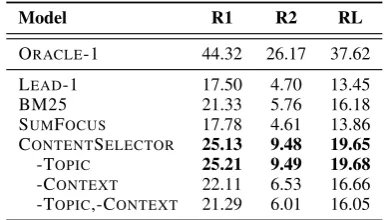
Model R1 R2 RL
ORACLE-1 44.32 26.17 37.62
LEAD-1 17.50 4.70 13.45
BM25 21.33 5.76 16.18
SUMFOCUS 17.78 4.61 13.86
CONTENTSELECTOR 25.13 9.48 19.65
-TOPIC 25.21 9.49 19.68
-CONTEXT 22.11 6.53 16.66
[image:7.595.97.264.230.275.2]-TOPIC,-CONTEXT 21.29 6.01 16.05
Table 4: The ROUGE F1 scores for the extractive mod-els, all of which are significantly lower than the oracle model, indicating there is room for improvement.
6.3 Extractive Models
The performance of the different extractive models
on the summary cloze task is presented in Table4.
The CONTENTSELECTOR model achieves the
best score overall with around 25 R1. Providing
CONTENTSELECTOR with the topic and context
improves the R1 score by nearly 4 points, however, this improvement is mostly due to the context. The topic does not change the model’s performance by a statistically significant amount, which is an indi-cation that it is not being properly utilized.
Among the symbolic models, BM25
out-performs SUMFOCUSby 3.55 R1. One reason for
this could be that BM25 uses a token weighting to score each sentence based on how frequently the token appears in the entire reference corpora,
whereas the standard SUMFOCUSimplementation
treats all tokens equally.
Although the models perform well, they are still significantly below the oracle model by at least 19 R1 and 16 R2 points. Such a large gap indicates that there is some signal in the data that is not yet captured by the extractive models.
6.4 Abstractive Models
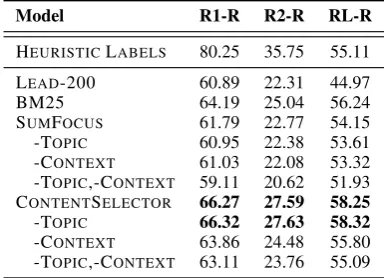
Extractive Step The ROUGE recall scores for
the different extractive models used to preprocess the input to the abstractive model are shown in
Ta-ble5. The results are largely consistent with the
extractive model scores, with CONTENT
SELEC-TORperforming the best, the topic causing no
sta-tistically significant difference, and a large gap re-maining between current models and a perfect sys-tem (the heuristic labels).
Table 5also contains an ablation study for the
SUMFOCUSin which the topic did make a
Model R1-R R2-R RL-R
HEURISTICLABELS 80.25 35.75 55.11
LEAD-200 60.89 22.31 44.97
BM25 64.19 25.04 56.24
SUMFOCUS 61.79 22.77 54.15
-TOPIC 60.95 22.38 53.61
-CONTEXT 61.03 22.08 53.32
-TOPIC,-CONTEXT 59.11 20.62 51.93
CONTENTSELECTOR 66.27 27.59 58.25
-TOPIC 66.32 27.63 58.32
-CONTEXT 63.86 24.48 55.80
-TOPIC,-CONTEXT 63.11 23.76 55.09
Table 5: An evaluation using the recall variant of ROUGE of the different extractive preprocessing steps.
may benefit from combining symbolic and contin-uous representations.
Abstractive Step The ROUGE scores and
per-plexities for the abstractive models that use three
different extractive steps are presented in Table6.
We observe that the CONTENTSELECTOR
extrac-tive step outperforms LEAD-200 in both ROUGE and perplexity. Additionally, including the con-text improves performance across all models, with nearly a 2 R1 gain with the CONTENTSELECTOR. This result is a clear signal that priming the de-coder with the context produces a better cloze.
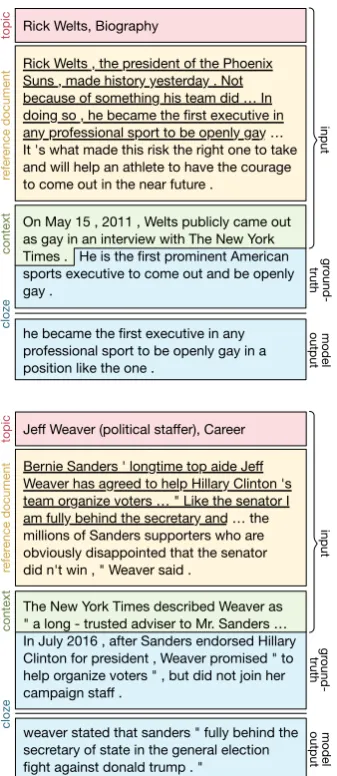
Example output from the CONTENTSELECTOR
model that uses the context can been seen in
Fig-ure4. In general, the model tends to copy long
se-quences from the reference document, often pre-ferring somewhat formulaic sentences that begin with phrases such as “he became,” “she gradu-ated,” or “she received” and are similar in style to Wikipedia articles.
Similar to the extractive results, there is a siz-able gap between the performance of the abstrac-tive model when it uses the heuristic labels versus the extractive model for preprocessing. This indi-cates that improving the extractive model will pro-vide large downstream abstractive improvements.
7 Related Work
Summarization Recent work on generic
sum-marization has focused on single-document mod-els on the CNN/DailyMail dataset (Nallapati et al., 2016), focusing on different neural architectures and loss functions for extractive and abstractive
summarization (Cheng and Lapata,2016;
Nallap-ati et al.,2017;Chopra et al.,2016;Nallapati et al.,
2016;See et al.,2017, inter alia). Our models were
Ext. Model Abs. R1 R2 RL PPL
HEUR. LAB. +C 34.30 16.34 28.73 18.08
–C 33.62 15.80 27.96 18.71
LEAD-200 +C 23.56 7.15 19.3 39.73
–C 21.79 6.18 17.83 40.90
CONTSEL. +C 24.67 8.55 20.44 33.22
[image:8.595.84.278.63.202.2]–C 22.71 7.33 18.71 32.77
Table 6: The ROUGE F1 and perplexity results for ab-stractive models with and without the context (+/–C) with heuristic labels, lead, and CONTENTSELECTOR extractive preprocessing steps.
based on the successful approaches of See et al.
(2017) and those described inKedzie et al.(2018).
Most work on topic-focused (also referred to as “query-focused”) summarization uses the DUC
2005 and 2006 datasets (Dang, 2005, 2006).
Approaches are mostly extractive, with some work selecting sentences based on token
fre-quency/salience (Otterbacher et al., 2005;
Van-derwende et al., 2007), diversity with
submod-ular functions (Lin and Bilmes, 2011), or using
Bayesian networks (Daum´e III and Marcu,2006).
To the best of our knowledge, ours is the first work which builds end-to-end models on a large-scale dataset for topic-focused summarization.
Generating Wikipedia In contrast to our work
focusing on content selection for topic-focused summaries, there have been previous work
inter-ested in generating Wikipedia articles. Sauper
and Barzilay(2009) try to generate articles from
a small set of domains by learning to generate templates from similar articles using an integer
linear program. Similarly, Banerjee and Mitra
(2016) build topic classifiers based on sections on Wikipedia to identify content in search results for topic keywords as part of a pipeline to generate
full articles. Like us,Liu et al.(2018) also employ
a two-step abstractive approach, but their goal is to generate the lead Wikipedia paragraph from all of the citations and web search results.
8 Conclusion
On May 15 , 2011 , Welts publicly came out as gay in an interview with The New York Times . He is the first prominent American sports executive to come out and be openly gay .
Rick Welts, Biography
Rick Welts , the president of the Phoenix Suns , made history yesterday . Not because of something his team did … In doing so , he became the first executive in any professional sport to be openly gay … It 's what made this risk the right one to take and will help an athlete to have the courage to come out in the near future .
topic
refer
ence document
context
cloze
input
truth gr
ound-he became tound-he first executive in any professional sport to be openly gay in a position like the one .
output model
The New York Times described Weaver as " a long - trusted adviser to Mr. Sanders … In July 2016 , after Sanders endorsed Hillary Clinton for president , Weaver promised " to help organize voters " , but did not join her campaign staff .
Jeff Weaver (political staffer), Career
Bernie Sanders ' longtime top aide Jeff Weaver has agreed to help Hillary Clinton 's team organize voters … " Like the senator I am fully behind the secretary and … the millions of Sanders supporters who are obviously disappointed that the senator did n't win , " Weaver said .
topic
refer
ence document
context
cloze
input
truth gr
ound-weaver stated that sanders " fully behind the secretary of state in the general election fight against donald trump . "
[image:9.595.98.267.61.450.2]output model
Figure 4: Example outputs from the abstractive model that uses the context. The model often copies se-quences from the references which are sometimes cor-rect (top) or incorcor-rect but sensible (bottom), highlight-ing the difficulty of automatic evaluation. (Documents shortened for space. Sentences which are underlined were selected by the extraction step.)
that the topic and partial summary help the extrac-tive and abstracextrac-tive models, but the task remains a significant challenge with room for improvement in future work.
Acknowledgements
The authors would like to thank the anonymous reviewers for their helpful feedback and sugges-tions.
Research was sponsored by the Army Research Laboratory and was accomplished under Coopera-tive Agreement Number W911NF-09-2-0053 (the ARL Network Science CTA). The views and con-clusions contained in this document are those of
the authors and should not be interpreted as rep-resenting the official policies, either expressed or implied, of the Army Research Laboratory or the U.S. Government. The U.S. Government is autho-rized to reproduce and distribute reprints for Gov-ernment purposes notwithstanding any copyright notation here on.
References
Siddhartha Banerjee and Prasenjit Mitra. 2016. Wiki-Write: Generating Wikipedia Articles Automati-cally. InIJCAI, pages 2740–2746.
Jianpeng Cheng and Mirella Lapata. 2016. Neural Summarization by Extracting Sentences and Words. InProceedings of the 54th Annual Meeting of the As-sociation for Computational Linguistics (Volume 1: Long Papers), pages 484–494. Association for Com-putational Linguistics.
Sumit Chopra, Michael Auli, and Alexander M. Rush. 2016.Abstractive Sentence Summarization with At-tentive Recurrent Neural Networks. In Proceed-ings of the 2016 Conference of the North American Chapter of the Association for Computational Lin-guistics: Human Language Technologies, pages 93– 98. Association for Computational Linguistics. Hoa Trang Dang. 2005. Overview of DUC 2005. In
Proceedings of the document understanding confer-ence, volume 2005, pages 1–12. Citeseer.
Hoa Trang Dang. 2006. Overview of DUC 2006. In
Document Understanding Conference.
Hal Daum´e III and Daniel Marcu. 2006. Bayesian Query-Focused Summarization. InProceedings of the 21st International Conference on Computational Linguistics and 44th Annual Meeting of the Asso-ciation for Computational Linguistics, pages 305– 312, Sydney, Australia. Association for Computa-tional Linguistics.
Guy Feigenblat, Haggai Roitman, Odellia Boni, and David Konopnicki. 2017. Unsupervised Query-Focused Multi-Document Summarization Using the Cross Entropy Method. InProceedings of the 40th International ACM SIGIR Conference on Research and Development in Information Retrieval, SIGIR ’17, pages 961–964, New York, NY, USA. ACM. Matt Gardner, Joel Grus, Mark Neumann, Oyvind
Tafjord, Pradeep Dasigi, Nelson F. Liu, Matthew Peters, Michael Schmitz, and Luke S. Zettlemoyer. 2017. AllenNLP: A Deep Semantic Natural Lan-guage Processing Platform.
Max Grusky, Mor Naaman, and Yoav Artzi. 2018.
Linguistics: Human Language Technologies, pages 708–719, New Orleans, Louisiana. Association for Computational Linguistics.
Sepp Hochreiter and J¨urgen Schmidhuber. 1997. Long short-term memory. Neural computation, 9(8):1735–1780.
Chris Kedzie, Kathleen McKeown, and Hal Daume III. 2018. Content Selection in Deep Learning Models of Summarization. InProceedings of the 2018 Con-ference on Empirical Methods in Natural Language Processing, pages 1818–1828, Brussels, Belgium. Association for Computational Linguistics.
Diederik P Kingma and Jimmy Ba. 2014. Adam: A method for stochastic optimization. arXiv preprint arXiv:1412.6980.
Chin-Yew Lin. 2004. ROUGE: A Package for Auto-matic Evaluation of Summaries. In Text Summa-rization Branches Out: Proceedings of the ACL-04 Workshop, pages 74–81, Barcelona, Spain. Associa-tion for ComputaAssocia-tional Linguistics.
Hui Lin and Jeff Bilmes. 2011. A Class of Submodu-lar Functions for Document Summarization. In Pro-ceedings of the 49th Annual Meeting of the Associ-ation for ComputAssoci-ational Linguistics: Human Lan-guage Technologies, pages 510–520, Portland, Ore-gon, USA. Association for Computational Linguis-tics.
Peter J Liu, Mohammad Saleh, Etienne Pot, Ben Goodrich, Ryan Sepassi, Lukasz Kaiser, and Noam Shazeer. 2018. Generating Wikipedia by Summariz-ing Long Sequences. International Conference on Learning Representations 2018.
Shulei Ma, Zhi-Hong Deng, and Yunlun Yang. 2016.
An Unsupervised Multi-Document Summarization Framework Based on Neural Document Model. In
Proceedings of COLING 2016, the 26th Interna-tional Conference on ComputaInterna-tional Linguistics: Technical Papers, pages 1514–1523, Osaka, Japan. The COLING 2016 Organizing Committee. Ramesh Nallapati, Feifei Zhai, and Bowen Zhou. 2017.
Summarunner: A Recurrent Neural Network based Sequence Model for Extractive Summarization of Documents. InThirty-First AAAI Conference on Ar-tificial Intelligence.
Ramesh Nallapati, Bowen Zhou, Cicero dos Santos, Caglar Gulcehre, and Bing Xiang. 2016. Ab-stractive Text Summarization using Sequence-to-sequence RNNs and Beyond. InProceedings of The 20th SIGNLL Conference on Computational Natural Language Learning, pages 280–290, Berlin, Ger-many. Association for Computational Linguistics. Ani Nenkova. 2006a. Summarization evaluation for
text and speech: issues and approaches. In INTER-SPEECH.
Ani Nenkova. 2006b. Understanding the process of multi-document summarization: content selection, rewriting and evaluation. Columbia University. Jahna Otterbacher, Gunes Erkan, and Dragomir Radev.
2005. Using Random Walks for Question-focused Sentence Retrieval. InProceedings of Human Lan-guage Technology Conference and Conference on Empirical Methods in Natural Language Process-ing, pages 915–922, Vancouver, British Columbia, Canada. Association for Computational Linguistics. Karolina Owczarzak, John M. Conroy, Hoa Trang Dang, and Ani Nenkova. 2012. An Assessment of the Accuracy of Automatic Evaluation in Summa-rization. InProceedings of Workshop on Evaluation Metrics and System Comparison for Automatic Sum-marization, pages 1–9, Montr´eal, Canada. Associa-tion for ComputaAssocia-tional Linguistics.
Adam Paszke, Sam Gross, Soumith Chintala, Gre-gory Chanan, Edward Yang, Zachary DeVito, Zem-ing Lin, Alban Desmaison, Luca Antiga, and Adam Lerer. 2017. Automatic differentiation in PyTorch. InNIPS-W.
Jeffrey Pennington, Richard Socher, and Christo-pher D. Manning. 2014. GloVe: Global Vectors for Word Representation. InEmpirical Methods in Nat-ural Language Processing (EMNLP), pages 1532– 1543.
Alec Radford, Jeff Wu, Rewon Child, David Luan, Dario Amodei, and Ilya Sutskever. 2019. Language Models are Unsupervised Multitask Learners. Stephen E Robertson, Steve Walker, Susan Jones,
Micheline M Hancock-Beaulieu, Mike Gatford, et al. 1995. Okapi at TREC-3. Nist Special Pub-lication Sp, 109:109.
Christina Sauper and Regina Barzilay. 2009. Automat-ically Generating Wikipedia Articles: A Structure-Aware Approach. InProceedings of the Joint Con-ference of the 47th Annual Meeting of the ACL and the 4th International Joint Conference on Natural Language Processing of the AFNLP, pages 208– 216, Suntec, Singapore. Association for Computa-tional Linguistics.
Abigail See, Peter J. Liu, and Christopher D. Man-ning. 2017. Get To The Point: Summarization with Pointer-Generator Networks. InProceedings of the 55th Annual Meeting of the Association for Com-putational Linguistics (Volume 1: Long Papers), pages 1073–1083, Vancouver, Canada. Association for Computational Linguistics.