Proceedings of the Third Conference on Machine Translation (WMT), Volume 1: Research Papers, pages 144–155
Using Monolingual Data in Neural Machine Translation:
a Systematic Study
Franck Burlot
Lingua Custodia 1, Place Charles de Gaulle 78180 Montigny-le-Bretonneux [email protected]
Franc¸ois Yvon
LIMSI, CNRS, Universit´e Paris Saclay Campus Universitaire d’Orsay
F-91 403 Orsay C´edex [email protected]
Abstract
Neural Machine Translation (MT) has radi-cally changed the way systems are developed. A major difference with the previous gener-ation (Phrase-Based MT) is the way mono-lingual target data, which often abounds, is used in these two paradigms. While Phrase-Based MT can seamlessly integrate very large language models trained on billions of sen-tences, the best option for Neural MT devel-opers seems to be the generation of artificial parallel data throughback-translation- a tech-nique that fails to fully take advantage of exist-ing datasets. In this paper, we conduct a sys-tematic study of back-translation, comparing alternative uses of monolingual data, as well as multiple data generation procedures. Our findings confirm that back-translation is very effective and give new explanations as to why this is the case. We also introduce new data simulation techniques that are almost as effec-tive, yet much cheaper to implement.
1 Introduction
The new generation of Neural Machine Transla-tion (NMT) systems is known to be extremely data hungry (Koehn and Knowles, 2017). Yet, most ex-isting NMT training pipelines fail to fully take ad-vantage of the very large volume of monolingual source and/or parallel data that is often available. Making a better use of data is particularly criti-cal in domain adaptation scenarios, where paral-lel adaptation data is usually assumed to be small in comparison to out-of-domain parallel data, or to in-domain monolingual texts. This situation sharply contrasts with the previous generation of statistical MT engines (Koehn, 2010), which could seamlessly integrate very large amounts of non-parallel documents, usually with a large positive effect on translation quality.
Such observations have been made repeatedly and have led to many innovative techniques to
in-tegrate monolingual data in NMT, that we review shortly. The most successful approach to date is the proposal of Sennrich et al. (2016a), who use monolingual target texts to generate artificial parallel data via backward translation (BT). This technique has since proven effective in many sub-sequent studies. It is however very computation-ally costly, typiccomputation-ally requiring to translate large sets of data. Determining the “right” amount (and quality) of BT data is another open issue, but we observe that experiments reported in the literature only use a subset of the available monolingual re-sources. This suggests that standard recipes for BT might be sub-optimal.
This paper aims to better understand the strengths and weaknesses of BT and to design more principled techniques to improve its effects. More specifically, we seek to answer the following questions: since there are many ways to generate pseudo parallel corpora, how important is the qual-ity of this data for MT performance? Which prop-erties of back-translated sentences actually matter for MT quality? Does BT act as some kind of regularizer (Domhan and Hieber, 2017)? Can BT be efficiently simulated? Does BT data play the same role as a target-side language modeling, or are they complementary? BT is often used for do-main adaptation: can the effect of having more in-domain data be sorted out from the mere increase of training material (Sennrich et al., 2016a)? For studies related to the impact of varying the size of BT data, we refer the readers to the recent work of Poncelas et al. (2018).
To answer these questions, we have reimple-mented several strategies to use monolingual data in NMT and have run experiments on two lan-guage pairs in a very controlled setting (see§ 2).
Our main results (see§4 and§5) suggest promis-ing directions for efficient domain adaptation with cheaper techniques than conventional BT.
Out-of-domain In-domain
Sents Token Sents Token
[image:2.595.71.291.63.105.2]en-fr 4.0M 86.8M/97.8M 1.9M 46.0M/50.6M en-de 4.1M 84.5M/77.8M 1.8M 45.5M/43.4M
Table 1: Size of parallel corpora
2 Experimental Setup
2.1 In-domain and out-of-domain data We are mostly interested with the following train-ing scenario: a large out-of-domain parallel cor-pus, and limited monolingual in-domain data. We focus here on the Europarl domain, for which we have ample data in several languages, and use as in-domain training data the Europarl cor-pus1(Koehn, 2005) for two translation directions:
English→German and English→French. As we
study the benefits of monolingual data, most of our experiments only use the target side of this corpus. The rationale for choosing this domain is to (i) to perform large scale comparisons of syn-thetic and natural parallel corpora; (ii) to study the effect of BT in a well-defined domain-adaptation scenario. For both language pairs, we use the Europarl tests from 2007 and 20082 for
evalua-tion purposes, keeping test 2006 for development. When measuring out-of-domain performance, we will use the WMT newstest 2014.
2.2 NMT setups and performance
Our baseline NMT system implements the atten-tional encoder-decoder approach (Cho et al., 2014; Bahdanau et al., 2015) as implemented in Nematus (Sennrich et al., 2017) on 4 million out-of-domain parallel sentences. For French we use samples from News-Commentary-11 and Wikipedia from WMT 2014 shared translation task, as well as the Multi-UN (Eisele and Chen, 2010) and EU-Bookshop (Skadin¸ˇs et al., 2014) corpora. For Ger-man, we use samples from News-Commentary-11, Rapid, Common-Crawl (WMT 2017) and Multi-UN (see table 1). Bilingual BPE units (Sennrich et al., 2016b) are learned with 50k merge opera-tions, yielding vocabularies of about respectively 32k and 36k for English→French and 32k and 44k
for English→German.
Both systems use 512-dimensional word em-beddings and a single hidden layer with 1024 cells. They are optimized using Adam (Kingma and Ba,
1Version 7, seewww.statmt.org/europarl/. 2www.statmt.org/wmt08.
2014) and early stopped according to the valida-tion performance. Training lasted for about three weeks on an Nvidia K80 GPU card.
Systems generating back-translated data are trained using the same out-of-domain corpus, where we simply exchange the source and target sides. They are further documented in§3.1.
For the sake of comparison, we also train a sys-tem that has access to a large batch of in-domain parallel data following the strategy often referred to as “fine-tuning”: upon convergence of the base-line model, we resume training with a 2M sentence in-domain corpus mixed with an equal amount of randomly selected out-of-domain natural sen-tences, with the same architecture and training pa-rameters, running validation every 2000 updates with a patience of 10. Since BPE units are selected based only on the out-of-domain statistics, fine-tuning is performed on sentences that are slightly longer (ie. they contain more units) than for the initial training. This system defines an upper-bound of the translation performance and is de-noted below asnatural.
Our baseline and topline results are in Table 2, where we measure translation performance using BLEU (Papineni et al., 2002), BEER (Stanojevi´c and Sima’an, 2014) (higher is better) and char-acTER (Wang et al., 2016) (smaller is better). As they are trained from much smaller amounts of data than current systems, these baselines are not quite competitive to today’s best system, but still represent serious baselines for these datasets. Given our setups, fine-tuning with in-domain nat-ural data improves BLEU by almost 4 points for both translation directions on in-domain tests; it also improves, albeit by a smaller margin, the BLEU score of the out-of-domain tests.
3 Using artificial parallel data in NMT
A simple way to use monolingual data in MT is to turn it into synthetic parallel data and let the train-ing procedure run as usual (Bojar and Tamchyna, 2011). In this section, we explore various ways to implement this strategy. We first reproduce re-sults of Sennrich et al. (2016a) with BT of various qualities, that we then analyze thoroughly.
3.1 The quality of Back-Translation 3.1.1 Setups
English→French
test-07 test-08 newstest-14
BLEU BEER CTER BLEU BEER CTER BLEU BEER CTER
Baseline 31.25 62.14 51.89 32.17 62.35 50.79 33.06 61.97 48.56 backtrans-bad 31.55 62.39 51.50 31.89 62.23 51.73 31.99 61.59 48.86 backtrans-good 32.99 63.43 49.58 33.25 63.08 49.29 33.52 62.62 47.23 backtrans-nmt 33.30 63.33 50.02 33.39 63.09 49.48 34.11 62.76 46.94 fwdtrans-nmt 31.93 62.55 50.84 32.62 62.66 49.83 33.56 62.44 47.65 backfwdtrans-nmt 33.09 63.19 50.08 33.70 63.25 48.83 34.00 62.76 47.22 natural 35.10 64.71 48.33 35.29 64.52 48.26 34.96 63.08 46.67
English→German
test-07 test-08 newstest-14
BLEU BEER CTER BLEU BEER CTER BLEU BEER CTER
Baseline 21.36 57.08 63.32 21.27 57.11 60.67 22.49 57.79 55.64 backtrans-bad 21.84 57.85 61.24 21.04 57.44 59.77 22.28 57.70 55.49 backtrans-good 23.33 59.03 58.84 23.11 57.14 57.14 22.87 58.09 54.91 backtrans-nmt 23.00 59.12 58.31 23.10 58.85 56.67 22.91 58.12 54.67 fwdtrans-nmt 21.97 57.46 61.99 21.89 57.53 59.71 22.52 57.93 55.13 backfwdtrans-nmt 22.99 58.37 60.45 22.82 58.14 58.80 23.04 58.17 54.96 natural 26.74 61.14 56.19 26.16 60.64 54.76 23.84 58.64 54.23
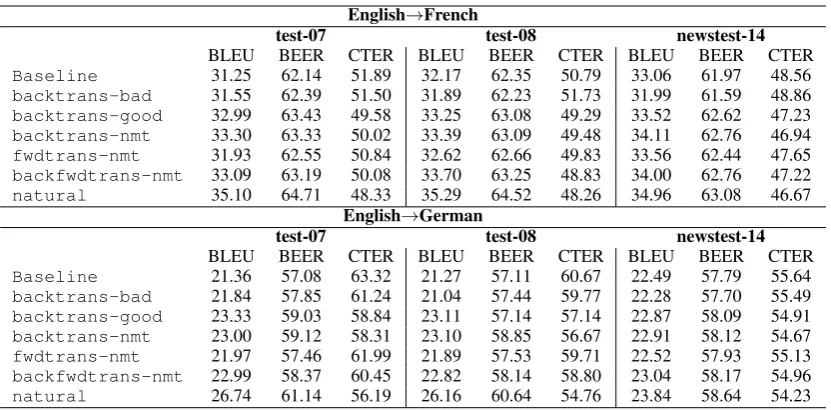
Table 2: Performancewrt.different BT qualities
French→English German→English
test-07 test-08 nt-14 unk test-07 test-08 nt-14 unk
[image:3.595.92.508.60.265.2]backtrans-bad 18.86 19.27 20.49 3.22% 14.66 14.62 15.07 1.45% backtrans-good 29.71 29.51 32.10 0.24% 24.19 24.19 25.75 0.73% backtrans-nmt 31.10 31.43 31.27 0.0% 26.02 26.03 26.98 0.0%
Table 3: BLEU scores for (backward) translation into English
three MT systems of increasing quality:
1. backtrans-bad: this is a very poor SMT system trained using only 50k parallel sen-tences from the out-of-domain data, and no additional monolingual data. For this system as for the next one, we use Moses (Koehn et al., 2007) out-of-the-box, computing align-ments with Fastalign (Dyer et al., 2013), with a minimal pre-processing (basic tokeniza-tion). This setting provides us with a pes-simistic estimate of what we could get in low-resource conditions.
2. backtrans-good: these are much larger SMT systems, which use the same parallel data as the baseline NMTs (see § 2.2) and all the English monolingual data available for the WMT 2017 shared tasks, totalling ap-proximately 174M sentences. These systems are strong, yet relatively cheap to build. 3. backtrans-nmt: these are the best NMT
systems we could train, using settings that replicate the forward translation NMTs. Note that we do not use any in-domain ( Eu-roparl) data to train these systems. Their perfor-mance is reported in Table 3, where we observe a
12 BLEU points gap between the worst and best systems (for both languages).
As noted eg. in (Park et al., 2017; Crego and Senellart, 2016), artificial parallel data obtained through forward-translation (FT) can also prove advantageous and we also consider a FT system (fwdtrans-nmt): in this case thetargetside of the corpus is artificial and is generated using the baseline NMT applied to a natural source.
3.1.2 BT quality does matter
Our results (see Table 2) replicate the findings of (Sennrich et al., 2016a): large gains can be ob-tained from BT (nearly+2 BLEU in French and German); better artificial data yields better trans-lation systems. Interestingly, our best Moses sys-tem is almost as good as the NMT and an order of magnitude faster to train. Improvements obtained with the bad system are much smaller; contrary to the better MTs, this system is even detrimental for the out-of-domain test.
English→French English→German
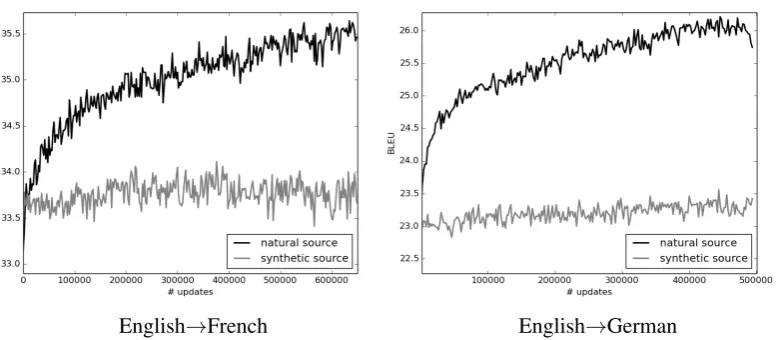
Figure 1: Learning curves frombacktrans-nmtandnatural. Artificial parallel data is more prone to over-fitting than natural data.
using a half of the available artificial data, do not outperform the best BT results.
We finally note the large remaining difference between BT data and natural data, even though they only differ in their source side. This shows that at least in our domain-adaptation settings, BT does not really act as a regularizer, contrarily to the findings of (Poncelas et al., 2018; Sennrich et al., 2016b). Figure 3.1.1 displays the learn-ing curves of these two systems. We observe that
backtrans-nmt improves quickly in the
ear-liest updates and then stays horizontal, whereas
natural continues improving, even after 400k updates. Therefore BT does not help to avoid over-fitting, it actually encourages it, which may be due “easier” training examples (cf.§3.2).
3.2 Properties of back-translated data
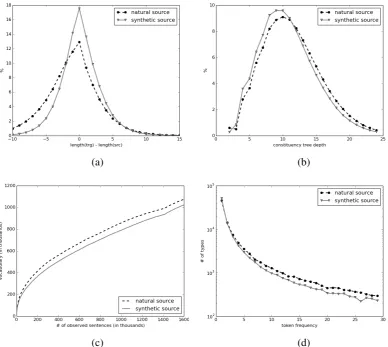
Comparing the natural and artificial sources of our parallel data wrt. several linguistic and distribu-tional properties, we observe that (see Fig. 2 - 3):
(i) artificial sources are on average shorter than natural ones: when using BT, cases where the source is shorter than the target are rarer; cases when they have the same length are more frequent.
(ii) automatic word alignments between artificial sources tend to be more monotonic than when using natural sources, as measured by the av-erage Kendall τ of source-target alignments
(Birch and Osborne, 2010): for French-English the respective numbers are 0.048 (natural) and 0.018 (artificial); for German-English 0.068 and 0.053. Using more
mono-tonic sentence pairs turns out to be a facilitat-ing factor for NMT, as also noted by Crego and Senellart (2016).
(iii) syntactically, artificial sources are simpler than real data; We observe significant differ-ences in the distributions of tree depths.3
(iv) distributionally, plain word occurrences in ar-tificial sources are more concentrated; this also translates into both a slower increase of the number of typeswrt. the number of sen-tences and a smaller number of rare events.
The intuition is that properties (i) and (ii) should help translation as compared to natural source, while property (iv) should be detrimental. We checked (ii) by building systems with only 10M words from the natural parallel data selecting these data either randomly or based on the regularity of their word alignments. Results in Table 4 show that the latter is much preferable for the overall performance. This might explain that the mostly monotonic BT from Moses are almost as good as the fluid BT from NMT and that both boost the baseline.
4 Stupid Back-Translation
We now analyze the effect of using much simpler data generation schemes, which do not require the availability of a backward translation engine.
(a) (b)
(c) (d)
Figure 2: Properties of pseudo-English data obtained withbacktrans-nmtfrom French. The synthetic source contains shorter sentences (a) and slightly simpler syntax (b). The vocabulary growthwrt. an increasing number of observed sentences (c) and the token-type correlation (d) suggest that the natural source is lexically richer.
test-07 test-08 newstest-14
BLEU BEER CTER BLEU BEER CTER BLEU BEER CTER
[image:5.595.93.484.74.425.2]random 32.08 62.98 50.78 32.66 62.86 49.99 23.05 55.38 58.51 monotonic 33.52 63.75 49.51 33.73 63.59 48.91 32.16 61.75 48.64
Table 4: Selection strategies for BT data (English-French)
4.1 Setups
We use the following cheap ways to generate pseudo-source texts:
1. copy: in this setting, the source side is a mere copy of the target-side data. Since the source vocabulary of the NMT is fixed, copy-ing the target sentences can cause the occur-rence of OOVs. To avoid this situation, Cur-rey et al. (2017) decompose the target words into source-side units to make the copy look like source sentences. Each OOV found in the copy is split into smaller units until all the resulting chunks are in the source vocabulary. 2. copy-marked: another way to integrate
copies without having to deal with OOVs is to augment the source vocabulary with a copy of the target vocabulary. In this setup, Ha et al. (2016) ensure that both vocabularies never overlap by marking the target word copies with a special language identifier. Therefore the English wordresumecannot be confused with the homographic French word, which is marked@fr@resume.
(a) (b)
[image:6.595.94.483.74.421.2](c) (d)
Figure 3: Properties of pseudo-English data obtained withbacktrans-nmt(back-translated from German). Tendencies similar to English-French can be observed and difference in syntax complexity is even more visible.
We then use the procedures described in §2.2, except that the pseudo-source embeddings in the
copy-marked setup are pretrained for three
epochs on the in-domain data, while all remaining parameters are frozen. This prevents random pa-rameters from hurting the already trained model.
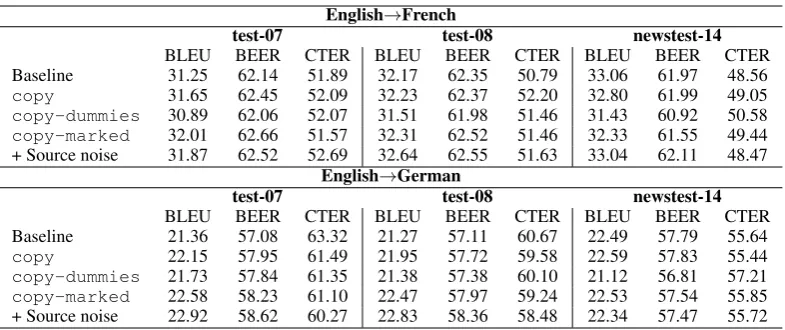
4.2 Copy+marking+noise is not so stupid We observe that thecopysetup has only a small impact on the English-French system, for which the baseline is already strong. This is less true for English-German where simple copies yield a sig-nificant improvement. Performance drops for both language pairs in thecopy-dummiessetup.
We achieve our best gains with the
copy-marked setup, which is the best way to use a copy of the target (although the performance on the out-of-domain tests is at most the same as the baseline). Such gains may look surprising, since the NMT model does not need to learn to translate but only to copy the source. This is
English→French
test-07 test-08 newstest-14
BLEU BEER CTER BLEU BEER CTER BLEU BEER CTER
Baseline 31.25 62.14 51.89 32.17 62.35 50.79 33.06 61.97 48.56 copy 31.65 62.45 52.09 32.23 62.37 52.20 32.80 61.99 49.05 copy-dummies 30.89 62.06 52.07 31.51 61.98 51.46 31.43 60.92 50.58 copy-marked 32.01 62.66 51.57 32.31 62.52 51.46 32.33 61.55 49.44 + Source noise 31.87 62.52 52.69 32.64 62.55 51.63 33.04 62.11 48.47
English→German
test-07 test-08 newstest-14
BLEU BEER CTER BLEU BEER CTER BLEU BEER CTER
[image:7.595.103.496.60.225.2]Baseline 21.36 57.08 63.32 21.27 57.11 60.67 22.49 57.79 55.64 copy 22.15 57.95 61.49 21.95 57.72 59.58 22.59 57.83 55.44 copy-dummies 21.73 57.84 61.35 21.38 57.38 60.10 21.12 56.81 57.21 copy-marked 22.58 58.23 61.10 22.47 57.97 59.24 22.53 57.54 55.85 + Source noise 22.92 58.62 60.27 22.83 58.36 58.48 22.34 57.47 55.72
Table 5: Performancewrt.various stupid BTs
test sets, compared to the baseline (about +1.5 BLEU). This last setup is even almost as good as the backtrans-nmt condition (see § 3.1) for
German. This shows that learning to reorder and predict missing words can more effectively serve our purposes than simply learning to copy.
5 Towards more natural pseudo-sources
Integrating monolingual data into NMT can be as easy as copying the target into the source, which already gives some improvement; adding noise makes things even better. We now study ways to make pseudo-sources look more like natural data, using the framework of Generative Adversar-ial Networks (GANs) (Goodfellow et al., 2014), an idea borrowed from Lample et al. (2017)4.
5.1 GAN setups
In our setups, we use a marked target copy, viewed as afakesource, which ageneratorencodes so as to fool a discriminatortrainedto distinguish afake from anaturalsource. Our architecture contains two distinct encoders, one for the natural source and one for the pseudo-source. The latter acts as the generator (G) in the GAN framework,
com-puting a representation of the pseudo-source that is then input to a discriminator (D), which has to
sort natural from artificial encodings. Dassigns a
probability of a sentence being natural.
During training, the cost of the discriminator is computed over two batches, one with natu-ral (out-of-domain) sentencesxand one with (in-domain) pseudo-sentencesx0. The discriminator is
4Our implementation is available at https://github.com/franckbrl/
nmt-pseudo-source-discriminator
a bidirectional-Recurrent Neural Network (RNN) of dimension 1024. Averaged states are passed to a single feed-forward layer, to which a sigmoid is applied. It inputs encodings of natural (E(x)) and pseudo-sentences (G(x0)) and is trained to op-timize:
J(D)=−1
2Ex∼preallogD(E(x))
−12Ex0∼ppseudolog(1−D(G(x0)))
G’s parameters are updated to maximally fool D, thus the lossJ(G):
J(G)=−Ex0∼ppseudologD(G(x0))
Finally, we keep the usual MT objective. (sis a real or pseudo-sentence):
J(MT)= logp(y|s) =−Es∼palllogMT(s) We thus need to train three sets of parame-ters: θ(D), θ(G) andθ(MT)(MT parameters), with θ(G) ∈ θ(MT). The pseudo-source encoder and
embeddings are updatedwrt.bothJ(G)andJ(MT).
Following (Goyal et al., 2016), θ(G) is updated
only when D’s accuracy exceeds 75%. On the other hand, θ(D) is not updated when its
accu-racy exceeds 99%. At each update, two batches are generated for each type of data, which are coded with the real or pseudo-encoder. The en-coder outputs serve to computeJ(D)andJ(G).
Fi-nally, the pseudo-source is encoded again (once
G is updated), both encoders are plugged into
English→French
test-07 test-08 newstest-14
BLEU BEER CTER BLEU BEER CTER BLEU BEER CTER
Baseline 31.25 62.14 51.89 32.17 62.35 50.79 33.06 61.97 48.56 copy-marked 32.01 62.66 51.57 32.31 62.52 51.46 32.33 61.55 49.44
+ GANs 31.95 62.55 52.87 32.24 62.47 52.16 32.86 61.90 48.97
copy-marked+ noise 31.87 62.52 52.69 32.64 62.55 51.63 33.04 62.11 48.47
+ GANs 32.41 62.78 52.25 32.79 62.72 50.92 33.01 61.98 48.37
backtrans-nmt 33.30 63.33 50.02 33.39 63.09 49.48 34.11 62.76 46.94 + Distinct encoders 32.29 62.83 51.55 32.98 62.91 51.19 33.60 62.43 48.06
+ GANs 32.91 63.08 51.17 33.24 62.93 50.82 33.77 62.42 47.80
natural 35.10 64.71 48.33 35.29 64.52 48.26 34.96 63.08 46.67 English→German
test-07 test-08 newstest-14
BLEU BEER CTER BLEU BEER CTER BLEU BEER CTER
Baseline 21.36 57.08 63.32 21.27 57.11 60.67 22.49 57.79 55.64 copy-marked 22.58 58.23 61.10 22.47 57.97 59.24 22.53 57.54 55.85
+ GANs 22.71 58.25 61.25 22.44 57.86 59.28 22.81 57.54 55.99
copy-marked+ noise 22.92 58.62 60.27 22.83 58.36 58.48 22.34 57.47 55.72
+ GANs 23.01 58.66 60.22 22.53 58.16 58.65 22.64 57.70 55.48
backtrans-nmt 23.00 59.12 58.31 23.10 58.85 56.67 22.91 58.12 54.67 + Distinct encoders 23.62 58.83 59.74 23.10 58.50 58.19 22.82 57.91 54.96
+ GANs 23.65 58.85 59.70 23.20 58.50 58.22 23.00 57.89 55.15
natural 26.74 61.14 56.19 26.16 60.64 54.76 23.84 58.64 54.23
Table 6: Performancewrt.different GAN setups
English→French
test-07 test-08 newstest-14
BLEU BEER CTER BLEU BEER CTER BLEU BEER CTER
Baseline 31.25 62.14 51.89 32.17 62.35 50.79 33.06 61.97 48.56
deep-fusion 31.85 62.52 52.27 32.25 62.40 51.64 33.65 62.40 48.24
copy-marked+ noise + GANs 32.41 62.78 52.25 32.79 62.72 50.92 33.01 61.98 48.37 +deep-fusion 31.96 62.59 51.96 32.59 62.59 51.65 32.96 61.95 48.95
English→German
test-07 test-08 newstest-14
BLEU BEER CTER BLEU BEER CTER BLEU BEER CTER
Baseline 21.36 57.08 63.32 21.27 57.11 60.67 22.49 57.79 55.64
deep-fusion 21.65 57.57 62.38 21.33 57.33 60.54 23.10 58.06 55.33
[image:8.595.92.509.59.308.2]copy-marked+ noise + GANs 23.01 58.66 60.22 22.53 58.16 58.65 22.64 57.70 55.48 +deep-fusion 23.07 58.50 60.47 22.86 58.18 58.76 22.64 57.46 55.85
Table 7: Deep-fusion model
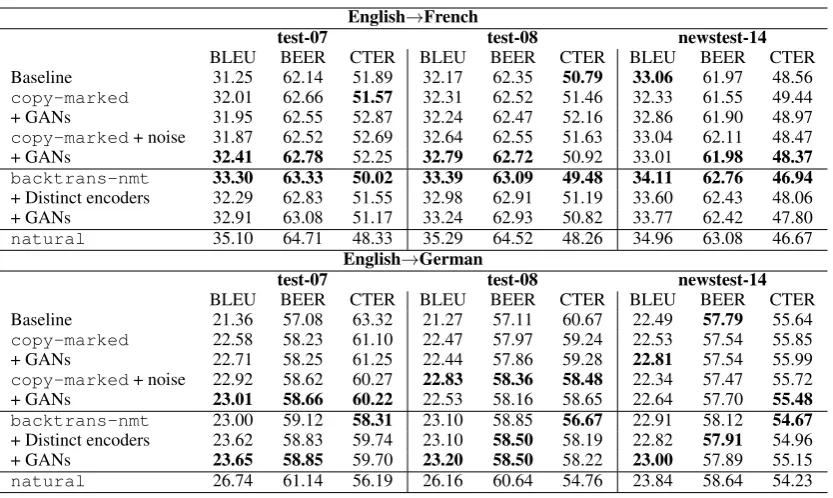
5.2 GANs can help
Results are in Table 6, assuming the same fine-tuning procedure as above. On top of the
copy-markedsetup, our GANs do not provide
any improvement in both language pairs, with the exception of a small improvement for English-French on the out-of-domain test, which we un-derstand as a sign that the model is more ro-bust to domain variations, just like when adding pseudo-source noise. When combined with noise, the French model yields the best performance we could obtain with stupid BT on the in-domain tests, at least in terms of BLEU and BEER. On the News domain, we remain close to the baseline level, with slight improvements in German.
A first observation is that this method brings stupid BT models closer to conventional BT, at a
greatly reduced computational cost. While French still remains 0.4 to 1.0 BLEU below very good backtranslation, both approaches are in the same ballpark for German - may be because BTs are bet-ter for the former system than for the latbet-ter.
al-lowed the German system to slightly outperform
backtrans-nmt. Even though this setup is un-realistic and overly costly, it shows that GANs are actually helping even good systems.
6 Using Target Language Models
In this section, we compare the previous meth-ods with the use of a target side Language Model (LM). Several proposals exist in the literature to integrate LMs in NMT: for instance, Domhan and Hieber (2017) strengthen the decoder by integrat-ing an extra, source independent, RNN layer in a conventional NMT architecture. Training is per-formed either with parallel, or monolingual data. In the latter case, word prediction only relies on the source independent part of the network.
6.1 LM Setup
We have followed Gulcehre et al. (2017) and reim-plemented5theirdeep-fusiontechnique. It
re-quires to first independently learn a RNN-LM on the in-domain target data with a cross-entropy ob-jective; then to train the optimal combination of the translation and the language models by adding the hidden state of the RNN-LM as an additional input to the softmax layer of the decoder.
Our RNN-LMs are trained using dl4mt6 with
the target side of the parallel data and the Europarl corpus (about 6M sentences for both French and German), using a one-layer GRU with the same dimension as the MT decoder (1024).
6.2 LM Results
Results are in Table 7. They show that
deep-fusionhardly improves the Europarl re-sults, while we obtain about +0.6 BLEU over the baseline on newstest-2014 for both languages.
deep-fusion differs from stupid BT in that
the model is not directly optimized on the in-domain data, but uses the LM trained on Europarl to maximize the likelihood of the out-of-domain training data. Therefore, no specific improve-ment is to be expected in terms of domain adap-tation, and the performance increases in the more general domain. Combiningdeep-fusionand
5Our implementation is part of the Nematus toolkit (theano branch): https://github.com/ EdinburghNLP/nematus/blob/theano/doc/ deep_fusion_lm.md
6https://github.com/nyu-dl/ dl4mt-tutorial
copy-marked+ noise + GANs brings slight im-provements on the German in-domain test sets, and performance out of the domain remains near the baseline level.
7 Re-analyzing the effects of BT
As a follow up of previous discussions, we analyze the effect of BT on the internals of the network. Arguably, using a copy of the target sentence in-stead of a natural source should not be helpful for the encoder, but is it also the case with a strong BT? What are the effects on the attention model?
7.1 Parameter freezing protocol
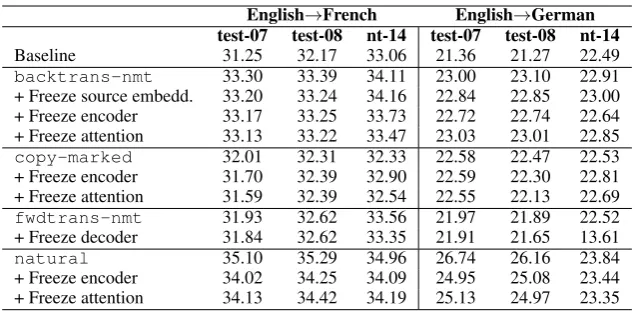
To investigate these questions, we run the same fine-tuning using the copy-marked,
backtrans-nmt and backtrans-nmt
se-tups. Note that except for the last one, all train-ing scenarios have access to same target traintrain-ing data. We intend to see whether the overall perfor-mance of the NMT system degrades when we se-lectively freeze certain sets of parameters, mean-ing that they are not updated durmean-ing fine-tunmean-ing.
7.2 Results
BLEU scores are in Table 8. The
backtrans-nmt setup is hardly impacted
by selective updates: updating the only decoder leads to a degradation of at most 0.2 BLEU. For
copy-marked, we were not able to freeze the source embeddings, since these are initialized when fine-tuning begins and therefore need to be trained. We observe that freezing the encoder and/or the attention parameters has no impact on the English-German system, whereas it slightly degrades the English-French one. This suggests that using artificial sources, even of the poorest quality, has a positive impact on all the compo-nents of the network, which makes another big difference with the LM integration scenario.
English→French English→German test-07 test-08 nt-14 test-07 test-08 nt-14
Baseline 31.25 32.17 33.06 21.36 21.27 22.49
[image:10.595.140.458.60.216.2]backtrans-nmt 33.30 33.39 34.11 23.00 23.10 22.91 + Freeze source embedd. 33.20 33.24 34.16 22.84 22.85 23.00 + Freeze encoder 33.17 33.25 33.73 22.72 22.74 22.64 + Freeze attention 33.13 33.22 33.47 23.03 23.01 22.85 copy-marked 32.01 32.31 32.33 22.58 22.47 22.53 + Freeze encoder 31.70 32.39 32.90 22.59 22.30 22.81 + Freeze attention 31.59 32.39 32.54 22.55 22.13 22.69 fwdtrans-nmt 31.93 32.62 33.56 21.97 21.89 22.52 + Freeze decoder 31.84 32.62 33.35 21.91 21.65 13.61 natural 35.10 35.29 34.96 26.74 26.16 23.84 + Freeze encoder 34.02 34.25 34.09 24.95 25.08 23.44 + Freeze attention 34.13 34.42 34.19 25.13 24.97 23.35
Table 8: BLEU scores with selective parameter freezing
8 Related work
The literature devoted to the use of monolingual data is large, and quickly expanding. We already alluded to several possible ways to use such data: using back- or forward-translation or using a target language model. The former approach is mostly documented in (Sennrich et al., 2016a), and re-cently analyzed in (Park et al., 2017), which focus on fully artificial settings as well as pivot-based artificial data; and (Poncelas et al., 2018), which studies the effects of increasing the size of BT data. The studies of Crego and Senellart (2016); Park et al. (2017) also consider forward translation and Chinea-Rios et al. (2017) expand these results to domain adaptation scenarios. Our results are complementary to these earlier studies.
As shown above, many alternatives to BT exist. The most obvious is to use target LMs (Domhan and Hieber, 2017; Gulcehre et al., 2017), as we have also done here; but attempts to improve the encoder using multi-task learning also exist (Zhang and Zong, 2016).
This investigation is also related to recent at-tempts to consider supplementary data with a valid target side, such as multi-lingual NMT (Firat et al., 2016), where source texts in several languages are fed in the same encoder-decoder architecture, with partial sharing of the layers. This is another re-alistic scenario where additional resources can be used to selectively improve parts of the model.
Round trip training is another important source of inspiration, as it can be viewed as a way to use BT to perform semi-unsupervised (Cheng et al., 2016) or unsupervised (He et al., 2016) training of NMT. The most convincing attempt to date along these lines has been proposed by Lample et al.
(2017), who propose to use GANs to mitigate the difference between artificial and natural data.
9 Conclusion
In this paper, we have analyzed various ways to integrate monolingual data in an NMT framework, focusing on their impact on quality and domain adaptation. While confirming the effectiveness of BT, our study also proposed significantly cheaper ways to improve the baseline performance, using a slightly modified copy of the target, instead of its full BT. When no high quality BT is available, using GANs to make the pseudo-source sentences closer to natural source sentences is an efficient solution for domain adaptation.
To recap our answers to our initial questions: the quality of BT actually matters for NMT (cf.
§ 3.1) and it seems that, even though artificial
source are lexically less diverse and syntactically complex than real sentence, their monotonicity is a facilitating factor. We have studied cheaper alter-natives and found out that copies of the target, if properly noised (§4), and even better, if used with GANs, could be almost as good as low quality BTs (§5): BT is only worth its cost when good BT can
be generated. Finally, BT seems preferable to in-tegrating external LM - at least in our data condi-tion (§ 6). Further experiments with larger LMs
are needed to confirm this observation, and also to evaluate the complementarity of both strategies. More work is needed to better understand the im-pact of BT on subparts of the network (§7).
References
Dzmitry Bahdanau, Kyunghyun Cho, and Yoshua Ben-gio. 2015. Neural machine translation by jointly learning to align and translate. In Proceedings of the first International Conference on Learning Rep-resentations, San Diego, CA.
Alexandra Birch and Miles Osborne. 2010. LRscore for evaluating lexical and reordering quality in MT. InProceedings of the Joint Fifth Workshop on Statis-tical Machine Translation and MetricsMATR, WMT ’10, pages 327–332, Stroudsburg, PA, USA. Associ-ation for ComputAssoci-ational Linguistics.
Ondˇrej Bojar and Aleˇs Tamchyna. 2011. Improving translation model by monolingual data. In Proceed-ings of the Sixth Workshop on Statistical Machine Translation, WMT ’11, pages 330–336, Strouds-burg, PA, USA. Association for Computational Lin-guistics.
Yong Cheng, Wei Xu, Zhongjun He, Wei He, Hua Wu, Maosong Sun, and Yang Liu. 2016. Semi-supervised learning for neural machine translation. In Proceedings of the 54th Annual Meeting of the Association for Computational Linguistics (Volume 1: Long Papers), pages 1965–1974. Association for Computational Linguistics.
Mara Chinea-Rios, ´Alvaro Peris, and Francisco Casacuberta. 2017. Adapting neural machine trans-lation with parallel synthetic data. In Proceed-ings of the Second Conference on Machine Trans-lation, Volume 1: Research Papers, pages 138–147, Copenhagen, Denmark. Association for Computa-tional Linguistics.
Kyunghyun Cho, Bart van Merrienboer, Dzmitry Bah-danau, and Yoshua Bengio. 2014. On the properties of neural machine translation: Encoder-decoder ap-proaches. InProceedings of SSST-8, Eighth Work-shop on Syntax, Semantics and Structure in Statisti-cal Translation, pages 103–111, Doha, Qatar. Asso-ciation for Computational Linguistics.
Josep Maria Crego and Jean Senellart. 2016. Neu-ral machine translation from simplified translations. CoRR, abs/1612.06139.
Annad Currey, Antonio Valerio Miceli Barone, and Kenneth Heafield. 2017. Copied monolingual data improves low-resource neural machine translation. In Proceedings of the Second Conference on Ma-chine Translation, pages 148–156, Copenhagen, Denmark. Association for Computational Linguis-tics.
Tobias Domhan and Felix Hieber. 2017. Using target-side monolingual data for neural machine transla-tion through multi-task learning. In Proceedings of the 2017 Conference on Empirical Methods in Natural Language Processing, pages 1500–1505, Copenhagen, Denmark. Association for Computa-tional Linguistics.
Chris Dyer, Victor Chahuneau, and Noah A. Smith. 2013. A Simple, Fast, and Effective Reparame-terization of IBM Model 2. In Proceedings of the 2013 Conference of the North American Chapter of the Association for Computational Linguistics: Hu-man Language Technologies, pages 644–648, At-lanta, Georgia.
Andreas Eisele and Yu Chen. 2010. MultiUN: A Mul-tilingual Corpus from United Nation Documents. In Proceedings of the Seventh conference on Interna-tional Language Resources and Evaluation, pages 2868–2872. European Language Resources Associ-ation (ELRA).
Orhan Firat, Kyunghyun Cho, and Yoshua Bengio. 2016. Multi-way, multilingual neural machine translation with a shared attention mechanism. In Proceedings of the 2016 Conference of the North American Chapter of the Association for Computa-tional Linguistics: Human Language Technologies, pages 866–875. Association for Computational Lin-guistics.
Ian Goodfellow, Jean Pouget-Abadie, Mehdi Mirza, Bing Xu, David Warde-Farley, Sherjil Ozair, Aaron Courville, and Yoshua Bengio. 2014. Generative adversarial nets. In Z. Ghahramani, M. Welling, C. Cortes, N. D. Lawrence, and K. Q. Weinberger, editors,Advances in Neural Information Processing Systems 27, pages 2672–2680. Curran Associates, Inc.
Anirudh Goyal, Alex Lamb, Ying Zhang, Saizheng Zhang, Aaron C. Courville, and Yoshua Bengio. 2016. Professor forcing: A new algorithm for train-ing recurrent networks. In Advances in Neural Information Processing Systems 29: Annual Con-ference on Neural Information Processing Systems 2016, pages 4601–4609, Barcelona, Spain.
Caglar Gulcehre, Orhan Firat, Kelvin Xu, Kyunghyun Cho, and Yoshua Bengio. 2017. On integrating a language model into neural machine translation. Comput. Speech Lang., 45(C):137–148.
Thanh-Le Ha, Jan Niehues, and Alex Waibel. 2016. Toward multilingual neural machine translation with universal encoder and decoder. In Proceedings of the 13th International Workshop on Spoken Lan-guage Translation (IWSLT 2016), Seattle, WA, USA.
Di He, Yingce Xia, Tao Qin, Liwei Wang, Nenghai Yu, Tieyan Liu, and Wei-Ying Ma. 2016. Dual learning for machine translation. In D. D. Lee, M. Sugiyama, U. V. Luxburg, I. Guyon, and R. Garnett, editors, Advances in Neural Information Processing Systems 29, pages 820–828. Curran Associates, Inc.
Philipp Koehn. 2005. A parallel corpus for statistical machine translation. InProc. MT-Summit, Phuket, Thailand.
Philipp Koehn. 2010. Statistical Machine Translation. Cambridge University Press.
Philipp Koehn, Hieu Hoang, Alexandra Birch, Chris Callison-Burch, Marcello Federico, Nicola Bertoldi, Brooke Cowan, Wade Shen, Christine Moran, Richard Zens, Chris Dyer, Ondˇrej Bojar, Alexan-dra Constantin, and Evan Herbst. 2007. Moses: Open source toolkit for statistical MT. In Proc. ACL:Systems Demos, pages 177–180, Prague, Czech Republic.
Philipp Koehn and Rebecca Knowles. 2017. Six chal-lenges for neural machine translation. In Pro-ceedings of the First Workshop on Neural Machine Translation, pages 28–39, Vancouver. Association for Computational Linguistics.
Guillaume Lample, Ludovic Denoyer, and Marc’Aurelio Ranzato. 2017. Unsupervised machine translation using monolingual corpora only. CoRR, abs/1711.00043.
Christopher Manning, Mihai Surdeanu, John Bauer, Jenny Finkel, Steven Bethard, and David McClosky. 2014. The Stanford CoreNLP Natural Language Processing Toolkit. InProceedings of 52nd Annual Meeting of the Association for Computational Lin-guistics: System Demonstrations, pages 55–60, Bal-timore, Maryland. Association for Computational Linguistics.
Kishore Papineni, Salim Roukos, Todd Ward, and Wei-Jing Zhu. 2002. Bleu: a method for automatic eval-uation of machine translation. In Proceedings of the 40th Annual Meeting on Association for Com-putational Linguistics, ACL ’02, pages 311–318, Stroudsburg, PA, USA.
Jaehong Park, Jongyoon Song, and Sungroh Yoon. 2017. Building a neural machine translation sys-tem using only synthetic parallel data. CoRR, abs/1704.00253.
Alberto Poncelas, Dimitar Shterionov, Andy Way, Gideon Maillette de Buy Wenniger, and Peyman Passban. 2018. Investigating backtranslation in neu-ral machine translation. In Proceedings of the 21st Annual Conference of the European Association for Machine Translation, EAMT, Alicante, Spain.
Rico Sennrich, Orhan Firat, Kyunghyun Cho, Alexan-dra Birch, Barry Haddow, Julian Hitschler, Marcin Junczys-Dowmunt, Samuel L¨aubli, Antonio Valerio Miceli Barone, Jozef Mokry, and Maria Nadejde. 2017. Nematus: a toolkit for neural machine trans-lation. InProceedings of the Software Demonstra-tions of the 15th Conference of the European Chap-ter of the Association for Computational Linguistics, pages 65–68, Valencia, Spain. Association for Com-putational Linguistics.
Rico Sennrich, Barry Haddow, and Alexandra Birch. 2016a. Improving neural machine translation mod-els with monolingual data. In Proceedings of the 54th Annual Meeting of the Association for Compu-tational Linguistics (Volume 1: Long Papers), pages 86–96, Berlin, Germany. Association for Computa-tional Linguistics.
Rico Sennrich, Barry Haddow, and Alexandra Birch. 2016b. Neural machine translation of rare words with subword units. InProceedings of the 54th An-nual Meeting of the Association for Computational Linguistics (Volume 1: Long Papers), pages 1715– 1725. Association for Computational Linguistics. Raivis Skadin¸ˇs, J¨org Tiedemann, Roberts Rozis, and
Daiga Deksne. 2014. Billions of parallel words for free: Building and using the eu bookshop corpus. In Proceedings of the 9th International Conference on Language Resources and Evaluation (LREC-2014), Reykjavik, Iceland. European Language Resources Association (ELRA).
Miloˇs Stanojevi´c and Khalil Sima’an. 2014. Fit-ting sentence level translation evaluation with many dense features. In Proceedings of the 2014 Con-ference on Empirical Methods in Natural Language Processing (EMNLP), pages 202–206, Doha, Qatar. Association for Computational Linguistics.
Weiyue Wang, Jan-Thorsten Peter, Hendrik Rosendahl, and Hermann Ney. 2016. CharacTer: Translation Edit Rate on Character Level. In Proceedings of the First Conference on Machine Translation, pages 505–510, Berlin, Germany. Association for Compu-tational Linguistics.